Abstract—Introduction to Engineering Technology is a
typical first-year course in the mechanical engineering technology curriculum of many institutions. The course is intended to introduce students to a number of aspects in the discipline of engineering, including design and manufacturing, engineering ethics, team work, and other areas, with the goal of motivating students in the engineering profession. As a means of improving instruction and better engaging students in their learning process in an Introduction to Engineering Technology course at the Wentworth Institute of Technology, this paper presents a series of hands-on active learning activities, which deploy innovative materials and techniques supported largely by information technology. These innovative learning activities include the use of hands-on lab projects, a focus on interdisciplinary topics, and the leveraging of Internet resources, video, and YouTube clips. All hands-on projects are directly related to each subject area in the mechanical engineering field, which helps students to understand and “to feel” the engineering profession. Feedback from students concerning the course has been positive, and anecdotal observations indicate that the innovative learning activities motivated the students and enhanced their learning experience.
Index Terms—engineering technology curriculum, hands-on
projects, online course management systems, student engagement.
I. INTRODUCTION
As a result of the impact of information technology, engineering education is currently undergoing a transformation from a strictly lecture-based delivery format to a format where a variety of innovative learning techniques are used. New technologies, such as the web, digital video, sound, animations, and interactivity, provide tools to make engineering education more effective and to enhance student engagement in coursework. Computers are introduced to today’s students as early as elementary school. Unlike “traditional” students, today’s students tend to be significantly more comfortable with information technology. Accordingly, these new technologies should be integrated into a course’s instruction to improve students’ learning, and to extend the learning beyond the classroom wall.
There is considerable literature that addresses the advantages of using hands-on experiences in an engineering curriculum. Significant work has been done in the development of hands-on content, with the goal of enhancing learning [1]-[4]. Much of the literature indicates that the combination of visualization and hands-on content creates a
Manuscript received July 26, 2010.
Guohua Ma is with Wentworth Institute of Technology, Boston, MA 02115, USA (phone: 617-989-4607; fax: 617-989-4591; e-mail: mag@ wit.edu).
positive effect on learning. Most authors in the literature discuss the application of hands-on experiences in specific engineering courses. This paper presents an instructional method that is applied to an introductory level course, and that combines computer- and Internet-based new technologies with hands-on demonstrations and laboratories.
II. INTRODUCTION TO ENGINEERING TECHNOLOGY COURSE Many universities and colleges offer an Introduction to Engineering course for first-year students in all engineering majors. Similarly, Wentworth Institute of Technology offers an Introduction to Engineering Technology course for its first-year students.
The Wentworth academic catalog states that the Introduction to Engineering Technology (MECH103) course provides an overview of the fundamental skills and knowledge utilized in the study of mechanical engineering technology. Topics covered include: institute resources, successful collegiate-level study skills, oral and written communication, design and research methodologies, as well as ethics and professional organizations. In the course, student teams perform introductory laboratory exercises to gain hands-on experience in the field of engineering technology.
Introduction to Engineering Technology is the first college-level engineering course that students encounter in the Wentworth curriculum. The course features two 50-minute lectures and one two-hour laboratory each week. As a general observation, Wentworth engineering students enjoy hands-on work. Based on the type of engineering student admitted to Wentworth, it was hypothesized that hands-on lab sessions and new technologies, such as Internet applications and videos, could be applied to the introductory course in order to motivate student learning.
III. TECHNOLOGY USED IN THE CLASSROOM
A. Visual Shock
The first homework assignment in the course poses the question, “Why choose Mechanical Engineering Technology?” Most of the students respond that they are good at math and physics, and that they enjoy hands-on work, such as working on cars. However, Mechanical Engineering is a very broad discipline. PowerPoint technology is then employed in an effort to open the minds of the students.”
Fig. 1, which consists of three images, and which is shown to the students, is a PowerPoint slide titled, “Small and Big.” In Fig. 1a, a microelectromechanical (MEMS) gear is depicted. In Fig. 1b, the gears are seen next to a mite. Finally, Fig. 1c is a picture of the Hoover Dam. Mistakenly believing
Innovation Teaching Technique in Introduction
to Engineering Technology Course
that the gears in Fig. 1b are normal-sized gears used in a car, some students have commented that “the bug is a monster.” In fact, the “bug” is a tiny mite, and the image is then used to inform the students that the MEMS gear is measured in terms of microns (10-6 m). MEMS technology is then briefly explained. Next, Fig. 1c – the Hoover Dam – is highlighted, and students are informed that mechanical engineering was instrumental in the design and creation of both the gears and the dam. The amazing field of mechanical engineering, in fact, ranges from the very small to the very large, and it even is concerned with the smallest NANO levels.
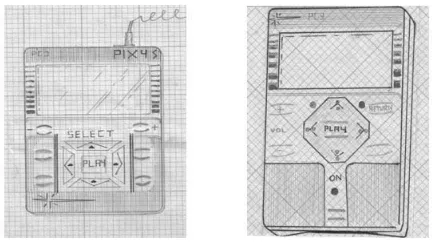
Fig. 2 is a PowerPoint slide showing concept drawings of the first iPod prototype. This PowerPoint slide is used in the beginning of the design module in the Introduction to Engineering Technology course. These IPOD drawings were selected because most students own an iPod, and because the drawings help to demonstrate the evolution of the design from its prototype stage to today’s high-tech models.
a) Gear [5]
b) A Mite and Gears [5]
[image:2.612.332.548.45.166.2]c) Hoover Dam [6] Fig. 1 Small and Big.
Fig. 2 First Prototype of IPOD [7].
B. Videos
As For incoming first year students, attending college is a significant milestone. Colleges and universities face the challenge of preparing these newest members of their community to be successful. A variety of academic skills and common transitional issues are covered by The Introduction to Engineering Technology course. One of the topics is time management. Besides the traditional lecture, students are urged to browse internet resources about time management. One of the recommendations is to watch the video of the “Last Lecture” – titled, “Really Achieving Your Childhood Dreams” – given by Dr. Randy Pausch at Carnegie Mellon University (CMU) in September 2007 [8].
Engineering is problem solving; engineers use the knowledge learned in school and in other places to solve real problems. Students learn knowledge from different academic courses, but sometimes fail to see the connections between the courses. In this case, engineering case studies can serve as good resources enabling students to see how knowledge learned in one place can be leveraged to solve a problem elsewhere.
One engineering case study used in the class to show the problem solving process is a PBS television program called “Bombing Nazi Dams” [9]. The program, which is available on YouTube (www.youtube.com), describes how a British engineer, Barnes Wallis, designed a special bomb to destroy Nazi dams in World War II. At the time, the problem of destroying Nazi Germany’s most important hydroelectric dams was considered unsolvable by the British military. The problem, however, was solved through the use of good engineering methods. Beginning with the clear definition of the problem, Barnes next divided the entire problem into a series of sub-problems, then generated ideas and solutions, culminating in the development of a working solution. Throughout the process, good engineering techniques were deployed, such as the use of reduced scale models, mock simulations, observations, engineering calculations, and thousands of experiments, all clearly shown in the video. Students are guided through a discussion of the video, which also demonstrates that previously learned knowledge can be used to effectively solve problems.
C. Online Resources
master effective literature searching. Therefore, the Introduction to Engineering Technology course features a library session in which students are introduced to the use of proper databases in order to locate useful literature. Students then can apply formal literature search skills in other courses and projects, and in the research project associated with the introductory engineering technology course, itself.
The research project for this course is focused on how a product, component, piece of machinery, or other item works or is produced. Students are required to team up with other students to work on the project. For help in selecting a research topic, students are referred to web sites such as www.howstuffswork.com and www.madehow.com, where numerous topics can be initially evaluated. In addition to the initial evaluation, students are required to obtain deeper knowledge about their selected topic by finding the latest research trends associated with the topic. In this way, students can perform a formal literature search to find relevant journal articles.
IV. HANDS-ON LAB SESSIONS
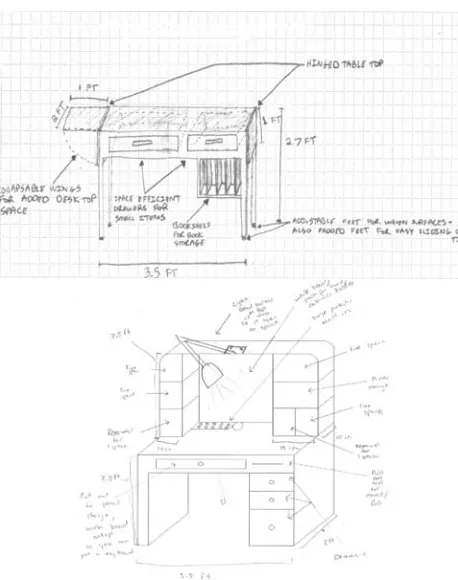
[image:3.612.71.300.423.713.2]Small hands-on projects help students to understand fundamental engineering theory. However, projects should be carefully selected to stimulate students with things that they are familiar with, so they can be better involved in the learning process. For example, in the Introduction to Engineering Technology course, when talking about the design process, students are asked to design a desk for their own dormitory room. Students have shown a great deal of interest in this small design project. Fig. 3 depicts two examples of student design ideas.
Fig. 3 Design Examples: Desks Used in Dormitory.
Several hands-on lab sessions are offered in this class in an effort to ensure that students have the opportunity to begin to ‘feel’ the engineering major. In the Strength of Materials lab session, students conduct experiments to compare the ultimate measured tensile strength of different material samples against published values. In the Mini-Turbine lab session, students learn the structure of the mini-turbine, and analyze engine thrust output indicators. In the Instrument and Measurement lab session, students use dial calipers and micrometers to measure data sets from machined parts, and then analyze the data. Students appear to enjoy these hands-on sessions.
V. DESIGN LAB
The objective of the design lab requires students to design a simple paper mouse trap with limited materials. The lab actually combines design and communication objectives. The idea for the lab was taken from The Johns Hopkins University’s introductory engineering course [10]. Students are teamed up to design the mouse trap with limited materials, and to write the construction manual, so that it can be used as the instructional guide for another team to re-build the same mouse trap. This project not only asks students to work on a design project, but it also requires practice in writing an instructional manual. Two lab sessions are allocated to the lab. In the first session, each team generates ideas to build the prototype. In the second lab session, each team is given a set of materials and an instructional manual provided by another team. The team is then required to build the mouse trap based on the instructions detailed in the manual. An example of a student team’s prototype mouse trap is shown in Fig. 4.
Fig. 4 An Example Prototype of a Mouse Trap. An interesting result frequently observed in this design lab is that many student teams complain that they cannot follow the instructions in the manual provided by the other team. Often, teams would find themselves guessing how to make the mouse trap, and would experiment with different methods.
[image:3.612.327.528.434.571.2]team’s instructional manual, the topic of producing an instructional manual is then specifically addressed in the design lab. Different ways of designing the manual are assessed. Students are guided to use sketches, pictures, and video clips, in addition to text, to develop the instructional manual. An extremely valuable result of this design lab project is that students experience directly the importance of effective communication skills.
Through this project, the students realized the importance of communication skills.
VI. ONLINE COURSE MANAGEMENT
Blackboard (www.blackboard.com) is one of several online course management systems that are available. Traditional courses are delivered with lectures and textbook reading. With Blackboard, web-based modules can be deployed, and can be used by students in homework or laboratory assignments. A number of advantages are associated with the use of web-based learning modules. For example, students can easily review materials posted in the Blackboard site for their course. Second, as part of their education for future engineering positions, students should become familiar and comfortable with web tools and resources to do research. The use of an online course management system obviously facilitates this process. Third, unlike a paper-based textbook, web-based learning modules typically provide instructors with the opportunity to employ audiovisual resources to assist students in understanding concepts to be learned. This feature is especially important for students whose primary learning style is not associated with verbal or reading input. In addition, from an institutional perspective, the use of web-based modules facilitates the online grading and assessment of assignments and projects, which saves resources and provides content for electronic resource rooms that are now required by some accreditation processes.
Blackboard is used to manage the Introduction to Engineering Technology course at Wentworth. The weekly schedule is posted on the Blackboard site for the course, so that students can clearly see the content taught in class. The homework and laboratory assignments are assigned through Blackboard, so that hard copies of those assignments are eliminated; a green benefit of these e-assignments, of course, is that it protects the environment and saves resources, such as paper. Not only are assignments posted through Blackboard, but students are required to use the online system to submit their homework and laboratory assignments. Their assignments are graded through Blackboard, and comments are added when their assignments are evaluated. Students can then see their grades, as well as any comments, through Blackboard.
VII. CONCLUSION AND FUTURE WORK
This paper summarized the experience of teaching an Introduction to Engineering Technology course at the Wentworth Institute of Technology. Because most students admitted to the Wentworth Engineering Technology program are attracted to experientially based learning, more hands-on
lab sessions and experiments are introduced to students in an effort to better help them to understand the concepts associated with the field of mechanical engineering. The subjective feedback of students in the course has generally been positive. The laboratories appear to assist the learning objectives of the course, and they also appear to be an effective way to motivate students. With online demonstrations through Internet resources such as YouTube, students can even engage in learning when no proper hands-on labs are available.
Blackboard is a very good online tool to manage the course. Lecture notes, homework, and laboratory assignments can be organized and delivered using the Blackboard online learning system. Combining computer- and Internet-based new technologies with hands-on lab sessions and experiments has also proven to be an effective way to motivate student learning.
The author wishes to express his thanks to Professor Ted Greene and Professor Robert Lind, who are part of the team that taught the Introduction to Engineering Technology course at Wentworth. In addition, a special thanks is offered to Professor Raymond Tavares, who had a detailed discussion with the author about the concepts associated with hands-on laboratory sessions and experiments.
APPENDIX :AN EXAMPLE OF THE CONSTRUCTION GUIDE FOR APAPER MOUSE TRAP
Construction Instructions:
1. Using the ruler and pencil, draw out a 20” by 20” square, and cut it out using the scissors.
2. Then draw out the following design, cutting only what is not drawn here (do not cut the lines).
3. Fold the shape into a box, using the lines drawn before as guidelines as where to fold.
4. Use rubber bands to hold the box in shape, both the short way and the long way around it.
5. While maintaining a good square shape, glue the box together along the two 10” sides that are not attached. Then glue one end of the box closed.
6. Once the glue has dried and is sturdy, the rubber bands can be removed.
7. The next step is to trim the loose end so that it can function as a door, swinging into the box without interference.
10”
10”
5”
5”
5”
5” 5”
Taking about a ¼” off of the three sides should make it able to swing. It needs to be able to swing without getting stuck, but not a big enough of a gap so that a mouse could get out.
8. Position the box so that it is laying the long way, with the hinges of the door on the top.
9. Bend a paper clip so that it is at a 45 degree angle. This needs to glue to the center of the door, with the angle opening down.
10. Find 2 rubber bands that, while fully extended, will reach from this paper clip, to the middle of the top of the box. Glue one end of the rubber bands to the top middle of the box.
11. Once the glue has dried, pulled the opposite ends down around the paper clip.
12. Take two more paper clips, and bend them at a 90 degrees. These will be used to keep the door from opening out. Half way up each way on the door end, they need to be glued so that they stick out around, holding the door from opening.
13. Repeat this step on the opposite side of the door. For added security.
14. The next steps are to create the trap device:
a. Cut a strip out of the scrap paper about ½” to 1” wide, about 5” long.
b. On one end, the bait will be glued
c. The other end, a paper clip will be used to set the door off.
d. The paper clip needs to be bent in this shape:
e. Glue the flat part of the paper clip to the small piece of cardboard, on the opposite end as the bait.
15. The trap and device are now complete.
ACKNOWLEDGMENT
Thanks for the team (Prof. Ted Greene, Prof. Robert Lind) taught introduction to engineering technology course at Wentworth. Special thanks to Prof. Raymond Tavares, who had a detailed discussion with the author about the concepts of hands-on laboratories and experiments.
REFERENCES
[1] D. Jensen, J. Wood, K. Wood, “Hands-on Activities, Interactive Multimedia and Improved Team Dynamics for Enhancing Mechanical Engineering Curricula”, International Journal of Engineering Education, Vol. 19, No. 6, pp. 874-884, 2003.
[2] A. Ater Kranov, C. Hauser, R. Olsen, L. Girardeau, “A Direct Method for Teaching and Assessing Professional Skills in Engineering Programs”, American Society for Engineering Education, 2008. [3] L.E. Carlson, “First year engineering projects: An interdisciplinary,
hands-on introduction to engineering”, Proceeding of the ASEE annual Conference, pp. 2039-2043, 1995.
[4] H.A. Aglan, S. F. Ali, “Hands-on experiences: An integral part of engineering Curriculum Reform”, Journal of engineering Education, pp. 327-330, 1995.
[5] Mite Approaching the Gear Chain, URL: http://mems.sandia.gov/gallery/images.html, 2010.
[6] Hoover Dam, URL: http://en.wikipedia.org/wiki/Hoover_Dam, 2010. [7] First digital music player, URL:
http://www.kanekramer.com/html/development.htm, 2010.
[8] R. Pausch, “Last Lecture: Achieving Your Childhood Dreams”, URL: http://www.youtube.com/watch?v=ji5_MqicxSo, 2007.
[9] Boming Nazi Dams, URL:
http://www.pbs.org/wnet/secrets/previous_seasons/case_nazidams/ind ex.html
[10] Design and Communication,
http://www.jhu.edu/virtlab/finals/FINALS/labs/l2/mse_trap_bld_lab.p df, 2010.
Paper Clip
Paper Clip
Door
Glued Flat to the small piece of cardboard