Original Article
Neuroprotective effects of lidocaine on early
postoperative cognitive dysfunction and
the possible mechanism
Xiaohong Guo1, Jianxiong Liu2, Lichun Liu1, Ming Huang2, Hengsan Chen2, Na Hui1, Li Qiao2
Departments of 1Pharmacy, 2Neurosurgery, Gansu Provincial Hospital, Lanzhou, China
Received March 17, 2019; Accepted June 6, 2019; Epub July 15, 2019; Published July 30, 2019
Abstract: Background: Postoperative cognitive dysfunction (POCD) is induced by general anesthesia and surgery. Advancing age is associated with POCD. To make matters worse, elderly people are also at a higher risk of under-going surgery than younger people. In this paper, the neuroprotective effects of lidocaine on early POCD in elderly patients undergoing orthopedic surgery were investigated and the possible mechanism was explored. Methods: A total of 116 patients scheduled for orthopedic surgery were randomly allocated to lidocaine group and control group (n = 58). Lidocaine group received a bolus of 1 mg/Kg of lidocaine in 5 minutes after induction of anesthe sia, and then a continuous infusion at 1.5 mg/Kg/h until the end of surgery. Control group received normal saline as a bolus. Mini-Mental State Examination (MMSE) scores, cerebral oxygen and energy metabolism metrics were
com-pared between lidocaine group and control group. Results: The MMSE scores were significantly decreased on the
3rd day after the end of surgery (T3) compared with before induction of anesthesia (T1) in control group, but were
not significantly different between T3 and T1 in lidocaine group. Moreover, the decreased level of control group was
greater than lidocaine group. Concentration of cerebral vein oxygen (CjvO2) was lower at the end of surgery (T2) than
at T1 in both lidocaine group and control group, but the decreased level was significantly attenuated by lidocaine.
Cerebral oxygen extraction rate (CERO2) was lower at T2 than at T1 in lidocaine group, but higher at T2 than at T1 in control group, which indicated that lidocaine could inhibit the elevation of CERO2. Djv-aLac was not significantly
different between T2 and T1 in lidocaine group, but higher at T2 than at T1 in control group, which indicated that lidocaine could inhibit the elevation of Djv-aLac. Conclusions: Lidocaine had neuroprotective effects on early POCD in elderly patients undergoing orthopedic surgery, and the possible mechanism was associated with decreased cerebral oxygen and anaerobic metabolism.
Keywords: Postoperative cognitive dysfunction, lidocaine, neuroprotective effects, cerebral oxygen metabolism, cerebral anaerobic metabolism
Introduction
Lidocaine is a local anesthetic which can read-ily cross the blood-brain barrier [1]. It can decrease required concentrations of general anesthetics during anesthesia [2] and protect neurons [3], which is possibly associated with its neuroprotective effects. Many studies have demonstrated its neuroprotective effects when it is given systemically [4-8].
As a frequent complication following general anesthesia and surgery [9], especially in elderly individuals, postoperative cognitive dysfunc-tion (POCD) is characterized with impaired
con-sciousness and disordered thinking [10, 11]. POCD is associated with the degeneration of the central nervous system [12] and increased surgical morbidity and mortality, decreased postoperative quality of life, prolonged hospital stay, and elevated perioperative medical cost [13, 14]. The precise mechanism of POCD is not yet very clear. Several possible causes are sug-gested, including an exaggerated systemic in- flammation, hypoxemia, cerebral hypoperfu-sion, endothelial dysfunction, and microembo-lism [15, 16].
under-going orthopedic surgery were investigated and the possible mechanism was explored. The aim was to provide the basis for application of lido-caine in orthopedic surgery.
Materials and methods
Participants
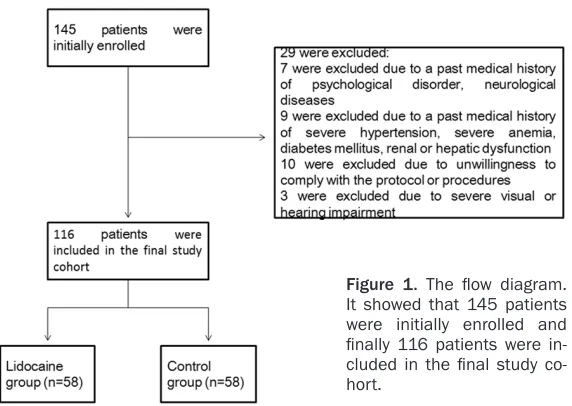
A total of 145 patients scheduled for orthope-dic surgery were enrolled in Gansu Provincial Hospital from January 2016 to June 2017. Twenty-nine patients were excluded according to exclusion criteria, and 116 patients were included in the final study cohort (Figure 1). Inclusion criteria included: (1) American Society of Anesthesiologists (ASA) physical status I or II; (2) Ranging from 64 to 80 years old; (3) Preoperative Mini-Mental State Examination (MMSE) scores ≥23. Exclusion criteria includ-ed: (1) A past medical history of psychological disorder, neurological diseases (including Al- zheimer’s disease and stroke history), and drug or alcohol abuse; (2) A past medical history of severe hypertension, severe anemia, diabetes mellitus, renal or hepatic dysfunction; (3) Un- willingness to comply with the protocol or pro-cedures; (4) Severe visual or hearing impair-ment. This study received the approval of the ethic committee of Gansu Provincial Hospital (201528116), and all patients provided written informed consents.
Grouping and general anesthesia
The 116 participants included in the final study cohort were randomly allocated to lidocaine
General anesthesia was performed using stan-dard protocols. Pulse oximetry, electrocardiog-raphy, capnogelectrocardiog-raphy, invasive arterial pressure and central venous pressure (CVP) were con-tinuously monitored during anesthesia. Anes- thesia was induced with 0.05-0.1 mg/Kg of midazolam, 0.5-1 μg/Kg of sufentanil, 1.5-2.5 mg/Kg of propofol, and 0.8-1.0 mg/Kg of rocuronium. It was then maintained with 4 mg/ Kg/h of propofol, 0.2 μg/Kg/min of remifent-anil, 2.0 μg/Kg/min of cisatracurium, 0.5 μg/ Kg/h of dexmedetomidine, and inhaled 0-4% of sevoflurane. Bispectral Index Score was main-tained at 40-60.
Evaluation of cognitive function
An experienced psychometrician, who received standard training in MMSE [17], evaluated indi-vidual cognitive function of participants pre-operatively and three days post-pre-operatively in a quiet room using the MMSE. The psychometri-cian completed all interpretation and data scor-ing. Both the psychometrician and participants were blinded to grouping. MMSE scores con-sisted of digit symbol test, accumulative test, digit span-forward test, digit span-reverse test and trace connection test A. The same version of the MMSE was administered at the 2 time points. POCD was determined using the criteria recommended by Moller JT et al [18].
Evaluation of cerebral oxygen and energy me-tabolism
Blood samples from the jugular vein bulb and peripheral artery were collected before induc-tion of an esthesia (T1), at the end of surgery Figure 1. The flow diagram.
It showed that 145 patients were initially enrolled and
finally 116 patients were in
-cluded in the final study co -hort.
[image:2.612.92.378.69.272.2](T2) and on the 3rd day after the end of surgery (T3). Blood gas analysis was performed, and concentrations of blood glucose and plasma lactic acid were measured. Cerebral oxygen extraction rate (CERO2), cerebral extraction ra- te of glucose (CERGlu) and difference between cerebral vein and artery for plasma lactic acid (Djv-aLac) were calculated using Fick equation. The calculation formula was given out in detail, as follows.
(1) Concentration of arterial oxygen (CaO2) = 1.34 × Hb × saturation of arterial oxygen (SaO2) + 0.0031 × pressure of arterial oxygen (PaO2). (2) Concentration of cerebral vein oxygen (CjvO2) = 1.34 × Hb × saturation of jugular vein bulb oxygen (SjvO2) + 0.0031 × pressure of jug-ular vein bulb oxygen (PjvO2). (3) Difference between cerebral artery and vein for oxygen (Da-jvO2) = CaO2 - CjvO2. (4) CERO2 = (Da-jvO2/ CaO2) × 100%. (5) Difference between cerebral artery and vein for blood glucose (Da-jvGlu) = arterial glucose (Glua) - jugular vein bulb glu-cose (Glujv). (6) CERGlu = (Djv-aLac/Glua) ×
percentage (%). Quantitative data at baseline were analyzed with Student’s t test and qualita-tive data with chi-square test. MMSE scores, cerebral oxygen (SjvO2, CaO2, CjvO2 and CERO2) and energy metabolism metrics (CERGlu, Laca, Lacjv, Glua, Glujv and Djv-aLac) were analyzed with repeated measures ANOVA. All data were analyzed with the SPSS version 19.0 for Windows (SPSS Inc., USA). Significance was set at P<0.05.
Results
Baseline data
The final study cohort (116 patients) included 49 males and 67 females with a mean age of 71.04±2.59 years. Baseline data of lidocaine group and control group were shown in Table 1. The differences in sex, age, body mass index (BMI), ASA classification and operation time were not statistically significant (P>0.05).
Cognitive function
As shown in Figure 2, there was no significant difference in the MMSE scores between lido-caine group (27.41±3.08) and control group (26.95±2.97) at T1 (P>0.05). The MMSE scores were significantly decreased at T3 (24.91±2.62) compared with T1 in control group (P<0.05). However, the MMSE scores were not signifi-cantly different between T3 (27.22±3.14) and T1 (xxx) in lidocaine group (P>0.05). Moreover, the decreased level of MMSE scores was great-er in control group than in lidocaine group (2.31, 95% confidence interval: 1.53-3.09 vs 0.46, 95% confidence interval: 0.26-0.65;
P<0.05). These results indicated that lidocaine had neuroprotective effects.
Cerebral oxygen metabolism
[image:3.612.92.373.86.178.2]As shown in Figure 3, there was no significant difference between T1 and T2 for SjvO2 in both
Table 1. Baseline data of lidocaine group and control group
Lidocaine group
(n = 58) Control group (n = 58) χ2/t P Sex (male/female) 21/37 28/30 1.731 0.188 Age (year) 70.96±2.49 71.12±2.68 0.333 0.736 BMI 20.89±3.67 21.05±3.95 0.226 0.834
[image:3.612.92.288.199.391.2]ASA classification (I/II) 36/22 31/27 0.883 0.347 Operation time (min) 128.59±8.24 129.23±8.62 0.409 0.685
Figure 2. MMSE scores of lidocaine group and con-trol group at preoperation and postoperative 3 days. *P<0.05, vs preoperative; **P<0.05, vs lidocaine group.
100%. (7) Djv-aLac = jugular vein bulb lactic acid (Lacjv) - arterial lactic acid (Laca).
Statistical analysis
lidocaine group (71.16±7.52 vs 72.17±8.13) and control group (71.58±7.86 vs 70.93±7.69), and the intergroup difference for (T2-T1) was also not significant. CaO2 was lower at T2 than at T1 in both lidocaine group (145.23±9.14 vs
157.84±11.38) and control group (143.89± 10.57 vs 158.92±12.87), but the intergroup difference for (T2-T1) was not significant. CjvO2 was lower at T2 than at T1 in both lidocaine group (110.69±4.85 vs 115.32±5.09) and con-trol group (98.94±5.21 vs 114.85±5.44), and T1-T2 was greater in control group than in lido-caine group. This indicated that the decreased level of CjvO2 was significantly attenuated by lidocaine. CERO2 was lower at T2 than at T1 in lidocaine group (23.44±2.28 vs 26.47±2.49), but higher at T2 than at T1 in control group (30.26±2.13 vs 27.78±2.04), which indicated that lidocaine could inhibit the elevation of CERO2.
Cerebral energy metabolism
As shown in Figure 4, there were no significant differences between T2 and T1 for CERGlu (8.87±2.95 vs 9.26±3.14 for lidocaine group, 9.16±3.29 vs 9.19±3.31 for control group), Laca (1.88±0.42 vs 1.84±0.44 for lidocaine
vs -0.13±0.10), and the intergroup difference for (T2-T1) was significant. This indicated that lidocaine could inhibit the elevation of Djv-aLac.
Discussion
[image:4.612.94.369.71.317.2]POCD can be induced by general anesthesia and surgery [9]. Originally, the studies about POCD focused on cardiac surgery. A recent study showed that POCD is also frequent in cardiac surgery and even in minor non-invasive procedures, such as coronary angiog-raphy [19]. A multi-center study reported that the incidence of POCD was 25% and 10%, respectively at 1 week and 3 months after non-cardiac surgery [18]. Many studies demonstrat-ed that advancing age is associatdemonstrat-ed with POCD [18, 20-22]. To make matters worse, elderly people are also at a higher risk of undergoing surgery than younger people [23]. Therefore, the prevention of POCD in elderly patients undergoing surgery should be paid attention to. The effects of lidocaine on neuroprotection have been demonstrated by several clinical and animal studies [4-8]. A recent report indi-cated that lidocaine may improve cognitive function and act as an effective neuroprotec-Figure 3. Cerebral oxygen metabolism metrics of lidocaine group and
con-trol group at preoperation and end of surgery. *P<0.05, vs preoperative; **P<0.05, vs lidocaine group.
group, 1.89±0.46 vs 1.82± 0.39 for control group) and Lacjv (1.79±0.28 vs 1.77±0.24 for lidocaine group, 1.82±0.33
vs 1.68±0.31 for control gr- oup) in both lidocaine group and control group, and the intergroup differences for (T2-T1) were also not significant. Both Glua (6.18±1.28 vs
4.97±1.31 for lidocaine group, 6.43±1.09 vs 5.26±0.97 for control group) and Glujv (5.46±1.47 vs 4.18±1.35 for lidocaine group, 5.95±1.53 vs
tive agent in treating early POCD of elderly patients undergoing spine surgery [24]. How- ever, the underlying mechanism is still not fully elucidated. It is speculated that the neuropro-tective effects of lidocaine are possibly corre-lated with the following mechanisms, including decelerating the ischemic transmembrane ion shift, reducing the cerebral metabolic rate and the ischemic excitotoxin release [16].
In this study, lidocaine could elevate the MMSE scores significantly in elderly patients undergo-ing orthopedic surgery. This result suggested that lidocaine had neuroprotective effects, which was consistent with previous reports. In addition, our results showed that lidocaine could elevate CjvO2 significantly, and mean-while decrease CERO2 and Djv-aLac signi- ficantly.
In clinical practice, cerebral oxygenation is usu-ally evaluated through measuring SjvO2 of the jugular vein bulb and calculating Da-jvO2 and CERO2. SjvO2 is an integrated index, which can reflect the balance of cerebral oxygen supp- ly and consumption with a normal value of 55%~75%. Lactate is the endproduct of
anaer-obic glycolysis, and the brain can release and absorb lactate. For the variation of lactic acid in cells, the concentration of lactic acid in the jug-ular vein bulb is a better index than the concen-tration of lactic acid in cerebrospinal fluid. Djv-aLac can reflect the net production of lactate and is usually regarded as the amount of lactic acid produced by anaerobic glycolysis of the brain. A positive value of Djv-aLac means anaerobic glycolysis in the brain. In this paper, lidocaine could decrease CERO2 and Djv-aLac significantly, which suggested that it could decrease cerebral oxygen and anaerobic metabolism.
[image:5.612.97.522.73.355.2]that lidocaine can decrease the number of dead cells in rat hippocampal slices [27]. Our study showed that the neuroprotective effects of lidocaine might be associated with decreased cerebral oxygen and anaerobic metabolism. In summary, lidocaine had neuroprotective effects on early POCD in elderly patients under-going orthopedic surgery, and the possible mechanism was associated with decreased cerebral oxygen and anaerobic metabolism.
Disclosure of conflict of interest
None.
Address correspondence to: Li Qiao, Department of Neurosurgery, Gansu Provincial Hospital, 204 Donggang West Road, Chengguan District, Lanzhou 730000, China. Tel: +86-931-8281763; E-mail: [email protected]
References
[1] Leng T, Gao X, Dilger JP and Lin J. Neuroprotective effect of lidocaine: is there clinical potential? Int J Physiol Pathophysiol Pharmacol 2016; 8: 9-13.
[2] Forster C, Vanhaudenhuyse A, Gast P, Louis E, Hick G, Brichant JF and Joris J. Intravenous
in-fusion of lidocaine significantly reduces propo -fol dose for colonoscopy: a randomised place-bo-controlled study. Br J Anaesth 2018; 121: 1059-1064.
[3] Sisti MS, Nishida F, Zanuzzi CN, Laurella SL, Cantet RJC and Portiansky EL. Lidocaine pro-tects neurons of the spinal cord in an excitotox-icity model. Neurosci Lett 2019; 698: 105-112.
[4] Flondor M, Listle H, Kemming GI, Zwissler B and Hofstetter C. Effect of inhaled and
intrave-nous lidocaine on inflammatory reaction in en -dotoxaemic rats. Eur J Anaesthesiol 2010; 27: 53-60.
[5] Habibi MR, Habibi V, Habibi A and Soleimani A. Lidocaine dose-response effect on
postopera-tive cognipostopera-tive deficit: analysis and
meta-regression. Expert Rev Clin Pharmacol 2018; 11: 361-371.
[6] Caracas HC, Maciel JV, Martins PM, de Souza MM and Maia LC. The use of lidocaine as an
anti-inflammatory substance: a systematic re -view. J Dent 2009; 37: 93-97.
[7] Leng T, Gao X, Dilger JP and Lin J. Neuroprotective effect of lidocaine: is there clinical potential? Int J Physiol Pathophysiol Pharmacol 2016; 8: 9-13.
[8] Lin D, Cao L, Wang Z, Li J, Washington JM and Zuo Z. Lidocaine attenuates cognitive
impair-ment after isoflurane anesthesia in old rats.
Behav Brain Res 2012; 228: 319-327. [9] Evered LA, Silbert B, Scott DA. The impact of
peri-operative period on cognition in older indi-viduals. J Pharm Practice Res 2015; 45: 93-9. [10] Kong F, Chen S, Cheng Y, Ma L, Lu H, Zhang H
and Hu W. Minocycline attenuates cognitive
impairment induced by isoflurane anesthesia
in aged rats. PLoS One 2013; 8: e61385. [11] Hua F, Yang C and Zhu B. Leptin: new hope for
the treatment of post-operative cognitive dys-function? Med Sci Monit 2014; 20:866-868. [12] Zhang Y, Bao HG, Lv YL, Si YN, Han L, Wang HY,
Gao YJ, Jiang WQ and Zhang C. Risk factors for early postoperative cognitive dysfunction after colorectal surgery. BMC Anesthesiol 2019; 19: 6.
[13] Tachibana S, Hayase T, Osuda M, Kazuma S, Yamakage M. Recovery of postoperative cogni-tive function in elderly patients after a long
du-ration of desflurane anesthesia: a pilot study. J
Anesth 2015; 29: 627-30.
[14] Feinkohl I, Winterer G and Pischon T. Hypertension and risk of post-operative cogni-tive dysfunction (POCD): a systematic review and meta-analysis. Clin Pract Epidemiol Ment Health 2017; 13: 27-42.
[15] Peng L, Xu L and Ouyang W. Role of peripheral
inflammatory markers in postoperative cogni -tive dysfunction (POCD): a meta-analysis. PLoS One 2013; 8: e79624.
[16] Riedel B, Browne K and Silbert B. Cerebral
pro-tection: inflammation, endothelial dysfunction,
and postoperative cognitive dysfunction. Curr Opin Anaesthesiol 2014; 27: 89-97.
[17] Yoelin AB, Saunders NW. Score disparity be-tween the MMSE and the slums. Am J Alzheimers Dis Other Demen 2017; 32: 282-288.
[18] Moller JT, Cluitmans P, Rasmussen LS, Houx P, Rasmussen H, Canet J, Rabbitt P, Jolles J, Larsen K, Hanning CD, Langeron O, Johnson T, Lauven PM, Kristensen PA, Biedler A, van Beem H, Fraidakis O, Silverstein JH, Beneken JE and Gravenstein JS. Long-term postopera-tive cognipostopera-tive dysfunction in the elderly ISPOCD1 study. ISPOCD investigators. interna-tional study of post-operative cognitive dys-function. Lancet 1998; 351: 857-861. [19] Evered L, Scott DA, Silbert B and Maruff P.
Postoperative cognitive dysfunction is inde-pendent of type of surgery and anesthetic. Anesth Analg 2011; 112: 1179-1185.
[20] Monk TG, Weldon BC, Garvan CW, Dede DE, van der Aa MT, Heilman KM and Gravenstein JS. Predictors of cognitive dysfunction after major noncardiac surgery. Anesthesiology 2008; 108: 18-30.
and postoperativecognitive function of elder- ly patients with hypertension: study protocol for a randomized controlled trial. Medicine (Baltimore) 2018; 97: e12851.
[22] Besch G, Vettoretti L, Claveau M, Boichut N, Mahr N, Bouhake Y, Liu N, Chazot T, Samain E and Pili-Floury S. Early post-operative cognitive dysfunction after closed-loop versus manual target controlled-infusion of propofol and remi-fentanil in patients undergoing elective major non-cardiac surgery: protocol of the random-ized controlled single-blind POCD-ELA trial. Medicine (Baltimore) 2018; 97: e12558. [23] Hall MJ and Kozak LJ. Ambulatory and
inpa-tient surgery: national patterns for the elderly. Stat Bull Metrop Insur Co 1999; 80: 22-31. [24] Chen K, Wei P, Zheng Q, Zhou J and Li J.
Neuroprotective effects of intravenous lido-caine on early postoperative cognitive dysfunc-tion in elderly patients following spine surgery. Med Sci Monit 2015; 21: 1402-1407.
[25] Astrup J, Sørensen PM and Sørensen HR. Inhibition of cerebral oxygen and glucose con-sumption in the dog by hypothermia, pentobar-bital, and lidocaine. Anesthesiology 1981; 55: 263-268.
[26] Lei B, Popp S, Capuano-Waters C, Cottrell JE and Kass IS. Lidocaine attenuates apoptosis in the ischemic penumbra and reduces infarct size after transient focal cerebral ischemia in rats. Neuroscience 2004; 125: 691-701. [27] Cao H, Kass IS, Cottrell JE and Bergold PJ.