Colour based Product Organization Tool using
Arduino
Anindita Ghosh1, Debolina Mukherjee2, Deepjyoti Das3, Manisha Chakraborty4, Sayani Chandra5, Sourish Mitra6, Nirupam Saha7, Ipsita Saha8
1, 2, 3, 4, 5, 6, 7, 8
Department of Computer Science & Engineering, Maulana Abul Kalam Azad University of Technology
Abstract: Sorting of products is a very challenging engineering procedure. Constant physical sorting and ordering creates uniformity problems. Nowadays the main struggle that is faced after the production is of sorting. Arranging of stuffs in an industry is a boring current procedure, which is done physically. So the necessity of a kind of machine in the industries has come up which will help in sorting the items according to their weight, size, color, shape, etc. This paper describes a working prototype intended for spontaneous sorting of objects based on the color using TCS3200 color sensor, Arduino Nano and Servo Motors. TCS230 sensor was used to detect the color of the product and microcontroller was used to control the overall process. The identification of the color is based on the frequency analysis of the outcome of the TCS230 sensor. Two servo motors are used here. The experimental results promise that the prototype will fulfill the requirements for greater production and precise quality in the field of automation.
Keywords: Arduino Nano, Jumper wires, Servo Motor, TCS230 color sensor.
I. INTRODUCTION
Machineries can accomplish highly repetitive jobs better than human beings. Employee tiredness on assembly lines can end in reduced performance, and cause challenges in upholding product quality. An employee who has been performing an review task over and over again may in the long run fail to identify the color of the product. Automating many of the tasks in the industries may aid to increase the productivity of the manufacturing system. The purpose of this paper is to develop and implement a system which automatically separates products based on their color. To lessen human struggles on mechanical maneuvering, different types of sorting machines are being developed.
II. LITERATUREREVIEW
This isn't a special idea, for the implementation of object sorting machine based on colour, size, weight, etc. The idea has existed for quite a while, after there has been improvement in technology. Industrial automation and robotics play a significant role in development of industry. Design and Development of Colour Sorting Robot by Lim Jie Shen, Irda Hassan – This gave us the information of how a robot is used for the sorting procedure and no manual help or labor was needed [1].
Automated Object Sorting Using Raspberry Pi N. Aarthi, P. Sahithi, P.V. Sitaramaih, M. Indu Vardhani, N. Ranjith Kumar, D. Suneel Varma – This published work gave different ideas on which of the sorting mechanisms can be taken into consideration [6]. Sorting of Objects Based on Colour, Weight and Type on A Conveyor Line Using PLCS, S.V. Rautu, A.P. Shinde, N.R. Darda, A.V. Vaghule, C.B. Meshram, S.S. Sarawade – their work gave us the knowledge of how different sensors are responsible and helpful for the sorting based on weight, colour and metal [7].
III. COMPONENT DESCRIPTION
A. Colour Sensor (TCS230)
If we take a closer look at the sensor we can see how it detects various colors. The photodiodes have three different color filters. 16 of them have red filters, another 16 have green filters, another 16 have blue filters and the other 16 photodiodes are clear with no filters.
Fig. 2 Zoomed view
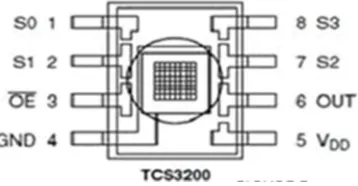
Each 16 photodiodes are connected in parallel, so using the two control pins S2 and S3 we can select which of them will be read. So for example, if we want to detect red color, we can just use the 16 red filtered photodiodes by setting the two pins to low logic level according to the following table.
[image:2.612.168.444.299.362.2]The sensor has two more control pins, S0 and S1 which are used for scaling the output frequency. The frequency can be scaled to three different preset values of 100 %, 20 % or 2%. This frequency-scaling function allows the output of the sensor to be optimized for various frequency counters or microcontrollers. Now we are ready to move on and connect the TCS230 sensor to the Arduino board. Following is the circuit representation. A color sensor depends on a photodiode which measure the power reflected by the protest for a red, green and blue light source. Because of the same it will help in detecting the specified color. There are total 8 pins in a color sensor. Pin no 7 and 8 are selection pins, pin no 1 and pin 2 are frequency scaling pin. Pin 6 is output.
Fig. 3 Pin Diagram of Colour Sensor
[image:2.612.217.396.455.548.2]B. Arduino Nano
The Arduino Nano is a small, comprehensive, and breadboard-friendly board based on the ATmega328P. It has more or less the same functionality of the Arduino Uno, but in a different package. It lacks only a DC power jack, and works with a Mini-B USB cable instead of a standard one.
C. Servo Motor
A servo motor is an electrical component which can rotate an object with great accuracy. It is small and lightweight with high output power. It can rotate about 180 degrees (90 in each direction), and works just like the standard kinds but smaller. We can use any servo code, hardware or library to control these servos. If we want to rotate an object at some specific angles or distance, and then we have to use servo motor. For this feature they are being used in many applications like toy car, RC helicopters, planes, robotics, machines etc.
D. Jumper Wire
Jumper wires are used for making connections between items on our breadboard and our Arduino’s header pins. In order to wire up all our circuits, we have to use jumper wires.
V.CIRCUITDIAGRAM
VI. PROPOSEDWORK
A. Objects which are to be separated are fed in tube.
B. A color sensor senses the items coming in its sight and code for the same is coded in arduino.
C. The coding is done in such a way that only the desired object colors are sensed.
D. And then the desired object is collected in the respective bins at the end using servo motors.
VII. RESULTSANDANALYSIS
The objects are sorted with respect to their color and dropped into the respective bins.
A. Colour Detection Results
VIII. APPLICATIONS
A. In food industry to identify rotten fruits and vegetables, in minor scale and in big scale productions, to categorize the products.
B. In production units to scan and identify the defects in raw materials.
C. In fruits and vegetable farming areas (rural areas) where installation of expensive sorters is very difficult.
D. In malls (to segregate and separate different clothes, toys, bags etc.) and in small shop.
IX. FUTUREWORK
It is extensively beneficial in wide varieties of industries, especially in the packaging section. Automatic sorting machine boosts productivity, practicality, and security of operators. Undeniably we need to add high speed DC motors and sensors with considerable response to accelerate the system for industrial application. The model can be upgraded by making some changes in the program and components. Some suggestions are as follows:
1) We can add a counter for counting the number of products
2) The system can be used as a quality controller by adding more sensors
3) The sensor can be changed according to the type of product
4) We can also detect objects depending on their images rather than their colors. That means depending on the color, shape, size etc. attributes of the products, they will be sorted. In a nutshell, we can improve the proposed work by converting it into an image based product sorting mechanism.
X.CONCLUSION
The recommended work is be a specimen version which gives overhead effective sorting procedure, taking less time. This mechanism is theoretically the easiest way for segregating objects. This process uses Arduino Nano which makes our work simple to utilize which is an added advantage. This proposed mechanism will not work properly if the sensing of objects according to their color is not done. Therefore, it is very vital to use the correct sensors which should be checked in prior whether they are functioning properly or not. After making appropriate changes it can also be used in small scale and large scale industries as well.
REFERENCES
[1] Shen, L.J. and Hassan, I., 2015. Design and Development of Colour Sorting Robot. JOURNAL OF ENGINEERING SCIENCE AND TECHNOLOGY, 10, pp.71-81.
[2] Himanshu Patel, Riya Joy, Selin Macwan, Hardik Modi, IOT Color Based Object Sorting Machine, International Journal of Applied Engineering Research, ISSN 0973-4562, Volume 13, Number 10 (2018), pp. 7383-738
[3] D.J. Lee and R. S. Anbalagan, “High-speed automated color sorting vision system”, in Optical Engineering Midwest ’95, pp 573-579, 1995. [4] How to use the Color Sensor with Arduino board (TCS3200 & TCS3210
[5] Tushar G. Gaikar, Soham N. Zadokar, Rajendra S. Bhandari, Sagar S. Patil, Object Sorting using Color Sensor and Arduino, International Journal on Recent and Innovation Trends in Computing and Communication, ISSN: 2321-8169, Volume: 4 Issue: 4, pp: 483 – 486
[6] Automated Object Sorting Using Raspberry Pi N.Aarthi, P.Sahithi, P.V.Sitaramaih, M.Indu Vardhani, N. Ranjith Kumar, D. Suneel Varma, Electronics and Communication Engineering, Bapatla Engineering College (Autonomous), Acharaya Nagarjuna University, India