Abstract— The aim of this work is to examine the influence of some structural parameters, namely, the mass per unit length and flexural rigidity of the upper beam on the natural frequencies of a symmetric non-prismatic double-beam system elastically connected by a Pasternak-type layer. A semi-analytical technique known as differential transform method was used to carry out the analysis of the vibration problem in this paper. The results of the analysis revealed that there is tendency to lower the vibration frequency of the double-beam system by increasing the mass of the upper beam. It was also found that the natural frequencies of the double-system generally increase with an increase in the flexural rigidity of the upper beam of the double-beam system. It can be concluded that both the mass per unit length and the flexural rigidity of the upper beam generally have influence on the natural frequencies of a non-prismatic double-beam system elastically coupled by a Pasternak-type elastic medium.
Index Terms—double-beam system, non-prismatic beam, Pasternak layer, structural parameters
I. INTRODUCTION
HERE has been much research into the vibration analysis of prismatic double-beam system continuously joined by an elastic layer. In particular, the natural frequencies and modes shapes of prismatic double-beam system elastically attached together by Winkler-type elastic layer have been examined by different authors [1]-[6]. Investigation into this class of problems is, however, still of great interest to researchers because of its applications in many engineering fields [7]-[8]. It has been noted that these previous studies on this class of vibration problems have been confined to modelling the layer connecting the two beams that made up the system by Winkler foundation as against Pasternak which has been found more efficient than the former [9]. Also, most of these previous researches are concerned with prismatic double-beam systems. Abd et al. [10] studied the effect of structural effects, namely, rigidity ratio, mass ratio and damping among others on the dynamic response of a beam structure attached with a beam vibration absorber by a Manuscript received March 05, 2017; revised March 20, 2017. This work was supported Covenant University
O. O. Agboola is with the Department of Mathematics, Covenant University, Ota, Nigeria (+2348032502412; e-mail: [email protected]).
J. A. Gbadeyan is with the Department of Mathematics, University of Ilorin, Ilorin, Nigeria (e-mail: [email protected]).
S. A. Iyase is also with the Department of Mathematics, Covenant University, Ota, Nigeria (e-mail: [email protected]).
viscoelastic layer.
In this present study, we make a principal contribution to filling this gap in the literature. We examine the effects of structural parameters, namely, the mass per unit length and flexural rigidity of the upper beam on the natural frequencies of an elastically connected non-prismatic double-beam system attached together by a Pasternak-type layer. The solution of the vibration problem is obtained via differential transform method (DTM).
The paper is structured as follows. The governing differential equations and the associated boundary conditions are presented in Section II. The solution procedure via differential transform method is given in Section III. Section IV contains the results and relevant discussions. Section V ends the paper with conclusions.
II. MATERIALS AND METHODS A. Formulation of the Problem
Consider a system of two non-prismatic Euler-Bernoulli beams of length L, continuously attached together by
elastic Pasternak-type elastic layer as shown in Fig. I. Winkler modulus, ( )k x and shear modulus, ( )G x characterize the elastic layer. The coupled differential equations of motion for the double-beam system based on the Euler-Bernoulli beam theory can be written as follows:
2 2
2
1 1
1 1 1 1
2 2 2
2
1 2
2
, ,
, , 0
w x t w x t
E I x A x
x x t
k x G x w x t w x t x
, (1)
and
2 2
2
2 2
2 2 2 2
2 2 2
2
2 1
, ,
, , 0
w x t w x t
E I x A x
x x t
k x G x w x t w x t x
. , (2)
where Ej and j are the Young’s modulus of elasticity and
mass density of the jth beam material respectively. A xj( ) and I xj( ) are the area of cross section and cross-sectional
Effects of Some Structural Parameters on the
Vibration of a Simply Supported Non-prismatic
Double-beam System
Olasunmbo O. Agboola, Member, IAENG, Jacob A. Gbadeyan, and Samuel A. Iyase
moment of inertia at distance x from the left end of the jth beam respectively. The transverse displacement of the jth beam at any distance x along the length of the beam at time
t, is denoted by w x tj( , ). The subscript j1and 2 refer to
upper beam and lower beam, respectively. Also, k x
is the variable Winkler modulus of the elastic layer (springs) that connects the two beams together and G x
is the variable shear modulus that accounts for the shear interaction among the springs.The boundary conditions corresponding to simply supported double-beam system are:
2
2 (0, )
(0, ) 0, j 0
j w t w t x
, (3)
2
2 ( , )
( , ) 0, j 0
j
w L t w L t
x
. (4)
Let us assume a harmonic motion of the form: ( , ) ( ) i t, 1, 2
j j
w x t Y x e j . (5) where is ( )Y xj the mode shape function of the jth beam,
i t
e is a harmonic function of time t with as the circular natural frequency of the double-system structure.
Substituting Eq. (5) into Eqs. (1) and (2) yields
2 2
1 2
1 1 1 1 1
2 2
2
1 2 2 1 2
( ) ( ) 0
d Y x d
E I x A x Y x
dx dx
d
k x Y x Y x G x Y x Y x dx
, (6)
and
2 2 2 22 2 2 2 2
2 2
2
2 1 2 2 1
( ) ( ) 0
d Y x d
E I x A x Y x
dx dx
d
k x Y x Y x G x Y x Y x dx
. (7)
The boundary conditions for the modal functions are also obtained as:
2 2
00 0, j 0
j
d Y Y
dx
, (8)
0, 2
2 0j j
d Y L Y L
dx
. (9)
The following dimensionless parameters are introduced for simplicity:
( )
, ( ) ,
( )
, ( ) ; 1, 2
(0) (0) j j j j j j j j Y x x y L L
I A x
I x A j
I A (10)
Substituting Eqs. (5) into Eqs. (6) and (7), the following non-dimensional governing equations of motion can be obtained:
2 2 2 2 11 1 1 1
2 2
2
1 1 2 1 2 1 2
d ( ) d
( )
d d
d
( ) ( ) ( ) ( ) ( ) ( ) 0
d y
I A y
y y G y y
, (11)
2 2 2 2 22 2 2 2
2 2
2
2 2 1 2 2 2 1
d ( ) d
( )
d d
d
( ) ( ) ( ) ( ) ( ) ( ) 0
d y
I A y
y y G y y
. (12)
where
4 4 2 1 1 2 1 1 0 ( ) ( ) ( ) , , ( )(0) 0 0
j j j
j j j j
A L
k x L G x L
G
E I E I E I
. (13)
The dimensionless boundary conditions are also obtained as:
2
2 00 0, j 0
j
d y y
d
, (14)
2 2
11 0, j 0
j
d y y
d
. (15)
B. DTM Solution of the Problem
The differential transformation of the rth derivative of the function y
is defined as follows:0
1 ( )
( ) ! r r d y Y r
r d
, (16)
The inverse differential transformation of ( )Y r is defined as follows:
0
( ) r ( )
r
y Y r
. (17)Combining equations Eqs. (16) and (17) yields
0 0 ( ) ( ) ! r r r r d y y
r d
TABLEI
DTM OPERATIONS USED FOR EQUATIONS OF MOTION
Original function Transformed function
( ) ( ) ( )
f x g x h x F r( )G r( )H r( )
( ) ( )
f x g x F k( )G k( ) ( ) ( ) ( )
f x g x h x
0
( ) ( ) ( )
k
r
F k G r H k r
( )
( ) n
n
d g x f x
dx
F r( ) ( r 1)(r2) (rn G r) ( n) ( ) n
f x x ( ) ( ) 1 if
0 if
k n
F k k n
k n
TABLEII
DTM OPERATIONS USED FOR BOUNDARY CONDITIONS (BCS) AT 0
Original BC Transformed BC
(0) 0
f F(0) 0
(0) 0 df dx (1) 0 F 2
2 (0) 0
d f
dx
(2) 0
F
3
3 (0) 0
d f dx
F(3) 0
TABLEIII
DTM OPERATIONS USED FOR BOUNDARY CONDITIONS (BCS) AT 1
Original BC Transformed BC
(1) 0 f
0
( ) 0
n r F r
(1) 0 dfdx 0 ( ) 0
n
r r F r
2
2 (1) 0
d f
dx 0 ( 1) ( ) 0
n
r
r r F r
3
3 (1) 0
d f dx
0
( 1)( 2) ( ) 0
n
r
r r r F r
which is the Taylor series of y
at 0. Eq. (18) implies that the concept of differential transformation is derived from the Taylor series expansion. However, it is important to remark that differential transformation method (DTM) does not evaluate the derivatives symbolically. In practice, Eq. (17) can be written as the finite series:0
( ) ( )
M r r
y Y r
(19)Eq. (19) implies that is negligibly small. In this study, the
convergence of the natural frequencies determines the value of M. The fundamental operations of the dimensional transform which are useful in the transformation of the governing equations and the boundary conditions are summarized in Tables 1 - 3. ([11]-[14])
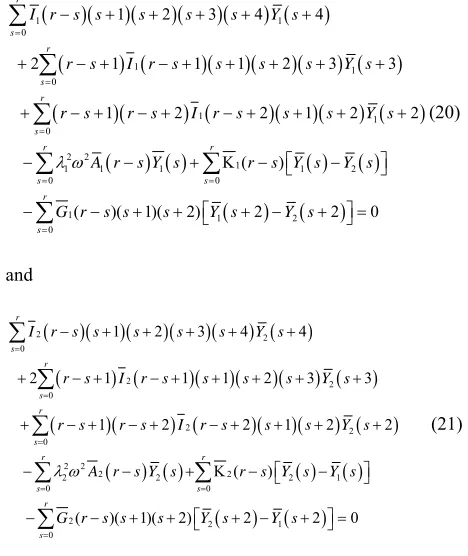
Using the DTM operations stated in Table I appropriately, the differential transform of Eqs. (11) and (12), are obtained as:
1 1 0 1 1 0 1 1 0 2 2 11 1 1 1 2
0 0
1 1 2
0
1 2 3 4 4
2 1 1 1 2 3 3
1 2 2 1 2 2
( )
( )( 1)( 2) 2 2 0
r s r s r s r r s s r s
I r s s s s s Y s
r s I r s s s s Y s
r s r s I r s s s Y s
A r s Y s r s Y s Y s
G r s s s Y s Y s
(20) and 2 2 0 2 2 0 2 2 0 2 2 2 22 2 2 1
0 0
2 2 1
0
1 2 3 4 4
2 1 1 1 2 3 3
1 2 2 1 2 2
( )
( )( 1)( 2) 2 2 0
r s r s r s r r s s r s
I r s s s s s Y s
r s I r s s s s Y s
r s r s I r s s s Y s
A r s Y s r s Y s Y s
G r s s s Y s Y s
(21)where I rj( ), A rj( ), and Yj( )r are the transformed
functions of Ij( ) , Aj( ) , and ( )Yj respectively.
By applying DTM operations in Tables II and III appropriately to the boundary conditions presented in Eqs. (14) and (15), we have
(0) 0, (2) 0
j j
Y Y , (22) and
0 0
( ) 0, 1 ( ) 0
M M
j j
r r
Y r r r Y r
. (23)The values of Y1(1), Y2(1), Y1(3), and Y2(3) are unknown. So, they are set as unknowns such as,
1(1) , 2(1) , 1(3) , 2(3)
Y a Y b Y c Y d. (24) The values of Y1(4), and Y2(4) can be obtained by using Eqs. (22) and (24) appropriately in Eqs. (20) and (21). Following an identical recursive procedure, the values of
1( )
[image:3.612.310.544.168.446.2]decided by the convergence of natural frequency) can be determined in terms of constants a, b, c, and d.
Substituting Y r1( ), and Y2( )r for r0,1, 2, , M into Eq. (23) yields the following system of equations:
( ) ( ) ( ) ( )
j1 ( ) j2 ( ) j3 ( ) j4 ( ) 0,
M M M M
f af b f c f d (25) for j1, 2,3, 4 such that j1( )( )
M
f , j2( )( )
M
f , j3( )( )
M
f , and ( )
j4 ( )
M
f are polynomial functions of corresponding to M. The system of Eqs. in (25) can be expressed in the following matrix form:
( ) ( ) ( ) ( )
11 12 13 14
( ) ( ) ( ) ( )
21 22 23 24
( ) ( ) ( ) ( )
31 32 33 34
( ) ( ) ( ) ( )
41 42 43 44
0
( ) ( ) ( ) ( )
0
( ) ( ) ( ) ( )
0
( ) ( ) ( ) ( )
0
( ) ( ) ( ) ( )
M M M M
M M M M
M M M M
M M M M
a
f f f f
b
f f f f
c
f f f f
d
f f f f
(26)
The frequency equation of the double-beam system is obtained be setting the determinant of the coefficient matrix of Eq. (26) to zero. The non-trivial solution of the frequency equation can be written as
(M), 1, 2,
n n
(27)
(M)
m
is the Mth estimated eigenvalue (natural frequency) corresponding to nth mode of vibration. The value of M is decided by the convergence of natural frequency expressed by the following inequality:
(M) (M 1) ,
m m
(28)
where (M)
m
is Mth estimated natural frequency corresponding to M and is the error tolerance parameter (allowable error). In this paper, the error tolerance parameter is taken as 0.0001.
III. RESULTS AND DISCUSSION
We restrict our attention to a beam pair with constant width and linearly varying depth in this paper. Thus, the cross-sectional area and the second moment of area of the jth beam can be written as:
( ) (0) 1 ; 1, 2
j j j
x
A x A j
L
(29)
and
3
( ) (0) 1 ; 1, 2
j j j
x
I x I j
L
(29)
where j is the taper ratio for jth beam, which satisfies
0j 1.
The cross-sectional area and moment of inertia of the jth
beam, in dimensionless form, can now be written as:
( ) 1 , 1, 2
j j
A j (31) and
3j( ) 1 j , 1, 2
I j (32) In this investigation, the mass per unit length and flexural rigidity of the upper beam are varied with the view of observing their effects on the natural frequencies of the double-beam system.
Effect of Mass per Unit Length of Upper Beam on Vibration Frequencies
To start with, the influence of the mass per unit length of the upper beam on the natural frequencies of a non-prismatic double-Euler-Bernoulli beam system elastically coupled by a Pasternak elastic layer is first examined. It is remarked that the moduli of the Winkler and Shear layers are assumed to be constant in our calculations for simplicity. Four cases of variation are considered as follows:
Case 1: 1 1A(0) 0.1 A(0); Case 2: 1 1A(0) 0.5 A(0); Case 3: 1 1A(0)A(0); Case 4: 1 1A(0) 2 A(0); where
10 1 10
E Nm-2, I(0) 4 10 4m4, 2 103kgm-3, 2
(0) 5 10
A m2, E I1 1(0)E I2 2(0)EI(0); 2A2(0) A(0)
; 2 105 k Nm-2, 100
G Nm-2, L1L2 L 10m, 12 0.5. The result of the analysis to study the effect of the mass of the upper beam on the vibration frequencies of the simply supported Euler-Bernoulli double-beam system is presented in Table IV.
The data in Table IV evidently indicate that all the four natural frequencies of the non-prismatic double-beam system are very sensitive to the mass of the upper beam. Specifically, there is tendency to lower the vibration frequency of the whole double-beam system by increasing the mass of the upper beam.
Effect of Flexural Rigidity of Upper Beam on Vibration Frequencies
Case 1: E I1 1(0) 0.1 EI(0);
Case 2: E I1 1(0) 0.5 EI(0);
Case 3: E I1 1(0)EI(0);
Case 4: E I1 1(0) 2 EI(0) TABLEIV
VARIATION OF THE FIRST FOUR VIBRATION FREQUENCIES OF NON
-PRISMATIC SIMPLY SUPPORTED DOUBLE-BEAM SYSTEM WITH MASS PER UNIT
LENGTH OF THE UPPER BEAM
cases frequencies Natural
1
Case 1 18.9741
Case 2 16.4124
Case 3 14.2431
Case 4 11.6053
2
Case 1 69.0134
Case 2 64.8811
Case 3 57.9037
Case 4 45.8779
3
Case 1 138.7188
Case 2 91.4104
Case 3 74.3212
Case 4 64.6369
4
Case 1 177.3322
Case 2 120.0124
Case 3 95.3683
Case 4 84.8614
where
10 1 10
E Nm-2, I(0) 4 10 4m4, 3
2 10
kgm-3, 2 (0) 5 10
A m2,
2 2(0) (0)
E I EI , 1 1A(0)2A2(0)A(0),
5 2 10
k Nm-2, G100N m-2, L1I2 L 10m,
1 2 0.5
.
The results of the study of the effects of the flexural rigidity of the upper beam on the first four natural
frequencies of the non-prismatic simply supported EB double-beam system coupled by Pasternak elastic layer are shown in Table V.
It is evident from Table V that natural frequencies of the double-system generally increase with an increase in the flexural rigidity of the upper beam of the double-beam system considered.
TABLEV
EFFECT OF FLEXURAL RIGIDITY OF UPPER BEAM ON VIBRATION
FREQUENCIES OF NON-PRISMATIC SIMPLY SUPPORTED EB DOUBLE-BEAM
SYSTEM ELASTICALLY CONNECTED BY PASTERNAK ELASTIC LAYER
cases frequencies Natural
1
Case 1 10.4893
Case 2 12.3155
Case 3 14.2431
Case 4 17.3895
2
Case 1 38.1351
Case 2 48.8783
Case 3 57.9037
Case 4 67.3792
3
Case 1 62.8207
Case 2 73.8182
Case 3 74.3212
Case 4 75.5563
4
Case 1 73.5035
Case 2 91.3999
Case 3 95.3683
Case 4 105.7530
IV. CONCLUSIONS
The free vibration analysis of non-prismatic double-beam system based on both Euler-Bernoulli and Rayleigh beam theories has been presented in this paper. The main purpose of this research work has been to investigate the effects of some structural parameters, namely the mass per unit length and flexural rigidity of the upper beam of the double-beam system on its natural frequencies.
REFERENCES
[2] T. Aida, S. Toda, N. Ogawa, and Y. Imada, “Vibration control of beams by beam-type dynamic vibration absorbers,” Journal of Engineering Mechanics, vol. 2, pp. 248-258, 1992.
[3] Y. X. Li, Z. J. Hu, and L. Z. Sun, “Dynamical behavior of a double-beam system interconnected by a viscoelastic layer,” International Journal of Mechanical Sciences, vol. 105, pp. 291–303, 2016. [4] Q. Mao, “Free vibration analysis of elastically connected
multiple-beams by using the Adomian modified decomposition method,” Journal of Sound and Vibration, vol. 331, pp. 232–2542, 2012. DOI: 10.1016/j.jsv.2012.01.028
[5] M. Huang, and J. K. Liu, “Structural method for vibration analysis of the elastically connected double-beam system,” Advances in Structural Engineering, vol. 16, pp. 365–377, 2013.
[6] Z. Oniszczuk, “Free transverse vibrations of elastically connected simply supported double-beam complex system,” Journal of Sound and Vibration, vol. 232, no 2, pp. 287–403, 2013
[7] M. Abu–Hilal, “Dynamic response of a double Euler–Bernoulli beam due to a moving constant load,” Journal of Sound and Vibration, vol. 297, no. 3-5, pp. 477–491, , 2006.
[8] J. Li, and H. Hua, “Spectral finite element analysis of elastically connected double–beam systems,” Finite Elements in Analysis and Design, vol. 43, pp. 1155–1168, 2007.
[9] M. A. Hamarat, Ü. H. Çalık Karaköse, and E. Orakdöğen, “Seismic analysis of structures resting on two parameter elastic foundation, in Proc. 15th World Conference on Earthquake Engineering, Lisbon, Portugal, 24-28 September, 2012
[10] M. Y. Abd, A. Putra, N. A. A. Jalili, and J. Noorzaei, “Effects of structural parameters on the dynamics of a beam structure with a beam-type vibration absorber,” Advances in Acoustics and Vibration, 2012, Article ID 268964, 10 pages, doi:10.1155/2012/268964 [11] A. Arikoglu, and I. Ozkol, “Solution of boundary value problems for
integro–differential equations by using differential transform method,” Applied Mathematics and Computation, vol. 168, no. 2, pp. 1145–1158, 2005, doi:10.1016/jamc.2004.10.009
[12] A. Mirzabeigy, “Semi-analytical approach for free vibration analysis of variable cross-section beams resting on elastic foundation and under axial force,” International Journal of Engineering, vol. 27, no. 3, pp. 385-394, March 2014.
[13] S. H. Ho, and C. K. Chen, “Analysis of general elastically end restrained non–uniform beams using differential transform,” Applied Mathematical Modelling, vol. 22, pp. 219–234, 1998.
[14] O. O. Agboola, A. A. Opanuga, and J. A. Gbadeyan, “Solution of third order ordinary differential equations using differential transform method,” Global Journal of Pure and Applied Mathematics, vol. 11, no. 4, pp. 2511-2516, 2015.
[15] J. A. Gbadeyan, and O. O. Agboola, “Dynamic Behaviour of a double Rayleigh beam-system due to uniform partially