Abstract—In this work is studied the behavior of particles in boundary layer on a flat plate longitudinal streamlined by flow of dilute suspension in the case of sufficiently lower volume concentrations of dispersed phase. Also is investigated the dynamics of nanosuspension in boundary layer taking into account the influence of particles concentration on suspension properties.
Index Terms—boundary-layer, diffusion, migration, nanofluid, particle
I. INTRODUCTION
NTEREST in studying the behavior of a mixture flow is caused by their possible wide practical applications. With increasing performance of electronic devices and development of high-energy technologies is appeared a need for creating the effective cooling systems and managing large heat fluxes. One of the ways of intensification of heat transfer is an enhancing thermal conductivity of fluid by adding solid particles with high thermal conductivity. Nanosized particles (or nanoparticles) are of particular interest in the creation of such suspensions (called in this case by nanofluids or nanosuspensions [1]). In contrast to microsized particles they are deposited slower, they do not lead to clogging and wear of the channels. At the same time, nanoparticles are often subject to diffusion.
Modeling and solving the problem of nanofluids flows in the presence of diffusion fluxes is a rather difficult task, so it is usually these problems are considered under the simplifying assumptions, such as the incompressibility of suspension, a dilute mixture, neglecting the influence of the particles on the thermal parameters of the suspension, and the like (see, for example, [2]–[6]).
It should be noted that the process of mass and heat exchange between the wall and suspension occurs in the boundary layer near the wall. In connection with this, the study of suspension characteristics in the boundary layer it is urgent and is of great practical importance.
The purpose of this work is, at first, the study of the behavior of particles in boundary layer on a flat plate in the
Manuscript received February 16, 2017. This work was supported by the Ministry of Education and Science of Republic of Kazakhstan under Grant 3486/GF4.
T. R. Amanbayev is with the South Kazakhstan State University, Shymkent, Tauke khan 5, at the same time with the Institute of Mathematics and Mathematical Modeling, Almaty, Pushkin 125, Kazakhstan (author to provide e-mail: [email protected]).
case of sufficiently lower volume concentrations of dispersed phase. In this connection the effect of liquid suction through the wall surface on the migration of particles is studied. Note that such problem in the absence of fluid suction was considered in [7], [8]. Secondly, we investigate the dynamics of nanosuspension in the boundary layer taking into account the influence of particle concentration on the thermophysical properties of the suspension.
II. MIGRATIONOF PARTICLES INBOUNDARY LAYER
Consider the process of migration of microsized particles in boundary layer on a flat plate streamlined by horizontal flow of dilute suspension. In this section assumed that particle volume concentrations sufficiently small so that the influence of dispersed phase to the fluid flow can be neglected. This allows to calculate the flow parameters in the boundary layer as usually without particles, and to calculate of motion of particles with taking into account of influence of liquid. It is assumed that particles falling to wall not be reflected back. Further lower indices 1, 2 correspond to the parameters of liquid and particles, respectively. We introduce the Cartesian system of coordinates, where x axis is oriented along the plate in flow direction, y axis is oriented in the transversal direction against gravity acceleration. Components of the velocity vector vm on the x and y axes denoted as um,vm, respectively (m=1, 2).
After simplifying of the Navier-Stokes equations system for the stationary liquid flow in the thin at wall viscous boundary layer is obtained the Prandtl equations system
0 1 1
y v x
u , (1)
2 1 2
1 1 1 1 1
y u y
u v x u u
, (2)
where 1 is the kinematical viscosity of liquid. Consider the case when the plate is permeable, i.e. on the plate surface occurs liquid suction, for example, due to filtration. In this case one of formulations of boundary condition on the permeable plate can be written as [9]
y=0: u10,
2 / 1 1 1 (1/2)S u /x
v , (S>0), (3)
where u is the velocity of incoming flow, S is the
Modeling of Particles Migration and Nanofluid
Flows in Boundary Layer
Tulegen R. Amanbayev
0 10 20 30 40 50 60 0.01
0.02 0.03 0.04 0.05 0.06 0.07 0.08 0.09 0.10
Longitudinal Direction x/h
T
ra
n
sve
rse
D
ire
ct
io
n
y/
h
(b)
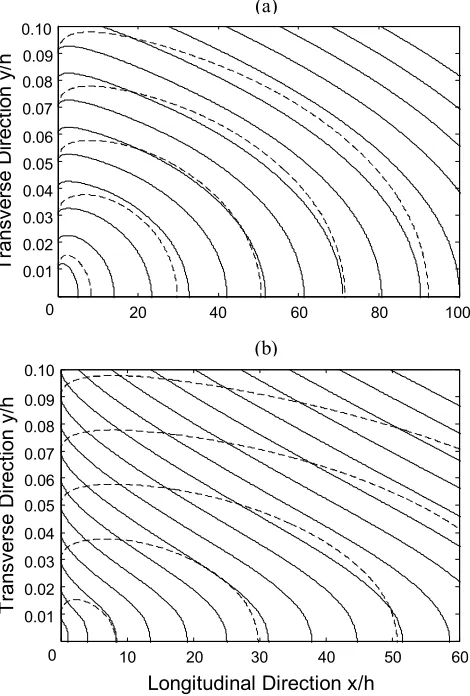
Fig. 1. Particles trajectories in the boundary layer for particle diameter of d=50 μm at the various values of suction coefficient S=0.3915 (Fig. a) and S=2.1464 (Fig. b).
0 20 40 60 80 100
0.01 0.02 0.03 0.04 0.05 0.06 0.09 0.10
T
ra
n
sve
rse
D
ire
ct
io
n
y/
h
(a)
0.08
0.07
coefficient, characterizing the liquid suction rate on the plate. Obviously, at the infinity the condition of the incoming flow is satisfied, so that y=∞: u1u.
Introducing the stream function ψ and self-similar variables η, f defined by Blasius transform [9]
y u
1 ,
x v
1 ,
1/2 1/ x
u
y
,
2 / 1 1 / )
( u x
f ,
from (2) we obtain the following equation (note equation (1) satisfied identically)
0 ) 2 / 1
(
ff
f . (4) The boundary conditions for the equation (4) are (taking account (3))
S
f(0) , f(0)0, f()1. (5)
The liquid velocity components are expressed as
f u y
u
1 ,
f f
x u x
v
2 / 1 1 1
2
1 .
Equations of particles motion we write in framework of Lagrange approach
2 2 v
r , m2v2 fr fSfAfmfg. (6) Here top dot denotes the derivation for time, r2, m2 are the radius-vector and mass of particle, fS, fA, fr, fm, fg are the Saffman’s force, Archimedes force, and the resistance, additional mass and gravity forces, respectively.
Expressions for the above-mentioned forces have the usual forms [10]–[13]
8 / )
( 1 2
2 1 1 2
v v v v
fr Cdd , 2 /6
3
j
fg d g
,
6 / ) ( 1 1 3
g v
fAd , 1( 1 2)/12
3
v v
fm d ,
j
f
y u y
u u
u d S
1 1
1 2 1 1 2
sign )
( 2 46 .
6 ,
where d is the particle diameter, 1
,
2
are the densities of the liquid and particle materials, Cd is a resistance coefficient, gis the gravity acceleration, j is the unit vector of y axis, Ψ is the function of Reynolds number. Initial conditions for the system (6) accepted as (assumed that the velocities of liquid and particles in the incoming flow are same u1=u2≡u)
: 0
t x0, y y0, u2u, v20. (7) For solving the formulated boundary value problem (4), (5) is used the numerical shooting method. Obtained numerical solution is approximated by polynomial, and then used for integrating the system of particles motion equations (6) with initial conditions (7) by the numerical Runge-Kutta method. Some results obtained by the described above approach are illustrated below.
[image:2.595.309.544.384.732.2]increase of liquid suction rate the behavior of particles in the boundary layer changes significantly. For example, at the larger value of the suction coefficient (Fig. 1b) the particles starting from the leading edge, immediately move downward toward the plate surface. Moreover, the coordinate of the fall point of particles on the surface is significantly decreased.
Calculations showed that the fine particles fall on the surface of the plate farther, than larger ones. This is due to a decrease in the lateral Saffman force effect with reducing the size of dispersed particles. Note that the particles fall onto the wall almost vertically. This is understandable, since in the vicinity of surface the horizontal speed of the fluid is close to zero.
It is important to have information about the rate of deposition of dispersed particles on the plate surface. Analysis of the calculation results showed that the highest rate of deposition of particles is observed in the region near the front edge of the plate, and with increasing distance from the front edge the speed of particles decreases rapidly enough, and, as expected, the presence of liquid suction through the surface leads to significant increase in the fall speed of disperse phase to the surface.
III. MODELING OF NANOFLUID FLOWSINBOUNDARY LAYER
Nanofluid (or nanosuspension) is a mixture of liquid (carrier) and solid (or dispersed) phase. It is believed that the dispersed phase consists of spherical particles. Each of the phases separately is incompressible. The phase and chemical transformations, as well as external forces are absent. Further, parameters of the carrier and the dispersed phase will be marked, as before, by the indices 1, 2, respectively, and the mixture parameters as a whole – without an index.
Along with the parameters defining the state of the individual components (true and reduced densities
m
, m, the volume fractions m, velocities vm, m=1,2), in the mechanics of mixtures are entered the parameters characterizing the mixture as a whole, namely, the density of the mixture ρ and the mass-average (barycentric) velocity
v of the mixture [10]
2 1
, v1v12v2,
1 1 1
, 222, 12 1, ( 1
, 2=const). Note that so determined velocity v is the speed of the overall center of mass of the individual volumes corresponding to the different components of the mixture.
The continuity equation for the components of the mixture in the presence of diffusion processes can be written in the form [10], [14]
m m
m
t vJ
, (8)
)
(v v
Jm m m , m=1, 2.
The vectors Jm are the diffusion flux vectors. Obviously, there is the relation J1J2 0. If to accept the condition of medium incompressibility v0 it is easy to verify that in the stationary case the divergence of the vectors of diffusion fluxes are also equal to zero, i.e. Jm 0 (m=1, 2). Thus, in this case the field of the diffusion flux vector represents, like as the velocity vector of mixture, a solenoidal field. The properties of solenoidal fields are well known [14]. In particular, the strength of the vector tube in such field, defined as the circulation along an arbitrary contour, embracing this tube once, is identical throughout this tube. In the case of an incompressible mixture, we have the relation v0, which means that the surfaces of level of the mixture density (or surfaces of the equal density) at the stationary motion are stream surfaces of barycentric speed field of the mixture.
The relative motion of the components, described by the diffusion rates, directly affect only on the concentration of the components, and determined by the diffusion mechanism. Diffusion laws establish the dependence of the instantaneous values of diffusion fluxes on the concentration gradient, temperature gradient, etc. The use of these diffusion laws assumes that the inertia of the relative motion of the mixture components may be neglected (so-called diffusive approximation) [10].
The equation of mixture momentum conservation (or the Navier-Stokes equation) under diffusive approximation can be written in the following form (it is assumed that the tensor of deformation rates is determined by the field of the barycentric velocities of the mixture) [15]
j j
i j j ik i k
k i
k
i k
i k i
x v
x x v
x v x v x
x p x
v v t v
3 2
(9)
Here xi, vi – spatial coordinates and corresponding components of velocity vector, p – pressure, μ, ζ – effective viscosities of mixture (μ – dynamical viscosity and ζ often called second or dilatational viscosity), ik – Kronecker symbol, i, j, k=1, 2, 3 (by j, k summation). In (9) the magnitudes of μ, ζ may depend, in general, from the temperature T, the volume concentration of dispersed particles 2, and etc. In the general case T, 2 and therefore, μ, ζ are not constant throughout the volume of the fluid, so that the parameters μ, ζ cannot be factored out from under the sign of the derivative. In the case of an incompressible medium, when v0, equation (9) takes the more compact form
k i
k i k i k i
x v x x p x
v v t
v . (10)
(when at each point can be determined the temperature T), the medium is incompressible, the external forces and viscous dissipation of energy are absence, the energy equation we can write as in [2]
T c cT t cT
v q 2J2 (11)
Here c is the effective heat capacity of the dispersed mixture, q is the heat flux vector, c2 is the heat capacity of the dispersed phase material. The quantity q can be calculated according to the formula set by the Fourier law
T k
q , where k is an effective thermal conductivity of a nanofluid. As seen from (11) the internal energy of the mixture can vary both due to conductive heat flux, and due to the diffusion transfer of matter.
The relative motion of the particles in the nanosuspension arises under the influence of various factors, among which, as stated in [2], the most significant are the diffusion due to Brownian motion and thermal diffusion. They arise from the presence of gradients of particles concentration and the temperature, respectively, and in the first approximation, proportional to the corresponding gradients. Assumed that the total diffusion flux of particles consists of these flows [2], [15]
T T D DB T
2 2 2
2
J , (12)
d T k D B B 1 3
, 2
1 1 T D , 2 1 1 2k k
k
.
Here DB, DT are the Brownian diffusion and thermal diffusion coefficients, respectively [16], [17], kB is the Boltzmann constant, 1 is dynamical viscosity of liquid,
1
k , k2 are the thermal conductivity of the liquid and particle materials, respectively.
It is interesting to consider the limiting case, when in the mixture the diffusion fluxes of the substance are lacking. Let’s call this limiting case, conditionally, as the state of “diffusion equilibrium” (DE) of the dispersed mixture. In order to have J2=0 parameters T, 2 according the expression (12) must satisfy the equation which can be rewritten relatively typical values of parameters T, 2 at the some fixed state (for example, at the infinity)
exp 1 1
A , (13)
2 2 A , T T , 2 D , B T D D D , ) (
D T
DB B , DT DT(2)
This relationship defines the connection between the concentration and the temperature, which should be the case for absence of diffusive flux of material [15] (so the
considered limited state of nanofluids can also be called "concentration-temperature equilibrium"). When A<exp(-σ) the state of DE is absent (since for these values the temperature will be negative). Thus, there is a limiting (or critical) value of volume concentration A exp() lower which there is no other state of DE. In view of the σ>>1 the quantity A is sufficiently small A<<1. Note that in the DE state the dispersed mixture is a non-compressible medium (v0), so that in this case, as mentioned above, velocity vector forms a solenoidal field. At this, we have the relation v1v2 v, i.e. in this case coincides not only the temperatures but also the velocities of phases. So in this situation, the dispersed mixture presents a fully thermodynamically equilibrium system.
In the framework of this approach with the diffusive flux the influence of the composition of the mixture directly manifested through physical-chemical parameters that determine the state of the mixture (density, effective coefficients of viscosity, heat capacity and heat conductivity of the mixture, etc.). For the density ρ and heat capacity c of the mixture there are the following relationships
2 2 1 2) 1 ( , 2 2 2 1 1 2) 1 (
c c c ,
where c1, c2 are the specific heats of fluid and a substance of particles. For the effective coefficients of dynamic viscosity μ and thermal conductivity k there exist various dependencies [2], [18]. At lower volume concentrations of particles often used the well-known Einstein’s formula for suspension viscosity [15] and the Maxwell’s formula for conductivity [19] ) 2 5 1 ( 2
1
, ) ( 2 ) ( 2 2 2 1 2 1 2 2 1 2 1 2 1 k k k k k k k k k k .
Next consider the stationary movement of nanofluids in the boundary layer on a flat plate streamlined longitudinally in the case of DE. Considering the nanofluid motion in framework of boundary layer approximation, and introducing stream function ψ and self-similar variables η, f (as in section II) we obtain from (8), (10), (11) the following system of equations (using the relation (13) instead three equations we have two equations)
0 2
M f R ff
f
M , (14)
0 ) ( 2 Pr 2
K C C f
K , (15)
1 R , 1 M , 1 k k
K ,
1 1c c C , 1 1 1 Pr k c ,
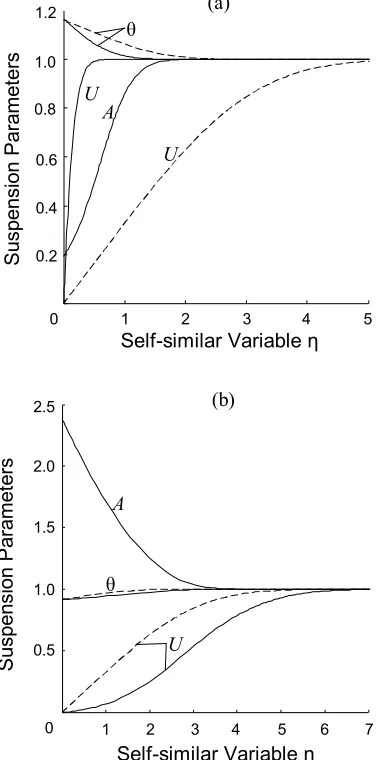
Fig. 2. The distribution of nanofluid parameters depending on the self-similar variable η in the cases of TwT (Fig. a) and Tw T (Fig. b).
coefficients depending from 2, by means of (13) are reduced to the dependencies on θ. Thus, system (14), (15) is a system of differential equations for the two unknown functions f and θ.
On the plate for liquid is posed the sticking condition, as well as is set a constant temperature. At infinity the conditions of the incoming flow are fulfilled. So we have following boundary conditions
f(0)=0, f(0)0, (0)w, (16) 1
) (
f , θ(∞)=1. (17) The system (14), (15) with the boundary conditions (16), (17) was numerically integrated by the shooting method. The calculations were performed for water with aluminum particles at the temperature of the incoming flow
K 300
T , and a constant temperature of plate
w
T =const. It were considered cases when the temperature of the plate is greater than the temperature of the incoming fluid Tw>T, and when, on the contrary, Tw<T. Below are shown the distributions of dimensionless longitudinal
velocity U u/u f, the relative volume concentration
of particles A and the temperature θ in dependence of the self-similar variable η (see Fig. 2). The dashed curves correspond to the "pure" (without particles) fluid.
In Fig. 2a shown the results of calculating at the diameter of particles d=1.25 nm with the volume concentration of the dispersed phase in the incoming flow
2 =0.05 in the case of Tw>T. It is seen that the presence of dispersed particles in the flow leads to a significant decrease of the boundary layer thickness. The relative volume fraction of the dispersed phase A increases with increasing η. The temperature of the liquid in the presence of particles is significantly smaller than in their absence.
Fig. 2b corresponds to the case Tw<T at d=1 nm, and
2 =0.1. In this case the value of A decreases with increasing η. Note that the suspension velocity U, in contrast to the previous case, less than the velocity of pure liquid. Moreover, the curve U in this situation has the inflection point. This fact fundamentally affects problem of stability of nanofluid motion in the boundary layer. However the discussion of this problem is beyond the scope of this article (see more details, for example, in [15]).
IV. CONCLUSION
The behavior of particles and nanofluids in the boundary layer on the longitudinally streamlined plate was studied. It is showed that at first the particles are lifted and then lowered down and fall on the plate surface. With the increase of liquid suction rate through surface the behavior of the particles in the boundary layer changes significantly.
We obtained the relation between the liquid temperature and concentration of the dispersed phase in the state of diffusion equilibrium (when the diffusion of the particles is absent, and the dispersive mixture can be regarded as incompressible medium). The calculations of the boundary layer parameters at different temperature regimes, namely, when the plate temperature is greater or less than the temperature of the free stream has been carried out. It was found radically different distribution of volume concentration of nanoparticles and nanofluids velocity in the boundary layer in these cases.
Note that in the general case where there are the diffusion fluxes, the suspension is compressible, and therefore the momentum equation will have a more complex form. Moreover a problem of a specification of second viscosity for the mixture is appeared. The problem of the boundary layer in nanofluids in this formulation requires the separate consideration.
In the future it would be interesting to consider the limiting case where the densities of fluid and particles substance are the same, so the suspension, in general, can be considered as incompressible medium. Although the diffusion fluxes of the mixture components, unlike the case of equilibrium diffusion discussed above, is non-zero.
Results and conclusions of this work may be useful for the estimating and testing of results based on the more complex models.
A
θ
U (b)
1.0
0.5 1.5 2.0 2.5
0 1 2 3 4 5 6 7
Self-similar Variable η
Su
sp
e
n
si
o
n
Pa
ra
me
te
rs
0 2 3 4
0.2 0.4 0.6 0.8 1.0
θ
A
U U
(a)
1.2
1 5
Su
sp
e
n
si
o
n
Pa
ra
me
te
rs
[image:5.595.70.258.358.738.2]
REFERENCES
[1] S. U. S. Choi, “Enhancing thermal conductivity of fluids with nanoparticles,” in Developments and Applications of Non-Newtonian Flows, D.A. Siginer and H.P. Wang, Eds. New York: ASME, 1995, pp. 99–105.
[2] J. Buongiorno, “Convective Transport in Nanofluids,” J. Heat Trans., v. 128, pp. 240–250, Mar. 2006.
[3] A. V. Kuznetsov, and D. A. Nield, “Natural convective boundary-layer flow of a nanofluid past a vertical plate,” International Journal of Thermal Sciences, vol. 49, no. 2, pp. 243–247, Feb. 2010.
[4] F. Kowsary, and M. M. Heyhat, “Heat conduction in a nanofluid layer considering the particle migration due to Brownian diffusion and thermophoresis,” Nanomech. Sci. Technology: An Inter. J., vol. 1, no. 3, pp. 257–272, Apr. 2010.
[5] W. A. Khan, A. Aziz, and U. Naseem, “Buongiorno model for nanofluid Blasius flow with surface heat and mass fluxes,” J. Thermophys. and Heat Transfer, vol. 27, no. 1, pp. 134–141. Jan.-Mar. 2013.
[6] M. H. Yasin, A. Ishak, and I. Pop, “Steady double-diffusive mixed convection boundary layer flow past a vertical flat plate embedded in a porous medium filled by a nanofluid using Buongiorno's model,” J. Porous Media, vol. 19, no. 4, pp. 331–338, May 2016.
[7] A. A. Osiptsov, and E. S. Asmolov, “Asymptotic model of the inertial migration of particles in a dilute suspension flow through the entry region of a channel,” Phys. Fluids, vol. 20, no. 12, pp. 123-130, Dec. 2008.
[8] E. S. Asmolov, “Dynamics of a spherical particle in a laminar boundary layer,” Fluid Dynamics, vol. 25, no. 6, pp. 886–890, Nov. 1990. [9] H. Schlichting, Boundary-Layer Theory. New York: McGraw-Hill,
1955.
[10] R. I. Nigmatulin, Dynamics of Multiphase Media. New York: CRC Press, 1990, ch. 1.
[11] P. G. Saffman, “The lift on a small sphere in a slow shear flow,” J. Fluid Mech., vol. 22, no. 2, pp. 385–400, Jun. 1965.
[12] M. R. Maxey, and J. J. Riley, “Equation of motion of a small rigid sphere in a nonuniform flow,” Phys. Fluids, vol. 26, no. 4, pp. 883-889, Apr. 1983.
[13] R. Mei, “An approximate expression for the shear lift force on a spherical particle at finite Reynolds number,” International J. Multiphase Flow, vol. 18, no. 1, pp. 145-147, Jan. 1992.
[14] L. I. Sedov, Mechanics of Continuous Media. World Scientific, 1997. [15] L. D. Landau, and E. M. Lifshitz, Fluid Mechanics. New York:
Pergamon Press, 1987, ch. VI.
[16] A. Einstein, Investigations on the Theory of Brownian Movement. New York: Dover, 1954.
[17] G. S. McNab, and A. Meisen, “Thermophoresis in liquids”, J. Colloid Interface Sci., vol. 44, no. 2, pp. 339–346, Aug. 1973.
[18] B. C. Pak, and Y. I. Cho, “Hydrodynamic and heat transfer study of dispersed fluid with submicron metallic oxide particles,” Exp. Heat Trans., vol. 11, no. 2, pp. 151–170, Jan. 1998.