COMPARATIVE STUDY OF WIDEBAND SPEECH SPECTRAL
QUANTISATION SCHEMES
G.
Guibi, H . T . HOW, and
L.
Hanzo
Dept.
of
Electr.
and
Comp. Sc.,Univ.
of
Southampton, SO17 IBJ, UK.
Tel: +44-1703-593 125,
Fax:
+44-1703-594 508
Email: [email protected] http://www-mobile.ecs.soton.ac.uk
ABSTRACT
In this treatise a range of Line Spectrum Fre- quency (LSF) Vector Quantization (VQ) schemes were studied comparatively, which were designed for wideband speech codecs. Both predictive ar- rangements and memoryless schemes were investi- gated. Specifically, both memoryless Split Vector Quantization (SVQ) and Classified Vector Quanti- zation (CVQ) were studied. These techniques ex- hibit a low complexity and high channel error re- silience, but require high bit rates for maintaining high speech quality. By contrast, Predictive Vector Quantizers (PVQ) offer a reduced Spectral Distor- tion (SD) performance, although they are sensitive to channel error propagation. It is shown that the family of the so-called Safety-Net Vector Quantiz- ers (SNVQ) offers a good design compromise in this sense.
1. INTRODUCTION
In wideband speech codecs a high number of spectral co- efficients
-
typically-
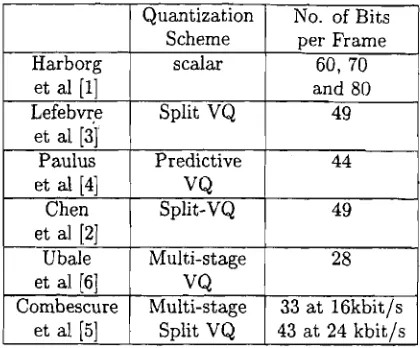
16 has to be quantized, in order t o represent t h e spectrum up to frequencies of 7kHz. How- ever, the Line Spectral Frequency (LSF) coefficients above4kHz are less amenable t o Vector Quantization (VQ) than their low-frequency counterparts. Table 1 summarizes most of the recent approaches t o wideband speech spectral quan- tization found in t h e literature. In this contribution we pro- vide a comparative study of a range of efficient wideband
LSF
vector quantisers, documenting their design trade-offs and performance.2. STATISTICAL PROPERTIES OF WIDEBAND LSFS
The employment of t h e LSF [7, 8, 9, 10, 111 representa- tion for quantization of t h e LPC parameters is motivated by their statistical properties. Figure 1 shows t h e Probabil- lty Density Functions (PDFs) of 16 wideband speech LSFs over the interval of 0-8kHz. These different P D F s have to be taken into account in the design of t h e associated LSF quantizers.
Table 1: Overview of Wideband
LPC
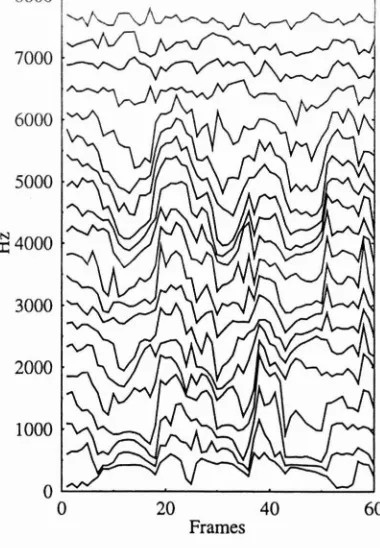
Quantizers.T h e essential motivation of vector quantization is the ex ploitation of the relationship between the LSFs in botl t h e frequency and t h e time domain. Figure 2 shows tht time-domain evolution of t h e wideband (WB) speech LSF traces, demonstrating their strong correlation in consecu. tive frames in the time-domain, which is often referred tr as their inter-frame correlation. Similarly, it demonstrate.. within each speech frame the ordering property of neigh- bouring LSF values, which is also referred t o as intra-framt correlation, motivating the employment of vector quantiza- tion.
3. WIDEBAND LSF VECTOR QUANTIZERS
3.1. Memoryless Vector Quantization
The so-called Nearest Neighbour Vector Q ~ a n t i z a t ~ i o r (NNVQ) scheme [14] theoretically constitutes the optima memoryless solution for VQ. However, the high number o
LSFs
-
typically 16 - required for wideband speech spectra [image:1.502.282.492.149.323.2]0.0
0 1000 2000 3000 4000
Frequency (Hz)
"."
3000 4000 5000 6000 7000 8000 Frequency (Hz)
0
0 20 40 60
[image:2.547.283.473.10.284.2] [image:2.547.24.213.10.256.2] [image:2.547.269.481.361.427.2]Frames Figure 1: P D F s of t h e LSFs using L P C analysis with a
filter order of
16,
demonstrating t h e ordering property of t h e LSFs.Figure 2:
Traces
of16
wideband LSFs, demonstrating their inter-and
intra-frame correlations.splitting of the original LSF vector into one-dimensional sub-vectors. This method exhibits a low complexity and a good Spectral Distortion (SD) performance [13] can be achieved using l b e n t r y or Cbit codebooks for each individ- ual LSF. Nevertheless, the large number of LSFs required in wideband speech codecs implies a requirement of 4.16=64 or 5-16=80 bits per 10 ms speech frame. As a result, the contribution of the scalar quantized LSFs t o the codec's bit rate is 6.4 or 8 kbit/s. Slight improvements can be achieved using a non-uniform bit allocation, when more bits are al- located to the perceptually most significant LSFs.
Between the above extreme cases, split VQ (SVQ) aims to define a split configuration that minimizes the average SD within a given total complexity. Specifically, split vec- tor quantization operates on sub-vectors of dimensions that can be vector quantized within the given constraints of com- plexity, following the schematic of Figure 3.
One of the main issues in split LSF VQ is defining the best possible partitioning of the initial LSF vector into sub- vectors. Since the high frequency LSFs typically exhibit a different statistical behaviour from their low frequency counterparts, they have to be encoded separately. For lin- ear predictive filters of order 16 the 3 highest order LSFs behave differently from the other LSFs, as exemplified by Figure 2. Hence, this leads naturally to a (13,3)-split VQ scheme. In our further discussions we will characterise the performance of various LSF VQs in terms of the PDF of their SD following the approach of Paliwal and Atal [13].
spLrr VQ
LSF STAGE
1
Figure 3: S'chematic of t h e multi-stage split VQ
I
Apart from a low average SD, the various designs have to minimise the probability of high-SD speech frames associ- ated with the so-called outliers of the PDF.
'7
Split VQ 41 bits0.0
[image:3.587.54.225.6.140.2] [image:3.587.307.482.112.245.2] [image:3.587.44.259.457.546.2]0.0 0.5 1.0 1.5 2.0 2.5 3.0 3.5 4.0 Spectral Distortion (dB)
Figure
4:
P D F of t h e S D for t h e 41-bit split V Q scheme using t h e [(6,7,3)777; ( 4 , 4 , 4 , 4 ) ~ j 5 5 ] tw e s t a g e regime (Compareto
Figure6
and 9).I
3.2. P r e d i c t i v e Vector Q u a n t i z a t i o nIn this section our work evolves from memoryless vector quantization to more efficient vector quantization schemes exploiting the time-domain inter-frame correlation of LSFs. According to this approach we typically quantize a sequence of vectors, where successive vectors may be statistically de- pendent.
Predictive vector quantization (PVQ) constitutes a vector- based extension of traditional scalar predictive quantiza- tion. Its schematic is shown in Figure 5. PVQ schemes aim to exploit the correlation between the current vector and its past values, in order to reduce the variation range of the signal t o be quantized. Provided that there is sufficient correlation between consecutive vectors and the predictor is efficient, the vector components to be quantized are ex- pected to be unpredictable, random noise-like signals, ex- hibiting a reduced dynamic range. Hence, for a given num- ber of codebook entries, PVQ is expected to give a lower SD, than non-predictive VQ.
PREDICTOR
1-II-J-
UF-,Figure 5: Schematic of a Predictive Vector Quantizer
/
(PVQ1.Auto-Regressive (AR) predictors use recursive reconstruc- tion of the LSFs, hence they potentially suffer from severe propagation of channel errors over consecutive frames. By contrast, a Moving-Average (MA) predictor can typically limit the error propagation to a lower number of frames, given by the predictor order. Here, however we will restrict
!
our experiments to first order AR vector predictors.
Predictive vector quantization does not necessarily preserve the LSF's ordering property, which may result in instability of the synthesis filter, deteriorating the perceptual speech quality. In order to counteract this problem, an LSF re- arrangement procedure [15] can be introduced, ensuring a minimum distance of 50Hz between neighbouring LSFs in the frequency domain.
Predictive VQ 36 bits
Spectral Distortion (dB)
Figure 6: P D F
of
t h e S D for t h e 36-bit P V Q scheme (Compare to Figure 4 a n d 9).Figure 6 shows the PDF of the SD using (4,4,4,4)9999 36- bit split vector quantization of the prediction error, employ- ing a 9-bit codebook per CLSF sub-vector. This quantizer hence requires. a total of 4
.
9 = 36 bits per LSF vector. Based on the above experience we conclude that our 36-bit Predictive VQ provides a gain of 5 bits per LSF vector in comparison to our previous 41-bit memoryless SVQ having a similar complexity. Equivalently, predictive VQ generates an average SD gain of approximatively 0.3 dB for a given bit rate. A deficiency of this method is its higher sensitiv- ity to channel error propagation, although this problem can be mitigated by using MA prediction instead of AR predic- tion. During our investigations we noted that this scheme was sensitive to unpredictable LSF vectors generated by the rapid speech spectral changes, which increase both the average SD as well as the number of SD outliers beyond SD=2dB. This problem is addressed in the next section.3.3. M u l t i m o d e Vector Quantization
using both the predictive \'Q and the fixed memoryless SVQ sclicmes For every speech frame, and the better candidate with respect to a mean-squared distortion criterion is cho- sen.
The safety-net VQ improves the overall robustness against outliers, which are tvpically due to input LSF vectors hav- ing a low correlation with the previous LSF vectors. In addition, the safetv net VQ allows the PVQ to concen- trate on the predictable, highly correlated frames. Hence, the variance of the LSF prediction error is reduced and a higher resolution LSF prediction error codebook can be de- signed. The advantage of this method is that when the inter-frame correlation cannot be successfully exploited in a PVQ scheme, the intra-frame correlation is capitalised on instead.
[image:4.545.286.452.19.144.2] [image:4.545.21.227.181.286.2]L
1
MemorylessI-
1
Figure
7:
Schematic of t h e Safety Net Vector Quantizer (SNVQ) constituted by a memoryless- a n d a predictive- VQ.Figure 7 shows the structure of the SNVQ scheme. Again, the input LSF vector is quantized using both predictive- and memoryless quantizers, then both quantized vectors are compared to the input vector, in order to select the better quantization scheme. The codebook index selected is transmitted to the decoder, along with a signalling bit that indicates the selected mode. The specific transmitted quantized vector is finally used by the PVQ, in order to predict the LSF vector of the next frame.
The performance difference between the memoryless SVQ and predictive VQ sections of the SNVQ suggests the em- ployment of variable bit rate schemes, where the lower per- formance of the memoryless SVQ can be compensated by using a larger codebook. In our experiments below
-
as be- fore-
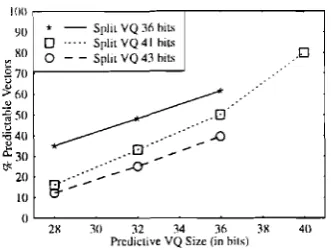
a 41-bit memoryless SVQ codebook was used. Hence, the SNVQ is characterized by its average bit rate, depend- ing on the proportion of vectors quantized by the predic- tive and memoryless VQ, respectively. Eriksson, Linden and Skoglung [17] argued that the optimum performance is attained, when 50 to 75% of frames invoke the PVQ.Figure 8 shows the proportion of frames quantized using the 28-, 32- and 36-bit PVQs in the context of SNVQ schemes employing 36-, 41- and 43-bit SVQs. We observe in Fig- ure 8 that for a PVQ codebook size of 28 and 32 bits a relatively low proportion of the LSF vectors was quantized using the PVQ and this indicated that its codebook size was too small, failing to outperform the memoryless 36-, 41- or 43-bit SVQs. Accordingly, only the 36-bit PVQ was
0 I I
2X 30 32 34 3h 3X 4 0
Prcdichve VQ Size (in hits)
Figure 8: Proportion of frames using P V Q in various SNVQ schemes, employing memoryless SVQs of 36, 41
a n d 43 bits.
deemed suitable. This figure illustrates that if the predic- tive VQ exhibits a low performance compared to the mem- oryless SVQ, i.e. the proportion of its utilization tends to zero, the SNVQ will tend to behave like a simple memory- less SVQ. Alternatively, if the memoryless SVQ exhibits a low performance compared to the PVQ, i.e. the proportion of PVQ LSF vectors tends to loo%, the SNVQ will tend to behave like a PVQ.
The individual PVQ and memoryless SVQ schemes em-
ployed so far were designed independently from each other,
I
hence the resulting scheme is sub-optimal. Furthermore,both quantizers were designed without distinction between predictable and unpredictable LSF vectors. Hence, their optimization will aim, on one hand, t o have the PVQ focus- ing on predictable frames, which generate LSF prediction errors with a low variation range. On the other hand, the memoryless SVQ codebook is to be matched t o the distribu- tion of the unpredictable LSF vectors in the p-dimensional LSF space. In order t o obtain an optimal SNVQ we will proceed as follows:
1) The original training sequence T is passed through our previously used individual sub-optimum code- book based SNVQ, in order to generate the sub- training sequences TpvQ and T s r ~ of vectors, quan- tized using either the predictive VQ or the memory- less SVQ, respectively, depending on which generated a lower SD.
2) Then codebooks for both the PVQ and the memo- ryless SVQ are designed using the sub-training se- quences generated above.
Our results to be highlighted with reference to Table 2 show that the optimized PVQ results in significant improvements, but only a modest further gain was obtained with the aid of the Safety-Net approach, invoking the optimised memory- less SVQ. Clearly, optimization is the main issue in SNVQ design, requiring the joint design of both parts of the SNVQ.
the first bracketed number indicates the number of bits as- signed to the PVQ, while the second one that of the mem- oryless SVQ. Again, the performance of these schemes is summarised in Table 2. In both cases a SD gain of about 0.15 dB was obtained upon the joint optimisation of the component VQs, as seen in Table 2. In addition, the num- ber of outliers between 2 and 4 dB was substantially reduced and all the outliers over 4 dB were removed.
Table 2: Optimization effects for t h e [36,36] a n d [36,41] SNVQ schemes.
We found that the optimization slightly increased the pro- portion of frames quantized using the PVQ. For our [36,36] SNVQ scheme, this proportion increased from 67% to 74%. Similarly, for the (36,411 SNVQ scheme constituted by the 36-bit PVQ and 41-bit memoryless SVQ respectively, this vroportion increased from 50% to 60%. Hence, in case of
.
-
such switched variable bit rate schemes, the optimization tends to reduce the average SNVQ bit rate, since the PVQ requires less bits, than the memoryless SVQ.SNVQ [36,411
0.1
0.0
[image:5.553.55.275.104.205.2] [image:5.553.316.500.348.510.2]0.0 0.5 1.0 1.5 2.0 2.5 3.0 3.5 4.0 Spectral Distortion (dB)
Figure
9:
P D F of t h e S D for t h e [36,41] bit SNVQ scheme (Compare to Figure 4 a n d 6).Figure 9 shows the P D F of the SD for the [36,41] SNVQ scheme, indicating a significant SD PDF enhancement com- pared to both the memoryless SVQ and the PVQ. In addi- tion, this system improves the robustness against channel errors, since the propagation of bit errors was limited due to the low number of consecutive employment of the PVQ. Clearly, the SNVQ enabled an efficient exploitation of both the inter-frame correlation and the intra-frame correlation
as many comparisons as the memoryless SVQ or the PVQ,
4. SIMULATION REXJLTS AND SUBJECTIVE EVALUATIONS
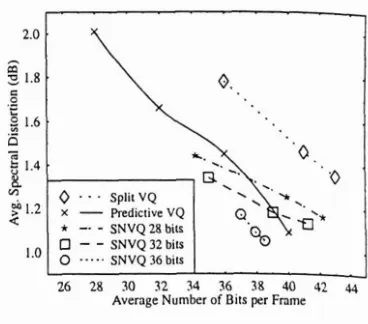
Figure 10 summarizes the performance of the split memo- ryless SVQ, the'PVQ and the SNVQ. As observed in the figure, the SD results for the memoryless SVQ are more modest and in general a better performance was obtained by using the predictive quantization schemes. This figure illustrates a difference of 4 or 5 bits between the memoryless SVQ and the PVQ for the same SD. The three SD curves corresponding to the SNVQ schemes using 28-, 32- and 36- bit PVQs in conjunction with various associated memory- less SVQ configurations are also shown in Figure 10. F~~ the SNVQ using 28- and 32-bit PVQs, the lines crossing the p v Q ~erformance curve drawn using a solid line indicate that a t this stage the PVQ starts to attain a better perfor- mance, than the SNVQ for the equivalent bit rate. Hence, in this scenario there is no benefit from employing SNVQ schemes using 28- and 32-bit PVQs beyond this cross-over point. A consistent SD gain in comparison to the pVQ is only ensured for the SNVQ using the 36-bit PVQ. In this case a 2-bit reduction in the number of required coding bits was obtained. Informal listening tests have shown that the best perceptual performance was obtained by employing the [36,41] SNVQ scheme.
1.6 ii
.
0
0
- -
SNVQ 32 bits0
.-.-.
SNVQ 36 bitsI I
26 28 30 32 34 36 38 40 42 44
[image:5.553.67.252.368.503.2]Avenge Number of Bits per Fnme
Figure 10: Average S D of the various vector quantizers considered in this study
Table 3: Transparent quantization schemes.
I
of LSF vectors. Its main deficiency is the increased com-plexity of the codebook search procedure, requiring twice Table 3 details the characteristics of two highquality Scheme
PVQ
Avg. S D (dB)
1.09
No. of Bits
40
Outliers (%) ' 2-4 dB
I
>4
d B [image:5.553.313.527.575.647.2]quantization schemes. The first configuration utilised a ( 4 , 4 , 4 : 4)l0,~o,~o,,o PVQ scheme employing 4.10= 40 bits and the second scheme used a [36,41] SNVQ arrangement with an average of 38 bits. Although both schemes have a similar average SD, the SNVQ provides a large reduction in the number of SD outliers between 2 and 4 dB, which have "Significant effect on the perceptual speech quality. A high
Speech quality was also obtained for the (36,361 fixed bit rate SNVQ, as shown in Table 2.
5. CONCLUSIONS
In this contribution, we have comparatively studied vari- OUS predictive and memoryless vector quantizers. In the context of memoryless VQ, a [(6,7,3)777; (4,4,4,4)5555] 41- bit multi-stage split vector quantizer was designed. This method enabled a simple implementation. In the context of 41-bit predictive vector quantization a SD quality en- hancement was achieved compared to memoryless schemes, Or alternatively the number of bits could be reduced to 36, while maintaining a similar average SD. The associ- ated SD PDFs were p r t r a y e d in Figures 4, 6 and 9, while their salient features were summarised in Tables 2 and 3.
Unfortunately, the channel error sensitivity increased due to potential error ~ropagation. Lastly, we combined both the memoryless- and the predictive approaches in a SNVQ scheme. Even though the SNVQ scheme increased the com- plexity, it improved significantly the SD performance and mitigated the propagation of channel errors. Our future work considers the design trade-offs of wideband backwards adaptive speech codecs and transform codecs.
6. ACKNOWLEDGEMENTS
The financial support of the following organisations is grate- fully acknowledged: Motorola ECID, Swindon, UK; Eu- ropean Community, Brussels, Belgium; Engineering and Physical Sciences b e a r c h Council, Swindon, UK; Mobile Virtual Centre of Excellence, UK.
7. REFERENCES
[I] E. Harborg, J.E. Knudsen, A. Fuldseth, and F. Jo- hansen, "A Real-Time Wideband CELP Coder for a Videophone Application", in Proc. ICASSP, pp.121- 124, 1994.
[21 J-H. Chen and D. Wang, "Transform Predictive Cod- ing of Wideband Speech Signals", in Proc. ICASSP, PP. 275- 278, 1996.
131 R. Lefebvre, R. Salami, C. L d a m m e
,
and J-P. Adoul, "High Quality Coding of Wideband Audio Signals Us- ing Transform Coded Excitation (TCX)", in Pmc. ICASSP, pp. 193-196, 1994.[41 J. Paulus and Schnitzler, "16 kbit/s Wideband Speech Coding Based on Unequal Subbands", in Proc. I c A s s p , pp. 255-258, 1996.
[j] P. Combescure, J . Schnitzler. K. Fischrr. R.. Kirchherr.
I
C. Lamblin, -4. Le G~iyader, D. Massalous, C. Quill- quis, J . Stegrriann, and P. Vary, " A 16, 24, 32 Kbit/s Wideband Speech Codec Based on ATCELP"
,
in Proc.1
ICASSP, Phenix, 1999.
1
[6] A . Ubale and A Gersho, "-4 Multi-Band CELP Wide- band Speech Coder", 111 Proc. ICASSP,pp. 1367-1370,
1997.
1
[7] F. Itakura, "Line Spectrum Representation of Linear Predictor Coefficients of Speech Signals", in J . Acoust.
Soc. Amer., Vol. 57, pp. S35(A), 1975
[8] L. Rabiner,
M.
Sondhi and S. Levinson, "Note on the Properties of a Vector Quantizer for LPC Coefficients", in The Bell System Technical Journal, Vo1. 62, No. 8, pp. 2603-2616, October 1983.[9] F. Soong and B.-H Juang, "Line Spectrum Pair (LSP) and Speech Data Compression" ,in Proc. ICASSP, pp. 1.10.1-1.10.4, San Diego, 1984.
[lo] R. Steele and L. Hanzo, Mobile Radio Communica-
tions, IEEE Press, 1999, 2nd Edition.
I
[ll] A. Kondoz, Digital Speech, Coding for Low Bit Rate Communication System, John Wiley, 1994.
[12] "7 kHz Audio Coding within 64 kbit/sn, CCITT Rec- ommendation G.722, 1988.
[13] K. Paliwal and S. Atal, "Efficient Vector Quantization of LPC Parameters a t 24 Bits/Framel', in IEEE 'l'kans. Speech and Audio Processing, Vol. 1, January 1993.
[14] A. Gersho and M. Gray, Vector Quantization and Sig- nal Compression, Kluwer Academic Publishers, 1991.
[15] ITU-T, "Recommendation G.729-Coding of speech at 8 kb/s using conjugate algebraic-code-excited linear- prediction (CS-ACELP)"
,
March 1996.[16] T. Eriksson, J . Linden, and J . Skoglung, " A Safety-
Net Approach for improved exploitation of speech cor- relation", in Proc. International Conference on Digital Signal Processing, Vol. 1, pp. 96-101, 1995.
[17] T . Erikssm, J . Linden, and J. Skoglung, "Exploit- ing Interframe Correlation in Spectral Quantization. A Study of Different Memory VQ Schemes", in Proc. ICASSP, pp. 765-768, May 1996.
![Figure 4: using the [(6,7,3)777; (4,4,4,4)~j55] twestage regime P D F of the SD for the 41-bit split VQ scheme (Compare to Figure 6 and 9)](https://thumb-us.123doks.com/thumbv2/123dok_us/1040806.619661/3.587.307.482.112.245/figure-using-twestage-regime-split-scheme-compare-figure.webp)