Abstract— Biogas production from anaerobic co-digestion of cow dung (CD), chicken manure (CM), pig manure (PM) sewage waste (SW) was evaluated in laboratory batch scale at ratios 1:1:1:1, 2:1:1:1 and 3:1:1:1. Highest methane yields were achieved from CD to CM, PM and SW at ratio of 1:1:1:1 (58% CH4/d). The effect of temperature on methane yield was also investigated at 35, 40, 50 and 55 f˚C. The optimum temperature for anaerobic co-digestion was found to be 40 ˚C with the highest methane yield of 62% CH4/ d on Day 6 of the gas production. Ratios of 3:1:1:1 had the highest impurities followed by ratios of 2:1:1:1 and 1:1:1:1, respectively. The study has shown that co-digestion of animal waste or other organic wastes is more advantageous than processing each feedstock separately.
Index Terms— Anaerobic digestion, Biogas, Co-digestion, Renewable energy
I. INTRODUCTION
NAEROBIC co-digestion of various organic wastes has been shown to improve biogas yield. Recent interest in producing renewable electricity or transport fuel through AD technology has rapidly increased the use of co-digestion of crops in farm-scale manure digesters [1]. Co-digestion of cattle manure with farm waste is also a common practice in the United States [2]. Mata-Alvarez et al. [3] reported that co-digestion of crops with manure results in a higher methane
Manuscript received March 05, 2015; revised April 16, 2015. This work was supported by the National Research Fund (NRF) and South African National Energy Development Institute (SANEDI).
M. R Sebola is with the Department of Chemical Engineering Technology at the University of Johannesburg, Doornfontein, South Africa: corresponding author: e-mail:[email protected]
H.B Tesfagiorgis is with Agricultural Research Council – Institute for Industrial Crops, Private Bag X82075, Rustenburg 0300, South Africa.
Edison Muzenda is a Professor of Chemical Engineering in the Department of Chemical and Petroleum Engineering, College of Engineering and Technology, Botswana International University of Science and Technology, Private Mail Bag16, Palapye, Botswana as well as Visiting Professor in the department of Chemical Engineering Technology at the University of Johannesburg, Doornfontein, South Africa; e-mail: [email protected]
yield than mono-digestion of manure due to the synergistic effects of the co-substrates.
The co-digestion concept has been studied and applied to treat substrates such as municipal solid waste, sewage sludge, cow manure and energy crops [4]. This study aim to co-digest different animal manures to evaluate if the combinations can improve the methane production. Co-digestion of manures with co-substrates will have a lot of benefits. Firstly, it can minimise the high concentrations of ammonia associated with mono manure digestion and provide a wide range of nutrient contents (C/N ratios) required by the methanogens [5]. In addition, the increase in the buffering capacity and the possibility of accumulation of volatile fatty acids (VFAs) during digestion [6] can stabilise the pH to suit the methanogenesis stage [6,7]. Moreover, it can provide organisational and economic benefits by bringing an energy surplus, which will provide additional income to the biogas plants [8].
II.MATERIALS AND METHOD
A.Feedstock preparation
Representative samples of chicken manure, pig manure, cow dung and sewage waste obtained from white poultry farms at Lenasia, Elandsfontein (Walkersville) and Moletjie, respectively, were used for this experiment. Feeding high particle size feedstock was avoided to reduce challenges with the agitation in the laboratory-scale digesters and with non-homogeneity of the digestate, hence all raw materials were dried at 65 °C for 6 days and then passed through a grinding impact mill and digital electromagnetic sieve for size reduction. The dried raw materials were stored in plastic container at room temperature.
B.Analytical methods
The gas samples were taken from digesters daily using 1-ml syringes. Before recording the pH, the overall biogas produced was measured. The volume of biogas produced was corrected to the standard temperature and pressure (STP) conditions. The volume of biogas was measured by displacement of water, and was then converted to the biogas volume under standard
Methane Production from Anaerobic
Co-digestion of Cow Dung, Chicken Manure, Pig
Manure and Sewage Waste
M. R. Sebola*
1, H. B. Tesfagiorgis
2, E. Muzenda
3temperature and pressure (STP) conditions of 0 °C and 1 atmosphere. The methane content in biogas was measured using a gas chromatograph (GC, claurus 580) with a thermal conductivity detector and a 45–60 mesh, matrix molecular sieve 5A column (Sigma–Aldrich, USA). Flammable ionisation detector (FID) was used to determine the CH4 composition and thermal conductivity detector (TCD) was used to measure CO2 and other additional gases present. Helium gas was the carrier gas at a flow rate of 30 ml/min while the temperatures of the oven, injector port and detector were maintained at 51, 80 and 300 ˚C, respectively. The experiment was conducted twice with two replications for each treatment. A two way ANOVA was performed using GenStat 12 [9] for the data collected.
C.Biological methane production potential (BMP) tests
Anaerobic co-digestion of CD, CM, PM and SW was carried out in three identical plastic batch reactors, each having a working volume of 1 litre. The top of each digester had two outlets which were used for introducing the feedstock and collecting biogas, respectively. The biological methane production potentials (BMPs) of the CD, CM, PM and SW mixtures were examined at the ratios of 1:1:1:1 (Treatment A), 2:1:1:1(Treatment B) and 3:1:1:1(Treatment C) in 1-litre digesters made from plastic bottles. The mass of VS of CD, CM, PM and SW added to the 1-litre digester for ratio of 1:1:1:1 was 25g each. Tap water was added to each digester to give a working volume of 800 ml. The initial pH of the mixed solution in each digester was adjusted to 7.26. The digesters were placed in a shaker incubators set to 35 °C, 40 °C, 50 °C and 55 °C. The biogas produced was measured daily as described above. The methane content and the biogas volume produced from each digester were measured once daily. The percentage of methane in the biogas was calculated by dividing overall methane measured daily by the total volume of biogas produced daily. No supplemental nutrients were added to the substrate. The digesters were agitated daily to avoid clogging of the feed. There were two replicates for each experiment.
III. RESULTS AND DISCUSSIONS
A.Effect of co-digestion on biogas and methane yields
In Treatments A, B and C, the initial biogas and methane produced was low. During Day 1, no biogas production was observed. In Day 2, 3.13 %, 2.35 % and 2.05 % percentages of methane were observed for treatments A, B and C, respectively (Table I). The pattern of daily biogas production was also similar (Fig. 1). This was probably due to the low initial concentrations of methanogens in the reactors. After Day 2, methane production increased sharply for all three treatments. The increase in methane yields from Day 3 indicates the enrichment of methanogens in the reactors. At the
declined due to the high consumption of soluble biodegradable organic substances by the process which resulted in low microbial activities. In Treatment A, B and C, methane production started to decrease on Day 8 and Day 9 due to lower final pH values which led to the accumulation of VFAs in the reactor.
TABLEI
INITIALANDFINAL PHOFTREATMENTA,BANDC
Feedstock Initial Final
Treatment A 7.26 6.94
Treatment B 7.26 7.01
Treatment C 7.26 6.90
Co-digestion of animal manure made up of low C/N ratio with any biodegradable material with higher C/N ratio allow more stable digestion and high methane yield as compared to digestion of manure alone [10]. In this study, animal manure with higher C/N ratios was co-digested with other manure with low C/N ratio. Although no significant difference was obtained from the ANOVA at P<0.05, the overall trend showed that, from the beginning of the experiment, Treatment A had higher methane yield as compared to Treatments B and C. This is probably due to the high fraction of CD manure in Treatment B and C which made it difficult to reach system performance in terms of methane production potential. In Treatment A, the highest daily methane yield occurred on Day 6 and Day 8 with 53 % and 55 %, respectively. In Treatments B and C, peaks of the highest daily methane yield occurred on Day 7 with 47 % and 49 %, respectively (Fig. ). However, for treatment C, the methane yield for Day 6 and Day 7 remained constant at 49 %. The methane content in biogas at different ratios, the methane contents rose from Day 3 to reach a higher peak of 55%, 47% and 49% in Treatments A, B and C, respectively. During Days 3 – 9, the methane contents at Treatment A ranged between 6-8% higher as compared to Treatments B and C. In Day 8, the methane contents for Treatments A, B and C decreased steadily to 46%, 47% and 44%, respectively. A further gradual decline in methane contents occurred in Day 9 due to low organic contents available in the digester to enhance further methane production. Therefore, the optimal ratio of CD to PM, CM and SW was of Treatment A because of its high methane production potential at a shorter biogas production period. The findings of this study are comparable to those of Lehtomaki et al. [11] who reported an increased in methane production by 30% using anaerobic co-digestion of animal manure with grass silage, sugar beet tops and oat straw within the range of 1:1 to 1:3.
Fig. 1 Daily biogas produced for Treatments A, B and C.
Fig. 1Daily methane produced for Treatment A, B and C.
B.Effect of temperature on methane yields
The intensity of the microbial activity is a function of the environmental temperature, especially in methanogenesis, wherein the degradation rate increases with temperature. Fig. 3 shows the percentage of biogas productions at different temperatures in the batch reaction. In general, it has been reported that the optimum reaction temperatures of mesophillic and thermophillic microbial anaerobic activity are 35–40 ˚C and 50–60 ˚C, respectively [12]. However, integration of thermophilic and mesophilic digestion processes is found to be successful in terms of both cost savings and increased biodegradability of organic wastes [13]. In this study, experiments were conducted at 35, 40, 50 and 60 ˚C for a period of 9 days to understand the effect of temperature on the anaerobic co-digestion and methane production potential of animal manure. The variation of temperature during digestion was considered to be the first index of the degree of anaerobic success. That is, temperature will indicate a typical digestion pattern, characterized by two major phases: a mesophillic phase followed by a thermophillic. Thus, temperature at which digestion occurs can significantly affect the biogas production that is the conversion, kinetics, stability and consequently the
methane yield. The biogas production and the volume collected were mostly affected in the thermophillic temperatures as depicted in Fig. 3 and methane yield in Fig. 4. High biogas volumes and methane yield were observed under mesophilic temperatures. Methane yields also increased with an increasing retention time but it was again more favourable for the mesophilic temperatures. Optimum retention time was reached on Day 6 for the mesophilic whereas for the thermophillic temperatures it was reached on Day 7. The findings are supported by the study conducted by Kim et al. [14] which showed that the temperature- and HRT-dependent total biogas and methane productions in the semi continuous reaction. At 50 °C, the maximum amount of biogas was produced when an HRT of 10 d was used, whereas methane was generated efficiently when an HRT of 12 d was used. The lowest biogas production was also observed at 55°C with methane contents ranging from 54% to 60%, depending on HRT. The study further shows that a high specific methane yield could be obtained in a thermophillic digester with a long HRT.
[image:3.612.51.277.57.215.2] [image:3.612.54.288.260.389.2]Fig. 3 Daily biogas production during anaerobic co-digestion of Treatment A, B and C at temperatures of 35 ˚C, 40 ˚C, 50 ˚C and 55 ˚C, respectively.
Fig. 4 Daily methane production during anaerobic co-digestion of Treatment A, B and C at temperatures of 35 ˚C, 40 ˚C, 50 ˚C and 55 ˚C, respectively.
[image:4.612.60.563.50.349.2] [image:4.612.60.563.391.680.2]In contrast, the highest biogas was obtained at HRT of 6 days for 50 and 55˚C, while the highest methane was observed at Day 7. This observation shows that the length of fermentation period is dependent on temperature that is even though the biogas produced on Day 6 was high, the quality of the methane was lower as compared to that of Day 7. This was as a result low soluble organic matter present in Day 6 to enhance more methane production. Singh et al., [20] observed that methanogens were very sensitive to sudden thermal changes; therefore, any drastic change in temperature should be avoided for better microbial activity.
C.Variation of trace elements
The trace gases monitored in the present study included carbon monoxide (CO), hydrogen sulphide (H2S) and hydrogen (H2) as shown in Table II. Hydrogen was extremely low; thus, it could not be identified by the gas chromatography and due to this it was left out in the analysis
.
The CO generated daily is presented in Fig. 5. Higher productions of CO were detected between days 2 and 5. On the 3rd day, Treatment C had a greater generation than the rest with 53.1 ppm while Treatment A generated 10.8ppm. This may be due to low methane production in Treatment C as shown in section A which promoted an increase in CO levels. Furthermore, Treatment B had the highest generation on the 4th day. After Day 5 of gas production, the production of carbon monoxide generally reduced in all Treatments. This may be attributed to limited microbial activity at that phase. In section A, methane yields were higher from Day 5. The increase in methane compound allowed the use of carbon to form methane which resulted in lower percentages of CO produced.
TABLEI
DAILYCOMPOSITIONOFTRACEGASES
0 10 20 30 40 50 60
0 1 2 3 4 5 6 7 8 9
CO
[
p
p
m
]
Time [days]
Fig. 2 Daily carbon monoxide produced, were Treatment A is (♦), Treatment B is (■) and Treatment C is (▲).
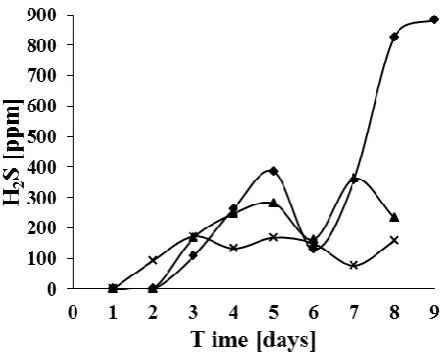
Measuring hydrogen sulphide levels makes it possible to keep the concentration of this toxic and corrosive gas as low as possible by taking appropriate action. Also high levels of hydrogen sulphide wear down the anaerobic digester and high concentration of it has a toxic effect which hinders bacteria growth [21]. In Fig. 6, variations of hydrogen sulphide with time during anaerobic digestion were presented. During the Day 1 and 2 of gas production, no H2S was generated in all treatments. This was believed to be the lag phase of the sulphur producing bacteria to reach to a certain population level before it is actively involved in the gas generation. On the 3rd day, traces of H2S were noticed in all treatments. A similar trend was observed were hydrogen sulphide increased with time from Day 3 up to Day 8. After the 8th day H2S reduced significantly by 137ppm for Treatment A. This was assumed to be the death phase of the bacteria resulted from nutrient depletion and high execution of methane in this reactor which lowers the conversion of the gas to form H2S. In contrast, a significant increase of 76.2 and 60.8ppm for Treatment B and C on the 8th day was observed, respectively. It is believed that the increase was related to the significant decrease in methane in section A and B which was attributed to the exhaustion of bacteria and led to H2S formation. In general, Treatment C had high average hydrogen sulphide (327.7ppm) emissions and this related to low methane yields. It was concluded that the gas adversely affect both the generation of biogas, methane and downstream processes.
Treatment A Treatment B Treatment C
Time (days) CO H2S CO H2S CO H2S
1 0 0 0 0 0 0
2 0 0 0 0 0 0
3 10.7 2.1 1.2 93.1 54.05 107.1
4 8.2 167.3 8.095 172.5 29.55 262.5
5 6.225 246.5 6.26 132.5 5.775 385
6 4.1 280.1 2.5 168.1 5.425 129.5
7 1.6 162.6 2.45 149 3.7 357
8 4.84 362 3 75.9 4.85 825.9
9 2.07 233.75 2.5 157.4 2.075 882.3
[image:5.595.313.537.90.255.2] [image:5.595.42.300.537.689.2]Fig. 3 Daily hydrogen sulphide produced, were (▲), (×) and
(♦) represents Treatment A, B and C, respectively.
IV. CONCLUSION
Anaerobic co-digestion of CD with CM, PM and SW at three different CD to CM, PM and SW ratios of 1:1, 2:1 and 3:1 was evaluated by examining the initial and final pH of the reactants and methane production potentials in 1-litre digesters made from plastic bottles. This study showed that a combined treatment of different waste types like manure gives the possibility of treating waste, which can be successfully treated separately but result to lower methane production as compared co-digestion. CM, PM and SW were quantitatively degraded to biogas when co-digested with CD manure without addition of any chemicals. The highest methane yields were achieved at CD to CM, PM and SW ratios of 1:1:1:1 (58% CH4/d). It was concluded that co-digestion of animal waste or other organic wastes is advantageous than processing each waste separately. The optimum temperature for anaerobic co-digestion is concluded to be 40˚C with the highest methane yield of 62% CH4/ d on Day 6.
ACKNOWLEDGMENT
The authors are grateful to the National Research Fund (NRF), South African National Energy Development Institute (SANEDI) and the Department of Chemical Engineering for supporting the research. Further appreciation to Mr Tebogo Tembane and Mr Tebogo Mabitsela for their experimental work assistance.
REFERENCES
[1] Neureiter M., Teixeira P.D.S.J., Lopez C.P., Pichler H., Kirchmayr R., Braun R., 2005. Effects of silage preparation on methane yields from whole crop maize silages. In: Proc. Of the 4th Int. Symp. on Anaerobic Digestion of Solid Waste, August–September 2005, Copenhagen, Denmark. Ahring B.K. and Hartmann H. (ed.).
[2] Frear C, Liao W, Ewing T, Chen S., . Evaluation of co-digestion at a commercial dairy anaerobic digester. Clean Soil Air Water 39, 697-704, 2011.
[3] Mata-Alvarez J., Macé S., Llabres P., 2000. AD of organic solid wastes. An overview of research achievements and perspectives. Bioresource Technology 74, 3-16.
[4] Mata-Alvarez J, Dosta J, Mace S, Astals S., 2011. Codigestion of solid wastes: a review of its uses and perspectives including modelling. Critical Reviews in Biotechnology 31, 99-111, 2011.
[5] Angelidaki, I., Ahring, B.K., 1994. Thermophilic anaerobic digestion of livestock waste: the effect of ammonia.Appl.Microb iol. Biotechnol.38 (4), 560–564. [6] Campos E, Palatsi J, Flotats X., 1999. Co-digestion of
pig slurry and organic wastes from food industry. In: Mata-AlvarezJ, Tilche A, Cecchi F, editors. Proceedings of the Second International Symposium on Anaerobic Digestion of solid Waste, volume 2, 192– 195.
[7] Brummeler E.T., Koster I.W., 1990. Enhancement of dry anaerobic batch digestion of the organic fraction of municipal solid waste by an aerobic pretreatment step. 0Biological Wastes 31(3), 199–210.
[8] Brolin L., Kattstrom L., 2000. CBG (Biogas as Vehicle Fuel) in Sweden, present situation and future development. In: Paper Presented at the Symposium Kick-off for a Future Development of Biogas Technology, 2000.
[9] Genstat, 2009. Genstat for Windows Release 12.1, Oxford: VSN International Ltd.
[10]Callaghan F.J., Wase D.A.J., Thayanithy K., Forster C.F., 2002. Continuous-co-digestion of cattle slurry with fruit and vegetable wastes and chicken manure. Biomass and Bioenergy 27, 71-77
[11]Lehtomäki A., Huttunena S., Rintala J.A., 2007. Laboratory investigations on co-digestion of energy crops and crop residues with cow manure for methane production: Effect of crop to manure ratio. Resources, Conservation and Recycling 51(3), 591-609.
[12]Xie S., Lawlor P.G., Frost P., Wu G., Zhan X. Effect of organic loading rates on anaerobic co-digestion of solid fraction of pig manure and grass silage (Oral presentation). The 21st Irish Environmental Researchers’ Colloquium, 6th - 8th April, 2011. University College Cork
[13]Nguyen, P.H.L., Kuruparan, P., Visvanathan, C., 2007. Anaerobic digestion of municipal solid waste as a treatment prior to landfill. Bioresource Technology 98, 380–387.
[14]Kim. J.K, Baek, R.Oh, Chun,Y.N, Kim, S.M. Effects of temperature and hydraulic retention time on anaerobic digestion of food waste.
[15]Sung, S., Santha, H., 2003. Performance of temperature-phased anaerobic digestion (TPAD) system treating dairy cattle wastes. Water Research 37, 1628– 1636.
[image:6.595.50.274.60.236.2]temperature on the performance of an anaerobic tubular reactor treating fruit and vegetable waste. Process Biochemistry 39, 2143–2148
[17]Umetsu, K., Takahata, H., Kawamoto, T., 1992. Effect of temperature on mesophilic anaerobic digestion of dairy cow slurry.Res.Bull. Obihiro Univ.Ser.I 17 (4), 401–408.
[18]Desai, M., Madamwar, D., 1994. Anaerobic digestion of a mixture of cheese whey, poultry waste and cattle dung: a study of the use of adsorbents to improve digester performance.Environ .Pollut. 86 (3), 337–340. [19]Mital, K., 1996. Biogas Systems-Principles and
Applications. New age International (P) Ltd.
[20]Singh, L., Maurya, M.S., Sairam, M., Alam, S.I., 1994. Production of biogas from night soil: effect of temperature and volatile solids. Indian J. Microbiol. 34 (3), 223–228.