Abstract—Knowledge management (KM) has been incorporated into our daily working routines and activities knowingly and/or unknowingly. Activities that have or involve the elements of KM are commonly known as KM processes, such as sharing of experience and knowledge among co-workers, innovation of products, documentation of projects and so on. To keep track and improve a company’s KM processes, they need to be evaluated from time to time. This paper intends to propose a simple method that can cope with the subjectivity and vagueness issues faced during the evaluation process by using fuzzy logic computed with the MATLAB software.
Index Terms—Knowledge management processes, performance evaluation, fuzzy logic
I. INTRODUCTION
N this current era, knowledge has become one of the most important assets of any organization. Innovativeness is what makes a company successful, staying ahead of its competitors in terms of products or services. The survival and performance of an organization is influenced by its ability to leverage its knowledge and develop knowledge-based competences [1], [2]. To do so, many companies have adopted the concept of knowledge management (KM), as by far it is one of the successful schemes in helping companies to manage their knowledge.
Some adopted KM knowingly with the intention to improve their company and there are also some that adopted KM unintentionally, just to be more organized and/or to have a smoother work flow. KM processes are day-to-day activities related to knowledge that employees carry out such as knowledge acquisition, creation, application, codification, storing, dissemination, and so on [3].
Either intentionally or unintentionally, after investing resources such as money, time, and workforce in KM, it is crucial for companies to keep track of their KM initiatives. Through evaluation, managers can obtain constructive feedback to formulate their improvement strategies to advance and excel in their endeavors. Having said that, it is
Manuscript received November 19, 2015; revised December 14, 2015. Cheng Sheng Lee is a Researcher at Universiti Teknologi Malaysia (UTM). Department of Manufacturing and Industrial Engineering, Faculty of Mechanical Engineering, Universiti Teknologi Malaysia, 81310 UTM Skudai, Malaysia (e-mail: [email protected]).
Kuan Yew Wong is an Associate Professor and the Head of the Industrial and Systems Engineering Research Group at Universiti Teknologi Malaysia (UTM). Department of Manufacturing and Industrial Engineering, Faculty of Mechanical Engineering, Universiti Teknologi Malaysia, 81310 UTM Skudai, Malaysia (e-mail: [email protected]).
undeniable that the evaluation process is a challenging task. The major issue faced is the subjectivity and intangible nature of the metrics used. In practice, most of the data required for performance evaluation are difficult to be quantified and they may not be precise with crisp boundaries. Rather, this information is obtained in expressions or words in natural language and with less precision.
Based on the issue stated above, this paper intends to propose a simple evaluation method for KM processes with the use of fuzzy logic. It is a useful approach for examining many real-world problems as this technique is based on the fuzzy set theory [4] that allows the elements of a set to have varying degrees of membership, from a non-membership grade of 0 to a full membership of 100 per cent or grade 1. This smooth gradation of values is what makes fuzzy logic matches well with the typical vagueness and uncertainty of many real-world problems [5]. Hence, it has the capability to cope with the vagueness and uncertainty in the evaluation of KM processes.
This paper begins with a general overview on KM processes together with examples of metrics that can be used for evaluation. The following section presents an introduction to fuzzy logic and the guidelines to design the performance measurement model, followed by an example to show its simplicity and applicability as an evaluation method. This paper then culminates with discussions and conclusions.
II. EVALUATING KNOWLEDGE MANAGEMENT PROCESSES
KM processes are the various activities that are related to tacit and explicit knowledge [6]. Hence, KM provides a systematic management of activities and processes such as acquisition, creation, utilization, codification and storing, and transferring and sharing of knowledge for an organization [1], [7]. These processes are not always in a linear sequence but rather concurrent.
To evaluate the performance of KM processes, [8] proposed to use metrics that represent the extent to which an organization has implemented a KM process. It can also be evaluated by linking knowledge processes with intermediate outcomes [9]. Knowledge can be acquired through attending training, seminars and conferences, outsourcing from suppliers and customers, retrieving from a company’s database, and browsing the internet. Therefore, knowledge acquisition can be evaluated through the number of times or frequency that workers have carried out those activities.
Evaluating Knowledge Management Processes:
A Fuzzy Logic Approach
Cheng Sheng Lee, Kuan Yew Wong
New knowledge is usually created from brainstorming sessions or from the research and development department [10]. Hence, knowledge creation can be measured through the frequency of employees having brainstorming sessions or the number of new knowledge, ideas and solutions created.
Knowledge utilization implies the process where new knowledge or ideas are being applied into daily work [11]. It can be evaluated through the frequency of employees applying useful ideas or proposals in practice and applying their knowledge to solve problems.
Knowledge codification and storing is the process of recording knowledge and storing it in a company’s repositories such as databases and filing systems [12]. It can be measured based on the amount of time that employees spent on this process and employees’ level of willingness to contribute their knowledge.
The transferring and sharing process is where knowledge is being dispersed through the whole organization [13], driven by activities such as employees’ involvement in work related discussion, meetings, assigning mentors to new recruits, and so on. So, it can be evaluated based on the frequency of workers taking part in those activities. Table I shows the examples of metrics [14] that can be used to evaluate the performance of KM processes.
III. FUZZY LOGIC
Since its introduction in 1965 by [4], fuzzy logic has been widely used in various fields due to its simplicity and ability to cope with imprecise data [15]. Its logical reasoning ability given by its fuzzy if-then rules makes it highly applicable as an evaluation system for performance measurement, in addition to its tolerance for imprecise data.
The fuzzy logic evaluation system can be built with five simple steps [16]. To reduce the degree of subjectivity in this method, Mamdani’s fuzzy inference mechanism [17] will be used as it is the most frequently used inference mechanism.
Step 1: Fuzzification of inputs. Inputs are converted into membership values or degrees of membership between 0 and
1 through a membership function. Triangular membership function is commonly used due to its simplicity and ease of computation [16].
Step 2: Application of fuzzy operators. Once the inputs have been fuzzified, and if the antecedent of a given rule has more than one part, a fuzzy operator is applied to resolve the antecedent to a single number between 0 and 1, which is the degree of support for the rule. This number will then be applied to the output function. There are three types of fuzzy operators: AND (selects the minimum value), OR (selects the maximum value), and NOT (fuzzy complement).
Step 3: Application of the implication method. In Mamdani’s max–min mechanism, implication is modeled by the minimum (AND) operator and it is implemented for every rule.
Step 4: Aggregation of all outputs. Aggregation is the process of combining all the fuzzy sets that represent the outputs of each rule into a single fuzzy set. In Mamdani’s max–min mechanism, the outputs of each rule are combined using the maximum (OR) operator.
Step 5: Defuzzification. In this step, the aggregated output from step 4 is defuzzified into a single crisp value. In this case, it will be the performance value for the evaluated construct. The most commonly used defuzzification method is the centroid calculation [16], which returns the center of area under the curve.
IV. EXAMPLE
This section demonstrates an example on evaluating the performance of KM processes using fuzzy logic based on the metrics from Table I. According to the number of metrics, there will be two input variables for each construct for the fuzzy logic inference system. Each input variable has five triangular membership functions. Take knowledge acquisition as an example, the triangular membership functions are as shown in Fig. 1 and 2 for metrics a1 and a2.
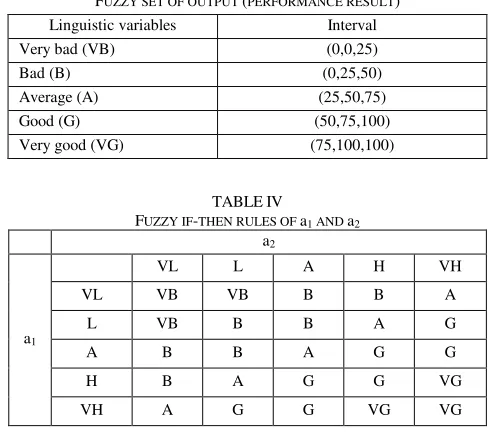
The fuzzy sets for the triangular membership functions are similar for all ten metrics, as shown in Table II. They are also the same for the output (performance result) as shown
TABLEI
CONSTRUCTS AND METRICS FOR EVALUATING KM PROCESSES
Constructs Metrics Knowledge acquisition
a1. The frequency of employees attending training or seminars to acquire knowledge.
a2. The frequency of employees accessing the company’s knowledge repositories to acquire knowledge.
Knowledge creation
b1. The frequency of employees participating in brainstorming sessions to create new knowledge.
b2. Number of new knowledge, ideas and solutions created.
Knowledge utilization
c1. The frequency of employees applying useful proposals or ideas in practice.
c2. The frequency of employees applying knowledge to solve problems.
Knowledge codification and storing
d1. Amount of time spent codifying and storing knowledge into the company’s knowledge repositories.
d2. Employees’ level of willingness to contribute to the company’s knowledge repositories.
Knowledge transferring and sharing
e1. The frequency of employees involving in work related discussion to share knowledge.
in Fig. 3 and Table III. The if-then rules of metrics a1 and a2
are shown in Table IV. The rules are set to be the same for the rest of the metrics as well for simplicity purposes.
MATLAB version R2013a is used to compute the proposed fuzzy system for evaluating KM processes. The computation is based on Mamdani’s max–min inference system. The linguistic terms and their respective input scores in Table V are proposed to be used for evaluation purposes. Assume that the input scores for (a1, a2), (b1, b2), (c1, c2), (d1,
d2), and (e1, e2), are (50, 40), (40, 30), (60, 20), (40, 70), and
(30, 40).
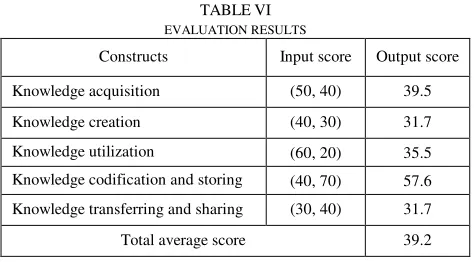
[image:3.595.301.545.71.290.2]Take knowledge acquisition as an example. First, each input score is fuzzified by the triangular membership functions into a membership value between 0 and 1. The maximum value for each rule is then selected by the OR fuzzy operator. Next is the implication step where each rule is modeled by the minimum (AND) operator based on Mamdani’s max–min mechanism. The outputs of each rule are then aggregated using the maximum (OR) operator. Finally, the centroid defuzzification method is applied to obtain a single crisp value from the aggregated output, which is the performance value for knowledge acquisition. Fig. 4 shows the active rules that have been fired and the performance value for knowledge acquisition which is 39.5 out of 100. The same evaluation process is then carried out to evaluate the rest of the KM processes and the results are shown in Table VI.
[image:3.595.51.289.113.252.2]Fig. 1. Membership function of input a1
Fig. 2. Membership function of input a2
TABLEII
FUZZY SET OF a1,a2, b1, b2, c1, c2, d1, d2, e1, AND e2
Linguistic variables Interval Very low (VL) (0,0,25) Low (L) (0,25,50) Average (A) (25,50,75) High (H) (50,75,100) Very High (VH) (75,100,100)
TABLEIII
[image:3.595.51.287.293.434.2]FUZZY SET OF OUTPUT (PERFORMANCE RESULT) Linguistic variables Interval Very bad (VB) (0,0,25) Bad (B) (0,25,50) Average (A) (25,50,75) Good (G) (50,75,100) Very good (VG) (75,100,100)
Fig. 3. Membership function of output (performance result)
TABLEIV
FUZZY IF-THEN RULES OF a1 AND a2
a2
a1
VL L A H VH VL VB VB B B A
L VB B B A G A B B A G G H B A G G VG VH A G G VG VG
TABLEV
LINGUISTIC TERMS AND THEIR INPUT SCORES
Linguistic terms Input scores
None 0
Extremely low 10 Very low 20
Low 30
Slightly low 40 Average 50 Slightly high 60
High 70
[image:3.595.52.288.579.750.2] [image:3.595.313.538.624.780.2]V. DISCUSSION
From Table VI, the performance scores obtained from the evaluation process for knowledge acquisition, creation, utilization, codification and storing, and transferring and sharing are 39.5/100, 31.7/100, 35.5/100, 57.6/100, and 31.7/100 respectively. The overall average performance score for KM processes is 39.2/100, which is fair to rate their performance as below average.
Based on the evaluation results, management can start to formulate improvement strategies. Among the KM processes, knowledge creation and knowledge transferring and sharing have the lowest scores. Management can start by
improving these two processes. For example, project leaders can be encouraged to hold more brainstorming sessions with their team to come out with new ideas, products or solutions. In order to increase knowledge sharing, managers can make efforts to improve their organizational culture. A positive culture promotes collaboration and social interaction among employees [18] and it also facilitates the transferring and sharing of truthful information [19].
Fuzzy logic is proposed as an evaluation system in this paper as it is extremely flexible. It allows management to use a broad range of linguistic variables rather than exact numeric values which may be irrelevant at some occasions where data are based on vagueness, uncertainty and opinion. Furthermore, changes can be made to the membership functions, fuzzy sets, fuzzy rules, and the number of metrics used to suit a company based on the judgment of the decision maker.
VI. CONCLUSIONS
[image:4.595.50.287.468.599.2]This paper is intended to give an illustrative example that uses fuzzy logic as an evaluation method for KM processes. The fuzzy logic model presented provides a flexible way of evaluating KM processes and also allows managers to introduce a wide range of linguistic variables and modifiers
Fig. 4. Active rules and performance value of knowledge acquisition
TABLEVI
EVALUATION RESULTS
indicators used in evaluation are usually subjective and difficult to be quantified, fuzzy logic enables the reviewer or decision maker to incorporate information which is vague and subjective into the evaluation system. This makes it a feasible performance measurement tool to evaluate KM processes.
Finally, as KM is one of the promising schemes in this knowledge era, companies need to ensure that their efforts in incorporating KM into their business strategy are successful. This can be achieved through proper planning and also continuous improvement. To improve KM, companies must first find out where and what they are lacking and from there only can they overcome their weaknesses and improve the aspects they neglected. .
REFERENCES
[1] H. Zaim, “Knowledge management implementation in IZGAZ,”
Journal of Economic and Social Research, vol. 8, no. 2, pp. 1-25, 2006.
[2] D. Salina and W. Y. W. Fadzilah, “An empirical study of knowledge management processes in small and medium enterprises,”
Communications of the IBIMA, vol. 4, no. 22, pp. 169-177, 2008. [3] H. S. Lee and B. G. Choi, “Knowledge management enablers,
processes, and organizational performance: an integrative view and empirical examination,” Journal of Management Information Systems,vol. 20, no. 1, pp. 179-22, 2003.
[4] L. A. Zadeh, “Fuzzy sets,” Information and Control, vol. 8, no. 3, pp. 338-353, 1965.
[5] H. M. Beheshti and J. G. Lollar, “Fuzzy logic and performance evaluation: discussion and application,” International Journal of Productivity and Performance Management, vol. 57, no. 3, pp. 237-246, 2008.
[6] I. Nonaka and H. Takeuchi, The Knowledge-Creating Company: How Japanese Companies Create the Dynamics of Innovation. New York: OxfordUniversity Press, 1995.
[7] E. Geisler, “A typology of knowledge management: strategic groups and role behavior in organizations,” Journal of Knowledge Management, vol. 11, no. 1, pp. 84-96, 2007.
[8] R. Erwee, B. Skadiang and B. Roxas, “Knowledge management culture, strategy and process in Malaysian firms,” Knowledge Management Research and Practice, vol. 10, no. 1, pp. 89-98, 2012. [9] T. H. Davenport, “Knowledge management and the broader firm:
Strategy, advantage, and performance,” In Knowledge Management Handbook,J. Liebowitz, Ed. Boca Raton: CRC Press, 1999. pp. 2-1– 2-11.
[10] T. H. Davenport, and L. Prusak, Working Knowledge, Boston: Harvard Business School, 1998.
[11] F. Habibi, A. Seyedi, and A. H. Karimi, “A review of organizational empowerment with emphasis on knowledge management,” Journal of Scientific Research and Development, vol. 2, no. 4, pp. 229-232, 2015.
[12] R. O. Shannak, “Measuring knowledge management performance,”
European Journal of Scientific Research, vol. 35, no. 2, pp. 242-253, 2009.
[13] G. Bhatt, “Organizing knowledge in the knowledge development cycle,” Journal of Knowledge Management, vol. 4, no. 1, pp. 15-26, 2000.
[14] C. T. Kuah, K. Y. Wong, and W. P. Wong, “Monte Carlo data envelopment analysis with genetic algorithm for knowledge management performance measurement,” Expert Systems with Applications, vol. 39, no. 10, pp. 9348-9358, 2012.
[15] B. Rahmani and H. Rafezi. (2010). Solving Fuzzy Logic Problems with MATLAB. [Online]. Available:
http://www.scribd.com/doc/33412283/Solving-Fuzzy-Logic-Problems-With-MATLAB.
[16] MathWorks. (2015). Fuzzy Logic Toolbox User's Guide. [Online]. Available: http://www.mathworks.com/help/pdf_doc/fuzzy/fuzzy.pdf.
[17] E. M. Mamdani, “Applications of fuzzy algorithms for simple dynamic plants,” Proceedings of the IEE, vol. 121, no. 12, pp. 1585-1588, 1974.
[18] W. C. N. Janet and C. Y. K. Alton, “The peculiarities of knowledge management processes in SMEs: the case of Singapore,” Journal of Knowledge Management, vol. 17, no. 6, pp. 958-972, 2013. [19] F. Chirico, “Knowledge accumulation in family firms: evidence from