Design Issues for Agent-based
Resource Locator Systems
Gary Wills, Harith Alani, Ronald Ashri, Richard Crowder, Yannis Kalfoglou and Sanghee Kim.
Intelligence Agents Multimedia Group Department of Electronics and Computer Science,
University of Southampton, Southampton SO17 1BJ,
UK
{gbw,ha,ra00r,rmc,y.kalfoglou,sk98r}@ecs.soton.ac.uk
Abstract. While knowledge is viewed by many as an asset, it is often difficult to locate particular items within a large electronic corpus. This paper presents an agent based framework for the location of resources to resolve a specific query, and considers the associated design issue. Aspects of the work presented comple-ments current research into both expertise finders and recommender systems. The essential issues for the proposed design are scalability, together with the ability to learn and adapt to changing resources. As knowledge is often implicit within electronic resources, and therefore difficult to locate, we have proposed the use of ontologies, to extract the semantics and infer meaning to obtain the results re-quired. We explore the use of communities of practice, applying ontology-based networks, and e-mail message exchanges to aid the resource discovery process.
1
Introduction
Many organisations view knowledge as an asset, though this knowledge is buried within the corporate memory, with much of the understanding and constraints surrounding the knowledge being held tacitly by people within the organisation [23]. It is not uncommon in some multi-site organisations to repeat work already undertaken elsewhere in the organisation, then try to discover if it has been carried out at a different location [7]. In addition, people do not always stay in the same location; they move into different task locations, disciplines or other organisations, and the changes in technologies may make a field of expertise irrelevant.
This paper focuses on design issues surrounding an agent-based resource locator for use within organisations. The system’s response to a particular query directs the user to the most appropriate set of resources. For example, if the query is of a who knows
about. . .type it will direct the user to a person, while a why does this occur. . .query may direct the user to a document describing the process. The system combines features of both expertise and expert finders together with that of recommender systems, but has fundamental differences:
– An expert or expertise finder system will locate an expert who has the special
knowledge or skill that causes that person to be regarded as an authority on a spe-cific topic. The quality of the answer will depend on the explicit knowledge being used for the search, in some cases this is not peer reviewed, but supplied by the ex-perts themselves or as the result of a consultancy exercise. Expertise systems range from centrally held database of personnel skills [6], searching a limited range of personally selected documents [17] to systems that use real-time information held within the corporate system [29];
– A recommender system is an extension of the basic expertise finder approach,
where the results will be modified by feedback provided by previous users, as to the quality and validity of the recommendations [25].
In our view, a resource locator looks across all the information repositories of the or-ganisation, and if needed outside the oror-ganisation, to locate the most suitable resources to resolve a specific query. As in some recommender systems the results of the query will be personalised to the user, for example by job function or status. In order to address the perceived problems of expertise finders and recommended system it was considered that a different design philosophy was required, to provide access to an organisation’s tacit and implicit knowledge to give the optimum answer to a query. Consider the fol-lowing scenario:
"An engineer has to resolve a specific problem regarding a product test fail-ure. By examining the data it is clear that reference must be made to a set of standards and their interpretation. The query tell me about this standard, will result in the standard itself, while a query asking for interpretation will re-sult in identifying company’s expert in this field, together with interpretative document from the standard’s body and professional institutions."
In order to return the knowledge required by the engineer, the following steps are required:
– Refine the query;
– Search and retrieve information from the organisation’s electronic resources; – Search and retrieve other resources across the Internet, if required to resolve the
query;
– Interpret the retrieved results, and
2
Related work
Our work complements related research into expert finder and recommender systems. A full listing is impractical, and space prevent us from a detailed comparison but we cite representative works as to highlight the research in these areas.
In the context of managing user profiles we point to attempts that have been made to infer user profiles from analyzing patterns of access to documents, for example the
InfoFinder system described in [16]. Most of these approaches try to deduce user
inter-ests by employing empirical methods, as in Kanfer et al, [11]. However, the MyPlanet system deliberately imposes an ontology-driven structure to the user profile which en-ables the system to reason about it using semantically rich relations as specified in the underlying ontology, [10].
In the Java Programming domain, Vivacqua and Lieberman presented a system that models users’ programming skills by reading source code files, and analysing what classes, libraries or methods are used and how often [28]. They then compare these to the overall usage for the remaining users, to determine their levels of expertise for specific topics (e.g., methods).
Kanfer and colleagues have used an agent based system to recommend people from within the user’s own social network [11]. Their work emphasizes the social nature of communication, and that people prefer to contact people they know or are acquainted with, when asking for help. This work is supported by the study undertaken by McDon-ald and colleagues in which the social, cognitive and information aspects of the system play a key role [18]. The authors observed that in the social context of any expertise finder systems, the user has two problems to solve, expert identification and expertise selection.
Social and collaborative networks had been the focus of much research on finding people. For example the Referral Web project at AT&T [13], focused on the creation of social networks from the co-existence of names on the Web and use these models to locate experts and referral paths. However, it is not possible to infer the type of relations with this approach. Newman [21], investigated searching for scientists in collaboration networks, built mainly from document co-authorships. He argues that true collaboration networks are based on the affiliations of people and their memberships to clubs, teams, and organisations.
The Expert Finder and XpertNet projects at MITRE [17] aim to provide an online search facility for searching for experts within the organisation. Expert Finder identi-fies experts in certain topics by searching a database of a variety of documents authored and submitted by employees. In this system a person is considered to be an expert in a certain field if their name is associated with many documents about a specific sub-ject. The type of association with these documents and the type of employee (e.g., researcher, administrative staff) indicates the degree of expertise. XpertNet constructs social networks from projects, publications, and technical interactions, and applies sta-tistical clustering techniques and social network analysis to bring together people with similar skills and interests. Experts are rated according to their network connectivity with relevant projects, documents, and other related experts.
uses ontologies to improve search from the perspectives of recall and precision as well as ease of query formation. Their tool is mainly targeted to the Information Retrieval research area and aims to improve search engines technology. They provide means for updating the topic sets used to categorize information. In addition to the use of ontolo-gies, the FindUR team also used the notion of ‘evidence phrases’ to uncover hidden information related to a given topic. For example, the company Vocaltec could be an evidence for the topic Internet telephony. The MyPlanet system however, elaborates this approach and use cue phrases which are used both as an evidence and an abstrac-tion of a given topic. A similar system, OntoSeek, is presented in [9]. It deploys content
matching techniques to support content-based access to the Web. As in the FindUR
project, the target was the Information Retrieval area with the aim of improving recall and precision and the focus was two specific classes of information repositories: yellow pages and product catalogues. Their underlying mechanism uses conceptual graphs to represent queries and resources descriptions. However these graphs are not constructed automatically. The OntoSeek team developed a semi-automatic approach in which the user has to verify the links between different nodes in the graph via a designated user-interface.
Other uses of ontologies in this area include skills management as discussed in [27]where OntoProper is discussed. It is an ontology-based approach for skills man-agement. The authors tackle two problems: find the approximate matches and maintain-ing skill data. They use a decision theory method, Multiple Attribute Decision Makmaintain-ing (MADM), also known as non-compensatory and compensatory methods to tackle the problem of approximate matching of skills. To maintain skill data, they use an ontology on users’ profiles and skills.
Agent-based approaches to expert finder systems have been used in the past. Sol and Sierra describe NetExpert in [26] where the search for experts is conducted on the Web using a multi-agent approach with similarity measures used for analysing experts’ profiles. The Agent Amplified Communication (AAC) relies on e-mail communication to construct a referral chain which is a kind of communication channel that a user refers to in order to obtain needed information [12]. A user profile is built as the user provides his/her interests in terms of a list of keywords. When a help-seeking query is submitted,
AAC firstly looks up a list of contact name addresses available for each user. However if
there is no good match, it generates a list of possible referrals using email records and the contact addresses.
Finally, a survey of AI-based expert-finding systems is given by Becerra-Fernandez in [4]. The author elaborates on the requirements for building such systems in large organisations in [3] where a prototype system, ExpertSeeker, is presented.
3
Design Issues
– The system should continuously update information about individual resources
while these are resources are created, revised, or eliminated as users or other re-sources make use of them;
– The system should take into account the different perspectives of resource providers
as well as users, such that it will provide only required information to relevant users;
– The system should keep a balance between enabling the discovery of information
in distributed environments and ensuring the provision of a resource locator that collects and combines such information in order to provide an appropriate user interaction.
All these requirements lead to a system design that is complex and needs to take into account interactions between subsystems that change over time. Our implementa-tion is based on an agent-based approach since it demonstrates a number of features which can support the above requirements. Firstly, in order to deal with distributed and heterogeneous resources, it is necessary to reduce effort and time needed for combining and maintaining such resources. By decomposing such sources into configurable com-ponents that can be easily incorporated or eliminated and treating them as individual agents, it is possible to build a scalable system. As such, we can capitalise on similar-ity between information sources which operate in a similar context while still allowing unique features to be captured. Secondly, in order to build a centralised resource lo-cator without adding much workload to users, a learning capability that automatically allows changes in resources to be tracked is necessary and as reported in [20] study, an agent-based approach is suitable where an prompt adaptation is crucial.
The architecture presented in this paper is dependent on ontologies to retrieve and infer all necessary information when searching and locating resources.
Ontologies can provide systems with classifications of topics, people roles, events, and all sorts of activities that could be relevant to locating resources within or across organisations. Information about the user, for example, can help personalising the expert search to those with similar roles or job categories as the user, or to those that are within short social paths to the user to encourage response [13]. The hierarchy of topics can be used to narrow down or broaden a query if too many or too few results are found respectively. Furthermore, ontology relations can be valued differently when searching for resources, thus gaining more control on the process and obtaining well tuned results. Social networks have shown to have an important role in people finder applications [13, 21]. In our approach we intend to treat the ontology and its assertions themselves as a social network and analyse it to infer a variety of information, such as hub and authoritative people, communities of practice, shortest paths, etc. (see section 4.1 on implementation).
4
System Framework
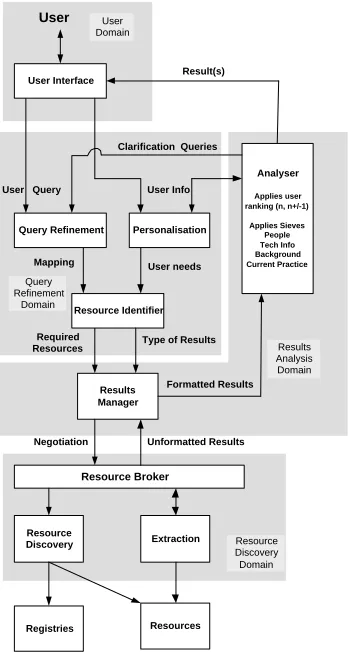
The block diagram of the proposed framework is shown in Figure 1, each block repre-sents an agent or group of agents.
Query Refinement
Resource Broker
Resources Extraction Results Manager
Analyser
Applies user ranking (n, n+/-1)
Applies Sieves People Tech Info Background Current Practice
User Query
Result(s)
Personalisation
Resource Identifier User Interface
Resource Discovery
User Info
User needs Mapping
Type of Results
Formatted Results
Unformatted Results
Registries
User
Resource Discovery Domain Clarification Queries User
Domain
Negotiation
Results Analysis Domain Query
Refinement Domain
[image:6.612.190.364.125.453.2]Required Resources
Fig. 1. An agent based framework for resource location.
the answers to the person who asked the question. As the user may be at a terminal or in a mobile situation, the User Interface agent would be responsible for delivering the answer in an appropriate manner. The type of user interface could range from a simple command-line input to range of mobile devices (for instance PDAs), [24]. This will allow the engineer in the scenario to use the system in the office, on a factory floor or at a remote location.
based on current responsibilities, project allocation and other management information. At this stage, there is no limit to the types of query that could be asked by the user or the type of interfaces that could be used. The type of questions that users would typically ask can be grouped under Kipling’s [15] "six honest serving-men. . ." of What, Why,
When, How, Where and Who,which when applied to the scenario give:
– What: What are the conditions that lead to this problem?
– Why: Why is there uncertainty about surrounding previous findings? – When: When is the project review meeting?
– How: How can I obtain copies of the report?
– Where: Where can I find more information on this problem? – Who: Who else is currently working or has worked on this problem?
The Personalisation agent would learn the preferences of the user and pass this in-formation onto the Query Refinement agent and the results agents. In addition, the Per-sonalisation agent would also continually monitor the user interaction with the system to keep the user’s profile up to date. The user profile passed from the Personalisation to the Query Refinement agent is used to shape the type of query asked. Similarly, the user profile information passed from the Personalisation agent to the Analyser would influ-ence the filters applied to the results before they are passed back to the user. Once the query has been refined, the associated phrases and keyword-list are transferred to a
Re-source Identifier agent. The ReRe-source Identifier agent identifies the documentary types
that are required to support each type of question. The type of documentary sources re-quired typically include publications (including minutes, reports, standards, handbooks, CAD models), departmental Web pages, document repositories, discussion groups, tele-phone directories, E-mails, human resource information, and lessons learnt log.
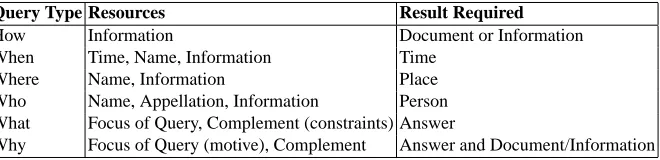
[image:7.612.146.476.549.629.2]Based on the type of query, the user expects a particular type of answer, Table 1 shows typical mapping between the type of question asked and the form of the reply. This information is then passed to the Results Manager agent, in an unstructured for-mat. The Results Manager agent, based on the mapping, will then format the result accordingly. Hence, irrespective of the source media or formatting, the Analyser agents will receive the information from a particular query in an appropriate and consistent format.
Table 1. Mapping the type of questions to resources and results required.
Query Type Resources Result Required
How Information Document or Information
When Time, Name, Information Time
Where Name, Information Place
Who Name, Appellation, Information Person What Focus of Query, Complement (constraints) Answer
Why Focus of Query (motive), Complement Answer and Document/Information
– Pass the results onto the User Interface agent.
– If there is a compound query, wait until all the answers are received.
– Ask for a further query to be made, by sending a query to the Query Refinement
agent.
The Analyser agent will do more than just sieve the result; for instance, it may run a statistical analysis of the results to check the probability of reliable data and the level of trust associated with the information. The sieves are used to rank the results, for instance if people are returned, it will suggest people that are in the same location or department at the top of the list. The order that the sieves are applied depends on the user profiles and user information needs. Table 2 shows the type of sieves to be applied in relation to the documentary sources. There are additional heuristics when the results are related to people. That is, since people tend to feel less threatened when asking questions of colleagues, the positions in organisational hierarchy can be exploited.
Table 2. List of sieves (filters) applied to results.
People Information Background Best Practice
Location Relevance Relevance Relevance
Site Date of Origin Date of Origin
Status Context (project)
The resources can be external to the system and could be in any location on the in-tranet or internet, hence the requirement for a Resource Discovery agent that will query a number of documentary sources. In addition to the Extraction agent, it is necessary to have a separate agent that would locate new or changed resources. For each of the spe-cific resource type there is a corresponding agent, that will understand how to integrate, analyse and extract the knowledge from the resource.
4.1 Implementation
We have already developed a set of systems offering specific services which realise parts of the proposed resource locator system. Some of these implementations are described below:
ONTOCOPI One of the tools that can support a resource locator system is
ONTO-COPI [1], a community of practice (CoP) identifier that applies Ontology-based Net-work Analysis (ONA) [22] to uncover the most related cluster of entities to a specific person or object. ONTOCOPI will form part of the "Resource Identifier" agent in Fig-ure 1. The tool analyses the relations between ontology assertions to calculate their re-latedness. The user can control the selection of relations and their relative importance, and the range of the CoP to be identified.
requirement is to locate an expert in Knowledge Management (KM), ONA algorithm spreads its activation starting from the assertion that represents the subject of KM until the search limit is reached (maximum number of links to be traversed). This crawl takes into account the type of relations being traversed to reflect their different impact on the judgement of expertise, so for example a relation between a person and a project on KM can be valued higher than a relation between a person and a KM workshop that he attended. Hubs and authoritative people can be identified by ONA and used to measure the level of expertise. At the end of this search, a list of people and objects will be produced, ranked according to their degree of relativity to the specific query topic, estimated from the amount and type of semantic paths between each entity in the network and the query object.
The temporal dimension can be an important one when searching for current re-sources. ONA can be tuned to work within a time limit, where time-related assertions can be filtered accordingly. For example, a document published in 1980 about KM may be less accounted for or disregarded when searching for current experts in this subject.
ONTOCOPI can also be used to find close alternatives to a specific resources if the later is unreachable for any particular reason. The top people in the CoP list will most likely be working on the same areas, and hence may all be consulted.
EMNLP One of the potential information resources that "Resource Discovery" agent,
5
Conclusions
Many of the current approaches to resource location have focused on locating experts. Those systems that are designed solely to return a person or persons, together with their current location. Various approaches have been published to provide this service; some have relied on management and social aspects of a community, while others methods have tried to infer expertise, from local resources or self published material.
In practice, we realised that people want more from their knowledge system than to just locate a person. We have taken a holistic knowledge management approach, in the design of an agent based framework for resource location. We did not focus on any particular implementation, and intended to design a generalised agent based approach to location of resources in an organisation and on the World-Wide-Web in response to a specific query.
The requirement of an agent-based resource locator to harness knowledge from a wide range of disparate systems, which may reside in different operating environments and administration domains, lead to the proposed framework detailed in this paper. In the approach we have taken, scalability, and the ability to learn and adapt to changing resources are essential, hence the multi-agent approach taken. The abstraction of goal-directed agents and multi-agent systems is especially suited to the area of resource location.
While the agent framework allows us to deal with the issues of accessing knowledge in many different environments, it alone will not be enough to obtain the answer the user requires. The knowledge is often implicitly held in electronic resources, hence the requirement for the ontologies, to extract the semantics and infer the results required.
Many of the agents shown in the block diagram (Figure 1) will require further de-tailed design. At which stage experiments to find the advantages or disadvantages of a particular statistical technique or the exact heuristic to be used.
Acknowledgements
This work is supported under the Advanced Knowledge Technologies (AKT) Inter-disciplinary Research Collaboration (IRC), which is sponsored by the UK Engineer-ing and Physical Sciences Research Council under grant number GR/N15764/01. The AKT IRC comprises the Universities of Aberdeen, Edinburgh, Sheffield, Southampton and the Open University. The views and conclusions contained herein are those of the authors and should not be interpreted as necessarily representing official policies or endorsements, either expressed or implied, of the EPSRC or any other member of the AKT IRC.
References
1. H. Alani, K. O’Hara and N. Shadbolt. ONTOCOPI: Methods and tools for identifying com-munities of practice Proceedings of 2002 World Computer Congress, Intelligent Information
2. L. Argote. Organizational Learning: Creating, Retaining and Transferring Knowledge.
Kluwer Academic Publishers, 1999. ISBN: 0-7923-8420-2.
3. I. Becerra-Fernandez. Facilitating the online search of experts at NASA using expert seeker people-finder. In I. Becerra-Fernandez, editor, Proceedings of the 3rd International
Con-ference on Practical Aspects of Knowledge Management (PAKM2000), Basel, Switzerland,
October 2000.
4. I. Becerra-Fernandez. The role of artificial intelligence technologies in the implementa-tion of people-finder knowledge management systems. In S. Staab and D. O’Leary, editors,
Proceedings of the Bringing Knowledge to Business Processes Workshop, AAAI Spring Sym-posium Series, Menlo Park, CA, USA, March 2000.
5. G.C. Bowker and S.L. Start. Sorting Things Out: Classification and its consequences. The MIT Press, England, 2000.
6. T. Davenport and L. Prusak. Working Knowledge: How Organizations Manage What They
Know. Harvard Business School Press, MA,USA, 1998.
7. D. DeRoure, W. Hall, S. Reich, G. Hill, A. Pikrakis, and M. Stairmand. Memoir - an open distributed framework for enhanced navigation of distributed information. Information
Pro-cessing and Management, 37:53–74, 2001.
8. N. Ducheneaut and V. Bellotti. E-mail as habitat: An exploration of embedded personal information management. ACM Interactions, pages 30–38, October 2001.
9. N. Guarino, C. Masolo, and G. Vetere. OntoSeek: Content-Based Access to the Web. IEEE
Intelligent Systems, 14(3):70–80, May 1999.
10. Y. Kalfoglou, J. Domingue, E. Motta, M. Vargas-Vera, and S. Buckingham-Shum. MyPlanet: an ontology-driven Web-based personalised news service. In Proceedings of the IJCAI’01
workshop on Ontologies and Information Sharing, Seattle, USA, August 2001.
11. A. Kanfer, J. Sweet, and A. Schlosser. Humanizing the net: Social navigation with a "know-who" e-mail agent. In Proceedings of the 3rd Conference on Human Factors and the Web,
Denver, CO, USA, 1997.
12. H. Kautz, B. Selman, and A. Milewski. Agent amplified communication. In Proceedings of
the 13th National Conference on Artificial Intelligence (AAAI’96),USA, pages 3–9, August
1996.
13. H. Kautz, B. Selman, and M. Shah. The hidden web. AI Magazine, 27(36), 1997.
14. S. Kim, W. Hall, and A. Keane. Natural language processing for expertise modelling in e-mail communication. In Proceedings of the 3rd International Conference on Intelligent Data
Engineering and Automated Learning, Manchester, England, 2002.
15. R. Kipling. "keep six honest..." a poem in the Elephant’s Child. In Just So Stories, 1902. 16. B. Krulwich and C. Burkley. The InfoFinder Agent: Learning User Interests through
Heuris-tic Phrase Extraction. IEEE Intelligent Systems, 12(5):22–27, 1997.
17. M. Maybury, R. Damore, and D. House. Awareness of organizational expertise. Technical report, MITRE, October 2000.
18. D.W. McDonald and M.S. Ackerman. Just talk to me: A field study of expertise location. In Proceedings of the 1998 ACM Conference on Computer Supported Cooperative Work
(CSCW), pages 14–18, 1998.
19. L.D. McGuinness. Ontological Issues for Knowledge-Enhanced Search. In N. Guarino, editor, Proceedings of the 1st International Conference on Formal Ontology in Information
Systems(FOIS’98), Trento, Italy, pages 302–316. IOS Press, June 1998.
20. P. Maes Agents that Reduce Work and Information Overload In Software Agents ed. B Jeffrey, 1997
22. K. O’Hara, H. Alani, and N. Shadbolt. Identifying Communities of Practice: Analysing On-tologies as Networks to Support Community Recognition Proceedings of the World
Com-puter Congress, 2002
23. D. O’Leary. How knowledge reuse informs effective system design and implementation.
IEEE Intelligent Systems, 16(1):44–49, January 2001.
24. G. Power, R. Damper, W. Hall. and G. Wills Realism and Naturalness in a Conversational Multi-Modal Interface In Proceedings of the IDS02, ISCA Tutorial and Research Workshop
on Multi-Modal Dialogue in Mobile Environments Kloster Irsee, Germany, June 17 - 19,
2002
25. P. Resnick and H.R. Varian. Recommender systems. Communications of the ACM, 40(3):56– 58, March 1997.
26. R. Sol and J. Serra. Netexpert: A multiagent system for expertise location. In Proceedings of
the IJCAI-01 Workshop on Knowledge Management and Organizational Memories, Seattle, USA, August 2001.
27. Y. Sure, A. Maedche, and S. Staab. Leveraging Corporate Skill Knowledge - From ProPer to OntoProPer. In Proceedings of the 3rd International Conference on Practical Aspects of
Knowledge Management(PAKM2000), Basel, Switzerland, October 2000.
28. A. Vivacqua and H. Lieberman. Agents to assist in finding help. In Proceedings of the 2000
ACM Conference on HCI, The Hague, Netherlands, pages 65–72, April 2000.
29. M. Weal, G. Hughes, D. Millard, and L. Moreau. Open hypermedia as a navigational in-terface to ontological information spaces. In Proceedings of the 20th ACM Conference on
Hypertext and Hypermedia (HT’01), Aarchus, Denmank, pages 227–236, August 2001.