Abstract—Supply chain of Indonesian Automotive Industry can be described from the component product industry as a supplier to consumer. Single Agent Brand in the supply chain automotive industry is a tier that has a dominant effect on supply chain automotive activities, so the wrong strategy selection in this tier can deliver a fatal effect on the majority tier of the supply chain automotive industry. This strategy can result in a violation of Indonesian law regulation. One of strategy that is likely to conflict with law regulation in Indonesia is a vertical restraint. This article discussed the evaluation of supply chain business strategy related to the indication of vertical restraint based on dealer and customer point of views. The result of this research proves that there are vertical restraints based on evaluation of resale price maintenance, territorial restriction, tying, and exclusive dealing.
Index Terms—Automotive industry, single agent brand, supply chain, vertical restraint
I. INTRODUCTION
The automotive industry is one of the industries, which is currently in the spotlight of the world. Various kinds of manufacturers in the automotive industry, especially manufacturers of four-wheeled vehicles have sprung up since 1990 [1]. The countries in Western Europe, United States, and Asia keep on improving their competitiveness to win the global market. However, the global crisis in 2000 has given an effect on the automotive industry, especially in some developing countries in Asia [1], [2]. The global crisis has weakened the automotive demand and production. Nevertheless, Asia with continued strong production growth in the automotive industry has ultimately been able to strengthen the position in the global market. The condition was evident from the growth of various countries in Asia that can exceed the ability of countries in the United States and Europe [2].
One of the areas that offer significant opportunities for
L. D. Laraswati and R. W. Astuti are Assistant of System Logistic and Business laboratory, Industrial Engineering Department, Sebelas Maret University, Surakarta, 57126, Indonesia. (corresponding author to provide phone: +628563140088; e-mail: [email protected]; [email protected]).
M. Budijanto, Yuniaristanto, and W. Sutopo are with The Research Group of Logistics System and Business Laboratory, Industrial Engineering Department, Sebelas Maret University, Surakarta, 57126, Indonesia (e-mail: [email protected]; [email protected]; [email protected]).
the global automotive (four-wheeled vehicles) in near to medium term is the Southeast Asia Region (ASEAN). ASEAN region was predicted to be the fifth largest automotive market in the world in 2019. A new analysis finds that the market is likely to grow at a compound annual growth rate (CAGR) of 5,8 percent, primarily driven by the rapid market expansion in Indonesia and Thailand. [3]
In Indonesia, supply chain of automotive industry can be described from the component product industry as a supplier to finished product in the hands of the consumer. The supply chain is a link between suppliers to end consumers in flow of product from raw material to finished product [4]. There are many previous research on supply chain between supplier-buyer, such as: effect of buyer-supplier in the modern retail industry [5], supplier-distributor-retailer on the distribution of staple food [6], influence of power driven buyer, supplier-buyer on the supply chain [7].
Each tier has one or more strategy to improve its competitiveness. Single agent brand or better known as ATPM in Indonesia is a tier that has a dominant effect on the supply chain automotive activities, so the wrong in the selection strategy in this tier can bring about a fatal effect to majority tier in the supply chain automotive industry. These errors can result in a violation of Indonesian law regulation. One strategy that is likely to conflict with Indonesian law regulation is a vertical restraint.
There are many ways to win the market competition and one of them is to establish a good vertical integration with their stakeholders. Vertical integration is an agreement entered into by two or more enterprises, each of which operates, for the purposes of the agreement, at a different level of the production or distribution chain, and relating to the conditions under which the parties may purchase, sell or resell certain goods or services [8]. However, the increasingly fierce competition condition has led to a variety of vertical restraint which allows the emergence of unfair competition in the Indonesian Automotive Industry. Vertical restraint itself is a contract made in a form of incorporation of linked companies to restrict competition in the field of business or industry [9].
There are four kinds of vertical restraint in Indonesian regulation, such as Resale Price Maintenance, Exclusive Dealing, Tying, and Territorial Restriction [10]. Tying is conditioning the sale of one good on the purchase of another, Resale Price Maintenance is commercial practice when a supplier or manufacturer refuses to sell to retailer who does not change the price suggested by supplier, Exclusive Dealing is a contract that is imposed by the
Effect of Vertical Restraint Strategy on Supply
Chain Automotive Industry: A Case Study in
Indonesia
Levinia Dian Laraswati, Rina Wiji Astuti, Murman Budijanto, Yuniaristanto, Wahyudi Sutopo
manufacturer on a retailer or intermediate producer that requires that retailer sell only manufacturer’s brand, and Territorial Restriction is the division of downstream market into a set of territorial monopolies [9].
Vertical restraint that arises will provide a tremendous advantage to a single agent brand or a main dealer or other parties that are involved in the agreement. However, the existing vertical restraint will also have a negative impact on consumers or certain other parties. Consumers or other parties are forced to buy or follow the rules that they may not expect, then it can be said that consumers have been prohibited or prevented from gaining an advantage over.
Each vertical restraint has its own case study in many industries in the world such as tying agreement in the computer industry. This case study explains that any firms in this industry sell hardware and software as a package. General court's presumption of economic power, its minimal requirement as to market power, and its rapid dismissal of business justifications [11]. The other case study discusses about imposing penalty because of the Exclusive Dealing in the generic drug industry [12] and in raw cinematic film industry [13]. Besides that, there are some case studies about the imposition of penalty for Territorial Restriction strategy and Resale Price Maintenance strategy in oil industry [14].
A kind of vertical restraint strategy has probability to reduce competition in the market when used on the wrong tier [15]. Several literature stated that the law that is regulating vertical restraint use under the rule of reason [16], [17]. The rule of reason is an approach that uses market analysis and impact that the competition declared as unconstitutional [17]. There has been some literature that informs about the effect of penalty that has been given to the parties or companies that has proven to be illegal vertical restraint strategy [17]. Penalties, which are given to those who are convicted in the use of vertical restraint strategy have ultimately provided a deterrent effect to the perpetrators and have increased market competitiveness.
The automotive world itself has been an evidence of the use of vertical restraint strategy in running the business [18], such as the fact that most dealers dealerships hold on just one brand [19], the dealership has been divided into several specific areas [20], there is price-fixing [21], and then the use of tying strategy for leveraging market power [21]. However, not all vertical restraint can be categorized as a barrier to competition. It requires some literature as well as
the statement of the dealer and opinion of the public (consumers) to prove the possibility of a relationship between vertical restraints and unfair competition in the automotive industry.
II. RELEVANT SYSTEM AND METHODOLOGY
The Fig. 1 shows that supply chain automotive industry in Indonesia starts from raw material or spare part in supplier to finished product that's marketed to consumers. Fig 1 states that this research is classified into two studies, namely vertical restraint indication of dealer point view and consumer point view in 5 cities, namely Jakarta (Ca), Surabaya (Cb), Yogyakarta (Cc), Semarang (Cd), and Solo (Ce). Age of respondent has been grouped in 4 groups, such as <20, 21-30, 31-40, 41-50, and >50. Furthermore, the brand is classified into 3 brands with the biggest sale in Indonesia.
Both of the studies have a strong relationship to prove the existence of vertical restraint on the relationship between Dealer and Single Agent Brand/Main Dealer and to find out the effect of vertical restraint strategy that is felt by the consumer in the Indonesian automotive industry.
This research began with literature study and Focus Group Discussion with competition expert to proper the design of questionnaire and the design of data collection. The application of SPSS v.20 and Microsoft Excel 2010 was used to calculate the data [23], [24].
TABLE I OUTCOME OF FGD Outome
Criteria
Sampling of Dealer
Sampling of Consumer -Number of Quetionnaire
-Sampling Collecting Technique
-Sample Criteria
-Sampling Result
-Method of Data Processing
23 numbers - TY : 4 - ED : 3 - TR : 3 - RPM: 4 - Marketing
strategy: 9 Snowball Sampling Technique Dealer in Three Brand and five Cities - City:
Ca : 3 Cb : 7 Cc : 2 Cd : 4 Ce : 2 - Brand
B1 : 8 B2 : 6 B3 : 4
Descrptive Method
27 numbers - TY : 3 - ED : 2 - TR : 4 - RPM: 1 - Marketing
strategy: 16 Quota Purposive Sampling Technique Consumers of three brand and five cities - City:
Ca : 31 Cb : 10 Cc : 9 Cd : 10 Ce : 7 - Age
[image:2.595.306.543.408.775.2]III. RESULT AND ANALYSIS
A. Dealer Point of View
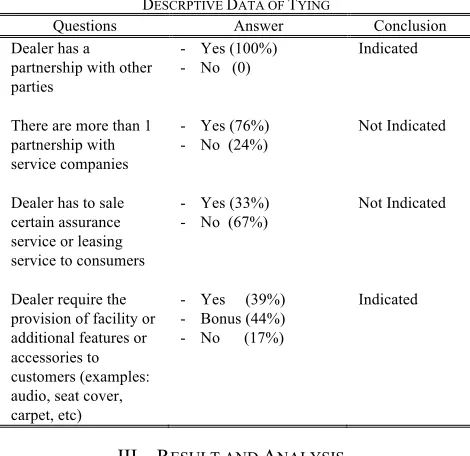
At this point of view, the data are processed undescriptive methods. Table II proves that there are indication in the 4 of vertical restraints in the Indonesian automotive industry. Each kind of vertical restraint is identified through some of the questions posed in the questionnaire. The majority result of respondents is a provisional conclusion of the vertical restraints strategy.
Based on Table II, III and IV, it can be stated that the results of the questionnaire show that there are indications of the use of Exclusive Dealing Strategy and Territorial Restriction Strategy. The majority of respondents suggests an answer that leads to indication of the use of Exclusive Dealing Strategy and Territorial Restriction Strategy.
As for the Tying Strategy and Resale Price Maintenance Strategy show a balanced respondent between the indication and no indication of the use of both strategies. Althought, every dealer is illegal because the majority has more than one of cooperation with external parties in terms of
simplifying their business processes and the single agent brand. It is also set a limit price that may be offered by the dealer to the consumer, but the limitation is that the price range, is still quite legal.
We made a comparative analysis to know about consistency of the respondent’s answers. This comparative analysis is divided into two parts, namely the consistency analysis of respondents in 5 locations and consistency analysis of respondents in 3 brands.
Assuming:
- H0 stated that the intercity has an equal average test value.
- H1 stated that the intercity has not an equal average test value.
Table VI and VII explain that there is no different statement of the respondent in 5 areas and 3 brands. It is because the fact that the significant value has a smaller value than statistical significance level (α = 0,05). From table VI it can be seen that the value of significance or probability values mean is above 0.05. This shows that the respondents’ answers to the indications of resale price maintenance, exclusive dealing, territorial restriction, and tying in five areas have the same variance (accept H0). Table VII shows that the value of asymp sig> 0.05. It proves that the initial hypothesis is accepted (accept H0), which means that there is a difference of opinion or responses from the three dealers who were observed. Finally, this point of view indicates that there are indications of the fourth form vertical restraint in the Indonesian automotive industry.
B. Consumer Point of View
Perception of consumer can measure the 4 vertical restraints, likely Exclusive Dealing, Territorial Restriction, Resale Price Maintenance, and Tying Agreement. This study was processed using a descriptive method and statistic
TABLEIII
DESCRIPTIVE DATA OF RESALE PRICE MAINTENANCE
Questions Answer Conclusion Establishes a
certain discount of dealer to attract consumers
- Yes (94%) - No (6%)
Not Indicated
required conditions to give discounts
- Market was quiet (4%) - Compulsion (39%) - Won the market
competition (35%) - Other (22%)
Indicated
Dealer will have the freedom to determine prices and discounts
- Yes (69%) - No (31%)
Not Indicated
Dealer will have better profits if they have the freedom to determine prices and discounts
- Yes (11%) - May (33%) - No (56%)
Indicated
TABLEV
DESCRPTIVE DATA OF TERRITORIAL RESTRICTION
Questions Answer Conclusion Selection of market
segments
- City (50%) - Kind of Market (39%) - Other (11%)
Indicated
Reason of set the dealer location for marketing the product
- Compulsion (46%) - Population Density (15%) - Traffic Density (31%) - Land Prices (0%) - Police Registration (8%)
Indicated
There are more than one dealership within the same brand in one location
- Yes (53%) - No (47%)
Not Indicated TABLEIV
DESCRPTIVE DATA OF EXCLUSIVE DEALING
Questions Answer Conclusion Dealer sell one brand - Yes (100%)
- No (0)
Indicated Reason for selling one
brand of dealership
- Profit (10%) - Ease of business (43%) - Code of Ethics (48%)
Indicated
Dealer will get better benefits if dealer sell more than one
- Yes (61%) - No (39%)
Indicated TABLEII
DESCRPTIVE DATA OF TYING
Questions Answer Conclusion Dealer has a
partnership with other parties
- Yes (100%) - No (0)
Indicated
There are more than 1 partnership with service companies
- Yes (76%) - No (24%)
Not Indicated
Dealer has to sale certain assurance service or leasing service to consumers
- Yes (33%) - No (67%)
Not Indicated
Dealer require the provision of facility or additional features or accessories to customers (examples: audio, seat cover, carpet, etc)
- Yes (39%) - Bonus (44%) - No (17%)
[image:3.595.53.288.63.291.2]method. If the data generates an answer with slight differences, the processing will be performed using the statistic method.
Table VIII shows that only Exclusive Dealing has little comparative value. Then conducted further data processing using statistical methods for Exclusive Dealing Data. Table IX indicates that there is no significant (Asymp sig < α, α = 0,05) difference of result, which mean that consumer feel difficult to compare products and prices they want to buy because of the far distance and they feel that one brand in one dealer can facilitate consumers in determining the choice of buying a car. Moreover, this study made comparisons to determine the difference in response to the region with response of national coverage. Assuming H0 stated that the intercity had an equal average test value.
Table X shows that significant value> α, it means that the inter-regions have an average test value equal to the other city. It shows that consumers feel that the consumer automotive industry, especially in the automobile industry was disadvantaged by the use of Territorial Restriction Strategy and Exclusive Dealing Strategy. Consumers feel that more dealers in one location and more varied products sold by the dealer, will help consumers to compare prices and quality products in accordance with the wishes of consumers.
In addition, based on open interviews, also found several factors that influence consumers in determining the car is the first purchase is the price of the product, after-sales service dealers, dealer location and quality of service dealer. The elasticity of demand for inter-dealer in the same brand is elastic and for inter-dealer in a different brand is inelastic. This is also supports the eliminated the usage of The
Exclusive Dealing and Territorial Restriction Strategy in Indonesia.
C. Combined Analysis
From the analysis, it can be concluded that there are indications of a vertical restraint in the Indonesian automotive industry. This is proven by the statement of the consumer, which indicates the vertical restraints. Yet another condition of the vertical restraints provides benefits for the consumer, for example with the tying agreement. Tying Agreement itself in this study is divided into two, namely tying agreement for leasing and tying agreement for assurance.
One form of tying agreement to lease is a lease with the provision of services to facilitate the consumer in the loan process, while leasing services for the provision of assurance is indicated by the activity of car and car insurance package offered by the dealer. In addition, the form of exclusive dealing is also considered detrimental to the consumer and provides benefits classified as the facility for the consumer in selecting the desired product. But from some of the open questions given, either the dealer or the consumer does not deny that the removal of exclusive dealing of the business strategy set by the single agent brand can provide a distinct advantage. So it can be said in this article’s finding asserts that overall, exclusive dealing strategy has the opportunity of being avoided because of the general consumers’ feeling. It is quite interference because it can be difficult for consumers to compare products, like to decide which car to buy. In addition, the majority of dealers also feels that with the abolition of Exclusive Dealing strategy, will provide opportunities for a greater profit increase for dealers
IV. CONCLUSION AND FUTURE RESEARCH
The result proves that there are indication for all vertical restraints, but only two vertical restraints that perceived consumer’s disadvantage, i.e. territorial restriction and exclusive dealing. The price of the product, dealers’ after-sales service, dealer’s location and dealer’s quality of service are as some factors that influence consumers in determining the car in the first purchase. There are some effects of vertical restraint strategy on consumer’s behavior i.e. complicate the customer’s mind, provides benefits and
TABLEVIII
OUTCOME OF CONSUMER POINT OF VIEW WITH
DESCRIPTIVE METHOD
Majority Answer
Difference of Value
Exclusive Dealing Interfere 11% Territorial Restriction
Resale Price Maintenance
Interfere Not Interfere
30% 43,2% Tying Agreement Not Interfere 34%
TABLEX OUTCOME OF ANOVATEST
SS df Mean Sqaure
F Sig. RPM 3,29 5 0,658 0,418 0,835
TR 1,712 5 0,342 0,785 0,562
ED 3,071 5 0,614 0,489 0,784
TY Asurance 0,073 5 0,015 0,064 0,995
TY Leasing 0,668 5 0,134 0,607 0,694 RPM = Resale Price Maintenance, TR = Territorial Restriction, TY= Tying, and ED = Exclusive Dealing
TABLEVII
CONSISTENCY ANALYSIS BY BRAND
Value df Asymp. Sig. Pearson Chi Square 2,712 2 0,258 Likelihood Ratio 2,720 2 0,257 Linier by Linier
Association
0,575 1 0,448 TABLEVI
CONSISTENCY ANALYSIS BY LOCATION
Levene Statistic
df1 df2 Sig. ED 0,182 1 52 0,672 TR 1,222 2 51 0,303 TY 0,034 1 70 0,854 RPM 0,075 1 68 0,785 RPM = Resale Price Maintenance, TR = Territorial Restriction, TY=Tying, and ED = Exclusive Dealing
TABLEIX
OUTCOME OF CHI-SQUARE METHOD
Territorial Restriction Exclusive Dealing Chi-Square 15,881 9,716
df 2 3
convenience for consumers who want to purchase a car, and makes it difficult for the consumers to compare the prices and product quality.
Mapping study of regulatory issues and barriers to enter into the existing industry are needed as future research to capture an integrative supply chain analysis. It is possible to extend vertical restraints analysis for winder tier from tier 1 (manufacturing components) to tier 3 (materials).
REFERENCES
[1] BERA. 2004 . “Modern Global Automobile Industry”. issue: The Automotive Industry. Available: http://www.loc.gov/rr/business/BERA/issue2/industry.html.
[2] J.V. Biesebroeck and T.J. Sturgeon. 2010. “Effect of The Crisis on The Automotive Industry in Developing Countries: A Global Value Chain Perspective”. Journal of The World Bank.
[3] Frost and Sullivan. 2013. “ASEAN to Emerge as A Key Global Automotive Market and Production Hub by 2019”. Available:
http://www.frost.com/prod/servlet/press-release.pag?docid=283142681.
[4] G. C. Stevens. 1989. “Integrating the Supply Chain”. Emerald Backfiles.
[5] W. Sutopo, M. Hisjam, Yuniaristanto. “An Agri-Food Supply Chain Model to Empower Farmers For Supplying Deteriorated Product to Modern Retailer”, Springer Science+Business Media Dordrecht 2013, (Book ISBN: 978-94-007-5623-6), Lecture Notes in Electrical Engineering 186 LNEE, pp. 189-202. (Indexed by SCOPUS) [6] W. Sutopo, S. N. Bahagia, A. Cakravastia, dan T. M. A. Arisamadhi.
2013. “A buffer stock model to ensure price stabilization and availability of seasonal staple food under free trade considerations”. ITB Journal of Engineering Science. Vol. 44B, pp. 128-147. [7] H. Shin, D. A. Collier, and D. D. Wilson. 1998. “Supply Management
Orientation and Supplier/Buyer Performance”. Journal of Operations Management. 18(20), pp. 317-333
[8] ASEAN. 1967. “Chapter 3: Scope of Competition Policy and Law”. In the ASEAN Region Guidlines on Competition Policy, pp. 14. Available: www.asean.org
[9] Chruch, J. and Ware, R. 1999. “Industrial Organization: A. Strategic Approach”. London: Mc Graw-Hill
[10] Law Number 5 year 1999. Anti Monopoly Practice and unfair Business Competition.
[11] G. Myers. 1985. “Tying Arrangements and The Computer Industry: Digidyne Corp. V. Data General Corp”. Journal of Duke Law, vol. 1027
[12] R. A. Feinstein, S. A. Newborn, B. W. Rein, A. M. Ashton, and P. D. Isakoff. (1999, July). Mylan Laboratories, Inc., Cambrex Corporation, Prfarmaco S.R.I., and Gyma Laboratories of America, Inc [Online]. NOS. 98-3144 (TFH), 98-3115 TFH). Available: http://www.leagle.com/decision/19998762FSupp2d25_185
[13] Y. Chen and M.H. Rordan. 2003. “Vertical Integration, Exclusive Dealing, and Ex Post Cartelization”. Department of Economics Discussion Paper Series.
[14] U. Khan and Associates, Inc. (1997, November). State Oil Company, Petitioner v. Barkat [Online]. Supreme Court of The United States, pp. 98-871. Available: http://www.law.cornell.edu/supct/html/96-871.ZO.html
[15] P. Rey and J. Stighlitz. 1988. “Vertical Restraint and Producers Competition”. Europe Economic Review, pp. 561-568.
[16] G. M. Herran, S. P. Sigue, and G. Zaccour. 2013. “Downstream Horizontal Integration and Multiunit Dealership”. Interational Transaction in Operational Research, pp 81-101.
[17] A. F. Lubis, A. M. T. Anggraini, K. Toha, L. B. Kagramanto, M. Hawin, N. N. Sirait, Sukarmi, S. Maarif, and U. Silalahi. 2009.
Business Competition Law in Text and Context. Deutsche Gesellschaft
für Technische Zusammenarbeit (GTZ).
[18] R. B. Sambharya and K. Bane. 1006. “The Effect of Keiretsu Affiliation and Resources Dependencies on Supplie Firm Performance in The Japanese Automobile Industry”. Management International Review, pp 7-37
[19] S.E. Boyle. 1971. “Restructuring The Automobile Industry Exclusive Dealing as An Unfair Method of Competition Under The FTC ACT”. Antitrust and Econ. Rev. 19.
[20] Toyota. 2013. “Dealer&Workshop”. Available: http://www.toyota.co.id/shopping-tools/dealer-service-locator/ [21] C. Bonnet and P. Dubois. 2004. “Inference on Vertical Contracts
between Manufacturers and Retailers Allowing for Nonlinier Pricing and Resala Price Maintenance”. Journal of Economics, pp. 139-164
[22] M.D. Whinston. 1990. “Tying, Foreclosure, amd Exclusion”. American Economic Review, pp. 837-859.
[23] A. W. Kerr, H. K. Hall, and S. A. Kozub. 2002. “Doing Statistics with SPSS”. London: SAGE Publications Ltd.