Abstract—The development of downstream palm industries
in Indonesia is still low compared to Malaysia. This paper aims to develop a holistic feasibility framework for selecting of potential palm derivative industry by considering the whole of the chain of industrial tree. The research began by establishing of the palm industrial tree from the leaves to the roots and from upstream to downstream. Approach of previous researches was adopted to obtain suitable criteria that can be used to evaluate business competitiveness of each commodity in industrial cluster. The result was obtained 7 core criteria named as infrastructure, feasibility analysis, supply, demand, human resource management, technology, and law and environment. The decision tree and evaluation matrix method can be utilized to prioritize some of the value chain of commodities then they will be cut off by relative and absolute criteria. The proposed framework not only focus on one industry level, but also to examine all industry levels from upstream to downstream and to cover a whole of tree palm oil industry. Based on previous studies, the framework chooses CPO, olein, and cooking oil as the first alternative.
Index Terms—Evaluation Matrix, Feasibility Study
Framework, Industrial Tree, Palm Oil Industry
I. INTRODUCTION
ased on Gross Domestic Product (GDP), agro sector has a vital role for the economy of Indonesia. The contribution of agro was the largest if it was compared by the other sectors in last 2011. At the time of economic crisis, agro sector was strong enough to face economic shocks and found to be reliable in the recovery of the national economy [1]. The plantation sub sector is one of the agro sectors which is quite large because of its important role in the potential provider of raw materials for industry, labor adsorption and foreign exchange producer.
Palm is one of commodities from plantation that is important for the economy of Indonesia. The potential of this commodity is profitable. Almost all parts of the tree can be used, ranging from roots, leaves, flowers, flower stalks, stems, up to the fresh fruit bunches (FFB). But there is no doubt that the main part which is often treated is their FFB. It is the main producer of crude palm oil (CPO) derived from the mesocarp of fruits and palm kernel oil (PKO)
D. I. Maryanie1) is with the Undergraduate Program of Department of
Industrial Engineering, Sebelas Maret University,57126, INDONESIA W. Sutopo2) and Yuniaristanto3) are with the Laboratory of Logistics System and Business, Department of Industrial Engineering, Sebelas Maret University, Surakarta, 57126, INDONESIA. (Corresponding authors: phone/fax.+62-271-632110; e-mail: 1[email protected]; 2[email protected]; 3[email protected]).
derived from palm kernel seeds [3].
Market prospect of palm oil in the future is predicted still very bright, because global demand is still growing by 5 percent per year [4]. This was confirmed from world consumption data which is far above the ability of production so that the prices will continue to rise [5]. Together with Malaysia, Indonesia is able to dominate most of the world palm oil production, even surpass the production of palm and CPO of Malaysia [6]. As the largest producer and exporter of CPO in the world, this commodity certainly plays a very important role in Indonesian economy. This potential market that is so promising should be able to be an opportunity for Indonesia to continue in adapting to process its palm plantations optimally. However, most of the palms that are produced are allocated to produce crude oil only so no wonder if in 2007, Indonesia could overtake Malaysia became the highest producer of CPO in the world [7].
Not only focus on producing of CPO, Indonesia should develop the other derivative products too. This derivative processing is required to maintain Indonesia’s position as the largest palm producer, which is not only limited to its upstream but also to downstream. Moreover, based on its selling price, the palm downstream industry promises better value than just CPO exports. Therefore, continuing on the development of palm processing industry certainly feasibles to be studied more deeply considering the benefits that can be obtained.
In recent years, Indonesian government actually has attempted to promote several policies including issuance of government regulations that govern the road map of development of palm processing industry cluster [12], to the central government program named as Masterplan for the Acceleration and Expansion of Indonesia Economic Development (MP3EI) that governs about the development areas. However, the development of derivative industries is certainly not easy. It takes much time and costs to make it happen. Therefore, it needs to integrate the key business processes from suppliers to consumers by providing value added services to entities involved in the supply chain in palm oil industry.
Feasibility studies in palm oil industry have gained interest among researchers. The development of palm oil derivative industrial cluster was studied by [20], which was divided into 4 groups : raw materials, primary products, finished products and markets. Numerous studies have focused on the design and analysis of supply chain networks in the palm oil industry [21] - [24]. Studies about feasibility analysis of commodities in oil palm industry had been done by [17] and [25]. Several researches had been proposed model to improve supply chain to enhance the coordination
A Holistic Feasibility Study Framework to
Determine Valuable Chain in Palm Oil Industry
Dwi Indah Maryanie, Wahyudi Sutopo, and Yuniaristanto
of the key business processes from suppliers to consumers by providing value added services in agri-food supply chain [26-28].
This research differs from the above mentioned, where we integrated an agri-food supply chain concepts and a fundamental structure of feasibility for emphasizing the importance of the whole and the interdependence of its parts in palm oil industry. This study aims to introduce a framework for determining the most potential commodities developed in palm industry so it can be selected the most potential palm derivative industry clusters. Determining of derivative industries is done by considering the whole of the chain of industrial tree so that in making its determination not only focuses on the derivative of one part, but also considers all parts of the palm tree. Moreover, not only focuses on one industry level, but also to examine all industry levels like upstream, intermediate and downstream level. The application for filling the evaluation matrix in Excel 2007 have been proposed to determine the valuable chain. This paper will use Province of Riau in Indonesia as selection area which is one of palm development areas that appointed by government in MP3EI program, and also based on its potential as a largest palm processing industry area in Indonesia.
II. PALM INDUSTRY TREE
Tree industry is a map of product diversifications of a commodity and their derivatives schematically [13]. In making derivative products to be industry tree, we used three types of research types which are researches based on research results [8], [9], researches based on market survey [5], [10], [11] and researches based on palm derivative products that have been produced in Indonesia [12]. It was done to make all palm derivative products can be identified well. The result shows that 10 of 105 palm derivative products have not been produced in Indonesia, namely amino acid, vitamin A, E, carotene, single cell protein, lipase, fat powder, metallic salt, polythoxyatated derivatives, fatty acid amines and food emulsifiers.
Then, grouping of derivative products into two types : vertical and horizontal. Grouping in horizontal is based on allign relationship between products that are produced by each constituent component of palm (leaves to roots). While grouping vertical is based on relationship in the form of use of final product of a group as a raw material in the group of other companies (upstream, intermediate and downstream industry). The result of industrial tree is tabulated in Table 1.
TABLEI PALM INDUSTRIAL TREE
III. SELECTION EVALUATION CRITERIA
IV. RESULTS
A. Selection of Upstream Industry
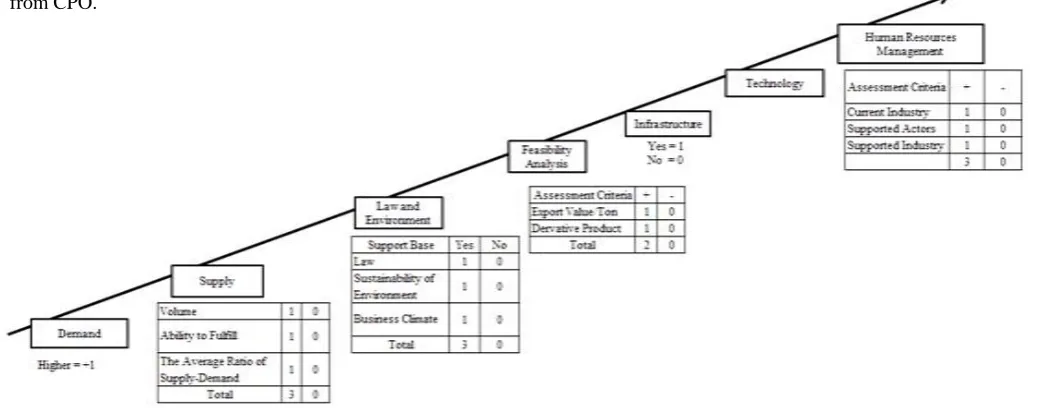
[image:3.595.97.503.69.361.2]At this stage, the decision tree method is used as a supporting tool in selecting derivative products of the upstream industry. The evaluation criteria that have been established in previous steps are used as a benchmark for commodity performance assessment in Riau. Commodities which are classified in the upstream product based on industry tree are CPO and PKO only. Fig. 1 shows a decision tree which is contained by evaluation criteria and Table 3 shows the assessment between CPO and PKO. The result shows that CPO is chosen as the most potential upstream commodity to be developed, then the selection of intermediate industry will be focused on products derived from CPO.
B. Selection of Intermediate Industry
The selection of intermediate industry is conducted by using an evaluation matrix method. The main purpose of this matrix is to evaluate an idea according to several factors or criteria [15]. The weights will be given to each evaluation criteria based on their interests to the objectives of this study, then addressed scores of each intermediate product to that criteria. In this study, the range of value is 1 to 5, where 1 is low (information N/A- not available) and 5 is high (very valuable). Then, multiply assessments with each weights of criteria and total them based on their commodities [16]. The result shows the order of commodity value from the highest to the lowest.
TABLEII
SELECTION EVALUATION CRITERIA
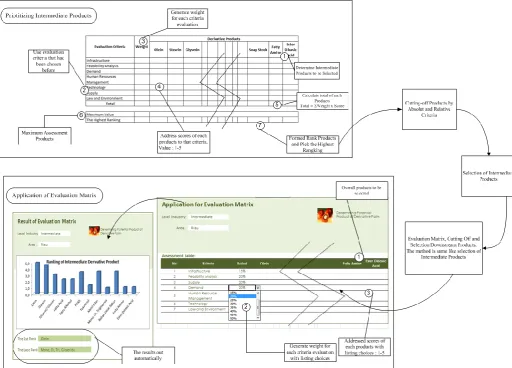
[image:3.595.42.565.558.762.2]There are two cut off options to choose the most potential intermediate product, that are : (1) absolute criteria which is done by paying attention to dependency of raw materials of upstream products against intermediate products, and (2) relative criteria which is based on the demand of intermediate product against to the raw materials of upstream products. The first option will evaluate the ability of CPO capacity in Riau to produce commodities from the first rank, second rank and so on. The chosen product is commodity that ability of CPO capacity can be met by the capacity of intermediate production. While the second option will evaluate the demand for commodities from the first, second and so on, and also evaluate the ability of CPO capacity in Riau to fulfill them. The chosen product is commodity that its market demand can be met by the capacity of upstream production. In this study, we use option 1 then we selected commodity that CPO capacity can be fulfill the capacity of intermediate production, named olein. Fig. 2 shows the steps in selecting of the upstream industry by evaluation matrix.
C. Selection of Downstream Industry
As the intermediate product selection, selecting of this downstream industry also uses evaluation matrix. The result shows that the chosen downstream industry is cooking oil that is the most potential commodities. Illustration how to find this commodity as the most potential downstream industry is described in Fig. 2.
D. Application for Replenishing Evaluation Matrix
In this paper, we also give sample application features in Excel 2007 to replenish the evaluation matrix. It is because the weight changes may occur at any time depends on the purpose of the study, so by the presence of this application,
it will help in assessing process automatically and flexibly. The final result shows a graph that describes ranking each product. The steps to find a holistic valuable chain of palm oil industry, from upstream, intermediate, to downstream are illustrated in Fig. 2 formed simple flowchart so that it can be tutorial how to use our framework.
Fig. 2 shows the steps for selecting intermediate products. But these steps are able to be used for selecting downstream products too. In Fig. 2 on the upper side, it shows a template for assessing process manually. The steps for using our framework in manual template is (1) determining intermediate products to be selected, (2) determining evaluation criteria for selecting potential intermediate products, (3) generating weights for each criteria evaluation, (4) addressing scores of each products to that criteria (value: 1-5), (5) calculating total scores from each products (Total = Ʃ Weight x Score), (6) The highest score will be shown in template and (7) Products that have the highest score will be shown in manual template. From these steps, the result shows prioritize product from the highest to the lowest score manually. To select the most potential of intermediate products, then use cut off criteria which are absolute and relative criteria, so that the most potential of intermediate products can be selected. Then, doing these steps again to be used for the selection of downstream products.
At the bottom of Fig. 2, there are sample application features in Excel 2007 to replenish the evaluation matrix. If weights or scores of commodities change, the calculating of score will change too automatically. The changes will be done flexibly by choosing one of the weights or scores from listing options. The result comes out in graph form, then ranking of each intermediate products can be seen clearly as the result of priority intermediate products. To select the most potential of intermediate products, then use cut off criteria which are absolute and relative criteria, so that the most potential of intermediate products can be selected. Then, doing these steps again to be used for the selection of downstream products.
V. CONCLUSION AND FUTURE WORKS
This paper constructs a holistic feasibility framework for the selection of potential palm derivative industry clusters by considering the whole of the chain of industrial tree. This framework is not only focused on one part of the tree but also to consider all parts of the palm tree. Seven criteria were obtained named as infrastructure, feasibility analysis, supply, demand, human resource management, technology, and law and environment. The decision tree is used to select the derivative product of upstream industry, whereas in the selection of intermediate and downstream products used evaluation matrix method. The result obtained the most potential chain of palm derivative product, which is CPO – Olein – Cooking Oil. Moreover, this paper also provides an application for replenishing evaluation matrix so that the assessment process can be done automatically and flexibly.
The framework should be extended by determining the entities or organizations that required to produce the chosen valuable chain before. Supply Chain Operations Reference (SCOR®) model with plan, source, make, deliver, and return analysis might be suitable to overcome this paper’s deficiency.
TABLEIII
ACKNOWLEDGMENT
The authors thank to Logistics and Business System Laboratory and also International Office Sebelas Maret University for supporting partial funding for the research and its result dissemination.
REFERENCES
[1] Ministry of Industry of Repulic of Indonesia, “Statistik Indagro 2011”, Jakarta, Indonesia : Directorate General of Agro Industry of RI, 2011, pp. 16-17
[2] The Statistic Central Agency of RI, “Indonesian Oil Palm Statistics 2011”, Jakarta : Statistics Central Agency of RI, 2011, ISBN 1978-9947, pp. 15-16
[3] I. Satyawibawa and Y. E. Widayastuti, “Palm Cultivation, Utilization and Market Aspects”, Jakarta : PT Penebar Swadaya, 2000
[4] Coordinating Ministry for Economic Affairs, “Masterplan for the Acceleration and Expansion of Indonesia Economic Development 2011-2025”, Jakarta : Coordinating Ministry for Economic Affairs, 2011, ISBN 978-979-3754-13-0
[5] Commission for the Supervision of Business Competition, “Evaluation of Palm Plantation Policy”, Jakarta: Commission for the Supervision of Business Competition, 2006, pp. 1-6
[6] MPOB Malaysia, “Malaysian Oil Palm Statistics 2008 : World Major Producers of Palm Oil 1999-2008”, 2008. Available : http://econ.mpob.gov.my/economy
[7] I. B. Mayun, “Potential and Prospect of Palm Plantation in Indonesia”, 2009. Available : http://bangkittani.com/wacana/potensi-dan-prospek-perkebunan-kelapa-sawit-di-indonesia/
[8] LIPI, “Palm: Poducts and Their Benefits”, Jakarta : LIPI, 2011
[9] A. Suryani, “Research Capacity in the Downstream Palm Industry”, Bogor : IPB, 2011
[10] Department of Agriculture of RI, “Industrial Tree of Palm”, 2012. Available :
http://pphp.deptan.go.id/xplore/index.php?dir=PENGOLAHAN-HASIL/PENGOLAHAN%20HASIL/2- Teknologi%20Proses/Pohon %20Industri%20Perkebunan&by=size&order=desc
[11] Department of Industry of RI, “A Glimpse into the Palm Oil Industry”, Jakarta : Departement of Industry of RI, 2007
[12] Ministry of Industry of RI, “Regulation of the Minister of Industry of RI No: 13/M-IND/PER/2010”, Jakarta : Ministry of Industry of RI, 2010
[13] A. Basmar, “Referrals of Agro Enterprise Integrated Area Development Based Coconut Comodity in West Lampung”, Bogor : Thesis of Departement of Regional Planning, IPB, 2008
[14] F. Lusby, and H. Panlibuton, “Value Chain Program Design: Promoting Market-Based Solutions for MSME and Industry Competitiveness”, Washington, D.C. : USAID, 2007
[15] M. Rebernik and B. Bradac, “Module 4: Idea Evaluation Methods and Techniques”, Poslovna: Institute for Enterpreneurship and Small Business Management
[16] Leigh, Mathers and Towlson, “Information Source Evaluation Matrix : Always Evaluate your Information”, Leicester: De Montfort University, 2010. Available : http://www.library.dmu.ac.uk/Images/Selfstudy/ISEMLeaflet.pdf [17] I. Pahan, E. G. Said, M. Tambunan, D. Asmono, and A. I. Suroso,
“The Future of Palm Oil Industrial Cluster of Riau Region-Indonesia”, European Journal of Social Sciences- Volume 24, Number 3, 2011, pp: 421-431
[image:5.595.41.554.54.422.2][18] M. Lundy, V. Gottret, W. Cifuentes, C. F. Ostertag, R. Best, D. Peters and S. Ferris, “Increasing the Competitiveness of Market Chains for
Smallholder Producers, Manual 3: Territorial Approach to Rural Agro-Enterprise Development”, Latin America : CIAT, 2004 [19] R. Mariati, “Opportunity of Palm Cooking Oil in East Kalimantan”,
EPP Vol. 4. No. 1. 2007: 43-50
[20] E. Hambali, “Development of Palm Oil Derivative Industrial Cluster”, Published in National Conferences of The Use of Palm Oil- Based Oleochemicals in Various Industries”, Bogor, 2005
[21] G. Van Duijn, “Traceability of the Palm Oil Supply Chain”, Lipid
Technology, vol. 25, no. 1, pp. 15-18, 2013
[22] E. Alfonso, D. Ferrucho, A. Roldan, M. Vargas, and F. Gonzalez, “Scenario Analysis for Reverse Logistrics Implementation Case Study of the Palm Oil Supply Chain”, Proceedings of the 2009 Winter
Simulation Conference, pp. 2310-2319, 2009
[23] D. N. Utama, T. Djatna, E. Hambali, Marimin and D. Kusdiana, “Multi Objectives Fuzzy Ant Colony Optimization of Palm Oil Based Bioenergy Supply Path Searching”, ICACSIS, ISBN : 978-979-1421-11-9, pp. 177-182, 2011
[24] M. Golparvar, and M. Seifbarghy, “Application of SCOR Model in an Oil-Producing Company”, Journal of Industrial Engineering 4, pp. 59-69, 2009
[25] J. F. Mccarthy, Gillespie, Piers and Z. Zen, “Swimming Upstream : Local Indonesian Production Networks in Globalized Palm Oil Production”. World Development, vol. 40 No. 3, Elsevier, pp. 555-569, 2012
[26] W. Sutopo, M. Hisjam, and Yuniaristanto, “An Agri-food Supply Chain Model to Empower Farmers as Supplier for Modern Retailer Using Corporate Social Responsibility Activities on Deteriorated Product”, Lecture Notes in Engineering and Computer Science , pp. 1423-1427, 2012.
[27] W. Sutopo, M. Hisjam, and Yuniaristanto, “An Agri-Food Supply Chain Model to Empower Farmers For Supplying Deteriorated Product to Modern Retailer,” in Lecture Notes in Electrical
Engineering 186 LNEE, 1st ed. S.I. Ao, G.C. Yang, X. Huang, and
O. Castillo, Ed. Heidelberg: Springer, 2013, pp. 189-202.
[28] J. M. Cruz, “Dynamics of SC networks with CSR through integrated environmental decision-making”, European Journal of Operational