Abstract— Coating adhesion strength is one of the most critical issues in magnetron sputtering technique. Therefore; investigating the influence of coating parameters on improving adhesion strength is highly essential. In this research work, an experimental evaluation was conducted to explore the fretting fatigue life of multilayer Cr-CrN coated AL7075-T6 alloy specimens with higher adhesion strength to substrate. PVD magnetron sputtering technique was used for coating purpose. A fuzzy rule-based system was established to investigate how to achieve higher adhesion of Cr-CrN coating on AL7075-T6 with respect to changes in input process parameters, DC power, nitrogen flow rate and temperature for Fretting Fatigue Life Enhancement.
Key words: AL7075-T6; Cr-CrN coating; Fuzzy logic; Fretting
fatigue; Magnetron sputter technique.
I. INTRODUCTION
S light-weight, high strength and high conductivity materials, aluminum alloys are becoming more and more important, particularly in the aircraft and automobile industries for both economic and technical reasons [1]. Dispersion hardening through solution and ageing heat treatments are usually used to induce high static mechanical properties in aluminum alloys. However, these alloys are always subject to different working conditions. Wear and fretting normally originate when the substrate is in contact with other surfaces and they rub each other under normal load, causing share force to act on the surface [2-5]. When two contacting components experience a vibratory motion of small amplitude, it is termed fretting. If these mating components are then subjected to cyclic load, the process is known as fretting fatigue. Fretting fatigue increases the
This work was supported by the high impact research (HIR) grant number: HIR-MOHE-16001-00-D000027 from the Ministry of Higher Education, Malaysia.
E. Zalnezhad is with the Center of Advanced Manufacturing and Material Processing, Department of Mechanical Engineering, Faculty of Engineering, University of Malaya, Kuala Lumpur, 50603, Malaysia
Ahmed. A.D. Sarhan is with the Center of Advanced Manufacturing and Material Processing, Department of Mechanical Engineering, Faculty of Engineering, University of Malaya, Kuala Lumpur, 50603, Malaysia (e-mail: [email protected]).
(Corresponding author to provide phone: +60379674593; fax: +60379675330; e-mail: [email protected])
M. Hamdi is with the Center of Advanced Manufacturing and Material Processing, Department of Mechanical Engineering, Faculty of Engineering, University of Malaya, Kuala Lumpur, 50603, Malaysia (e-mail: [email protected]).
shear and tensile stresses at the contact surface, creating surface flaws which can act as stress concentration sites [6]. For this reason, aluminum alloys are often subjected to surface modifications. Material with proper coating should reveal different properties for working effectively in a given tribological application. Vital coating properties are high adhesion strength to the substrate, low tendency to adhere to the mated material, good wear resistance (high hardness), high fracture toughness and superior chemical and thermal stability. Nowadays, the hard coatings of metal nitrides are used in several tribological applications [7, 8]. The hard coatings are generally deposited via physical vapor deposition techniques such as ion plating, magnetron sputtering, and thermal evaporation, permitting the creation of dense adhesive thin films at low temperatures, which is one of the most important advantages of these sorts of coatings [9]. In the past few decades, transition metal nitride coatings, mostly based on titanium and chromium, have attracted significant attention due to their beneficial potential applications in several fields such as electronics, optical, decorative and magnetic coatings [10, 11]. Cr-CrN thin film coating is particularly appropriate to serve as wear and corrosion protection because of its fine mechanical properties (wear resistance, low friction coefficient and high hardness). Cr-CrN coating using magnetron sputtering technique has the main specific advantages of easily controlled deposition rate and low impurities. Furthermore, this method allows the creation of thin films of numerous crystallographic and morphology structures [12]. Multilayer Cr-CrN coatings are made by changing coating parameters which help the construction of thin films over the crystalline, i.e., lower deposition rate and lower substrate temperature [13]. The traditional method of attaining high strength and hardness at different coating parameters is to use the experimental trial and error approach, which is very time-consuming due to the large number of experiments. Hence, a reliable systematic approach for predicting surface hardness at different parameter conditions is required to cover all the parameter ranges in a low number of experiments [14]. Soft computing techniques are useful when exact mathematical information is not available. In contrast to traditional computing, these techniques suffer from approximation, partial truth, met heuristics, uncertainty, and inaccuracy. One of the soft computing techniques with a significant role in input-output parameter relationship modeling is fuzzy logic system. Artificial intelligence (AI) tools play an important role in
Adhesion Strength Predicting of Cr/CrN Coated
Al7075 Using Fuzzy Logic System for Fretting
Fatigue Life Enhancement
E. Zalnezhad, Ahmed. A. D. Sarhan, M. Hamdi
Table 1 Factors and levels used in experiment
Parameters Levels
1 2 3 4
A DC Power (w) 200 300 400 500
B Temperature(˚C) 150 200 250 300
[image:2.595.313.530.506.719.2]C Nitrogen low rate (%) 3 6 9 12
Table 2 L16 (34) orthogonal array
Experime nt
Parameters combination
Average Scratch Force (mN)
A B C 845
1 1 1 1 1033
2 1 2 2 1030
3 1 3 3 1372
4 1 4 4 939
5 2 1 2 713
6 2 2 1 1287
7 2 3 4 1447
8 2 4 3 1752
9 3 1 3 1426
10 3 2 4 1035
11 3 3 1 794
12 3 4 2 683
13 4 1 4 681
14 4 2 3 823
15 4 3 2 539
16 4 4 1 845
manufacturing processes. Compared to other artificial intelligence methods, development of fuzzy logic is moderately easier and it does not need many software and hardware resources. Fuzzy logic was introduced by Zadeh (1965) and is the victorious application of theory of the fuzzy set, as an extension of the set theory by the characteristic function replacement of a set through a membership function whose values range from 0 to 1. A considerable amount of studies have focused on the prediction and measurement of coating surface integrity [15].
In this study, Al7075-T6 substrate was coated with Cr-CrN at different parameter conditions. Each parameter has four levels, namely: substrate temperature, nitrogen percentage and DC power. The fuzzy rule-based method was proposed to investigate surface adhesion of multilayer Cr-CrN coating on AL7075-T6 alloy. The fretting fatigue life of Cr-CrN coated specimens with high adhesion was investigated.
II. EXPERIMENTAL
A. Material, Specimen preparation and construction of fretting portions
The material investigated in this work is Al-7075-T6 aluminum alloy with the following chemical composition (wt%): 4.6Zn; 1.8Mg; 1.85Cu; 0.06Mn; 0.47Si and 0.28Cr. The ultimate strength and yield stress of Al7075-T6 were attained via a number of tensile tests, and they are:
ut=590MPa and y=520MPa, respectively.
For sample preparation, the cylindrical shape test specimens, show in Fig. 1(a), were machined by lathe turning (CNC LATHE MACHINE, Miyano, BNC-42C5) in accordance with ISO 1143 standard [16]. Fretting fatigue pads were fabricated from AISI 4140 steel plate with hardness of 346HV. Substrate material (179HV) is softer than the pads but Cr-CrN coating (630HV) is harder. The friction pads drawings are depicted in Fig. 1(b).
[image:2.595.59.284.530.597.2](a) (b)
Fig. 1 Drawings of the fretting fatigue specimen and the fretting pad
B. Coating Procedure
In order to make the films adhere well to the substrates, surfaces must be carefully cleaned before film deposition. Therefore, all substrates were polished with SiC paper of 800-2000 grit, and were surface mirrored with diamond liquid. The substrates were ultrasonically cleaned in alkali and alcohol baths, respectively, and thoroughly rinsed with distilled water. The samples were then inserted into the chamber for in-situ cleaning. The chamber was evacuated to a pressure of 3.7×10⁻⁵Torr, and the substrates were heated to 350°C for one hour. This process mainly removed water molecules, which were absorbed on almost all surfaces.
During the last step of cleaning, called ion-etching or Ar+ sputtering, Ar+ ions were accelerated by applying substrate bias potential Vs (−200V) onto the substrates. In the ion-etching process, oxides or chemisorbed nitrogen and/or carbon atoms were removed. A magnetron sputtering machine (SG Control Engineering Pte Ltd) was utilized in order to deposit thin film on the metal. DC generators were selected to facilitate the sputter metals. Sputtering pressure was adjusted to around 5.2 ×10⁻³Torr. Table 1 presents the coating parameter conditions used in this experiment, in an investigation of how to increase sputtered CrN thin film adhesion to the substrate. A pure chromium 99.95% target was selected for exploring the sputtering parameters condition for Al 7075-T6 alloy. Pure chromium was initially coated onto the substrate as an interfacial layer for one hour to improve adhesion between the substrate and second layer of coating (chromium nitride). The deposition time for the second layer was adjusted to 3 hours.
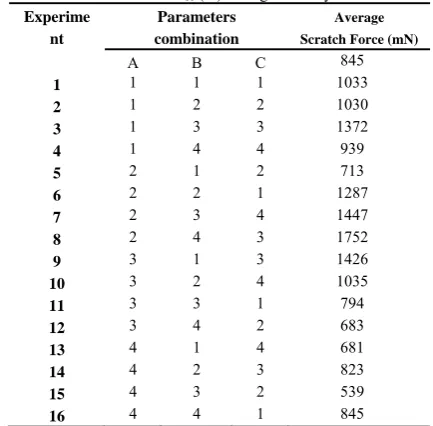
The coating procedure was planned using the experimental array shown in Table 2. Adhesion of coating to substrate is the most essential factor to be investigated. The layers were characterized by scanning electron microscopy (FE/SEM-FEG) and focused ion beam technique (Quanta FEG250). Substrate adhesion was measured using micro-scratch force equipment (Micro Material Ltd, Wrexham, U.K.). Each experiment was repeated three times and the average values were used for analysis.
C. Fretting fatigue test
applied at a frequency of 50Hz and constant contact pressure of 100MPa at room temperature to attain the S-N curves. This type of testing was chosen because it produces the greatest amount of stress on specimen surface.
III. RESULTS OF EXPERIMENTAL WORK
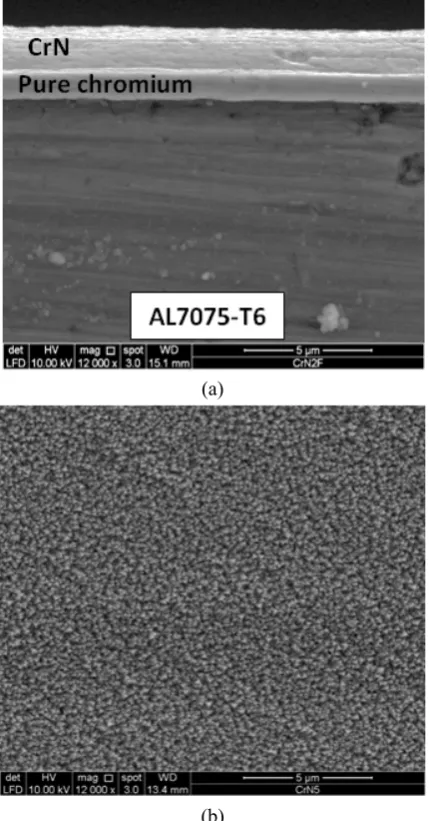
Figures 2(a) and (b) show the SEM cross section and surface view of thin film Cr-CrN coating. As it can be seen under the SEM, the coatings consist of two distinct parts: the interfacial layer (pure chromium) and the second layer (CrN) on AL 7075-T6 alloy. The adhesion strength (scratch force) of the coating layers to substrate was measured utilizing the aforementioned equipment. Each measurement was repeated three times, and the measured values are summarized in Table 2.
(a)
[image:3.595.62.277.264.675.2](b)
Fig. 2 Typical (a) cross-sectional and (b) surface views of SEM micrograph of Cr-CrN coating on AL7075-T6.
An initial load (zero) was applied onto a sample by a Rockwell type diamond indenter with a radius of 25µm at a sliding velocity of 5µm/sec. The load was increased gradually by 9.2mN/sec. Scratch length during the scratch test was 1000µm. In the scratch test, critical load Lc could be used to calculate adhesion strength. Critical load
magnitude was obtained by applying acoustic signal, friction curve and microscope observation. Acoustic signal produced by film delamination could be used to characterize the critical load (Lc). Scratch adhesion testing was performed on a coated sample to measure Lc. The two images shown in Figs. 3(a) and (b) represent the weakest and strongest adhesion strengths.
Fig. 3 Adhesion strength of Cr-CrN coated samples at different condition (a) weak adhesion (DC power 500W, temperature 150 and nitrogen flow rate 3%, scratch force 510 mN) and (b) strongest adhesion (DC power 300W, temperature 250 and nitrogen flow rate 9%, scratch force 2200 mN)
IV. FUZZY LOGIC MODEL
Fuzzy logic is a continuous conversion from truth to false conditions, as opposed to the separate true: false transition in binary logic. The possibility theory of fuzzy logic provides a measure of a subset’s potential ability to belong to another subset. It can be shown that the probability theory is a special case of the possibility theory [14]. Therefore, fuzzy logic has an extensive scope and range of applications compared to many other statistical methods.
Fuzzy logic in engineering applications utilizes this continuous transition in subset membership to alter a problem from wavy numeric to fuzzy linguistic territories. Fuzzy logic employs conventional language to define variables and uses fuzzy linguistic rules to describe relationships instead of working with numeric values of variables and using mathematical functions. This is especially beneficial in coatings where some variables such as DC power, temperature, and the effect of nitrogen flow rate, have no exact numeric values. It also allows the use of accrued experience and knowledge in the form of rules-of-thumb, which cannot be incorporated into a mathematical formula. The most important power of fuzzy logic is that when correctly choosing fuzzy rules and membership functions, it can simulate very complex and non-linear systems while obviously maintaining the physical inferences and effects of every variable. The fuzzy rule base contains a group of IF–THEN declarations with three inputs, A, B and C, and one output, D. The notion of fuzzy argumentation for three inputs and one output of the fuzzy logic unit are defined as follows:
Rule 2: if A is X2 and B is Y2 and C is Z2 then D is W2; else
Rule n: if A is Xn and B is Yn and C is Zn then D is Wn Xn, Yn, Zn, and Wn are fuzzy subsets distinctive by their
corresponding membership functions, λXn, λYn, λZn, and λWn, respectively.
Sixteen fuzzy rules were established based on the experimental conditions. By following the maximum-minimum compositional process, the fuzzy logic of these rules results in fuzzy output. Assuming that A, B, and C are the three input parameters of the fuzzy logic unit, the membership function of the fuzzy logic output can be stated as [15]:
λW0(D)= [λX1(A) ∧ λY1(B) ∧ λZ1(C) ∧ λW1(D) ∨ … × λXn(A) ∧λYn(B) ∧λZn(C) ∧λWn(D)]
Where, ∨ is the maximum and ∧ is the minimum operation. There are different forms of membership functions such as triangular, trapezoidal, Gaussian, sigmoid, etc. In this present study, the Gaussian membership function for input parameters DC power, temperature and nitrogen flow rate, and triangular membership function for the output parameter of coating adhesion strength are presented. The Gaussian fuzzy membership function often used to characterize vague, linguistic terms is given by:
Where, Cn and n are the center and width of the nth fuzzy
set An, respectively.
The triangular form membership function for output is definite by three parameters {a, b, c} as follows [23]:
By utilizing minimum and maximum, an alternate
statement for the following equation is:
Where; a, b, c define the triangular fuzzy triplet and
determine the x coordinates of the three corners of the underlying triangular membership function.
The numerical input–output values are connected by linguistic variables. This was attained by designing membership functions consisting of a set of fuzzy set values. Linguistic values such as LOW, MEDIUM, HIGH and VERY HIGH show the input variables’ DC power, temperature, and nitrogen flow rate. The output numerical values (adhesion to substrate) are also closely connected in the same way, using membership functions such as LOW, AVERAGE, HIGH and HIGHER.
Gaussian membership functions for input parameters’ DC power, temperature and nitrogen flow rate and output parameter adhesion strength using triangular membership function are used in this study. Lastly, a defuzzification process was carried out. Defuzzification is an imperative procedure in the theory of fuzzy sets, and modifies fuzzy set information into numeric information. This process,
accompanied by fuzzification, is critical in designing fuzzy systems because both of these processes deliver a series of connections between the fuzzy set region and real-valued scalar region. Defuzzification with a form of centroid was designated, because it provides the possibility distribution’s center area of the inference output and is a more frequently used defuzzification method for calculating the centroid of the area under the membership function [14, 15].
The non-fuzzy value D0 gives the output value in
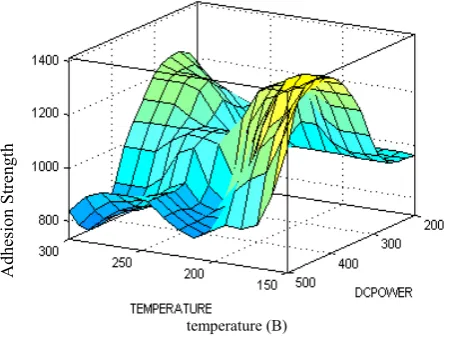
numerical form. Figure 4 (a&b) shows the predicted surface adhesion by fuzzy logic in relation to parameter change. Figure 4(a) manifests the predicted adhesion strength using fuzzy logic in relation to change nitrogen flow rate and temperature. It is presented that the strength of adhesion between substrate and coating increases by raising the nitrogen flow rate from 3 to 9%. However, a higher nitrogen value leads to a decline in adhesion strength. Study of Fig 4 (b) suggests that coating adhesion strength is increased with increasing DC power from 200 to 400W. From Figs. 4 (a&b) it can be understood that temperature has less effect than the other two parameters. However, the best temperature value for achieving higher adhesion strength of CrN coating seems to be around 250˚C.
(a) Adhesion strength in relation to change nitrogen flow rate (C) and
temperature (B)
[image:4.595.310.532.368.518.2](b) Adhesion strength in relation to change DC power (A) and temperature (B)
Fig. 4 The predicted adhesion strength by fuzzy logic in relation to parameters change
Adhesion Strength
[image:4.595.308.533.556.725.2]After the fuzzy rules were created, six new experimental tests from separate experiments were carried out, while the proposed fuzzy model was used to predict surface adhesion under the same conditions as in Table 3 for further investigation of fuzzy model suitability compared to experimental results. The comparison between experimental results and fuzzy model prediction values are depicted in Fig. 5. The figure conclude that the experimental and fuzzy results are in very close agreement to each other and hence the fuzzy logic method can be efficiently used for predicting the adhesion strength of Cr-CrN coating on substrate in magnetron sputter coating technique. Maximum model error was found to be less than 7%, indicating that the fuzzy prediction model can be used to predict CrN coating adhesion strength by application of magnetron sputtering technique in change in parameters levels.
Fig. 5 Comparison between experimental and fuzzy results
V. FRETTING FATIGUE LIFE EVALUATION OF MULTILAYER
CR-CRN COATED AL7075-T6
In order to investigate the fretting fatigue life of specimens coated with Cr-CrN at high surface adhesion, some experiments were carried out and the results are shown in Figs. 6(a) and (b).
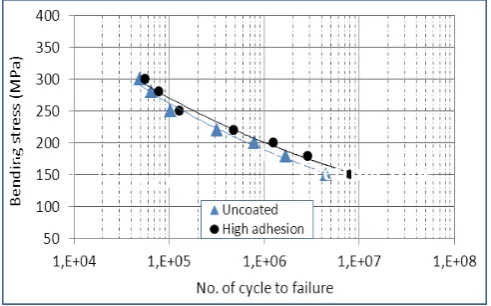
The experiments were conducted for a stress ratio of R=-1, 50Hz, at a constant contact force of 100Mpa and working stress amplitudes of 150 to 300MPa. Each data point on the S/N curve represents the average of five specimens tested under identical conditions. Figure 6(a) shows a comparison of the number of cycles to failure versus bending stress for plain fatigue and fretting fatigue of uncoated specimens. As shown in Fig. 6 (a), the fatigue life of uncoated specimens diminished with increasing bending stress. It is also evident that fretting has a deleterious effect on fatigue life. The S/N curve of fretting fatigue for uncoated and Cr-CrN coated
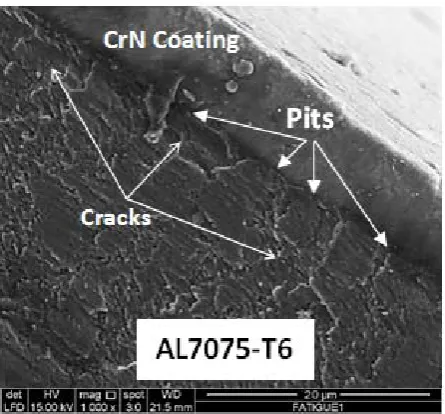
specimens with higher surface adhesion is illustrated in Fig. 6 (b). The fretting fatigue lives of Cr-CrN coated specimens were enhanced at both low and high cyclic fatigue as opposed to uncoated specimens. Figures 7 (a) and (b) show typical microscopic image examples from cross sectional views of fractured uncoated and Cr-CrN coated specimens under fretting fatigue test. From the images it can be understood that the fractured surfaces consist of two areas: the fretting regions made by friction pads and a tensile district made by bending stress. A typical SEM micrograph of a CrN coated specimen with adhesion of 2200mN after fracture under fretting fatigue at a stress of 200MPa is shown in Fig. 8. This figure manifests the CrN thin film coating on AL7075-T6 alloy which acts as antifriction under the fretting pads.
(a) S/N curve of plain fatigue and fretting fatigue for uncoated specimens
b) S/N curve of fretting fatigue for uncoated and Cr-CrN coated with highest surface adhesion specimens
Fig. 6 S/N curve of fretting fatigue test
(a) (b)
[image:5.595.51.285.384.531.2]Fretting zone
Fretting zone
Table 3 The accuracy and error of the fuzzy logic model prediction No. of
Experiment Parameters (Inputs)
Scratch force result (output) (mN)
Measured scratch force Standard deviation
( )
Predicted adhesion
strength (Fuzzy) Error %
A B C 1st 2nd 3rd Average
1 225 160 4 871 884 866 874 6,57172 897 2.63
2 250 180 5 1085 1115 1101 1100 10,61544 1148 4.36
3 275 220 7 1565 1442 1612 1540 62,07405 1591 3.12
4 350 240 8 1694 1712 1724 1710 10,67708 1763 3.10
5 375 260 10 1416 1410 1381 1402 13,23584 1475 5.21
[image:5.595.304.550.561.714.2]VI. DISCUSSION
A. Adhesion Strength
[image:6.595.52.278.272.382.2]The results clearly indicate that applying DC power (in the range of 200 to 400W) improves coating adhesion properties. This can be attributed to the additional energy available to the growing film. Thus, high-energy atoms have greater mobility to find the surface’s low energy sites for maximizing adhesion characteristics. It was observed that maximum coating adhesion was obtained with a critical load of 2200mN. The best condition for scratch force of surface was achieved at maximum DC power (400). However, further increasing DC power would result in very high-energy bombardments, adding many defects to the growing film and lowering coating adhesion to a certain level [17]. Temperature has less effect on scratch force (adhesion); the best point for the highest surface adhesion is (250˚C).
Fig. 7 Typically example of microscopic image from cross sectional view of fractured specimens under fretting fatigue test (a) uncoated (b) Cr-CrN
coated
Fig. 8 Typically SEM micrograph of CrN coated specimen with adhesion of 2200 (mN) after fracture at stress of 200 MPa.
Nitrogen is another important parameter playing a significant role in the effect on adhesion between substrate and coating. The detected enhancement in adhesion strength can be attributed to the increased strength of the nitrogen influencing the Cr interlayer. Nitrogen gas does not significantly change the chemical nature of α-Cr, because no CrN compound is formed and nitrogen is dissolved in the α -Cr lattice. It is thus expected that nitrogen gas will influence the Cr interlayer. When the nitrogen rate increased from 3%
to 9%, the chromium nitride coating adhesion to the substrate increased. But, by further increasing nitrogen content, the interlayer became too strong and brittle to accommodate interfacial stresses, leading to an obvious reduction in adhesion strength. The nitrogen gas at 9% N2 seemed to produce the optimum strength value for adhesion enhancement in the present deposition conditions [17, 18].
B. Fretting fatigue S/N curve
The corresponding plain fatigue and fretting fatigue S/N curves at contact pressure of 100MPa are displayed in Fig. 6 (a). Clearly, there is a significant reduction in fretting fatigue life compared to normal fatigue life, particularly at lower stresses. Decreased fretting fatigue life of uncoated specimens as opposed to plain fatigue is due to the existence of stress concentration in the interface area between the friction pads and substrate. The fretting fatigue crack formed in the region where the frictional shear stress on the contact surface locally concentrated. Thus, the decrease in fatigue life due to fretting damage is considered to be attributable to the increase in crack initiation life caused by the local stress concentration produced by fretting, and the acceleration of the initial crack propagation by fretting.
Figure 6 (b) shows the S/N curve of fretting fatigue for uncoated and Cr-CrN coated AL7075-T6 with the highest surface adhesion. The fretting fatigue lives of coated specimens with high surface adhesion improved at both low and high cyclic fatigue. The values of surface hardness, adhesion and roughness of Cr-CrN coated specimens with
the best adhesion are 630HV, 2150mN and 0.055μm
respectively. The surface hardness of Cr-CrN with high adhesion coating is 630HV, which seems to be sufficient to endure under the contact pressure of the fretting pads (346HV).
Figure 8 represents fracture of a Cr-CrN coated specimen with high adhesion (2200mN). The fretting fatigue life of this Cr-CrN coated specimen is more than an uncoated specimen’s, which is attributed to sufficient hardness, higher elasticity and good adhesion that caused the coating to endure the contact pressure under the fretting pads. Another advantage of the Cr-CrN coating with high adhesion is the suitable roughness (0.055µm) which effectively influences the increase in fretting fatigue life.
A comparison between fretting fatigue life of uncoated and Cr-CrN coated specimens indicate that the lives of coated specimens increased more at high cyclic fatigue, which is attributed to the coating’s sufficiently high stability under the fretting pads during the fretting fatigue test. The fretting fatigue results of the coated specimen with higher adhesion strength imply that Cr-CrN multilayer coating on AL7075-6 alloy by magnetron sputtering technique can improve the fretting fatigue lives of AL7075-T6 by 70% and 22% at high and low cyclic fatigue, respectively.
VII. CONCLUSION
In this research work, Cr-CrN thin film was coated on AL7075-T6 alloy at different coating parameter conditions utilizing PVD magnetron sputtering technique. The
Fretting zone
Fretting zone
(a (b
Tensile
Fretting
Fretting
Tensile
Fretting
[image:6.595.59.282.424.631.2]influence of different coating parameters on adhesion strength to substrate was investigated through a fuzzy logic model. The experimental and fuzzy logic model results are
in very close assent. The fretting fatigue lives of samples
coated with Cr-CrN with the best adhesion strengths were evaluated at different bending stresses. The S/N curve indicates that thin film Cr-CrN multilayer coating improved the fretting fatigue life of AL7075-T6 alloy by 70% and 22% at high and low cyclic fatigue respectively.
ACKNOWLEDGMENT
This research was funded by the high impact research (HIR) grant number: HIR-MOHE-16001-00-D000027 from the Ministry of Higher Education, Malaysia.
REFERENCES
[1] Genel, K. (2007). The effect of pitting on the bending fatigue performance of high-strength aluminum alloy. Scripta Materialia. (57). 297–300.
[2] Pao, P. S., Gill, S. J., & Feng, C. R. (2000). On fatigue crack initiation
from corrosion pits in 7075-T7351 aluminum alloy. Scripta mater.
(43). 391-396.
[3] Lee, H., & Mall, S. (2006). Fretting behavior of shot peened Ti-6Al-4V under slip controlled mode. Wear. (260). 642-651.
[4] Majzoobi, G. H., Nemati, J., NovinRooz, A. J., & Farrahi, G. H. (2009). Modification of fretting fatigue behavior of AL7075– T6 alloy by the application of titanium coating using IBED technique and shot peening. Tribology International. (42). 121-129.
[5] Cirik, E., & Genel, K. (2008). Effect of anodic oxidation on fatigue performance of 7075-T6 alloy. Surface & Coatings Technology. (202). 5190-5201.
[6] Lietch, L. C., Lee, H., & Mall, S. (2005). Fretting fatigue behavior of Ti-6Al-4V, under seawater environment. Materials Science and Engineering A. (403). 281-289.
[7] Majzoobi, G. H., & Jaleh, M. (2007). Duplex surface treatments on AL7075-T6 alloy against fretting fatigue behavior by application of titanium coating plus nitriding. Materials Science and Engineering A. (452–453, 15). 673-681.
[8] Ortmann, S., Savan, A., Gerbig, Y., & Haefke, H. (2003). In-process structuring of CrN coatings and its influence on friction in dry and lubricated sliding. Wear. (254). 1099-1105.
[9] Sresomroeng, B., Premanond, V., Kaewtatip, P., Khantachawana, A., Kurosawa, A., Koga, N. (2011). Performance of CrN radical nitrided tools on deep drawing of advanced high strength steel. Surface & Coatings Technology. (205). 4198-4204.
[10] Rebole, R., Martinez, A., Rodriguez, R., Fuentes, G. G., Spain, E., Watson, N., Batista, J. C. A., Housden, J., Montala, F., Carreras, L. J., & Tate, T. J. (2004). Microstructural and tribological investigations of CrN coated, wet-stripped and recoated functional substrates used for cutting and forming tools. Thin Solid Films. (469–470). (466-471).
[11] Bertrand, G., Mahdjoub, H., & Meunier, C. A.(2000). Study of the
corrosion behaviour and protective quality of sputtered chromium nitride coatings. Surface & Coatings Technology. (126) 199-209. [12] Sahoo, P. (2009). Wear behaviour of electroless Ni–P coatings and
optimization of process parameters using Taguchi method. Materials and Design. (30). 1341-1349.
[13] Hanafi, I., Khamlichi, A., Cabrera, F. M., Lopez, P. J. N., & Jabbouri, A. (2012). Fuzzy rule based predictive model for cutting force in turning of reinforced PEEK composite. Measurement. (45). 1424-1435.
[14] Biglari, F. R., & Fang, X. D. (1995). Real-time fuzzy logic control for maximizing the tool life of small-diameter drills. Fuzzy Sets and Systems. (72). 9l-101.
[15] Nandi, A. K., & Davim, J. P. (2009). A study of drilling performances with minimum quantity of lubricant using fuzzy logic rules, Mechatronics. (19). 218-232.
[16] ISO Standard, Metallic materials- rotating bar bending fatigue testing, ISO International, 2010.
[17] Gupta, A., Singh, H., & Aggarwal, A. (2011). Taguchi-fuzzy multi output optimization (MOO) in high speed CNC turning of AISI P-20 tool steel. Expert Systems with Applications. (38). 6822–6828. [18] Latha, B. & Senthilkumar,V. S. (2010). Modeling and Analysis of