11. S
ITE
1218
1Shipboard Scientific Party
2BACKGROUND AND OBJECTIVES
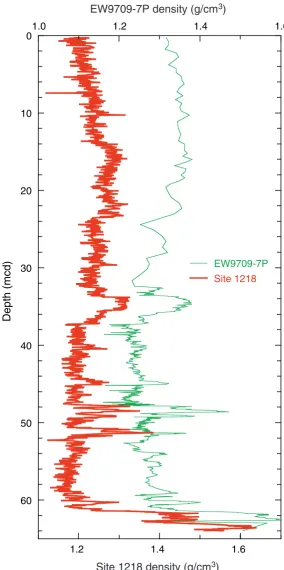
Site 1218 (8°53.378′N, 135°22.00′W; 4828 meters below sea level [mbsl]; Fig. F1) is the sole site to be drilled on the 40-Ma transect during Leg 199 and will be used to investigate paleoceanographic processes in the equatorial Paleogene Pacific Ocean during the inferred transition of Earth’s climate from the early Paleogene “greenhouse” into the late Paleogene “icehouse.” Site 1218 is situated on a basement swell ~3° north of the Clipperton Fracture Zone in the central tropical Pacific Ocean. The age of basement at Site 1218 was poorly constrained prior to Leg 199 because the crust formed near the Eocene magnetic equator so that little magnetic anomaly data are available between the Clipper-ton and Clarion Fracture Zones (Cande et al., 1989). Thus, prior to Leg 199, our estimate for basement age at Site 1218 (~40 Ma) was based on previous drilling and assumed spreading rates. Nevertheless, at the out-set of Leg 199 drilling, the availability of sediment descriptions from Deep Sea Drilling Project (DSDP) Sites 161, 574, and 575 meant that the Cenozoic history of sedimentation in the region of Site 1218 was better constrained than in the regions of Sites 1215, 1216, and 1217. Based on data from these rotary-cored holes, shallow-penetration piston cores taken near Site 1218 (taken on the site survey EW9709-7PC), and seis-mic profiling (Fig. F2), we expected the sedimentary sequence at Site 1218 to comprise a relatively thick (25 to 35 m thick) section of clays overlying radiolarian and nannofossil oozes to chalks of early Miocene– late Eocene age with little to no chert (estimated total depth ~250–280 meters below seafloor [mbsf]).
Site 1218 was chosen because it is anticipated to have been located on the equator at 40 Ma (at ~0°N, 107°W) based upon a fixed hotspot model (Gripp and Gordon, 1990, for 0- to 5-Ma Pacific hotspot rotation pole; Engebretson et al., 1985, for older poles) and because our interpre-tation of seismic data suggested that this site afforded the best
possibil-160°W 150° 140° 130°
0°
10°
20°
30°
N
0 500 1000 Site 1215 Site 1216 Site 1217 Site 1218 Site 1219 Site 1220 Site 1221 Site 1222 Site 40 Site 42 Site 43
Site 69 Site 70 Site 71 Site 72 Site 160 Site 161 Site 162 Site 163 Site 573 Site 574 Site 575 Honolulu
Molokai F.Z.
Clipperton F .Z. Clarion F.Z.
Site 1216 Site 1217 Site 1218 Site 1222 Site 1221 Site 1220 Site 1215
Molokai Fracture Zone
Clarion Fracture Zone
Mahi M ahi Fracture Zone
Site 1219
Clipp erton Fracture Zone
574 573 575 161 162 163 40 42 43 70 71 72 0° 10° 20° 5° 15° 25° N 150°W 145° 140° 135°
km
Leg 199 sites DSDP sites
F1. Site location map, p. 40.
PAT8-Line 1 Bandpass 3 km
T w o-w ay tr a veltime (ms) Hour Minute 6300 6500 6600 6700 6800 6900 6400
X Line 3 EW9709-7PC X Line 2
N S
Site 1218
PAT-8C X Line 4
F2. Seismic reflection profile, p. 41.
1Examples of how to reference the
whole or part of this volume.
2Shipboard Scientific Party
addresses.
ity of penetrating Eocene/Oligocene (E/O) boundary sediments within the depth range of the Ocean Drilling Program’s (ODP’s) advanced pis-ton corer (APC) system (~180 mbsf in these sediments).
The paleoceanographic and paleoclimatic objectives of drilling the sedimentary sequence anticipated at Site 1218 are as follows: (1) to help define the shift in the Intertropical Convergence Zone through the Paleogene by following the change in eolian dust composition and flux (red clays) through time; (2) to help constrain changes in the calcite compensation depth (CCD) from the late Eocene to the early Oli-gocene; (3) to obtain a complete Oligocene section of tropical-assemblage carbonate and siliceous microfossils with good magneto-stratigraphic control; and (4) to sample the E/O boundary, late Oli-gocene, and Oligocene/Miocene (O/M) boundary, three of the most cli-matologically interesting intervals of Cenozoic time. Recovery of deep-sea sediments from above the CCD across the E/O boundary time inter-val during Leg 199 is a particularly high priority because complete E/O boundary sections for this time interval are not available from the Pa-cific Ocean.
SUMMARY
Site 1218 (8°53.38′N, 135°22.00′W) is the only Leg 199 drill site on the 40-Ma transect and is situated at a water depth of 4826 m. It was chosen for drilling in order to investigate paleoceanographic processes in the equatorial Paleogene Pacific Ocean during the inferred transition of Earth’s climate from the early Paleogene greenhouse into the late Paleogene icehouse state. Site 1218 is situated on a basement swell ~3° north of the Clipperton Fracture Zone in the central tropical Pacific at a water depth of 4826 m. Pacific plate motion carried Site 1218 across the equator at ~40 Ma based upon a fixed hotspot model (Gripp and Gor-don, 1990, for the 0- to 5-Ma Pacific hotspot rotation pole; Engebretson et al., 1985, for older poles). Based upon the same model, the site re-mained within 2° of the equator from the time crust was formed until 27 Ma. Therefore, sediments recovered from Site 1218 should record near-equatorial oceanographic conditions from the middle Eocene until the early Oligocene. The precise age of basement at the site was poorly constrained prior to Leg 199 because little magnetic anomaly data are available between the Clipperton and Clarion Fracture Zones (Cande et al., 1989).
At Site 1218, we recovered a complete sediment section to within 15 m of basaltic basement. A continuous spliced section (from 0 to 263 mbsf) was developed using the three drilled holes (~41–42 Ma; nanno-fossil biostratigraphic Subzone CP14a). The sediments immediately overlying basalt are from near the CP14a/CP13 boundary (42 Ma), which indicates that basement at Site 1218 is slightly older than origi-nally expected. A full suite of downhole logs were obtained to the base of the Hole 1218A, and the data are of excellent quality.
In contrast to other sites, the cherty sections at Site 1218 were com-pletely recovered by extended core barrel (XCB) coring, undoubtedly because they were interbedded with chalks rather than ooze. The base of the sediment column is middle Eocene chalk (250–274 mbsf). The lower 7 m of the chalk is dolomitized with up to 20% dolomite in the coarse fraction. Basalt was recovered at the base of the drilled section.
Planktonic foraminifers are sporadically present through the lower Miocene, Oligocene, and middle Eocene sediments at Site 1218 with generally less consistent presence than other calcitic groups such as benthic foraminifers and calcareous nannofossils. Samples show at least some dissolution of planktonic foraminifers with preferential preserva-tion of thick-walled, large specimens, in many cases. Middle Oligocene sediments (Zones P21 and P20) were generally the best preserved and most species-rich sediments for planktonic foraminifers at Site 1218. Benthic foraminifers are present in core catchers throughout the cored interval except in the Neogene radiolarian clays and the upper Eocene interval. Calcareous nannofossils, in contrast, are present at varying concentrations and states of preservation from uppermost middle Mio-cene Zone NN8 (37mbsf) to the base of the sediment section. Radiolari-ans were found in all recovered cores.
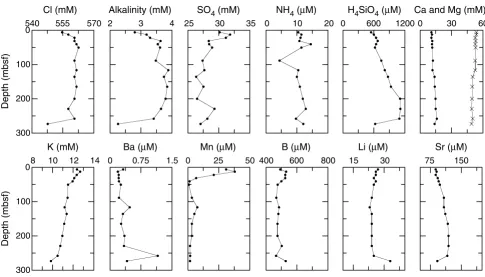
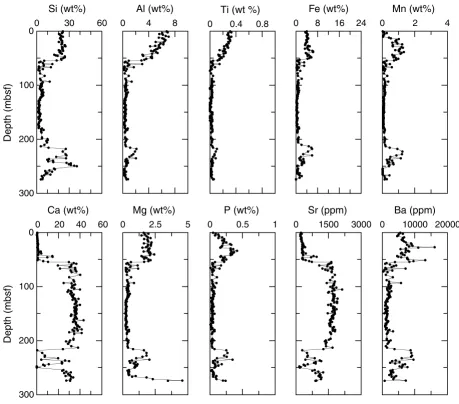
Pore water chemical profiles at Site 1218 are subtle. Sulfate concen-trations are near seawater values throughout the section, indicating the lack of significant organic matter diagenesis, whereas trends in Ca and Mg reflect modest basement alteration. Bulk-sediment concentrations (measured every 1.5 m) outline the major lithologic units. Only Ca and Sr concentrations are high in the lower Oligocene–Miocene nannofossil oozes, and all other elements tend to be higher in the clays and radio-larite sediments. Biogenic enrichment of Ba can be detected through Ba/Ti ratios. High Mg concentrations can be found in the basal dolo-mitized chalk.
Natural remanent magnetization (NRM) intensity of the sediments at Site 1218 is relatively strong, and magnetic overprint from drilling can be mostly removed by alternating-field (AF) demagnetization. An excel-lent record of magnetic reversals was made for the entire APC-cored sediment section (0–210 meters composite depth [mcd]) to Chron C12r of the early Oligocene. In addition, magnetic inclinations were deter-mined on discrete samples after more thorough demagnetization. Mid-dle and early Miocene samples have an average inclination of 5.2° (range = +2.2° to +8.4°), whereas the Oligocene samples have an average inclination of 3.8° (α95 = 6.2), which is indistinguishable from the
paleoequator.
Highlights
Composite Section
Oligocene–Miocene Transition
The short range of nannofossil species Sphenolithus delphix provides a reliable marker close to the O/M boundary between Subchrons C6Cn.3n and C6Cn.2n (Raffi, 1999), and on this basis, the O/M bound-ary in Site 1218 occurs at ~98 mbsf. The first occurrence of the plank-tonic foraminifer Paragloborotalia kugleri (the marker for the O/M boundary) and first occurrence of the radiolarian Cyrtocapsella tetrapera
also occur at this depth.
Calcareous benthic foraminifer assemblages indicate lowermost bathyal and upper abyssal paleodepths at Site 1218. Examination of test walls under transmitted light indicates that most of the benthic fora-minifers at this site have suffered little or no postburial diagenetic alter-nation. Average sedimentation rates across the Oligocene–Miocene transition (~1–2 cm/k.y.) are relatively high for a deep-ocean Pacific setting.
Eocene–Oligocene Transition
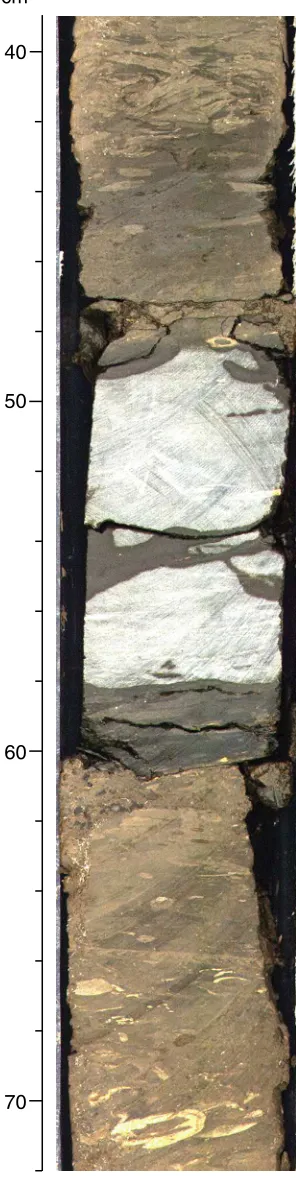
The E/O boundary at Site 1218 is characterized by a major lithologic change involving a two-step downcore shift from pale nannofossil chalk to dark radiolarite. This transition from carbonate-rich to carbonate-poor sediments is also evident as a two-step decrease in gamma ray attenuation (GRA) bulk density and a decrease in magnetic susceptibility (MS) values in MST data. Based upon biostratigraphic in-formation, this transition occurs across or just above the Eocene– Oligocene transition.
The extinction of the calcareous nannofossil Discoaster saipanensis is estimated to have occurred ~0.3 m.y prior to the E/O boundary event sensu stricto (extinction of the planktonic foraminifer genus Hantken-ina), and the last representative of the Paleogene rosette-shaped discoasters, Discoaster barbadiensis, disappeared ~0.2 m.y. before D. saipanensis. D. barbadiensis and D. saipanensis are constrained to have disappeared over narrow (~20–30 cm) intervals in Site 1218 sediments, shortly below the major change in lithology. These findings reveal that the entire two-step change in lithology occurred within Zone NP21 (CP16c) above the extinction of the last Eocene discoasters. Based on a linear sedimentation rate (LSR), the estimated position of the E/O boundary is at 243.3 mcd, whereas the midpoint of the initial change in carbonate composition is at 242.0 mcd. The midpoint of the second, final step in carbonate composition is at 240.0 mcd. The boundary-con-dition change of the ocean-climate system that caused the first step of this drastic deepening of the CCD and accompanying change in sedi-mentation in the tropical Pacific Ocean occurred near the middle of Oi-1 (33.5–33.Oi-1 Ma) (Zachos et al., 200Oi-1) on the common timescale used (Cande and Kent, 1995). The abrupt change in the lithologies across the Eocene–Oligocene transition is a reflection of the rapid deepening of the CCD (van Andel et al., 1975) in the Oligocene. Site 1218 demon-strates that the change in CCD occurred during the earliest Oligocene in two steps: as a rapid increase in calcium carbonate (CaCO3) over 10–
~20 k.y. followed by a pause of ~100–200 k.y. and then another rapid increase in CaCO3 over 10–~20 k.y. The CCD was shallower than ~3600
Middle and Late Eocene Radiolarites
From Site 1218, it is clear that radiolarian-rich sediments are charac-teristic of the late and late–middle Eocene Pacific Ocean, even near the equator. Nannofossils occasionally are dominant sediment compo-nents, showing that the CCD deepened beyond the paleodepth of Site 1218 at times within the late and middle Eocene. The presence of radio-larians and occasional intervals of nannofossils and the relative absence of diatoms (except in specific intervals near the E/O boundary) is more typical of Neogene plankton assemblages found at the fringes of the equatorial high-productivity zone than in the near-equatorial position that Site 1218 probably occupied during the middle and late Eocene.
Middle Eocene Basal Sediments
The basal nannofossil chalks of Site 1218 abruptly become radiolar-ites upcore at ~40 Ma (base of nannofossil Subzone CP14b; Core 199-1218C-21X). The transition from chalks to radiolarites occurs over only 1.5 m when the site was at a paleodepth of 3000–3100 m. The middle Eocene rise in CCD at 40 Ma is almost as abrupt as the drop in CCD at the E/O boundary.
Finally, the basal 7 m of nannofossil chalk that overlies basement is, like its Site 1215 and 1217 counterparts, dolomitized, which is an in-triguing discovery given its proximity to what is generally considered to be a kinetically more favorable geochemical sink for Mg (alteration minerals in the upper oceanic crust).
OPERATIONS
Transit to Site 1218 (PAT-8C)
The 497-nmi voyage to proposed Site PAT-8C was accomplished in 47.0 hr at an average speed of 10.6 kt. At 0030 hr on 14 November, 2001, the vessel slowed to 5 kt, and a short 3.5-kHz survey was made from north to south across the site. Upon conclusion of the 45-min survey, the vessel came about and returned to site as the thrusters were lowered and the dynamic positioning system (DPS) was activated. The Global Positioning System receiver interface to the DPS was employed, and the vessel was over the coordinates of the new location by 0115 hr. A beacon was deployed at 0241 hr. The corrected precision depth re-corder (PDR) depth was 4848.0 meters below rig floor (mbrf).
Hole 1218A
After the drill string was deployed to a depth of 4811 mbrf, the driller then lowered the bit until the heave compensator appeared to activate, suggesting contact with a firm sea bottom at a bit depth of ~4840 mbrf. Hole 1218A was spudded with the APC at 1000 hr on 14 November. The seafloor depth indicated by the recovery of the initial core was 4837.3 mbrf, 10.7 m shallower than the PDR depth.
drilled over to release them from the sediment. The average recovery for the APC section was 102.8% (Table T1).
Ten XCB cores were taken over the interval from 188.7 to 276.8 mbsf (Cores 21X–30X). A small sample of basalt was obtained in the last core, confirming basement contact. XCB coring deepened the hole 88.1 m and recovered 72.4 m (82.2% recovery). The total recovery of Hole 1218A was 266.4 m, which represents 96.3% of the cored interval (Table T1).
Downhole Logging Operations (Hole 1218A)
To prepare Hole 1218A for logging, the drill string was pulled up to 78 mbsf and then lowered back to 277 mbsf. The hole was then dis-placed with 110 bbl of 8.9-lb/gal sepiolite mud, and the bit was dis-placed at the logging depth of 85 mbsf. Logging rig-up operations began at 1130 hr on 16 November and, after some minor technical problems, were completed by 1645 hr. The triple combination (triple combo) tool was then run to the bottom of the hole (276.8 mbsf), and logging began at 2210 hr on 16 November.
Two passes were made with the triple combo tool in Schlumberger mode and a third pass in “Lamont mode” for multisensor gamma ray tool (MGT) data acquisition. Two passes were also made with the For-mation MicroScanner-sonic velocity (FMS-sonic) tool string. At the end of the second FMS-sonic pass, the drill pipe was gradually withdrawn to a depth of 65 mbsf, providing an extra 20 m of logged formation. In to-tal, five logging runs were made with no bridges encountered, and the bottom of the hole was reached on all attempts (see “Downhole Mea-surements,” p. 32, for details of the downhole logging operations and tool strings). After logging operations, the bit was pulled free of the sea-floor at 1917 hr on 17 November, and the vessel was offset 20 m north of Hole 1218A.
Hole 1218B
In order to obtain a good stratigraphic overlap with cores from the first hole, the spud-in position for Hole 1218B was 3 m shallower than that for Hole 1218A. Hole 1218B was spudded with the APC at 2050 hr on 17 November. Eighteen piston cores were obtained over the interval from 0 to 165.40 mbsf with orientation beginning at Core 3H. The aver-age APC recovery was 102.1%. Heat flow measurements were obtained at 32.4 mbsf (Core 4H), 60.9 mbsf (Core 7H), 89.4 mbsf (Core 10H), and 108.4 mbsf (Core 12H). Following APC operations, 11 XCB cores were collected over the interval from 165.40 to 263.50 mbsf, with an average recovery of 92.2%. Core 25X was drilled only 5 m instead of the usual 9.6 m in order to maintain a good stratigraphic overlap with cores from Hole 1218A. The total recovery of the hole was 259.25 m, representing 98.4% of the cored interval.
Hole 1218C
Once the bit cleared the seafloor at 1654 hr on 19 November, the ves-sel was moved another 20 m north, and Hole 1218C was spudded at 1735 hr. The coring objective for the third hole was to fill the gaps in the compiled stratigraphic record of the first two holes. The hole was washed ahead to 55 mbsf and then piston cored to 163.5 mbsf. The av-erage recovery from the 11 piston cores was 103.4%. All the cores were
oriented. It was necessary to drill from 140.5 to 144.5 mbsf to maintain the required overlap with cores from Holes 1218A and 1218B. Heat flow measurements were made at 83.5 mbsf (Core 3H), 102.5 mbsf (Core 5H), and 121.5 mbsf (Core 7H).
After APC coring operations ceased, the hole was deepened with 10 XCB cores to a total depth of 256.8 mbsf (Table T1). The interval from 220.0 to 223.0 mbsf was drilled to maintain stratigraphic overlap with the cores from Holes 1218A and 1218B. XCB operations resulted in 90.3 m cored with 99.7% recovery. The total for the hole was 194.8 m cored and 198.05 m recovered (101.7%).
After drilling operations ceased, drilling equipment was secured, and the beacon was successfully recovered. The transit to the next site be-gan at 1300 hr on 21 November.
LITHOSTRATIGRAPHY
Drilling of the three holes at Site 1218 recovered a 274-m section of pelagic sediment (Fig. F3). The four sedimentary units are differentiated by sedimentary composition. Fifty-two meters of early Miocene and younger pelagic and radiolarian clay overlies 165 m of nannofossil ooze and chalk, 33 m of radiolarite, and 24 m of nannofossil chalk. A fifth unit consists of seafloor basalt and was sampled only in Hole 1218A. The basement was not reached in Hole 1218B. Hole 1218C was washed down to 55.0 mbsf, and drilling was terminated at 256.8 mbsf.
Unit I
Intervals: Section 199-1218A-1H-1, 0 cm, through 6H-4, 140 cm; and Section 199-1218B-1H-1, 0 cm, through 6H-CC, 12 cm Depths: 0–52.1 mbsf (Hole 1218A) and 0–51.0 mbsf (Hole 1218B) Age: Holocene to early Miocene
Lithology: radiolarian clay, clay with radiolarians, and clay with ze-olites
The sediment of Unit I alternates between light yellowish brown (10YR 6/4) radiolarian clay and dark yellowish brown (10YR 4/4) clay with radiolarians. At 15.8 mbsf (Hole 1218A), there is a 56-cm-thick interval of dark grayish brown (10YR 4/2) to very dark grayish brown (10YR 3/2) clay with zeolites. Clay with zeolites is found at 17.7 mbsf and gradually changes to clay with radiolarians downcore. In Hole 1218B, smear slide estimates show diatoms comprise the main siliceous component from 0 to 10.8 mbsf. Distinct 40- to 60-cm-thick yellowish brown to brown (10YR 4/3 to 10YR 5/4) nannofossil ooze layers with various amounts of clay and radiolarians are present through the inter-val from 35.7 to 46.3 mbsf in Hole 1218A and from 34.3 to 44.1 mbsf in Hole 1218B.
All lithologies exhibit slight to moderate mottling. Lithologic con-tacts are obscured by mottles. In interval 199-1218B-3H-2, 94–97 cm, a 3-cm-diameter manganese nodule was recovered (Fig. F4).
Unit II
Intervals: 1218A-6H-4, 140 cm, through 24X-2, 70 cm; 199-1218B-6H-CC, 12 cm, through 24X-2, 35 cm; and 199-1218C-1H-1, 0 cm, through 17X-6, 90 cm
CoreRecoveryCoreRecoveryCoreRecovery Hole 1218AHole 1218BHole 1218C 10 20 30 40 60 70 80 90 110 120 130 140 50 100 150 Site 1218 1H 1H 2H 3H
Drilled 0.0 - 55.0 mbsf
4H 5H 6H 7H 1H 2H 3H 4H 5H 6H 7H 8H 9H Drilled 10H 8H 9H 10H 11H 12H 13H 14H 15H 16H 17H 2H 3H 4H 5H 6H 7H 8H 9H 10H 11H 12H 13H 14H 15H 16H
Magneticsusceptibility(10
-6
SI ) Bulk density(g/cm
3) Magneticstratigraphy
Color reflectance( L*) Calcite(model wt%) Illite(model wt%) Smectite(model wt%) Opal(model wt%) Lithology Lithologic unit Age
Physical
properties LAS mineralogy Downhole logging Zone
1.2 1.640 60 80
C3An.1n C3An.2n C4n C5n C3n.1n C3n.4n C3Bn C4An C5ADn C5ACn C5An.1n C5AAn C5ABn C5An.2n C5Bn C5Cn C5Dn C5En C6n C6An.1n C6An.2n C6AAn C6AAr.1n C6AAr.2n C6Bn.1n C6Bn.2n C6Cn.1n C6Cn.3n C6Cn.2n C7n.2n C7n.1n C7An C8n.1n C8n.2n C9n
20 6010 30 50 20 60 Naturalgamma ray(gAPI) 01020
Pass 1 Pass 2 C10n.1n C10n.2n I II Planktonicforaminifers Calcareousnannofossils Radiolarians
M2/M3 M1a M1b P22 P21b RP21 RP22 RN1 RN2 RN3 RN4 RN5 RN6 RN7 RN15 RN14 Pleist. m. Mio. early Miocene late Oligocene Barren Barren CN5b CN4 CN3 CN1 CN1c CP19b CP19a CP18 Mixed Sporadicoccurr.
2060 20 40 60
Depth (mbsf)
l. MioceneCN6
F3. Lithologic summary, p. 42.
cm
94
96
98
Depths: 52.1–216.9 mbsf (Hole 1218A); 51.0–215.6 mbsf (Hole 1218B); and 55.0–218.5 mbsf (Hole 1218C)
Age: early Miocene to early Oligocene
Lithology: nannofossil ooze, clayey radiolarian nannofossil ooze, and chalk
The upper part of Unit II consists of nannofossil ooze, with clay con-tent varying from 5% to 20% (Hole 1218A: 52.1–84.7 mbsf; Hole 1218B: 51.0–80.0 mbsf; and Hole 1218C: 55.0–84.2 mbsf). The sediment color alternates from pale brown (10YR 7/3) to yellowish brown (10YR 5/3) and brown (10YR 4/3). The lowermost part of this unit is a pale brown (10YR 8/2) to white (10YR 8/1) nannofossil ooze grading downcore to a nannofossil chalk with minor amounts of radiolarians (Hole 1218A: 84.2–216.9 mbsf; Hole 1218B: 80.0–215.55 mbsf; and Hole 1218C: 84.2– 218.5 mbsf). In Hole 1218B, several centimeter-scale nannofossil chalk layers are present within the light nannofossil ooze at 122.9 and 124.8 mbsf and at 147.5 mbsf in Hole 1218C.
Diatom content increases in the lower 15 m of Unit II, with intervals containing up to 50% diatoms (e.g., intervals 199-1218A-23X-1, 0 cm, to 24X-CC, 35 cm; 1218B-22X-4, 0 cm, to 22X-CC, 6 cm; and 199-1218C-17X-5, 2 cm, to 17X-6, 90 cm). A stepwise shift to the darker ra-diolarite of Unit III is seen in Sections 199-1218C-17X-5 and 17X-6. In-terval 199-1218C-17X-5, 2 cm, through 17X-6, 90 cm, contains brown (10YR 5/3) nannofossil chalk with clay, diatoms, and radiolarians. Mot-tles are common to abundant throughout Unit II, often obscuring lithologic contacts. Rice-shaped carbonate crystals without square-tipped terminations, 15–20 µm long, are occasionally observed in the dominant lithology (~5%) and burrow infills. Although similar in ap-pearance to aragonite needles (Rothwell, 1989), X-ray diffraction analy-sis shows only calcite mineralogy. Manganese oxides are common in black (10YR 2/1) burrows. All lithologic contacts are gradational.
Small millimeter- to centimeter-sized medium gray (N5) pumice frag-ments are sporadically present throughout Holes 1218A, 1218B, and 1218C (e.g., intervals 199-1218A-17H-7, 84 cm; 199-1218B-22X-3, 70– 71 cm; and 199-1218C-1H-3, 5–7 cm). Black (N1) centimeter-sized chert fragments and nodules are occasionally found throughout the unit. A 50-µm spherical, glassy green mineral was found in a sieved core catcher sample from Core 199-1218A-23X and was inferred to be a mi-crotectite.
The nannofossil chalk and underlying units are biscuited (commonly 5–50 cm in size) by XCB coring. The biscuits are surrounded by a slurry matrix.
Unit III
Intervals: 1218A-24X-2, 70 cm, through 27X-CC, 11 cm; 199-1218B-24X-2, 35 cm, through 28X-1, 150 cm; and 199-1218C-17X-6, 90 cm, through 21X-4, 48 cm
Depths: 216.9–250.2 mbsf (Hole 1218A); 215.6–249.0 mbsf (Hole 1218B); and 218.5–252.2 mbsf (Hole 1218C)
Age: earliest Oligocene to middle Eocene Lithology: radiolarite and nannofossil chalk
(10YR 4/3). In Holes 1218A, 1218B, and 1218C, several 7- to 12-cm-thick, 6- to 27-cm-12-cm-thick, and 6- to 10-cm-12-cm-thick, respectively, very dark brown to black (10YR 2/2 to 10YR 2/1) intact chert layers were recovered in the intervals 199-1218A-25X-1, 49 cm, to 27X-1, 41 cm (225.2–244.3 mbsf), 199-1218B-25X-1, 12 cm, to 25X-1, 141 cm (223.4–224.7 mbsf), and 199-1218C-18X-3, 90 cm, to 20X-2, 120 cm (227–244.9 mbsf). For details, see Table T2 and Figure F5. These layers are present in the very dark brown (10YR 2/2) radiolarian intervals. Mottling in the lithified chert layers is common.
Gray (10YR 6/1) siliceous horizons, probably porcellanite, are present in interval 199-1218B-26X-7, 27–82 cm (237.1–237.6 mbsf). In interval 199-1218A-24X-4, 0 cm, to 24X-CC, 10- to 40-cm-thick layers of dark grayish brown (10YR 4/2) diatomite are present within dark brown (10YR 3/3) radiolarite (Sections 199-1218B-24X-2 through 24X-CC).
The entire unit contains abundant mottles. Zoophycos and Chondrites
burrows are common through this unit. Small fractures with centime-ter-scale offset are present in Core 199-1218B-24X.
Sediments from this unit are strongly biscuited (10–20 cm in size) by XCB coring. A slurry matrix surrounds the biscuits.
Unit IV
Intervals: 199-1217A-27X-CC, 11 cm, through 30X-CC, 27 cm; 199-1218B-28X-1, 150 cm, through 29X-CC, 37 cm; 199-1218C-21X-4, 48 cm, through 21X-CC, 17 cm
Depths: 250.2–274.3 mbsf (Hole 1218A); 249.0 mbsf to base of hole (Hole 1218B); and 252.2 mbsf to base of hole (Hole 1218C) Age: middle Eocene
Lithology: nannofossil chalk and nannofossil chalk with dolomite Unit IV is differentiated into two subunits on the basis of mineralog-ical and sedimentary composition. Subunit IVB was not recovered in Holes 1218B and 1218C.
Subunit IVA
Intervals: 1218A-27X-CC, 11 cm, through 29X-3, 134 cm; 199-1218B-28X-1, 150 cm, through 29X-CC, 37 cm; and 199-1218C-21X-4, 48 cm, through 21X-CC, 17 cm
Depths: 250.2–267.4 mbsf (Hole 1218A); 249.0 mbsf to base of hole (Hole 1218B); and 252.2 mbsf to base of hole (Hole 1218C) Age: middle Eocene
Lithology: nannofossil chalk
Subunit IVA consists of a nannofossil chalk containing 10%–30% clay and 5%–15% diatoms. Color varies from very pale brown (10YR 8/2) to white (10YR 8/1). Layers of fragmented, very dark brown (10YR 2/2) chert are present within intervals 199-1218A-29X-2, 117 cm, to 29X-CC, 20 cm (265.8–268.7 mbsf) and 199-1218B-29X-1, 96 cm, to 29X-3, 102 cm (258.2–261.2 mbsf). Strong mottling is present throughout Subunit IVA.
Subunit IVB
Interval: 199-1218A-29X-3, 134 cm, through 30X-CC, 27 cm Depth: 267.4–274.3 mbsf (Hole 1218A)
T2. Intervals of intact chert layers recovered, p. 90.
cm
60
70 50 40
Age: middle Eocene
Lithology: nannofossil chalk with dolomite
Subunit IVB is composed of nannofossil chalk with dolomite and var-ious amounts of clay (up to 15%) and radiolarians (up to 20%). Sediment varies between dark yellowish brown and light yellowish brown (10YR 4/6 and 10YR 6/4). The color change between Subunits IVA and IVB is gradational. Chert layers are present in interval 199-1218A-29X-4, 20 cm, to 29X-CC, 20 cm (267.8–268.7 mbsf). Bedding shows inclinations up to 45°. Centimeter-scale faults are observed throughout this unit (Fig. F6). The dolomite content increases to 20% in the coarser sediment near the base of Section 199-1218A-30X-CC. Dolomite crystals, commonly as large as 100 µm, are authigenic and euhedral. Smear slide analysis indi-cates that dolomite is principally replacing discoasters and coccoliths. Sediments of Subunit IVB contain abundant mottles.
Unit V
Interval: 199-1218A-30X-CC, 27 cm, through 30X-CC, 31 cm Depth: 274.3–274.34 mbsf (Hole 1218A)
Age: middle Eocene Lithology: basalt
At the bottom of Hole 1218A, a centimeter-sized piece of weathered basalt was recovered. The fragment is fine-grained phaneritic and has a glassy rind. We terminated coring before reaching basement in Holes 1218B and 1218C.
Discussion/Summary
The middle Eocene basalt is overlain by 274 m of pelagic sediments at Site 1218. The middle Eocene pelagic unit is represented by carbon-ate-rich sediments with radiolarians. The middle–late Eocene is domi-nated by a dark radiolarite, reflecting the paleoequatorial productivity zone of the Pacific Ocean. The E/O boundary interval is characterized by a major lithologic change from dark radiolarite to pale nannofossil chalk. The first interval with remarkable radiolarian content in the nan-nofossil-dominated lithology above the radiolarite emphasizes a step-wise shift to the pale-colored lower Oligocene sediments. DSDP Sites 161 and 162 show similar compositional changes near the E/O bound-ary interval (van Andel, Heath, et al., 1973). The MST data (see “Com-posite Depths,” p. 21) indicate a stepwise shift in the lithologies at the E/O boundary. Tektites were not found in the upper Eocene sediments in the interval proposed for the late Eocene impact. The abrupt change in the lithologies at the E/O boundary interval may reflect a rapid deep-ening of the CCD (van Andel et al., 1975). The lower Oligocene–lower Miocene interval is characterized by an alternating sequence of dark and pale nannofossil ooze with various amounts of clay (5%–20%). Holocene–lower Miocene sediments are dominated by pelagic clay.
BIOSTRATIGRAPHY
Pleistocene–middle Eocene strata were recovered at Site 1218 and permit the development of an integrated calcareous and siliceous biozo-nation (Fig. F7). All microfossil groups, with the exception of
radiolar-cm 10 15 20 5 0
F6. Subunit IVB fault, p. 46.
Core
Depth (mbsf)
Recovery Core Recovery Core Recovery
1H 1H
2H
3H
Drilled 0.0 - 55.0 mbsf
4H 5H 6H 7H 1H 2H 3H 4H 5H 6H 7H 8H 9H Drilled 140.5-144.5 10H 8H 9H 10H 11H 12H 13H 14H 15H 16H 17H 2H 3H 4H 5H 6H 7H 8H 9H 10H 11H 12H 13H 14H 15H 16H Planktonicforaminifers Calcareousnannofossils Radiolarians
M2/M3 M1a M1b P22 P21b RP21 RP22 RN1 RN2 RN3 RN4 RN5 RN6 RN7 RN15 RN14 Miocene Pleist. middle early Oligocene late Hole 1218C Hole 1218B Hole 1218A late Barren Barren CN6 CN4 CN3 CN1 CN1c (a+b) CP19b CP19a CP18 Mixed Series Sporadic occurr. 10 20 30 40 60 70 80 90 110 120 130 140 50 100 150
ians, have sporadic occurrences and often poor preservation in the up-per Neogene sequence but become better preserved in the lower Miocene–Oligocene interval. Radiolarians are consistently present in the recovered material, but their abundance and preservation are vari-able in the younger parts of the Neogene. The presence of expanded, well-preserved radiolarian fauna throughout the Miocene–Eocene section will permit the detailed calibration of the tropical radiolarian zonation to magnetostratigraphy and calcareous microfossil stratig-raphy. The O/M boundary is well constrained by radiolarian and fora-miniferal datum events, and the presence of the nannofossil S. delphix
provides an additional reliable marker close to the boundary. At Site 1218, we recovered a complete succession of Oligocene and upper Eocene biozones, including a record of the E/O boundary interval with a well-defined radiolarian and calcareous nannofossil biostratigraphy. Calcareous nannofossils generally suffer from some dissolution but were sufficiently well preserved to construct a detailed biozonation in the Eocene, whereas planktonic foraminifers have been completely re-moved from upper Eocene sediments and are only represented by dissolution-resistant taxa in the middle Eocene. Benthic foraminifers are present in most samples of lower Miocene–middle Eocene sedi-ments and represent a cosmopolitan bathyal to abyssal fauna.
Calcareous Nannofossils
Calcareous nannofossils are present at varying concentrations and states of preservation from the uppermost middle Miocene Zone NN8 (CN6) in Core 199-1218A-4H to the basal part of the middle Eocene Zone NP16 (CP14a) in Core 30X. Nannofossils are lacking from the sea-floor to Sample 199-1218A-4H-6, 50 cm, because of calcite dissolution. Below this barren interval, assemblages are consistently affected by cal-cite dissolution, albeit less so in the lower Miocene and Oligocene carbonate-rich assemblages than in the Eocene assemblages. Preserva-tion is generally poor in the condensed middle Miocene sediments, ex-cept for discoasters. Depth positions and age estimates of key biostrati-graphic marker events are shown in Table T3.
Miocene
The uppermost carbonate-bearing sediments in interval 199-1218A-4H-6, 85 cm, contain a low-diversity assemblage consisting chiefly of
Discoaster spp., Catinaster spp., and Triquetrorhabdulus rugosus, suggest-ing that Site 1218 last moved below the CCD dursuggest-ing Zone NN8 (CN6) time. Discoaster kugleri is present in Sample 199-1218A-4H-CC, placing this sample in Zone NN7 (CN5b), which corresponds to Sample 199-1218B-5H-2, 56 cm.
Sample 199-l218B-5H-CC held the highest occurrence of both Cycli-cargolithus floridanus and Coronocyclus nitescens and the lowest occur-rence of T. rugosus. Rare aberrant forms with Triquetrorhabdulus affinity are also present in Sample 199-1218B-5H-CC, presumably reflecting the evolutionary transition creating the T. rugosus lineage from Orthorhab-dus serratus. This core catcher sample also contains a well-preserved dis-coaster assemblage lacking calcite overgrowth with abundant Discoaster exilis and other species belonging to the Discoaster deflandrei, D. exilis, Discoaster variabilis group and beautifully developed Discoaster signus,
having a range in lower Zone NN5 (CN4) and upper NN4 (CN4–CN3 transition).
Section 199-1218B-6H-1 has a discoaster assemblage with abundant
D. deflandrei. This marked change in proportion among discoasters indi-cates a position below the CN4/CN3 boundary when using Bukry’s (1973) top acme D. deflandrei concept as boundary definition. The cor-responding change in Hole 1218A is observed between Samples 199-1218A-5H-6, 15 cm, and 5H-CC. In this latter sample, only rare speci-mens of Sphenolithus heteromorphus were observed, suggesting that this core catcher sample belongs to lower Zone NN4 (CN3).
Several lower Miocene samples investigated from below Section 199-1218A-5H-CC contain common to abundant sphenoliths but no S. het-eromorphus or Sphenolithus belemnos. Sediment deposits with an age range of over 7 m.y. may be contained in Cores 199-1218A-5H and 6H. Available calcareous nannofossil data cannot resolve if a hiatus is present or if condensation was a factor.
O/M Boundary Interval
Several species events are employed in the classical zonal schemes to subdivide the interval around the O/M boundary, which is recognized by the presence of S. delphix in the upper portion of Core 199-1218A-10H. Three other events are commonly used to subdivide the lower-most Miocene. These include the base of Discoaster druggii (observed in the lower part of Section 199-1218B-9H-5), the base of Sphenolithus dis-belemnos (observed in Section 199-1218A-9H-4), and the top of Tri-quetrorhabdulus carinatus (observed in the core break between Cores 199-1218A-6H and 7H). Detailed distribution patterns of these species at the Oligocene–Miocene transition are shown in Figure F8. S. dis-belemnos provides a distinct biostratigraphic signal just above the O/M boundary, in contrast to the basal part of the range of D. druggii, which is characterized by discontinuous occurrences of few to rare specimens.
Triquetrorhabdulus milowii is observed in a short interval immediately above the range of T. carinatus. Two biohorizons are recognized within the upper range of T. carinatus, based on the pattern observed between Cores 199-1218A-7H and 9H and Cores 199-1218B-7H and 10H (Fig. F8). The interval between Sections 199-1218A-7H-5 and 9H-2 yields only discontinuous, rare specimens of T. carinatus, which becomes an abundant member of the assemblage in Sample 199-1218A-9H-2, 130 cm, and downhole for a long interval into the upper Oligocene.
Three species events are used to subdivide the uppermost Oligocene. These include the top of common to abundant Cyclicargolithus abisectus
(≥10 µm) in Section 199-1218A-11H-5, the top of Sphenolithus ciperoen-sis in Section 11H-3, and the top of Dictyococcites bisectus in Section 13H-6. C. abisectus provides a distinct event, whereas D. bisectus and S. ciperoensis are rare members of the assemblages in the uppermost part of their ranges, implying that their true extinctions are difficult to deter-mine accurately. Specimens of C. abisectus in Section 199-1218A-7H-CC are considered to be reworked from Oligocene strata (Fig. F8).
S. ciperoensis overlaps with abundant C. abisectus for a short interval in Core 199-1218A-11H, causing Subzone CN1a to disappear. A similar relationship between these two species events is observed on the On-tong Java Plateau in the western equatorial Pacific Ocean (Kroenke, Berger, Janecek, et al., 1991) and the Ceara Rise in the western equato-rial Atlantic Ocean (Curry, Shackleton, Richter, et al., 1995).
Of the discussed lower Miocene–upper Oligocene calcareous nanno-fossil events, only three are well calibrated to an independent chronol-ogy: namely, the base of S. disbelemnos at 22.7 Ma, the top of S. delphix
S
. disbelemnos
S
. delphix
S
. ciperoensis
T
. car
inatus
C
. abisectus
(>10
µ
m)
D
. dr
uggii
Hole 1218A Hole 1218B
(No samples) (No samples)
T
. car
inatus
D
. dr
uggii
S
. delphix
S
. disbelemnos
Depth (mcd)
D
. dr
uggii
D
. dr
uggii
T
. car
inatus
T
. car
inatus
S. delphix 60
70
100 80
90
110 Top T. carinatusBase D. druggii
Top acme T. carinatus
Base S. disbelemnos
Base
Top S. ciperoensis Top acme C. abisectus Top Base D. druggii
7H
8H
9H
10H 7H
8H
10H
11H 9H 6H
at 23.0 Ma, and the base of S. delphix at 23.2 Ma (Shackleton et al., 1999).
Oligocene
Oligocene assemblages are generally monotonous in composition apart from the evolution observed among the sphenoliths. Heli-cosphaerids are absent in Miocene and upper Oligocene sediments at Site 1218, probably because of dissolution, but are rare to few in the as-semblages of the lower Oligocene and are notably represented by Heli-cosphaera compacta.
Key elements of upper lower Oligocene (NP23/CP17–18) assemblages are abundant (C. floridanus, D. bisectus, and Sphenolithus moriformis) few to common (Coccolithus pelagicus, Coccolithus eopelagicus, Dictyococcites hesslandii [junior synonym: Dictyococcites scrippsae], and D. deflandrei),
and few to rare (Sphenolithus predistentus, Sphenolithus celsus, Reticu-lofenestra gartneri, Discoaster tanii, and H. compacta).
The NP23/NP22 (CP17/CP16c) boundary is distinct in Section 22X-2, occurring over a 77-cm-long interval. Core 199-1218A-22X also contains unusually large specimens of D. bisectus, similar in size to the large (per definition) Reticulofenestra umbilicus. The NP22/ NP21 (CP16c/CP16a+b) boundary is equally distinct, occurring over a 35-cm interval in the uppermost part of Section 199-1218A-23X-3.
E/O Boundary Interval
The extinction of the planktonic foraminifer genus Hantkenina is adopted for recognition of the E/O boundary. The nearest calcareous nannofossil event is the extinction of D. saipanensis, estimated to have occurred ~0.3 m.y. prior to the Hantkenina event and, thus, the E/O boundary. The last representative of the Paleogene rosette-shaped dis-coasters, D. barbadiensis, disappeared ~0.2 m.y. before D. saipanensis.
D. barbadiensis disappeared over a 30-cm interval in Section 199-1218A-24X-5, and D. saipanensis disappeared over a 22-cm interval in Section 24X-4, shortly below the major change in lithology. The lithol-ogy change occurs in two steps, from radiolarite below to nannofossil chalk above, observed in Cores 199-1218A-24X and 199-1218C-17X, re-spectively. A complete composite stratigraphic section is obtained from these cores, revealing that the entire two-step change in lithology oc-curs within Zone NP21 (CP16a and CP16b) above the extinction of the last Eocene discoasters. By assuming an LSR within Zone NP21 in this composite section, an age estimate of 33.3 Ma is obtained for the initial change (midpoint of transition) in lithology and an estimate of 32.9 Ma for the midpoint of the second, final step. The boundary condition change of the ocean-climate system that caused the first step of this drastic deepening of the CCD and the accompanying change in sedi-mentation in the tropical Pacific Ocean occurred in middle Oi-1 (33.5– 33.1 Ma) (Zachos et al., 2001) on the common timescale of Cande and Kent (1995).
Rare specimens of the “cool-water marker” (Bukry, 1973), or “non-tropical species” in Martini’s (1971) vocabulary, Isthmolithus recurvus
Eocene
The number of species preserved and the total abundance of calcare-ous nannofossils were strongly biased by calcite dissolution in the up-per Eocene and upup-per middle Eocene radiolarites. Typical remaining forms included C. pelagicus, C. eopelagicus, D. barbadiensis, D. saipanen-sis, D. tanii, Discoaster nodifer, D. bisectus, D. hesslandii, Ericsonia formosa, R. umbilicus, Reticulofenestra dictyoda, and R. gartneri. Three middle Eocene species events were determined in the interval, which show en-hanced dissolution: the top of Chiasmolithus grandis, the base of D. bi-sectus, and the top of Chiasmolithus solitus.
Sphenoliths reappeared in the better-preserved, lowermost interval of Hole 1218A and included Sphenolithus furcatolithoides and Spheno-lithus radians, both becoming extinct in middle Eocene Subzone CP14a (NP16). The assemblage of large reticulofenestrids is characterized by higher abundances of morphotypes <14 µm in the lowermost sample of the sequence (Sample 199-1218A-30X-CC). The species R. umbilicus
(≥14 µm) is still present in that sample, albeit as a rare member of the nannofossil assemblage. The uppermost occurrence of Nannotetrina spp. is also observed in Section 199-1218A-30X-CC, indicating that this sec-tion was formed during Zone NP16 close to the CP14a/CP13 boundary.
Planktonic Foraminifers
Planktonic foraminifers are present sporadically through the lower Miocene, Oligocene, and middle Eocene at Site 1218 with generally less consistent occurrence than other calcitic groups such as benthic fora-minifers and calcareous nannofossils. Most samples show at least some dissolution of planktonic foraminifers, with preferential preservation of thick-walled, large specimens in many cases. Middle Oligocene sedi-ments (Zones P21 and P20) are generally the best preserved and most species rich, whereas the Pleistocene–middle Miocene and lower Oli-gocene could not be zoned at all owing to the absence of dissolution-susceptible marker species (Table T4). Planktonic foraminifers were completely absent in samples within the upper Eocene. The distribu-tion of middle Eocene species is given in Table T5. Well-defined datum levels for planktonic foraminifers are presented in Table T6.
Planktonic foraminifers can be used to delineate a condensed se-quence of lower Miocene Zones M1a–M3 in Holes 1218A and 1218B (Fig. F7). Core catchers from Hole 1218A contain planktonic foramini-fers in Sample 199-1218A-5H-CC (46.35 mbsf) that include an undiffer-entiated Miocene assemblage of Paragloborotalia mayeri, Paragloborotalia continuosa, and Paragloborotalia siakensis. The top of Zone M3 is located in Sample 199-1218A-6H-7, 39-41 cm, which contains the highest oc-currence of Catapsydrax dissimilis ciperoensis. The M2/M3 boundary could not be differentiated at Site 1218 owing to the absence of Globi-gerinatella insueta. Zone M2/M3 assemblages are present as deep as Sec-tion 199-1218A-7H-CC and are characterized by dissoluSec-tion-resistant species such as Globoquadrina praedehiscens, Globoquadrina venezuelana, P. mayeri, and Globorotaloides suteri. The highest occurrence of Para-globorotalia kugleri is in Sample 199-1218A-8H-2, 110–114 cm (67.8 mbsf), and defines the top of Subzone M1b. Subzone M1a is present be-tween Sections 199-1218A-8H-6, 60–62 cm, and 10H-1, 130–132 cm, as recognized, respectively, by the disappearance of Globoquadrina dehis-cens and the first appearance of P. kugleri. The corresponding interval in Hole 1218B is indicated by the last downhole occurrence of G. dehiscens
T4. Distribution of Miocene–upper Eocene planktonic foraminifers, p. 92.
T5. Distribution of middle Eocene planktonic foraminifers, p. 96.
in Sample 199-1218B-9H-4, 63–65 cm. The base of Subzone M1a, and, therefore, the M/O boundary, is placed between Samples 199-1218A-10H-1, 130–132 cm, and 10H-2, 74–75 cm (86.15 ± 0.30 mbsf).
Catapsydrax dissimilis displays two distinctive morphologies in the Oligocene–lowermost Miocene section at Hole 1218A. One form closely resembles the holotype of this species; it possesses 3.5 large inflated chambers and a thin, straplike bulla over the aperture. The other form is similar to the holotype specimen of C. dissimilis ciperoensis, named by Blow and Banner (1962), and specimens figured as C. dissimilis by Ken-nett and Srinivasan (1983). Specimens we refer to C. dissimilis ciperoensis
have four slightly compressed chambers and an aperture completely covered by a flattened bulla that forms two slitlike secondary apertures. Our studies suggest that C. dissimilis (sensu stricto) ranges only to the top of Subzone M1a at Site 1218, whereas C. dissimilis ciperoensis is the form that ranges to the top Zone M3 and defines the M3/M4 zonal boundary.
A number of long-ranging Miocene species have first occurrences in the basal Miocene sequence at Site 1218, although several characteristic species of the Oligocene range into the lower Miocene. Dentoglobigerina altispira, P. continuosa, G. praedehiscens, and Globoquadrina biniaensis
have first occurrences within Zone M1 in Hole 1218A. Species typical of the Oligocene, such as Globoquadrina sellii, Paragloborotalia pseudoku-gleri, Globoquadrina tripartita, and Subbotina gortani, were all found in the lower Miocene at this site. The Miocene ranges of G. sellii, G. tripar-tita, and S. gortani are unusual and when coupled with the occurrence of these taxa in the Oligocene of Site 1218 suggest reworking from Oli-gocene strata.
Assemblages of Zone P22 are present between Sections 199-1218A-10H-2 and14H-4 (86.9–127.01 mbsf). Preservation is mostly very poor in this interval, with only dissolution-resistant species present in Cores 199-1218A-10H, 11H, and 13H. Characteristic species include Globo-quadrina tapuriensis, G. tripartita, G. suteri, and, in the lower part, Para-globorotalia opima nana.
Subzone P21b is recognized by the highest occurrence of Paragloboro-talia opima opima in Sample 199-1218A-14H-5, 32–37 cm (128.52 mbsf), and the first common occurrence of Chiloguembelina cubensis in Sample 16H-7, 39–44 cm (150.59 mbsf). This interval includes the best-preserved planktonic foraminifer assemblages in the whole of Site 1218. The zone marker, P. opima opima, is present continuously and is fre-quently the most abundant species. Therefore, the top of Subzone P21b is very well delineated. In contrast, C. cubensis is very rare in Hole 1218A and may not be useful as a datum level. Subzone P21b includes
G. tapuriensis (including specimens with an inflated, subspherical final chamber), G. tripartita, G. praedehiscens, G. praeturritilina, Subbotina euap-ertura, Catapsydrax dissimilis, Tenutiella clemincea, and Tenutellinata an-gustiumbilicata in the >150-mm size fraction. Also present at low abun-dance levels is Globoquadrina prasaepis, a relatively large four-chambered taxon that is similar to S. euapertura but differs from it by having a more compressed final chamber and a more restricted, lower aperture. Large and typical forms of G. venezuelana, which are consis-tently present throughout the lower Miocene and upper Oligocene, dis-appear below Core 199-1218A-15H from this site. It is of note that a number of the forms referred to C. dissimilus ciperoensis are extraordi-narily large and inflated for the taxon.
at its base by the downhole first occurrence of Turborotalia ampliapertura
in Sample 199-1218A-18H-4, 98–103 cm. The assemblages are less well preserved than in Subzone P21b and only occasionally contain G. tapu-riensis and G. tripartita. The last downhole occurrence of five-chambered low trochospiral species, including P. mayeri, is present in Sample 199-1218A-17H-CC. Globigerina angulisuturalis was not found in the samples from Site 1218, and therefore, we are unable to differenti-ate Zone P20 from Subzone P21a.
Planktonic foraminiferal assemblages become increasingly dissolved and impoverished from Sample 199-1218A-19H, 98–103, through 23X-CC, coincident with the shift from the nannofossil ooze to chalk at the base of lithostratigraphic Unit II. Based on the occurrence of Turborota-lia ampTurborota-liapertura and a lack of characteristic Eocene forms, we assign this interval to the P18/P19 zonal range. The assemblages from this in-terval are composed of dissolution-resistant species, with Catapsydrax dissimilis, G. suteri, Paragloborotalia nana, G. tripartita, and Tenutellinata angustiumbilicata occurring most consistently. Catapsydrax unicavus is also present in Samples 199-1218A-18H-5, 98–100 cm, to 20H-2, 102– 104 cm, but disappears below this. S. euapertura, which ranges from the top of Core 199-1218A-15H, has its last common downhole occurrence in Sample 199-1218A-19H-4, 100–105 cm. Subbotina angioporoides and
S. utilisindex are also present in the middle part of Core 199-1218A-20H. We do not find Pseudohastigerina micra, the marker species for the base of the Oliogocene, in any of the samples from Site 1218 and are, there-fore, unable to identify the lower boundary of Zone P19. Dissolution may be responsible for the absence of most foraminifers other than heavily encrusted species from the <150-µm fraction below Core 199-1218A-20H. Samples 199-1218A-22X-2, 28–32 cm; 22X-1, 40–45 cm; and 23X-CC contain a species that is very similar to, but slightly smaller than, P. opima opima (to which it has been referred) and not as small as co-existing P. opima nana. This is an unusually low occurrence for P. opima opima and suggests contamination of younger material downhole. However, the small size of these specimens indicates that they may represent an in situ but, as yet, unidentified species that is closely related to P. opima opima s.s.
sug-gests, this species resembles Subbotina linaperta in general morphology but has a more prominent apertual lip and a wall texture that is more closely comparable to that of Parasubbotina or Paragloborotalia.
Similar assemblages containing unusually large numbers of para-subbotinids and clavigerinellids, commonly occurring with radiolarian-rich sediments, have been found at ODP Sites 959 and 960 (Ivory Coast), Kane 9-C piston core (Endeavour Seamount), and onshore sec-tions in Ecuador, Peru, Colombia, and California. This restricted distri-bution pattern suggests that their presence may be linked to conditions of high productivity due to upwelling during the Eocene. The occur-rence of Clavigerinella and Parasubbotina at Site 1218, which is believed to have been located within the equatorial productivity belt during the middle Eocene, further supports this view.
Benthic Foraminifers
Benthic foraminifers are present throughout the cored interval at Site 1218 (Table T7), except for core catcher Samples 199-1218A-24X-CC through 27X-CC and 1H-CC through 4H-CC, which are barren of benthic foraminifers. The assemblages examined are predominantly composed of well-preserved and diverse calcareous forms, and aggluti-nated foraminifers are rare and poorly preserved (Fig. F9).
Benthic foraminifers such as Siphonodosaria abyssorum, Oridorsalis umbonatus, Pullenia subcarinata, and various forms of dentalinids/ nodosarids are consistently present in all samples. These species are long ranging (Eocene–Holocene) and of little stratigraphic use. Species of the genera Globocassidulina, Gyroidinoides, and Cibicidoides are also common in most samples at this site. Species of the genus Cibicidoides,
such as C. havanensis, C. grimsdalei, and C. praemundulus, also have long stratigraphic ranges and are present from the middle Eocene to the mid-dle Miocene. They are indicators of lower bathyal and abyssal palaeoen-vironments but are also commonly reported from abyssal paleodepths (van Morkhoven et al., 1986). These assemblages indicate lowermost bathyal and upper abyssal paleodepths at this site during the middle Miocene and Oligocene.
Nuttallides umbonifer is present but rare in middle Miocene– Oligocene sediments between Samples 199-1218A-16H-CC and 23X-CC and is sporadically present between 5H-CC and 15H-CC. This species is tolerant of low food supply and is adapted to waters that are undersatu-rated with respect to calcite (Nomura, 1995). O. umbonatus is present in all the samples where foraminifers are present. C. praemundulus is spo-radically present between Samples 199-1218A-10H-CC and 30X-CC. O. umbonatus is considered to be adapted to sediments with low organic carbon (Corg)content. Cibicidoides mundulus, which is the descendant of
C. praemundulus, is also common in areas of low productivity or low Corg content (Nomura, 1995). This information suggests that little
or-ganic material was received at the seafloor in this deepwater setting.
Globocassidulina spp. are very common in Sections 199-1218A-9H-CC to 12H-CC. Some of these taxa are similar to Globocassidulina subglo-bosa, which is sometimes reported as preferring environments with high Corg content. However, there are taxonomic problems associated
with the identification of this species, so we do not utilize these taxa to interpret the depositional environment. In contrast, Epistominella ex-igua indicates the influence of high productivity at other times. This
T7. Distribution of benthic fora-minifers, p. 98.
100 µm
A
B
species, which is long ranging in most deep-sea sites, is restricted to Sec-tions 199-1218A-8H-CC and 9H-CC.
Samples 199-1218A-24X-CC through 27X-CC contain very poorly preserved foraminiferal assemblages that are characterized by large specimens of C. grimsdalei, C. eocaenus, Siphionodosaria abyssorum, and
O. umbonatus.
Nuttallides truempyi, which is commonly found in Samples 199-1218A-28X-CC and 29X-CC, is present in association with Cibicidoides eocaenus, C. grimsdalei, C. praemundulus, and Anomalinoides spissiformis. N. truempyi commonly disappears at the end of the middle Eocene (Berggren and Miller, 1989; Nomura, 1995); thus, Samples 199-1218A-28X-CC and 29X-CC can be assigned to the middle Eocene. The assem-blage composition indicates lower bathyal to abyssal paleodepths.
In order to evaluate the preservation of foraminiferal test walls more thoroughly than is possible under reflected light, optical textures of a number of species were examined under transmitted light: O. um-bonatus in Samples 199-1218A-10H-CC, 17H-CC, 22H-CC, and 28H-CC; Globocassidulina sp., Gyrodinoides sp., and P. subcarinata in Sample 199-1218A-10H-CC; and Fursenkoina sp., Fissurina sp., and N. truempyi
in Sample 199-1218A-28X-CC. Fissurina sp. and N. truempyi show a well-defined radial texture (Fig. F9A) that indicates the original crystal-line structure is preserved. Other species, which have a granular texture, also retain an original crystalline structure (Fig. F9B). These observa-tions indicate that most of the benthic foraminifers at this site have suf-fered little or no postburial diagenetic alternation. The exceptions to this are Samples 199-1218A-24X-CC through 27X-CC and 29X-CC through 30X-CC, in which benthic foraminifers show signs of dissolu-tion.
Radiolarians
Radiolarians were found in all recovered material. The stratigraphic distribution of radiolarian datums is shown in Table T8. The fauna in Samples 199-1218A-1H-1, 45–47 cm, to 1H-3, 46–48 cm, consists of moderately well preserved and relatively rare Pleistocene radiolarians belonging to Zone RN15. Sample 199-1218A-1H, 45–47 cm, contains a similar fauna belonging to Zone RN14. Sections 199-1218A-1H-5 through 2H-7 contain a mixed assemblage of sparse and poorly pre-served Eocene–Miocene radiolarians, for which we were unable to as-sign an age. These mixed assemblages may be the result of slumping or unusual current activity. Sample 199-1218A-2H-CC is tentatively as-signed to Zone RN10.
The quality and quantity of the radiolarian fauna improves some-what in Sample 199-1218A-3H-4, 46–48 cm (Zone RN7), is variable throughout the late Miocene and late middle Miocene assemblages found in Cores 199-1218A-4H and 5H, and is generally common to abundant and well preserved in the rest of the downhole material. The boundary between Zones RN7 and RN6 lies between Samples 199-1218A-4H-3, 45–47 cm, and 4H-5, 45–47 cm. The latter sample contains an abundance of monospecific, D-shaped sagittal rings. The boundary between Zones RN6 and RN5 lies between Sample 199-1218A-4H, 45– 47 cm, and Section 4H-CC, based on the absence of Diartus petterssoni
in the latter sample. The boundary between Zones RN5 and RN4 lies be-tween Samples 199-1218A-5H-4, 45-47 cm, and 5H-5, 45–47 cm. The first occurrence of Calocyclotta costata in Sample 199-1218A-6H-1, 45– 47 cm, places the RN4/RN3 boundary between Samples
1, 45–47 cm, and 6H-2, 45–47 cm, whereas the first occurrence of Sti-chocorys wolffii places the RN3/RN2 zonal boundary between Samples 199-1218A-6H-7, 45–47 cm, and 6H-CC. The earliest Neogene zone (RN1) is found in Sample 199-1218A-7H-7, 46–48 cm, and continues through 9H-5, 74–75 cm.
The O/M boundary is approximated here by the range of calcareous nannofossil S. delphix between Subchrons C6Cn.3n and C6Cn.2n (Raffi, 1999) and the first occurrence of the planktonic foraminifer P. kugleri at the same level and lies within the upper part of radiolarian Zone RP22. This latest Paleogene radiolarian zone is found between Samples 199-1218A-9H-6, 74–75 cm, and 11H-3, 44–46 cm, and is marked by the presence of Lychnocanoma elongata and the absence of Cyrtocapsella tet-rapera. For radiolarian biostratigraphy, the first occurrence of C. tetrap-era serves as a good approximation to the O/M boundary (Sanfilippo and Nigrini, 1995).
Below Sample 199-1218A-11H-3, 44–46 cm, there is an expanded Oligocene comprised of only two zones (RP21 and RP20). The boundary between these zones, which is defined by the evolutionary transition from Tristylospyris triceros to Dorcadospyris ateuchus, is between Samples 1218A-18H-6, 46–48 cm, and 18H-CC. The section between 199-1218A-19H-CC and 23X-CC is also rich in diatoms.
The top of the next older radiolarian zone (RP19) is thought to ap-proximate the E/O boundary and is present in Hole 1218A between Samples 199-1218A-23X-CC and 24X-1, 45–47 cm. The upper limit of this zone was further constrained using material from Hole 1218C and was found to lie between Section 199-1218A-23X-CC (238.58 mcd) and Sample 199-1218C-17X-4, 56–58 cm (238.96 mcd). The lithologic change from nannofossil chalk to radiolarite is placed at 241.98 mcd. Zone RP19 extends to Section 199-1218A-24X-CC. Upper Eocene Zone RP18 is represented in only one sample (199-1218A-25X-1, 24–26 cm). The rest of the hole is of middle Eocene age with Zone RP17 extending from Sample 199-1218A-25X-2, 82–24 cm, through 6X-1, 46–48 cm; Zone RP16 from 26X-2, 45–47 cm, through 27X-1, 45–47 cm; and Zone RP15 from 27X-2, 45–47 cm, through 28X-4, 46–48 cm, at least. Sec-tions 199-1218A-28X-CC through 29X-3, 49–51 cm, belong to either Zone RP15 or RP14. Trace occurrences of radiolarians in the rest of Cores 199-1218A-29X and 30X contain no age diagnostic species.
A limited number of samples were taken from Holes 1218B and 1218C in order to further constrain some first and last occurrences of species and zonal boundaries (Table T8).
PALEOMAGNETISM
sections from Site 1218 were in poor condition, mostly because of drill-ing disturbance, and, therefore, were not used for paleomagnetic study. NRM magnetization intensities were in the order of 10–2 to 10–1 A/m
and decreased to ~10–3 to 10–2 A/m after partial AF demagnetization
(Fig. F10). These values, typical of the sediments found during this leg, are well above the magnetometer’s noise level even in the most weakly magnetized carbonate units. A large group of NRM inclinations showed steep downward directions (~70°), which are indicative of a drilling-induced overprint. This overprint was mostly removed with AF demag-netization, typically disappearing at 10 to 15 mT. Some magnetic direc-tions did not reach a stable point between 5 and 20 mT, suggesting that the characteristic remanent magnetization (ChRM) has not been fully isolated.
Orientation
The Tensor tool was used to orient Hole 1218A APC cores starting with Core 199-1218A-3H. The Tensor tool provided a good first-order orientation for most of the cores. Although pass-through measurements were not done on XCB cores, some discrete samples were taken from in-dividual biscuits in Cores 199-1218A-22X through 30X because the E/O boundary was thought to occur within Cores 199-1218A-23X to 24X. To orient the samples taken from XCB cores, we assume that a soft mag-netic component directed toward present-day magmag-netic north is still recognizable in the samples and is only partially masked by the drilling-induced overprint. This component of the magnetization vector can possibly be recognized after a detailed demagnetization. We applied this procedure on all measured samples from XCB cores with various de-grees of success. Also, a few APC cores produced abnormal directions af-ter correction for the Tensor tool data (e.g., east-west–trending declina-tions). In these cases, we also used the overprint direction to help determine the orientation of the cores. In all cases, results were cross-checked among Holes 1218A, 1218B, and 1218C to produce consistent results.
Discrete Sample Analysis
About 100 oriented discrete samples (8-cm3 plastic cubes) were
col-lected from Hole 1218A, and 55 of them were AF demagnetized. These samples were used to determine the stability of the remanent magneti-zation and compute a more faithful ChRM direction. We divided the samples into two sets based on their age (Fig. F11). The average Fisher mean inclination for the Miocene set of samples is 10.4° (with the 95% confidence interval α95 = 12°), corresponding to a paleolatitude of 5.2°N
(error margin = 2.2°/8.4°), whereas the Oligocene set has an average in-clination of 3.8° (α95 = 6.2°), which indicates a paleolatitude
indistin-guishable from the paleoequator. Although the confidence cones of the two means overlap, the increase in inclination from the Oligocene to the Miocene is consistent with the expected plate motion. The overall mean inclination for the discrete samples (6°; α95 = 5.9°) is significantly
shallower than the mean inclination (11.7°) obtained from blanket de-magnetization in the best sections of the archive halves. Apparently, ei-ther the ChRM of the archive halves is not fully isolated or the sedi-ment’s magnetization is disturbed near core edges by the coring
Intensity (A/m)
Depth (mcd)
Lith.
unit
0
50
100
150
200
250
300
10-510-4 10-3 10-2 10-1 1
I
II
III
IV
F10. Magnetization intensities af-ter AF demagnetization, p. 51.
Miocene Oligocene
Hole 1218A discrete samples
Fisher statistics: Dec = 344.6° Inc = 3.8°
R = 36.36, k = 14.42, α95 = 6.25°, N = 39 Fisher statistics:
Dec = 334.7° Inc = 10.4°
R = 14.54, k = 10.30, α95 = 12.08°, N = 16
North North
procedure. Both these hypotheses can be addressed by shore-based studies.
Magnetic Polarity Stratigraphy
Except for a very few sections that had to be discarded because of ex-cessive drilling disturbance, Site 1218 provided an excellent record of geomagnetic reversals, which are readily interpreted as magnetozones (Table T9). Overall, the composite magnetic stratigraphy of the oriented cores from Site 1218 spans the interval from the Pleistocene (Chron 1n) to the early Oligocene (Chron 12r; 33.5 Ma). The upper 18 m of Hole 1218A was interpreted by using changes in declination after inspecting the orientation of the soft-component overprint (Fig. F12A). ChRM in-clinations are very shallow as expected in these latitudes, and a few cores that were given a reversal test gave a particularly good set of ChRMs, which suggests that they represent a relatively clean record of the geomagnetic field directions. The magnetostratigraphy of Site 1218, shown in Figure F12, results from a composite of the virtual geomag-netic pole latitudes of Holes 1218A, 1218B, and 1218C that were spliced using MST data (see “Composite Depths,” p. 21). The polarity reversals from Holes 1218A, 1218B, and 1218C match remarkably well with a few exceptions. In Core 199-1218C-6H, from 108 to 115 mcd (Fig. F12C), Subchron C7n.2n is shorter than that in Holes 1218A and 1218B, and Chron C7An is shifted upcore, suggesting a hiatus in sedi-mentation or uncertainty in the composite-depth column. We also no-tice that in Core 199-1218C-6H, from 123 to 126 mcd (Fig. F12C), the magnetic polarity does not agree with that of Holes 1218A and 1218B. As before, possible explanations include partial magnetic cleaning of the samples, uncertainty in the composite-depth column and possible compression of the core relative to other cores (see “Composite Depths,” p. 21). It is worthwhile to point out that the directions used for the magnetostratigraphy are based on blanket demagnetization only, and consequently, it is possible that secondary components have not been completely eliminated. The short normal-polarity interval in Hole 1218C at ~175 mcd is attributable to machine error probably caused by a flux-jump during the last demagnetization step. The 20-mT demagnetization step was repeated in Section 199-1218C-11H-2 and updated in the Janus database.
In the magnetostratigraphy working upsection, we identify Chron C12 (early Oligocene) only in Hole 1218A at ~201 to 203.7 mcd. The three records from Holes 1218A, 1218B, and 1218C start overlapping in Chron 11n, which displays both Subchrons C11n.1n and C11n.2n. All subsequent geomagnetic reversals up to the mid-Pliocene (Chron C2Ar) have been successfully identified. The magnetic stratigraphy of Site 1218 is, therefore, virtually complete and offers a highly detailed his-tory of geomagnetic reversals during the last 30 m.y.
COMPOSITE DEPTHS
In contrast to other Leg 199 sites, the recovered sediment was only mildly affected by drilling disturbances. Under these circumstances and in the presence of high signal-to-noise ratio data sets, it was possible to direct drilling in Holes 1218B and 1218C in real time to complete the construction of the composite sediment section. MST and color reflec-tance data collected from cores from Holes 1218A, 1218B, and 1218C
T9. Composite depths of geomag-netic reversals, p. 101.
Gilbert
Gauss
Matuyama
Brunhes
0
4
8
20
24 12
16
A
Depth (mcd)
P
olar
ity
Chron 0
0 180 -90 90
Declination (°) Inclination (°)
were used to construct a continuous sequence down to ~263 mbsf (~287 mcd). Hole 1218A was extended to basement at ~274 mbsf, but the two lowermost cores (Cores 199-1218A-29X and 30X) could not be bridged with data from Hole 1218B or Hole 1218C. Disturbed intervals, as determined by visual inspection of split cores, are listed in Table T10. Data from these intervals were removed prior to further correlation work. Table T11 lists the offsets that were applied to cores from each hole to create a composite depth record. This allowed the construction of a spliced record designed for sampling purposes as listed in Table T12.
On cores from Hole 1218A, MS, P-wave velocity, and color reflec-tance data were collected at 2-cm intervals and GRA bulk density at 4-cm intervals down to Core 199-1218A-22X, below which GRA bulk density data were acquired at 2-cm intervals. GRA bulk density data showed a strong and characteristic signal. Because of time constraints, it was desirable to obtain GRA bulk density data at a higher resolution (2-cm intervals) at the expense of P-wave velocity measurements. In ad-dition, the P-wave whole-core logger does not operate properly in XCB-cored intervals because the core does not make full contact with the core liner. For these reasons, P-wave velocity data were not collected be-low Core 199-1218A-22X and then only from selected intervals from Holes 1218B and 1218C. GRA bulk density data were collected at 2-cm intervals throughout Holes 1218B and 1218C. Readings from the natu-ral gamma ray (NGR) instrument showed only background radiation levels below ~5 mbsf. This component from the MST assemblage was only run on Hole 1218A cores. Color reflectance data were collected at 2-cm intervals on all cores.
The interval from the seafloor to ~55 mbsf was cored only in Holes 1218A and 1218B. However, a 3- to 4-m coring offset between the two holes provided complete coverage of gaps between cores. This upper section consists of clay (see “Lithostratigraphy,” p. 7) and has a very characteristic MS signal, whereas the GRA density data are rather fea-tureless. The MS data allow a very clear correlation between holes in this upper interval as illustrated in Figure F14. The stratigraphic correla-tion in deeper intervals is supported by a strong signal in the GRA bulk density data that arises from varying proportions of CaCO3, silica, and
clay end-members. GRA bulk density (Fig. F13) and MS (Fig. F14) data made the interhole correlation straightforward down to a depth of ~155 mbsf (~174 mcd), above which there is only very little stretching or squeezing observed between features that can be seen in more than one hole. An exception to this general situation is evident in Core 199-1218C-6H where, alignment of this core with equivalent sections in the other holes suggests that the core is compressed. This core disturbance is supported by the apparent misalignment of paleomagnetic reversal datums between the holes over this interval (see “Paleomagnetism,” p. 19). The disappearance and reappearance of two biostratigraphic da-tums (see “Biostratigraphy,” p. 10) across Cores 199-1218A-7H and 8H indicates an additional interval with lithological disturbance that is not apparent from the MST data.
Below Core 199-1218B-21X (~220 mcd), cores from Holes 1218A and 1218B did not overlap sufficiently to cover gaps between cores. Thus, coring of Hole 1218C was designed to cover the missing intervals as well as provide additional material for high-resolution studies. The cor-ing effort in Hole 1218C was successful at covercor-ing gaps between cores in Holes 1218A and 1218B to a depth of ~262 mbsf (287 mcd). In con-trast to the overlying interval, the XCB-cored lower part of Site 1218
T10. Core disturbance intervals, p. 102.
T11. Composite depth offsets, p. 103.
T12. Splice tie points, p. 104.
1.0 2.0 0 10 20 30 40 50 60 70
GRA bulk density (g/cm3)
Depth (mcd) 1.0 2.0 80 90 100 110 120 130 140 150
GRA bulk density (g/cm3)
1.0 2.0 150 160 170 180 190 200 210 220
GRA bulk density (g/cm3)
1.0 2.0 230 240 250 260 270 280 290 300
GRA bulk density (g/cm3) F13. GRA bulk density data vs. composite depth, p. 56.
0 40 80 120 0 10 20 30 40 50 60 70 Magnetic susceptibility
(10-6 SI)
Depth (mcd)
0 40 80120 80 90 100 110 120 130 140 150 Magnetic susceptibility
(10-6 SI)
0 40 80 120 150 160 170 180 190 200 210 220 Magnetic susceptibility (10-6 SI)
0 40 80 120 230 240 250 260 270 280 290 300 Magnetic susceptibility
(below 210 mcd) shows medium to strong differential stretching and squeezing between features that are clearly recognizable in differ