is shown to be in the range of milliseconds. Permanent gratings persist for months and, when heated above the liquid crystal phase transition temperature, they can be only partially erased. Furthermore, on cooling the diffraction efficiency can be restored, indicating a strong anchoring at the boundaries of the cell.
Index Terms—Liquid crystals, transient and permanent grat-ings, ac field enhancement, switching, refractive index change.
I. INTRODUCTION
I
N recent years, the discovery and research into laser induced gratings in nematic liquid crystals [1] has opened up new possibilities for their applications in, for example, optical image and laser beam processing. Photorefractive-like patterns created in dye-doped nematic liquid crystals [1]–[9] are an order of magnitude stronger than in the best con-ventional photorefractive materials with no applied electric field. Liquid crystals doped with dispersed polymers [7] dyes, fullerenes [8], [10], or with added photo-conducting polymer layers [9] show record high two-beam cou-pling coefficients. Two-beam coucou-pling gain coefficients as high as cm in polymer-dispersed liquid crystal struc-tures [7] and cm in fullerene-doped liquid crystals [8] have been achieved with relatively small dc voltages of 0.1–1 V m . Permanent gratings [1], [2] can also be created and are particularly interesting for applications as high-resolution holo-graphic patterns [11]–[13].Doping liquid crystals with dyes increases their light sensi-tivity and lowers the intensity threshold for molecular reorien-tation [14], resulting in the largest optically induced refractive index changing coefficient known to date. In doped liquid crys-tals, there are typically several mechanisms involved in the
re-Manuscript received February 27, 2001; revised January 28, 2002. This work was supported by the Army Research Office, the Center for Collective Phenomena in Restricted Geometries, by the Penn State MRSEC under NSF Grant DMR-0080019, and also by British Engineering and Physical Sciences Research Council (EPSRC) under Grant GR/R27242 and Grant GR/R27235.
M. Kaczmarek is with the Department of Physics and Astronomy, University of Southampton, Southampton SO17 1BJ, U.K.
M.-Y. Shih and I. C. Khoo are with the Department of Electrical Engineering, Pennsylvania State University, University Park, PA 16802 USA.
R. S. Cudney is with the División de Física Aplicada, CICESE, Ensenada, B.C., C.P. 22880, Mexico.
Publisher Item Identifier S 0018-9197(02)04118-0.
plying different layers, such as specially treated polymers, for example, to substrates of a liquid crystal cell can vary the de-gree of surface anchoring. Surface memory of such layers can lead to strong anchoring and permanent ordering of the liquid crystal molecules. For example, adsorption of phototransformed dye molecules onto the polymer surface causes surface-medi-ated reorientation of the director and gives rise to permanent alignment of molecules [1], [13], [20], [23].
Polymers that were used for this purpose include photosensi-tive polymer layers [20] or an isotropic polymer layer (such as PVCN, for example) containing a small amount (0.5%–1%) of photosensitive agent, such as an azo-dye [13], [20]. Moreover, by doping a polymer layer with dye, such as azo-dye, gratings can be also written directly into that layer [20]. It was also shown that the diffraction efficiency of such doped-polymer-mediated gratings can be varied (but not enhanced) by application of an ac/dc field [12], [24]. Patterns [3], [23] written in cells without special coating of the cell surfaces persisted in time, but typi-cally decayed over a period of a few hours. Dopants can also be added directly to the liquid crystal itself to prolong the lifetime of a grating. Permanent patterns [10] in fullerene-doped liquid crystals (0.05% of C60) were created with the assistance of a dc field. However, when the dc field was switched off, the diffrac-tion efficiency decreased.
In this paper, we present the results of further experimental studies of hitherto unexplored ac field effects on the diffrac-tion of transient and permanent gratings written in dye-doped nematic films. Permanent gratings are particularly promising, as they are stable and robust, and exhibit a residual diffraction above the nematic-isotropic phase transition temperature. We demonstrate that an externally applied ac field can enhance the permanent grating diffraction efficiency and also switch diffrac-tion on and off in both transient and permanent gratings.
II. LIQUIDCRYSTALSAMPLES ANDEXPERIMENTAL
CONDITIONS
The nematic liquid crystal used was 5CB (EM chemicals and Merck) doped with MR (Methyl Red, 4-dimethylaminoazoben-zene-2’-carboxylic acid) (Aldrich). We prepared both lightly doped (0.5%) and highly (2%) doped samples. The uniform distribution of dye was controlled by using ultrasonic mixing.
(a)
[image:2.612.142.459.62.249.2](b)
[image:2.612.133.457.293.498.2]Fig. 1. (a) Chemical structure of Methyl-Red (4-dimethylaminoazobenzene-2’-carboxylic acid). (b) Chemical structure and phase transition of pentyl-cyano-biphenyl (5CB) liquid crystal.
Fig. 2. Schematic diagram of experimental geometry to write gratings. The example shows a planar cell with a dye-doped liquid crystal.
The chemical structures of Methyl Red and 5CB are shown in Fig. 1. Planar samples were made by putting dye-doped liquid crystal into 10–25- m-thick planar-alignment glass cells, in which the inside surfaces are coated with a thin rubbed PVA1 layer. Homeotropic samples were made by treatment of the cell windows with a HTAB or lecithine solution. These were the only layers added, respectively, in homeotropic or planar sam-ples, to the cell windows apart from the standard, transparent ITO electrodes. Samples doped with 2% concentration dye exhibit an absorption coefficient of 416 cm at the writing beam wavelength (488 nm).
Fig. 2 presents a schematic diagram of the experimental ge-ometry and alignment of molecules inside a cell in the case of a planar sample. Transient gratings were written with two co-herent writing beams derived from a Ar laser ( nm), each with a power of a few milliwatts and a beam diameter of 3 mm. The diffraction efficiency of both types of gratings
1Polyvinylalcohol, Kodak.
was monitored by a He-Ne [ nm] probe beam. At the probe wavelength (633 nm) and in the most heavily doped sam-ples (2% of methyl red) the absorption coefficient was about 20 cm , and 416 cm at the writing beam wavelength of 488 nm. In other words, the probe beam does not cause any appreciable effect on the grating.
to be -polarized. Diffraction was measured with either a -polarized or circularly polarized probe beam. No diffraction was observed for a -polarized probe beam. No grating was observed if the writing beams were -polarized, irrespective of the probe polarization. No external ac or dc voltage had to be applied during the writing process.
III. SWITCHING ANDENHANCEMENT OFDIFFRACTIONWITH
APPLIEDFIELDS
As reported in earlier studies [14], [28], [29] of methyl-red-doped nematic liquid crystals (MRNLC), these films exhibit unusually large static space charge fields and photo-voltages. Under an optical intensity of 1 mW/cm , photo voltages of sev-eral millivolts are produced. Also, the materials become more conductive. These photo-induced space charge fields, in con-junction with an applied dc or low-frequency ac field, have been shown to play an important role in initiating the director axis re-orientation [2]–[5], besides the inter-molecular torque produced
by the excited dye dopant molecules. Accordingly, we expect
that that an applied field will influence the reorientation grating and therefore the grating diffraction efficiency.
The effects of externally applied fields can be deduced further from the space-charge fields. There are three principal contri-butions. One is the usual photorefractive space charge field due to optically induced charged ions separation [5], and the other two, and , arise from the reorientation grating in conjunction with the dielectric and conductivity anisotropies of the nematic liquid crystals [2]–[4], [30], as follows:
(1)
(2)
(3)
where
Boltzmann constant; illuminated conductivity; dark state conductivity
, diffusion constants for the positively and nega-tively charged ions, respecnega-tively.
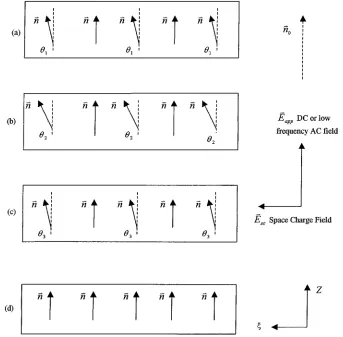
increase and the director axis is increasingly reoriented, as illus-trated in Fig. 3(a)–(b). Upon further increases in the applied field strength, the reorientation will finally reach an optimal value corresponding to the maximal space charge field strengths al-lowed by the molecular parameters. Beyond this value, further increases in the applied field will simply increase the applied field strength in the direction, which tend to realign the di-rector axis and, thus, diminish the reorientation effect 3(c)–(d).
Equally important to note is that the enhancement of the space-charge field reorientation effect (i.e., the grating diffrac-tion efficiency) will be significant only if the applied field is a dc field or low-frequency ac field, so that the ionic flows and space charge accumulation can follow the field. Above the cut-off frequency, we expect the enhancement to be reduced. This was, indeed, observed in the ac field and dc field effect on the transient grating as reported previously [1], [14]
IV. PERMANENTGRATING AND THEAC FIELDEFFECT ON
THEIRDIFFRACTIONEFFICIENCY
In heavily dye-doped samples, the phototransformation process of dye molecules can become quite significant. For example, when investigated under a polarizing microscope, the permanent gratings we created in 2% dye-doped homeotropic samples exhibit a structure of unperturbed homeotropic align-ment and reoriented, planar-like alignalign-ment of molecules. The orientation of molecules toward planar alignment indicates the strong contribution from phototransformed, adsorbed molecules in spite of the initial, strong homeotropic anchoring on both surfaces of the cells. Large dye concentrations and, therefore, significant adsorption on the surfaces is most likely to be responsible for this light-induced alignment [11]–[14]. The final configuration of molecules was stable, showed no changes with time for months and could not be erased by uniform illumination, an applied field, or heating.
Surface effects are so strong that we were able to record two superimposed permanent gratings with 10- and 11- m spac-ings, perpendicular to each other. In this case, the diffraction pattern consisted of a 2-D pattern of spots. Under a polarizing microscope, we observed a grid structure of the 2-D permanent grating. This result suggests that complicated patterns of at least 100 lines/mm can be stored permanently.
Fig. 3. Change in liquid crystal director axis orientation grating with electric field applied to the cell. The reorientation angle is (a) first enhanced, then (b) reaches a maximal value, and then (c) and (d) diminished as the applied field (alongz direction) is increased.
homeotropic samples. We monitored the power of the first diffracted order and how it can be controlled by an externally applied sinusoidal electric field. For very low frequencies, up to a few Hertz, the diffracted power was modulated by the ac field and followed its variations. However, the most interesting feature was that the diffraction efficiency can be both enhanced and reduced depending on the voltage and frequency of the ac field. Fig. 4 shows the variation of the intensity of the first diffracted order with the voltage of the ac field for different frequencies. The angle of incidence of the reading beam was zero. The measured diffraction intensity has been time-averaged over a number of cycles of the applied field. For clarity, only data for three frequencies are shown. In general, the diffraction efficiency exhibits interesting nonmonotonic behavior: as the ac voltage increases, the diffraction efficiency falls below the zero-field value and then increases, reaching a maximum which can be, in turn, much larger than the zero-field value. This behavior is consistent with the explanation given in conjunction with Fig. 3(a)–(d). The location of the maximum and minimum of the diffraction efficiency depends on the voltage and on the frequency of the applied field. For example, at 1 kHz and at the optimum voltage of 4 V (peak to peak), the diffracted intensity can be increased by a factor of 3.5 as compared with the case of no applied field. Diffracted intensity can also reach a minimum at 2 V, which is almost an order of magnitude smaller than the zero field intensity.
Fig. 4. Enhancement of diffraction efficiency with applied ac field in homeotropic permanent gratings in 2% methyl red-doped 5CB in comparison to the diffraction efficiency in the absence of an applied field.
[image:4.612.303.554.442.625.2](b)
Fig. 5. Switching between (a) minimum diffraction and maximum diffraction (b) between maximum and minimum, by changing the amplitude of the ac field from 2 to 4.5 V (and from 4.5 to 2 V) for 1-kHz ac frequency.
switching the optimum diffraction off. As can be seen, the switch-on time is much faster and monotonic, namely about 73 ms, than the switching-off time, which reaches steady state only after approximately 2 s.
We also investigated the response to high ac frequencies. We observed that, in a manner similar to the case of transient gratings [1], diffraction disappears at high frequencies. Fig. 6 presents the case of diffraction from a permanent, planar grating. The power of the first order with an ac field applied has been normalized to its power in the absence of the applied field giving the enhance-ment factor due to the ac field. As can be seen, the enhanceenhance-ment of diffraction for ac frequencies up to 40 kHz can exceed a factor of 4. Around 100 kHz, there exists a region of instability indicated by large error bars. Above 1 MHz, diffraction is switched off. The speed of switching from the enhanced to zero diffraction is shown in Fig. 7, for the case when a constant voltage (8-V peak to peak) ac field applied to the liquid crystal cell had its frequency changed from 4 MHz to 400 Hz. As observed before, the switching on time is faster than the switching off time.
[image:5.612.303.549.61.234.2]We also checked the possible contributions from thermal ef-fects. With the low powers we used, there should be less than a 0.5 C increase in temperature. This negligible heating effect should not, therefore, affect the gratings formation and diffrac-tion. Moreover, the induced grating is probe polarization depen-dent and, therefore, its origin due to the orientational effect can
[image:5.612.303.548.285.387.2]Fig. 6. Diffraction from planar permanent gratings for high-frequency ac field showing both enhancement and diminished diffraction for a different range of frequencies.
Fig. 7. Switching diffraction on in planar, permanent gratings. ac field amplitude (peak to peak) is 8 V and the field’s frequency changed from 4 MHz to 400 Hz. The scale is 200 ms per division.
Fig. 8. First-order diffraction dependence on the polarization of the incident probe beam with and without applied ac field.
[image:5.612.307.545.437.607.2]diffractions becomes more sensitive to minute deviation from -polarization.
As with transient gratings [1], we can adapt and control the diffraction by simply changing the frequency of the ac field. This enhancement of diffraction and switching it on and off with ac field voltage and frequency provide a flexible control of diffraction, a function that could prove invaluable in switching applications. Since the large birefringence of nematic liquid crystals spans the entire visible to infrared spectrum [31], [32], these tunable gratings will be useful for a variety of broadband switching applications, including telecommunications. Indeed, we have recently [33] measured the refractive index changing coefficients of some dye-doped nematic liquid crystals in the 1.55- m region, and have shown that their values are as large as in the visible spectrum.
V. CONCLUSION
In conclusion, we have demonstrated a method of forming both transient and permanent, 1- and 2-D gratings in nematic liquid crystals that can be easily controlled by externally ap-plied ac fields. With doping with methyl red dye and no special polymer coatings of the cell surfaces, patterns can be created that persist for months. The diffraction efficiency can be flexibly adjusted using an ac field or switched off for high frequencies. The promising and unique features of dye-doped liquid crystals proved particularly interesting and beneficial not only for the richness of physical effects, but also for their interplay in deter-mining the orientation of molecules.
ACKNOWLEDGMENT
The authors thank Prof. R. Sambles, Dr. S. Tatarkova, and Dr. C. Yang for their input to this research.
REFERENCES
[1] I. C. Khoo, M. Y. Shih, M. V. Wood, B. D. Guenther, P. H. Chen, F. Simoni, S. S. Slussarenko, O. Francescangeli, and L. Lucchetti, “Dye-doped photorefractive liquid crystals for dynamic and storage holographic grating formation and spatial light modulation,” Proc.
IEEE, vol. 87, pp. 1897–1911, 1999.
[2] I. C. Khoo, “Orientational photorefractive effects in nematic liquid crystal films,” IEEE J. Quantum Electron., vol. 32, pp. 525–534, 1996. [3] I. C. Khoo, H. Li, and Y. Liang, “Observation of orientational pho-torefractive effects in nematic liquid crystal,” Opt. Lett., vol. 19, pp. 1723–1725, 1994.
[4] I. C. Khoo, “Optical DC field induced space charge fields and photore-fractive-like holographic grating formation in nematic liquid crystals,”
Mol. Cryst. Liq. Cryst., vol. 282, pp. 53–66, 1996.
[5] E. V. Rudenko and A. V. Sukhov, “Optically-induced space separation of charges in nematics and nematic-caused orientation nonlinearity,” Sov.
Phys. JETP, vol. 105, pp. 1621–1634, 1994.
[6] , “Photorefractive effect in nematic liquid crystal: Ion-diffusion ap-proach,” Mol. Cryst. Liq. Cryst. Sci. & Tech. A, vol. 282, pp. 125–137, 1996.
[7] H. Ono and N. Kawatsuki, “Orientational photorefractive gratings ob-served in polymer dispersed liquid crystals doped with fullerene,” Jpn.
J. Appl. Phys., vol. 36, pp. 6444–6448, 1997.
[8] I. C. Khoo, B. D. Guenther, M. V. Wood, P. Chen, and M.-Y. Shih, “Co-herent beam amplification with a photorefractive liquid crystal,” Opt.
Lett., vol. 22, pp. 1229–1231, 1997.
[9] S. Bartkiewicz, A. Miniewicz, F. Kajzar, and M. Zagorska, “Observation of high gain in a liquid-crystal panel with photoconducting polymeric layers,” Appl. Opt., vol. 37, pp. 6871–6877, 1998.
[10] I. C. Khoo, “Holographic grating formation in dye- and fullerene C60-doped nematic liquid crystal film,” Opt. Lett., vol. 20, pp. 2137–2139, 1995.
[11] W. M. Gibbons, T. Kosa, P. Palffymuhoray, P. J. Shannon, and S.-T. Sun, “Continuous gray-scale image storage using optically aligned nematic liquid-crystals,” Nature, vol. 377, pp. 43–46, 1995.
[12] S.-T. Sun and W. M. Gibbons, “Optically generated liquid-crystal grat-ings,” Appl. Phys. Lett., vol. 65, pp. 2542–2544, 1994.
[13] F. Simoni, O. Francescangeli, Y. Reznikov, and S. Slussarenko, “Dye-doped liquid crystals as high-resolution recording media,” Opt. Lett., vol. 22, pp. 549–551, 1997.
[14] I. C. Khoo, S. Slussarenko, B. D. Guenther, M.-Y. Shih, P. Chen, and M. V. Wood, “Optically induced space-charge fields, dc voltage, and extraordinarily large nonlinearity in dye-doped nematic liquid crystals,”
Opt. Lett., vol. 23, pp. 253–255, 1998.
[15] F. Simoni and O. Francescangeli, “Effects of light on molecular orienta-tion of liquid crystals,” J. Phys: Condens. Mat., vol. 11, pp. R439–R487, 1999.
[16] I. Janossy and T. Kosa, “Influence of anthraquinone dyes on optical reorientation of nematic liquid crystals,” Opt. Lett., vol. 17, pp. 1183–1185, 1992.
[17] I. Janossy, “Molecular interpretation of the absorption-induced optical reorientation of nematic liquid crystals,” Phys. Rev. E, vol. 49, pp. 2957–2963, 1994.
[18] L. Marrucci and D. Paparo, “Photoinduced molecular reorientation of absorbing liquid crystals,” Phys. Rev. E, vol. 56, pp. 1765–1772, 1997. [19] O. Francescangeli, S. Slussarenko, F. Simoni, D. Andrienko, V. Reshet-nyak, and Y. Reznikov, “Light-induced surface sliding of the nematic di-rector in liquid crystals,” Phys. Rev. Lett., vol. 82, pp. 1855–1858, 1999. [20] W. M. Gibbons, P. J. Shannon, S.-T. Sun, and B. J. Swetlin, “Surface-mediated alignment of nematic liquid crystals with polarized laser light,”
Nature, vol. 351, pp. 49–50, 1991.
[21] S.-T. Sun, W. M. Gibbons, and P. J. Shannon, “Alignment of guest-host liquid crystals with polarized laser light,” Liq. Cryst., vol. 12, pp. 869–874, 1992.
[22] D. Voloshchenko, A. Khyzhnyak, Y. Reznikov, and V. Reshetnyak, “Control of an easy-axis on nematic-polymer interface by light action to nematic bulk,” Jpn. J. Appl. Phys., vol. 34, pp. 566–571, 1995. [23] A. G.-S. Chen and D. J. Brady, “Surace-stablilized holography in an
azo-dye doped liquid crystal,” Opt. Lett., vol. 17, pp. 1231–1233, 1992. [24] J. Zhang, V. Ostroverkhov, K. D. Singer, V. Reshetnyak, and Yu. Reznikov, “Electrically controlled surface diffraction gratings in nematic liquid crystals,” Opt. Lett., vol. 25, pp. 414–416, 2000. [25] L. Lucchetti, F. Simoni, and Y. Resnikov, “Fast optical recording in
dye-doped liquid crystals,” Opt. Lett., vol. 24, pp. 1062–1064, 1999. [26] I. C. Khoo and R. Normandin, “Nanosecond laser-induced transient
and erasable permanent grating diffractions and ultrasonic waves in a smectic film,” J. Appl. Phys., vol. 55, pp. 1416–1418, 1984.
[27] , “Nanosecond degenerate optical wave mixing and ultrasonic wave generation in the nematic phase of liquid crystals,” Opt. Lett., vol. 9, pp. 285–287, 1985.
[28] S. Sato, “Photovoltaic effects in MBBA cells containing organic dyes,”
Jpn. J. Appl. Phys., vol. 20, pp. 1989–1990, 1981.
[29] L. K. Vistin, P.-A. V. Kazlauskas, and S. Paeda, “Photoelectric effect in liquid crystals,” Sov. Phys. Dokl., vol. 29, pp. 207–209, 1984. [30] W. Helfrich, “Conduction-induced alignment of nematic liquid crystals:
Basic model and stability considerations,” J. Chem. Phys., vol. 51, pp. 4092–4105, 1969.
[31] I. C. Khoo, Liquid Crystals: Physical Properties and Nonlinear Optical
Phenomena. New York: Wiley-Interscience, 1995.
[32] I. C. Khoo and S. T. Wu, Optics and Nonlinear Optics of Liquid Crystals, Singapore: World Scientific, 1994.
[33] I. C. Khoo, M. Kaczmarek, M. Y. Shih, A. Shishido, J. Ding, Y. Zhang, and M. V. Wood, “Communication-wavelength (1.55 mm) laser induced refractive index change in nematic liquid crystalline films,” in Proc.
SPIE, vol. 4463, 2001, pp. 87–91.
Malgosia Kaczmarek received the M.Sc. degree in physics (with distinction)
from A. Mickiewicz University, Poznan, Poland, in 1986 and the D.Phil. degree from the University of Oxford, Oxford, U.K., in 1991. Her thesis concerned dynamics of four-wave mixing in gaseous media.
She was a Research Scientist at the Department of Engineering Science, Uni-versity of Oxford, and then at the Optoelectronics Research Centre, Univer-sity of Southampton, Southampton, U.K. Her research concentrated on non-linear optics and photosensitive materials, in particular photorefractive crystals, waveguides, and characterization of new infrared-sensitive materials. In 2000, she joined the faculty at the Department of Physics and Astronomy, University of Southampton, as a Lecturer. Her current research interests include photore-fractive, dye-doped liquid crystals, patterning, and nonlinear effects in liquid crystals and microstructuring of optical materials.