Drought has recently become the basic limiting factor of plant production. Dry vegetation periods are more and more frequent and last longer than in the previous years. Štěpánek et al. (2016) reports that drought occurred in the Czech Republic in 2012, 2013, 2014 and 2015. The reason for the droughts in the Czech Republic is below-normal amounts of precipitation and/or very high temperatures. However, drought is not only our problem; it tortures the whole Central European region as well. According to Trnka et al. (2016) up to 45% of the evaluated stations in the Czech Republic became significantly drier during the 1961−2014 period except for areas in the west and north of the region.
The prediction models allow for the assumption that the future period of 2021–2050 will be warmer
by an average of 1.5°C and the period of 2071–2100 will be even warmer by 3.4°C than 1961–1990. Also, the average monthly temperature will rise. The in-creasing trend was also observed in the number and duration of heat waves. In the future, there will be an increased incidence of zero precipitation periods which will also be longer (Fukalová et al. 2014).
In the case of potatoes, the need for water during the vegetation period ranges between 500–700 mm (Brower and Heibloem 1986). This quantity depends on soil conditions in the locality and on the cultivar, or early/late ripening of the given cultivar.
Drought during the vegetation period negatively affects potato yields. One of the options of preven-tion of the negative effect of droughts on potato yields is represented by irrigation. Irrigation
in-Effect of different drip irrigation regimes on tuber
and starch yield of potatoes
Petr ELZNER
1,*, Miroslav JŮZL
1, Pavel KASAL
21Department of Crop Science, Breeding and Plant Medicine, Mendel University in Brno,
Brno, Czech Republic
2Potato Research Institute Havlíčkův Brod, Ltd., Havlíčkův Brod, Czech Republic *Corresponding author: [email protected]
ABSTRACT
Elzner P., Jůzl M., Kasal P. (2018): Effect of different drip irrigation regimes on tuber and starch yield of potatoes. Plant Soil Environ., 64: 546–550.
Small-plot field trials monitored the effect of drip irrigation of potatoes on tuber and starch yield. The trials were performed at two different localities in two trial years, 2016 and 2017. The subject of the evaluation included two cultivars with different vegetation periods (the very early cv. Monika and the semi-early cv. Jolana). Four repeated trials studied 4 irrigation treatments according to the available water capacity (AWC) of the soil, i.e. without irriga-tion, irrigation when soil humidity decreased below 60, 65 and below 70% AWC. All monitored parameters reflect-ed a positive effect of irrigation in comparison to the non-irrigatreflect-ed control. The Žabčice locality showreflect-ed the highest tuber and starch yields mostly after medium-intensity irrigation. The Valečov locality achieved the highest tuber and starch yields after the highest-intensity irrigation. Subject to the locality and the cultivar, the recommendation is to introduce automatic irrigation start when the soil humidity drops to 65% AWC for heavy soils and 70% AWC for medium heavy soils.
Keywords: drought; Solanum tuberosum L.; precipitation; climate change; irrigation frequency; permanent wilting point
creases the mean tuber weight (Yuan et al. 2003), but not always the number of tubers per turf (Ierna et al. 2011). Drip irrigation is able to achieve up to 70% higher potato gain in comparison to seepage irrigation (Matović et al. 2016). Reyes-Cabrera et al. (2016) report that drip irrigation uses 48% to 88% less water compared to seepage irrigation, with the same yield level of most potato cultivars. Some potato cultivars, however, show reduced yield after drip irrigation in comparison to seepage.
Most authors report increased tuber yield after drip irrigation, with increasing values with increased quantity of irrigation water, but only up to a certain quantity. High-intensity irrigation not always in-creases the yield significantly in comparison to the medium-intensity irrigation (Camargo et al. 2015). Yield increase depends on the particular agro-climatic conditions and ranges from a couple of percent to multiple yield increase in comparison to the non-irrigated plots (Onder et al. 2005, Badr et al. 2010, Ayas 2013). Further advantages of drip irrigation in comparison to the classical seepage also include reduced soil nutrient washout (Shock et al. 2007).
MATERIAL AND METHODS
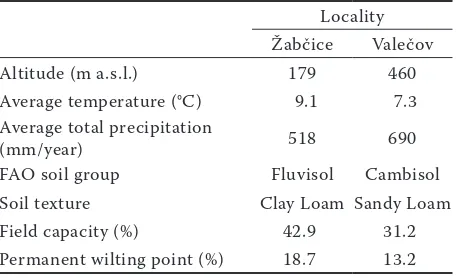
The exact field trials were performed in two years, 2016 and 2017, in two different localities (Table 1) in the Czech Republic – locality Valečov (49.639396N; 15.491996E) and locality Žabčice (49.022072N; 16.617161E). On each locality soil hydro limits were determined. The samples were taken by means of the Kopecky cylinder (100 cm3)
and were analysed at the Department of Agrochemistry, Soil Science, Microbiology and
Plant Nutrition, Mendel University in Brno. The progress of precipitation and temperatures in the vegetation periods of the individual years is shown in Figure 1. Two cultivars were planted with different vegetation periods – the very early cv. Monika and the semi-early cv. Jolana. Four repeated trials implemented in the two locali-ties studied 4 irrigation treatments according the available water capacity (AWC) of the soil, i.e. without irrigation, irrigation when soil humidity decreased below 60, 65 and below 70% AWC. Soil humidity was measured separately for each irriga-tion treatment by a VIRRIB sensor (Amet, Velké Bílovice, Česká Republika). For each treatment, soil humidity was measured once a day and irrigation was started whenever its value dropped below the specified limit. The available water capacity of the soil was calculated as the difference between permanent wilting point (PWP) and field capacity (FC) (Romano et al. 2002):
AWC = θfc − θpwp
[image:2.595.305.533.113.252.2]The automatic irrigation start was calculated from these values on the basis of the specified soil hydro
Table 1. Characteristics of experimental localities
Locality Žabčice Valečov
Altitude (m a.s.l.) 179 460
Average temperature (°C) 9.1 7.3 Average total precipitation
(mm/year) 518 690
FAO soil group Fluvisol Cambisol
Soil texture Clay Loam Sandy Loam
Field capacity (%) 42.9 31.2
[image:2.595.68.531.575.747.2]Permanent wilting point (%) 18.7 13.2
Figure 1. Precipitation (mm) and temperature (°C) in the vegetation period (a) Žabčice and (b) Valečov
-10 –5 0 5 10 15 20 25
0 20 40 60 80 100 120 140 160
I II III IV V VI VII VIII
Precipitation 2016 Precipitation 2017 Precipitation normal Temperature 2016 Temperature 2017 Temperature normal
–10 –5 0 5 10 15 20 25
0 20 40 60 80 100 120 140
I II III IV V VI VII VIII
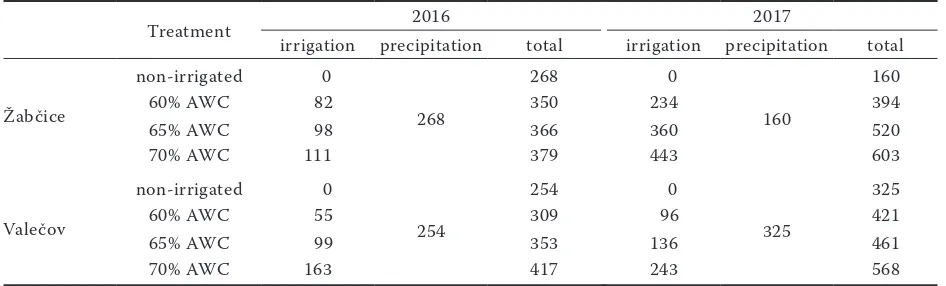
limits in the given locality. The individual irrigation dose corresponded to 10 mm of water. The quantities of irrigation water for the individual trial treatments and the sum of precipitation per vegetation period are shown in Table 2. Plot size for each treatment and cultivar was 100 m2. The fertilisation was uniform
for all treatments (120 kg N/ha, 39.3 kg P/ha and 149.4 kg K/ha). The specimens for yield and quality analyses were taken manually at the end of the physi-ological maturity period and starch level analysis was performed by Ewers polarimetry. Statistical data evaluation was performed by the analysis of variance (ANOVA) and by the Tukey’s HSD (hon-estly significant difference) test (significance level P < 0.05). For the evaluation, Statistica 12 (StatSoft, USA) software was used.
RESULTS AND DISCUSSION
Tuber yield per hectare in 2016 was statistically affected by the trial locality (Figure 2). Higher yields
were achieved at all treatments at the Valečov site. At this locality, the tuber yield increased with in-creasing irrigation water volume. At the Žabčice locality, the responses of the studied cultivars dif-fered. The cv. Monika showed the highest yield after medium-intensity irrigation (var. 3), the only one statistically significantly differing from the non-irrigated control. In the case of the cv. Jolana, the yields after irrigation showed no statistically significant differences. The highest yield followed after the most intense irrigation and was statistically significantly higher than the yield of the non-irrigated control. The difference between the two localities was probably caused by the weather or precipita-tion progress. In Žabčice, episodes of several-day raining over-moistened the soil (especially towards the end of the vegetation period). This may have caused insufficient air in soil for the plant growth. This explanation is supported by the findings of Birecki (1958) and Linker et al. (2016). Trifonov et al. (2017) confirmed that excess irrigation may result in reduction of tuber yield caused by bad
aera-Table 2. Total amount of water (mm) during the growing season
Treatment 2016 2017
irrigation precipitation total irrigation precipitation total
Žabčice
non-irrigated 0
268
268 0
160
160
60% AWC 82 350 234 394
65% AWC 98 366 360 520
70% AWC 111 379 443 603
Valečov
non-irrigated 0
254
254 0
325
325
60% AWC 55 309 96 421
65% AWC 99 353 136 461
70% AWC 163 417 243 568
[image:3.595.62.535.113.256.2]AWC – available water capacity
Figure 2. Yield (t/ha) – (a) cv. Monika and (b) cv. Jolana. Different letters indicate significant differences at α = 0.05 by the Tukey’s HSD test (honestly significant difference). AWC – available water capacity
a
a
a b
b
ab bc
b
b c
b
ab
0 20 40 60 80 100 120
Y
ie
ld (t
/ h
a)
non-irrigated 60% AWC
65% AWC 70% AWC
a
a
a a
b ab
a
b
ab b
b
b
0 20 40 60 80 100 120
2016 2017 2016 2017 2016 2017 2016 2017
Valečov Žabčice Valečov Žabčice
a b ab ab
a ab ab b (b)
[image:3.595.67.530.579.732.2]tion conditions, lack of oxygen for the root system and enhanced vegetative growth. In 2016, high day temperature maximums measured at the Žabčice locality also negatively affected tuber growth. As mentioned by Lafta and Lorenzen (1995), higher temperatures retard tuber growth in comparison to top growth. Engel and Raeuber (1962) specified the optimum temperature for tuber development between circa 15–18°C.
In 2017, statistically significant increase of tuber yield was demonstrated for all irrigated plots in comparison to the non-irrigated controls at both trial localities and for both studied cultivars (Figure 2). A more significant increase was found at the Žabčice locality, where only 160 mm of natural precipitation was measured during the vegetation period. However, the low soil humidity at this locality was also en-hanced by the low precipitation rates in the autumn and winter seasons. Groundwater level dropped significantly there in comparison to the previous year and the soil dried quickly after irrigation. Due to the low groundwater level, the irrigation water quickly penetrated to greater depths and therefore the water quantity supplied by drip irrigation was several times higher than in the previous trial year. The reaction of the cultivars in this locality was similar to the previous year reaction. Cv. Monika showed the highest yield after the medium-intensity irrigation. In the case of cv. Jolana, the differences between the individual treatments were smaller and statistically insignificant. This cultivar achieved the highest yield with the lowest irrigation intensity. At the Valečov locality in 2017, both cultivars achieved higher tuber yields with increasing irrigation water quantity. All irrigation treatments statistically sig-nificantly differed from the non-irrigated controls. There were no significant differences in yield between the individual irrigation levels in either cultivar.
It may then be concluded that automatically con-trolled drip irrigation can significantly increase potato yield. Irrigation frequency or its control by measuring soil humidity must be set according to locality and cultivar. For localities with medium-heavy soil, the highest irrigation intensity may be recommended, i.e. automatic irrigation start at 70% AWC. For localities with heavy soil, medium irrigation intensity will suf-fice, i.e. AWC 65%. In the case of this soil type, higher irrigation intensity is no longer economical as it does not increase tuber yield sufficiently to justify the increased irrigation water consumption. In warmer areas, early-ripening cultivars may be recommended for irrigation: the very early cv. Monika grown at the Žabčice locality achieved statistically significantly higher tuber yields in both trial years. In the colder Valečov locality, there was no significant difference between the two cultivars.
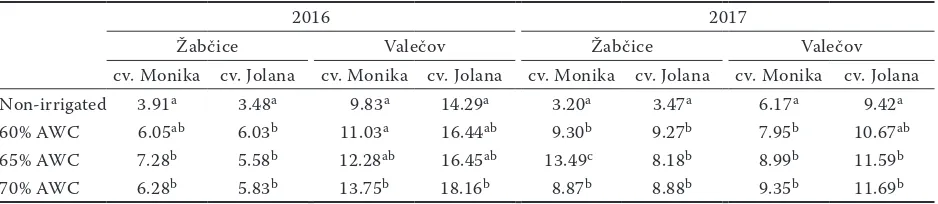
[image:4.595.64.533.626.728.2]Starch yield per hectare in the individual trial years is shown in Table 3. The trends shown by the individual cultivars at the trial localities are similar to the tuber yields trends. At the Žabčice locality in trial year 2016, the starch yield was statistically signifi-cantly higher in the case of the irrigated treatments in comparison to the non-irrigated control, except for the lowest irrigation intensity in cv. Monika. At this locality, the highest starch yield was observed in cv. Monika in both trial years at treatment 3, even though in 2016 it did not statistically significantly differ from the other irrigation treatments. In the case of cv. Jolana, the starch yield at the Žabčice locality was similar in all irrigated treatments and in both trial years; the differences between treatments 2, 3 and 4 were statistically insignificant. At the Valečov local-ity, starch yield increased with increasing irrigation frequency. This trend was observed in both studied cultivars and in both trial years (2016 and 2017). Due to the more favourable climatic conditions at this
Table 3. Starch yield (t/ha)
2016 2017
Žabčice Valečov Žabčice Valečov
cv. Monika cv. Jolana cv. Monika cv. Jolana cv. Monika cv. Jolana cv. Monika cv. Jolana Non-irrigated 3.91a 3.48a 9.83a 14.29a 3.20a 3.47a 6.17a 9.42a 60% AWC 6.05ab 6.03b 11.03a 16.44ab 9.30b 9.27b 7.95b 10.67ab 65% AWC 7.28b 5.58b 12.28ab 16.45ab 13.49c 8.18b 8.99b 11.59b
70% AWC 6.28b 5.83b 13.75b 18.16b 8.87b 8.88b 9.35b 11.69b
locality, the starch yield per hectare was relatively high even in the case of the non-irrigated controls. A statistically significant increase in starch yield in comparison to the control was achieved only in the case of cv. Monika in treatment 4 (in 2016) and in treatments 3 and 4 (in 2017).
Increased starch yield per hectare connected with irrigation was also confirmed by trials performed by Pszczolkowski et al. (2016), who reported that the increase depends on both the potato cultivar and the locality where it is grown. Wszelaczynska et al. (2015) also confirmed that starch content and starch yield per hectare are increased by ir-rigation, especially by irrigation with fertigation. The achieved results allow for the conclusion that drip irrigation positively affected starch yield per hectare in all irrigation treatments. The optimum threshold of AWC appears to be 65–70%, subject to locality and cultivar. Automatic irrigation con-trol by soil humidity levels can then be considered as the optimum method not only for increase of tuber yield but also for increase of starch yield.
REFERENCES
Ayas S. (2013): The effects of different regimes on potato ( So-lanum tuberosum L. Hermes) yield and quality characteristics under unheated greenhouse conditions. Bulgarian Journal of Agricultural Science, 19: 87–95.
Badr M.A., Abou Hussein S.D., El-Tohamy W.A., Gruda N. (2010): Efficiency of subsurface drip irrigation for potato production under different dry stress conditions. Gesunde Pflanzen, 62: 63–70. Birecki W. (1958): Potatoes. Warszawa, Powszechne Wydawnictwo
Rolnicze i Leśne. (In Polish)
Brower C., Heibloem M. (1986): Irrigation Water Management: Irrigation Water Needs. Training Manual No. 3. Rome, FAO Land and Water Development Division.
Camargo D.C., Montoya F., Córcoles J.I., Ortega J.F. (2015): Mod-eling the impacts of irrigation treatments on potato growth and development. Agricultural Water Management, 150: 119–128. Engel K.H., Raeuber A.R. (1962): Allometric Growth of Potato.
Hamburg, Zeitschrift für Planzenzüchtung. (In German) Fukalová P., Středová H., Vejtasová K. (2014): Development and
prediction of selected temperature and precipitation charac-teristics in Southern Moravia. Acta Universitatis Agriculturae et Silviculturae Mendelianae Brunensis, 62: 91–98.
Ierna A., Pandino G., Lombardo S., Mauromicale G. (2011): Tuber yield, water and fertilizer productivity in early potato as affected
by a combination of irrigation and fertilization. Agricultural Water Management, 101: 35–41.
Lafta A.M., Lorenzen J.H. (1995): Effect of high temperature on plant growth and carbohydrate metabolism in potato. Plant Physiology, 109: 637–643.
Linker R., Ioslovich I., Sylaios G., Plauborg F., Battilani A. (2016): Optimal model-based deficit irrigation scheduling using AquaCrop: A simulation study with cotton, potato and tomato. Agricultural Water Management, 163: 236–243.
Matović G., Broćić Z., Djuričin S., Gregorić E., Bodroža D. (2016): Profitability assessment of potato production applying differ-ent irrigation methods. Irrigation and Drainage, 65: 502–513. Onder S., Caliskan M.E., Onder D., Caliskan S. (2005): Different
irrigation methods and water stress effects on potato yield and yield components. Agricultural Water Management, 73: 73–86. Pszczółkowski P., Sawicka B., Lenartowicz T. (2016): Effect of irrigation on the content and yield of starch in early potato cultivars in different regions of Poland. Acta Sciientiarum Polonorum Seria Agricultura, 15: 61–71.
Reyes-Cabrera J., Zotarelli L., Dukes M.D., Rowland D.L., Sargent S.A. (2016): Soil moisture distribution under drip irrigation and seepage for potato production. Agricultural Water Man-agement, 169: 183–192.
Romano N., Santini A. (2002): Measurement of water retention: Field methods. In: Dane J.H., Topp G.C. (eds.): Methods of Soil Analy-sis. Part 4. Madison, Soil Science Society of America, 721–738. Shock C.C., Pereira A.B., Eldredge E.P. (2007): Irrigation best
management practices for potato. American Journal of Potato Research, 84: 29–37.
Štěpánek P., Zahradníček P., Farda A., Skalák P., Trnka M., Meit-ner J., Rajdl K. (2016): Projection of drought-inducing climate conditions in the Czech Republic according to Euro-CORDEX models. Climate Research, 70: 179–193.
Trifonov P., Lazarovitch N., Arye G. (2017): Increasing water productivity in arid regions using low-discharge drip irrigation: A case study on potato growth. Irrigation Science, 35: 287–295. Trnka M., Balek J., Štěpánek P., Zahradníček P., Možný P., Eitzinger J., Žalud Z., Formayer H., Turna M., Nejedlík P., Semeradová D., Hlavinka P., Brázdil R. (2016): Drought trends over part of Central Europe between 1961–2014. Climate Research, 70: 143–160.
Wszelaczynska E., Pobereżny J., Dudek S., Kusmierek-Tomasze-wska R., Zarski J., Pawelzik E. (2015): The effects of fertilizers, irrigation and storage on the properties of potato tubers and their constituent starches. Starch, 67: 478–492.
Yuan B.-Z., Nishiyama S., Kang Y.H. (2003): Effects of different irrigation regimes on the growth and yield of drip-irrigated potato. Agricultural Water Management, 63: 153–167.