Cite as: Jones, K. (1997), Children Learning to Specify Geometrical Relationships Using a Dynamic Geometry Package. In: Pehkonen E (Ed), Proceedings of the 21st Conference of the International Group for the Psychology of Mathematics Education. University of Helsinki, Finland, Volume 3, 121-128.
Children Learning to Specify Geometrical Relationships using a Dynamic Geometry Package
Keith Jones
University of Southampton, UK
In order to understand the learning taking place when students use a dynamic geometry package such as Cabri-Géomètre, a particular focus for study needs to be on the learning mediated through employing such a resource. In this paper I describe how one pair of 12 year old students begin learning how to specify geometrical relationships in Cabri. I argue that, while Cabri provides certain elements of the mathematical language necessary for the articulation of relevant mathematical ideas, significant aspects must be provided by the teacher.
Introduction
The use of concrete materials such as manipulatives, and tools such as calculators and computers, to support mathematics learning is reasonably well-established and widely encouraged. In trying to understand the mathematics learning taking place when students use such devices, the work of Wertsch (1991), amongst others, suggests that we need to consider carefully what stands between the learners and the ‘knowledge’ that they are intended to learn; that is, we need to focus on the learning mediated through employing such resources. Ohtani (1994), for example, presents this in the usual triangular form (adapted slightly as Figure 1).
Mediating artifact
Learner Mathematics
Figure 1
Dynamic geometry environments (DGEs), such as Cabri-Géomètre, are one
articulation which offers some purchase on what the learner is thinking, and it is in the process of articulation that a learner can create mathematics and simultaneously reveal this act of creation to an observer.” Hence when students are using a DGE
such as Cabri to tackle mathematical problems they are involved in both
erceiving and specifying relationships between geometrical objects. p
In this paper I focus on the transition from perceiving and specifying geometrical relationships when students are using Cabri and how this is mediated by the computer environment. In what follows I describe how one pair of 12 year old students begin learning how to specify geometrical relationships in Cabri. I argue that, while Cabri provides certain elements of the mathematical language necessary for the articulation of relevant mathematical ideas, significant aspects must be provided by the teacher. The data comes from a longitudinal research project designed to trace the transition of student conceptions of some chosen geometrical objects from informal notions towards formal mathematical definitions. I begin with a brief outline of the theoretical framework with which I
ill interpret the data. w
The Mediation of Learning
One of the central concepts underlining the approach I adopt in this paper is Wertsch’s notion of “individual(s)-acting-with mediated means” (Wertsch 1991 p 12) which is itself based on aspects of the work of Vygotsky and Bakhtin. From such a perspective there is an intimate relationship between psychological processes and the sociocultural setting such that all mental processes are considered to be mediated by communication that is inherently and complexedly situated. In this model, when we describe human action we can only do so in terms of the mediating artifact because “action and mediating means are mutually
etermined” (p 119). d
A second central concept is the idea that the move from perceiving to specifying is at the heart of mathematics learning. In this context, specifying requires the use of elements of conventional mathematical language. With certain computer applications, such as Logo, spreadsheets and perhaps DGEs, the computer can become a special tool for mathematics learning because the actions of learners using such applications necessarily involves some formal use of mathematical language. Noss and Hoyles call such a computer environment “autoexpressive” when it contains elements of mathematical language “to talk about itself” (1996 p 69). For a DGE such as Cabri, some of the relevant elements of mathematical language (such as mid-point, bisector, perpendicular, and so on) can be considered to be explicitly available via the various menu items. Further elements are implicitly contained within the figure as it is constructed. I will return to this point later in this paper. Given these considerations, the central question here is how we can describe the learning of aspects of plane geometry when mediated by a
With the above in mind, particular foci for the presentation and analysis of the qualitative data from this study are:
• how particular geometric figures presented on paper are interpreted by the students when the aim is to construct them using Cabri
• how the figures are constructed; that is how they are specified in terms of the Cabri menu items
• what the response is to the feedback presented by the resulting image on the screen
• how the specification is checked
• what form of assistance is sought from the teacher/researcher and what the response is to interventions
I follow the example of Meira by focusing on how “instructional artifacts and representational systems are actually used and transformed by students in activity” (1995 p 103, emphasis in original) rather than simply asking whether the students learn particular aspects of geometry better by using a tool such as Cabri. This is because what I am interested in is both what the students learn and how they learn
t. i
Description of an Episode
This data comes from a research study in which pairs of students in their regular mathematics classroom tackle a series of tasks focusing on the geometrical properties of quadrilaterals. The pair of students in this extract are 12 year olds who have used Cabri on four previous occasions, each one lasting almost an hour, the last time being about four weeks earlier. The class is of above-average attainment in mathematics and from a UK city comprehensive school whose results in mathematics at age 16 are at the national average. The mathematics teacher employs a problem-based approach to teaching mathematics and the students usually work in pairs or small groups. The class has three 50-minute mathematics
essons per week. The version of Cabri in use was Cabri I for the PC. l
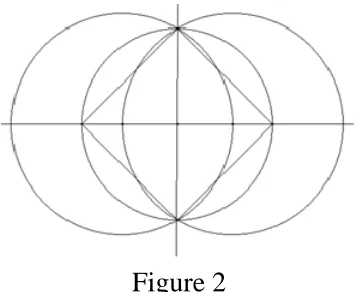
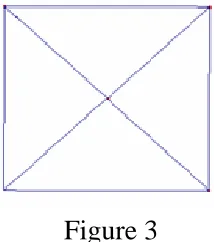
[image:3.595.201.381.596.742.2]The task the pair of students are undertaking is to construct the following diagram, Figure 2, using Cabri and hence obtain Figure 3.
Figure 3
The task then asks the students to “explain why the shape is a square”. The students know that they need to construct the figure in such a way that the figure is invariant when any basic object used in its construction is dragged. In the words of
ealy et al (1994), the figure must be impossible to “mess up”. H
After a short discussion the pair begin by constructing two interlocking circles, as shown in Figure 4.
Figure 4
In order to draw the third circle they need to construct its centre. They realise that it has to be midway in between the centres of the two larger circles. In the extracts that follow, R and H are the students, I is myself as teacher/researcher.
R You want to get that thing in between them, I can't remember what it's called
now.
28 29 30 31
39 40 41 42 43 44
69 70
H Construction is it? No ..
R Yes, on Construction, and it is ...
H & R Intersection!
32
together) (
The students attempt to use intersection, but, of course, it is not the correct choice. I decide to intervene.
I What are you trying to do?
R Make a point in between there.
I An intersection will only give you the point where two lines cross. But there is
something else which will give you something which is halfway between.
R Go under Construction.
I Yes, have a look under Construction again.
H & R Yeah, Midpoint!
45
(together)
They create the third circle and check that their construction is correct by dragging one of the points on their figure.
R Yeah, that’s it Then we want like a diamond shape inside it.
R Just see if they all stay together first.
69 70 71
167 168 169 0
174 175 176 177 178 179 180 1
195 196 197 198 199 200 201 202 203
H OK.
R Pick up by one of the edge point.
H & R Yeah, it stays together!
72
together) (
The next step the students make is to draw two lines, see Figure 5, and again check, by dragging, that their
construction is correct
Figure 5
They complete their construction by drawing the four line segments forming the square and once more check, by dragging, that their figure cannot be “messed up”. To construct the figure shown in Figure 2 they “erase” (or, more accurately, hide) the requisite lines and finish by constructing line segments as diagonals of the
quare. s
One of the students comments:
R A square. Four triangles in it.
Or is it a rectangle? Those bits look longer.
H They do slightly.
R Should I get a ruler?
17
I intervene by asking them what they can say about the diagonals of the shape.
R They are all diagonals.
I No, in geometry diagonals are the lines that go from a vertex, from a corner, to
another vertex.
R Yeah, but so’s that, from there to there.
I That’s a side.
R Yeah, but if we were to pick it up like that ... like that. Then they’re diagonals
I In mathematics, in geometry, a line that goes like that is called an oblique line.
It’s not vertical, it’s not horizontal. It’s oblique.
18
Following this I prompt them into beginning to explain why the quadrilateral is a square. For example, I ask them to compare the lengths of the diagonals and how they intersect.
I and what can you say about that line and this line [referring to the diagonals]?
H They’re the same distance.
I They’re the same length?
H Length, yeah.
I OK, so the diagonals are the same length. And what can you say about the way in
which they cross?
H They cross exactly in the middle.
I So you’re saying that from there to there is the same as from there to there.
I At what angle do they cross?
214 215 216 217 218 9
271 272 273 274 275 6
H A right angle.
I (to R) Is it a right angle?
R No .. yeah.
I Yes? So this is a right angle here?
R Yeah.
21
The session finishes with my asking them:
I So what sort of shape has got diagonals that are the same, that cross in the
middle, so they bisect each other, that cross at 90 degrees, and has got 90 degree corners? What sort of shape is it?
H A square.
I No other shape is like that?
H No.
27
Analysis and Discussion
The students successfully complete the task, but with particular input from myself as teacher/researcher. This is not altogether unexpected as, in every attempt to reveal the mathematical thinking of learners, the balance between exploration and guidance is always problematic. As Noss and Hoyles explain “This tension is not completely resolvable. We might be able to engineer situations in which a mathematical way of thinking is encouraged. But mathematics per se is not discovered by accident” (1996 p 71). What becomes of interest here is the nature of the interventions that were
ecessary. n
The students begin confidently enough, although it soon transpires that they have forgotten the term midpoint. They know what they want to specify (the centre for the third, smaller, circle) but attempt to locate it using intersection, as the drop-down menu calls it (actually the item locates points of intersection). An intervention is
ufficient to put the students on the right track again. s
Lines 69 through 74 shows student R firstly referring to the square to be constructed as a diamond (presumably due to its orientation; see Hershkowitz 1990 p 82- 86) and later calling a point on the circumference of a circle an edge point. This latter choice of terminology is especially interesting as this particular form of point (and there are several forms of point in Cabri I) is referred to in three different ways on the screen in this version of Cabri (Cabri I for the PC). From the creation menu, one can construct a circle using the menu item circle by centre and rad. pt. ( the user needs to know, presumably, that rad. pt. is a shortened version of radius point). The pop-up help offers the advice “select or create the centre of the circle, then a point on the circle”, while the screen pointer uses the terms “this centre” and “this circle point”
hen creating such a circle. This particular student then invents their own term. w
image. As I do not think measuring, particularly with a ruler, will resolve the matter I intervene by asking them to reflect on what they have done (transcript lines 174-276). In so doing, I have to introduce terminology that does not occur in any menu item in this version of Cabri. At various times I employ terms such as diagonal, vertex,
blique, bisect (note that bisector is a Cabri menu item), and right angle. o
Finally, the students complete their construction, again checking by dragging that the construction can not be “messed up”. They are convinced that the quadrilateral they have constructed is a square and they can articulate some of its geometrical
roperties. p
Concluding Remarks
Overall, the episode portrayed here demonstrates that this particular pair of students had, at their disposal, sufficient technical fluency with Cabri to successfully complete the required task (albeit with some timely intervention). It was they who devised the strategy for the construction and consequently it was they who were able to specify their construction using the facilities offered by this particular dynamic geometry environment. They did not merely line up relevant objects by eye nor did they start guessing by randomly opening menus and trying out all the items in some false hope of hitting on the right one (phenomena observed by Noss et al 1994 and by Jones
995). 1
Yet, at the same time, the computer environment alone was insufficient to allow the students to fully articulate their specification in conventional mathematical language. For one thing, the menu items cannot hope to provide the range of terms required (nor could they be expected to do so). For another, a full articulation of why the quadrilateral is a square requires some of those delicate chains of reasoning characteristic of the finer elements of mathematical proof. The explanation of why the shape is a square is not simply and freely available within the computer environment. It needs to be sought out and, as such, it is mediated by the computer
nvironment. e
The example provided in this paper shows some aspects of how it is interaction with more knowledgeable others that ensures that at least some of the explanation available with the DGE can become accessible to the student learners of mathematics.
Hence, while Cabri provides certain elements of the mathematical language
necessary for the articulation of relevant mathematical ideas, significant aspects must be provided by the teacher. This paper has attempted to document at least some of
hese aspects. t
References
Department for Education (1995), Mathematics in the National Curriculum. London: HMSO.
Healy, L., Hoelzl, R., Hoyles, C., & Noss, R. (1994). “Messing Up”. Micromath,
10(1), 14-16.
Hershkowitz, R. (1990). “Psychological Aspects of Learning Geometry”. In P Nesher & J Kilpatrick (Eds.), Mathematics and Cognition. (pp. 70-95). Cambridge: CUP. Hölzl, R. (1996), ‘How does “dragging” affect the learning of geometry’,
International Journal of Computers for Mathematical Learning, 1(2), 169–187. Jones, K. (1995), “Intuition and geometrical problem solving”. In C Mammana (Ed),
Proceedings of the ICMI Conference on Perspectives on the Teaching of Geometry for the 21st Century. Catania, It: University of Catania. p 112-116
Laborde, C. and Laborde, J-M. (1995), “What about a Learning Environment where Euclidean Concepts are manipulated with a Mouse?”. In A. A. diSessa, C. Hoyles and R. Noss (Eds), Computers and Exploratory Learning. Berlin: Springer-Verlag. Laborde, C. (1993). The Computer as Part of the Learning Environment: the case of
geometry. In C. Keitel & K. Ruthven (Eds), Learning from Computers:
mathematics education and technology. Berlin: Springer-Verlag. p48-67.
Meira, L. (1995), “Mediation by Tools in the Mathematics Classroom”. In L. Meira and D. Carraher (Eds), Proceedings of the 19th Conference of the International Group for the Psychology of Mathematics Education. Recife, Brazil. Vol I p102-111.
Noss, R. and Hoyles, C. (1996), Windows on Mathematical Meanings: learning
cultures and computers. Dordrecht: Kluwer.
Noss, R., Healy, L, Hoyles, C., & Hoelzl, R., (1994), “Constructing Meanings for Construction”. In J P da Ponte and J F Matos (Eds), Proceedings of the 18th Conference of the International Group for the Psychology of Mathematics Education. Lisbon, Portugal. Vol III p360- 367.
Ohtani, M. (1994), “Sociocultural Mediateness of Mathematical Activity: analysis of “voices” in a seventh-grade mathematics classroom”. In J. P. da Ponte and J. F. Matos (Eds), Proceedings of the 18th Conference of the International Group for the Psychology of Mathematics Education. Lisbon, Portugal. Vol III p385- 391. Wertsch, J. V. (1991), Voices of the Mind: a sociocultural approach to mediated