Abstract—This paper introduces a Mobile Video Quality Prediction (MVQP) project for Long Term Evolution (LTE). The MVQP aims to predict the quality of streaming video service over user datagram protocol (UDP) in LTE cellular networks. In this study, 100 subjects evaluated video quality using smart phones based on the ITU-T P.910 recommendation. Collected data of subjective ratings were analyzed and used to compute the Mean Opinion Score (MOS). The MOS was compared with packet loss results showing how these quantities are related to each other and how they impact the final video quality rating. This paper explains Phase 1 of the MVQP project.
Index Terms—LTE, MVQP, Packet loos, Subjective video quality assessment, Video quality
Network traffic has increased significantly with the advent of cellular technologies and widespread use of mobile phones. Mobile applications that are using more data have become popular and have congested cellular networks. Many applications, such as video streaming apps, consume both data and voice and play a major role in increase of the overall traffic.
Video streaming increases as new technology continues to advance. Recent surveys and measurements show a drastic increase in the amount of video streaming by users of smart phones and other hand-held devices, all made possible by fast Internet service provided by cellular network providers [1][2]. Research is now being done to suggest enhancements in video quality assessment.
There is a recognized need to improve video quality to meet user expectations in terms of video resolution and speed of access. Users are spending more for latest smart phones. These phones have the best technology for running high quality video as well as for subscriptions to data plans that enable watching videos without interruption. There is strong competition among service providers in their efforts to satisfy customers by improving their cellular networks. As a result, the providers need to carry out video quality
Manuscript received June 25, 2014; revised July 18, 2014. H. Almohamedh is a PhD candidate in the Electrical and Computer Engineering Department, Florida Institute of Technology, Melbourne, FL 32901 USA, (phone: 321-368-3117; e-mail: [email protected]).
F. Al Qurashi is a PhD candidate in the Electrical and Computer Engineering Department, Florida Institute of Technology, Melbourne, FL 32901 USA, (phone: 321-960-7196; e-mail: [email protected]).
I. Kostanic is with the Electrical and Computer Engineering
Department, Florida Institute of Technology, Melbourne, FL 32901 USA, (phone: 321-674-7189); e-mail: [email protected]).
measurements and continuously evaluate the performance of their network. Based on these measurements they make changes of network parameters to provide better service. There is a need to evaluate the quality of video streaming at both the provider’s end and the consumer’s end so that the improvements can be made.
A. Importance of Video quality from users’ point of view
Many thought that mobile phone screens were too small for a high quality video watching experience and that cellular networks would not be able to provide good quality video streaming to their users. The current trend, however, contradicts that perception as people are increasingly using their phones to access video. People watch regular TV programs, sports highlights, movies, and news. Whatever the purpose or the network, users are expecting to have a good video quality experience. Meeting these expectations depends on a variety of factors, including cellular network parameters, user’s perception regarding quality, pricing and cost of service, and the type of device used. Users see the service providers as having the responsibility for providing the best possible quality and user experience.
B. Importance of video quality measurements from cellular network provider point of view
Video quality depends on network factors such as frame rates, bit rates, and packet loss. These factors make mobile video services difficult to handle due to bandwidth limitations and device capabilities [3]. Improvement of video streaming services requires a profound understanding of these parameters.
Mobile television and video services have been launched in many countries with success being measured largely by the subjective quality perception of the end user. An understanding of these quality perceptions is necessary in making improvements to reach an acceptable quality level [3].
Clearly, if service providers fulfill user needs and expectations, they will keep existing customers and get new customers. It is known that some cellular companies have more users because their quality is perceived to be better and compares favorably against other providers.
C. Video Quality Measurements Methods
The field of video communication has grown rapidly in the past few years with new technologies leading to mobile videos. It is now important to measure video quality in assessing performance of a digital video system. In general,
Subjective Assessment of Mobile Videos
Quality for Long Term Evolution (LTE) Cellular
Networks
there are two approaches for measuring the quality of video subjective assessment and objective assessment.
Subjective quality assessment is the most accurate method for measuring video quality. In this process, subjects are asked to watch test videos and to rate their quality from 1 to 5 depending upon their perception of the video. After the test viewings, the mean opinion score (MOS) of the values for each test sequence are calculated. Subjective assessment is time consuming and can be expensive since it depends on the availability of the subject viewers and space to hold the test and involves more data processing time. It generally provides a relatively smaller number of tests in a given time period [4].
Objective assessment is a computational model that predicts video quality automatically (i.e. without test subjects) and can be used to optimize algorithms and parameter settings. It has three basic categories: with full reference, with reduced reference, and with no reference - depending on the availability of the original video [5].
II. MVQPPROJECT FOR LTEPHASE 1
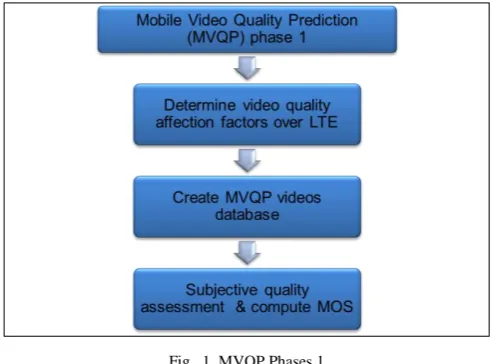
[image:2.595.45.292.458.640.2]An important issue related to mobile devices that is not yet fully addressed is the ability to predict video streaming quality over a Long Term Evolution (LTE) network. There are some objective methods available for evaluation of video streaming quality over Wi-Fi networks [6]. The MVQP project introduces a new method for predicting the quality of video streaming over User Diagram Protocol (UDP) through an LTE cellular network. The proposed MVQP method is divided into two phases. The MVQP Phase 1 is explained in [7] and [8]. This paper builds upon the work presented in [7, 8]. Fig.1 shows the MVQP phase 1.
Fig. 1. MVQP Phases 1
A. Determine Video Quality Affecting Factors over LTE cellular network
A video must be coded before it is sent from a transmitter to a receiver. This involves many factors causing distortion. The MVQP project works to determine those distortion factors as part of its aim to predict video streaming quality.
In [8] a set of LTE parameters is evaluated. The study shows consistency and correlation among the Reference Signal Strength Indicator (RSSI), Reference Signal Received Power (RSRP), Reference Signal Receiver Quality (RSRQ),
and packet loss. A decrease in RSSI, RSRP, and RSRQ cause packet loss to increase. These parameters impact video quality over an LTE cellular network.
B. MVQP Database
In [7] a comprehensive 4k resolution raw videos for MVQP project and researchers on video quality assessment is introduced. The MVQP database has a total of 40 videos that have different attributes like motion, contents and type of shots. A group of those videos have been used in MVQP phase 1 as described in [8]
C. SUBJECTIVE MOBILE VIDEO QUALITY ASSESSMENT
1. Source and Distorted Videos
This study evaluates 100 videos streamed live from different locations that were selected based on the LTE signal strength over the cellular network. These videos were then saved in MVQP client laptops as described in [8]. The videos were all recorded on or near the campus of Florida Institute of Technology (FIT) campus in Melbourne, Florida. These 100 videos were taken from the following 10-source videos, (each streamed lived at 10 different location).
a) Garden (ga). Shot at FIT’s campus. The camera tilts the trees from bottom to top.
b) Building (bu). Shot at FIT’s campus on a sunny afternoon. The camera pans from left to right.
c) Playground (pl). Shot in a park on a sunny afternoon. Children are playing on slides.
d) Basketball Training (bt). Shot inside Clemente Center at FIT. Players show fast and complex motions. The camera was stationary.
e) Tree (tr2). Shot near the side of a road on a sunny afternoon. The camera pans across the scene from top to bottom.
f) Basketball Training (bt2). Shot inside Clemente Center at FIT. Different ratios of light are shown with the movement of players. The cameral was showing steady movement.
g) Lawn Service (ls). Shot at FIT campus where a man is mowing lawn. The camera tracks him from left to right.
h) Students at Library (sl). Shot in main library at FIT on early morning. The stationary camera zooms out.
i) Swimming Pool 2 (sw2). Shot at FIT swimming pool on a sunny afternoon. Shows a man jumping into the swimming pool with the bright twinkle of waves clearly visible in water. The camera pans from right to left.
j) Melbourne Downtown (md). Shot from the top of a roof on a cloudy afternoon. The entire area is comprised on tall buildings and trees. Various cars are moving on the road. The camera pans from right to left.
D. Subjective Evaluation Procedure
telecommunications services. It presents test sequences one at a time to viewers who rate each one independently. The viewer watches a video for 15 seconds and then immediately within the next 10 seconds rates the quality of that video on a scale of 1 to 5. Figure 2 describes the “Stimulus Presentation in the ACR Method”.
Fig. 2. Stimulus presentation in the ACR method
[image:3.595.311.547.245.482.2]In this study a non-expert group of individuals (subjects) at FIT and at English Language services (ELS) was asked to watch a set of videos that vary in quality and rate them. A special android application (“MVQP Rating”) was developed for this purpose to make the subjective evaluation process easy and efficient. The MVQP Rating application displays a list of videos as shown in Fig.3.
Fig. 3. MVQP Application Main Screen
[image:3.595.54.290.327.455.2]A subject viewer evaluates a video by first selecting it from a list. After selection, the MVQP application plays the video. When the video is finished playing, a rating screen appears showing the rating scale on a bar of one to five stars. A subject viewer is able to rate the selected video by touching the screen where one star represents the lowest quality and five stars represent the highest quality. See Fig.4, “MVQP Application Rating Screen”
Fig. 4. MVQP Application Rating Screen
The post-rating activity involves steps in which the application deletes the video temporarily and goes back to the video list screen so that each subject viewer evaluates each video only once. A total of 1000 evaluations are
conducted from among 100 different individual subject viewers. Both females and males ranging from ages 18 to 40 years old are included. The study is designed so that each video receives 10 evaluations from 10 different individual subject viewers. After evaluations are received for a particular video, the MVQP rating application deletes that video permanently from the video list and save the rating results in MVQP server.
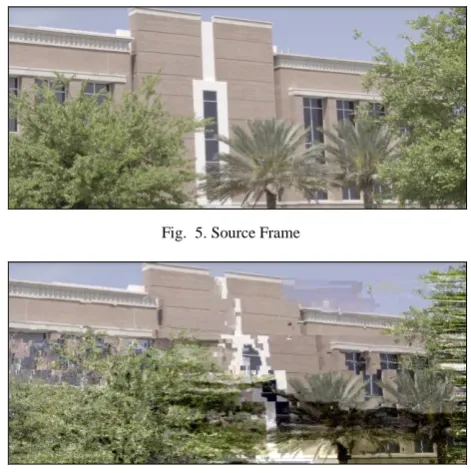
The handset device used in this study is the Samsung Galaxy s3 that has a 4.8-inch screen with a resolution of 1280 x 720. Four such identical handset devices were used for subjective assessment in this study. The videos vary in quality based on the total packet loss during live streaming. Figure 5, “Source Frame” and Figure 6, “Distorted Frame” illustrate how distortion occurs from packet loss.
Fig. 5. Source Frame
Fig. 6. Distorted Frame
III. STUDYANALYSISANDRESULTS
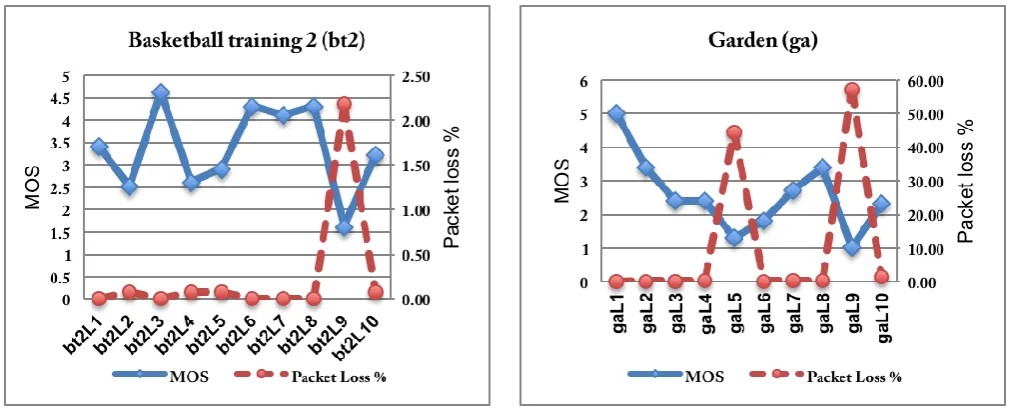
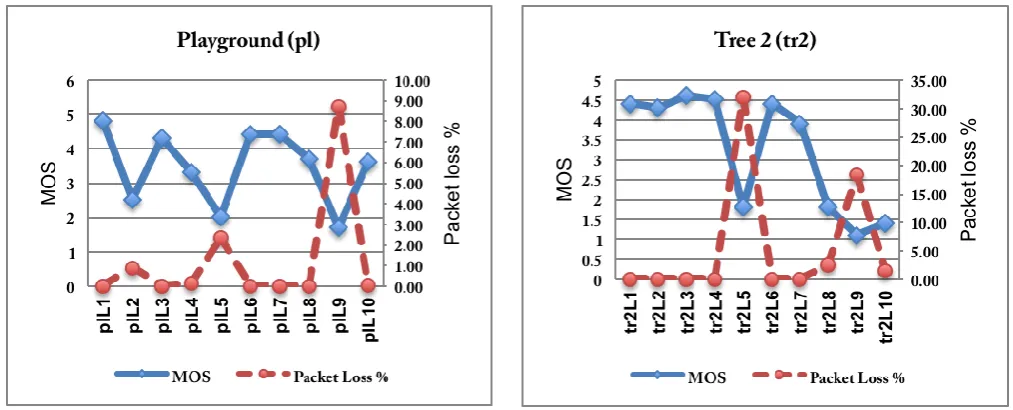
Subject viewers evaluated a total of 100 videos that were saved during live radio frequency (RF) signal measurements in [8]. These 100 videos vary in quality based on total packet loss during live streaming. The MOS for each video is shown in Figures 7 – 16 below. In addition to the MOS, 95% confidence intervals of the subject ratings are also calculated to ensure accuracy of the results.
Results of this study show the amount of consistency and correlation between packet loss and MOS. As expected, packet loss and MOS are found to be inversely proportional to each other. Study results also show a small percentage packet loss can have a major impact on video quality.
[image:3.595.55.292.586.720.2]Fig. 7. Basketball training 2 (bt2) video
Fig. 8. Basketball training (bt) video
[image:4.595.45.554.48.256.2]Fig. 9. Building (bu) video
[image:4.595.42.554.248.490.2]Fig. 10. Garden (ga) video
Fig. 11. Lawn services (ls) video
[image:4.595.45.548.527.740.2]Fig. 13. Playground (pl) video
Fig. 14. Students at library (sl) video
Fig. 15. Swimming pool 2 (sw2) video
Fig. 16. Tree 2 (tr2) video
IV. CONCLUSION AND FUTURE WORK
This paper and study focuses on research based on calculating live measurements of distortions of streaming video over an LTE cellular network. The MVQP project also focuses on predicting the video quality over a 3G cellular network [10]. Study results obtained through the MOS are quite accurate due to usage of an actual smart phone in the subjective evaluations. Results show how packet loss is related to MOS values. The study can be considered a first milestone and the basis for continuing with a later Phase 2 of the MVQP project. Study results will be made available on the MVQP website [11].
Further study in Phase 2 of the MVQP project will focus on developing MVQP capable of automatically determining video quality over LTE cellular networks. The aim is to enable MVQP to perform predictions by using MOS study results obtained in this study. Toward that end, in parallel, the LTE network parameters have been determined in [8]. The MVQP project plans to perform further studies utilizing MOS results in relation to distortion parameters. It is proposed that the MVQP project will be able to map such results and relationships accordingly. See Fig. 17 for, “MVQP Project Phases”.
[image:5.595.45.554.343.753.2]REFERENCES
[1] Ayaskant Rath, Sanjay Goyal, and Shivendra Panwar, “Streamloading:Low Cost High Quality Video Streaming for Mobile Users”, Polytechnic Institute of New York University, 2013 [2] Nicholas D. Lane, Emiliano Miluzzo, Hong Lu, Daniel Peebles,
Tanzeem Choudhury,and Andrew T, “A Survey of Mobile Phone Sensing, “ AD HOC AND SENSOR NETWORKS, 2012.
[3] Satu Jumisko-Pyykkö, Jukka Häkkinen, “Evaluation of Subjective Video Quality of Mobile Devices,“ in Proceedings of the 13th Annual ACM International Conference on Multimedia, Hilton, Singapore,2005,pp. 535-538
[4] FARIAS, Mylene C. Q.; No-Reference and Reduced Reference Video Quality Metrics. Saarbracken, Alemanha : VDM Verlag, 2008, v.1. p.168.
[5] D.S. Hands et al., ‘‘Objective Perceptual Quality Measurement of 3G Video Services,’’ Proc. IEE 3G Mobile Conf., IEE Conf. Publications, 2004, pp. 437-441.
[6] Elisangela Aguiar, Andr´e Riker, Mu Mu, and Sherali Zeadally, “Real-Time QoE Prediction for Multimedia Applications in Wireless Mesh Network”, 4th IEEE Future Multimedia Network Workshop, Las
Vegas, USA, Jan 2012.
[7] Fahad Al Qurashi, Hamad Almohamedh, and Ivica Kostanic “RAW Video Database of Mobile Video Quality Prediction (MVQP),” The 2014 International Conference on Image Processing, Computer Vision, and Pattern Recognition (to be published),2014.
[8] Hamad Almohamedh, Fahad Al Qurashi, and Ivica Kostanic “Mobile Videos Quality Measurements over Long Term Evolution (LTE) Network,” The 2014 International Conference on Image Processing, Computer Vision, and Pattern Recognition (to be published),2014. [9] ITU-T P.910 Subjective video quality assessment methods for
multimedia applications, International Telecommunications Union – Telecommunication sector, 1999.
[10] Fahad Al Qurashi, Hamad Almohamedh, and Ivica Kostanic Subjective Video Streaming Quality Evaluation in 3G Cellular Networks,” The 2014 International Conference on Image Processing, Computer Vision, and Pattern Recognition (to be published),2014. [11] Hamad Almohamedh, Fahad Al Qurashi, and Ivica Kostanic “Mobile
Videos Quality Predection project Website,“ 2014