Abstract— This paper analyses the various losses due to partial shading on different photovoltaic array configurations under moving non-uniform illumination conditions (passing cloud). Each solar array is composed of modules which are interconnected in series and parallel. Bypass diodes are also modelled to avoid hotspot conditions in a photovoltaic module. The developed model is able to simulate and compute the electrical characteristics of the different array configurations under changing illumination conditions. The array configurations have been compared on the basis of various partial shading losses and fill factor.
Index Terms— bypass diode; mismatch loss; fill factor; passing cloud; single diode model
I. INTRODUCTION
T
he energy requirement of the world is ever increasing. Among the renewable sources accessible, solar energy has received special attention. In the recent years the advancement of smart grid concept has acted as a catalyst for the widespread expansion of Photo Voltaic (PV) systems. The electric grids have precise voltage levels. In order to interface the PV generators with the grid, the PV cells are connected in series to form PV modules. The generators are built by linking the PV modules in series and in parallel (PV array) in order to get necessary voltage level and to increase the nominal power of the generator.The series connection of PV cells is subjected to mismatch power losses if the electrical characteristics of the PV cells are not identical or the cells do not operate under uniform conditions. The PV cell with the lowermost short circuit (SC) current limits the current of the whole series connection [1]. The major environmental reason for the uneven SC current is the partial shading (PS) of the PV power generator due to clouds, nearby trees, buildings etc. This will also generate hot spots in the shaded cells and the cell may be damaged [2]. To prevent PV cells from damage
Manuscript received April 8, 2014; revised April 15, 2014. Vijayalekshmy S is a research scholar in the Department of Electrical Engineering, College of Engineering, Trivandrum, Kerala, India. (corresponding author: +914712446994); e-mail: 73viji@ gmail.com).
Bindu G R is Associate Professor in the Department of Electrical and Electronics Engineering, College of Engineering, Trivandrum, Kerala, India.e-mail: [email protected].
S Rama Iyer was the Dean at College of Engineering, Trivandrum.e-mail:[email protected]
due to hotspots, bypass diodes are connected in antiparallel with the PV cells [3]. When the shaded cells in the PV module become reverse biased, the bypass diode connected in antiparallel begins to bypass the current exceeding the SC current of the shaded cells and limits the power dissipated in the shaded cells.
When the bypass diodes conduct during non-uniform condition, the power- voltage (PV) curves of a PV generator shows multiple maxima. Thus the extraction of maximum power from the PV array becomes complex since there are local maximum power point (MPP) at low voltages and at higher voltages. Techniques to track the global maximum power point (GMPP) have also been developed as in [4] - [8], but they tend to be complicated and many of them are unable to track the GMPP under changing illumination conditions.
Significant influence on partial shading on the electrical characteristics and the power output of the PV arrays on the different PV generator configurations has been reported by researchers [9]. The focus has been mainly on the development of a simulation model for a series connected PV array and on the operation of MPPT algorithms or the converter configuration. A new mathematical formulation for the optimal reconfiguration of PV arrays to minimize partial shading losses has been developed in [10]. The mismatch losses and the power losses due to tracking of local MPP instead of the global one for long string, parallel string and multi string configurations has been studied in [11]. A comparative analysis on the performance of a short string of series connected and parallel connected PV modules for low power application is dealt in [12]. A detailed analysis on the various array configurations under changing illumination conditions is reported in [13]. In [14], a method to configure the physical placement of the modules based on Su Do Ku puzzle pattern in a TCT connected PV array has been proposed to enhance the PV power generation under partial shaded conditions.
In this paper, the various partial shading losses due to the false tracking of the local MPP instead of the global MPP and fill factor under changing illumination conditions (i.e. a passing cloud) have been thoroughly investigated. Four configurations namely series parallel (SP), bridge linked (BL), honey comb (HC) and total cross tied (TCT) configurations have been investigated by using a MATLAB /Simulink model. The influence of bypass diodes on the electrical characteristics of the solar array under moving shadows for the four configurations have also been evaluated.
Estimation of Power Losses in Photovoltaic
Array Configurations under Passing Cloud
Conditions
I.PV MODULE MODELLING
Various electrical equivalents of the PV cell are found in literature of which the single diode model is the most widely used model. In this paper the single diode model of the PV cell proposed by Villalva et al [15] is implemented. The PV cell current is given by (1).
where V and I represent the PV cell output voltage and current respectively, Iph is the light generated cell current
(photo current), Rs and Rsh are the solar cell series and shunt
resistances, I0, the reverse saturation current, A is a
dimensionless junction material factor, K is Boltzmann‟s constant (1.38 × 10⁻²³ J/K), T is the temperature in Kelvin and q is the electron charge (1.6 × 10⁻²³ C) respectively. The photo current Iph can be expressed by the relation,
In (2), Isc is the cell SC current, Ki the temperature
coefficient of SC current, G the irradiance reaching the surface of the module and ST the Standard test conditions: Irradiance 1000W/m2, cell junction temperature 250 C, and reference air mass 1.5 solar spectral irradiance distribution. Definite number of such solar cells is connected in series to constitute a PV module. The module current, Imod is
described by equation (3)
Vmodis the output voltage of the module , Ns is the number of
solar cells connected in series to constitute a PV module , RsMthe series resistance of the module and RshM the shunt
resistance of the module.
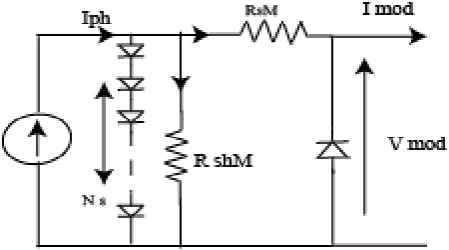
Bypass diodes are connected across each module (fig .1.) to bypass the module current under shadowing conditions so as to protect the module from damage. Henceforth the expression for module current with bypass diode is as in (4).
Iobypass is the saturation current and Abypass is the ideality
factor of the bypass diode. The simulation has been performed for the values available from the datasheet of GENERIC POLY 60Wp module. The open circuit (OC) voltage and SC current of the module under ST conditions are 21.1V and 3.8A respectively. The nominal voltage and current are 17.1V and 3.5A respectively. The shunt resistance and series resistance of the module considered are 339.1Ω and 0.1Ω respectively.
II.PARTIAL SHADING LOSSES.
The MPP of the array does not match with the MPP of the individual modules under PS conditions and this causes
[image:2.595.312.537.77.202.2]power losses through different mechanisms [16]. Various powers
[image:2.595.51.289.549.613.2]Fig. 1. Equivalent circuit of PV Module with bypass diode.
Fig. 2. Various losses for the PS Array
losses due to PS are illustrated in fig. 2. The maximum possible power under PS is the sum of the maximum powers of the individual modules when operating independently under the same solar insolation. Obviously, array maximum power without partial shading is always more than the maximum possible power under PS. The difference between the two powers, the shading losses cannot be avoided. Mismatch loss is a distinctive property of each generator configuration. Mismatch loss of the PV generator is calculated by comparing the power of the global MPP to the sum of the maximum power of the individual modules under PS conditions. The mismatch loss represents the lost power owing to the fact that the PV modules do not operate at its own MPP, although the whole PV generator operates at its GMPP. Mismatch loss is depicted by (5)
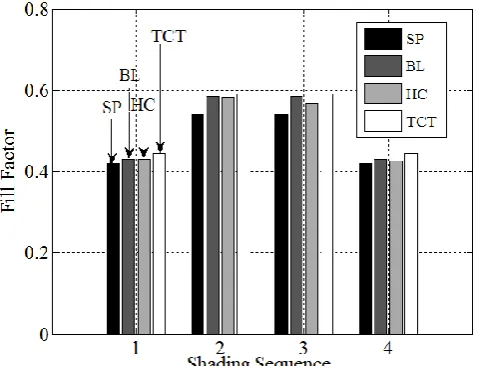
Loss of power due to PS is also defined by the Fill Factor (FF). FF is specified by (6)
III. ARRAY CONFIGURATIONS.
configuration has been derived from SP by interconnecting the rows of the junction through ties. In TCT, voltage across the various ties and the sum of the currents through various ties are equal. The BL configuration has been adapted to get the HC configuration. TCT has more number
SP BL HC TCT Fig.3. Different Array Configurations
of ties which make difficulties in the interconnection between the modules. HC has lesser number of ties and under certain conditions of insolation level HC is more suitable than TCT.
IV. MODELLING AND SIMULATION OF A MOVING CLOUD. The PV array is modelled as a matrix with dimensions (pxq), where p denotes the number of modules in the series string and q represents the number of modules in the parallel string. The shadow of the moving cloud will reduce the solar irradiance resulting in non-uniform solar insolation to the PV array. The change in insolation will change the SC current and the OC voltage of each cell. The temperature of the solar cells is assumed to remain constant. The irradiance of each solar module at each instant of time (t1 to t4) varies
in accordance with the ST conditions.
For simulating a moving cloud a method has been proposed in [17].The distance Dx, y between the solar module
with index (x, y) at instant of time tz and the center of the
cloud is to be determined. This is found by solving (7)
The cloud is moving with the speed v . Realistic values for the ratio of irradiance in each solar cell or module will range from 0 to 1, and can be specified using the sine function as in the subsequent equation
In (8), ISC0 is the short circuit current of the non-shaded solar
cell and ISC(x,y)are short circuit current of the solar cell (x,y).
The approaching cloud is darker at the center and brighter at the bounds. At t1 the epicenter of the cloud falls in the lowest
left solar cell. At the end point t4, the center of the cloud
falls in the extreme right side solar cell. The insolation is roughly proportional to the short- circuit current, so that the effect of a passing cloud to a solar array may be modelled as the change of SC current through all elements of p x q matrix. Fig.4. illustrates the graphical output of the MATLAB program based on (7) and (8).
(a)
(b)
(c)
(d)
V. RESULTS AND DISCUSSION. A. Mismatch loss
Mismatch loss is the difference between the sum of individual maximum power under PS conditions and the GMMP. The sum of individual maximum powers under PS is the same irrespective of the configuration. Mismatch loss of the four different configurations of the approaching cloud is shown in bar chart (Fig.5.). For all the four configurations it is observed that at time instants of t2 and t3,
the mismatch loss is less than at instants of t1and t4. At t2
and t3 the locus of the cloud is towards the centre of the
array and hence there is only small variation in the insolation levels between the various modules. But at instants of t1 and
t4 the centre of the cloud is towards the corners of the array.
[image:4.595.318.555.49.184.2]Hence there is wide discrepancy in insolation level among the modules. Hence it is concluded that shade dispersion improves the power output of the array. The mismatch loss is found to be more for a SP configuration. As the number of parallel ties in the configurations increases, the mismatch loss is found to decline appreciably. The mismatch loss is found to be lower in the case of a TCT configuration as is evident from the literature.
Fig. 5. % Mismatch loss for the four configurations
B. Shading loss
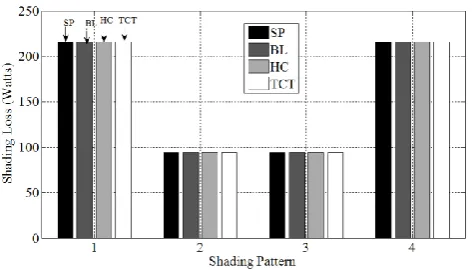
Shading loss is the difference between the array maximum power without PS and the sum of individual maximum power of the modules under PS condition. Unlike the mismatch loss TCT configuration does not produce the maximum possible power under PS conditions. The array maximum power without PS is 806.3W for all the configurations under study. Further the sum of individual maximum powers for the four configurations at instants of t1,
t2, t3 and t4are 590.11W, 712.2W, 712.2W and 590.11 W
respectively. Hence the shading loss for the four configurations under study is the same at instants of t1, t2, t3
and t4. The shading loss is as depicted in fig. 6.
C. Misleading power
Misleading power is due to the false tracking of the MPP tracker. Multiple maxima exist in P-V characteristics under PS conditions for all the array configurations with bypass diodes. Fig.7. depicts the misleading power for the four configurations under partial shading conditions. For
Fig. 6. Shading loss for the four configurations
SP configuration, the misleading power is established to decline at instants of t2 and t3 when the cloud is sited at the
middle of the array than at the corners. On the contrary for a BL configuration, the misleading power intensifies at instants of t2 and t3 than at instants of t1 and t4. The wide
variations in misleading power are not detected in HC configuration as in BL and SP. Moreover for TCT configuration at instants of t3 and t4 misleading power is zero
since there exists only one peak when the cloud has approached to the middle of the array. Also at instants of t3
and t4 the misleading power is less as compared to that of
[image:4.595.53.288.335.489.2]SP, BL and HC configurations. This facilitates the implementation of the classical MPP tracker for TCT configuration.
Fig.7. Misleading power for the four configurations
D. Fill factor
[image:4.595.304.549.369.551.2]Fig.8. Fill Factor for the four configurations
E. Power difference of local MPPs.
Under PS conditions, the P-V curve of the PV generator has typical multiple MPPs and the generator can operate in a local MPP of low power instead of the global MPP. From MPP tracking point of view, multiple MPPs are challenging, because conventional tracking algorithms based on hill climbing type of methods are not able to track the global MPP in case of multiple MPPs. From this point of view, the power difference of the local MPPs is important while choosing the configuration for the PV power generator, if a conventional MPP algorithm is implemented.
The power difference for the local MPPs for the studied PV power configurations is shown in fig .9. The relative power difference is calculated by using the absolute value of the power difference, since we are mainly concerned on the magnitude of the power difference. In case of two local MPPs, PMP1 and PMP2, PMP1 is the power of the local MPP at low voltage and PMP2 is the power of the MPP at the higher voltage. The power difference is zero in case of only one MPP and when the powers of the local MPPs are equal.
For SP configuration there are two local MPPs for the four instants of time. At instants of t2 and t3, the difference of
local MPPs is negligible as compare to instants of t1 and t4.
This indicates that for a SP configuration, the probabilities of false tracking by a conventional MPP tracker is negligible at instants of t2 and t3 since the power difference is only
[image:5.595.48.285.603.740.2]0.64%.
Fig. 9. Power difference of local MPPs for the four configurations
While for a BL configuration there is only one local MPP for all instants of time. At instants of t2and t3the relative
power difference is as high as 45% and this leads to a higher power loss in the case of false tracking by a conventional MPP tracker. For HC configuration, the difference in local MPP is about 9.73% at instants of t1 and t4, while at t2and t3
it is 0% and 17.31% respectively. In TCT configuration the difference in local MPP is 6% at instants of t1 and t4 and nil
at t2 and t3. Thus for TCT configuration, the conventional
MPP tracker does not generate significant power loss under changing illumination conditions.
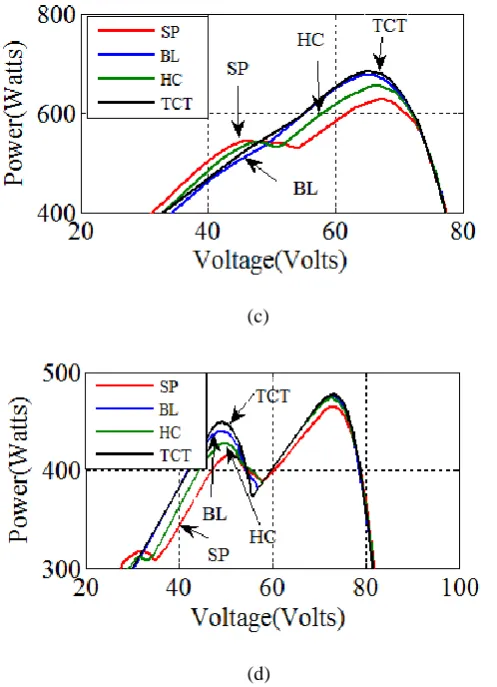
In order to illustrate the effects of changing illumination conditions, the P-V curves for the four configurations are shown in fig.10. TCT has the maximum power output at instants of t1, t2, t3 and t4with 477.1W, 683.7 W, 683.7W
and 477.1W respectively. BL configurations have a lesser maximum power with 475.5W, 676.4W, 676.4W and 475.5W. The difference in maximum power output is only 1.6W at instants of t1 and t4 but 7.3 W at instants of t3and t4.
As the cloud approaches towards the middle of the array the difference in illumination between the adjacent modules is less when compared to the instants when the cloud is towards the corners of the array. Dispersion of shade is professed when is cloud is at the centre and this property has proved to be beneficial for the TCT configuration.
(a)
(c)
(d)
Fig. 10. (a), (b), (c) and (d). P-V Characteristics of the four configurations at instants from t1 to t4
VI. CONCLUSION
The effects of partial shading on SP, BL, HC and TCT configurations have been investigated under changing illumination conditions based on the well-known single diode model of the PV cell. The effects of partial shading was studied on the power of the global MPP of the generators, the mismatch loss, shading loss, fill factor, misleading power and power of local MPPs of the generators.
Results show that SP configuration of PV modules is more prone to reduction in maximum power, increase in of mismatch losses and losses due to failure in tracking the global MPP under changing illumination conditions of partial shading than configurations with more number of parallel ties. The effect of bypass diodes on the configurations in increasing the power output is significant for a TCT configuration. But when compared to SP, BL and HC configurations, TCT has more number of interconnections between the modules which increases the cable losses. Thus shading due to climatic conditions has a considerable implication on the array output for various configurations.
ACKNOWLEDGMENT
The first author is thankful to the IT Department, Ministry of Kerala for providing facilities under the „SPEED IT‟ Programme for undertaking research.
REFERENCES
[1] Planning and Installing Photovoltaic Systems: A Guide for Installers and Architects, and Engineers, 2nd ed. London, Sterling, VA: Earth Scab, 2008, pp. 152-157, The German Energy Society.
[2] E. Molenbroek, D. W. Waddington, and K. A. Emery, “Hot spot susceptibility and testing of PV modules,”in Proc. Conf.Rec. 22nd IEEE Photovoltaic Spec. Conf. 1991,Vol1,pp 547-552
[3] S. Silvestre, A. Boronat, and A. Chouder, “Study of bypass diodes configuration on PV modules,” Appl.Energy, vol. 86, no. 9, pp. 1632–1640 Sep. 2009
[4] H. Patel and V. Agarwal, “Maximum power point tracking scheme for PV systems operating under partially shaded conditions,” IEEE Trans. Ind. Electron., vol. 55, no. 4, pp. 1689–1698, Apr. 2008. [5] K.Kobayashi, I. Takano, andY. Sawada, “A study of a two stage
maximum power point tracking control of a photovoltaic system under partially shaded insolation conditions,” Solar Energy Mater. Solar Cells, vol. 90, pp. 2975–2988, Nov. 2006.
[6] J. Young-Hyok, J. Doo-Yong, W. Chung-Yuen, L. Byoung-Kuk, and K. Jin-Wook, “A real maximum power point tracking method for mismatching compensation in PV array under partially shaded conditions,” IEEE Trans. Power Elctron., vol. 26, no. 4, pp. 1001– 1009, Apr. 2011.
[7] E. Koutroulis and F. Blaabjerg, “A new technique for tracking the global maximum power point of PV arrays operating under partial-shading conditions,” IEEE J. Photovolt., vol. 2, no. 2, pp. 184–190, Apr. 2012.
[8] Syafaruddin, E. Karatepe, and T. Hiyama, “Artificial neural network-polar coordinated fuzzy controller basedmaximum power point tracking control under partially shaded conditions,” IET Renewable Power Generat., vol. 3, no. 2, pp. 239–253, 2009.
[9] G. Lijun, R. A. Dougal, L. Shengyi, and A. P. Iotova, “Parallel-connected solar PV system to address partial and rapidly fluctuating shadow conditions,” IEEE Trans. Ind. Electron., vol. 56, no. 5, pp. 1548–1556, May 2009.
[10] G. Velasco-Quesada, F. Guinjoan-Gispert, R. Pique-Lopez, M. Roman-Lumbreras, and A. Conesa-Roca, “Electrical PV array reconfiguration strategy for energy extraction improvement in grid-connected PV systems,” IEEE Trans. Ind. Electron., vol. 56, no. 11, pp. 4319–4331, Nov. 2009
[11] Anssi Maki, Seppo Valkealahti, “Power Losses in Long String and Parallel-Connected Short Strings of Series- Connected Silicon-Based Photovoltaic Modules due to Partial Shading Conditions”IEEE Transactions on Energy Conversion,Vol 27, No 1, ,pp. 173-183, March 2012
[12] Vijayalekshmy S, S RamaIyer, Bisharathu Beevi, „ Evaluation of power losses in a short string of series connected and parallel connected Photovoltaic modules for low power applications‟, IEEE Conference Proceedings of International Conference on Control, Control and Computing (ICCC 2013),pp 125-130,Dec-2013 [13] Vijayalekshmy S, S RamaIyer, Bisharathu Beevi,‟ Analysis of Solar
Photo Voltaic Array Configurations under Changing illumination conditions‟. IEEE Conference Proceedings of International Confererence on Circuits,Power, Computing and Telecommunication,Nagercoil, pp 1032-1037,March 2014
[14] B InduRani,G Sarava Ilango and Clilakapati Nagamani,”Enhanced power generation from PV array under partial shading conditions by Shade dispersion using Su Do Ku configuration”,IEEE Trans on Sustainable Energy. April 2013
[15] M Villalva, J R Gazoli and E R Filho,”Comprehensive approach to modeling and simulation of photovoltaic arrays,”IEEE Transactions on Power Electronics, vol24, no.5, pp. 1198-1208, 2009.
[16] [26] M.Z.Shams El-Dein,Mehrdad Kezerani,M M A Salama,”Optimal photovoltaic array reconfiguration to reduce partial shading losses”,IEEE transactions on Sustainable Energy,vol. 4,No. 1, pp. 145-153, Jan 2013
[image:6.595.49.298.55.399.2]