An Evaluation of XML Associated Vulnerabilities in the
Xerces-C++ Parser
by
John O’ Donnell, B.A. Mod., MSc.
A dissertation submitted to the University of Dublin,
in partial fulfilment of the requirements for the Degree of
Master of Science in Computer Science
Declaration
I, the undersigned, declare that this work has not previously been submitted as an exercise for
a degree at this, or any other University, and that unless otherwise stated, is my own work.
John O’ Donnell
Permission to Lend and/or Copy
I, the undersigned, agree that Trinity College Library may lend or copy this thesis upon
re-quest.
John O’ Donnell
Acknowledgments
I would like to thank my supervisor Stephen Farrell for coming up with the idea for this thesis and for his help and guidance throughout. I would like to thank my parents for recovering from the shock of my announcement that I was quitting my job, moving home and going back to college for the year and supporting me throughout the year, especially in accepting the arduous task of proof reading this thesis. I would like to thank my girlfriend Anna for all her support and patience throughout the year. Finally I would like to thank my class for a very enjoyable year.
JOHN
O’ DONNELL
University of Dublin, Trinity College
An Evaluation of XML Associated Vulnerabilities in the
Xerces-C++ Parser
John O’ Donnell
University of Dublin, Trinity College, 2005
Supervisor: Mr. Stephen Farrell
One of the key concerns to the adoption of XML as the de facto standard for information representation is security. This has clear concerns for the continued success of Web Services as many elements of Web Services are XML based. XML parsers are present in all XML based applications and therefore any security vulnerability discovered in a parser is a serious threat to all applications of which it is a component.
This thesis concerns itself with the analysis of the Xerces-C++ (Xerces) parser. It deals explicitly with vulnerabilities that could be exploited by an attacker, for uses such as crashing or gaining privileges on applications that incorporate Xerces. Xerces was chosen as it is open source, is widely available and is written in a non-typesafe language, i.e. C++.
Using a static analysis tool, ITS4, two separate buffer overflows were discovered. The first buffer overflow, a heap based overflow, was caused by the use of the insecure C function
strcat()and could be effected by the use of theschemaLocationattribute in an XML document or schema. The second buffer overflow, a stack based overflow, was caused by the use of the insecure C functionstrcpy()and could be effected using Xerces error messages location setting.
Contents
Acknowledgments iv
Abstract v
List of Figures xi
Chapter 1 Introduction 1
1.1 Introduction . . . 1
1.2 XML Security . . . 2
1.3 XML Vulnerabilities . . . 3
1.4 Research Objectives . . . 3
1.5 Dissertation Outline . . . 3
Chapter 2 Background 6 2.1 XML . . . 6
2.2 XML Parsing . . . 9
2.3 Xerces-C++ . . . 10
2.4 Existing XML Security Mechanisms . . . 11
2.4.1 XML Signatures . . . 11
2.4.2 XML Encryption . . . 13
2.4.3 Security Assertion Markup Language . . . 14
2.4.4 XML Key Management Specification . . . 14
2.4.5 Extensible Access Control Markup Language . . . 15
2.4.6 Web Services Security . . . 16
2.5.1 CERT . . . 16
2.5.2 FIRST . . . 17
2.5.3 Bugtraq . . . 17
2.6 Win32 CRT Debug Heap . . . 17
Chapter 3 State of the Art 20 3.1 Unsafe Coding Practices . . . 20
3.1.1 Buffer Overflows . . . 20
Stack Overflows . . . 21
Heap Overflows . . . 22
3.1.2 Integer Manipulation Vulnerabilities . . . 23
3.2 Known XML Vulnerabilities . . . 24
3.2.1 XML Content-Based attacks . . . 24
3.2.2 Denial-Of-Service Attacks . . . 24
3.2.3 Schema Poisoning . . . 25
3.2.4 Buffer Overflow Attacks . . . 25
3.3 Preventative Measures . . . 26
3.4 Static Analysis . . . 26
3.5 Xerces Vulnerabilities Research . . . 27
3.6 ASN.1 Vulnerabilities . . . 28
Chapter 4 Vulnerability Analysis 29 4.1 Static Analysis . . . 29
4.2 Vulnerable Classes . . . 30
4.2.1 BinHTTPURLInputStream . . . 30
4.2.2 ICUMsgLoader . . . 32
4.3 Unsuccessful Attacks and Vulnerabilities . . . 33
4.3.1 Content-Based Attacks . . . 33
4.3.2 Recursive Payloads . . . 33
4.3.3 Construct Rich Schemas . . . 33
4.3.4 Encoding Types . . . 34
4.3.5 Grepping . . . 34
Chapter 5 Vulnerability Implementation 35
5.1 BinHTTPURLInputStream Buffer Overflow . . . 35
5.2 ICUMessageLoader Buffer Overflow . . . 36
Chapter 6 Vulnerability Demonstration 39 6.1 Applications . . . 39
6.1.1 Xalan-C++ . . . 39
6.1.2 Berkeley DB XML . . . 40
6.2 Overflows . . . 40
6.2.1 Berkeley DB XML Overflow . . . 40
6.2.2 Xalan-C++ Overflow . . . 43
6.3 Theoretical Exploits . . . 44
6.3.1 Stack Exploits . . . 44
6.3.2 Heap Exploits . . . 45
6.4 Vulnerability Countermeasures . . . 46
Chapter 7 Conclusion 48 7.1 Conclusion . . . 48
7.2 Future Work . . . 50
Appendix A Heap Vulnerability Example 51
Appendix B Static Analysis Output 55
Appendix C BinHTTPURLInputStream Class 59
Appendix D ICUMessageLoader Class 61
Appendix E Heap Buffer Overflow Code 63
Appendix F Stack Buffer Overflow Code 65
Appendix G Compiling Xerces-C++ with ICU Message Support 67
Appendix I Xalan-C++ Vulnerability Demonstration Code 71
Appendix J Berkeley DB XML Vulnerability Demonstration Code 73
List of Figures
2.1 Example XML Document . . . 7
2.2 Example Schema . . . 8
2.3 Example XML Signature . . . 12
2.4 Example <EncryptedData> Element . . . 14
2.5 _CrtMemBlockHeader Structure . . . 18
3.1 Memory Arrangement . . . 22
3.2 Integer Manipulation Underflow . . . 24
3.3 Entity Expansion Attack . . . 25
4.1 xsi:schemaLocation Example . . . 30
4.2 SchemaLocation Example . . . 30
5.1 Debug Window of Visual C++ During Stack Based Buffer Overflow . . . . 36
5.2 Debug Window of Visual C++ During Heap Based Buffer Overflow . . . . 37
5.3 Visual C++ Messages During Heap Based Buffer Overflow . . . 37
5.4 Visual C++ Messages During Heap Based Buffer Overflow . . . 38
6.1 Berkeley DB XML commands . . . 41
6.2 Visual C++ Message in BDBXML in Debug Mode . . . 42
6.3 Visual C++ Exception in BDBXML in Release Mode . . . 42
6.4 XSL Style Sheet . . . 43
Chapter 1
Introduction
1.1
Introduction
It is acknowledged that one of the key concerns to the broad adoption of Web Services is security. As Web Services integration becomes integral to core business processes, protect-ing web services from attack by hackers will become more and more necessary. Apart from being the standard for representing data in web services, protocols such as the Simple Object Application Protocol (SOAP) [1], which is the messaging protocol used to encode the in-formation in Web Service request and response messages and the Web Services Description Language (WSDL) [2], which is the language used to describe Web Services are XML based. It is very easy to create and parse and is platform and vendor independent, making it perfect for use in the heterogeneous environment of the internet. As XML is so pervasive it makes it a prime target to either be attacked itself or used as a means of attacking another vulnera-ble component, such as an XML parser. Any application that uses XML must incorporate a parser to process incoming XML documents so the data contained within the documents can be used by the application. This makes parsers integral to web services and so an obvious point of attack for hackers. There are already many attacks known, such as Denial of Service attacks, which target poorly coded parsers.
1.2
XML Security
XML security can be broken up into two main areas; firstly there is the security of XML documents themselves and secondly there is the use of XML technology to enhance security for other applications. One of the problems with XML is that the core specification does not address security in anyway. This leaves developers with the hard task of finding ways to secure their data. Three of the fundamental tenets of data security are data authentication, integrity and confidentiality.
In terms of XML security these are addressed by Digital signatures and Encryption. XML encryption (Xenc), is a standard proposed by the W3C and IETF for encrypting the XML tags and data within an XML document, which can run in conjunction with being able to use standard methods of encryption when transmitting XML documents. This would allow one to encrypt sensitive portions of a document or to even encrypt different portions of a document with different keys so the one XML document could be distributed to various re-cipients, with each recipient only being able to decrypt the parts relevant to them. XML signatures (XML-SIG), are closely related to encryption. They are similar in concept to se-curity certificate signatures and are used to ensure that the content within an XML document has not changed.
The other side of XML security is leveraging the features of XML to provide security for other applications. The Security assertion markup language (SAML) handles the exchange of authentication and authorization requests and responses between systems. A SAML request is sent via SOAP to the counterpart system which processes the request. The XML key management specification (XKMS) defines a way to distribute and register the public keys used by the XML-SIG specification and is made up of two parts: the XML Key Registration Service Specification KRSS) and the XML Key Information Service Specification (X-KISS). The Extensible Access Control Markup Language (XACML) is designed specifically for creating policies and automating their use to control access to resources on a network. It can be seen as a counterpart to SAML.
1.3
XML Vulnerabilities
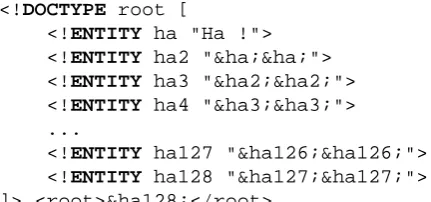
As XML becomes ubiquitous, many more types of security issues will surface. Some target-ing the XML itself and some ustarget-ing the XML as the means to target applications and other resources. There are many types of attacks that can compromise XML based applications, using XML as the source of the attack. Many of these types of attack prey on the fact that many parsers do not put an upper limit to processing parameters or resource consumption [3]. Some of the most common are XML Content-Based attacks, Denial-Of-Service Attacks, Schema Poisoning and Buffer Overflow Attacks.
1.4
Research Objectives
As has been alluded to the XML parser is an integral component in all XML based applica-tions and so is an obvious point of attack especially as it very much on the outer limits of the application structure, dealing with the raw XML documents as they are received. With this in mind the objective of this thesis was to examine XML parsers for vulnerabilities such as Schema Poisoning, Content-based attacks and Denial of Service attacks and document any vulnerabilities, if any, that are found. It was decided to concentrate on one type of parser, the Xerces-C++ parser, which is part of the Apache XML project. The reasons for this being it was open source, there was a large amount of information available on it and the fact that it was written in a non typesafe language, which gives more scope for possible vulnerabil-ities. Finally any vulnerabilities that are found will be tested against real applications that use the Xerces-C++ parser. The Microsoft Windows XP platform with service pack 2 was used throughout this dissertation and so the Windows implementations of all applications that feature in this dissertation were used.
1.5
Dissertation Outline
The following is an outline of the structure of the rest of this document.
• Chapter 3 - State of the Art, this Chapter discusses the current level of understanding in the areas key to this dissertation.
• Chapter 4 - Vulnerability Analysis, this Chapter introduces the buffer overflow vul-nerabilities and the methods that were developed to implement them. It also discusses some of the other types of attacks which were attempted but resulted in no vulnerabil-ities being found.
• Chapter 5 - Vulnerability Implementation, this Chapter describes how the methods discussed in Chapter 4 were employed to cause the buffer overflows in Xerces-C++ and discusses the outcomes of their implementations.
• Chapter 6 - Vulnerability Demonstration, this Chapter describes how the methods used to cause the heap overflow in Xerces-C++ were evaluated on two applications that in-corporate Xerces-C++ as a component. The results of these are then evaluated. Theo-retical exploits of these vulnerabilities are then discussed and finally countermeasures to these vulnerabilities are discussed.
• Chapter 7 - Conclusion, this Chapter gives a final summation of this dissertation. Ideas for further work are also discussed.
• Appendix A - Heap Vulnerability Exploit, this Appendix gives example code for a heap buffer overflow exploit.
• Appendix B - Static Analysis Output, this Appendix gives the output from the static analysis of the Xerces-C++ code.
• Appendix C - BinHTTPURLInputStream Class, this Appendix shows the constructor for the BinHTTPURLInputStream class.
• Appendix D - ICUMessageLoader Class, this Appendix shows the constructor for the ICUMessageLoader Class.
• Appendix E - Heap Buffer Overflow Code, this Appendix contains the code used for implementing the heap based buffer overflow.
• Appendix G - Compiling Xerces-C++ with ICU Message Support, this Appendix de-scribes how to compile Xerces-C++ with ICU Message Support.
• Appendix H - IPO.xml, this Appendix shows the XML document used for all tests throughout this dissertation.
• Appendix I - Xalan-C++ Vulnerability Demonstration Code, this Appendix shows the code used for implementing the heap based buffer overflow in Xalan-C++.
Chapter 2
Background
This Chapter gives an overview of some of the key topics in this dissertation such as XML, XML parsing and XML security mechanisms.
2.1
XML
<?xml version="1.0" encoding="ISO-8859-1"?> <note id="1">
<to>Tove</to> <from>Jani</from>
<heading>Reminder</heading>
<body>Don’t forget me this weekend!</body> </note>
Figure 2.1: Example XML Document
An XML document, such as that shown in figure 2.1, which is an XML representation of a note written to someone, consists of elements, attributes and other information. Elements are the main building blocks of XML documents. Elements are marked up with tags, an opening and closing tag. For example in figure 2.1, the <to> and </to> tags define an element which describes to whom the note is to. Between the opening and closing tags of the element, the information the element is describing is placed. Elements in an XML document can have relationships such as in figure 2.1; where to, from, heading and
bodyare children of the root elementnote.
Attributes are contained within elements, these contain additional information about the element, which is not necessarily part of the information described by the XML, but could be of use to the application that uses the document. In figure 2.1, thenoteelement contains the attributeid, which gives an identifier for the note. Attributes always have a name and a value separated by an equals sign. The value is always surrounded by single or double quotes.
Unlike in HTML where the markup tags are fixed, XML requires the user to create their own tags, which are defined in a DTD or more modernly in a schema. This gives the user flexibility and control over how they want to markup their data.
A DTD like a schema, defines the grammar rules for an XML document, which and in what order elements and attributes can appear in the document and the relationship between them. The syntax is somewhat similar to Backus Naur Form. A document which adheres to the rules outlined in the DTD is said to be valid.
<?xml version="1.0" encoding="UTF-8"?> <schema xmlns="http://www.w3.org/2001/XMLSchema"
targetNamespace="https://www.cs.tcd.ie/~odonnelj/1.0"> <!-- definition of simple elements -->
<element name="orderperson" type="string"/> <element name="name" type="string"/>
<element name="address" type="string"/> </schema>
Figure 2.2: Example Schema
As can be seen from figure 2.2, a schema always has a schema element as root, together with some attributes such as namespace definitions and rules on qualifying elements. Under this element are the definitions of the elements, attributes and other data that can be contained in any XML document that adheres to the schema.
As alluded to above XSL is a family of recommendations for defining XML document transformation and presentation. It consists of three parts:
• XSL Transformations (XSLT) [6] is a language for transforming XML documents into other formats such as HTML or PDF. An XSLT stylesheet consists of a collection of template rules, each of which specify what to add to the output document when the XSLT processor finds a node in the source tree that meets certain conditions.
• XML Path Language (XPath) [7] is a declarative language for locating nodes and frag-ments in XML trees. Its used in XPointer for addressing, XSL for pattern matching and XQuery for selection and iteration. Although originally created to provide a com-mon syntax and behavior model between XPointer and XSL, XPath has rapidly been adopted by developers as a query language.
• XSL Formatting Objects (XSL-FO)[8] is an XML vocabulary for specifying format-ting semantics.
2.2
XML Parsing
Any application that needs to process XML data requires an XML parser. XML parsers take textual representations of XML documents as input and create data representations of the documents as output which capture the XML hierarchy of the document and can be used by the application to process them. The parsers also serve to check the well-formedness and validity of the document.
XML parsers will not try and process an XML document unless it is well-formed and therefore adherent to the XML standard. For an XML document to be considered well-formed it must obey certain constraints contained in the XML specification [4]. These in-clude the following constraints:
1. Element Type Match: The Name in an element’s end-tag must match the element type in the start-tag.
2. No Recursion: A parsed entity must not contain a recursive reference to itself, either directly or indirectly.
3. Root Element: Each XML document must have one, and only one, root element.
4. Quoted Attribute values: All attribute values must be surrounded by quotation marks.
Validation ensures that the structure of the XML document is correct. An XML document is validated against its associated schema to ensure that it follows the structure defined by the schema, such as the elements present, they’re order and allowed values.
The parser creates either an in-memory representation of the data, which is called tree based parsing, or a stream of events, which is known as event based parsing, which can then be processed using the requisite API. In a tree based structure the XML document is mapped into an internal tree structure.
and document validation. It also specifies document loading and saving, document views, document formatting, and key events. XML DOM creates a hierarchical structure out of an XML document which can then be navigated using the DOM API. This allows information to be modified, deleted or added to the DOM document. The major problem with this method for parsing is that the entire document must be loaded into memory before the information can be accessed, which for large documents can be very time and resource intensive. These problems can be solved using other models such as event based models, the most popular being the Simple API for XML (SAX) [12] model.
The SAX model works on streams of data, processing the data and reporting parsing events to the application as it is read. There reports are called callbacks and are reported to event handlers in the application. In this way the whole document does not have to be built up in memory. The downside of this being that is very hard to navigate through a document and manipulate the information contained within or to move backwards in the data stream. SAX is actually two separate APIs, SAX 1.0 is the original, and SAX 2.0 is the current revised specification. The two are similar, but different enough that most applications based on SAX 1.0 break when they are moved to the newer specification.
There are many different XML parsers available today, some using the event based model of parsing and others using the tree based model. Some of the more common are Xerces, which is the parser used in this dissertation and Microsoft’s MSXML, Sun’s Project X parser and Oracle’s parser.
2.3
Xerces-C++
use XML as their data format and on-the-fly validation for creating XML editors. Xerces is part of a family of software packages, the Apache XML project, used for manipulating and parsing XML. The goals of the Apache XML Project are to provide commercial-quality standards-based XML solutions that are developed in an open and cooperative fashion, to provide feedback to standards bodies (such as IETF and W3C) from an implementation perspective, and to be a focus for XML-related activities within Apache projects [13]. Some of the other sub-projects under the Apache XML Project umbrella are:
• Xalan - XSLT stylesheet processors, in Java and C++
• AxKit - XML-based web publishing, in mod_perl
• Xang - Rapid development of dynamic server pages in JavaScript
• SOAP - Simple Object Access Protocol
• Crimson - A Java XML parser derived from the Sun Project X Parser.
• XMLBeans - XML-Java binding tool
Xerces-C++ allows the application to use the DOM or SAX API’s depending on the type of XML documents being processed and what type of information is needed from them.
2.4
Existing XML Security Mechanisms
If XML is to fully take off and be the complete standard for information exchange then XML security standards will need to be developed so users can be confident of issues such as controlling content distribution and ensuring its integrity. Below are some of the XML standards that deal with security issues.
2.4.1
XML Signatures
XML compliant syntax used for representing the signature of Web resources and portions of protocol messages and procedures for computing and verifying such signatures [16]. The specification defines a schema and corresponding DTD that specify how XML signatures can be represented. XML signature defines the syntax used to sign all or importantly part of an XML document. The XML signature can be included inside of the document to which the signature applies, or it can exist in a separate document. It contains the basic encrypted hash of the signed document, along with information that tells the recipient of the document what data was signed and which algorithms were used. A single document can have multiple signers either in different sections of the document or even over the same section. One of the main problems with trying to implement an XML signature is that typographical varia-tions can end up giving a document a completely different signature. To guard against this canonicalization (XML-C14N) [17] was introduced. Canonicalization structures the docu-ment in its simplest form. XML digital signatures are represented by the Signature eledocu-ment, reference 3.1, shows the outline for a signature, where? denotes zero or one occurrence,+
denotes one or more occurrences and*denotes zero or more occurrences.
<Signature ID?> <SignedInfo>
<CanonicalizationMethod/> <SignatureMethod/>
(<Reference URI? > (<Transforms>)? <DigestMethod> <DigestValue>, </Reference>)+ </SignedInfo> <SignatureValue> (<KeyInfo>)? (<Object ID?>)* </Signature>
Figure 2.3: Example XML Signature
The main steps for signing a document are:
• Pick the algorithms you wish to use for signing, digesting, etc
• Decide which parts of the XML document are to be signed
• Form a SignedInfo element
• Canocalise the above
• Apply your private key
• Form up an XML<Signature>
2.4.2
XML Encryption
XML encryption (Xenc) [18], is the new encryption standard for encrypting XML data and tags within a document. It follows the traditional encryption steps for public key cryptog-raphy, where the data is encrypted, typically using a randomly created secret key and then the secret key is encrypted using the intended recipient’s public key. This information is packaged to ensure that only the intended recipient can retrieve the key and decrypt the data. Decryption involves applying the private key to decrypt the secret key, then decrypting the data with the secret key. The specification provides end-to-end security for applications that require secure exchange of structured XML data and addresses security requirements that are important to Xenc but have been over looked by the de facto standards, TLS and SSL such as encrypting parts of documents and setting up secure sessions between more then 2 parties. This means that any party in a session have could secure or insecure states with any of the communicating other parties. XML Encryption can handle both XML and non-XML data. The data is encrypted using a strong symmetric encryption algorithm such as AES. As Xenc allows one to encrypt individual tags within a document it is possible to encrypt sepa-rate portions of a document with different keys, so one XML document could be distributed to various recipients, but each recipient would only be able to decrypt the parts relevant to them. Figure 4.1, shows the outline for an<EncryptedData>element.
<EncryptedData Id? Type? MimeType? Encoding?> <EncryptionMethod/>?
<ds:KeyInfo> <EncryptedKey>? <AgreementMethod>? <ds:KeyName>?
<ds:RetrievalMethod>? <ds:*>?
</ds:KeyInfo>? <CipherData>
<CipherValue>?
<CipherReference URI?>? </CipherData>
<EncryptionProperties>? </EncryptedData>
Figure 2.4: Example <EncryptedData> Element
2.4.3
Security Assertion Markup Language
SAML is the OASIS consortium’s Security Assertion Markup Language [19]. It is one of many languages which builds on the syntax and semantics of XML. SAML uses XML signatures and encryption to protect the exchange of security credentials for single sign-on and other applicatisign-ons. A SAML request csign-ontains informatisign-on such as authenticatisign-on, username and password. This information is delivered to an application designed to process it with the intended goal of using XACML to allow or deny access to an XML resource. SAML use an Assertion scheme created by OASIS. Assertions are constructs that convey information about authentication acts performed by subjects (users or computers), attributes of subjects, and authorization decisions about whether subjects are allowed to access certain resources which are issued by SAML authorities. SAML also defines protocols for client requests for assertions and responses from authorities. Finally SAML also defines bindings to other protocols, such as HTTP and SOAP.
2.4.4
XML Key Management Specification
used in conjunction with XML Signature and XML Encryption. It will make it straightfor-ward to develop applications that will interact with key-related services such as registration and validation since all developers will have to worry about is XKMS clients, as the XKMS servers will be looked after by PKI providers. The specification is divided into 2 parts: The XML Key Information Service Specification (X-KISS) and the XML Key Registration Service Specification (X-KRSS). X-KISS minimizes the complexity of applications using XML Signature by allowing the client to delegate the tasks for processing XML signature elements to a trusted service. Thus by becoming a client of the trust service, the application is relieved of the complexity and syntax of the underlying PKI used to establish trust rela-tionships. X-KRSS describes a protocol for registration of public key information. XKMS will even allow mobile devices to access full-featured PKI through ultra-minimal-footprint client device interfaces.
2.4.5
Extensible Access Control Markup Language
The Extensible Access Control Markup Language (XACML) is designed to standardise pol-icy management and access decisions, specifically for creating policies and automating their use to control access to disparate devices and applications on a network [21]. Like XKMS and SAML it is built on the syntax and semantics of XML. The SAML specification defines how identity and access information is exchanged, but SAML can only communicate in-formation XACML defines how this inin-formation is used. The XACML specification which offers the same descriptions of subjects and actions as SAML, lets one define rules for cre-ating an organization’s security policies and making authorization decisions. XACML has 2 basic components. The first is an access-control policy language that lets developers specify the rules about who can do what and when and the other is a request/response language that presents client requests for assertions and responses to these requests. When a client makes a resource request to a system, the Policy Enforcement Point (PEP) controls the access to the resources. In order to enforce policy, the PEP formalises attributes describing the requester client at the Policy Information Point (PIP) and delegates the authorization decision to the Policy Decision Point (PDP). Applicable policies are located in a policy store and evaluated at the PDP, which then returns the authorization decision. Using this information, the PDP can deliver the appropriate response to the client1.
2.4.6
Web Services Security
Oasis’s Web Services Security (WSS) specification is a standard set of SOAP extensions that can be used when building secure Web Services to implement message integrity, mes-sage confidentiality and single mesmes-sage authentication [22]. WSS was originally developed by IBM, Microsoft, and VeriSign. As Web Services are used in many heterogeneous en-vironments, WSS does not specify a particular set of message exchanges or cryptographic operations but is designed to be used as the basis for the construction of a wide variety of security models including PKI, Kerberos, and SSL. WSS provides support for multiple security tokens, multiple trust domains, multiple signature formats, and multiple encryp-tion technologies. The WSS specificaencryp-tion provides three main mechanisms: security token propagation, message integrity, and message confidentiality. The specification is extensible and so WSS can be used in conjunction with other Web Service extensions and higher-level application-specific protocols to accommodate a wide variety of security models and encryp-tion technologies.
2.5
Security Institutions
In this section some of the institutions and other forums that deal with internet security will be discussed.
2.5.1
CERT
The Computer Emergency Response Team (CERT) is an organisation devoted to ensuring that appropriate technology and systems management practices are used to resist attacks on networked systems and to limiting damage and ensure continuity of critical services in spite of successful attacks, accidents, or failures2. It is located at the Software Engineering
Insti-tute (SEI), which is operated by Carnegie Mellon University. The CERT Coordination Center (CERT/CC) is one component of the overall CERT Program. It was created by DARPA in 1988 after the Morris worm struck and is a major coordination center in dealing with internet security problems. In September 2003, the Department of Homeland Security announced the creation of US-CERT, a joint effort with CERT/CC. US-CERT draws on CERT/CC
ties to help prevent cyber attacks, protect systems, and respond to the effects of cyber attacks across the Internet3.
2.5.2
FIRST
FIRST is the global Forum for Incident Response and Security Teams 4. It is the
recog-nized global leader in incident response. The aims of FIRST are to foster cooperation and coordination in incident prevention, to stimulate rapid reaction to incidents, and to promote information sharing among members and the community at large. It was founded in 1990, as a response to the need for information exchange and cooperation on issues such as new vul-nerabilities and wide ranging attacks. FIRST brings together a wide variety of security and incident response teams including especially product security teams from the government, commercial, and academic sectors.
2.5.3
Bugtraq
Bugtraq is a full disclosure mailing list dedicated to computer security issues such as vul-nerabilities, exploitations and fixes. It was formed in 1993 by Scott Chasin as a response to what he saw as the perceived failings of the existing security infrastructure to deal with the influx of vulnerabilities that were appearing at the time. The idea behind the mailing list was to publish new vulnerabilities in full regardless of vendor response and so force the vendors into developing fixes for the vulnerabilities, something they were notoriously slow in doing at the time. Since 1999 Bugtraq has been the property of the computer security company SecurityFocus5, who are owned at present by the security company Symantec6.
2.6
Win32 CRT Debug Heap
The C Run-time library (CRT) provides operators and functions likemalloc(),new and
free()for heap memory management. In debug mode these operators are implemented differently to the release versions. An example of this being _malloc_dbg the debug
3http://www.us-cert.gov/ 4http://www.first.org/
version of the malloc operator, which like malloc allocates memory on the heap, but also offers several debugging features such as buffers on either side of the user portion of the block to test for leaks and a block type parameter to track specific allocation types. In debug mode the operators are implemented to guard against and spot heap errors such as overflows and underflows. This is achieved through methods such as using guard blocks to detect overflows, initialising newly allocated memory to a fixed value (0xCD) to aid reproducibility and setting freed blocks to a known value (0xDD) so that the writing through of dangling pointers can be detected7.
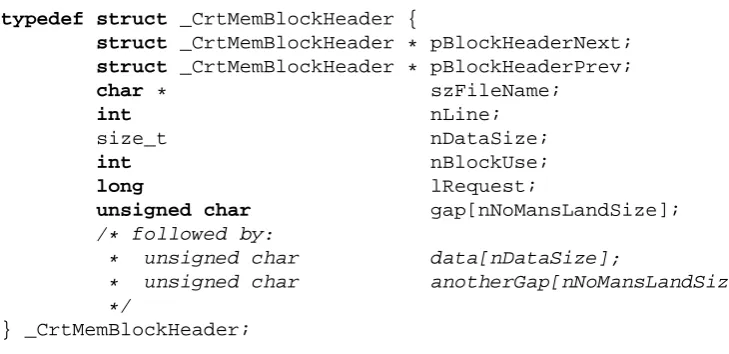
When one of the CRT operators such asnewis used to request an amount of memory on the heap, the CRT will actually allocate more then was requested so as to wrap the allocated block with bookkeeping information8. For each allocated block, the CRT keeps information in a structure called_CrtMemBlockHeader. Figure 2.5 shows the declaration for this structure.
#define nNoMansLandSize 4
typedef struct _CrtMemBlockHeader {
struct _CrtMemBlockHeader * pBlockHeaderNext; struct _CrtMemBlockHeader * pBlockHeaderPrev;
char * szFileName;
int nLine;
size_t nDataSize;
int nBlockUse;
long lRequest;
unsigned char gap[nNoMansLandSize];
/* followed by:
* unsigned char data[nDataSize];
* unsigned char anotherGap[nNoMansLandSize]; */
[image:29.595.100.465.396.573.2]} _CrtMemBlockHeader;
Figure 2.5: _CrtMemBlockHeader Structure
pBlockHeaderNextandpBlockHeaderPrevare pointers to the blocks allocated previously and after the current block.nDataSizedefines the number of blocks requested.
nBlockUsedefines the type of block it. The block can be a freed block, a normal block or a block specially used by the CRT.gap[nNoMansLandSize]is a zone of 4 bytes filled
with 0xFD, fencing the data block ofnDataSizebytes. Another block filled with 0xFD of the same size follows the data. These guard blocks are used to check for heap errors such as buffer overflows. The CRT checks these blocks to make sure that they contain 0xfd. If they have changed the CRT knows that can error has occurred and throws an exception.
Most of the actual heap block allocation work is done using the Win32 functions,
HeapAlloc()andHeapFree(). When the functionmalloc()is used to request a cer-tain amount of bytes on the heap,malloc()will callHeapAlloc(), which will request 36 more bytes more on top of what has already been requested. These bytes are split up be-tween 32 bytes for the_CrtMemBlockHeaderstructure and another nNoMansLandSize number of bytes, which is 4 bytes as present, to fence the data zone. This all gets initialised to 0xBAADF00D. Memory also needs to be reserved for Win32 bookkeeping information and soHeapAlloc()will reserve another 40 Bytes in addition for this. 8 Bytes are reserved for below the memory already reserved and 32 Bytes for above it. Finallymalloc() fills the_CrtMemBlockHeaderblock with information, initialises the data block with 0xCD and the guard blocks with 0xFD.
When the block is freed using an operator such asfree(), the CRT will set the block it requested fromHeapAlloc()to 0xDD, indicating this is a free zone. Normally after this,
Chapter 3
State of the Art
This Chapter discusses the current level of understanding in the areas key to this dissertation.
3.1
Unsafe Coding Practices
3.1.1
Buffer Overflows
The first well known exploit using buffer overflows occurred in 1988, when the Morris worm was released onto the internet. The worm exploiting an unchecked buffer initialised by thegets()function call in the fingerd daemon process [23], collected host, network, and user information and then broke into other machines using the same exploit. After breaking in, the program would replicate itself and the replica would attempt to infect other systems. This resulted in over 6,000 systems being shutdown in just a few hours.
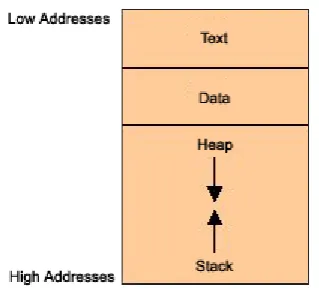
All programs and applications can be divided into two basic parts: text and data. The text is the actual read-only program code and data is the information that the program code operates on. The data area can be broken down into 3 parts: static, stack and heap data. Static data reserved for information known before runtime such as global variables and static class members.
The stack is an actual data structure which works on the principle of last in first out, growing down from higher to lower memory addresses. It holds a function’s parameters and local variables while that function is in scope and importantly it also holds the return address for the next instruction to be executed after the present function has returned. Items are pushed onto the top of the stack when they are added to it and popped off the top of the stack when taken off.
The heap is the section in memory where all dynamically allocated variables are stored. These are variables which are allocated at run time by C and C++ operators such as
malloc()andnew. The heap grows from lower to higher memory addresses. Figure 3.1, represents the basic memory layout1.
Stack Overflows
Stack overflows involve the overwriting of function pointers so as to change program flow or gain elevated privileges on the System [24].
When a function is called, the first thing that takes place is that the function parameters are pushed onto the stack. The CALL instruction then pushes the instruction pointer (EIP) onto the stack. The instruction pointer, holds the address of the next code to be executed when the function returns. The function can now execute on its own. First, the Stack Frame Pointer (SFP) of the function within which the new function is being called from is pushed onto the stack. The SFP always points to a fixed location within the stack frame and is
Figure 3.1: Memory Arrangement
used to refer to the local variables and parameters stored on the stack. The current stack pointer (ESP), is then copied into the base pointer (EBP) register, making it the new SFP. The ESP always points to the last element that was pushed onto the stack. Finally the memory space for the local variables is allocated by subtracting their size from the ESP. The opposite happens when the function exits. So if an attacker was able to modify the EIP value on the stack then when the function exits the attacker would be able to control where in memory the program went to execute the next instruction. A potential buffer overflow gives the attacker the obvious method to do this, by overflowing a buffer the attacker could potentially overwrite the return address. Finding the exact position of the return address in memory is tricky, the easiest way is too overflow a whole memory region setting each overwriting word value to the chosen memory address. The next problem is knowing the exact address of the buffer containing exploit shellcode in memory. An approximate address will be known and this can be used sufficiently by putting shellcode in the middle of the buffer and padding the beginning with NOP opcode. NOP is a 1 byte opcode that does nothing at all. So when it comes time to retrieve the return address, the stack pointer will jump to the approximate address and then execute NOPs until finding the shellcode and running whatever instruction is contained in the shellcode [25].
Heap Overflows
The heap is a large contiguous block of memory for dynamically allocated variables. When a dynamically allocated variable is created a section of the heap is reserved for the variable and a pointer to the first memory location of the section is returned. The free
operator is used to free these memory sections again once they are not needed. Consecutive sections of used or unused memory in the heap are called chunks. Signatures at the top and bottom of the chunks are used to indicate whether they are free or in use.
Unlike stack overflows where the attacker concentrates on overwriting the return address, heap based overflows concentrate on overflowing a buffer or pointer, for example, that is located after the buffer in memory. There are several kinds of heap based overflows, the overwriting of pointers being the easiest. The idea being that the attacker use an overflow to overwrite resources such as filenames or passwords. What makes heap based overflows harder is that unlike a stack based overflow where the Instruction pointer is always present on the stack frame, there is no promise that there will be an interesting pointer or buffer located after the vulnerable buffer.
3.1.2
Integer Manipulation Vulnerabilities
There are two types of Integer manipulation vulnerabilities integer underflows and overflows. Integer overflows are by far the more common2. These vulnerabilities are caused by the fact
that integers in computers have a finite range. For instance, the range of a signed 16-bit integer is -32767 to 32767. If a value is operated on and moves out of this range then it could become massively larger or smaller than the expectation of the program’s logic. Figure 3.2, shows an example of an integer underflow. The code validates that cbSize is no larger than 1 KB. The variable cbSize cannot be a negative number, because its of type size_t. But what happens if cbSize is zero? The code that allocates the buffer subtracts one from the buffer size request. Subtracting one from zero causes a size_t variable, which is an unsigned integer, to wrap under to 0xFFFFFFFF which is equal to 4 GB, causing whatever program the code is part of to crash.
bool func(size_t cbSize) {
if (cbSize < 1024) {
// we never deal with a string trailing null char *buf = new char[cbSize-1];
memset(buf,0,cbSize-1); delete [] buf;
return true;
} else {
return false;
} }
Figure 3.2: Integer Manipulation Underflow
3.2
Known XML Vulnerabilities
3.2.1
XML Content-Based attacks
XML Content-Based attacks employ the technique of embedding malicious content within an XML document and so using the XML as the means of transmitting the malicious code [3]. The embedded malicious code can then be spread to the target system through standard attacks such as SQL injections or buffer overflows.
3.2.2
Denial-Of-Service Attacks
will permit in a particular document
3.2.3
Schema Poisoning
As schemas describe the necessary formatting instructions for XML documents when pars-ing XML documents, they are very susceptible to attack [3]. Schema Poisonpars-ing is the com-promisation of an XML document’s schema by its replacement with a similar but modified schema. Compromised schemas open the door to DOS attacks or malicious data manipula-tion. It is also possible to modify the encoding to allow for data obfuscation that eventually gets through to a parser and reformed into an attack, in the same way a Unicode attack can traverse directories through web servers.
3.2.4
Buffer Overflow Attacks
XML has no built-in limits on names of elements, entity depths, and the like, so an attacker could provide long values for these constructs. Doing so can lead some poorly written im-plementations into buffer overflow errors [27]
<!DOCTYPE root [
<!ENTITY ha "Ha !"> <!ENTITY ha2 "&ha;&ha;"> <!ENTITY ha3 "&ha2;&ha2;"> <!ENTITY ha4 "&ha3;&ha3;"> ...
[image:36.595.101.317.439.540.2]<!ENTITY ha127 "&ha126;&ha126;"> <!ENTITY ha128 "&ha127;&ha127;"> ]> <root>&ha128;</root>
Figure 3.3: Entity Expansion Attack
3.3
Preventative Measures
Buffer Overflows are in the main due to non-security conscious coding and the use of cer-tain insecure functions such asstrcpy(). A lot of efforts are now been made to educate programmers in security conscious methods. Functions such asstrcpy(), all have sister functions which put limits on the amount of information copied into the destination buffer. The functionstrncpy(), behaves exactly likestrcpy(), except it only copies the first n bytes of the source buffer to the destination buffer.
Static analysis tools can be used to check old code for vulnerabilities such as buffer over-flows. An example tool would be Splint, which is a tool for statically checking C programs for security vulnerabilities and programming mistakes.
Using typesafe languages like Java can also prevent buffer overflows, but this is of course not always possible as languages like C and C++ are still dominant in a lot of fields.
Microsoft has incorporated some features to guard against buffer overflows in their Vi-sual C++ products. In ViVi-sual C++.NET (7.0), a generated cookie with a known value is inserted into the stack below the return address of the function. Therefore a malicious buffer overrun that changes the value of the address will also overwrite the cookie, which will be detected when the function returns. Visual C++.NET 2003 (7.1) enhances the protection against buffer overruns by moving vulnerable data structures, such as the address of excep-tion handlers, to a posiexcep-tion in the call stack below the area where buffers are located3.
As XML grows in popularity some security companies are specialising in XML security. Companies are creating XML firewalls. The most modern products are not only firewalls but act as XML proxies and perform XML well-formedness checks, buffer overrun checks, XML schema and SOAP validation and XML filtering4.
3.4
Static Analysis
Static Code analysis is a set of methods for analysing software source code or object code in an effort to gain understanding of what the software does and establish certain correctness criteria. There are various different types of static analysis such as using tools to look for vulnerabilities and other sorts of dangers within the code or formal methods such as CSP
3http://www.developer.com/security/article.php/3417861
which trace the possible behaviours of the program being analysed. The former is often used to try and find possible vulnerabilities within code when conducting security audits. There were many different tools available to analyse the code. RATS5 (Rough Auditing Tool for Security) is a tool to help source code auditors find potential trouble spots in C, C++, Perl, Python and PHP code. As its name implies RATS performs only a rough analysis of source code. It will not find all errors and may also flag false positives. Splint (Secure Program-ming Lint)6the successor to LCLint is a tool for statically checking C programs for security
vulnerabilities and programming mistakes. Splint checks for many different possible prob-lems from Buffer Overflows to possible infinite loops to dangerous macro implementations. There is no implementation of Splint that works with C++ programs. ITS47is a tool for sta-tically scanning security critical C and C++ source code for vulnerabilities [28]. ITS4 scans through source code for potentially dangerous function calls that are stored in a database and flags any it comes across. ITS4 tries to automate a lot of the grepping usually done by hand when performing security audits. ITS4 gives the file name, the potential vulnerability, the problems the vulnerabilities could cause and a suggested countermeasure.
3.5
Xerces Vulnerabilities Research
Searching the Common Vulnerabilities and Exposures (CVE) database for security issues in relation to Xerces, only 1 vulnerability was found to have been reported. The vulnerability called an Attribute Blowup DOS (ref: CAN-2004-1575) could be perpetrated by an attacker crafting a malicious XML document, which uses duplicated XML attributes in a way that inflicts a denial of service condition on the target machine. It is caused by an input valida-tion error in the XML parser. The vulnerability had been patched as of Xerces-C++ 2.6.0. Searching the SecurityFocus and Secunia8websites for vulnerabilities only showed the same
vulnerability again. The CERT database contained no security advisories for Xerces at all. The SANS Institute website showed a second vulnerability, discovered in December 2002, which caused a DOS when parsing a malformed DTD causing the parser to enter an infinite loop and consume 100% CPU and or excessive amounts of memory9.
5website for download: http://www.secureprogramming.com/?action=view&feature=links&linkid=8 6http://www.splint.org/
7http://www.cigital.com/its4/ 8http://secunia.com/
3.6
ASN.1 Vulnerabilities
Abstract Syntax Notation one (ASN.1), another data representation language like XML, is a standard and flexible notation that describes data structures for representing, encoding, trans-mitting, and decoding data. It is used in the telecommunications and computer networking spheres in an extensive range of applications involving the Internet, intelligent network, cel-lular phones and ground-to-air communications. It provides a set of formal rules for describ-ing the structure of objects10. The standardized XML Encoding Rules (XER) allow ASN.1 specifications to be used as ASN.1 schemas against which XML documents can be validated. An XER definition specifies the equivalence and necessary conversion between appropriate ASN.1 encoded data structures and XML encoded data structures. XML parsers are not the first type of parsers to show vulnerabilities. ASN.1 parsers have been shown over the past few years to contain serious vulnerabilities.
ASN.1 has caused multiple vulnerabilities in S/MIME implementations. S/MIME ex-tends the MIME specification by including the secure data in an attachment encoded using ASN.1. If one of the entities in an email system knowingly or unknowingly sends an excep-tional ASN.1 element that cannot be handled properly by another party, the behavior of the application receiving such an element is unpredictable. Most of these vulnerabilities exist in ASN.1 parsing routines. The impacts associated with these vulnerabilities include denial of service, and potential execution of arbitrary code.11
In October 2004, the Microsoft Windows ASN.1 parsing library was found to be prone to an integer handling vulnerability. The issue was found to exist because an integer value that was contained as a part of ASN.1 based communications was interpreted as an unsigned integer. Because this integer value was assumed trusted, unsigned, and conjectured to be then further employed in potentially sensitive computations, memory corruption could result
12.
10http://asn1.elibel.tm.fr/en/
11http://www.kb.cert.org/vuls/id/428230
Chapter 4
Vulnerability Analysis
In this Chapter methods that were used to discover vulnerabilities in the Xerces will be looked at. The vulnerabilities will then be discussed and methods to implement the vulner-abilities will be proposed. Finally attacks for which no vulnervulner-abilities were discovered are examined.
4.1
Static Analysis
There are various tools available with which to conduct a static analysis of the Xerces source code. RATS was the first tool to be looked at, unfortunately various insurmountable prob-lems were encountered while trying to install it and so it was not used. The next tool to be looked at was Splint, this was the best of the tools looked at, but unfortunately there was no C++ implementation of the Splint available and so it could not analyse the C++ classes in Xerces. The ITS4 tool was the last tool looked at and although it came with a scarcity of documentation and was quite unwieldily to operate it was chosen. Appendix B, shows the cleaned-up output of this analysis. Of all the potential vulnerabilities those which showed promise were those contained in the following classes:BINHTTTPURLInputStreamand
4.2
Vulnerable Classes
In this section the two classes discussed above as containing potential buffer overflows will be looked at. The theory as well as possible methods for achieving overflows in the classes will be discussed.
4.2.1
BinHTTPURLInputStream
TheBinHTTPURLInputStreamclass is used by Xerces to create sockets for any HTTP access that is required. The BinHTTPURLInputStream class constructor, in which all the potential vulnerabilities ITS4 discovered for this class reside in, is detailed in Appendix C. This shows the four instances of thestrcat() function which can cause buffer over-flows. The linestrcat ( fBuffer , pathAsCharStar )showed great promise as it concatenated the pointerpathAsCharStar, which is a character pointer to the path-name of a URL that Xerces is trying to open a socket to, into the bufferfBuffer. The buffer fBuffer is a statically member variable, 4000 Bytes long, declared in the class’s header file. Therefore by creating a URL with a pathname longer then 4000 bytes it should be possible to cause a buffer overflow.
<ROOT_ELEMENT
xmlns:xsi="http://www.w3.org/2001/XMLSchema-instance" xmlns:ipo="NAMESPACE"
xsi:schemaLocation="NAMESPACE URL">
Figure 4.1: xsi:schemaLocation Example
<import namespace="NAMESPACE" schemaLocation="URL"/>
Figure 4.2: SchemaLocation Example
values, the first being the namespace the schema uses and the second being the location of the schema. Figure 4.1 gives an example of what form thexsi:schemaLocationtakes and where it resides within the XML document. The importstructure is used when one wants to use schemas from different namespaces together. TheschemaLocationattribute inside this structure, as shown in 4.2, takes one value the location of the schema. Appendix H shows the XML document,ipo.xml, with an example validschemaLocationattribute. This is the schema that was used throughout this dissertation.
By using this attribute in either of the ways mentioned above one should be able to provide a URL with a pathname greater then 4000 Bytes and so therefore when Xerces tries to open a socket to the URL a buffer overflow should occur as detailed above. AsfBuffer
is a member variable of theBinHTTPURLInputStreamclass it will be allocated memory on the heap when the class is instantiated using thenewoperator. Thus any overflow of this buffer will be a heap overflow.
Appendix E, shows the main method of the code,heapVuln.cpp, which was written to read in an XML document and try and cause an overflow using theschemaLocation
attribute. The exception logic inside the catch brackets has been removed to conserve space. Xerces-C++ Version 2.6.0, which was the latest version as of May 2005, was used for all tests throughout this dissertation1. All the code used in this dissertation was compiled and
run using Microsoft Visual C++ (7.0)(VC++), running on a Dell Latitude D400 with 256MB of RAM.
The code takes in the location of an XML document as a runtime argument.
XMLPlatformUtils::Initialize(), initialises Xerces, this must be called before Xerces can be used by any application. The parser must then be instantiated. There are a few ways of achieving this, but using theDomBuilder class was found to be the most convenient. DomBuilder is a new interface introduced by the W3C DOM Level 3.0 Abstract Schemas and Load and Save Specification [29]. DOMBuilder provides the "Load" interface for parsing XML documents and building the corresponding DOM document tree. A DOM-Builder instance is obtained from the DOMImplementationLS interface by invoking its cre-ateDOMBuilder method. Certain options can be set to tell how to run.fgDOMNamespaces, tells Xerces to perform namespace processing. fgXercesSchema, enables the parsers schema support.fgXercesSchemaFullChecking, enables full schema constraint check-ing, including checking which may be time-consuming or memory intensive.
fgDOMValidation, sets up Xerces to report all validation errors. In the next Chapter the results of running this code on an XML document using a longschemaLocationURL string will be discussed.
4.2.2
ICUMsgLoader
Xerces may be built in stand-alone mode using native encoding support and also using ICU where you get support for over 180 different encodings and language and locale spe-cific message support. ICU 2 is an open source software development project delivering
Unicode support. ICUMsgLoaderis derived from the base class XMLMsgLoader as is
WIN32MsgLoader. This hierarchy of classes are message loaders which are used for load-ing up textual representations of the possible error codes Xerces can emit. These messages are stored in a location specified by thenlsHomevariable. By default Xerces is set up to use the Win32 message loader, Appendix G contains the instructions needed to get Xerces to use the ICU message loader. In this dissertation the most up to date version of ICU, ICU 3.4 was used.
Appendix D shows a portion of theICUMsgLoaderconstructor in which some of the vulnerabilities found in the static analysis of the Xerces code reside. The buffer
locationBuf is declared statically with a size of 1024 Bytes. The line strcpy ( locationBuf , nlsHome )is used to copy thenlsHomevariable to the
locationBuf buffer. This makes the buffer a prime target for an overflow as it is stati-cally declared and is filled using thestrcpy()function. By setting nlsHome equal to be a string longer then 1024 Bytes, one should be able to effect a buffer overflow. ThenlsHome
variable is set when Xerces is initialised. This is achieved using the
XMLPlatformUtils::Initialize(locale, nlsHome„,)function. As
locationBufis declared locally within theICUMsgLoaderconstructor it is placed on the stack when the constructor is called and so any overflow of this buffer will result in a stack overflow.
Appendix F, shows the main method of the code,stackVuln.cpp, which was written to try and cause a stack overflow as described above. Again an XML document is read in as a runtime argument. The different this time being that the vulnerability is not contained in the XML document or one of it’s associated schemas. A character pointernlsHome is
initialised with a string containing approximately 2000 a characters. This is then passed in as an argument in the initialisation function. TheloadMsgSet function loads up the required message set using whatever message loader has been specified. This is the line of code which results in theICUMsgLoaderconstructor being called. In the next Chapter the results of running this code will be discussed.
4.3
Unsuccessful Attacks and Vulnerabilities
4.3.1
Content-Based Attacks
The effect on Xerces of trying to parse a large element name was investigated. Using an element name of approximately 6,000 letters in an XML document, the parser came up with an Element ’name’ is not valid for content model warning and then an OutOfMemory
exception message. This resulted in a severe slowing down of the system and its resources while the parser tried to process the element name. Repeated use of long element names could be used as the basis for a DOS attack.
4.3.2
Recursive Payloads
Xerces’s handling of recursive payloads was looked at by passing the parser an XML docu-ment with 1,000,000 nested eledocu-ments to parse. This caused the parser to throw an
OutOfMemoryException after a period of time. While the parser was attempting to parse the document the system was extremely unresponsive, indicating that a lot of the systems resources were being used to try and parse the document. The parser was able to parse an XML document with 500,000 nested elements, which again took time and hogged a lot of the systems resources. This type of attack can be used for DOS attacks.
4.3.3
Construct Rich Schemas
4.3.4
Encoding Types
How Xerces handled XML and schema documents containing various encodings was inves-tigated. Legal encodings that were not compatible with Xerces gave a
transcodingExceptionexception. Putting in gibberish for the encoding type resulted in aBad XML encoding exception being thrown. Using various different schemas for the one XML document and corresponding schema, all with different legal encodings did not result in any problem at all.
4.3.5
Grepping
The Xerces source code was grepped for the wordmax to try and look for limits that one could try to supersede to crash Xerces. The resulting list was very long, some 60 pages. None of the occurrences which were examined were pursued.
4.3.6
Schema Poisoning
Chapter 5
Vulnerability Implementation
In this Chapter the implementations of the methods described in the previous Chapter for causing heap and stack based buffer overflows in the BinHTTPURLInputStream and
ICUMessageLoaderclasses respectively will be described. The latter requires access to a Xerces configuration setting which specifies in which location Xerces error messages are stored. The location, nlsHome is set when Xerces is initialised and causing this type of overflow would only be possible if one had access to the initialisation parameters. As the
BinHTTPURLInputStreamoverflow is easier to implement it will be discussed in detail, while the results of theICUMessageLoaderoverflow will be merely touched on.
5.1
BinHTTPURLInputStream Buffer Overflow
Xerces was recompiled as described in Appendix G, so as to provide support for the ICU message loader. ThestackVuln.cpp code, see Appendix F, described in the previous Chapter was run in release mode in VC++. The XML document shown in Appendix H was used as the input XML document. In release mode the program crashed throwing an
Unexpected Exception. To investigate what precisely was causing the program to crash the next step was to run the code in debug mode to see what further information, if any, could be gained from the debugger.
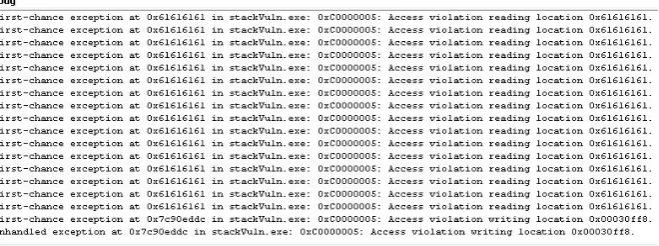
Figure 5.1: Debug Window of Visual C++ During Stack Based Buffer Overflow
the exceptions visible in the debug window when the program crashed. The0x61616161
memory locations, are caused by the large string of a characters that are being used to affect the overflow. 0x61 is the hex code for the ASCII charactera. This infers that the overflow is overwriting a pointer to a memory location, that the program is trying to read from, with multipleacharacters.
5.2
ICUMessageLoader Buffer Overflow
Xerces was recompiled using it’s default mode settings. The xsi:schemaLocation
attribute inipo.xmlwas given a string value consisting of the hostname
http://www.cs.tcd.ieand a pathname of 6,000Acharacter’s. As there is no proxy support in Xerces, a hostname within Trinity College had to be used. TheheapVuln.cpp
code, see Appendix E, described in the previous Chapter was run in release mode. It took in theipo.xml file as a runtime argument. This resulted in the program crashing and an
Unexpected Exceptionerror being thrown.
Again to try and discern what was causing this crash the next step was to run the program again in debug mode to see what was happening. Stepping through the code, the program crashed in theBinHTTPURLInputStream class as predicted, but instead of crashing at the firststrcat()it crashed further down at
strcat ( fBuffer , hostNameAsCharStar ), where the hostname of the URL is concatenated onto the buffer. The reason for this could be explained by looking at the memory locations of the local variables in the class. The hostname variable,
buffer is overflown it overwrites what is contained inhostNameAsCharStaras well as all the bookkeeping information for that memory block. Therefore when the CRT attempts to accesshostNameAsCharStarit finds it’s bookkeeping information overwritten.
Figure 5.2: Debug Window of Visual C++ During Heap Based Buffer Overflow
Figure 5.3: Visual C++ Messages During Heap Based Buffer Overflow
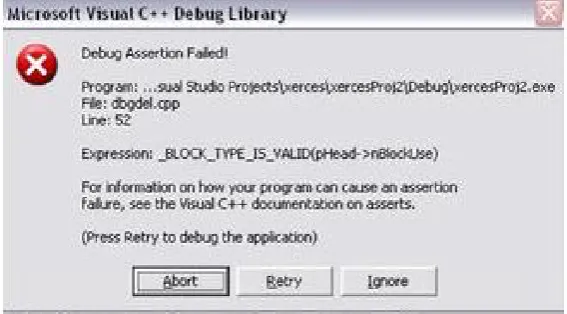
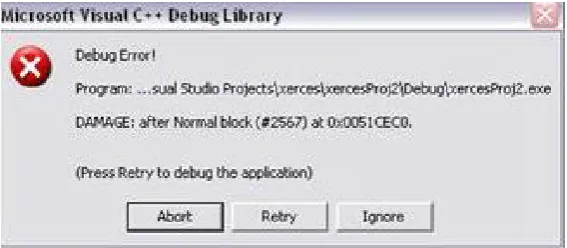
When the crash occurred VC++ displayed various messages such as figure 5.3 and figure 5.4 indicating that a buffer overflow had occurred. These are all due to damage caused to the CRT’s bookkeeping information that accompanies every memory allocation made to the heap in debug mode. The assertion failure shown in figure 5.3 indicated that a buffer on the heap has overflown overwriting thenBlockUsevariable in the_CrtMemBlockHeader
Figure 5.4: Visual C++ Messages During Heap Based Buffer Overflow
blocks located around the block of memory, identified in the message, on the heap had been overwritten. Figure 5.2, showed the exceptions visible in the debug window at this stage. The access violation writing to location0x41414141, is due to overflowing Acharacters, which have hex value 0x41, overwriting a pointer to a memory location that the program is trying to write to. The twoHEAP exceptions are thrown because of detected overflows in the heap. The message specifying that the heap block had been modified past the requested size of fe4 indicated that an attempt had been made to modify the heap block at a memory location outside of that requested for the block. The memory location0051CE98was where the block of memory allocated tofBuffer began in memory. The allocated memory was indicated to be 4068 bytes or 0xfe4 in hexadecimal, which was the size of the allocated block of memory reserved forfBufferafter taking the extra memory allocated for bookkeeping into account. The invalid address to RtlValidateHeapand RtlFreeHeap messages indicate that the memory address being pointed to outside of the local heap.
Chapter 6
Vulnerability Demonstration
In this Chapter the heap overflow discussed in the previous Chapters will be evaluated on two products which incorporate Xerces-C++ as a component, Berkeley DB XML and Xalan-C++. In the first section a brief overview of the products will be given and in the second the attempt to cause the overflow and the results will be discussed. Some theoretical exploits for the buffer overflows will then be discussed and finally a countermeasure will be examined.
6.1
Applications
Both products, Xalan-C++ and Berkeley DB XML, are in common use and have been devel-oped by experienced development teams.
6.1.1
Xalan-C++
Xalan-C++ (Xalan) is an XSLT processor for transforming XML documents into HTML, text, or other XML document types and is a robust implementation of the W3C Recommen-dations for XSL Transformations (XSLT) and the XML Path Language (XPath) [13]. It trans-forms the XML documents using the methods contained within theXalanTransformer
Xalan written in Java. The latest version of Xalan, Xalan-C++ version 1.9, uses the Xerces-C++ version 2.6.0 parser to parse XML documents and XSL stylesheets by default, although it can be configured to use other XML parsers.
6.1.2
Berkeley DB XML
Berkeley DB XML (BDB XML) is a native XML database engine, which takes the form of a C++ library which can be linked into applications. It also has a command line shell so one can work with the stored XML documents outside of the normal programs used to interact with it. In BDB XML documents are stored in containers. Each container can store millions of documents. Containers are simply files in memory which contain all the data on the XML document such as the documents themselves and any associated metadata. There are two ways of storing the documents either as whole documents, which is best for small documents or as document nodes whereby the documents are broken down into their individual element nodes and each node is stored as an individual record in the container. XML documents are stored and indexed in their native format using Berkeley DB as the underlying transactional database engine, which means that all of Berkeley DB’s features such as; full ACID transactions, automatic recovery, hot standby, on-disk data encryption with AES and database replication for high availability and failover are inherited. Once a document is stored in a container XQuery can be used to query that container and retrieve 1 or more documents or portions of documents [31]. Berkeley DB XML adheres to the XQuery 1.0 July 2004 draft and therefore XPath 2.0 as XQuery is an extension of this.
6.2
Overflows
6.2.1
Berkeley DB XML Overflow
Berkeley DB XML (BDBXML) can be run stand-alone using a command line shell or linked into an application by using the various programming language API’s. The buffer overflow vulnerability will be tried on both methods.
When using the command line shell only two commands needed to be used, these are shown in figure 6.1. The first command simply creates a container to be used for storing XML documents. The validate argument tells the container to try and validate all documents that are entered into it. The second command is used for entering data into the container. The itemName is the document