Abstract—The capacity of the Government of Indonesia to grow the country to be developed country in 2025 as mentioned in The Master Plan for Acceleration and Expansion of Indonesia's Economic Development (abbreviated MP3EI) faces many challenges, one of them is financial capacity. Huge archipelago like Indonesia needs to be connected by good infrastructure, especially airport, and it’s needed a big amount of money that the government still can afford it. The government realizes the limitation in funding the infrastructure needs. The government comes with the concept to form the cooperation with private sectors as known as a Public Private Partnership (PPP). The national planning agency in Indonesia for PPP planning and implementation issues the PPP book to provide potential investors the information on available infrastructure investment in Indonesia. Project listed in PPP Book are results of rigorous review and screening process by national planning agency. The projects are organized into potential projects, prospective projects, and ready to offer projects. The airport projects obtain the potential income from international flights and the forecast of passengers becomes the main factor in increasing the development of infrastructure. The PPP schemes is expected to fulfill the financial problems in infrastructure service providing. However, the private participation is expected not only to fill the funding but also to share experience and knowledge in the development, operation, and management of qualified infrastructure service. Therefore, the aim of the study is to develop risk mitigation strategy for airport infrastructure development projects and expected to be problem solving for the lack of succession of PPP and can be a solution for acceleration of infrastructure development in Indonesia. The research study was conducted by collecting data at several airports in Indonesia. The data used were primary and secondary data. The primary based upon field survey, while secondary according to the study on the various literatures of the success with the implementation of PPP in Indonesia and abroad. The findings and recommendations for the study are risk response and risk strategy in order to address of each risk that already identified. Risk response can be: Retention, Avoidance, Reduction, or Transfer.
Index Terms—risk mitigation, risk response, public private partnership
I. INTRODUCTION
plan for the acceleration and expansion of Indonesia Economic Development (MP3EI) is an ambitious plan by the government of Indonesia to be a developed country in 2025. To reach this plan, it is required
The author is from Civil Engineering, Hasanudin University, Jl. Poros Malino Km. 6, Gowa 92171, Indonesia, Email: [email protected]
for the real economic
growth 6.4 to 7.5 percent during the period 2011-2014 and about 8.0 to 9.0 for the period 2015-2025. However, the inflation shall be declined from 6.5 percent in the period 2011-2014 to 3.0 percent for the period 2025. Which shows the characteristic of developed countries. The demographic potential, the wealth of natural resources and geographical position will support the acceleration and expansion of Indonesia’s economic development. Although Indonesia has good strategic geographic position, but a number of challenges are needed to be solved. One of them is the lack of quality and quantity of infrastructures so that becomes the reducing of competitiveness and attractiveness of climate investment. Another challenge is that the main investment problem of the Government of Indonesia in infrastructures is less of financial resources. Therefore, the participation of the private sector and both foreign and domestic sectors is desired. The presence of Public Private Partnership (PPP) has been participating as an alternative and effective method to mobilize additional financial resources to invest in infrastructures. PPP is not only for financial mechanism, but can also be appropriate to finance resource for infrastructure projects. Currently, PPP is widely taken a part in the sector of water treatment and highways due to these sectors guarantees the financial benefits. Moreover, PPP has been participating in other sectors such as railway/railroad, housing, and airports.
The need of air transportation in Indonesia grows rapidly, the increase of passenger and cargo reflects the circumstance each year. Surely it should be countered by the enlargement of airport infrastructure [6]. However, Fiscal limitation which is from the national budget causes the expansion of infrastructure capacity in Indonesia hampered. Amongst of 2010-2014, it is estimated the need of investment about an IDR1.450 quintillion [5]. One step the government has taken to cope the infrastructure deficit is to encourage active participation of the private sector, where private is allowed to join in developing infrastructure through Public – Private Partnership (PPP) scheme including risks share to each other. Until now there has been no implementation of a successful PPP airport in Indonesia due to the high risk for private parties. Risk mitigation must be done to reduce the chances of occurrence of the risk or impact of a risk. Therefore, this study aims to develop risk mitigation strategy in airport infrastructure development and expected to be problem solving for the lack of succession of
Risk Mitigation Strategy for Public Private
Partnership (PPP) of Airport Infrastructure
Development Projects in Indonesia
Rusdi Usman Latief
PPP in Indonesia, especially for airport infrastructure development.
II.LITERATURE REVIEWS
A.PPP Airport Infrastructure Project in Indonesia
The airport can be defined as one or more runways and facilities to complement the aircraft (taxiway, apron area) along with Union terminal and facilities to lower passenger and cargo [1]. Airport operators are responsible for the provision and maintenance of airport infrastructure, and on conditions of service, including the main searches of passengers, and security, fire, hygiene and maintenance areas of the passenger terminal. The operational of the airport received income from aircraft service and marketing. Major infrastructure airport terminal operations, consisting of runway operations, and taxiway facilities, are such engineering facilities. The cargo, plane maintenance facility, ARRF (Airport Rescue and Fire Fighting) fuel, logistics facilities, administration, service aircraft, traffic and utilities are also the main of airport infrastructures [3]. Airport operation such as service aircraft, service fleets, and marketing activities is a part of the main airport of service provision. This infrastructure becomes a reference for BAPPENAS to develop the airport in the form of cooperation PPP. The type of project that exists in PPP book 2010-2014 BAPPENAS diverse. The project will be soon in tender’s supports airport infrastructure in Indonesia, especially in the form of PPP cooperation entered into PPP Book list (2010-2014) BAPPENAS.
B.Risk of PPP Airport Infrastructure
The main risk in investment related to the Airport directly with the basic parameters of the PPP infrastructure investment in the airport that is the decisive variable the magnitude as the cost of the investment. PPP risks are divided the airport into Air Traffic Forecast, Airport Development Proposal, Airport Transport Risk, Revenue Estimation, Capital Cost Estimates, Concessionaire Competition & amp; Culture, Institutional Influence, Effect of Term of Reference for Privatization [8]. PPP risks are among other airport Revenue Risk, Operating Risk, Regulatory Risk, and Review of Policy on Water Infrastructure [2]. In addition, the national development and Planning Agency of the Republic of Indonesia (BAPPENAS) [4], the risk of PPP is the airport land acquisition, tariffs, demand, political risk and country risk, as well as the main buyer of creditworthiness (off-taker). Risk response preference has been investigated how to assess the risk of PPP airport infrastructures development project in Indonesia [7]. This will give the description to the Government of Indonesia that risk mitigation is significant issue for developing the airport infrastructures in Indonesia.
C.Risk Mitigation
Risk response is the response or reaction to the risks undertaken by any person or company in making decisions, which are influenced by the risk attitude of decision makers. Action taken to reduce this risk is called mitigation / risk management (risk mitigation). Occasionally, Risks can be
not eliminated completely but can only be reduced so that there will be residual risk. Thus, this can be done by risk retention, risk reduction, risk transfer and risk avoidance.
III. RESEARCH METHODOLOGY
A.Research Frameworks
This study have a framework which have five main steps to achieving the purpose. Schematically, the research frameworks following the steps as below.
1)Literature Study
This research conducted an observation for the recent condition of airport infrastructure of Indonesia and research related in the model. The references are collected to identify the risks then determine all of variable risks for research. Moreover, conduct the preliminary study not only for the risk respond but also the risk strategy model as reference.
2)Preparing Questionnaire
Preparing a questionnaire with setting the total respondents, draft, and the conceptual assessment model risk respond and mitigation for PPP airport in Indonesia. The pilot survey is conducted to verify the feasibility of the questionnaire through discuss with professionals in airport infrastructure before doing the main survey with a fix draft.
3)Collecting Data
The questionnaire distributed to all primary stakeholders as respondents to get the model of risk mitigation with e-mail, post e-mail, or direct interview.
4)Analysis and Discussion
The feedback of the questionnaire from respondents is a primary data, then analysis to get the interpretation and further information.
5)Result and Conclusions
The result describes the interpretation of analysis data and new finding of this research.
B.Method of Data Collections
TABLEI
PRIMARY RESPONDENT ON PPPAIRPORT PROJECTS
PRIMARY STAKEHOLDER Sum of
Respondents
Public
Private
Direktorat Jenderal Perhubungan Udara BAPPENAS
Kementrian Keuangan RI Total Public
Kertajati Int. Airport, West Java South Banten Airport, Pandeglang Development of Singlawang, West Borneo Expansion of Dewandaru Karimun Jawa, Java Expansion of Tjililriwut, Central Kalimantan Development of New Samarinda, East Borneo Development of New Bali Airport
Radin Inten II Airport (Bandar Lampung) Mutiara Airport (Palu)
Haluoleo Airport (Kendari) Komodo Airport (Labuan Bajo) Sentani Airport (jayapura) Juwata Airport (Tarakan)
Tjilik Riwut Airport (Palangkaraya) Fatmawati Airport (Bengkulu) Hananjoeding Airport (Tj. Pandan) Total Private 12 2 2 16 1 1 1 1 1 1 1 1 1 1 1 1 1 1 1 1 16
To collect the data, this study has adopted methods from literature studies. Then, collecting primary data with spreading the questionnaires to public and private sectors related to variables study. Table I shows the respondents of primary stakeholders on PPP airports. The respondents consist of public and private with differently number. For public as shown in the table, total respondents are 16 from three agencies. The private also have 16 respondents from sixteen ongoing project of airport. Moreover, collecting secondary data also conducted by with collecting data from the journals and studies that related to PPP airport projects.
C.Method of Data Analysis
To analysis the data, this study used test validity and reliability methods and descriptive analysis method. Both this methods were used to analysis the data respondents from public and private sectors. Each respondent provided response options to each risk variable of risk reduction, risk retention, risk transfer, and risk avoidance. Further, the analysis shows the response from high and extreme categories level of risks.
IV. RESULT AND DISCUSSIONS
A.Method of Data Analysis
The method of study was carried out by spread questionnaires to some respondents who related in this study. The following will be explained about the profile of the respondents based at the level of education, positions at the agency/institution, type of institution/agencies, and work experience in their institutions. The following results as bellow.
1)Business entity
Table II shows that the majority of respondents worked in business government with the percentage reached 54.2% and 45.8% working in private business enterprises.
2)Position in Institution
Based on data in Table III, it can be seen that the first position of respondent is senior manager with percentage of 50% or as much as twelve respondents. The second position is as section chief with the percentage of 16.7%. The managing director and senior administrator are in third
position with same percentage of 12.5%. The last position is airport project advisor or as much as two respondents.
3)Level of Education
Table IV shows the majority of respondent has level of education in master degree with percentage of 54.2% or 13 respondents. Ten respondents have level of education in Bachelor degree with percentage of 41.7%. The last is Diploma degree with percentage with percentage 4.2% or only one respondent.
4)Work Experience
Table V is seen that the respondents have working experience less than 5 years until 20 years. Majority respondents has working experience11-20 years with percentage of 29.2% or has 7 respondents. Respondents have percentage of 25% with work experience less 5 years and 5-10 years. The last is minority respondents have work experience more than 20 years with percentage of 20.8% or 5 respondents.
B.Risk Mitigation and Recommendation Strategy
The existence of the risks will give effect to the development of airport infrastructure of PPP projects that will require the measuring mitigation to reduce its impact. The important risks were already knew the need to follow up with responds and mitigates. Risk mitigation can be done by risk reduction, risk retention, risk transfer and risk avoidance. Mitigation action undertaken for this study was obtained from the results on the analysis, interviews with experts and reference supported from previous studies.
The preference of risk response presents the data of percentage value for each variable risk from public and private sector. The management of risk mitigation as one of the parts in cooperation schemes. Most of the guidance in PPP risk describes clearly about the risk allocation and action will be charged to all parties who are involved in the airport project. The alternative approach also suggested to reduce PPP risk that comes from any source.
Table VI shows the results analysis with a survey of risk responses according to respondents who works in public and private sectors. Risk variable of land acquisition in response to the preferences of 70.83% retention risk
TABLEIII POSITIONS
Positions Frequency Percent (%)
Managing Director 3 12,5
Section Chief 4 16,7
Senior Manager 12 50,0
Airport Project Advisor 2 8,3
Senior Administrator 3 12,5
Total 24 100
TABLEV WORK EXPERIENCE
Work Experience Frequency Percent (%)
<5 years 6 25,0
5-10 years 6 25,0
11-10 years 7 29,2
>20 years 5 20,8
<5 years 6 25,0
Total 24 100
TABLEII TYPE OF BUSINESS
Type of Business Entity Frequency Percent (%)
Government 13 54,2
Private 11 45,8
Total 24 100
TABLEIV LEVEL OF EDUCATION
Level of Education Frequency Percent (%)
Diploma 1 4,2
Bachelor 10 41,7
Master 13 54,2
responses.
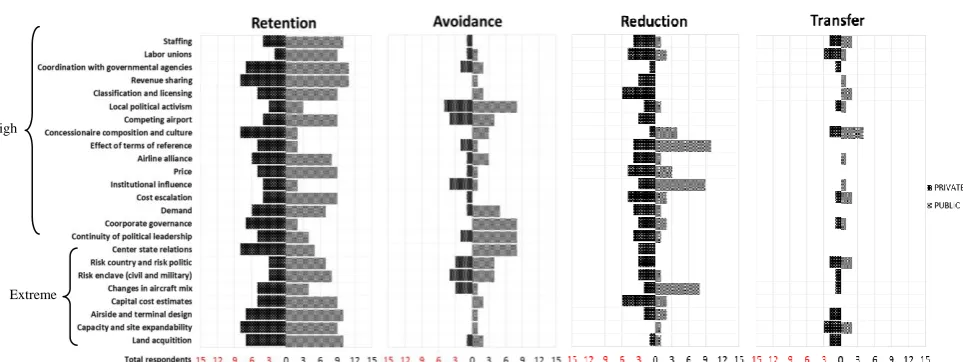
The risk avoidance response preference as much 13%, for 8% of a preference response risk reduction, and amount to 8% of transfer of risk response preferences. Based on the results of survey variables, land acquisition has mainly retention of preference of risk response due to the number of respondent. Moreover, the preferences of risk responses mitigation if categorizes according to implementing risk assessment divide into extreme and high [7]. The majorities
respondents retention for the high risks as much as 36% and 16% for extreme, it has shown on the following figures 1 on the preference of risk response mitigation based on risk level. The figures shows bar with the total of respondents from public and private prefer to retention, as a sequence followed by reduction, avoidance, and transfer. This show all risk prefer to retention and action responses to the all risks variable from public and private respondents.
Fig. 1Preference risk response mitigation based on risk level categories
TABLEVI
RESULT ANALYSIS OF A SURVEY OF RISK RESPONSES
No Risk Variables Preference of Risk Response (%)
Retention Avoidance Reduction Transfer
1 Land acquisition 13 8 8
2 Airline and terminal design 4 17 8
3 Capacity and site expandability 4 4 21
4 Changes in aircraft mix 17 42 4
5 Competing airport 33 13 0
6 Airline alliance 17 21 4
7 Capital cost estimates 8 33 0
8 Concessionaire composition and culture 13 21 25
9 Institutional influences 21 50 4
10 Effect of terms of reference (TOR) 13 58 0
11 Corporate governance 33 21 8
12 Center state relations 33 13 0
13 Continuity of political leadership 42 21 0
14 Activity of local politics 54 13 8
15 Demand 25 21 0
16 Price 8 33 0
17 Cost escalation 4 29 13
18 Staffing 4 21 17
19 Labor unions 8 29 17
20 Coordination between government agencies 17 4 4
21 Classification and licensing 8 25 8
22 Revenue sharing 4 13 4
23 Risk country and risk politics 29 13 17
24 Risk enclave (civil and military) 33 17 4
High
[image:4.595.55.537.585.766.2]Therefore, Table VII shows the risk mitigation model in sequenced according to risk level as description of recommendation strategies to the airport infrastructures in Indonesia. The strategy are created with study literature and interview an experts as the suggestion to formulate the strategy for each variable on PPP airport of Indonesia. Recommended strategy are conducted according responds for all variable risks. For 24 risks variable, each of them could have two until three recommendation strategy in accordance with situation, suggestion, and literature review. These strategy expected as approaching reference to who are interest to PPP schemes especially for airport infrastructure projects in Indonesia. The recommendation probably has a difference condition to another country.
V. CONCLUSION
Risk Mitigation on Public Private Partnership (PPP) to the airport infrastructures development project in Indonesia has
been analyzed and given the recommendation strategies in order to solve the problem of airport infrastructure project. Therefore, this study can briefly give the conclusion as follows:
[1] Risk response based on public private partnership conformed that risk retention reaches about 52%. Other respondents showed that risk reduction and risk avoidance are 22% and 19% respectively. A minority respondents choose risk transfer by 7% response. [2] According to risk level high and extreme, the majorities
respondent retention for the high risks as much as 36% and 16% for extreme.
[3] Recommendation of risk mitigation strategies is contrary to the four highest risks which is described as follows:
a. Land Acquisition: socialize the rules, invite the land owners to invest their land, replace the land to the non-cash.
b. Capacity and Expansion of the airport: use experts
TABLEVII
RISK MITIGATION AS RECOMMENDATION STRATEGIES
No Risk Variables Risk Mitigation
Risk responds Recommendation Strategy
1 Land acquisition Socialize the rules. Invite land owners to invest. Replacement land into noncash payment
2 Airline and terminal design Private use experts to forecast traffic passenger to determine the capacity of airports
The government make master plan and spatial planning airport development and disseminating the tender process of PPP project
3 Capacity and site expandability Government provides airport development concept clearly to the private sector Private use professional engineers and experienced in the process of making design
4 Changes in aircraft mix Retention Use experts to develop scenarios to forecast the growth of passengers and travel route
5 Competing airport Retention Private improves services and promotions to airports user
6 Airline alliance Retention Governments makes regulations regarding operational technical airline alliance airport
7 Capital cost estimates Retention Using professionals in estimating costs
8 Concessionaire composition and culture Retention Government as regulator sets minimum standards of expertise in concessionaire competition
9 Institutional influences Retention Government provides compensation to the private sector if there are institutions that disrupt the project
10 Effect of terms of reference (TOR) Retention Provide a complete and clear TOR
11 Corporate governance Retention Set up management infrastructure such as SOP as a reference work for business entities
12 Center state relations Retention Synchronization rules against institutions associated with the course of the project
13 Continuity of political leadership Avoidance Build emotional attachment to all political stakeholders
14 Activity of local politics Avoidance Place a project manager who understand the dynamics of local politics
15 Demand Retention Make a good quality of service to passenger and airlines
16 Price Retention The government provides a guarantee in the even of a decrease in revenue due to level of demand that below the agreed level
17 Cost escalation Retention Using a competent estimators in calculating the price adjustment at the time of initiation and operation the concession (multi-year)
18 Staffing Retention Provide regular training of staff
19 Labor unions Retention Regular coordination with union leaders
20 Coordination between government agencies The private sector/ business entities to coordinate with the various parties involved in the airport such as the police, immigration, and customs
21 Classification and licensing The government will facilitates and foster business entity in order to obtain licenses and international classification
22 Revenue sharing Creating and selecting appropriate forms of cooperation on revenue sharing and allocation risk
23 Risk country and risk politics Government guarantees to investors in case of disruption due to the political situation in the country
for forecasting passenger traffic to determine the capacity of airports, create a master plan and spatial planning of airport development and socialize the tender process of PPP projects.
c. Airside and terminal design: the government provides the airport development concepts clear to the private sector, the private sector using professional engineers and experienced in the process of making design.
d. Estimation on capital cost: use professional engineers and experienced in the process of making design.
ACKNOWLEDGMENT
The authors thank to Budi Prasetyo, the Airport Ministry of Indonesia for advice and suggestions in pilot survey. Thanks also for family that always cheering along the time and pray for also to all lecturer of civil engineering to support with suggestion in writing of this manuscript.
REFERENCES
[1] Asian Development Bank. Airport and Air Traffic Control, ADB. Philippines, 2000.
[2] B. Varkey, Public Private Partnership in Airport Development, Oxford University Press, New Delhi, 2002.
[3] Dewey and Lebouf, PPP in Airport Infrastructure. University Press, Pulkovo, 2006.
[4] Pemerintah Republik Indonesia, KPS dan Panduan Bagi Investor untuk Investasi, Bappenas. Jakarta, 2010.
[5] R. Magagi, Increasing Trend Towards Airport PPPs in Emerging Markets. IFC’s Global Airport PPP Seminar, Dubai, 2011.
[6] S. Adjisasmita, PPP Scheme in Airport. Jakarta, 2010.
[7] U. L Rusdi, S. Pallu, S. Adisasmita, S. A., Aly, S. H., Suyuti, A. Risk Response Preference on Public Private Partnership (PPP) in Indonesia Airport Infrastructure Development. International Journal of Application or Innovation in Engineering and Management (IJAIEM). Volume 3, pp 120-124. Japan, 2014.