Original Article
Alleviation of pain after spinal surgery and
morphine-related side effects using comprehensive
care interventions: a randomized controlled trial
Yiyan Xu
Department of Operation Room, Linyi Central Hospital, Linyi City, Shandong Province, China
Received August 20, 2017; Accepted September 24, 2017; Epub November 15, 2017; Published November 30, 2017
Abstract: Objective: To investigate the clinical effects of comprehensive care interventions on alleviation of pain and morphine-related side effects after spinal surgery. Methods: Ninety-eight patients who underwent spinal surgeries in department of orthopaedics of our hospital from January 2016 to December 2016 were included as subjects in this study. Patients were randomly divided into two groups: the conventional care group and the comprehensive care group. The conventional care group adopted routine carewhile the comprehensive care group adopted compre-hensive care interventions. The visual analogue scale (VAS) was used to evaluate the degree of pain perception of patients and the incidence of side effects such as nausea, vomiting, vertigo and others were compared between the two groups. Results: There was no statistical difference in pain scores 3 h after spinal surgery between two groups (P=0.559). However, the pain scores of comprehensive care group were lower than those of conventional care group 6 h, 12 h, 24 h and 48 h after spinal surgery (all P<0.05). The incidence of pruritus in comprehensive care group (4.08%) was lower than that of conventional care group (16.33%, P=0.045). The incidence of nausea and vomit-ing in comprehensive care group (0.40%) was similar to that in conventional care group (14.28%, P=0.980). And the incidence of urinary retention in comprehensive care group (4.08%) was lower than that in conventional care group (16.33%, P=0.025). Conclusion: The comprehensive care interventions are suitable for postoperative care of spinal surgery because they were quite helpful in reducing the degree of postoperative pain and the incidence of morphine-related side effects in patients with spinal surgery.
Keywords: Comprehensive care interventions, spinal surgery, morphine
Introduction
Postoperative pain is very common, which has adverse effects on the patients and affect their postoperative recoveries, so it is quite neces-sary to further improve the management of postoperative pain [1, 2]. The nerves and blood vessels are rich in the spine, and as postopera-tive pain is a prominent problem, so it is also necessary to choose a better way of analgesia for spinal surgery [3, 4]. Morphine is a common postoperative analgesic in clinic, but it can eas-ily lead to skin pruritus, nausea, vomiting, even urinary retention and other adverse effects, therefore, the pros and consof using morphine for analgesia needs to be weighed [5]. With the improvement of people’s living standards, peo-ple are demanding a higher quality of medical services, which can not only achieve better analgesic and therapeutic effects, but also
minimize the incidence of complications [6]. Comprehensive care interventions are involv- ed in exercises, diets, psychology and other aspects [7]. The author hypothesized that the use of morphine combined with comprehensive care interventions synchronously after spinal surgery could improve the effects of morphine and effectively reduce the morphine-related side effects, so that the clinical study was accordingly conducted.
Materials and methods
General information
comprehensive care group and conventional care group (with 49 cases in each group). Inclusion criteria: All the patients aged from 18 to 65 years old who were treated with general anesthesia for spinal surgeries; patients whose postoperative analgesia were achieved using intravenous injection of morphine; patients who were in ASA degreeI or II; patients who were informed and volunteered to participate in this study.
Exclusion criteria: Patients who synchronously hadother complications incardiopulmonary sys-tem, urinary syssys-tem, etc.; patients who were allergic to morphine; patients who had taken analgesics for a long time; patients with obnu-bilation or reading and language barriers. Research methods
All the patients underwent spinal surgeries in the condition of general anesthesia and were treated with intravenous injection of morphine to achieve analgesia with a dose of 10 mg at a time after being operated and returned to the ward. When the patients felt the pain was unbearable, they would be reinjected, but the intervals between two injections should not be shorter than 4 h. And all the injection dose with-in one day should not exceed 40 mg.
Patients in the conventional care group were treated with routine care which included post-operative wound care, assisted rehabilitation and other routine care methods. Patients in the comprehensive care group adopted compre-hensive care interventions, the specific mea-sures were as follows.
Firstly, patients applied rehabilitation interven-tions. Individualized rehabilitation programs of patients were established according to patien- ts’ conditions, including rehabilitation metho- ds, time schemes, and the patients were assist-ed to adhere to their rehabilitation exercises [8]. Secondly, patients appliedthe diet care. Diet plans were made, in which the intake of high protein and high calorie was paid attention to, and the selected food was digestible. Patients took fresher vegetables and fruits but less sugar and starch in the food [9]. Thirdly, patients received a better recovery environ-ment, and the bedding and room had been kept clean and comfortable. Patients was guided to have self-massage and activities when they
had a rest in order to improve their overall com-fort level [10]. Fourthly, patients applied psy-chological care. By communicating with pati- ents every day, their existent negative emoti- ons and mentalities can be detected in time which was beneficial to resolve in a timely man-ner. If patients had serious anxiety, depression or other emotions, they would get some profes-sional guidance from a profesprofes-sional psychologi-cal doctor to obtain emotional ease, so that patients can maintain a positive attitude [11]. Follow-up and observed indicators
Firstly, the baseline information such as pa- tients’ age, ratio of sex, operation time, anes-thesia time, operative blood loss volume etc., was collected. Secondly, the visual analogue scale (VAS) scoring method was used to evalu-ate the pain situations 3 h, 6 h, 12 h, 24 h and 48 h after spinal surgery respectively [12]. In VAS, there wasa total of 11 levels represented by scores of zero to ten. Zero represented pain-less and ten symbolized the most painful. The scores were counted according to patients’ self-perception. Thirdly, the incidences of four relevant adverse reactions (nausea and vomit-ing, skin pruritus, and urinary retention) during postoperative analgesia were recorded. The co- nditions of patients were examined and reco- rded during daily rounds of the wards, and patients’ everyday adverse reactions were re- corded at any time.
Statistical methods
SPSS17.0 software was used to analyze statis-tical significance of data of this study. The enu-meration data were expressed as number of cases and percentage, and the test method between two groups was chi-square test. The measurement data were expressed as mean ± standard deviation and the between-group comparisons were performed by t test. The repeated measurements of variance analysis combined with post Bonferroni test were used for VAS scores comparison. The difference was statistically significant when P<0.05.
Results
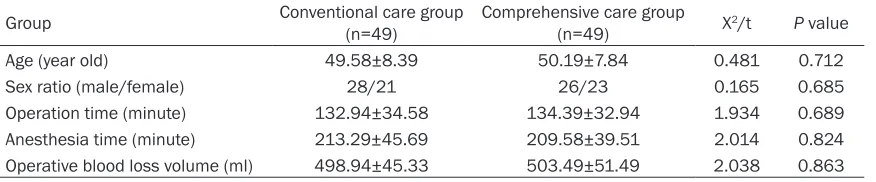
Comparison of general information between two groups
the age, sex ratio, operation time, anesthesia time and operative blood loss volume between two groups (all P>0.05), as shown in Table 1. Comparison of pain scores at different time points after operation between two groups There was no statistical difference in pain scores 3 h after spinal surgery between two groups (P=0.559). The pain scores of compre-hensive care group 6 h, 12 h, 24 h and 48 h after spinal surgery were all lower than those of conventional care group (all P<0.05), as shown in Table 2.
Comparison of incidence and severity of skin pruritus between two groups
The incidence of skin pruritus in comprehen-sive care group (4.08%) was lower than that in conventional care group (16.33%), as shown in Table 3.
Comparison of incidence and severity of nau-sea and vomiting between two groups
The incidence of nausea and vomiting in com-prehensive care group (0.40%) was similar to that in conventional care group (14.28%, P=0.980), as shown in Table 4.
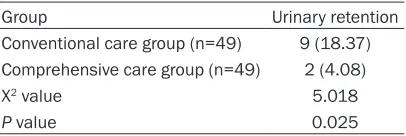
Comparison of incidence of urinary retention between two groups
The incidence of urinary retention in compre-hensive care group (4.08%) was lower than that
[image:3.612.90.528.86.177.2]tion of patients treated with comprehensive care decreased significantly [14]. Therefore, the comprehensive care could not only improve the analgesia efficacy, but also achieve security [15]. The possible reasons were as follows. First, a special care group was set up in com-prehensive care interventions. Under the con-straint of the designated examination system, every member in the special care group was ensured to care for the patient with due dili-gence, which was the precondition for patients’ getting a good care experience [16]. Second, comprehensive care interventions focused more on postoperative rehabilitation activities of patients, so the patients could acquire a small quantity of activity ability in early times. Ability of activity could bring a lot of benefits to the recovery of patients, and it could help patients to use their own abilities to ease pain which could accelerate the recovery rate of patients [17]. Third, comprehensive care inter-ventions made adjustments to patients’ recov-ery environment, and a good recuperation envi-ronment was an effective guarantee for re- habilitation. Fourth, comprehensive care inter-ventions provided specific rules on diets of patients. Every patient had his or her own indi-vidualized diet programs, in which the adverse intake of patients to recovery was reduced, and the intake that were beneficial to emotions and surgical operation recovery of patients was improved [18]. So, the supply of nutrition and energy requirement of patients could be well Table 1. Comparison of general information between two groups
Group Conventional care group (n=49) Comprehensive care group (n=49) X2/t P value
[image:3.612.90.384.224.313.2]Age (year old) 49.58±8.39 50.19±7.84 0.481 0.712 Sex ratio (male/female) 28/21 26/23 0.165 0.685 Operation time (minute) 132.94±34.58 134.39±32.94 1.934 0.689 Anesthesia time (minute) 213.29±45.69 209.58±39.51 2.014 0.824 Operative blood loss volume (ml) 498.94±45.33 503.49±51.49 2.038 0.863
Table 2. Comparison of postoperative pain scores at different time points between two groups
Group Conventional care group (n=49) care group (n=49) F valueComprehensive P value Postoperative 3 h 2.83±0.38 2.85±0.42 0.482 0.559 Postoperative 6 h 2.67±0.31 2.34±0.39 4.293 0.016 Postoperative 12 h 2.49±0.43 2.01±0.19 8.492 0.015 Postoperative 24 h 1.93±0.39 1.69±0.31 9.392 0.008 Postoperative 48 h 1.79±0.34 1.61±0.39 13.925 0.003
of conventional care group (18.37%, P=0.025), as sh- own in Table 5.
Discussion
urina-met. Fifth, the psychological care was added into comprehensive care interventions with the development of psychological medicine. Patients were unwilling to cooperate with medi-cal workers due to the bad moods or emotions, which might result in patients’ uninsured sleep and diet, thus could be harmful to the recovery of patients. While positive attitudes could not only make patients cooperate more actively with treatment, but also make their emotions ease, which would ensure that a variety of hor-mone secretions in body could be stable and be helpful for recovery of patients.
The results of this study showed that conscio- us pain of patients in comprehensive care group had decreased since 6 h after spinal sur-gery, which actually was the effect of compre-hensive care. Although patients did not get any exercise or diet care at this time, the environ-mental care and psychological care endow- ed patients with more positive emotions. Me- anwhile, there were special care workers work-ing to ease the postoperative psychological pressure of patients, which had positive psy-chological implications on patients. So, the
trauma and found that the subjective pain per-ception began to decrease within postopera-tive 12 h, at the same time the incidence of various adverse reactions related to morphine was low, which was consistent with the results of this study [19]. Akeda et al. did a research on 209 patients and revealed that the pain degrees of patients decreased obviously at the third day after comprehensive care interven-tions, which was possibly caused by the absence of designated, immediate, specific, postoperative counseling for adverse emotions in their research [20]. However, this study did not count the effects of morphine dose on the results of this study, which needed multi-level and in-depth study in subsequent researches. In summary, comprehensive care interventions can effectively improve the analgesic effects of morphine and reduce the morphine-related side effects, which is worth promoting in clinic. Disclosure of conflict of interest
None.
Address correspondence to: Yiyan Xu, Department of Operation Room, Linyi Central Hospital, No.17 Jiankang Road, Yishui County, Linyi City 276400, Shandong Province, China. Tel: +86-15106691680; E-mail: [email protected]
References
[image:4.612.90.522.83.152.2][1] Wang Y, Zang XY, Bai J, Liu SY, Zhao Y and Zhang Q. Effect of a Health Belief Model-based
Table 3. Comparison of incidence and severity of skin pruritus between two groups (n, %)
Group No scratch Light scratch Unbearable pruritus Total Conventional care group (n=49) 2 (4.08) 2 (4.08) 4 (8.16) 8 (16.33) Comprehensive care group (n=49) 1 (2.04) 0 1 (2.04) 2 (4.08)
X2 value 0 0.510 0.843 4.009
[image:4.612.90.414.199.276.2]P value 1 0.475 0.359 0.045
Table 4. Comparison of incidence and severity of nausea and vomiting between two groups (n, %)
Group Nausea Nausea and oc-casional vomiting Vomiting Total Conventional care group (n=49) 4 (8.16) 1 (2.04) 2 (4.08) 7 (14.28) Comprehensive care group (n=49) 1 (2.04) 0 1 (2.04) 2 (4.08)
X2 value 0.843 0 0 1.598
P value 0.359 1 1 0.980
Table 5. Comparison of incidence of urinary retention between two groups (n, %)
Group Urinary retention Conventional care group (n=49) 9 (18.37) Comprehensive care group (n=49) 2 (4.08) X2 value 5.018
P value 0.025
ception of conscious pain of patients was decreased.
[image:4.612.92.295.319.387.2]nursing intervention on Chinese patients with moderate to severe chronic obstructive pulmo-nary disease: a randomised controlled trial. J Clin Nurs 2014; 23: 1342-1353.
[2] Yu L, Mo L, Tang Y, Huang X and Tan J. Effects of nursing intervention models on social adap-tion capability development in preschool chil-dren with malignant tumors: a randomized control trial. Psychooncology 2014; 23: 708-712.
[3] He HG, Zhu L, Li HC, Wang W, Vehvilainen-Julkunen K and Chan SW. A randomized con-trolled trial of the effectiveness of a therapeu-tic play intervention on outcomes of children undergoing inpatient elective surgery: study protocol. J Adv Nurs 2014; 70: 431-442. [4] Gozalo P, Prakash S, Qato DM, Sloane PD and
Mor V. Effect of the bathing without a battle training intervention on bathing-associated physical and verbal outcomes in nursing home residents with dementia: a randomized cross-over diffusion study. J Am Geriatr Soc 2014; 62: 797-804.
[5] Chen HT, Tseng MH, Lu L, Sie JY, Chen YJ, Chung Y and Lai F. Cloud Computing-Based Smart Home-Based Rehabilitation Nursing System for Early Intervention. Journal of Com-putational & Theoretical Nanoscience 2014; 20: 218-221.
[6] Coolbrandt A, Wildiers H, Aertgeerts B, Van der Elst E, Laenen A, Dierckx de Casterle B, van Achterberg T and Milisen K. Characteristics and effectiveness of complex nursing interven-tions aimed at reducing symptom burden in adult patients treated with chemotherapy: a systematic review of randomized controlled tri-als. Int J Nurs Stud 2014; 51: 495-510. [7] Lovell K, Wearden A, Bradshaw T, Tomenson B,
Pedley R, Davies LM, Husain N, Woodham A, Escott D, Swarbrick CM, Femi-Ajao O, Warbur-ton J and Marshall M. An exploratory random-ized controlled study of a healthy living inter-vention in early interinter-vention services for psychosis: the INTERvention to encourage AC-Tivity, improve diet, and reduce weight gain (INTERACT) study. J Clin Psychiatry 2014; 75: 498-505.
[8] Villegas N, Santisteban D, Cianelli R, Ferrer L, Ambrosia T, Peragallo N and Lara L. The devel-opment, feasibility and acceptability of an In-ternet-based STI-HIV prevention intervention for young Chilean women. Int Nurs Rev 2014; 61: 55-63.
[9] Lee BO, Chien CS, Hung CC and Chou PL. Ef-fects of an in-hospital nursing intervention on changing illness perceptions in patients with injury. J Adv Nurs 2015; 71: 2540-2550.
[10] Jung H, Yoo H, Lee Y and Chung KY. Interactive pain nursing intervention system for smart health service. Multimedia Tools & Applica-tions 2015; 74: 2449-2466.
[11] Van Haitsma KS, Curyto K, Abbott KM, Towsley GL, Spector A and Kleban M. A randomized controlled trial for an individualized positive psychosocial intervention for the affective and behavioral symptoms of dementia in nursing home residents. J Gerontol B Psychol Sci Soc Sci 2015; 70: 35-45.
[12] Kemp J, Despres O, and Dufour A. Unreliability of the visual analog scale in experimental pain assessment: a sensitivity and evoked poten-tials study. Pain Physician 2012; 15: 693-699. [13] Wu JR, Wang ML, Liu KC, Hu MH and Lee PY.
Real-time advanced spinal surgery via visible patient model and augmented reality system. Comput Methods Programs Biomed 2014; 113: 869-881.
[14] Losby JL, Hyatt JD, Kanter MH, Baldwin G, and Matsuoka D. Safer and more appropriate opi-oid prescribing: a large healthcare system’s comprehensive approach. J Eval Clin Pract 2017.
[15] Sim J, Crookes P, Walsh K, and Halcomb E. Measuring the outcomes of nursing practice: a Delphi study. J Clin Nurs 2017.
[16] Bergs J, Lambrechts F, Mulleneers I, Lenaerts K, Hauquier C, Proesmans G, Creemers S, and Vandijck D. A tailored intervention to improving the quality of intrahospital nursing handover. Int Emerg Nurs 2017.
[17] Flikweert ER, Izaks GJ, Knobben BA, Stevens M, and Wendt K. The development of a com-prehensive multidisciplinary care pathway for patients with a hip fracture: design and results of a clinical trial. BMC Musculoskelet Disord 2014; 15:188.
[18] Thompson J. Improving clinical care for pa-tients with irritable bowel syndrome. Br J Nurs 2017; 26: 76-80.
[19] Chen RK, Than KD, Park P and Shih AJ. Ther-moelectrical modeling of bipolar coagulation on posterior spinal artery in a porcine spinal surgery model. IEEE Trans Biomed Eng 2014; 61: 182-188.