Weakly-Supervised Acquisition of Labeled Class Instances using Graph
Random Walks
Partha Pratim Talukdar∗ University of Pennsylvania
Philadelphia, PA 19104 [email protected]
Joseph Reisinger∗ University of Texas at Austin
Austin, TX 78712 [email protected]
Marius Pas¸ca Google Inc.
Mountain View, CA 94043 [email protected]
Deepak Ravichandran Google Inc.
Mountain View, CA 94043 [email protected]
Rahul Bhagat∗
USC Information Sciences Institute Marina Del Rey, CA 90292
Fernando Pereira Google Inc.
Mountain View, CA 94043 [email protected]
Abstract
We present a graph-based semi-supervised la-bel propagation algorithm for acquiring open-domain labeled classes and their instances from a combination of unstructured and struc-tured text sources. This acquisition method significantly improves coverage compared to a previous set of labeled classes and instances derived from free text, while achieving com-parable precision.
1 Introduction
1.1 Motivation
Users of large document collections can readily ac-quire information about the instances, classes, and relationships described in the documents. Such rela-tions play an important role in both natural language understanding and Web search, as illustrated by their prominence in both Web documents and among the search queries submitted most frequently by Web users (Jansen et al., 2000). These observations moti-vate our work on algorithms to extract instance-class information from Web documents.
While work on named-entity recognition tradi-tionally focuses on the acquisition and identifica-tion of instances within a small set of coarse-grained classes, the distribution of instances within query logs indicates that Web search users are interested in a wider range of more fine-grained classes. De-pending on prior knowledge, personal interests and immediate needs, users submit for example medi-cal queries about the symptoms of leptospirosis or
∗
Contributions made during internships at Google.
the treatment of monkeypox, both of which are in-stances ofzoonotic diseases, or the risks and benefits ofsurgical proceduressuch asPRKandangioplasty. Other users may be more interested inAfrican coun-tries such as UgandaandAngola, oractive volca-noeslikeEtnaandKilauea. Note thatzoonotic dis-eases, surgical procedures, African countries and active volcanoesserve as useful class labels that cap-ture the semantics of the associated sets of class in-stances. Such interest in a wide variety of specific domains highlights the utility of constructing large collections of fine-grained classes.
Comprehensive and accurate class-instance in-formation is useful not only in search but also in a variety of other text processing tasks includ-ing co-reference resolution (McCarthy and Lehn-ert, 1995), named entity recognition (Stevenson and Gaizauskas, 2000) and seed-based information ex-traction (Riloff and Jones, 1999).
1.2 Contributions
We study the acquisition of open-domain, labeled classes and their instances from both structured and unstructured textual data sources by combin-ing and rankcombin-ing individual extractions in a princi-pled way with the Adsorption label-propagation al-gorithm (Baluja et al., 2008), reviewed in Section 3 below.
A collection of labeled classes acquired from text (Van Durme and Pas¸ca, 2008) is extended in two ways:
1. Class label coverage is increased by identify-ing additional class labels (such aspublic agen-cies and governmental agencies) for existing
instances such asOffice of War Information),
2. The overall instance coverage is increased by extracting additional instances (such as Addi-son WesleyandZebra Books) for existing class labels (book publishers).
The WebTables database constructed by Cafarella et al. (2008) is used as the source of additional instances. Evaluations on gold-standard labeled classes and instances from existing linguistic re-sources (Fellbaum, 1998) indicate coverage im-provements relative to that of Van Durme and Pas¸ca (2008), while retaining similar precision levels.
2 First Phase Extractors
To show Adsorption’s ability to uniformly combine extractions from multiple sources and methods, we apply it to: 1) high-precision open-domain extrac-tions from free Web text (Van Durme and Pas¸ca, 2008), and 2) high-recall extractions from WebTa-bles, a large database of HTML tables mined from the Web (Cafarella et al., 2008). These two meth-ods were chosen to be representative of two broad classes of extraction sources: free text and structured Web documents.
2.1 Extraction from Free Text
Van Durme and Pas¸ca (2008) produce an open-domain set of instance clusters C ∈ C that parti-tions a given set of instancesI using distributional similarity (Lin and Pantel, 2002), and labels using is-apatterns (Hearst, 1992). By filtering the class labels using distributional similarity, a large number of high-precision labeled clusters are extracted. The algorithm proceeds iteratively: at each step, all clus-ters are tested for label coherenceand all coherent labels are tested for high cluster specificity. Label
L is coherent if it is shared by at least J%of the instances in cluster C, and it is specific if the total number of other clustersC0∈ C, C06=Ccontaining instances with labelLis less thanK. When a cluster is found to match these criteria, it is removed from
Cand added to an output set. The procedure termi-nates when no new clusters can be removed fromC. Table 1 shows a few randomly chosen classes and representative instances obtained by this procedure.
2.2 Extraction from Structured Text
To expand the instance sets extracted from free text, we use a table-based extraction method that mines structured Web data in the form of HTML tables. A significant fraction of the HTML ta-bles in Web pages is assumed to contain coherent lists of instances suitable for extraction. Identifying such tables from scratch is hard, but seed instance lists can be used to identify potentially coherent ta-ble columns. In this paper we use the WebTata-bles database of around 154 million tables as our struc-tured data source (Cafarella et al., 2008).
We employ a simple ranking scheme for candi-date instances in the WebTables corpusT. Each ta-bleT ∈ T consists of one or more columns. Each column g ∈ T consists of a set of candidate in-stances i ∈ g corresponding to row elements. We define the set of uniqueseed matchesingrelative to semantic classC∈ Cas
MC(g)
def
= {i∈I(C) :i∈g}
whereI(C)denotes the set of instances in seed class
C. For each columng, we define itsα-unique class coverage, that is, the set of classes that have at least
αunique seeds ing,
Q(g;α)def= {C ∈ C:|MC(g)| ≥α}.
Using M and Q we define a method for scoring columns relative to each class. Intuitively, such a score should take into account not only the number of matches from class C, but also the total num-ber of classes that contribute toQand their relative overlap. Towards this end, we introduce the scoring function
score(C, g;α)def= |MC(g)|
| {z }
seed matches
·
class coherence
z }| {
|MC(g)|
|S
C0∈Q(g;α)I(C0)|
Class Size Examples of Instances
Book Publishers 70 crown publishing, kluwer academic, prentice hall, puffin
Federal Agencies 161 catsa, dhs, dod, ex-im bank, fsis, iema, mema, nipc, nmfs, tdh, usdot
Mammals 956 armadillo, elephant shrews, long-tailed weasel, river otter, weddell seals, wild goat NFL Players 180 aikman, deion sanders, fred taylor, jamal lewis, raghib ismail, troy vincent
Scientific Journals 265 biometrika, european economic review, nature genetics, neuroscience
[image:3.612.78.537.56.159.2]Social Issues 210 gender inequality, lack of education, substandard housing, welfare dependency Writers 5089 bronte sisters, hemingway, kipling, proust, torquato tasso, ungaretti, yeats
Table 1: A sample of the open-domain classes and associated instances from (Van Durme and Pas¸ca, 2008).
is, a column containing many semantically similar classes is penalized less than one containing diverse classes.1 Finally, an extracted instanceiis assigned a score relative to classCequal to the sum of all its column scores,
score(i, C;α)def= 1
ZC
X
g∈T,T∈T
score(C, g;α)
whereZC is a normalizing constant set to the
max-imum score of any instance in class C. This scor-ing function assigns high rank to instances that oc-cur frequently in columns with many seed matches and high class specificity.
The ranked list of extracted instances is post-filtered by removing all instances that occur in less thandunique Internet domains.
3 Graph-Based Extraction
To combine the extractions from both free and struc-tured text, we need a representation capable of en-coding efficiently all the available information. We chose a graph representation for the following rea-sons:
• Graphs can represent complicated relationships between classes and instances. For example, an ambiguous instance such as Michael Jor-dancould belong to the class of both Profes-sors andNBA players. Similarly, an instance may belong to multiple nodes in the hierarchy of classes. For example,Blue Whalescould be-long to both classesVertebratesandMammals, becauseMammalsare a subset ofVertebrates.
1Note that this scoring function does not take into account class containment: if all seeds are bothwind Instrumentsand instruments, then the column should assign higher score to the more specific class.
• Extractions from multiple sources, such as Web queries, Web tables, and text patterns can be represented in a single graph.
• Graphs make explicit the potential paths of in-formation propagation that are implicit in the more common local heuristics used for weakly-supervised information extraction. For exam-ple, if we know that the instanceBill Clinton belongs to both classesPresidentandPolitician then this should be treated as evidence that the class ofPresidentandPoliticianare related.
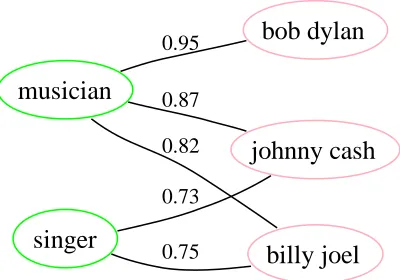
Each instance-class pair (i, C) extracted in the first phase (Section 2) is represented as a weighted edge in a graphG= (V, E, W), whereV is the set of nodes,E is the set of edges andW : E → R+ is the weight function which assigns positive weight to each edge. In particular, for each(i, C, w)triple from the set of base extractions,iandC are added toV and(i, C)is added toE,2withW(i, C) =w. The weightwrepresents the total score of all extrac-tions with that instance and class. Figure 1 illustrates a portion of a sample graph. This simple graph rep-resentation could be refined with additional types of nodes and edges, as we discuss in Section 7.
In what follows, all nodes are treated in the same way, regardless of whether they represent instances or classes. In particular, all nodes can be assigned class labels. For an instance node, that means that the instance is hypothesized to belong to the class; for a class node, that means that the node’s class is hypothesized to be semantically similar to the label’s class (Section 5).
We now formulate the task of assigning labels to nodes as graph label propagation. We are given a
bob dylan
musician
0.95
johnny cash
0.87
singer
0.73
billy joel
0.82
[image:4.612.86.286.59.199.2]0.75
Figure 1: Section of a graph used as input into Adsorp-tion. Though the nodes do not have any type associated with them, for readability, instance nodes are marked in pink while class nodes are shown in green.
set of instancesI and a set of classesCrepresented as nodes in the graph, with connecting edges as de-scribed above. We annotate a few instance nodes with labels drawn fromC. That is, classes are used both as nodes in the graph and as labels for nodes. There is no necessary alignment between a class node and any of the (class) labels, as the final labels will be assigned by the Adsorption algorithm.
The Adsorption label propagation algo-rithm (Baluja et al., 2008) is now applied to the given graph. Adsorption is a general framework for label propagation, consisting of a few nodes annotated with labels and a rich graph structure containing the universe of all labeled and unlabeled nodes. Adsorption proceeds to label all nodes based on the graph structure, ultimately producing a probability distribution over labels for each node.
More specifically, Adsorption works on a graph
G= (V, E, W)and computes for each nodeva
la-bel distribution Lv that represents which labels are
more or less appropriate for that node. Several in-terpretations of Adsorption-type algorithms have ap-peared in various fields (Azran, 2007; Zhu et al., 2003; Szummer and Jaakkola, 2002; Indyk and Ma-tousek, 2004). For details, the reader is referred to (Baluja et al., 2008). We use two interpretations here:
Adsorption through Random Walks: Let Gr = (V, Er, Wr)be the edge-reversed version of the
original graphG = (V, E, W)where(a, b) ∈
Er iff (b, a) ∈ E; and Wr(a, b) = W(b, a).
Now, choose a node of interestq ∈ V. To es-timateLqforq, we perform a random walk on
Grstarting fromqto generate values for a
ran-dom label variableL. After reaching a nodev
during the walk, we have three choices:
1. With probabilitypcontv , continue the ran-dom walk to a neighbor ofv.
2. With probability pabndv , abandon the ran-dom walk. This abandonment proba-bility makes the random walk stay rela-tively close to its source when the graph has high-degree nodes. When the ran-dom walk passes through such a node, it is likely that further transitions will be into regions of the graph unrelated to the source. The abandonment probability mit-igates that effect.
3. With probability pinjv , stop the random
walk and emit a labelLfromIv.
Lqis set to the expectation of all labelsL
emit-ted from random walks initiaemit-ted from nodeq.
Adsorption through Averaging: For this interpre-tation we make some changes to the original graph structure and label set. We extend the la-bel distributionsLv to assign a probability not
only to each label inC but also to the dummy label⊥, which represents lack of information about the actual label(s). We represent the ini-tial knowledge we have about some node labels in anaugmented graph G0 = (V0, E0, W0) as follows. For eachv ∈ V, we define an ini-tial distribution Iv = L⊥, where L⊥ is the
dummy distribution with L⊥(⊥) = 1, repre-senting lack of label information forv. In addi-tion, letVs ⊆ V be the set of nodes for which
we have some actual label knowledge, and let
V0 = V ∪ {v¯ : v ∈ Vs}, E0 = E∪ {(¯v, v) :
v ∈ Vs}, and W0(¯v, v) = 1 for v ∈ Vs,
W0(u, v) = W(u, v) for u, v ∈ V. Finally, letIv¯(seed labels) specify the knowledge about possible labels forv ∈ Vs. Less formally, the ¯
vnodes inG0 serve toinjectinto the graph the prior label distributions for eachv∈Vs.
distributions that are weighted averages of the label distributions for all their neighbors. This causes the non-dummy initial distribution ofVs
nodes to be propagated across the graph.
Baluja et al. (2008) show that those two views are equivalent. Algorithm 1 combines the two views: instead of a random walk, for each nodev, it itera-tively computes the weighted average of label distri-butions from neighboring nodes, and then uses the random walk probabilities to estimate a new label distribution forv.
For the experiments reported in Section 4, we used the following heuristics from Baluja et al. (2008) to set the random walk probabilities:
• Let cv = log(β+ explogβ H(v)) where H(v) =
−P
upuv×log(puv)withpuv= PW(u,v)
u0W(u
0 ,v).
H(v) can be interpreted as the entropy of v’s neighborhood. Thus,cv is lower ifvhas many
neighbors. We setβ = 2.
• jv = (1−cv)×
p
H(v) if Iv 6= L> and 0
otherwise.
• Then let
zv = max(cv+jv,1)
pcontv = cv/zv
pinjv = jv/zv
pabndv = 1−pcontv −pabndv
Thus, abandonment occurs only when the con-tinuation and injection probabilities are low enough.
The algorithm is run until convergence which is achieved when the label distribution on each node ceases to change within some tolerance value. Alter-natively, the algorithm can be run for a fixed number of iterations which is what we used in practice3.
Finally, since Adsorption is memoryless, it eas-ily scales to tens of millions of nodes with dense edges and can be easily parallelized, as described by Baluja et al. (2008).
3The number of iterations was set to 10 in the experiments reported in this paper.
Algorithm 1Adsorption Algorithm.
Input:G0 = (V0, E0, W0),Iv(∀v∈V0).
Output: Distributions{Lv :v∈V}.
1: Lv =Iv ∀v∈V 0
2:
3: repeat
4: Nv =PuW(u, v)
5: Dv= N1vPuW(u, v)Lu ∀v∈V 0
6: for allv∈V0do
7: Lv =pcontv ×Dv+pinjv ×Iv+pabndv ×L>
8: end for
9: untilconvergence
4 Experiments
4.1 Data
As mentioned in Section 3, one of the benefits of using Adsorption is that we can combine extrac-tions by different methods from diverse sources into a single framework. To demonstrate this capabil-ity, we combine extractions from free-text patterns and from Web tables. To the best of our knowl-edge, this is one of the first attempts in the area of minimally-supervised extraction algorithms where unstructured and structured text are used in a prin-cipled way within a single system.
Open-domain (instance, class) pairs were ex-tracted by applying the method described by Van Durme and Pas¸ca (2008) on a corpus of over 100M English web documents. A total of 924K (instance, class) pairs were extracted, containing 263K unique instances in 9081 classes. We refer to this dataset as A8.
Using A8, an additional 74M unique (in-stance,class) pairs are extracted from a random 10% of the WebTables data, using the method outlined in Section 2.2. For maximum coverage we setα = 2
andd= 2, resulting in a large, but somewhat noisy collection. We refer to this data set as WT.
4.2 Graph Creation
Seed Class Seed Instances
Book Publishers millbrook press, academic press, springer verlag, chronicle books, shambhala publications Federal Agencies dod, nsf, office of war information, tsa, fema
Mammals african wild dog, hyaena, hippopotamus, sperm whale, tiger NFL Players ike hilliard, isaac bruce, torry holt, jon kitna, jamal lewis
[image:6.612.73.539.57.157.2]Scientific Journals american journal of roentgenology, pnas, journal of bacteriology, american economic review, ibm systems journal
Table 2: Classes and seeds used to initialize Adsorption.
edges originating from A8 were set at 14. This graph is used in all subsequent experiments.
5 Evaluation
We evaluated the Adsorption algorithm under two experimental settings. First, we evaluate Adsorp-tion’s extraction precision on (instance, class) pairs obtained by Adsorption but not present in A8 (Sec-tion 5.1). This measures whether Adsorp(Sec-tion can add to the A8 extractions at fairly high precision. Second, we measured Adsorption’s ability to assign labels to a fixed set of gold instances drawn from various classes (Section 5.2).
Book Publishers Federal Agencies NFL Players Scientific Journals Mammals
20 40 60 80 100
Adsorption A8
Book
[image:6.612.75.299.398.497.2]Publishers AgenciesFederal PlayersNFL ScientificJournals Mammals A8 Adsorption
Figure 2: Precision at 100 comparisons for A8 and Ad-sorption.
5.1 Instance Precision
First we manually evaluated precision across five randomly selected classes from A8: Book Publish-ers, Federal Agencies, NFL PlayPublish-ers, Scientific Jour-nals and Mammals. For each class, 5 seed in-stances were chosen manually to initialize Adsorp-tion. These classes and seeds are shown in Table 2. Adsorption was run for each class separately and the
4A8 extractions are assumed to be high-precision and hence we assign them the highest possible weight.
resulting ranked extractions were manually evalu-ated.
Since the A8 system does not produce ranked lists of instances, we chose 100 random instances from the A8 results to compare to the top 100 instances produced by Adsorption. Each of the resulting 500 instance-class pairs(i, C)was presented to two hu-man evaluators, who were asked to evaluate whether the relation “iis aC” was correct or incorrect. The user was also presented with Web search link to ver-ify the results against actual documents. Results from these experiments are presented in Figure 2 and Table 4. The results in Figure 2 show that the A8 system has higher precision than the Adsorption system. This is not surprising since the A8 system is tuned for high precision. When considering individ-ual evaluation classes, changes in precision scores between the A8 system and the Adsorption system vary from a small increase from 87% to 89% for the class Book Publishers, to a significant decrease from 52% to 34% for the class Federal Agencies, with a decrease of 10% as an average over the 5 evaluation classes.
Class Precision at 100 (non-A8 extractions)
Book Publishers 87.36
Federal Agencies 29.89
NFL Players 94.95
Scientific Journals 90.82
[image:6.612.324.527.526.629.2]Mammal Species 84.27
Table 4: Precision of top 100 Adsorption extractions (for five classes) which werenotpresent in A8.
Seed Class Non-Seed Class Labels Discovered by Adsorption
Book Publishers small presses, journal publishers, educational publishers, academic publishers, commercial publishers
Federal Agencies public agencies, governmental agencies, modulation schemes, private sources, technical societies
NFL Players sports figures, football greats, football players, backs, quarterbacks
Scientific Journals prestigious journals, peer-reviewed journals, refereed journals, scholarly journals, academic journals
[image:7.612.82.535.53.181.2]Mammal Species marine mammal species, whale species, larger mammals, common animals, sea mammals
Table 3: Top class labels ranked by their similarity to a given seed class in Adsorption.
Seed Class Sample of Top Ranked Instances Discovered by Adsorption
Book Publishers small night shade books, house of anansi press, highwater books, distributed art publishers, copper canyon press
NFL Players tony gonzales, thabiti davis, taylor stubblefield, ron dixon, rodney hannah Scientific Journals journal of physics, nature structural and molecular biology,
sciences sociales et sant´e, kidney and blood pressure research, american journal of physiology–cell physiology
Table 5: Random examples of top ranked extractions (for three classes) found by Adsorption which were not present in A8.
Such an evaluation is important as one of the main motivations of the current work is to increase cov-erage (recall) of existing high-precision extractors without significantly affecting precision. Results in Table 4 show that Adsorption is indeed able to ex-traction with high precision (in 4 out of 5 cases) new instance-class pairs which were not extracted by the original high-precision extraction set (in this case A8). Examples of a few such pairs are shown in Table 5. This is promising as almost all state-of-the-art extraction methods are high-precision and low-recall. The proposed method shows a way to overcome that limitation.
As noted in Section 3, Adsorption ignores node type and hence the final ranked extraction may also contain classes along with instances. Thus, in ad-dition to finding new instances for classes, it also finds additional class labels similar to the seed class labels with which Adsorption was run, at no extra cost. Some of the top ranked class labels extracted by Adsorption for the corresponding seed class la-bels are shown in Table 3. To the best of our knowl-edge, there are no other systems which perform both tasks simultaneously.
5.2 Class Label Recall
Next we evaluated each extraction method on its rel-ative ability to assign labels to class instances. For each test instance, the five most probably class la-bels are collected using each method and the Mean Reciprocal Rank (MRR) is computed relative to a gold standard target set. This target set, WN-gold, consists of the 38 classes in Wordnet containing 100 or more instances.
In order to extract meaningful output from Ad-sorption, it is provided with a number of labeled seed instances (1, 5, 10 or 25) from each of the 38 test classes. Regardless of the actual number of seeds used as input, all 25 seed instances from each class are removed from the output set from all methods, in order to ensure fair comparison.
The results from this evaluation are summarized in Table 6; ADxrefers to the adsorption run withx
MRR MRR # found Method (full) (found only)
A8 0.16 0.47 2718
WT 0.15 0.21 5747
AD 1 0.26 0.45 4687
AD 5 0.29 0.48 4687
AD 10 0.30 0.51 4687
[image:8.612.90.286.56.173.2]AD 25 0.32 0.55 4687
Table 6: Mean-Reciprocal Rank scores of instance class labels over 38 Wordnet classes (WN-gold). MRR (full) refers to evaluation across the entire gold instance set. MRR (found only) computes MRR only on recalled in-stances.
lower MRR scores compared to Adsorption. This result highlights Adsorption’s ability to effectively combine high-precision, low-recall (A8) extractions with low-precision, high-recall extractions (WT) in a manner that improvesbothprecision and coverage.
6 Related Work
Graph based algorithms for minimally supervised information extraction methods have recently been proposed. For example, Wang and Cohen (2007) use a random walk on a graph built from entities and relations extracted from semi-structured text. Our work differs both conceptually, in terms of its focus on open-domain extraction, as well as methodologi-cally, as we incorporate both unstructured and struc-tured text. The re-ranking algorithm of Bellare et al. (2007) also constructs a graph whose nodes are in-stances and attributes, as opposed to inin-stances and classes here. Adsorption can be seen as a general-ization of the method proposed in that paper.
7 Conclusion
The field of open-domain information extraction has been driven by the growth of Web-accessible data. We have staggering amounts of data from various structured and unstructured sources such as general Web text, online encyclopedias, query logs, web ta-bles, or link anchor texts. Any proposed algorithm to extract information needs to harness several data sources and do it in a robust and scalable manner. Our work in this paper represents a first step towards that goal. In doing so, we achieved the following:
1. Improved coverage relative to a high accuracy instance-class extraction system while main-taining adequate precision.
2. Combined information from two different sources: free text and web tables.
3. Demonstrated a graph-based label propagation algorithm that given as little as five seeds per class achieved good results on a graph with more than a million nodes and 70 million edges.
In this paper, we started off with a simple graph. For future work, we plan to proceed along the fol-lowing lines:
1. Encode richer relationships between nodes, for example instance-instance associations and other types of nodes.
2. Combine information from more data sources to answer the question of whether more data or diverse sources are more effective in increasing precision and coverage.
3. Apply similar ideas to other information extrac-tion tasks such as relaextrac-tion extracextrac-tion.
Acknowledgments
We would like to thank D. Sivakumar for useful dis-cussions and the anonymous reviewers for helpful comments.
References
A. Azran. 2007. The rendezvous algorithm: multiclass semi-supervised learning with markov random walks.
Proceedings of the 24th international conference on Machine learning, pages 49–56.
S. Baluja, R. Seth, D. Sivakumar, Y. Jing, J. Yagnik, S. Kumar, D. Ravichandran, and M. Aly. 2008. Video suggestion and discovery for youtube: taking random walks through the view graph.
K. Bellare, P. Talukdar, G. Kumaran, F. Pereira, M. Liber-man, A. McCallum, and M. Dredze. 2007. Lightly-Supervised Attribute Extraction. NIPS 2007 Workshop on Machine Learning for Web Search.
C. Fellbaum, editor. 1998.WordNet: An Electronic Lexi-cal Database and Some of its Applications. MIT Press. M. Hearst. 1992. Automatic acquisition of hyponyms from large text corpora. InProceedings of the 14th In-ternational Conference on Computational Linguistics (COLING-92), pages 539–545, Nantes, France. P. Indyk and J. Matousek. 2004. Low-distortion
embed-dings of finite metric spaces. Handbook of Discrete and Computational Geometry.
B. Jansen, A. Spink, and T. Saracevic. 2000. Real life, real users, and real needs: a study and analysis of user queries on the Web. Information Processing and Man-agement, 36(2):207–227.
D. Lin and P. Pantel. 2002. Concept discovery from text. In Proceedings of the 19th International Conference on Computational linguistics (COLING-02), pages 1– 7.
K. McCarthy and W. Lehnert. 1995. Using decision trees for coreference resolution. InProceedings of the 14th International Joint Conference on Artificial Intel-ligence (IJCAI-95), pages 1050–1055, Montreal, Que-bec.
E. Riloff and R. Jones. 1999. Learning dictionaries for information extraction by multi-level bootstrapping. In Proceedings of the 16th National Conference on Artificial Intelligence (AAAI-99), pages 474–479, Or-lando, Florida.
M. Stevenson and R. Gaizauskas. 2000. Using corpus-derived name lists for named entity recognition. In
Proceedings of the 6th Conference on Applied Natu-ral Language Processing (ANLP-00), Seattle, Wash-ington.
M. Szummer and T. Jaakkola. 2002. Partially labeled classification with markov random walks. Advances in Neural Information Processing Systems 14: Proceed-ings of the 2002 NIPS Conference.
B. Van Durme and M. Pas¸ca. 2008. Finding cars, god-desses and enzymes: Parametrizable acquisition of la-beled instances for open-domain information extrac-tion. Twenty-Third AAAI Conference on Artificial In-telligence.
R. Wang and W. Cohen. 2007. Language-Independent Set Expansion of Named Entities Using the Web. Data Mining, 2007. ICDM 2007. Seventh IEEE Interna-tional Conference on, pages 342–350.