Robust Morphological Tagging with Word Representations
Thomas M¨uller and Hinrich Sch¨utze
Center for Information and Language Processing University of Munich, Germany
Abstract
We present a comparative investigation of word representations for part-of-speech (POS) and morphological tagging, focusing on sce-narios with considerable differences between training and test data where arobustapproach is necessary. Instead of adapting the model towards a specific domain we aim to build a robust model across domains. We developed a test suite for robust tagging consisting of six languages and different domains. We find that representations similar to Brown clusters per-form best for POS tagging and that word rep-resentations based on linguistic morphological analyzers perform best for morphological tag-ging.
1 Introduction
Most natural language processing (NLP) tasks can be better solved if a preprocessor tags each word in the natural language input with a label like “noun, singular” or “verb, past tense” that gives some in-dication of the syntactic role that the word plays in its context. The most common form of such pre-processing is POS tagging. However, for morpho-logically rich languages, a large subset of the lan-guages of the world, POS tagging in its original form – where labels are syntactic categories with little or no morphological information – does not make much sense. The reason is that POS and morpho-logical properties are mutually dependent, so solv-ing only one task or solvsolv-ing the tasks sequentially is inadequate. The most important dependence of this type is that POS can be read off morphology in many
cases; e.g., the morphological suffix “-iste” is a reli-able indicator of the informal second person singu-lar preterite indicative form of a verb in Spanish. In what follows, we use the term “morphological tag-ging” to refer to “morphological and POS tagtag-ging” since morphological tags generally include POS in-formation.
The importance of morphological tagging as part of the computational linguistics processing pipeline motivated us to conduct the research reported in this paper. The specific setting that we address is in-creasingly recognized as the setting in which most practical NLP takes place: We look at scenarios with considerable differences between the training data and the application data, i.e., between the data that the tagger is trained on and the data that it is ap-plied to. This type of scenario is frequent because of the great diversity and variability of natural language and because of the high cost of annotation – which makes it impossible to create large training sets for each new domain. For this reason, we address mor-phological tagging in a setting in which training and application data differ.
The most common approach to this setting is domain adaptation. Domain adaptation has been demonstrated to have good performance in scenarios with differently distributed training/test data. How-ever, it has two disadvantages. First, it requires the availability of data from the target domain. Second, we need to do some extra work in domain adaptation – consisting of taking target domain data and using it to adapt our NLP system to the target domain – and we end up with a number of different versions of our NLP system. The extra work required and the
liferation of different versions increase the possibil-ity of errors and increase the complexpossibil-ity of deploy-ing NLP technology. Similar to other recent work (Zhang and Wang, 2009), we therefore take an ap-proach that is different from domain adaptation. We build a system that isrobust across domains without any modification. As a result, no extra work is re-quired when the system is applied to a new domain: there is only one system and we can use it for all domains.
The key to making NLP components robust across domains isthe use of powerful domain-independent representations for words. One of the main contri-butions of this paper is that we compare the perfor-mance of the most important representations that can be used for this purpose. We find that two of these are best suited for robust tagging. MarLiN (Mar-tin et al., 1998) clusters – a derivative of Brown clusters – perform best for POS tagging. MarLiN clusters are also an order of magnitude more effi-cient to induce than the original Brown clusters. We provide an open source implementation of MarLiN clustering as part of this publication (Section 8). We compare the word representations to Morphological Analyzers (MAs), which are finite-state transducers that find the stems of a form and use them to de-rive all its possible morphological readings. MAs produce the best results in our experiments on mor-phological tagging. Our initial expectation was that domain differences and lack of coverage would put manually created MAs at a disadvantage when com-pared to learning algorithms that are run on very large text corpora. However, our results clearly show that MA-based representations are the best represen-tations to use for robust morphological tagging.
The motivation for our work is that both mor-phological tagging and the “robust” application set-ting are important areas of research in NLP. To sup-port this research, we created an extensive evalua-tion set for six languages. This involved identify-ing morphologically rich languages in which usable data sets with different distributional properties were available, designing mappings between different tag sets, organizing a manual annotation effort for one of the six languages and preparing large “general” (not domain-specific) data sets for unsupervised learning of word representations. The preparation and publi-cation (Section 8) of this test suite is in itself a
sig-nificant contribution.
The remainder of this paper is structured as fol-lows. Section 2 discusses related work. Section 3 presents the representations we tested. Section 4 de-scribes the data sets and the annotation and conver-sion efforts required to create the in-domain (ID) and out-of-domain (OOD) data sets. In Section 5, we de-scribe the experiments and discuss our findings. In Section 6, we provide an analysis of our results. Sec-tion 7 summarizes our findings and contribuSec-tions.
2 Related Work
Morphological tagging(Oflazer and Kuru¨oz, 1994; Hajiˇc and Hladk´a, 1998) is the task of assigning a morphological reading to a token in context. The morphological reading consists of features such as case, gender, person and tense and is represented as a single tag. This allows for the application of stan-dard sequence labeling algorithms such as Condi-tional Random Fields (CRFs) (Lafferty et al., 2001), but also puts an upper bound on the accuracy as only readings occurring in the training set can be pro-duced. It is still the standard approach to morpho-logical disambiguation as the number of readings that cannot be produced is usually small.
The related work can be divided in systems that try to exploit certain properties of a language (Habash and Rambow, 2005; Yuret and T¨ure, 2006) and language-independent systems (Hajiˇc, 2000; Smith et al., 2005). In this paper, we adopt a language-independent approach.
represen-tations to represenrepresen-tations obtained from MAs.
Domain adaptation(DA) attempts to adapt a model trained on a source domain to a target domain. DA can be broadly divided into supervised and unsuper-vised approaches depending on whether labeled tar-get domain data is available or not. Among unsu-pervised approaches to DA, representation learning (Ando and Zhang, 2005; Blitzer et al., 2006) uses the unlabeled target domain data to induce a structure that is suitable for transferring information from the labeled source domain to the target domain. Simi-lar to representation learning for DA, we attempt to include word representations into the model. How-ever, we induce the representation from a general domainin an attempt to obtain a model that has ro-bust high accuracy across domains, for the source domain as well as for the target domains, for which neither labeled nor unlabeled training data is avail-able.
3 Representations
We survey the following distributional represen-tations: (i) count vectors reduced by a Singular Value Decomposition (SVD), (ii) word clusters in-duced using the likelihood of a class-based language model, (iii) distributed embeddings trained using a neural network and (iv) accumulated tag counts, a task-specific representation obtained from an auto-matically tagged corpus.
Singular value decomposition of word-feature cooccurrence matrices (Sch¨utze, 1995) has been found to be a fast and efficient way to obtain dis-tributed embeddings. The approach selects a subset of the vocabulary as so-called feature words, usually by including words up to a certain frequency rank. Every word form can then be represented by the ac-cumulated counts of feature words occurring to its left and right. Then an SVD is applied to the cooc-currence matrix as a form of dimension reduction and to reduce sparsity.
We also experimented with unreduced count vec-tors, but they did not give better results than SVD reduced count vectors. SVD-based representations have been used in English POS induction (Lamar et al., 2010) as well as as features in English POS tag-ging and syntactic chunking (Huang et al., 2009);
they have a similar level of accuracy as unsupervised Hidden Markov Models (HMMs) in these studies. Language model-based (LM-based) word clus-ters were introduced by Brown et al. (1992) and later found to be helpful in a range of NLP tasks. The basic idea is to find the optimal clustering with respect to the likelihood of a class-based language model:
g= arg max
g
|D|
Y
i=1
p(g(xi)|g(xi−1))·p(xi|g(xi))
where g(x) is the cluster assignment function that maps a word form x to a cluster and |D| denotes the length of the training set. Brown et al. (1992) propose a greedy bottom-up algorithm for the opti-mization that merges the pair of clusters that yields the smallest loss in likelihood; as well as a more efficient approximation of that algorithm that limits the number of clusters under consideration and still works well in practice. It is used by most work in the literature (Liang, 2005; Turian et al., 2010; Koo et al., 2008).
We, however, found the algorithm proposed by Martin et al. (1998) to be faster and to give slightly better results. The algorithm is similar to K-means in that it starts with an initial clustering and greed-ily improves the objective function by moving sin-gle words to their optimal cluster. In contrast to K-means, it updates the objective function immedi-ately. The algorithm has also been shown to work well in unsupervised POS induction (Clark, 2003; Blunsom and Cohn, 2011). Our implementation of this algorithm is called MarLiN and has been made available as open-source software (Section 8). Miller et al. (2004) use tags of different granular-ity induced from unlabeled text to improve the per-formance of an averaged perceptron tagger (Collins, 2002) on an English NER task.
(LDA) model on Spanish and French morphological tagging and find them to yield similar performance.1
Neural networkshave been used by Collobert and Weston (2008) to train embeddings for POS tag-ging as well as other NLP tasks. These embed-dings – henceforth CW embeddings – are trained by building a neural network that given contexts of a word as input is trained to discriminate be-tween the correct center word and a random word. The proposed training algorithm is reported to need several days or even weeks, but has been reimple-mented by Al-Rfou et al. (2013), who induced em-beddings for the Wikipedias of more than 100 lan-guages. Turian et al. (2010) find that the perfor-mance of Brown clusters is competitive with more training intensive embeddings like CW. In our exper-iments, we find that MarLiN clusters slightly outper-form CW. We do not evaluate bag-of-words models such asWORD2VEC(Mikolov et al., 2013), because the ordering of words is essential for finding mor-phological properties.
Accumulated tag counts(ACT) are a form of task-specific sparse representation. The unlabeled cor-pus is first annotated by a tagger; for each occurring word form, the number of times a specific tag was assigned can then be used as a representation. Gold-berg and Elhadad (2013) and (Sz´ant´o and Farkas, 2014) show that using such information in the word-preterminal emission probabilities of PCFGs can improve parsing accuracy. Specifically, Sz´ant´o and Farkas (2014) show that this approach performs as well as an MA in some cases. We find MAs to be more effective than the accumulated count embed-dings; this is not a contradiction as we try to improve the performance of the tagger itself.
4 Data Preparation
Our test suite consists of data sets for six differ-ent languages: Czech (cs), English (en), German (de), Hungarian (hu), Spanish (es) and Latin (la). Czech, German, Hungarian and Latin are morpho-logically rich. We chose these languages because
1The authors claim that LDA Gibbs sampling is faster than
the induction of Brown clusters because it only depends linearly on the number of clusters. We, however, could not train their models on our bigger data sets as the sampling depends linearly on the number of tokens.
they represent different families: Germanic (En-glish, German), Romance (Latin, Spanish), Slavic (Czech) and Finno-Ugric (Hungarian) and differ-ent degrees of morphological complexity and syn-cretism. For example, English and Spanish rarely mark case while the other languages do; and as an agglutinative language, Hungarian features a low number of possible readings for a word form while languages like German can have more than 40 dif-ferent readings for a word form. An additional crite-rion was to have a sufficient amount of labeled OOD data. The data sets also feature an interesting selec-tion of domain differences. For example, for Latin we have texts from different epochs while the En-glish data contains canonical and non-canonical text. Labeled Data.This section describes the annotation and conversion we performed to create consistent ID and OOD data sets.2 No conversion was required for
Hungarian, English and Latin as the data is already annotated in a consistent way.
For Hungarian we use the (multi-domain) Szeged Dependency Treebank (Vincze et al., 2010). We use the part that was used in the SPMRL 2013 shared task (Seddah et al., 2013) as ID data (news-wire) and an excerpt from the novel1984and aWindows 2000 manual as OOD data.
For Latin we use the PROIEL treebank (Haug and Jøhndal, 2008). It consists of data from theVulgate (bible text,≈380 AD),Commentarii de Bello Gal-lico(≈50 BC), Letters from Cicero to his friend At-ticus (≈50 BC) andThe Pilgrimage of Aetheria(≈
380 AD). We use the biggest text source(Vulgate) as ID data and the remainder as OOD data.
For English we use the SANCL shared task data (Petrov and McDonald, 2012), which consists of Ontonotes 4.0 as ID data and five OOD domains from the Google Web treebank: Yahoo! Answers, weblogs, news groups, business reviews and emails. For Czech we use the part of the Prague Depen-dency Treebank (PDT) (B¨ohmov´a et al., 2003) that was used in the CoNLL 2009 shared tasks (Hajiˇc et al., 2009) as ID data. We use the Czech part of the Multext East (MTE) corpus (Erjavec, 2010) as OOD data. MTE consists of translations of the
2Table 5 of the appendix provides a structured overview over
novel 1984 that have been annotated morphologi-cally. PDT and MTE have been annotated using two different guidelines that without further anno-tation effort could only be merged by reducing them to a common subset. Specifically, we removed fea-tures such as sub POS tags as well as markers for (in)animacy. The PDT features a number of tags that are ambiguous and could not always be resolved. The gender feature Q for example can mean femi-nine or neuter. If we could not disambiguate such a tag, we removed it; this results in morphological tags that are not present in the MTE corpus and a relatively high number of unseen tags. Instead of describing the conversion process in greater detail we refer to our conversion scripts (Section 8).
For Spanish we use the part of the AnCora corpus (Taul´e et al., 2008) of CoNLL 2009 and the IULA treebank (Marimon et al., 2012), which consists of five domains: law, economics, medicine, computer science and environment. We use the AnCora cor-pus as ID data set and IULA as OOD data set. The two treebanks have been annotated using the same annotation scheme, but slightly different guidelines. Similar to Czech we merged the data sets by delet-ing features that could not be merged or were not present in one of the treebanks. Again we refer to the conversion script for further details (Section 8).
For German we use the Tiger treebank (Brants et al., 2002) in the same split as M¨uller et al. (2013) as ID data and the Smultron corpus (Volk et al., 2010) as OOD data. Smultron consists of four parts: a description of Alpine hiking routes, a DVD man-ual, an excerpt of Sophie’s World and economics texts. It has been annotated with POS and syntax, but not with morphological features. We annotated Smultron following the Tiger guidelines. The anno-tation process was similar to Marimon et al. (2012) in that the data sets were automatically tagged with the MORPH tagger MarMoT (M¨uller et al., 2013) and then manually corrected by two annotators. This tagger is a strong baseline as we could include fea-tures based on gold lemma, POS and syntax (Seeker and Kuhn, 2013). The agreement of the annotators was .9628 and theκagreement .64.3 As most of the
3For calculatingκ, we assume that random agreement
oc-curs when both annotators agree with the reading proposed by the tagger. We then estimate the probability of random agree-ment by multiplying the individual estimated probabilities of
differences between the annotators were cases where only one of the annotators had corrected an obvious error that the other had overlooked, the differences were resolved by the annotators themselves.
We used the provided segmentation if available and otherwise split ID data 8/1/1 into training, opment and test sets and OOD data 1/1 into devel-opment and test sets if not mentioned otherwise. We thus have a classical setup of in-domain news paper text vs. prose, medical, law, economic or technical texts for Czech, German, Spanish and Hungarian. For English we have canonical vs. non-canonical data and for Latin data of different epochs (ca. 400 AD vs 50 BC). Additionally, for German one of the test domains is written in Swiss German.
Looking at some statistics of the labeled data sets,4we find that: Hungarian and Latin are the
lan-guages with the highest OOV rates (27% and 37%, which for reasons of consistency we will henceforth write as follows: .27 and .37); Hungarian has a very productive agglutinative morphology while the high number of Latin OOVs can be explained by the small training set (<60,000); Czech features the highest unknown tag rate (.05) as well as the highest unseen word-tag rate (.16). This can be explained by the limits of the conversion procedure we discussed above, e.g., ambiguous features like Q.
Unlabeled Data. As unlabeled data we use Wikipedia dumps from 2014 for all languages ex-cept for Latin for which we use the Patrologia Latina, a collection of clerical texts from ca. 100 AD to 1200 AD from Corpus Corporum (Roelli, 2014). We do not use the Latin version of Wikipedia because it is written by enthusiasts, not by native speakers, and contains many errors.
We preprocessed the Wikipedia dumps with WIKIPEDIAEXTRACTOR (Attardi and Fuschetto, 2013) and NLTK’S (Bird et al., 2009) implemen-tation of PUNKT (Kiss and Strunk, 2006) to de-tect sentence boundaries. Tokenization was per-formed usingMAGYARLANC(Hungarian, Zsibrita et al. (2013)), STANFORDTOKENIZER(English, Man-ning et al. (2014)), FREELING (Spanish, Padr´o and Stanilovsky (2012)) and CZECHTOK5 (Czech). For changing the proposed tagging. This yields a random agree-ment probability of .8965.
4Complete tables are in the appendix: Tables 1 and 2.
Latin, we removed punctuation because PROIEL does not contain punctuation. We also split off the cliticsne,queandveif the resulting token was ac-cepted by LATMOR(Springmann et al. (2014)). Fol-lowing common practice, we normalized the text by replacing digits with 0s.6
In our experiments, we extract representations for the 250,000 most frequent word types. This vo-cabulary size is comparable to other work; e.g., Turian et al. (2010) use 269,000 types. This thresh-old yields low fractions of uncovered tokens7 for
English and Latin (.009 and .02). For the other languages, this fraction rises to .04. We also ex-tract the morphological readings of the words in this vocabulary using MAGYARLANC(Hungarian, Zsib-rita et al. (2013)), FREELING(English and Spanish, Padr´o and Stanilovsky (2012)), SMOR (German, Schmid et al. (2004)), an MA from Charles Uni-versity (Czech, Hajiˇc (2001)) and LATMOR(Latin, Springmann et al. (2014)). Throughout this paper we extract one feature for each cluster id or MA reading of the current word form. For example, SMOR produces two readings for the German word formerhielt‘received’: <1><SG><PA S T><IN D> and <2><SG><PA S T><IN D>, we thus fire two features representing the respective tags whenever erhielt is seen in the data. We also experimented with cluster indexes of neighboring uni/bigrams, but obtained no consistent improvement. For the dense embeddings we analogously extract the vector of the current word form.
5 Experiments
For all our experiments we use MarMoT (M¨uller et al., 2013) a joint POS and morphological tag-ger.8 The CRF tagger employs a pruning strategy on
forward-backward lattices to efficiently handle big tag sets and higher orders. Its feature set is similar to Ratnaparkhi (1996) and Toutanova et al. (2003) and includes prefixes, suffixes, immediate lexical context and shape features based on capitalization, special characters and digits. MarMoT was shown to be a competitive POS and morphological tagger czechtok/
6For statistics of the unlabeled data sets cf. Table 3 of the
appendix.
7Cf. Table 4 in the appendix.
8http://cistern.cis.lmu.de/marmot/
across six languages (M¨uller et al., 2013). In order to make sure that it is also robust in an OOD setup we compare it to the two popular taggers SVM-Tool (Gim´enez and Marquez, 2004) and Morfette (Chrupała et al., 2008). The results are summarized in Table 1.
MarMoT uses stochastic gradient descent and produces different results in each training run. We therefore always report the average of five runs. The OOD numbers are macro-averages over the different OOD data sets of a language. 9 The tables in this
paper are based on the development sets; the only exception to this is Table 5, which is based on the test set. MarMoT outperforms SVMTool and Mor-fette on every language and setup (ID / OOD) ex-cept for the Spanish OOD data set. For Czech, Ger-man and Latin the improvements over the best base-line are >1. Different orders of MarMoT behave as expected: higher-order models (order>1) outper-form first-order models. The only exception to this is Latin. This suggests a drastic difference of the tag transition probabilities between the Latin ID and OOD data sets. Given the results in Table 1 and for simplicity we use an second-order MarMoT model in all subsequent experiments.
LM-based clustering. We first compare different implementations of LM-based clustering. The im-plementation of Brown clustering by Liang (2005) is most commonly used. Its hierarchical binary struc-ture can be used to extract clusterings of varying granularity by selecting different prefixes of the path from the root to a specific word form. Follow-ing other work (Ratinov and Roth, 2009; Turian et al., 2010), we induce 1000 clusters and select path lengths 4, 6, 10 and 20. We call this representa-tion Brown path. We compare Brown path to mk-cls10 (Och, 1999) and MarLiN. These
implementa-tions just induce flat clusterings of a certain size; we thus run them for cluster sizes 100, 200, 500 and 1000 to also obtain cluster ids of different sizes. The cluster sizes roughly resemble the granularity ob-tained in Brownpath. We call the corresponding
mod-9Throughout this paper we use the approximate
randomiza-tion test (Yeh, 2000) to establish significance. To this end, we compare the output of the medians of the five independent mod-els. We regard p-values<.05 as significant.
10mkcls implements a similar training algorithm as MarLiN,
MarMoT (1) MarMoT (2) MarMoT (3) Morfette SVMTool
ID OOD ID OOD ID OOD ID OOD ID OOD
morph
cs 93.27 77.83 93.89 78.52 93.86 78.55 91.48 76.56 91.06 75.41
de 88.90 82.74 90.26 84.19 90.54∗84.30 85.89 80.28 85.98 78.08
es 98.21 93.24 98.22 93.62 98.16 93.42 97.95 93.97∗ 97.96 91.36
hu 96.11 89.78 96.07 89.83 95.92 89.70 95.47 89.18 94.72 88.44
la 86.09 67.90∗ 86.44 67.47 86.47 67.40 83.68 65.06 84.09 65.65
Table 1: Baseline experiments comparing MarMoT models of different orders with Morfette and SVMTool. Num-bers denote average accuracies on ID and OOD development sets on the full morphological tagging task. A result significantly better than the other four ID (resp. OOD) results in its row is marked with∗.
Brownflat Brownpath MarLiN mkcls
ID OOD ID OOD ID OOD ID OOD
pos
cs 99.19 97.25 99.18 97.21 99.19 97.26 99.21 97.26
de 98.08 93.42 98.07 93.47 98.10 93.44 98.11 93.64∗
en 96.99 91.67 97.02 91.71 97.01 91.71 97.03 91.86∗
es 98.84 97.91 98.84 97.97 98.87 97.97 98.84 97.90
hu 97.95 93.40 97.89 93.39 97.98 93.36 97.99 93.42
la 96.78 86.49 96.62 86.60 96.91 87.24 96.95 87.19
morph
cs 94.20 78.95 94.23 79.01 94.35 79.14 94.32 79.11
de 90.71 85.39 90.75 85.44 90.78 85.58 90.68 85.47
es 98.47 95.08 98.47 95.12 98.48 95.15 98.48 95.13
hu 96.60 90.57 96.52 90.54 96.60 90.64 96.61 90.66
[image:7.612.140.474.53.123.2]la 87.53 71.69 87.44 71.60 87.87 72.08 87.67 71.88
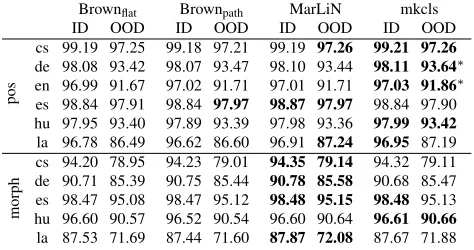
Table 2: Tagging results for LM-based models
els Brownflat, mkcls and MarLiN. The runtime of the
Brown algorithm depends quadratically on the num-ber of clusters while mkcls and MarLiN have linear complexity. This is reflected in the training times: For German the Brown algorithm takes≈5000 min, mkcls≈2000 minand MarLiN≈500 min.
Table 2 shows that the absolute differences be-tween systems are small, but overall MarLiN and mkcls are better.11 We conclude that systems based
on the algorithm of Martin et al. (1998) are slightly more accurate for tagging and are several times faster than the more frequently used version of Brown et al. (1992). We thus use MarLiN for the remainder of this paper.
Neural Network Representations. We compare MarLiN with the implementation of CW by Al-Rfou et al. (2013). They extracted 64-dimensional repre-sentations for only the most frequent 100,000 word forms. To make the comparison fair, we use the in-tersection of our and their representation vocabular-ies.12 The results in Table 3 show that MarLiN is
11Brown
pathreaches the same performance as MarLiN in one
case: pos/es/OOD.
12We also use representations from Wikipedia (instead of
Corpus Corporum) for Latin to increase the similarity of the
Baseline MarLiN CW
ID OOD ID OOD ID OOD
pos
cs 99.00 96.80 99.16∗97.06 99.12 97.00
de 97.87 92.21 98.03 93.35∗ 98.03 93.02
en 96.92 91.12 97.05 91.72 97.00 91.86∗
es 98.62 96.70 98.79 97.82∗ 98.80 97.31
hu 97.49 92.79 97.94 93.30 97.88 93.40
la 95.80 81.92 96.35∗85.52∗ 95.88 84.50
morph
cs 93.89 78.52 94.23∗78.91 94.10 78.80
de 90.26 84.19 90.54 85.08 90.59 85.21
es 98.22 93.62 98.44 94.97∗ 98.44 94.32
hu 96.07 89.83 96.47 90.60 96.48 90.95∗
la 86.44 67.47 86.95 70.30∗ 86.76 69.32
Table 3: Tagging results for CW
best in 15 out of 22 cases and significantly better in eight. CW is best in 9 out of 22 cases and signif-icantly better in two. We conclude that LM-based representations are more suited for tagging as they can be induced faster, are smaller and give better re-sults.
SVD and ACT Representations. For the SVD-based representation we use feature ranks out of
{500, 1000} and dimensions out of{50, 100, 200, 500}. We found that l1-normalizing the vectors be-fore and after the SVD improved results slightly. For the accumulated tag counts (ACT) we annotate the data with our baseline model and extract word-tag probabilities. The probabilities are then used as sparse real-valued features. Table 4 shows that all representations outperform the baseline. Improve-ments are biggest for Latin. Overall, SVD outper-forms ACT and is outperformed by MarLiN and MA. MarLiN gives the best representations for POS tagging while MA outperforms MarLiN in MORPH tagging. Table 5 shows that the findings for the base-line, MarLiN and MA also hold for the test set.
[image:7.612.321.533.189.315.2] [image:7.612.71.308.191.316.2]Baseline ACT MarLiN MA SVD
ID OOD ID OOD ID OOD ID OOD ID OOD
pos
cs 99.00 96.80 99.11 97.03 99.19 97.26 99.18 97.25 99.11 97.09
de 97.87 92.21 98.00 92.92 98.10 93.44∗ 98.00 92.87 98.09 92.88
en 96.92 91.12 96.97 91.47 97.01 91.71 96.99 91.57 97.00 91.75
es 98.62 96.70 98.79 97.09 98.87 97.97 98.87 97.89 98.80 97.16
hu 97.49 92.79 97.84 93.15 97.98 93.36 98.12∗93.77∗ 97.86 93.30
la 95.80 81.92 96.17 83.40 96.91 87.24∗ 96.81 86.31 96.36 85.01
morph
cs 93.89 78.52 94.16 78.75 94.35 79.14 94.48∗79.41∗ 94.14 78.94
de 90.26 84.19 90.56 84.78 90.78 85.58 90.75 85.75 90.69 85.15
es 98.22 93.62 98.38 93.92 98.48 95.15 98.56∗95.43∗ 98.40 94.18
hu 96.07 89.83 96.25 90.07 96.60 90.64 96.83∗91.14∗ 96.46 90.50
[image:8.612.143.473.54.178.2]la 86.44 67.47 86.96 68.61 87.87 72.08 88.40∗73.23∗ 87.45 70.81
Table 4: Tagging results for the baseline and four different representations
Baseline MarLiN MA
ID OOD ID OOD ID OOD
pos
cs 98.88 96.43 99.11∗96.94 99.06 96.95
de 97.32 91.10 97.73∗92.00∗ 97.60 91.49
en 97.36 89.81 97.58∗90.65∗ 97.47 90.51
es 98.66 97.94 98.94∗98.33 98.87 98.38
hu 96.84 92.11 97.08 92.95 97.46∗93.25∗
la 93.02 81.35 95.20 87.58∗ 95.11 86.45
morph
cs 93.93 77.50 94.33 78.12 94.50∗78.37∗
de 88.41 82.78 89.18 83.91 89.32∗84.09
es 98.30 95.65 98.53 95.92 98.54 96.33∗
hu 94.82 88.82 95.46 89.98 95.85∗90.46∗
[image:8.612.79.296.223.348.2]la 82.09 65.59 84.67 71.25 85.91∗72.42∗
Table 5: Test set results for: baseline, MarLiN, MA
f = 0 0< f <10 f >= 10
morph
cs MarLiN 0.29 0.22 0.11
MA 0.37 0.35 0.16
de MarLiN 1.02 0.17 0.19
MA 0.85 0.29 0.42
es MarLiN 1.36 0.15 0.02
MA 1.50 0.27 0.04
hu MarLiN 0.62 0.18 0.00
MA 1.07 0.20 0.03
la MarLiN 3.76 0.80 0.06
MA 4.98 0.69 0.09
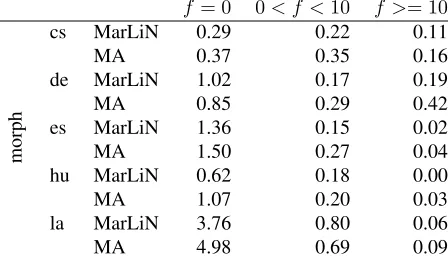
Table 6: Improvement compared to the baseline for dif-ferent frequency ranges of words on OOD
6 Analysis
We now analyze why MarLiN and MA perform bet-ter than the baseline. First we compare the improve-ments in absolute error rate over the baseline by grouping word forms by their training set frequency
f. The number are shown in Table 6. We find that most of the improvement comes from OOV words. Rare words (frequency<10) show a smaller, but still important contribution while the contribution of
fre-morph
cs MarLiN gen0.70 cas 0.41 pos 0.35 MA gen0.85 cas 0.51 pos 0.31 de MarLiN gen1.23 pos 1.14 num 0.62 MA gen1.37 pos 0.63 num0.59 es MarLiN sub 1.49 gen1.21 pos 1.07 MA sub 1.34 gen1.24 pos 1.10 hu MarLiN cas 0.71 sub 0.66 pos 0.52 MA cas 0.88 sub 0.84 pos 0.76 la MarLiN pos 5.19 cas 3.46 gen 3.25 MA pos 4.68 gen3.85 cas 3.01
Table 7: Improvement compared to the baseline for dif-ferent features
quent words can be almost neglected for four lan-guages. The exception is German where frequent words contribute more to the error reduction than rare words. This could be caused by syncretisms such as in plural noun phrases where the gender is not marked in determiner and adjective and can only be derived from the head noun; e.g., the adjectives in schwere Schulf¨acher ‘difficult school subjects’ andverd¨achtige Personen ‘suspect persons’ are un-marked for gender and the correct genders (neuter vs. feminine) cannot be inferred from distributional information or suffixes for the nouns (although gen-der is easy to infer distributionally for singular forms of nouns).
[image:8.612.319.548.224.359.2] [image:8.612.74.298.388.518.2]three features with the highest improvements. Gen-der is also always among the three features with the highest improvements for the four languages that have gender (es, de, la, cs). We just discussed an example for German where gender could not be de-rived from context or inflectional suffixes. Other languages also have word forms that do not mark gender, e.g., Spanish masculineave‘bird’ vs. femi-ninellave‘key’. The gender can, however, easily be derived if the word representation encodes whether a word form has been seen with a specific determiner or adjective on its right or left.
Lastly, we use Jaccard similarity13to compare the
sets of gold and predicted morphological features. Jaccard can be interpreted as a soft variant of ac-curacy: If the two tags are identical it yields 1 and otherwise it corresponds to the number of correctly predicted features divided by the size of the union of gold and predicted features.
morph
cs de es hu la
accuracy 79.41 85.72 95.43 91.14 73.23 Jaccard 89.89 90.71 96.77 93.52 83.68 This table demonstrates that the evaluation measure we have used throughout this paper – a tag counts as completely wrong if a single feature was misidenti-fied even though all others are correct – is conserva-tive. On a feature-by-feature basis accuracy would be much higher. The difference is largest for Czech and Latin.
7 Conclusion
We have presented a test suite for morphological tagging consisting of in-domain (ID) and out-of-domain (OOD) data sets for six languages: Czech, English, German, Hungarian, Latin and Spanish. We converted some of the data sets to obtain a rea-sonably consistent annotation and manually anno-tated the German part of the Smultron treebank. We surveyed four different word representations: SVD-reduced count vectors, LM-based clusters, accumu-lated tag counts and CW embeddings. We found that the LM-based clusters outperformed the other rep-resentations for POS and MORPH tagging, ID and OOD data sets and all languages. We also showed that our implementation of MarLiN (Martin et al., 1998) is an order-of-magnitude more efficient and
13Jaccard(U, V) =|U∩V|/|U∪V|
performs slightly better than the implementation by Liang (2005). We also compared the learned repre-sentations to manually created Morphological Ana-lyzers (MAs). We found that MarLiN outperforms MAs in POS tagging, but that it is substantially worse in morphological tagging. In our analysis of the results, we showed that both MarLiN and MAs decrease the error most for out-of-vocabulary words and for the features POS and gender.
8 Resources
As part of this publication we also release the fol-lowing resources athttp://cistern.cis.lmu. de/marmot/: (i) our implementation of MarLiN as open-source (ii) the morphological layer of the German part of the SMULTRON corpus. For eas-ier reproducibility, we also made (iii) the prepro-cessed Wikipedia dumps and the induced represen-tation dictionaries available. (iv) Morphological dic-tionaries were released to the extent this was com-patible with the usage agreement. (v) We also pub-lished the conversion code for unifying the Spanish and Czech annotations.
Acknowledgments
We would like to thank the anonymous reviewers for their comments. The first author is a recipient of the Google Europe Fellowship in Natural Language Processing, and this research is supported by this Google Fellowship. The annotation of the SMUL-TRON data was supported by Deutsche Forschungs-gemeinschaft (grant DFG 2246/2, Wordgraph).
References
Rami Al-Rfou, Bryan Perozzi, and Steven Skiena. 2013. Polyglot: Distributed word representations for multi-lingual NLP. InProceedings of CoNLL.
Rie Kubota Ando and Tong Zhang. 2005. A high-performance semi-supervised learning method for text chunking. InProceedings of ACL.
Giuseppe Attardi and Antonia Fuschetto. 2013. Wikipedia Extractor. http://medialab.di. unipi.it/wiki/Wikipedia_Extractor. Steven Bird, Ewan Klein, and Edward Loper. 2009.
John Blitzer, Ryan McDonald, and Fernando Pereira. 2006. Domain adaptation with structural correspon-dence learning. InProceedings of EMNLP.
Phil Blunsom and Trevor Cohn. 2011. A hierarchi-cal Pitman-Yor process HMM for unsupervised part of speech induction. InProceedings of ACL-HLT. Alena B¨ohmov´a, Jan Hajiˇc, Eva Hajiˇcov´a, and Barbora
Hladk´a. 2003. The Prague dependency treebank. In Proceedings of Treebanks. Springer.
Sabine Brants, Stefanie Dipper, Silvia Hansen, Wolfgang Lezius, and George Smith. 2002. The TIGER tree-bank. In Proceedings of the workshop on treebanks and linguistic theories.
Peter F. Brown, Peter V. Desouza, Robert L. Mercer, Vin-cent J. Della Pietra, and Jenifer C. Lai. 1992. Class-based n-gram models of natural language. Computa-tional linguistics.
Grzegorz Chrupała, Georgiana Dinu, and Josef Van Gen-abith. 2008. Learning morphology with Morfette. In Proceedings of LREC.
Grzegorz Chrupala. 2011. Efficient induction of prob-abilistic word classes with LDA. In Proceedings of IJCNLP.
Alexander Clark. 2003. Combining distributional and morphological information for part of speech induc-tion. InProceedings of EACL.
Michael Collins. 2002. Discriminative training meth-ods for hidden Markov models: Theory and experi-ments with perceptron algorithms. InProceedings of EMNLP.
Ronan Collobert and Jason Weston. 2008. A unified ar-chitecture for natural language processing: Deep neu-ral networks with multitask learning. InProceedings of ICML.
Tomaˇz Erjavec. 2010. MULTEXT-East version 4: Mul-tilingual morphosyntactic specifications, lexicons and corpora. InProceedings of LREC.
Jes´us Gim´enez and Lluis Marquez. 2004. SVMTool: A general POS tagger generator based on support vector machines. InProceedings of LREC.
Yoav Goldberg and Michael Elhadad. 2013. Word seg-mentation, unknown-word resolution, and morpholog-ical agreement in a Hebrew parsing system. Computa-tional Linguistics.
Nizar Habash and Owen Rambow. 2005. Arabic tok-enization, part-of-speech tagging and morphological disambiguation in one fell swoop. InProceedings of ACL.
Jan Hajiˇc and Barbora Hladk´a. 1998. Tagging inflective languages: Prediction of morphological categories for a rich, structured tagset. InProceedings of Coling. Jan Hajiˇc, Massimiliano Ciaramita, Richard
Johans-son, Daisuke Kawahara, Maria Ant`onia Mart´ı, Llu´ıs
M`arquez, Adam Meyers, Joakim Nivre, Sebastian Pad´o, Jan ˇStˇep´anek, et al. 2009. The CoNLL-2009 shared task: Syntactic and semantic dependencies in multiple languages. InProceedings of CoNLL. Jan Hajiˇc. 2000. Morphological tagging: Data vs.
dictio-naries. InProceedings of NAACL. Jan Hajiˇc. 2001. Czech Free Morphology.
Dag TT Haug and Marius Jøhndal. 2008. Creating a parallel treebank of the old Indo-European bible trans-lations. InProceedings of LaTeCH.
Zhongqiang Huang, Vladimir Eidelman, and Mary Harper. 2009. Improving a simple bigram hmm part-of-speech tagger by latent annotation and self-training. InProceedings of NAACL.
Tibor Kiss and Jan Strunk. 2006. Unsupervised multi-lingual sentence boundary detection. Computational Linguistics.
Terry Koo, Xavier Carreras, and Michael Collins. 2008. Simple semi-supervised dependency parsing. In Pro-ceedings of ACL.
John Lafferty, Andrew McCallum, and Fernando Pereira. 2001. Conditional random fields: Probabilistic mod-els for segmenting and labeling sequence data. In Pro-ceedings of ICML.
Michael Lamar, Yariv Maron, Mark Johnson, and Elie Bienenstock. 2010. SVD and clustering for unsuper-vised POS tagging. InProceedings of ACL.
Percy Liang. 2005. Semi-supervised learning for natu-ral language. Ph.D. thesis, Massachusetts Institute of Technology.
Christopher D. Manning, Mihai Surdeanu, John Bauer, Jenny Finkel, Steven Bethard, and David McClosky. 2014. The Stanford CoreNLP natural language pro-cessing toolkit. In Proceedings of ACL: System Demonstrations.
Montserrat Marimon, Beatriz Fisas, N´uria Bel, Marta Villegas, Jorge Vivaldi, Sergi Torner, Merc`e Lorente, Silvia V´azquez, and Marta Villegas. 2012. The IULA treebank. InProceedings of LREC.
Sven Martin, Jorg Liermann, and Hermann Ney. 1998. Algorithms for bigram and trigram word clustering. Speech communication.
Tomas Mikolov, Kai Chen, Greg Corrado, and Jeffrey Dean. 2013. Efficient estimation of word representa-tions in vector space. InProceedings of ICLR: Work-shop.
Scott Miller, Jethran Guinness, and Alex Zamanian. 2004. Name tagging with word clusters and discrimi-native training. InProceedings of NAACL-HLT. Thomas M¨uller, Helmut Schmid, and Hinrich Sch¨utze.
2013. Efficient higher-order CRFs for morphological tagging. InProceedings of EMNLP.
Kemal Oflazer and `Ilker Kuru¨oz. 1994. Tagging and morphological disambiguation of turkish text. In Pro-ceedings of the Applied natural language processing. Llu´ıs Padr´o and Evgeny Stanilovsky. 2012. Freeling
3.0: Towards wider multilinguality. In Proceedings of LREC.
Slav Petrov and Ryan McDonald. 2012. Overview of the 2012 shared task on parsing the web. InProceedings of SANCL.
Lev Ratinov and Dan Roth. 2009. Design challenges and misconceptions in named entity recognition. In Proceedings of CoNLL.
Adwait Ratnaparkhi. 1996. A maximum entropy model for part-of-speech tagging. InProceedings of EMNLP. Phillip Roelli. 2014. Corpus Corporum. http://
www.mlat.uzh.ch/MLS/.
Helmut Schmid, Arne Fitschen, and Ulrich Heid. 2004. SMOR: A German computational morphology cover-ing derivation, composition and inflection. In Pro-ceedings of LREC.
Hinrich Sch¨utze. 1995. Distributional part-of-speech tagging. InProceedings of EACL.
Djam´e Seddah, Reut Tsarfaty, Sandra K¨ubler, Marie Candito, Jinho Choi, Rich´ard Farkas, Jennifer Fos-ter, Iakes Goenaga, Koldo Gojenola, Yoav Goldberg, et al. 2013. Overview of the SPMRL 2013 shared task: Cross-framework evaluation of parsing morpho-logically rich languages. InSPMRL. Association for Computational Linguistics.
Wolfgang Seeker and Jonas Kuhn. 2013. The effects of syntactic features in automatic prediction of morphol-ogy. InProceedings of EMNLP.
Noah A. Smith, David A. Smith, and Roy W. Tromble. 2005. Context-based morphological disambiguation with random fields. InProceedings of EMNLP. Drahom´ıra ”johanka” Spoustov´a, Jan Hajiˇc, Jan Raab,
and Miroslav Spousta. 2009. Semi-supervised train-ing for the averaged perceptron pos tagger. In Pro-ceedings of EACL.
Uwe Springmann, Dietmar Najock, Hermann Morgen-roth, Helmut Schmid, Annette Gotscharek, and Flo-rian Fink. 2014. OCR of historical printings of Latin texts: problems, prospects, progress. InProceedings of DATeCH.
Zsolt Sz´ant´o and Rich´ard Farkas. 2014. Special tech-niques for constituent parsing of morphologically rich languages. InProceedings of EACL.
Mariona Taul´e, Maria Ant`onia Mart´ı, and Marta Re-casens. 2008. Ancora: Multilevel annotated corpora for Catalan and Spanish. InProceedings of LREC. Kristina Toutanova, Dan Klein, Christopher D. Manning,
and Yoram Singer. 2003. Feature-rich part-of-speech tagging with a cyclic dependency network. In Pro-ceedings of NAACL.
Joseph Turian, Lev Ratinov, and Yoshua Bengio. 2010. Word representations: A simple and general method for semi-supervised learning. InProceedings of ACL. Veronika Vincze, D´ora Szauter, Attila Alm´asi, Gy¨orgy
M´ora, Zolt´an Alexin, and J´anos Csirik. 2010. Hun-garian dependency treebank. InProceedings of LREC. Martin Volk, Anne G¨ohring, Torsten Marek, and Yvonne Samuelsson. 2010. SMULTRON (version 3.0) — The Stockholm MULtilingual parallel TReebank.
Alexander Yeh. 2000. More accurate tests for the statis-tical significance of result differences. InProceedings of COLING.
Deniz Yuret and Ferhan T¨ure. 2006. Learning morpho-logical disambiguation rules for Turkish. In Proceed-ings of NAACL.
Yi Zhang and Rui Wang. 2009. Cross-domain depen-dency parsing using a deep linguistic grammar. In Pro-ceedings of ACL-AFNLP.