Automatic tagging and retrieval of E-Commerce products based on visual
features
Vasu Sharma and Harish Karnick
Dept. Of Computer Science and Engineering Indian Institute of Technology, Kanpur
[email protected] [email protected]
Abstract
This paper proposes an automatic tag assign-ment approach to various e-commerce prod-ucts where tag allotment is done solely based on the visual features in the image. It then builds a tag based product retrieval system upon these allotted tags.
The explosive growth of e-commerce products being sold online has made manual annotation infeasible. Without such tags it’s impossible for customers to be able to find these prod-ucts. Hence a scalable approach catering to such large number of product images and al-locating meaningful tags is essential and could be used to make an efficient tag based product retrieval system.
In this paper we propose one such ap-proach based on feature extraction using Deep Convolutional Neural Networks to learn de-scriptive semantic features from product im-ages. Then we use inverse distance weighted K-nearest neighbours classifiers along with several other multi-label classification ap-proaches to assign appropriate tags to our im-ages. We demonstrate the functioning of our algorithm for the Amazon product dataset for various categories of products like clothing and apparel, electronics, sports equipment etc.
Keywords: Content based image retrieval, Multi-Modal data embeddings and search, Automatic Image Annotation, E-commerce product categorization
1 Introduction
In the present day world of mass internet pene-tration and the advent of the e-commerce era the
number of products being bought and sold online has increased exponentially in the past few years. In 2012, Business to Consumer (B2C) e-commerce sales grew 21.1% to top $1 trillion for the first time1. This is expected to grow steadily at the rate
of around 20% and is estimated to hit $2.5 trillion by 20182.
Given the explosive growth in the number of products being sold online and the relative hetero-geneity in the categories these products could be allotted to, it has become physically impossible and infeasible to manually tag these products. Besides not everyone will tag the same images with the same tags. This leads to discrepancy in the kinds of tags allotted to the products. Search engines looking for products based on customers query heavily rely on these tags allotted to each image to return accurate and meaningful results to customers queries but mainly only the product images are available which is impossible for the search engine to make sense of. Besides the discrepancy in tagging leads to a lot of useful search results to get excluded.
An automatic tagging system can help take care of both of these problems and will be able to build an efficient product database querying system even if the database consists solely of visual information about the products. Such an automated systems will bring about tagging homogeneity so that similar products are tagged with the same tags. This will
1
http://www.emarketer.com/Article/Ecommerce-Sales-Topped-1-Trillion-First-Time-2012/1009649
2
http://www.emarketer.com/Article/Global-B2C- Ecommerce-Sales-Hit-15-Trillion-This-Year-Driven-by-Growth-Emerging-Markets/1010575
also eliminate the need for the laborious process of manually tagging such products.
The e-commerce marketplace is a truly multi-modal space with visual features co-existing with product descriptions and feature specifications. To be truly effective, such a marketplace must allow the user to be able to find products based on it’s visual features as well as product descriptions. This paper proposes an efficient approach to create such a Multi-Modal visual feature based product information retrieval system.
This is achieved in a 2 step process:
1. (Image to Tags) Visual features are extracted from product images and are used to automati-cally annotate these product images with mean-ingful tags.
2. (Tags to Images) Now these tags are used to query a hash table indexed on these tags and used to retrieve all images corresponding to this tag.
The rest of the paper is organized as follows. Re-lated literature is reviewed in Section 2. Section 3 presents our proposed approach along with details of techniques used. Sections 4 presents a detailed description of obtained results for various datasets. Section 5 and 6 present Conclusion and Future Work respectively.
2 Literature Review
The e-commerce boom we have seen in the past few years has created a lot of interest in this particular area of research as such a system which can auto-matically tag product images is of great commercial and economic value. We saw a lot of recent work on this suggesting that this a very active area of re-search and is quickly gaining popularity.
One of the best work in this field is from Zoghbi et al. (2016) who similar to us use visual features to assign textual descriptors to the image and use these descriptors for query based image retrieval. In this paper they use two latent variable models to bridge between textual and visual data: bilingual latent Dirichlet allocation and canonical correlation analysis. They report their results on a self created
image dataset and work only for apparel and do not generalise to other categories.
Another promising work on this problem was done by Mason et al (2013). In this work they use SIFT (Scale Invariant Feature Transform) features Lowe (2004), along with colour features, Gabor filters Fo-gel and Sagi (1989) and bag of HOG (Histogram of Gradient) features Dalal and Triggs (2005) as the visual features. Gibbs sampling is used to sample topic assignments for visual terms in the test image. Then they apply the technique of Latent Dirichlet Allocation (LDA) Blei et al. (2003) to generate prob-able captions for a given set of visual features. Feng et al (2010), proposed a system called MixLDA which tried to automatically generate cap-tions for news images which is similar to our task. Their model works with a bag-of-words represen-tation and treats each article-image-caption tuple as a single document. LDA is then used to infer la-tent topics which generated these documents. It now uses the distribution over these latent topics to es-timate the multimodal word distributions over top-ics for new images which in turn is used to estimate posterior of the topic proportions over visual docu-ments. This is used to annotate the news images. Style Finder Di et al. (2013), is another system which tries to identify visual features present in an image and uses those to build a visual feature vo-cabulary which could then be used for query based product retrieval. They use the women’s coats dataset and extract SIFT, HoG and GIST features from these images and train binary linear SVM’s to detect the presence or absence of each feature. We feel that such an approach would not be able to scale up to a very large number of labels as it tries to train a classifier for each label .
Whittlesearch approach Kovashka et al. (2015) was another interesting work where the authors try to cater to user queries based on relative strengths of visual attributes in a product image. First they learn a ranking function to predict the relative strength of certain visual attributes. This is achieved by cast-ing estimation of such a rankcast-ing function as a large-margin formulation of Joachims Tsochantaridis et al. (2005) with suitable constraints, which could then easily be solved. The users can then query for products which have less or more of a certain at-tribute than a given image and are shown a ranked list of such products based on this ranking function. Based on the user feedback, they update their scor-ing function usscor-ing what they call as the Relative At-tribute Feedback approach.
Several other SVM based approaches on a variety of visual features like SIFT, HoG, SURF etc have also been proposed Rothe et al. (2015), Li (2010), Gangopadhyay (2001), Zeng et al. (2014), Tadse et al. (2014). However we note that none of these ap-proaches attempt to generalize to the classification of all varieties of products and restrict themselves to certain product classes (mainly apparel and cloth-ing). Besides, they do not operate on a multi la-bel setting and hence need one-vs-all type classifiers to detect multiple labels which do not scale up for large number for possible tags. Our approach on the other hand is extremely adaptive and is able to iden-tify tags for multiple categories of products. Besides we directly deal with tag annotation as a multi label problem allowing our approach to scale up to a large number of tag categories.
3 Approach
In this section we elaborate upon the approach we used to build the automatic annotation system and then how we use these tags to build an efficient tag based product retrieval system.
3.1 Dataset
Lack of open availability of a dataset is one of the biggest problems which hinders the development of effective automatic tagging systems for e-commerce products. Most of the data present on the web is highly unstructured and lacks proper labels and hence cant be effectively used. Even when the
la-bels are there, they are extremely noisy and cant be relied upon. In our paper we present the results on the Amazon e-commerce product dataset McAuley et al. (2015b), McAuley et al. (2015a) which con-tains images of various product categories and their meta data which we parse to obtain the tags associ-ated with each image. For this paper we demonstrate our approach for apparels and clothing, electronics and sports equipment categories and show that the approach scales up to large number of tags and per-forms well on a wide category of products. Images of these categories are tagged with a total of 1664, 886 and 2224 possible tags respectively.
3.2 Feature Extraction from Images
Researchers in the computer vision domain have frequently used Scale Invariant Feature Transform (SIFT) vectors, Histogram of Gradients (HoG) vec-tors, SURF vecvec-tors, Gabor filters etc. to extract use-ful features from images. However in our project we use features extracted from higher layers of a very Deep Convolutional Neural Network to serve as our visual features. Here we use the 19 layer deep VGG network Simonyan and Zisserman (2014) and it is trained on the Imagenet dataset first. We then use this trained network on the Imagenet dataset Rus-sakovsky et al. (2015) and use the concept of ’Trans-fer Learning’ Yosinski et al. (2014) to train it on our Amazon product dataset next. We also experi-ment with the VGG-16 and Googlenet networks, but VGG-19 features give us the best performance and hence we use them for our paper. The network struc-ture is presented in Image 1.
It is observed that Deep Convolutional Neural net-works have the ability to learn useful feature repre-sentations by non-linearly projecting the input im-ages into a discriminative subspace where similar images tend to have similar intermediate feature rep-resentations while non-similar images are projected far from each other. This trend is independent of the dataset it is trained on and hence a network trained on Imagenet network too is able to learn useful fea-ture representations for the Amazon product dataset when trained on it. Oquab et al. (2014), Bengio (2012)
Deep CNN models from scratch is computationally very expensive. We use the 4096 Dimensional fea-tures from the last fully connected hidden layer of the VGG net as features to represent a given visual image.
Figure 1: The VGG-19 Network
The conv layers represent convolution layers, Max-pool are Max Pooling layers and FC are Fully con-nected layers
3.3 Automatic tag assignment to images
After having obtained the extracted feature vectors for each images from the Deep CNN’s, our next task to automatically assign all relevant tags to each image. This is essentially a multi label problem which is still a very active area of research till date. We avoid using one-vs-all classifiers like SVM’s etc as such classifiers can’t be scaled up for a very large number of tag categories which we observe in the case of e-commerce products. In this paper we use Weighted K-Nearest Neighbours approach with weights for each neighbour as inverse of the distance of the neighbour from the query point. For each query point we evaluate it’s K nearest neighbours from the training set and evaluate the weighted average of the presence of each particular tag from among these K neighbours. Ultimately, we allot the D tags with the highest weighted average to the query image.
The ’presence score’ of the occurrence of the tag
tiin the query imagexcould be calculated as:
S(ti|x) =PjK=1 Id(x,nji,j)/ PK
j=1dx,nj1
Wheredx,njis the distance between query point and
the jth neighbour, I(i, j) is an indicator variable
which is defined as follows:
I(i, j) =
(
1 ifnjhas tagti
0 Otherwise
This is how we do tag allocation to the various images. K-Nearest Neighbour approach is computa-tionally very efficient and can be scaled up to a very large number of tags without a very large increase in computational complexity.
3.4 Querying product based on tagged visual features
Once we have a fully tagged dataset of product im-ages we can easily store the tags and imim-ages which have been tagged with it in a hash table with the tag as the key. We also store the probability of the pres-ence of this tag in each image. The image list corre-sponding to each tag is then sorted according to this probability score and stored and the value for the en-try with the tag as the key.
Now when the user queries this database looking for products with a certain tagged feature, then the hash table is looked up for that tag and the images corre-sponding to those tags are returned in the order of higher probability score first. This helps us build a lightning fast retrieval system for tagged visual fea-ture based queries for the various e-commerce prod-ucts.
4 Results
4.1 Annotation Results
We present our results on 3 different categories of products i.e. apparel and clothing, electronics and sports equipment. The metrics we use to measure the performance of our method are Precision, Recall andF1-score which are computed over all possible
tag categories. These metric are defined as follows:
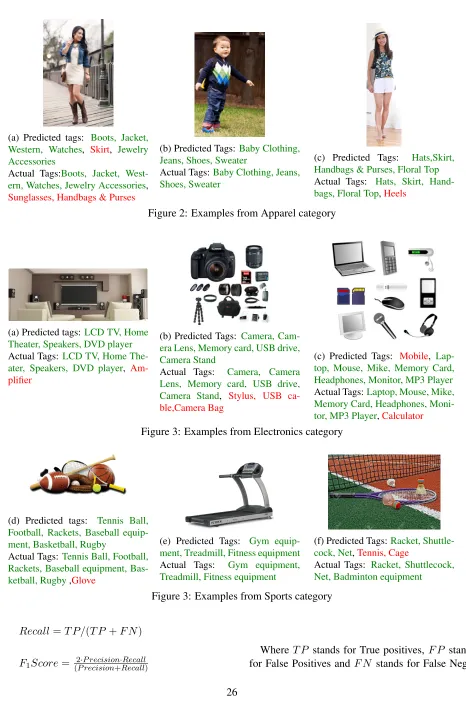
(a) Predicted tags: Boots, Jacket, Western, Watches, Skirt, Jewelry Accessories
Actual Tags:Boots, Jacket, West-ern, Watches, Jewelry Accessories, Sunglasses, Handbags & Purses
(b) Predicted Tags:Baby Clothing, Jeans, Shoes, Sweater
Actual Tags:Baby Clothing, Jeans, Shoes, Sweater
(c) Predicted Tags: Hats,Skirt, Handbags & Purses, Floral Top
Actual Tags: Hats, Skirt, Hand-bags, Floral Top,Heels
Figure 2: Examples from Apparel category
(a) Predicted tags:LCD TV, Home Theater, Speakers, DVD player
Actual Tags: LCD TV, Home
The-ater, Speakers, DVD player,
Am-plifier
(b) Predicted Tags: Camera, Cam-era Lens, Memory card, USB drive, Camera Stand
Actual Tags: Camera, Camera Lens, Memory card, USB drive,
Camera Stand, Stylus, USB
ca-ble,Camera Bag
(c) Predicted Tags: Mobile, Lap-top, Mouse, Mike, Memory Card, Headphones, Monitor, MP3 Player
[image:5.612.64.530.39.748.2]Actual Tags:Laptop, Mouse, Mike, Memory Card, Headphones, Moni-tor, MP3 Player,Calculator
Figure 3: Examples from Electronics category
(d) Predicted tags: Tennis Ball, Football, Rackets, Baseball equip-ment, Basketball, Rugby
Actual Tags:Tennis Ball, Football, Rackets, Baseball equipment, Bas-ketball, Rugby,Glove
(e) Predicted Tags: Gym equip-ment, Treadmill, Fitness equipment
Actual Tags: Gym equipment, Treadmill, Fitness equipment
(f) Predicted Tags:Racket, Shuttle-cock, Net,Tennis, Cage
Actual Tags: Racket, Shuttlecock, Net, Badminton equipment
Figure 3: Examples from Sports category
Recall=T P/(T P +F N)
F1Score= (2P recision·P recision+·RecallRecall)
Nega-tives.
We present our results for 4 different values of K, applying the inverse distance weighed KNN in each case. Our results are shown in Table 1
Product K F1score Precision Recall
Category
1 0.282 0.284 0.283 Apparel and 3 0.343 0.536 0.252
Clothing 5 0.345 0.603 0.242 7 0.340 0.635 0.232 1 0.317 0.317 0.316 Electronics 3 0.396 0.621 0.291
5 0.407 0.706 0.286 7 0.406 0.743 0.280 1 0.251 0.252 0.250 Sports 3 0.329 0.626 0.223
5 0.336 0.765 0.215 7 0.335 0.819 0.210 Table 1: Tag Annotation results
Some sample images and tags allotted to them for each category are shown in images 2, 3, 3. To the best of our knowledge, these results are the best on this given dataset. The tagged images clearly show that the approach works very well and is able to identify tags correctly despite the large amount of noise in the data and the large number of possible tags.
4.2 Retrieval Results
[image:6.612.71.301.132.328.2]Once the Tag annotation was completed we set up the hash table based indexing system with the tags as keys and a list of images relevant to that tag sorted in order of ’presence score’ of occurrence of that tag. We use this to perform our retrieval. We create a list of 1000 tag queries for each category and use this trieval system to obtain the relevant images. The re-trieval accuracy depends on the accuracy of tagging. We note that by retrieval times were blazingly fast with all 1000 queries for each product category. The retrieval times are presented in Table 2. Clearly the time complexity remains more or less constant for each of the categories despite the varying number of labels denoting that the retrieval times are constant with respect to increasing dataset size and number of labels.
Table 2: Performance of the Content Based Image Retrieval System for a list of 1000 query tags
Product Category Retrieval Time(s) Apparel and Clothing 0.083
Electronics 0.095
Sports 0.081
5 Conclusions
In this paper we proposed an Automatic tagging ap-proach for e-commerce products by making use of it’s visual features and using these tags to build an efficient query based product retrieval system. We demonstrated that the system performs extremely well and to the best of our knowledge, it outperforms all other systems for automatic e-commerce prod-uct tagging on this dataset. Besides the approach is highly scalable, catering to a very large number of tags and products and could easily generalize to multiple product categories and performs well on each category.
The retrieval system built on top of this is also ex-tremely fast and is able to obtain meaningful results at lightning fast speeds.
6 Future Work
We plan to extend this work by incorporating bet-ter multi label algorithms which could provide even better performances. We are also exploring alternate feature representation techniques which could pro-vide us with further semantic information. One such representation we plan to explore is to use the activa-tion values from multiple layers of the VGG network as we know that each layer of the network learns a certain kind of distinguishing feature. A combina-tion of such features might provide superlative per-formance over just using the features from a single layer.
References
[Bengio2012] Y. Bengio. 2012. Deep learning of representations for unsupervised and transfer learn-ing. JMLR: Workshop on Unsupervised and Transfer Learning, 27:17–37.
[Dalal and Triggs2005] Navneet Dalal and Bill Triggs. 2005. Histograms of oriented gradients for human de-tection. pages 886–893.
[Di et al.2013] W. Di, C. Wah, A. Bhardwaj, R. Pira-muthu, and N. Sundaresan. 2013. Style finder: Fine-grained clothing style detection and retrieval. pages 8–13.
[Feng and Lapata2010] Y. Feng and M. Lapata. 2010. How many words is a picture worth? automatic cap-tion generacap-tion for news images. Proceedings of the 48th Annual Meeting of the Association for Computa-tional Linguistics, pages 1239–1249.
[Fogel and Sagi1989] I. Fogel and D. Sagi. 1989. Gabor filters as texture discriminator. Biological Cybernet-ics, 61(1).
[Gangopadhyay2001] A. Gangopadhyay. 2001. An image-based system for electronic retailing. Decision Support Systems, 32.
[Kovashka et al.2015] A. Kovashka, D. Parikh, and K. Grauman. 2015. Whittlesearch: Interactive image search with relative attribute feedback. Int. J. Comput. Vision, 115(2):185–210.
[Li2010] Jing Li. 2010. The application of cbir-based system for the product in electronic retailing. IEEE 11th International Conference on Computer-Aided In-dustrial Design Conceptual Design, 2:1327–1330. [Lowe2004] David Lowe. 2004. Distinctive image
fea-tures from scale-invariant keypoints. International Journal of Computer Vision, 60:91–110.
[Mason and Charniak2013] Rebecca Mason and Eugene Charniak. 2013. Annotation of online shopping im-ages without labeled training examples. Proceedings of the NAACL HLT Workshop on Vision and Language (WVL 13), pages 1–9.
[McAuley et al.2015a] J. McAuley, R. Pandey, and J. Leskovec. 2015a. Inferring networks of substi-tutable and complementary products. Knowledge Dis-covery and Data Mining.
[McAuley et al.2015b] J. McAuley, C. Targett, J. Shi, and A. van den Hengel. 2015b. Image-based recommen-dations on styles and substitutes.SIGIR.
[Oquab et al.2014] M. Oquab, L. Bottou, I. Laptev, and J. Sivic. 2014. Learning and transferring mid-level image representations using convolutional neural net-works. Proceedings of the 2014 IEEE Conference on Computer Vision and Pattern Recognition, pages 1717–1724.
[Rothe et al.2015] R. Rothe, M. Ristin, M. Dantone, and L. Van Gool. 2015. Discriminative learning of apparel features. pages 5–9.
[Russakovsky et al.2015] O. Russakovsky, J. Deng, H. Su, J. Krause, S. Satheesh, S. Ma, Z. Huang, A. Karpathy, A. Khosla, M. Bernstein, A. Berg, and
Li Fei-Fei. 2015. Imagenet large scale visual recog-nition challenge. International Journal of Computer Vision (IJCV), 115(3):211–252.
[Simonyan and Zisserman2014] K. Simonyan and A. Zis-serman. 2014. Very deep convolutional networks for large-scale image recognition. CoRR, abs/1409.1556. [Tadse et al.2014] R. Tadse, L. Patil, and C. Chauhan.
2014. Review on content based image retrieval for digital library using text document image. Interna-tional Journal of Computer Science and Mobile Com-puting, 4:211–214.
[Tsochantaridis et al.2005] I. Tsochantaridis, T. Joachims, T. Hofmann, and Y. Altun. 2005. Large margin methods for structured and interde-pendent output variables. J. Mach. Learn. Res., 6:1453–1484.
[Yosinski et al.2014] J. Yosinski, J. Clune, Y. Bengio, and H. Lipson. 2014. How transferable are features in deep neural networks? CoRR, abs/1411.1792. [Zeng et al.2014] K. Zeng, N. Wu, and K. Yen. 2014. A
color boosted local feature extraction method for mo-bile product search. Int. J. on Recent Trends in Engi-neering and Technology, 10.
[Zhan et al.2015] Huijing Zhan, Sheng Li, and A. C. Kot. 2015. Tagging the shoe images by semantic attributes. pages 892–895.