345
Modelling Adaptive Presentations in Human-Robot Interaction using
Behaviour Trees
Nils Axelsson
Division of Speech, Music and Hearing KTH Royal Institute of Technology
Stockholm, Sweden
Gabriel Skantze
Division of Speech, Music and Hearing KTH Royal Institute of Technology
Stockholm, Sweden
Abstract
In dialogue, speakers continuously adapt their speech to accommodate the listener, based on the feedback they receive. In this paper, we explore the modelling of such behaviours in the context of a robot presenting a
paint-ing. A Behaviour Tree is used to organise
the behaviour on different levels, and allow the robot to adapt its behaviour in real-time; the tree organises engagement, joint attention, turn-taking, feedback and incremental speech processing. An initial implementation of the model is presented, and the system is evalu-ated in a user study, where the adaptive robot presenter is compared to a non-adaptive ver-sion. The adaptive version is found to be more engaging by the users, although no effects are found on the retention of the presented mate-rial.
1 Introduction
Speakers in dialogue cannot just assume that their speech is received by the addressee and under-stood as intended. They have to continuously monitor the addressee to verify that the informa-tion is attended to, perceived, understood and ac-cepted (Clark, 1996). By keeping close track of verbal and non-verbal feedback from the ad-dressee, speakers can alter their presentation in or-der to accommodate the listener.
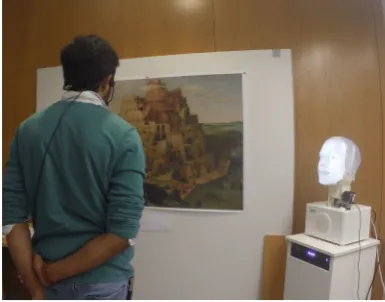
In this paper, we explore how this process can be modelled in spoken human-robot interaction. As a test-bed, we have designed a scenario where a robot is presenting visual information (such as a poster or a piece of art) to a human, as seen in Fig-ure 1. This setting allows us to explore how the presentation can be adapted to the audience’s level of attention, understanding and engagement.
[image:1.595.319.512.223.374.2]Modelling adaptive presentation in a human-robot interaction scenario is non-trivial, as the robot needs to pick up feedback from different
Figure 1: The scenario chosen as a test-bed for the model: a robot presenting a painting to a human.
2 Background
The scenario of a robot presenting information to an audience (one or several people), has been ex-plored in earlier work (Jensen et al.,2005;Szafir and Mutlu, 2012; Ohya et al., 2006). However, these works have not focused on how the presen-tation can be adapted based on verbal and non-verbal feedback. Poster presentations between hu-mans have been studied in order to analyse the gaze and backchannel behaviours of participants and presenters (Kawahara, 2012). Hashimoto et al.(2011) andVerner et al.(2016) have shown that more interactive robot teachers lead to better results in learning. Yousuf et al.(2012) and Eich-ner et al. (2007) show that users prefer present-ing agents that adapt their groundpresent-ing behaviour to their audience.
2.1 Grounding and Adaptation
According to Clark (1996) and Allwood et al. (1992), any coordinated action can be described as an action ladder, with each level requiring the co-operation of speaker and addressee. If the speaker A is presenting to the addressee B, then the levels of the action ladder, bottom-to-top, are attention (B must be paying attention to A’s presentation), hearing(B must hear the words said by A), un-derstanding(B must understand the meaning be-hind the words said by A) andacceptance(B must accept, and optionally be interested in, the concept proposed by A’s presentation).
The addressee can give positive and negative evidence of each level (feedback), to signal com-pleteness to the speaker. If negative evidence is signalled for a level, all levels above it have failed by extension. If positive evidence is signalled for a level, all levels below it have succeeded by ex-tension. Feedback signals like these can then be used by the speaker to adapt the presentation – by explaining some information in more depth or by making the presentation more interesting – and thereby accommodate the listener. This process is referred to asGroundingbyClark(1996). It is not possible to give positive evidence in response to every piece of a conversation, but the important thing is to receive enough evidence to meet the grounding criterion, the requirements for evidence needed depending on how important the speakers deem the content of the presentation to be.
2.2 Behaviour Trees
A Behaviour Tree, or BT, is a tree structure that models a plan, initially proposed byMateas and Stern(2002). Behaviour Trees have been used in video games (Isla, 2005, 2008; Hasegawa et al., 2017) and to model robot behaviours (Hu et al., 2015;Colledanchise et al., 2016). There is pre-vious work applying BTs to virtual agents (Sun et al.,2012;Fujita et al.,2003), but to our knowl-edge, so far they have not been used to model con-versational agents or social behaviour.
The leaves of the tree are the tasks that are exe-cuted. All non-leaves are control flow nodes. Ex-ecution flows from the root down the tree, start-ing when some external processticks the root to start execution. Each node in the tree returns one of three values to its parent; SUCCESS or
FAILUREif the task has finished with either
re-sult, orRUNNINGif it has not finished.
The two most common control flow nodes are SequenceandSelectornodes.Sequencenodes run their children in order from left to right until a
FAILUREorRUNNINGis encountered, at which
point the sequence returns that value. If all child nodes succeed, the sequence returns SUCCESS.
Selectornodes run their children from left to right until aSUCCESSorRUNNINGis encountered,
re-turning that value, orFAILUREif all children fail
(Colledanchise and ¨Ogren,2018).
3 Modelling the presentation
In this paper, we propose a Behaviour Tree to model the complex task of poster presentation while taking grounding and adaptation into ac-count. The tree breaks down this complex task into smaller,independenttasks. As Section4 de-scribes, our initial implementations of these in-dividual tasks are greatly simplified, as many of them are indeed challenging research problems in their own right. However, the decomposition into the behaviour tree allows us to start with sim-pler initial implementations of the individual tasks (some of which can be controlled throughWizard of Oz), and then gradually replace them with more complex models (e.g., through machine learning), without changing the structure of the tree, or the implementation of other tasks.
incremen-⟶ Present poster
? Establish engagement
? Ensure user attention
? Interact with user
⟶ User's initiative
User is
speaking allowed turnUser is user speechProcess Give evidence ofattention, etc.
⟶ Robot's
initiative No one hasinitiative
Robot takes turn
⟶ Execute presentation
⟶ React to
user request joint attention⟶ Ensure Robot is
speaking presentation⟶ Deliver
Speak (from agenda) Attend most
relevant target ? Ensure positivehearing ? Ensure positiveunderstanding acceptance/interest? Ensure positive
?: Selector
⟶: Sequence
? Robot has turn Engage
user User
[image:3.595.74.526.61.276.2]engaged
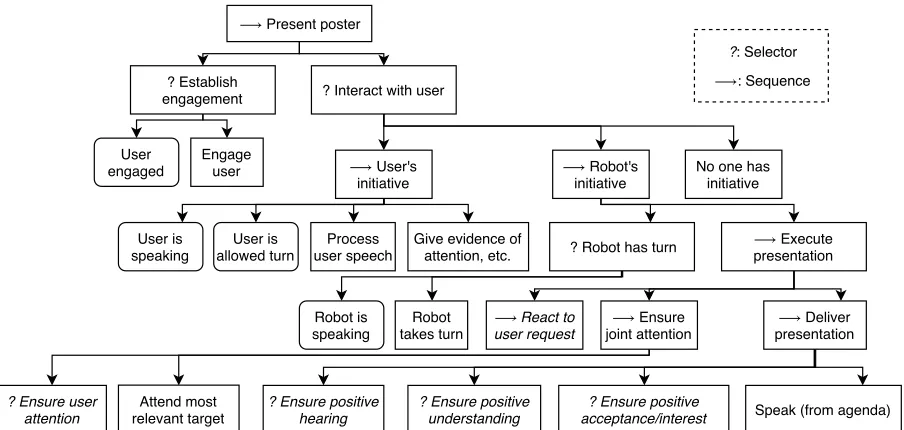
Figure 2: The Behaviour Tree developed as part of this project. Note that the children of any selector or sequence with an italic title are not shown to save room.
tally, in real time (in the vein of Schlangen and Skantze, 2009). Thus, the tree is designed to be executed on the time scale of 10 times per second. The root represents the entire task of presenting a poster. The tree contains both a sub-tree for find-ing and recruitfind-ing participants and presentfind-ing to them, and thus will never return SUCCESS; the
presentation is either going on (RUNNING) or
im-possible (FAILURE). The deeper levels of the tree
are discussed, top-to-bottom and left-to-right, be-low.
Dynamic information is not kept in the static tree; instead, it depends on external modules to keep track the joint action ladder (a knowledge manager), and where the agent is in its presenta-tion (anagenda). These components are not dis-cussed here, as they are less general than the tree.
The system needs to find a user to whom to present, which happens in theEstablish engage-mentsub-tree at the top of the tree. After this tree has succeeded at inviting or engaging a user into the presentation, which can be a more or less com-plicated task (Bohus and Horvitz,2009,2014), the system presents its presentation through its inter-act with usersub-tree.
This sub-tree handles turn-taking by offering the turn to the addressee if appropriate, which can be done in multiple ways (Meena et al., 2014; Str¨om and Seneff, 2000). As the tree runs at its rate of 10 Hz, the user’s utterance is processed in-crementally, and the system can deploy
backchan-nels and gaze cues in response (Morency et al., 2008).
If the user does not have the turn, the robot either has or takes the turn through its Robot’s initiativesub-tree, and executes the presentation. Firstly, joint attention is ensured or grabbed (see Yu et al.(2015)) if lost, this can be sensed in mul-tiple ways (Ba and Odobez,2009;Sheikhi,2014; Szafir and Mutlu,2012).
If the system has the user’s attention, it en-sures hearing, understanding, and acceptance, in order, according to the respective grounding cri-teria. As these sub-trees have had their chance to change the presentation agenda to address neg-ative evidence of hearing, understanding and ac-ceptance (see (Vaufreydaz et al., 2016; Aly and Tapus, 2015; Sidner et al., 2006; Skantze et al., 2014) for examples on how to measure these), the system thenspeaks from the agenda, driving the presentation forward. Only if the tree reaches this leaf without any previous leaf returningRUNNING
does the system speak, resulting in incremental, adaptive speech synthesis in the vein of Skantze and Hjalmarsson(2010);Buschmeier et al.(2012); Kopp et al.(2014).
4 Implementation
2012). TheFurhatrobot head (shown in Figure1) served as the robot platform (Al Moubayed et al., 2012).
Theagendaof the implemented system tracked entire lines of the presentation’s script. To adapt the presentation, evidence of understanding was thus tracked on a line-by-line basis, and the sys-tem could explain a line for which understanding had not been shown, by finding other lines that ex-plained the misunderstood line.
The system modelled attention by treating users as attentive if they were looking at the system or the poster, using their head pose (estimated via Kinect) as a proxy of gaze direction. Upon inat-tention, the system would restart its current utter-ance, similar to the stop-and-restart method em-ployed byYousuf et al. (2012). AWizard of Oz setup was used to tag positive and negative evi-dence of hearing, attention and acceptance.
5 Experiment
To evaluate the system and tree, we set up an experiment where the system described in Sec-tion 4 had two modes: in the adaptive mode, the system fully used its adaptive behaviour. In the non-adaptive mode, the system always as-sumed positive feedback on all four levels of the joint action ladder. The non-adaptive system also never yielded the turn to the user. The non-adaptive mode presented the same surface-level minute presentation every time, so a five-minute time limit was also set for the adaptive mode, which would end its presentation after that time. The agent’s gaze behaviour was the same in both modes, shifting between the participant’s head and the poster.
We used a within-subject experimental design, where each subject interacted with the two ver-sions of the system. Two posters with 16th-century paintings were created: Gentile Bellini’s Miracle of the Cross fallen into the channel of Saint Lawrence (Croce, for short), and Great Tower of Babel, by Pieter Bruegel the Elder. The orders of the two paintings and modes were both counterbalanced between subjects.
30 subjects participated in the experiment, 16
male and 14 female. A majority of participants
were undergraduate university students. Partici-pants were not told about the differences between the adaptive and non-adaptive modes, other than that only the adaptive mode could answer
ques-tions. Participants were otherwise encouraged to give active feedback to the agent regardless of condition (even though the non-adaptive version would actually ignore this feedback).
Conditions were evaluated immediately follow-ing the end of the respective presentation. Firstly, in order to evaluate retention of the information presented, participants were given an electronic form where they answered questions about the presentation and painting. Secondly, they were asked to fill in adapted versions of theGodspeed questionnaire by Bartneck et al. (2009), and the Networked Minds social presence questionnaire by Biocca and Harms (2011). Participants were rewarded with a cinema ticket.
6 Results
The results of 2 participants had to be excluded
due to technical problems during the experiment, yielding28 data points (16 male, 12 female), of
which14indicated that they had previous
experi-ence with a social robot, two indicated that they had seen theCrocepainting before, and eight in-dicated they had seen theBabelpainting before.
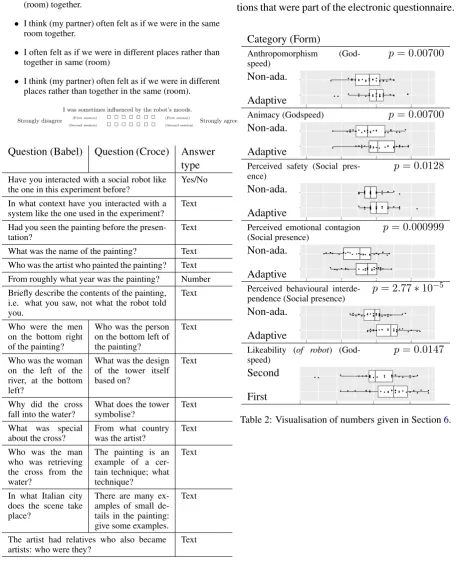
The Wilcoxon paired signed-rank test (Wilcoxon, 1945) was used to compare the answers given in the Social Presence and God-speed forms. The questions were grouped by categories in each test, and the answers to them were averaged. This compensated for the large number of questions.
Five out of ten categories (anthropomorphism (p = .0342, δ = 0.4 ± 0.4), animacy (p =
.00770, δ = 0.63±0.46),perceived safety(p =
.0128, δ= 0.58±0.42),perceived emotional
con-tagion (p = .000999, δ = 0.47 ± 0.22),
per-ceived behavioural interdependence (p = 2.77∗ 10−5, δ = 0.96 ± 0.29)) show statistically sig-nificant differences between the adaptive and non-adaptive modes, with the non-adaptive scoring higher. One additional category, likeability of the robot, shows a statistically significant difference (p =
.0148, δ = 0.70±0.60) between the first and the
second presentation given to participants, the first scoring higher. No statistically significant differ-ences were found between the two paintings.
ques-tions that were possible to answer based on the presentation the user received. The answers in the Babelquestionnaire (M = 6.938, Mdn = 7.542,
SD = 1.989) were found to have a statistically
significantly (p = .04235) different distribution
than those in theCrocequestionnaire (M= 6.270,
Mdn = 6.758, SD = 1.771), but no statistically
significant differences were found when compar-ing the adaptive mode and the non-adaptive mode (p = .449), or the first and second presentation
participants received (p=.990).
7 Discussion
The results from the Social presence and God-speed questionnaires showed that the adaptive ver-sion was perceived to have a higher Animacy, Anthropomorphism, Safety, Emotional contagion, and Behavioural interdependence. These are all aspects that relate to higher interactivity, and are all associated with positive values, which indicates that an interactive presenter that takes the user’s attention and understanding into account is indeed perceived to be more engaging. When asking the subjects about the difference between the two ver-sions after the experiment, they typically had a hard time identifying the exact difference in terms of interactivity. This is interesting, as it indicates that they were not aware of the specific reason for why they preferred the adaptive version. The gaze behaviour of the robot, which followed users around even in the otherwise non-adaptive mode, may have led to the perception that the system was paying attention to the user even in this mode.
There was a somewhat unexpected difference between the first and second presentation, where the former had a somewhat higher Likeability of the robot, regardless of painting and mode. One potential explanation for this is that users were aware of the format of the evaluation the second time, and might have been more stressed about it.
However, no statistically significant differences were found in the user’s retention of the two pre-sentations. There was a large variation in how much the individual subjects remembered from each presentation. Certain participants remem-bered almost nothing of either presentation. Oth-ers were able to quote the robot on every question in both the adaptive and non-adaptive modes. This introduces noise and makes the comparison hard to perform, given the relatively small number of participants.
7.1 Future work
Although the agent developed in our initial im-plementation does adapt its presentation based on feedback from the user, this adaptation was mostly done on a semantic level (i.e., updating its agenda). In future studies, we will explore how the system could also adapt factors like turn length, speech rate, the frequency with which the agent would require evidence of understanding, and what the system would consider as evidence of understanding.
Classifying negative and positive evidence based on multi-modal signals is indeed a very challenging task, as these cues could be very sub-tle (e.g., facial expressions of boredom or interest). In this experiment, this classification was done by a humanWizard of Oz. The data collected through this experiment could potentially be used to train specific models for this, as they have already been partially annotated by the Wizard.
A natural extension of the model is to also allow several users to take part in the presentation. This would give rise to new challenges when it comes to determining who should be considered to be en-gaged in the presentation, and how to adapt the presentation, since the different users in the au-dience might show evidence of understanding to various degrees. Also, if a new user appears in the middle of the presentation, it is not clear how to proceed with the agenda.
8 Conclusions
This paper presents a first step towards a system that uses Behaviour Trees to create an adaptive presentation agent. Initial results show that users find a system that attempts to adapt its presen-tation to their reception of the presenpresen-tation more positive along several dimensions. Our initial implementation of the proposed Behaviour Tree model is a promising first step towards a complex adaptive behaviour model for conversational in-teraction, where the complex task of making an adaptive presentation has been decomposed into smaller tasks, which can gradually be replaced by more and more sophisticated models.
Acknowledgements
References
Samer Al Moubayed, Jonas Beskow, Gabriel Skantze,
and Bj¨orn Granstr¨om. 2012. Furhat: a
back-projected human-like robot head for multiparty
human-machine interaction. In Cognitive
be-havioural systems, pages 114–130. Springer.
Jens Allwood, Joakim Nivre, and Elisabeth Ahls´en. 1992. On the semantics and pragmatics of linguistic
feedback.Journal of semantics, 9(1):1–26.
Amir Aly and Adriana Tapus. 2015. An online fuzzy-based approach for human emotions detection: An overview on the human cognitive model of
under-standing and generating multimodal actions. In
In-telligent Assistive Robots.
Sileye O Ba and Jean-Marc Odobez. 2009. Recogniz-ing visual focus of attention from head pose in
nat-ural meetings.IEEE Transactions on Systems, Man,
and Cybernetics, Part B (Cybernetics), 39(1):16–33.
Christoph Bartneck, Dana Kuli´c, Elizabeth Croft, and
Susana Zoghbi. 2009. Measurement instruments
for the anthropomorphism, animacy, likeability, per-ceived intelligence, and perper-ceived safety of robots.
International journal of social robotics, 1(1):71–81.
F Biocca and C Harms. 2011. Networked minds social
presence inventory (scales only version 1.2). East
Lansing: MIND Labs, Michigan State University. Retrieved from http://cogprints. org/6742.
Dan Bohus and Eric Horvitz. 2009. Learning to predict engagement with a spoken dialog system in
open-world settings. InProceedings of the SIGDIAL 2009
Conference: The 10th Annual Meeting of the Special Interest Group on Discourse and Dialogue, pages 244–252. Association for Computational Linguis-tics.
Dan Bohus and Eric Horvitz. 2014. Managing human-robot engagement with forecasts and... um...
hesita-tions. InProceedings of the 16th international
con-ference on multimodal interaction, pages 2–9. ACM.
Dan Bohus and Alexander I. Rudnicky. 2009. The
RavenClaw dialog management framework: Archi-tecture and systems.Computer Speech & Language, 23(3):332 – 361.
Johan Boye. 2007. Dialogue management for
au-tomatic troubleshooting and other problem-solving
applications. InProc. of 8th SIGdial Workshop on
Discourse and Dialogue, pages 247–255. Citeseer.
Hendrik Buschmeier, Timo Baumann, Benjamin
Dosch, Stefan Kopp, and David Schlangen. 2012. Combining incremental language generation and in-cremental speech synthesis for adaptive information
presentation. In Proceedings of the 13th Annual
Meeting of the Special Interest Group on Discourse and Dialogue, pages 295–303. Association for Com-putational Linguistics.
Herbert H. Clark. 1996. Using language. Cambridge
University Press, Cambridge, UK.
M. Colledanchise and P. ¨Ogren. 2018. Behavior Trees
in Robotics and Al: An Introduction. Chapman & Hall/CRC artificial intelligence and robotics series. Taylor & Francis Limited.
Michele Colledanchise, Alejandro Marzinotto,
Di-mos V Dimarogonas, and Petter ¨Ogren. 2016. The
advantages of using behavior trees in multi-robot
systems. InProceedings of ISR 2016: 47st
Inter-national Symposium on Robotics, pages 1–8. VDE.
Tobias Eichner, Helmut Prendinger, Elisabeth Andr´e, and Mitsuru Ishizuka. 2007. Attentive presentation
agents. In International Workshop on Intelligent
Virtual Agents, pages 283–295. Springer.
Masahiro Fujita, Yoshihiro Kuroki, Tatsuzo Ishida, and Toshi T Doi. 2003. Autonomous behavior control architecture of entertainment humanoid robot
sdr-4x. In Proceedings 2003 IEEE/RSJ International
Conference on Intelligent Robots and Systems (IROS 2003)(Cat. No. 03CH37453), volume 1, pages 960– 967. IEEE.
Isamu Hasegawa, Tomohiro Hasegawa, Kazutaka Kurosaka, Akihiko Kishi, Akira Iwasawa, and
Youichiro Miyake. 2017. How to build a fantasy
world based on reality: A case study of final fantasy xv: Part ii. InSIGGRAPH Asia 2017 Courses, SA ’17, pages 7:1–7:149, New York, NY, USA. ACM.
Takuya Hashimoto, Naoki Kato, and Hiroshi
Kobayashi. 2011. Development of educational
system with the android robot saya and evaluation.
International Journal of Advanced Robotic Systems, 8(3):28.
Danying Hu, Yuanzheng Gong, Blake Hannaford, and
Eric J Seibel. 2015. Semi-autonomous simulated
brain tumor ablation with ravenii surgical robot
us-ing behavior tree. In2015 IEEE International
Con-ference on Robotics and Automation (ICRA), pages 3868–3875. IEEE.
Dami´an Isla. 2005. Handling complexity in the Halo 2 AI. Proceedings of the Game Developers’ Confer-ence.
Dami´an Isla. 2008. Building a better battle. InGame
Developers Conference, San Francisco, volume 32.
Bj¨orn Jensen, Nicola Tomatis, Laetitia Mayor, Andrzej Drygajlo, and Roland Siegwart. 2005. Robots meet
humans-interaction in public spaces. IEEE
Transac-tions on Industrial Electronics, 52(6):1530–1546.
Tatsuya Kawahara. 2012. Multi-modal sensing and
analysis of poster conversations toward smart
poster-board. InProceedings of the 13th Annual Meeting
Stefan Kopp, Herwin van Welbergen, Ramin Yaghoubzadeh, and Hendrik Buschmeier. 2014.
An architecture for fluid real-time conversational agents: integrating incremental output generation and input processing. Journal on Multimodal User Interfaces, 8(1):97–108.
Michael Mateas and Andrew Stern. 2002. A behavior
language for story-based believable agents. IEEE
Intelligent Systems, 17(4):39–47.
Raveesh Meena, Gabriel Skantze, and Joakim
Gustafson. 2014. Data-driven models for timing
feedback responses in a map task dialogue system.
Computer Speech & Language, 28(4):903–922.
Louis-Philippe Morency, Iwan de Kok, and Jonathan Gratch. 2008. Predicting listener backchannels: A
probabilistic multimodal approach. InInternational
Workshop on Intelligent Virtual Agents, pages 176– 190. Springer.
Taku Ohya, Tatsuya Hiramatsu, Yong Xu, Yasuyuki Sumi, and Toyoaki Nishida. 2006. Towards robot
as an embodied knowledge medium. Inthe 5th
in-ternational workshop of social intelligence design (SID2006).
David Schlangen and Gabriel Skantze. 2009. A gen-eral, abstract model of incremental dialogue
pro-cessing. InProceedings of the 12th Conference of
the European Chapter of the Association for Com-putational Linguistics, pages 710–718. Association for Computational Linguistics.
Samira Sheikhi. 2014. Inferring visual attention and
addressee in human robot interaction. Technical
report, ´Ecole Polytechnique F´ed´erale de Lausanne
(EPFL).
C Sidner, C Lee, L-P. Morency, and C ForLines. 2006. The effect of head-nod recognition in human-robot
conversation. InProceedings of the 1st Annual
Con-ference on HumanRobot Interaction, pages 290– 296. ACM Press.
Gabriel Skantze and Samer Al Moubayed. 2012. IrisTK: a statechart-based toolkit for multi-party
face-to-face interaction. InProceedings of the 14th
ACM international conference on Multimodal inter-action, pages 69–76. ACM.
Gabriel Skantze and Anna Hjalmarsson. 2010.
To-wards incremental speech generation in dialogue
systems. InProceedings of the 11th Annual
Meet-ing of the Special Interest Group on Discourse and Dialogue, pages 1–8. Association for Computational Linguistics.
Gabriel Skantze, Anna Hjalmarsson, and Catharine
Oertel. 2014. Turn-taking, feedback and joint
at-tention in situated human-robot interaction. Speech Communication, 65:50–66.
Ronnie W Smith and D Richard Hipp. 1994. Spoken
natural language dialog systems: A practical ap-proach. Oxford University Press on Demand.
Nikko Str¨om and Stephanie Seneff. 2000. Intelligent
barge-in in conversational systems. InSixth
Interna-tional Conference on Spoken Language Processing.
Libo Sun, Alexander Shoulson, Pengfei Huang, Nicole Nelson, Wenhu Qin, Ani Nenkova, and Norman I Badler. 2012. Animating synthetic dyadic conver-sations with variations based on context and agent
attributes. Computer Animation and Virtual Worlds,
23(1):17–32.
Daniel Szafir and Bilge Mutlu. 2012. Pay attention!: designing adaptive agents that monitor and improve
user engagement. In Proceedings of the SIGCHI
conference on human factors in computing systems, pages 11–20. ACM.
Dominique Vaufreydaz, Wafa Johal, and Claudine
Combe. 2016. Starting engagement detection
to-wards a companion robot using multimodal features.
Robotics and Autonomous Systems, 75:4 – 16. As-sistance and Service Robotics in a Human Environ-ment.
Igor M Verner, Alex Polishuk, and Niv Krayner. 2016.
Science class with robothespian: using a robot
teacher to make science fun and engage students.
IEEE Robotics & Automation Magazine, 23(2):74– 80.
Frank Wilcoxon. 1945. Individual comparisons by
ranking methods.Biometrics bulletin, 1(6):80–83.
Mohammad Abu Yousuf, Yoshinori Kobayashi, Yoshi-nori Kuno, Akiko Yamazaki, and Keiichi Yamazaki.
2012. Development of a mobile museum guide
robot that can configure spatial formation with
vis-itors. In Intelligent Computing Technology, pages
423–432, Berlin, Heidelberg. Springer Berlin Hei-delberg.
A Appendices
The Godspeed forms included the questions as found at http://www.bartneck.de/2008/03/11/the-godspeed-questionnaire-series/. The Social Pres-ence forms includes the questions as referPres-enced (Biocca and Harms,2011), but the following ques-tions were removed:
• I often felt as if (my partner) and I were in the same (room) together.
• I think (my partner) often felt as if we were in the same room together.
• I often felt as if we were in different places rather than together in same (room)
• I think (my partner) often felt as if we were in different places rather than together in the same (room).
Question (Babel) Question (Croce) Answer type
Have you interacted with a social robot like the one in this experiment before?
Yes/No
In what context have you interacted with a system like the one used in the experiment?
Text
Had you seen the painting before the presen-tation?
Text
What was the name of the painting? Text
Who was the artist who painted the painting? Text
From roughly what year was the painting? Number
Briefly describe the contents of the painting, i.e. what you saw, not what the robot told you.
Text
Who were the men on the bottom right of the painting?
Who was the person on the bottom left of the painting?
Text
Who was the woman on the left of the river, at the bottom left?
What was the design of the tower itself based on?
Text
Why did the cross fall into the water?
What does the tower symbolise?
Text
What was special about the cross?
From what country was the artist?
Text
Who was the man who was retrieving the cross from the water?
The painting is an example of a cer-tain technique; what technique?
Text
In what Italian city does the scene take place?
There are many ex-amples of small de-tails in the painting: give some examples.
Text
The artist had relatives who also became artists: who were they?
[image:8.595.70.527.185.748.2]Text
Table 1: The questions that measured retention.
An example Social Presence question is shown above Table 1. Godspeed questions were pre-sented identically (with the same seven-point scale), but the ends of the scale were instead the two adjectives or adjective phrases connected to the specific Godspeed question.
The full questionnaires can not be presented here because of space issues. Table1on the bot-tom of this page shows the retention-based ques-tions that were part of the electronic questionnaire.
Category (Form)
Anthropomorphism (God-speed)
p= 0.00700
Non-ada. ● ● ● ● ● ● ● ● ● ● ● ● ● ● ● ● ● ● ● ● ● ● ● ● ●● ● ● ● ● ● ● ● ●● ● ● ● ● ● ● ● ● ●● ● ● ● ● ● ● ●● ● ● ● e e
0 2 4 6
Adaptive
Animacy (Godspeed) p= 0.00700
Non-ada. ● ● ● ● ●● ● ● ● ● ● ●● ● ● ● ● ● ● ● ● ● ● ● ● ● ● ● ● ● ● ● ●● ● ● ● ● ● ● ● ● ● ● ● ● ● ● ● ● ● ●● ● ● ● e e
0 2 4 6
Adaptive
Perceived safety (Social pres-ence)
p= 0.0128
Non-ada. ● ● ● ● ● ● ● ● ● ● ● ● ● ● ● ● ● ● ● ● ● ● ● ● ● ● ● ● ● ● ● ● ● ● ● ● ● ● ● ● ●● ● ● ● ● ● ● ●● ● ● ● ● ● ● e e
0 2 4 6
Adaptive
Perceived emotional contagion (Social presence)
p= 0.000999
Non-ada. ● ● ● ●●● ● ● ● ● ● ● ● ● ● ●●● ●● ● ● ● ● ● ●● ● ● ● ● ● ●● ●● ● ● ●● ● ● ● ● ● ● ● ● ● ● ● ● ● ●●● e e
0 2 4 6
Adaptive
Perceived behavioural interde-pendence (Social presence)
p= 2.77∗10−5
Non-ada. ● ● ● ● ● ● ● ● ● ● ● ●● ● ● ●● ● ● ● ●● ● ● ● ● ●● ● ● ● ●● ● ● ● ● ● ● ● ● ● ● ●● ● ● ● ● ● ● ● ● ● ● ● e e
0 2 4 6
Adaptive
Likeability (of robot) (God-speed)
p= 0.0147
Second ● ● ● ● ● ● ● ● ● ● ● ● ● ● ● ● ● ● ● ● ● ● ● ● ● ● ● ● ● ● ● ● ● ● ● ● ● ● ● ●● ● ●● ● ● ● ● ● ● ● ● ● ● ● ●
0 2 4 6
First
[image:8.595.292.521.219.591.2]