Original Article
Establishment of reference interval for immature
platelet fraction using Sysmex XN9000 hematology
analyzer in Anhui province in China
Baixia Yang, Yindi Zhou, Shoufu Ding, Helin Zha, Fan Zhang, Wentao He, Yuanhong Xu
Department of Clinical Laboratory, The First Affiliated Hospital of Anhui Medical University, Hefei, China
Received November 9, 2016; Accepted January 21, 2017; Epub February 15, 2017; Published February 28, 2017
Abstract: The aim of this study was to establish reference intervals for immature platelet fraction (IPF) for healthy adults and term newborns in the area of Anhui province. Except outliers, a total of 2179 health adult examination subjects and 153 healthy term newborns were included in this study. The percentage (IPF%) and absolute value (IPF#) of IPF in adult peripheral blood and neonatal umbilical cord blood were measured using the Sysmex XN9000 fully automatic hematology analyzer. The reference intervals were calculated by non-parametric percentile method according to the Clinical and Laboratory Standard Institute guideline C28-A3. Our results showed that, for adults, no significant differences were found between males and females, while significant difference existed between different age groups for IPF% and IPF#. A significant difference also existed between adults and term newborns for all test parameters. The reference intervals of IPF% and IPF# for adults and term newborns were 0.7-8.4% and 2.9-16.9×10⁹/L, 0.9-4.8% and 3.1-13.5×10⁹/L, respectively. The reference intervals determined by the Sysmex
XN9000 hematology analyzer for healthy adults and term newborns in the area of Anhui province would be useful for future clinical diagnosis as well as treatment.
Keywords: Reticulated platelet, reference interval, immature platelet fraction
Introduction
Reticulated platelet (RP) refers to the platelet that is newly released from the bone marrow, usually with higher coagulation activity [1]. RP can reflect the production of platelets by mega-karyocytes in bone marrow. Therefore, it can help distinguish bone marrow failure from peripheral destruction in thrombocytopenia and can early predict bone marrow recovery after chemotherapy and transplantation; How- ever, RP determination is lack of standardiza-tion of methodology [2]. With the progress of detection technology, researchers have found that there was a good correlation between immature plateletfraction (IPF) and RP in thro- mbocytopenia, and IPF can be measured sim-ply and reliably on fully automated hematology analyzers, facilitating its clinical utility for diag-nosing and monitoring thrombocytopenia [2, 3]. During the clinical practice, IPF is often mea-sured by Sysmex hematology analyzers, such
Reference interval for IPF determined by hematology analyzer
enable us to establish new normal references for IPF in this area and then play an important role in clinical diagnosis and treatment.
Materials and methods
Study participants
A total of 2202 health examination subjects who visited the First Affiliated Hospital of Anhui Medical University between March 2nd 2016 and April 3rd 2016 were included in this study. Participants met the following inclusion criteria were selected: a) in the physical examination, no significant abnormality was seen on internal examination, surgical examination, ECG, X-ray chest examination or B-ultrasonography exa- mination, b) in the chemical test, individuals with white blood cell (WBC) <10×109/L, Hb >120 g/L for male and >110 g/L for female, PLT >125×109/L, without significant infectious symptoms or anemia. The exclusion criteria were: a) fasting blood level >6.11 mmol/L, TG level >1.7 mmol/L, cholesterol level >5.98 mmol/L, aspartate amino transferase level >40 U/L, alanine amino transferase level >50 u/L, creatinine >106 umol/L, urea >7.1 mmol/L, uric acid (female) >357 umol/L, uric acid (male) >428 umo/L, or the upper limit of urine red blood cells in female >10/HP.
Additionally, umbilical cord blood samples were collected from 158 healthy term newborns in our hospital between April 2015 and March 2016. Their median gestational week was 39.4
weeks (37.3-41.8 weeks), average birth weight was 3258 g (2502-4036 g). Their mothers were void of infectious disease, hereditary disease or hematologic disease, with a median age of 29 years (19-48 years).
This study was performed in accordance with the Declaration of Helsinki and was approved by the Ethical Committee of the First Affiliated Hospital of Anhui Medical University. Written informed consent was obtained from all recipi-ents or their legal guardians.
Collection and measurement of blood samples
EDTA-K2 anticoagulant peripheral blood sam-ples and cord blood samsam-ples were respectively collected from health examination subjects and term newborns (2 ml each subject). Mea- surement was completed within a two hour timeframe after collection using the Sysmex XN9000 fully-automatic hematology analyzer (Sysmex, Kobe, Japan). Blood samples were analyzed according to the method previously reported to ensure that results of all parame-ters were available [7].
Statistical analysis
[image:2.612.96.521.73.243.2]ously [8]. The distribution of platelet counts and IPF was examined for normality by the Kol- mogorov-Smirnov Z-test. The reference inter-vals for IPF% and IPF# were calculated by a non-parametric percentile method (2.5th and 97.5th percentiles), according to the Clinical and Laboratory Standard Institute guideline C28-A3. Comparison of test parameters bet- ween male and female, adults and newborns, as well as different age groups, were performed using non-parametric Mann-Whitney U test or Kruskal-Wallis H test. P value less than 0.05 was considered statistically significant.
Results
Distribution analysis of immature platelet frac-tion in healthy adult and newborns
From a total of 2202 adult peripheral blood and 158 neonatal umbilical cord blood samples, 23 peripheral blood and 5 umbilical cord blood were considered as outliers and excluded. The remained 2179 adult peripheral blood and 153
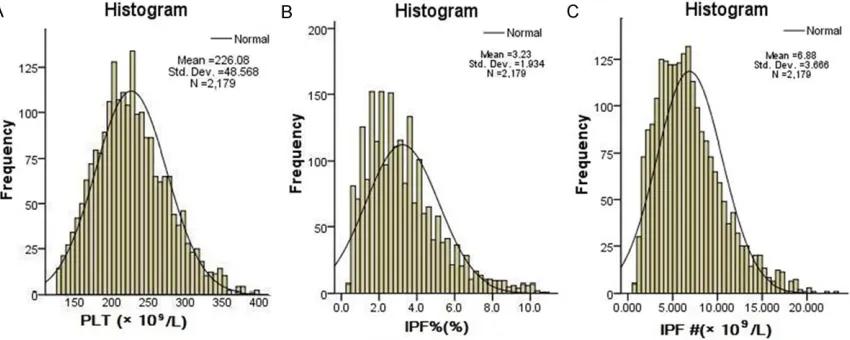
adults, the median values (min-max range) for platelet counts, IPF% and IPF# were 222×109/L (125-397×109/L), 2.9% (0.4%-10.8%) and 6.3× 10⁹/L (0.8-23.0×10⁹/L), respectively (Figure 1). As for newborns, the median values (min-max range) for platelet counts, IPF% and IPF# were 292×109/L (182-412×109/L), 2.2% (0.6%-5.2%) and 6.4×10⁹/L (1.8-15.5×10⁹/L), respec-tively (Figure 2).
Distribution of immature platelet fraction in healthy adults at different age groups
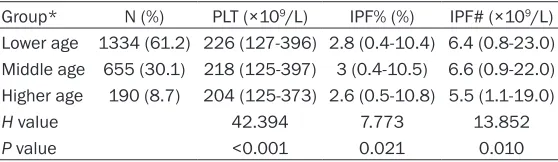
[image:3.612.95.519.73.238.2]The data reflected askewed distribution and expressed as median (min-max range). The comparison of test parameters between differ-ent age groups was performed by the non-para-metric rank sum Kruskal-Wallis H test. We stratify the healthy adults into three groups according to age: the lower (<40 years old), middle(40-60 years old) and higher age group (>60 years old). In the lower age group, the median values for platelet counts, IPF% and IPF# were 226×109/L (127-396×109/L), 2.8% Figure 2. Histograms of PLT, IPF% and IPF# in healthy term newborns. The result demonstrated that the count of PLT, the absolute values (IPF#) and percentages (IPF%) of IPF for the cord blood reflected a skewed distribution (P<0.001).
Table 1. Parameters in different age groups in healthy adults
Group* N (%) PLT (×109/L) IPF% (%) IPF# (×109/L)
Lower age 1334 (61.2) 226 (127-396) 2.8 (0.4-10.4) 6.4 (0.8-23.0) Middle age 655 (30.1) 218 (125-397) 3 (0.4-10.5) 6.6 (0.9-22.0) Higher age 190 (8.7) 204 (125-373) 2.6 (0.5-10.8) 5.5 (1.1-19.0)
H value 42.394 7.773 13.852
P value <0.001 0.021 0.010
*Note: lower age group: <40 years; middle age group: 40-60 years; higher age group: >60 years.
[image:3.612.92.371.313.394.2]Reference interval for IPF determined by hematology analyzer
(0.4%-10.4%) and 6.4×10⁹/L (0.8-23.0×10⁹/L), respectively. In the middle age group, the medi-an values for platelet counts, IPF% medi-and IPF# were 218×109/L (125-397×109/L), 3.0% (0.4%-10.5%) and 6.6×10⁹/L (0.9-22.0×10⁹/L), res- pectively. In the higher age group,the median values for platelet counts, IPF% and IPF# we- re 204×109/L (127-396×109/L), 2.6% (0.5%-10.8%) and 5.5×10⁹/L (1.1-19.0×10⁹/L), respe- ctively. The platelet count gradually decline with ageincreased. The middle age group had largest value of IPF% and IPF#, both decreased obviously in the higher age group (Table 1).
Distribution of immature platelet fraction in healthy adults and term newborn
The data between different genders reflected a skewed distribution, as a result the data were also expressed as median (min-max range). The comparisons between male and female, as well as adults and newborns, were performed using the non-parametric Mann-Whitney U test, as shown in Table 2. In the man group, the median values for platelet counts, IPF% and IPF# were 221×109/L (125-373×109/L), 2.9% (0.4%-10.4%) and 6.4×10⁹/L (0.8-23.0×10⁹/L), respectively. In the women group, the medi- an values for platelet counts, IPF% and IPF# were 224×109/L (125-397×109/L), 2.8% (0.4%-10.0%) and 6.2×10⁹/L (0.8-22.0×10⁹/L), respe- ctively. For platelet counts, there was a signifi-cant difference between men and women (P=0.032); as for IPF% and IPF#, no statistical difference was observed (P=0.232 for IPF%;
intervals are not necessary. During the com-parison between adults and term newborns, we found that there was a significant difference existed regarding all three parameters (P<0.001 for all).
Reference interval for immature platelet frac-tion in healthy adults and term newborn
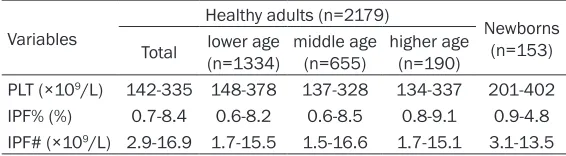
[image:4.612.90.529.86.152.2]The reference intervals of IPF% and IPF# for healthy adults (for different age groups) and newborns were established by non-parametric percentile method according to the Clinical and Laboratory Standard Institute guideline C28-A3 (Table 3).
In the lower age group, the reference interval for platelet counts, IPF% and IPF# were 148-378×109/L, 0.7-8.4% and 2.9-16.9×10⁹/L, res- pectively. In the middle age group, the refer-ence interval for platelet counts, IPF% and IPF# were 137-328×109/L, 0.6-8.2% and 1.7-15.5× 10⁹/L, respectively. In the higher age group, the reference interval for platelet counts, IPF% and IPF# were 134-337×109/L, 0.6-8.5% and 1.5-16.6×10⁹/L, respectively. In term newborns, the reference interval for platelet counts, IPF% and IPF# were 201-402×109/L, 0.9%-4.8% and 3.1-13.5×10⁹/L, respectively.
Reference intervals comparison between our data and data from a Korean study
In a Korean study [9], authors used the same series Sysmex XN instruments to determine ref-Table 2. Parameters in adults (different genders) and term newborns
Variables Healthy adults (n=2179) Newborns (n=153) P value* Total Male (n=1138) Female (n=1041) P value
PLT (×109/L) 222 (125-397) 221 (125-373) 224 (125-397) 0.032 292 (182-412) <0.001
IPF% (%) 2.9 (0.4-10.4) 2.9 (0.4-10.4) 2.8 (0.4-10) 0.232 2.2 (0.6-5.2) <0.001 IPF# (×109/L) 6.3 (0.8-23.0) 6.4 (0.8-23.0) 6.2 (0.8-22.0) 0.511 6.4 (1.8-15.5) <0.001
Note: *P value was calculated by comparing parameters between the healthy adults group and the newborns group.
Table 3. Reference intervals of test parameters in healthy adults and term newborns
Variables
Healthy adults (n=2179)
Newborns (n=153) Total lower age (n=1334) middle age (n=655) higher age (n=190)
PLT (×109/L) 142-335 148-378 137-328 134-337 201-402
IPF% (%) 0.7-8.4 0.6-8.2 0.6-8.5 0.8-9.1 0.9-4.8 IPF# (×109/L) 2.9-16.9 1.7-15.5 1.5-16.6 1.7-15.1 3.1-13.5
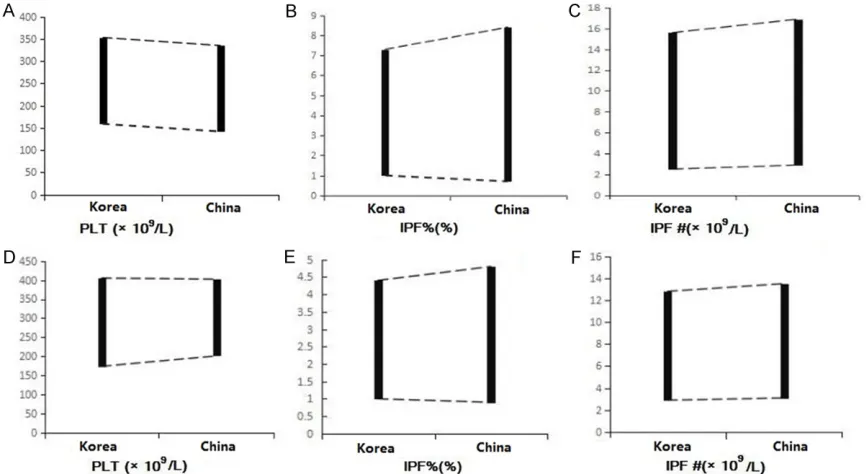
[image:4.612.89.372.210.288.2]erence intervals of IPF for both healthy individ-uals and term newborns. The reference inter-vals established in that study for IPF% and IPF# on Sysmex XN were: 1.0-7.3% and 2.49-15.64×10⁹/L in healthy individuals; and 1.0-4.4% and 2.94-12.82×10⁹/L in term newborns. After comparison, we found IPF% and IPF# in healthy individuals had increased and widened reference intervals than that of the Korean; While, the reference intervals for the term new-borns were almost same (Figure 3).
Discussion
Currently, in most Chinese clinical laboratories, the reference intervals of IPF were primarily determined by the manufacturers of reagents or instruments, or established based on the population in Europe, American or Japan, which indicated that the previously established refer-ence intervals for IPF may not be applicable. Moreover, most of these earlier studies were restricted to mainly adults with very few about newborns. It is necessary, therefore, to estab-lish the reference intervals suitable for specific region for both adults and newborns.
Studies have found that the hematological ref-erence interval correlates significantly with
[image:5.612.90.523.73.310.2]Reference interval for IPF determined by hematology analyzer
are different, there exists a natural difference between reference intervals, b) Different instru-ments are based on different test principles. The XE2100 has only 2 PLT test channels: PLT-I and PLT-O, while the XN9000 has 3 channels to count PLT, specifically the PLT-F channel and the PLT-I and PLT-O channels. The PLT-F chan-nel’s fluorescent dye is oxazine, which could specifically dye DNA in the mitochondria of platelets, but it’s dying extent for the non nucle-ic acid content, such as cell membrane, is much lower than PLT-O, consequently it has greater power to differentiate RBC fragments. Additionally, the power of the PLT-F channel to count PLT particles is five times greater than the PLT-I and PLT-O channels. And so, the rea-son that the PLT-F channel of XN9000 mea-sures PLT with better precision and accuracy than PLT could be explained by either the test principles or the particles counted. Likewise, the measurement of IPF% and IPF# is also more specific and sensitive [13, 14]. The abso-lute value of reticulated platelet (IPF#) reflects the amount of immature platelets in the circula-tion, as a result it can reflect the timely produc-tion of platelets more specifically [15].
Neonatal thrombocytopenia is a common hematological disease in the neonatal period, with an incidence rate of 22%~35% in critical newborn [16]. Studies have shown that the most common reason for premature neonatal thrombocytopenia was chronic intrauterine hypoxia, often with intrauterine fetal growth retardation. The pathogenesis lies in the reduc-tion in the megakaryocytes generareduc-tion. Chronic intrauterine hypoxia produces a rise in the gen-eration of erythropoietin, resulting in the hemo-cytoblasts over-differentiating into red blood cells while lower-differentiating into megakary-ocytes [17-19]. Reticulated platelet can directly reflect the platelet-producing ability of the megakaryocytes, and it has a clear application prospect for the etiologic analysis of neonatal thrombocytopenia. Accordingly, it is also need-ed to establish reference intervals for IPF in healthy full-term neonates, and we further established the reference intervals for IPF% and IPF# in neonatal umbilical cord blood samples.
The reference intervals of IPF% and IPF# in cord blood have never been reported in China. In the current study, the amount of cord blood
collected (153) was smaller relative to that of adults (2179). However, this number was suffi-cient for establishing a reference interval rec-ommendation (≥120). According to our study, the reference interval of IPF% and IPF# for cord blood was 0.9-4.80% and 3.1-13.5×10⁹/L, which was significantly differenced from the adult results (P<0.001). The results of cord blood were higher and wider than the adult results, which suggests that the platelet-pro-ducing ability of megakaryocytes in cord blood is more active.
Limitations for this study include: a) whether the cord blood could truly represent the results of newborns as the amount of cord blood sam-ples was relatively little. We would confirm the results in future studies; b) we did not compare the results of PLT-O with PLT-F with instrumen-tal methods, especially in patients with throm-bocytopenia. It is accurate PLT and IPF mea-surement that could guide effective clinical diagnosis and treatment.
In conclusion, we established reference inter-vals of IPF% and IPF# for cord blood of healthy term newborns and peripheral blood of healthy adults in Anhui province for the first time in our country. Our results also suggested the estab-lishment of reference intervals for different age groups was necessary. We hope this will pro-vide a valuable reference frame for future clini-cal therapy and research.
Disclosure of conflict of interest
None.
Address correspondence to: Yuanhong Xu, Depart- ment of Clinical Laboratory, The First Affiliated Hospital of Anhui Medical University, 218 Jixi Road, Hefei 230022, China. Tel: (+86)551-62922078; E-mail: [email protected]
References
[1] Briggs C, Kunka S, Hart D, Oguni S and Machin SJ. Assessment of an immature platelet frac-tion (IPF) in peripheral thrombocytopenia. Br J Haematol 2004; 126: 93-99.
[3] Hoffmann JJ, van den Broek NM and Curvers J. Reference intervals of reticulated platelets and other platelet parameters and their associa-tions. Arch Pathol Lab Med 2013; 137: 1635-1640.
[4] Meintker L, Haimerl M, Ringwald J and Krause SW. Measurement of immature platelets with Abbott CD-Sapphire and Sysmex XE-5000 in haematology and oncology patients. Clin Chem Lab Med 2013; 51: 2125-2131.
[5] Jung H, Jeon HK, Kim HJ and Kim SH. Imma-ture platelet fraction: establishment of a refer-ence interval and diagnostic measure for thrombocytopenia. Korean J Lab Med 2010; 30: 451-459.
[6] Briggs C, Longair I, Kumar P, Singh D and Machin SJ. Performance evaluation of the Sys-mex haematology XN modular system. J Clin Pathol 2012; 65: 1024-1030.
[7] van der Linden N, Klinkenberg LJ, Meex SJ, Beckers EA, de Wit NC and Prinzen L. Imma-ture platelet fraction measured on the Sysmex XN hemocytometer predicts thrombopoietic recovery after autologous stem cell transplan-tation. Eur J Haematol 2014; 93: 150-156. [8] Luneburg N, Xanthakis V, Schwedhelm E,
Sul-livan LM, Maas R, Anderssohn M, Riederer U, Glazer NL, Vasan RS and Boger RH. Reference intervals for plasma L-arginine and the L-argi-nine: asymmetric dimethylarginine ratio in the Framingham offspring cohort. J Nutr 2011; 141: 2186-2190.
[9] Ko YJ, Hur M, Kim H, Choi SG, Moon HW and Yun YM. Reference interval for immature plate-let fraction on Sysmex XN hematology analyz-er: a comparison study with Sysmex XE-2100. Clin Chem Lab Med 2015; 53: 1091-1097. [10] Cheng CK, Chan J, Cembrowski GS and van
As-sendelft OW. Complete blood count reference interval diagrams derived from NHANES III: stratification by age, sex, and race. Lab Hema-tol 2004; 10: 42-53.
[11] Ko YJ, Kim H, Hur M, Choi SG, Moon HW, Yun YM and Hong SN. Establishment of reference interval for immature platelet fraction. Int J Lab Hematol 2013; 35: 528-533.
[12] Joergensen MK and Bathum L. Reference in-tervals for mean platelet volume and imma-ture platelet fraction determined on a sysmex XE5000 hematology analyzer. Scand J Clin Lab Invest 2016; 76: 172-176.
[13] Schoorl M, Schoorl M, Oomes J and van Pelt J. New fluorescent method (PLT-F) on Sysmex XN2000 hematology analyzer achieved higher accuracy in low platelet counting. Am J Clin Pathol 2013; 140: 495-499.
[14] Kim H, Hur M, Choi SG, Moon HW, Yun YM, Hwang HS, Kwon HS and Sohn IS. Perfor-mance evaluation of Sysmex XN hematology analyzer in umbilical cord blood: a comparison study with Sysmex XE-2100. Clin Chem Lab Med 2014; 52: 1771-1779.
[15] Barsam SJ, Psaila B, Forestier M, Page LK, Sloane PA, Geyer JT, Villarica GO, Ruisi MM, Gernsheimer TB, Beer JH and Bussel JB. Plate-let production and platePlate-let destruction: as-sessing mechanisms of treatment effect in im-mune thrombocytopenia. Blood 2011; 117: 5723-5732.
[16] Bolat F, Kilic SC, Oflaz MB, Gulhan E, Kaya A, Guven AS, Aygunes U, Icagasioglu D and Gultekin A. The prevalence and outcomes of thrombocytopenia in a neonatal intensive care unit: a three-year report. Pediatr Hematol On-col 2012; 29: 710-720.
[17] Saxonhouse MA, Rimsza LM, Stevens G, Jouei N, Christensen RD and Sola MC. Effects of hy-poxia on megakaryocyte progenitors obtained from the umbilical cord blood of term and pre-term neonates. Biol Neonate 2006; 89: 104-108.
[18] Yuko S, Takeda T, Hirota A, Hisaeda Y, Amakata S, Nakao A and Kawakami T. Examination of the percentage of immature platelet fraction in term and preterm infants at birth. J Clin Neona-tol 2013; 2: 173-178.