Proceedings of NAACL-HLT 2018, pages 141–151
Improving Implicit Discourse Relation Classification by Modeling
Inter-dependencies of Discourse Units in a Paragraph
Zeyu Dai, Ruihong Huang
Department of Computer Science and Engineering Texas A&M University
{jzdaizeyu, huangrh}@tamu.edu
Abstract
We argue that semantic meanings of a sentence or clause can not be interpreted independently from the rest of a paragraph, or independently from all discourse relations and the overall paragraph-level discourse structure. With the goal of improving implicit discourse relation classification, we introduce a paragraph-level neural networks that model inter-dependencies between discourse units as well as discourse relation continuity and patterns, and predict a sequence of discourse relations in a paragraph. Experimental results show that our model out-performs the previous state-of-the-art systems on the benchmark corpus of PDTB.
1 Introduction
PDTB-style discourse relations, mostly defined between two adjacent text spans (i.e., discourse units, either clauses or sentences), specify how two discourse units are logically connected (e.g., causal, contrast). Recognizing discourse relations is one crucial step in discourse analysis and can be beneficial for many downstream NLP applications such as information extraction, machine transla-tion and natural language generatransla-tion.
Commonly, explicit discourse relations were distinguished from implicit ones, depending on whether a discourse connective (e.g., “because” and “after”) appears between two discourse units (Prasad et al., 2008a). While explicit course relation detection can be framed as a dis-course connective disambiguation problem (Pitler and Nenkova, 2009; Lin et al., 2014) and has achieved reasonable performance (F1 score > 90%), implicit discourse relations have no dis-course connective and are especially difficult to identify (Lin et al.,2009,2014;Xue et al.,2015). To fill the gap, implicit discourse relation pdiction has drawn significant research interest re-cently and progress has been made (Chen et al.,
2016; Liu and Li, 2016) by modeling composi-tional meanings of two discourse units and ex-ploiting word interactions between discourse units using neural tensor networks or attention mecha-nisms in neural nets. However, most of existing approaches ignore wider paragraph-level contexts beyond the two discourse units that are examined for predicting a discourse relation in between.
To further improve implicit discourse relation prediction, we aim to improve discourse unit rep-resentations by positioning a discourse unit (DU) in its wider context of a paragraph. The key obser-vation is that semantic meaning of a DU can not be interpreted independently from the rest of the paragraph that contains it, or independently from the overall paragraph-level discourse structure that involve the DU. Considering the following para-graph with four discourse relations, one relation between each two adjacent DUs:
(1): [The Butler, Wis., manufacturer went pub-lic at $15.75 a share in August 1987,]DU1
and (Explicit-Expansion) [Mr. Sim’s goal then was a $29 per-share price by 1992.]DU2
(Implicit-Expansion) [Strong earnings growth helped achieve that price far ahead of sched-ule, in August 1988.]DU3 (Implicit-Comparison)
[The stock has since softened, trading around
$25 a share last week and closing yesterday at
$23 in national over-the-counter trading.]DU4But
(Explicit-Comparison) [Mr. Sim has set a fresh target of $50 a share by the end of reaching that goal.]DU5
Clearly, each DU is an integral part of the para-graph and not independent from other units.First, predicting a discourse relation may require under-standing wider paragraph-level contexts beyond two relevant DUs and the overall discourse struc-ture of a paragraph. For example, the implicit “Comparison” discourse relation between DU3 and DU4 is difficult to identify without the
ground information (the history of per-share price) introduced in DU1 and DU2. Second, a DU may be involved in multiple discourse relations (e.g., DU4 is connected with both DU3 and DU5 with a “Comparison” relation), therefore the pragmatic meaning representation of a DU should reflect all the discourse relations the unit was involved in. Third, implicit discourse relation prediction should benefit from modeling discourse relation continuity and patterns in a paragraph that in-volve easy-to-identify explicit discourse relations (e.g., “Implicit-Comparison” relation is followed by “Explicit-Comparison” in the above example). Following these observations, we construct a neural net model to process a paragraph each time and jointly build meaning representations for all DUs in the paragraph. The learned DU represen-tations are used to predict a sequence of discourse relations in the paragraph, including both implicit and explicit relations. Although explicit relations are not our focus, predicting an explicit relation will help to reveal the pragmatic roles of its two DUs and reconstruct their representations, which will facilitate predicting neighboring implicit dis-course relations that involve one of the DUs.
In addition, we introduce two novel designs to further improve discourse relation classifica-tion performance of our paragraph-level neural net model. First, previous work has indicated that recognizing explicit and implicit discourse rela-tions requires different strategies, we therefore un-tie parameters in the discourse relation prediction layer of the neural networks and train two separate classifiers for predicting explicit and implicit dis-course relations respectively. This unique design has improved both implicit and explicit discourse relation identification performance. Second, we add a CRF layer on top of the discourse relation prediction layer to fine-tune a sequence of pre-dicted discourse relations by modeling discourse relation continuity and patterns in a paragraph.
Experimental results show that the intu-itive paragraph-level discourse relation prediction model achieves improved performance on PDTB for both implicit discourse relation classification and explicit discourse relation classification.
2 Related Work
2.1 Implicit Discourse Relation Recognition
Since the PDTB (Prasad et al.,2008b) corpus was created, a surge of studies (Pitler et al.,2009;Lin
et al.,2009;Liu et al.,2016;Rutherford and Xue, 2016) have been conducted for predicting dis-course relations, primarily focusing on the chal-lenging task of implicit discourse relation clas-sification when no explicit discourse connective phrase was presented. Early studies (Pitler et al., 2008;Lin et al.,2009,2014;Rutherford and Xue, 2015) focused on extracting linguistic and seman-tic features from two discourse units. Recent re-search (Zhang et al.,2015;Rutherford et al.,2016; Ji and Eisenstein, 2015; Ji et al., 2016) tried to model compositional meanings of two discourse units by exploiting interactions between words in two units with more and more complicated ral network models, including the ones using neu-ral tensor (Chen et al.,2016;Qin et al.,2016;Lei et al., 2017) and attention mechanisms (Liu and Li,2016;Lan et al.,2017;Zhou et al.,2016). An-other trend is to alleviate the shortage of annotated data by leveraging related external data, such as explicit discourse relations in PDTB (Liu et al., 2016;Lan et al., 2017; Qin et al., 2017) and un-labeled data obtained elsewhere (Rutherford and Xue,2015;Lan et al.,2017), often in a multi-task joint learning framework.
However, nearly all the previous works assume that a pair of discourse units is independent from its wider paragraph-level contexts and build their discourse relation prediction models based ononly
two relevant discourse units. In contrast, we model inter-dependencies of discourse units in a para-graph when building discourse unit representa-tions; in addition, we model global continuity and patterns in a sequence of discourse relations, in-cluding both implicit and explicit relations.
Hierarchical neural network models (Liu and Lapata,2017;Li et al.,2016) have been applied to RST-style discourse parsing (Carlson et al.,2003) mainly for the purpose of generating text-level hi-erarchical discourse structures. In contrast, we use hierarchical neural network models to build context-aware sentence representations in order to improve implicit discourse relation prediction.
2.2 Paragraph Encoding
methods remain the most effective approaches. RNNs, especially the long-short term memory (LSTM) (Hochreiter and Schmidhuber, 1997) models, have been widely used to encode a para-graph for machine translation (Sutskever et al., 2014), dialogue systems (Serban et al.,2016) and text summarization (Nallapati et al., 2016) be-cause of its ability in modeling long-distance de-pendencies between words. In addition, among four typical pooling methods (sum, mean, last and max) for calculating sentence representations from RNN-encoded hidden states for individ-ual words, max-pooling along with bidirectional LSTM (Bi-LSTM) (Schuster and Paliwal, 1997) yields the current best universal sentence repre-sentation method (Conneau et al., 2017). We adopted a similar neural network architecture for paragraph encoding.
3 The Neural Network Model for Paragraph-level Discourse Relation Recognition
3.1 The Basic Model Architecture
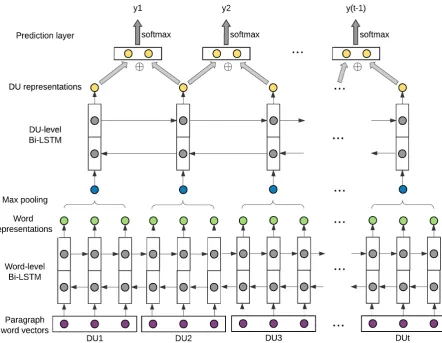
Figure1illustrates the overall architecture of the discourse-level neural network model that consists of two Bi-LSTM layers, one max-pooling layer in between and one softmax prediction layer. The input of the neural network model is a paragraph containing a sequence of discourse units, while the output is a sequence of discourse relations with one relation between each pair of adjacent dis-course units1.
Given the words sequence of one paragraph as input, the lower Bi-LSTM layer will read the whole paragraph and calculate hidden states as word representations, and a max-pooling layer will be applied to abstract the representation of each discourse unit based on individual word rep-resentations. Then another Bi-LSTM layer will run over the sequence of discourse unit repre-sentations and compute new reprerepre-sentations by further modeling semantic dependencies between discourse units within paragraph. The final soft-max prediction layer will concatenate representa-tions of two adjacent discourse units and predict the discourse relation between them.
Word Vectors as Input: The input of the paragraph-level discourse relation prediction
1In PDTB, most of discourse relations were annotated be-tween two adjacent sentences or two adjacent clauses. For exceptional cases, we applied heuristics to convert them.
model is a sequence of word vectors, one vector per word in the paragraph. In this work, we used the pre-trained 300-dimension Google English word2vec embeddings2. For each word that is not in the vocabulary of Google word2vec, we will randomly initialize a vector with each dimension sampled from the range[−0.25,0.25]. In addition, recognizing key entities and discourse connective phrases is important for discourse relation recognition, therefore, we concatenate the raw word embeddings with extra linguistic features, specifically one-hot Part-Of-Speech tag embeddings and one-hot named entity tag embeddings3.
Building Discourse Unit Representations: We aim to build discourse unit (DU) representations that sufficiently leverage cues for discourse re-lation prediction from paragraph-wide contexts, including the preceding and following discourse units in a paragraph. To process long paragraph-wide contexts, we take a bottom-up two-level ab-straction approach and progressively generate a compositional representation of each word first (low level) and then generate a compositional rep-resentation of each discourse unit (high level), with a max-pooling operation in between. At both word-level and DU-level, we choose Bi-LSTM as our basic component for generating composi-tional representations, mainly considering its ca-pability to capture long-distance dependencies be-tween words (discourse units) and to incorporate influences of context words (discourse units) in each side.
Given a variable-length words sequence X = (x1, x2, ..., xL)in a paragraph, the word-level Bi-LSTM will process the input sequence by using two separate LSTMs, one process the word se-quence from the left to right while the other fol-lows the reversed direction. Therefore, at each word position t, we obtain two hidden states
− →
ht,←h−t. We concatenate them to get the word rep-resentation ht = [−→ht,←h−t]. Then we apply max-pooling over the sequence of word representations for words in a discourse unit in order to get the discourse unit embedding:
2Downloaded from https://docs.google.com/ uc?id=0B7XkCwpI5KDYNlNUTTlSS21pQmM
Figure 1: The Basic Model Architecture for Paragraph-level Discourse Relations Sequence Prediction.
M PDU[j] =
DU end max
i=DU starthi[j] (1) where,1≤j≤hidden node size (2)
Next, the DU-level Bi-LSTM will process the sequence of discourse unit embeddings in a para-graph and generate two hidden states −−−→hDUt and
←−−−
hDUtat each discourse unit position. We concate-nate them to get the discourse unit representation hDUt= [−−−→hDUt,←−−−hDUt].
The Softmax Prediction Layer:Finally, we con-catenate two adjacent discourse unit representa-tionshDUt−1andhDUtand predict the discourse relation between them using a softmax function:
yt−1=sof tmax(Wy∗[hDUt−1, hDUt] +by) (3)
3.2 Untie Parameters in the Softmax Prediction Layer (Implicit vs. Explicit)
Previous work (Pitler and Nenkova, 2009; Lin et al., 2014; Rutherford and Xue, 2016) has
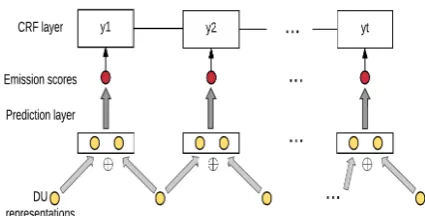
re-Figure 2: Untie Parameters in the Prediction Layer
[image:4.595.309.522.443.563.2]contents of its two discourse units (Lin et al.,2014; Rutherford and Xue,2016).
Considering the different natures of explicit vs. implicit discourse relation prediction, we decide to untie parameters at the final discourse relation prediction layer and train two softmax classifiers, as illustrated in Figure2. The two classifiers have different sets of parameters, with one classifier for
onlyimplicit discourse relations and the other for
onlyexplicit discourse relations.
yt−1=
(
sof tmax(Wexp[hDUt−1, hDUt] +bexp), exp
sof tmax(Wimp[hDUt−1, hDUt] +bimp), imp
(4)
The loss function used for the neural network training considers loss induced by both implicit re-lation prediction and explicit rere-lation prediction:
Loss=Lossimp+α∗Lossexp (5)
The α, in the full system, is set to be 1, which means that minimizing the loss in predicting either type of discourse relations is equally important. In the evaluation, we will also evaluate a system variant, where we will set α = 0, which means that the neural network will not attempt to predict explicit discourse relations and implicit discourse relation prediction will not be influenced by pre-dicting neighboring explicit discourse relations.
3.3 Fine-tune Discourse Relation Predictions Using a CRF Layer
Data analysis and many linguistic studies (Pitler et al., 2008;Asr and Demberg, 2012;Lascarides and Asher, 1993; Hobbs, 1985) have repeatedly shown that discourse relations feature continuity and patterns (e.g., a temporal relation is likely to be followed by another temporal relation). Es-pecially, Pitler et al. (2008) firstly reported that patterns exist between implicit discourse relations and their neighboring explicit discourse relations.
Motivated by these observations, we aim to improve implicit discourse relation detection by making use of easily identifiable explicit discourse relations and taking into account global patterns of discourse relation distributions. Specifically, we add an extra CRF layer at the top of the softmax prediction layer (shown in figure 3) to fine-tune predicted discourse relations by considering their inter-dependencies.
The Conditional Random Fields (Lafferty et al., 2001) (CRF) layer updates a state transition ma-trix, which can effectively adjust the current
la-Figure 3: Fine-tune Discourse Relations with a CRF layer.
bel depending on proceeding and following la-bels. Both training and decoding of the CRF layer can be solved efficiently by using the Viterbi al-gorithm. With the CRF layer, the model jointly assigns a sequence of discourse relations between each two adjacent discourse units in a paragraph, including both implicit and explicit relations, by considering relevant discourse unit representations as well as global discourse relation patterns.
4 Evaluation
4.1 Dataset and Preprocessing
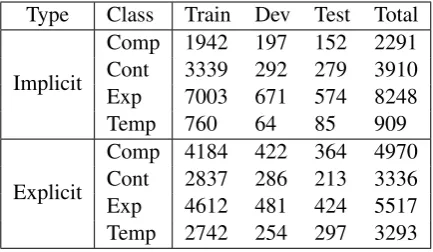
The Penn Discourse Treebank (PDTB): We ex-perimented with PDTB v2.0 (Prasad et al.,2008b) which is the largest annotated corpus contain-ing 36k discourse relations in 2,159 Wall Street Journal (WSJ) articles. In this work, we fo-cus on the top-level4 discourse relation senses which are consist of four major semantic classes: Comparison (Comp), Contingency (Cont), Expan-sion (Exp) and Temporal (Temp). We followed the same PDTB section partition (Rutherford and Xue,2015) as previous work and used sections 2-20 as training set, sections 21-22 as test set, and sections 0-1 as development set. Table1presents the data distributions we collected from PDTB.
Preprocessing: The PDTB dataset documents its annotations as a list of discourse relations, with each relation associated with its two discourse units. To recover the paragraph context for a dis-course relation, we match contents of its two an-notated discourse units with all paragraphs in cor-responding raw WSJ article. When all the match-ing was completed, each paragraph was split into a sequence of discourse units, with one discourse relation (implicit or explicit) between each two
[image:5.595.306.519.60.168.2]Type Class Train Dev Test Total
Implicit
Comp 1942 197 152 2291 Cont 3339 292 279 3910 Exp 7003 671 574 8248 Temp 760 64 85 909
Explicit
[image:6.595.73.290.62.188.2]Comp 4184 422 364 4970 Cont 2837 286 213 3336 Exp 4612 481 424 5517 Temp 2742 254 297 3293
Table 1: Distributions of Four Top-level Discourse Re-lations in PDTB.
# of DUs 2 3 4 5 >5 ratio 44% 25% 15% 7.3% 8.7%
Table 2: Distributions of Paragraphs.
jacent discourse units5. Following this method, we obtained 14,309 paragraphs in total, each contains 3.2 discourse units on average. Table2shows the distribution of paragraphs based on the number of discourse units in a paragraph.
4.2 Parameter Settings and Model Training
We tuned the parameters based on the best per-formance on the development set. We fixed the weights of word embeddings during training. All the LSTMs in our neural network use the hidden state size of 300. To avoid overfitting, we applied dropout (Hinton et al.,2012) with dropout ratio of 0.5 to both input and output of LSTM layers. To prevent the exploding gradient problem in training LSTMs, we adopt gradient clipping with gradient L2-norm threshold of 5.0. These parameters re-main the same for all our proposed models as well as our own baseline models.
We chose the standard cross-entropy loss func-tion for training our neural network model and adopted Adam (Kingma and Ba,2014) optimizer with the initial learning rate of 5e-4 and a mini-batch size of 1286. If one instance is annotated with two labels (4% of all instances), we use both of them in loss calculation and regard the predic-tion as correct if model predicts one of the anno-tated labels. All the proposed models were
imple-5In several hundred discourse relations, one discourse unit is complex and can be further separated into two elementary discourse units, which can be illustrated as [DU1-DU2]-DU3. We simplify such cases to be a relation between DU2 and DU3.
6Counted as the number of discourse relations rather than paragraph instances.
mented with Pytorch7 and converged to the best performance within 20-40 epochs.
To alleviate the influence of randomness in neu-ral network model training and obtain stable ex-perimental results, we ran each of the proposed models and our own baseline models ten times and report the average performance of each model in-stead of the best performance as reported in many previous works.
4.3 Baseline Models and Systems
We compare the performance of our neural net-work model with several recent discourse relation recognition systems that only consider two rele-vant discourse units.
• (Rutherford and Xue, 2015): improves im-plicit discourse relation prediction by creat-ing more traincreat-ing instances from the Giga-word corpus utilizing explicitly mentioned discourse connective phrases.
• (Chen et al., 2016): a gated relevance net-work (GRN) model with tensors to capture semantic interactions between words from two discourse units.
• (Liu et al.,2016): a convolutional neural
net-work model that leverages relations between different styles of discourse relations annota-tions (PDTB and RST (Carlson et al.,2003)) in a multi-task joint learning framework.
• (Liu and Li, 2016): a multi-level
attention-over-attention model to dynamically exploit features from two discourse units for recog-nizing an implicit discourse relation.
• (Qin et al., 2017): a novel pipelined
adver-sarial framework to enable an adaptive imi-tation competition between the implicit net-work and a rival feature discriminator with access to connectives.
• (Lei et al., 2017): a Simple Word
Interac-tion Model (SWIM) with tensors that cap-tures both linear and quadratic relations be-tween words from two discourse units.
• (Lan et al.,2017): an attention-based LSTM neural network that leverages explicit dis-course relations in PDTB and unannotated external data in a multi-task joint learning framework.
Implicit Explicit Model Macro Acc Comp Cont Exp Temp Macro Acc (Rutherford and Xue,2015) 40.50 57.10 - - -
-(Liu et al.,2016) 44.98 57.27 - - -
-(Liu and Li,2016) 46.29 57.57 - - -
-(Lei et al.,2017) 46.46 - - -
-(Lan et al.,2017) 47.80 57.39 - - -
-DU-pair level Discourse Relation Recognition (Our Own Baselines)
Bi-LSTM 40.01 53.50 30.52 42.06 65.52 21.96 - -+ tensors 45.36 57.18 36.88 44.85 68.70 30.74 -
-Paragraph level Discourse Relation Recognition
Basic System Variant (α = 0) 47.56 56.88 37.12 46.47 67.72 38.92 - -Basic System (α= 1) 48.10 57.52 37.33 47.89 68.39 38.80 91.93 92.89 + Untie Parameters 48.69 58.20 37.68 49.19 68.86 39.04 93.70 94.46
[image:7.595.79.525.61.270.2]+ the CRF Layer 48.82 57.44 37.72 49.39 67.45 40.70 93.21 93.98
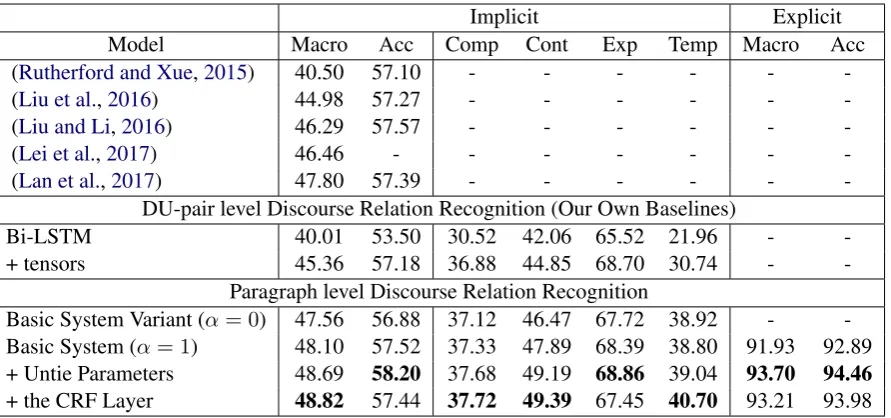
Table 3: Multi-class Classification Results on PDTB. We report accuracy (Acc) and macro-average F1-scores for both explicit and implicit discourse relation predictions. We also report class-wise F1 scores.
4.4 Evaluation Settings
On the PDTB corpus, both binary classification and multi-way classification settings are com-monly used to evaluate the implicit discourse rela-tion recognirela-tion performance. We noticed that all the recent works report class-wise implicit relation prediction performance in the binary classification setting, while none of them report detailed per-formance in the multi-way classification setting. In the binary classification setting, separate “one-versus-all” binary classifiers were trained, and each classifier is to identify one class of discourse relations. Although separate classifiers are gener-ally more flexible in combating with imbalanced distributions of discourse relation classes and ob-tain higher class-wise prediction performance, one pair of discourse units may be tagged with all four discourse relations without proper conflict resolu-tion. Therefore, the multi-way classification set-ting is more appropriate and natural in evaluat-ing a practical end-to-end discourse parser, and we mainly evaluate our proposed models using the four-way multi-class classification setting.
Since none of the recent previous work reported class-wise implicit relation classification perfor-mance in the multi-way classification setting, for better comparisons, we re-implemented the neu-ral tensor network architecture (so-called SWIM in (Lei et al., 2017)) which is essentially a Bi-LSTM model with tensors and report its detailed evaluation result in the multi-way classification setting. As another baseline, we report the
per-formance of a Bi-LSTM model without tensors as well. Both baseline models take two relevant dis-course units as the only input.
For additional comparisons, We also report the performance of our proposed models in the binary classification setting.
4.5 Experimental Results
Multi-way Classification: The first section of ta-ble 3 shows macro average F1-scores and accu-racies of previous works. The second section of table3shows the multi-class classification results of our implemented baseline systems. Consis-tent with results of previous works, neural tensors, when applied to Bi-LSTMs, improved implicit discourse relation prediction performance. How-ever, the performance on the three small classes (Comp, Cont and Temp) remains low.
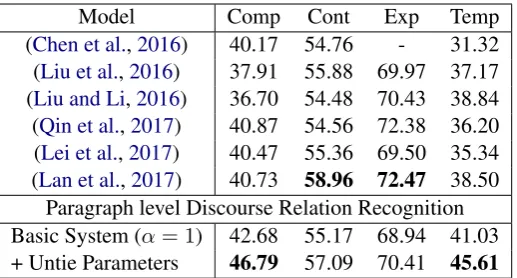
perfor-Model Comp Cont Exp Temp (Chen et al.,2016) 40.17 54.76 - 31.32 (Liu et al.,2016) 37.91 55.88 69.97 37.17 (Liu and Li,2016) 36.70 54.48 70.43 38.84 (Qin et al.,2017) 40.87 54.56 72.38 36.20 (Lei et al.,2017) 40.47 55.36 69.50 35.34 (Lan et al.,2017) 40.73 58.96 72.47 38.50
Paragraph level Discourse Relation Recognition Basic System (α= 1) 42.68 55.17 68.94 41.03 + Untie Parameters 46.79 57.09 70.41 45.61
Table 4: Binary Classification Results on PDTB. We report F1-scores for implicit discourse relations.
[image:8.595.171.430.61.200.2]Implicit Explicit Model Macro Acc Macro Acc Basic System (α= 1) 49.92 59.08 93.05 93.83 + Untie Parameters 50.47 59.85 93.95 94.74 + the CRF Layer 51.84 59.75 94.17 94.82
Table 5: Multi-class Classification Results of Ensemble Models on PDTB.
mance across all the four relations and improved the macro-average F1-score by over 7 percents. In addition, compared with the baseline Bi-LSTM model with tensor, this model improved implicit relation classification performance across the three small classes, with clear performance gains of around 2 and 8 percents on contingency and tem-poral relations respectively, and overall improved the macro-average F1-score by 2.2 percents.
The second row shows the performance of our basic paragraph-level model which predicts both implicit and explicit discourse relations in a para-graph. Compared to the variant system (the first row), the basic model further improved the classi-fication performance on the first three implicit re-lations. Especially on the contingency relation, the classification performance was improved by an-other 1.42 percents. Moreover, the basic model yields good performance for recognizing explicit discourse relations as well, which is comparable with previous best result (92.05% macro F1-score and 93.09% accuracy as reported in (Pitler et al., 2008)).
After untying parameters in the softmax pre-diction layer, implicit discourse relation classifi-cation performance was improved across all four relations, meanwhile, the explicit discourse re-lation classification performance was also proved. The CRF layer further improved im-plicit discourse relation recognition performance on the three small classes. In summary, our full
paragraph-level neural network model achieves the best macro-average F1-score of 48.82% in pre-dicting implicit discourse relations, which out-performs previous neural tensor network models (e.g., (Lei et al., 2017)) by more than 2 percents and outperforms the best previous system (Lan et al.,2017) by 1 percent.
Binary Classification: From table4, we can see that compared against the best previous systems, our paragraph-level model with untied parameters in the prediction layer achieves F1-score improve-ments of 6 points on Comparison and 7 points on Temporal, which demonstrates that paragraph-wide contexts are important in detecting minority discourse relations. Note that the CRF layer of the model is not suitable for binary classification.
4.6 Ensemble Model
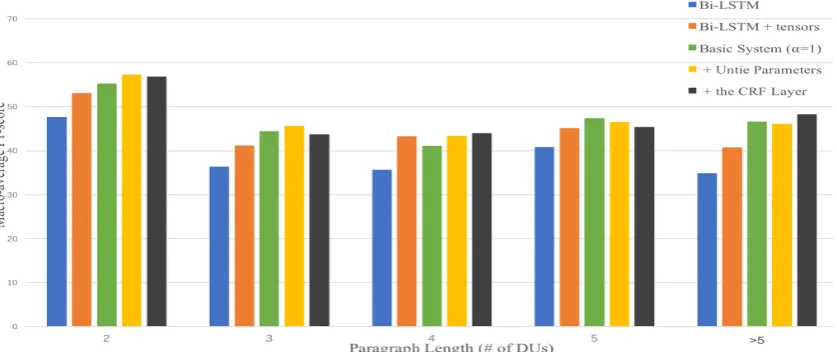
Figure 4: Impact of Paragraph Length. We plot the macro-average F1-score of implicit discourse relation classifi-cation on instances with different paragraph length.
and explicit discourse relations simultaneously.
4.7 Impact of Paragraph Length
To understand the influence of paragraph lengths to our paragraph-level models, we divide para-graphs in the PDTB test set into several sub-sets based on the number of DUs in a para-graph, and then evaluate our proposed models on each subset separately. From Figure 4, we can see that our paragraph-level models (the lat-ter three) overall outperform DU-pair baselines across all the subsets. As expected, the paragraph-level models achieve clear performance gains on long paragraphs (with more than 5 DUs) by ex-tensively modeling mutual influences of DUs in a paragraph. But somewhat surprisingly, the paragraph-level models achieve noticeable perfor-mance gains on short paragraphs (with 2 or 3 DUs) as well. We hypothesize that by learning more ap-propriate discourse-aware DU representations in long paragraphs, our paragraph-level models re-duce bias of using DU representations in predict-ing discourse relations, which benefits discourse relation prediction in short paragraphs as well.
4.8 Example Analysis
For the example (1), the baseline neural tensor model predicted both implicit relations wrongly (“Implicit-Contingency” between DU2 and DU3; “Implicit-Expansion” between DU3 and DU4), while our paragraph-level model predicted all the four discourse relations correctly, which indicates that paragraph-wide contexts play a key role in im-plicit discourse relation prediction.
For another example:
(2): [Marshall came clanking in like Marley’s ghost dragging those chains of brigades and air wings and links with Arab despots.]DU1
(Implicit-Temporal)[He wouldn’t leave]DU2until
(Explicit-Temporal) [Mr. Cheney promised to do whatever the Pentagon systems analysts told him.]DU3
Our basic paragraph-level model wrongly pre-dicted the implicit discourse relation between DU1 and DU2 to be “Implicit-Comparison”, with-out being able to effectively use the succeeding “Explicit-Temporal” relation. On the contrary, the full model corrected this mistake by modeling dis-course relation patterns with the CRF layer.
5 Conclusion
We have presented a paragraph-level neural net-work model that takes a sequence of discourse units as input, models inter-dependencies between discourse units as well as discourse relation con-tinuity and patterns, and predicts a sequence of discourse relations in a paragraph. By building wider-context informed discourse unit representa-tions and capturing the overall discourse structure, the paragraph-level neural network model outper-forms the best previous models for implicit dis-course relation recognition on the PDTB dataset.
Acknowledgments
References
Fatemeh Torabi Asr and Vera Demberg. 2012. Implic-itness of discourse relations. InColing. pages 2669– 2684.
Lynn Carlson, Daniel Marcu, and Mary Ellen Okurowski. 2003. Building a discourse-tagged cor-pus in the framework of rhetorical structure theory. InCurrent and new directions in discourse and dia-logue, Springer, pages 85–112.
Jifan Chen, Qi Zhang, Pengfei Liu, Xipeng Qiu, and Xuanjing Huang. 2016. Implicit discourse relation detection via a deep architecture with gated rele-vance network. InACL 2016.
Alexis Conneau, Douwe Kiela, Holger Schwenk, Lo¨ıc Barrault, and Antoine Bordes. 2017. Supervised learning of universal sentence representations from natural language inference data. InProceedings of the 2017 Conference on Empirical Methods in Nat-ural Language Processing, EMNLP 2017, Copen-hagen, Denmark, September 9-11, 2017. pages 681–691. http://aclanthology.info/
papers/D17-1071/d17-1071.
Geoffrey E Hinton, Nitish Srivastava, Alex Krizhevsky, Ilya Sutskever, and Ruslan R Salakhutdinov. 2012. Improving neural networks by preventing co-adaptation of feature detectors. arXiv preprint arXiv:1207.0580.
Jerry R Hobbs. 1985. On the coherence and structure of discourse. CSLI.
Sepp Hochreiter and J¨urgen Schmidhuber. 1997. Long short-term memory. Neural computation
9(8):1735–1780.
Yangfeng Ji and Jacob Eisenstein. 2015. One vector is not enough: Entity-augmented distributed semantics for discourse relations. TACL3:329–344. https: //tacl2013.cs.columbia.edu/ojs/
index.php/tacl/article/view/536.
Yangfeng Ji, Gholamreza Haffari, and Jacob Eisen-stein. 2016. A latent variable recurrent neural net-work for discourse relation language models. In
Proceedings of NAACL-HLT. pages 332–342.
Diederik Kingma and Jimmy Ba. 2014. Adam: A method for stochastic optimization. arXiv preprint arXiv:1412.6980.
John Lafferty, Andrew McCallum, and Fernando CN Pereira. 2001. Conditional random fields: Prob-abilistic models for segmenting and labeling se-quence data. In Proceedings of the 18th Interna-tional Conference on Machine Learning. volume 951, pages 282–289.
Man Lan, Jianxiang Wang, Yuanbin Wu, Zheng-Yu Niu, and Haifeng Wang. 2017. Multi-task attention-based neural networks for implicit discourse rela-tionship representation and identification. In
Pro-ceedings of the 2017 Conference on Empirical Meth-ods in Natural Language Processing. pages 1310– 1319.
Alex Lascarides and Nicholas Asher. 1993. Temporal interpretation, discourse relations and commonsense entailment. Linguistics and philosophy16(5):437– 493.
Wenqiang Lei, Xuancong Wang, Meichun Liu, Ilija Ilievski, Xiangnan He, and Min-Yen Kan. 2017. Swim: A simple word interaction model for im-plicit discourse relation recognition. In Proceed-ings of the Twenty-Sixth International Joint Con-ference on Artificial Intelligence, IJCAI-17. pages 4026–4032. https://doi.org/10.24963/
ijcai.2017/562.
Qi Li, Tianshi Li, and Baobao Chang. 2016. Discourse parsing with attention-based hierarchical neural net-works. InProceedings of the 2016 Conference on Empirical Methods in Natural Language Process-ing. pages 362–371.
Ziheng Lin, Min-Yen Kan, and Hwee Tou Ng. 2009. Recognizing implicit discourse relations in the penn discourse treebank. In Proceedings of the 2009 Conference on Empirical Methods in Natural Language Processing: Volume 1 - Vol-ume 1. Association for Computational Linguistics, Stroudsburg, PA, USA, EMNLP ’09, pages 343–
351. http://dl.acm.org/citation.cfm?
id=1699510.1699555.
Ziheng Lin, Hwee Tou Ng, and Min-Yen Kan. 2014. A pdtb-styled end-to-end discourse parser. Natural Language Engineering20(2):151–184.
Yang Liu and Mirella Lapata. 2017. Learning contex-tually informed representations for linear-time dis-course parsing. InEMNLP.
Yang Liu and Sujian Li. 2016. Recognizing implicit discourse relations via repeated reading: Neural net-works with multi-level attention. InProceedings of the 2016 Conference on Empirical Methods in Nat-ural Language Processing, EMNLP 2016, Austin, Texas, USA, November 1-4, 2016. pages 1224– 1233. http://aclweb.org/anthology/D/
D16/D16-1130.pdf.
Yang Liu, Sujian Li, Xiaodong Zhang, and Zhi-fang Sui. 2016. Implicit discourse relation classification via multi-task neural networks. In Proceedings of the Thirtieth AAAI Confer-ence on Artificial IntelligConfer-ence, February 12-17, 2016, Phoenix, Arizona, USA.. pages 2750–2756. http://www.aaai.org/ocs/index.php/
AAAI/AAAI16/paper/view/11831.
Emily Pitler, Annie Louis, and Ani Nenkova. 2009. Automatic sense prediction for implicit discourse re-lations in text. InProceedings of the Joint Confer-ence of the 47th Annual Meeting of the ACL and the 4th International Joint Conference on Natural Language Processing of the AFNLP: Volume 2 -Volume 2. Association for Computational Linguis-tics, Stroudsburg, PA, USA, ACL ’09, pages 683–
691. http://dl.acm.org/citation.cfm?
id=1690219.1690241.
Emily Pitler and Ani Nenkova. 2009. Using syntax to disambiguate explicit discourse connectives in text. In Proceedings of the ACL-IJCNLP 2009 Confer-ence Short Papers. Association for Computational Linguistics, pages 13–16.
Emily Pitler, Mridhula Raghupathy, Hena Mehta, Ani Nenkova, Alan Lee, and Aravind Joshi. 2008. Easily identifiable discourse relations. InIn Proceedings of the 22nd International Conference on Computa-tional Linguistics (COLING 2008) Short Papers.
R. Prasad, N. Dinesh, Lee A., E. Miltsakaki, L. Robaldo, Joshi A., and B. Webber. 2008a. The Penn Discourse Treebank 2.0. Inlrec2008.
Rashmi Prasad, Nikhil Dinesh, Alan Lee, Eleni Milt-sakaki, Livio Robaldo, Aravind Joshi, and Bonnie Webber. 2008b. The penn discourse treebank 2.0. InIn Proceedings of LREC.
Lianhui Qin, Zhisong Zhang, and Hai Zhao. 2016. A stacking gated neural architecture for implicit dis-course relation classification. In EMNLP. pages 2263–2270.
Lianhui Qin, Zhisong Zhang, Hai Zhao, Zhiting Hu, and Eric P. Xing. 2017. Adversarial connective-exploiting networks for implicit discourse relation classification. In Proceedings of the 55th An-nual Meeting of the Association for Computational Linguistics, ACL 2017, Vancouver, Canada, July 30 - August 4, Volume 1: Long Papers. pages 1006–1017. https://doi.org/10.18653/ v1/P17-1093.
Attapol Rutherford and Nianwen Xue. 2015. Improv-ing the inference of implicit discourse relations via classifying explicit discourse connectives. In HLT-NAACL. pages 799–808.
Attapol T Rutherford, Vera Demberg, and Nianwen Xue. 2016. Neural network models for implicit discourse relation classification in english and chi-nese without surface features. arXiv preprint arXiv:1606.01990.
Attapol T Rutherford and Nianwen Xue. 2016. Robust non-explicit neural discourse parser in english and chinese.ACL 2016page 55.
Mike Schuster and Kuldip K Paliwal. 1997. Bidirec-tional recurrent neural networks. IEEE Transactions on Signal Processing45(11):2673–2681.
Iulian Vlad Serban, Alessandro Sordoni, Yoshua Ben-gio, Aaron C Courville, and Joelle Pineau. 2016. Building end-to-end dialogue systems using gener-ative hierarchical neural network models. InAAAI. pages 3776–3784.
Ilya Sutskever, Oriol Vinyals, and Quoc V Le. 2014. Sequence to sequence learning with neural net-works. InAdvances in neural information process-ing systems. pages 3104–3112.
Nianwen Xue, Hwee Tou Ng, Sameer Pradhan, Rashmi PrasadO Christopher Bryant, and Attapol T Ruther-ford. 2015. The conll-2015 shared task on shallow discourse parsing. CoNLL 2015page 1.
Biao Zhang, Jinsong Su, Deyi Xiong, Yaojie Lu, Hong Duan, and Junfeng Yao. 2015. Shallow convolu-tional neural network for implicit discourse relation recognition. InEMNLP. The Association for Com-putational Linguistics, pages 2230–2235.
Ruqing Zhang, Jiafeng Guo, Yanyan Lan, Jun Xu, and Xueqi Cheng. 2017a. Spherical paragraph model.
arXiv preprint arXiv:1707.05635.
Yizhe Zhang, Dinghan Shen, Guoyin Wang, Zhe Gan, Ricardo Henao, and Lawrence Carin. 2017b. De-convolutional paragraph representation learning. In
Advances in Neural Information Processing Sys-tems. pages 4170–4180.