6
A Soft Label Strategy for Target-Level Sentiment Classification
Da Yin, Xiao Liu, Xiuyu Wu, Baobao Chang
MOE Key Lab of Computational Linguistics, School of EECS, Peking University
{wade yin9712,lxlisa,xiuyu wu,chbb}@pku.edu.cn
Abstract
In this paper, we propose a soft label approach to target-level sentiment classification task, in which a history-based soft labeling model is proposed to measure the possibility of a con-text word as an opinion word. We also apply a convolution layer to extract local active fea-tures, and introduce positional weights to take relative distance information into considera-tion. In addition, we obtain more informative target representation by training with context tokens together to make deeper interaction be-tween target and context tokens. We conduct experiments on SemEval 2014 datasets and the experimental results show that our approach significantly outperforms previous models and gives state-of-the-art results on these datasets. 1 Introduction
Target-level sentiment classification aims to iden-tify the sentiment polarities towards given targets by analyzing sentence context. For example, in the sentence “Thefood is good but service is bad.”, there are two targets“food” and“service” men-tioned. The sentiment towards“food” and“ ser-vice”are positive and negative respectively.
Neural network models (Tang et al., 2016a;
Wang et al., 2016; Tang et al., 2016b; Liu and Zhang, 2017; Ma et al., 2017; Tay et al., 2017;
Chen et al., 2017;Huang et al., 2018;Gu et al.,
2018) have achieved high accuracy on this task. Most of the neural network models introduce at-tention mechanism to find the correlation between target and context tokens. However, the combina-tion of word-level features computed by attencombina-tion weights may introduce noise into model. For in-stance, in “The dish tastes bad but its vegetable
is delicious though it looks ugly.”, these attention-based models tend to highlight some involve some other words such as“bad”and“ugly”.
Instead of using the attention mechanism, we propose a soft label approach for the target-level
sentiment classification task. Intuitively, the task could be treated as a two-step process. Firstly the sentiment words that are related to the given target, called opinion words, are labeled and extracted. Then the final decision on the sentiment polarity would be made by taking all the extracted opinion words into account. However, this kind of hard la-bel strategy, which directly determines whether a token is an opinion word or not, for labeling opin-ion words is non-differentiable and hinders train-ing through normal back-propagation. Thus we use a soft labeling model to avoid the hard deci-sion and make sure the model works in an end-to-end way.
Specifically, the soft label model is used to mea-sure the likelihood of a context word as an opinion word at each time step. The larger the value of one word’s soft label, the greater its effect on tar-get sentiment. In fact, given a tartar-get, people are accustomed to going through a sentence from be-ginning to end, and to judge whether current word is highly related to the target sentiment at each step with comparison of history information till the current word in the reading process. There-fore, we implement an LSTM-based (Hochreiter and Schmidhuber,1997) soft labeling model by a history-based approach, which utilizes history in-formation (previous soft labels and cell states) to-gether with representation of the current word, to decide how to pay attention to history information or current word representation based on their cor-relation with target representation.
Moreover, since the convolution layer (LeCun et al., 1989) does better in capturing local ac-tive features than other neural networks do and these extracted features are proved to be benefi-cial to text classification (Kim,2014;Johnson and
Zhang, 2015), we apply a convolution based
are more likely to affect on the targets. Therefore, we adopt positional weights to scale the features with relative distance information between context tokens and the target.
Target representation is also critical to this task. Previous works, such asTang et al.(2016a), sim-ply take the average of target embeddings as tar-get representation. In fact, this kind of representa-tion does not incorporate contextual informarepresenta-tion. Words in a sentence have strong dependencies on each other. Thus it is necessary to train target representation together with context tokens to ob-tain more informative representation dependent on contextual information.
In summary, our contributions are as follows:
• Our model uses a soft label approach to eval-uating the likelihood of a context word as an opinion word based on the history informa-tion.
• Our model leverages convolution layer, which is seldom used in the task, to extract features, and these features are accordingly weighed by positional information.
• Our model learns more informative represen-tation of the target, instead of the average of target embeddings, and strengthens the inter-action between target and context tokens in soft label computation process.
• We conduct experiments on benchmark datasets and the experimental results show that our approach significantly outperforms previous models and achieves state-of-the-art results on these datasets.
2 Related Work
Early methods mainly apply supervised learning approach with large quantities of handcrafted fea-tures (Blair-Goldensohn et al., 2008; Yu et al.,
2011;Jiang et al.,2011;Kiritchenko et al.,2014), but ignore context information and deep relations between target and context tokens.
Neural network models have achieved high ac-curacy on this task.AE-LSTMandATAE-LSTM
(Wang et al.,2016) simply concatenate target em-beddings to context word emem-beddings to make connection between targets and contexts. How-ever, both models described above do not obtain target representations based on context-aware in-formation. Inspired by the TNet (Li et al.,2018),
which learns deep representations for targets, we propose a model which could strengthen the inter-action between target and context tokens.
Recently, most of the previous state-of-the-art models leverage attention mechanism to evaluate the correlation between the tokens in one sen-tence. IAN(Ma et al.,2017) adopts two separate LSTM layers and an interactive attention mech-anism. Hazarika et al.(2018) classifies the senti-ment polarities of all the targets in one sentence si-multaneously with attention mechanism to model inter-target dependencies. MemNet (Tang et al.,
2016b),RAM(Chen et al.,2017),TRMN(Wang
et al., 2018) andIARM (Majumder et al., 2018) introduce deep memory network and multi-hop at-tention model over sentence-level memories to in-corporate target information into sentence repre-sentations. Specifically, TRMN and IARM at-tach importance to the interaction between targets and contexts, and inter-target relations, which con-tain the information of relationship between multi-ple targets in one sentence, respectively. Different from them, our model adopts a novel and effective soft label approach in an intuitive way.
There are few works (Xue and Li,2018;Huang
and Carley, 2018) applying CNN, which is
con-sidered to be good at text classification, on target-level sentiment classification.GCAE(Xue and Li,
2018) andPG-CNN(Huang and Carley,2018) are both CNN-based models and adopt gate mecha-nism to make interaction between target and text tokens. To improve the effectiveness of con-volution layers, our model further adopts posi-tional weights, which take relative distance infor-mation into account.
3 Model
Target-level sentiment classification task is to de-cide which sentiment is expressed towards a tar-get: positive, neutral or negative.
Our model is illustrated in Figure1. It is divided into four parts: (1) a Bi-LSTM (Schuster and Pali-wal,1997) layer to get context-aware representa-tions, (2) a convolution based feature extractor, (3) computation of soft labels, and (4) sentiment classification using the soft labels and positional weights.
posi-Context-Aware Representations Convolution Based
Feature Extractor Computation of Soft
Labels Sentiment Classification
Ċ Ċ
Delicious and Sake Ikura roll well
SLC SLC Ċ SLC
Positive
Max-Pooling
Average-Pooling
+
G
TR +
G TR
SLC SLC
TR
CR
[image:3.595.85.525.64.236.2]CR CR
Figure 1: Overall architecture of the proposed method. We use the sentence“Delicious and good-looking Sake Ikura roll, and sashimi tastes good as well.” as an example. The term “SLC” indicates soft label computation. “TR” indicates target representation and “CR” represents context representation.
tion of the target tokens, wheret≥1, t+m−1≤
n. The length of the target ism.
3.1 Context-Aware Representations
Since words in a sentence have strong dependen-cies on each other, it is necessary to fetch context-aware representations to combine context infor-mation with words. In order to incorporate the context information into words, we encode them with a Bi-LSTM layer:
xi = [−−−−→LSTM(wi);←−−−−LSTM(wi)] (1)
We concatenate the forward and backward hidden outputs of LSTM, of which the dimension size is bothd0, and[; ]denotes concatenation. We regard xi ∈ R2d0 as the context-aware representation of wordwi, and feed it to following layers.
3.2 Convolution Based Feature Extractor
To extract the local active features, we use a con-volution layer with three parallel windows, which have different sizes. Each kernel hasd1filters. For kernel sizesj, letWconvj ∈Rd1×sj×2d0 be thed1 filters for the convolution with the same size sj, andbconvj ∈Rd1 be the bias.xconvj, the output of
the convolution layer is produced by convoluting Wconvj with the word windowx
i−sj2−1:i+sj2at eachi∈[1, n](positions out of range are padded with zero):
xconvi j = ReLU(x
i−sj2−1:i+sj2◦W
convj+bconvj)
(2) where ReLU indicates a nonlinear activation func-tion, and◦is element-wise multiplication.
Merging outputs of three kinds of kernels, the word representation is computed as:
hEi =xconv1
i ⊕x
conv2
i ⊕x
conv3
i (3)
where⊕is concatenation. The dimension ofhEi is d1 = 3d1.
htargetis computed by an average-pooling layer to refine the target representation:
htarget = 1
m m
i=1
hEt+i−1 (4)
3.3 Computation of Soft Labels
Instead of using a hard label strategy and labeling explicitly context words as opinion words or not, we adopt a soft labeling model in which soft label is defined as the probability of each context word as an opinion word. An LSTM layer is applied to compute the final word representationhDi and the soft labelli for the i-th word. It takes both the interacted representation produced by the convo-lution based feature extractor and the soft label of the previous time step as the input, in order to take history contexts into consideration:
hDi , cDi = LSTM(hDi−1, cDi−1, ui) (5)
wherehDi ∈Rd1 is the output of theitime stamp, cDi ∈Rd1 is the LSTM cell state, which could be treated as long-term memory till thei-th word, and uiis the input which will be described later.
be closely related to the target. Consider predict-ing the sentiment of the target “service” in the sen-tence“Tasty food but theservicewas dreadful!”. When the LSTM comes to the word “dreadful”, a simple soft label approach might indicate that the sentiment polarity is positive due to the influence of the word “Tasty”, which in fact does not modify the target “service”. To solve the problem, we ap-ply a gate mechanism to determine the proportion of the history information in the input, according to the ratio of history information and current word information’s correlation with the target:
gi =
exp(cDi−1Wghtarget)
exp(cD
i−1Wghtarget) +exp(hEi Wghtarget) (6) whereWg ∈ Rd1×d1 is the weight matrix. Also, we intend to strengthen the influence from target representation. Thus we further incorporate target information into the input:
ui =gi·(WDli−1) + (1−gi)·hEi +htarget (7)
where WD ∈ Rd1 is the weight parameter and li−1 is the soft label of the (i−1)-th word. To reduce the dimensions of LSTM inputs, we fuse the target representation with word representations by a simple addition operation.
With the output of the LSTM layer, the soft la-belliis computed as:
li =p(ei = 1|hDi )
=p(ei = 1|l1, l2, ..., li−1, hDi−1, hEi )
= sigmoid(WlhDi +bl)
(8)
where ei = 1 indicates that the word should be considered as bearing sentiment towards the cur-rent target,Wl∈Rd1 andbl∈R.
3.4 Sentiment Classification
Features that are close to the target often con-tribute more to the sentiment towards the target. Considering the impact of the distance to the tar-get, we define the positional weights:
posi= ⎧ ⎪ ⎪ ⎨ ⎪ ⎪ ⎩
1−t−i
β i∈[1, ..., t−1]
1−i−t+ 1
β i∈[t, ..., n−m] (9)
where β controls the rate of decaying of the po-sitional weights according to the distances to the target. The value of the rate is 1β.
Algorithm 1Training framework of our model.
Input: Sentencew, targett, golden labely. 1: hE, htarget=ComputeRepresentation(w,t)
2: forwordwiin sentencewdo 3: ifi== 1then
4: gi= 0
5: else
6: gi=ComputeGate(hEi , cDi−1, htarget)(Eq.6) 7: end if
8: ui=ComputeInput(gi, li−1, hEi, htarget)(Eq.7) 9: hDi , cDi = LSTM(hiD−1, cDi−1, ui)
10: li=ComputeSof tLabel(hDi )(Eq.8) 11: end for
12: p=P redict(l, hD, pos)
13: L=CrossEntropy(p,y)
14: Back propagate errors and update parametersθ
Then we combine the soft labels and positional weights together to take both the history contexts and the relative distances into consideration. The integrated weight of thei-th word is:
ci =li·posi (10)
We put the word representations together to pre-dict the sentiment towards the target, according to the integrated weight of each word:
p(˜y|w,t) = softmax(Wpmax{ci·hDi }+bp) (11) wherey˜is the three categories of sentiment polar-ity,max{·}is the max-pooling operation,Wp ∈
R3×d1 andbp ∈ R3 are the prediction matrix and its bias. In summary, the whole algorithm is shown in Algorithm1.
In training, we utilize the cross entropy loss function as the objective:
L=−1
T T
i=1 3
j=1
yi,jlogpi,j+λ||θ||2 (12)
whereT is the number of training samples,yi ∈
R3denotes the ground truth label of samplei, rep-resented by one-hot vector, and pi,j is the pre-dicted probability of sampleiwith sentimentj. θ is the set of all parameters andλis the coefficient forL2regularization.
Algorithm1shows the overall framework of our model.
4 Experiments
4.1 Experimental Setup
Dataset Positive Negative Neutral
Restaurant Train 2159 800 632
Test 730 195 196
Laptop Train 980 858 454
[image:5.595.73.293.64.137.2]Test 340 128 171
Table 1: Statistics of benchmark datasets.
2014)1, which contain reviews about laptop and restaurant respectively and are used by previous works. The statistics of two benchmark datasets are shown in Table 1. There are three kinds of sentiment polarity: positive, negative and neutral.
In our experiments, we use GloVe.840B.300d embeddings (Pennington et al., 2014)2 as previ-ous works do. Each word embedding has 300 dimensions. Out-of-vocabulary (OOV) words are randomly sampled from the uniform distri-bution U(−0.02,0.02). Weight matrices are ini-tialized by sampling from uniform distribution
U(−0.1,0.1). The kernel sizes of convolution based feature extractorss1, s2, s3are 3, 4, 5. Each kernel consists of 128 filters. The dimension of outputs of LSTM2d0and the convolution layerd1 are 400 and 384 respectively. We use Adam op-timizer (Kingma and Ba,2014) with learning rate 0.003. The batch size is set to 128. In order to alleviate overfitting, we set the dropout rate to 0.5 and the coefficient ofL2regularization to 0.00001. The hyperparameterβused to calculate positional weights is set to 40. We choose the model with the minimum loss on testing set among 100 epochs. Besides, since there exists class imbalance in Se-mEval dataset, we additionally show the Macro-F1 scores of each model together with accuracy metric to further investigate the effectiveness and robustness of our model.
4.2 Comparison Results
In order to evaluate the effectiveness of our model, we compare it with 10 previous state-of-the-art models. The description is below:
• AE-LSTM (Wang et al., 2016) encodes the context-aware words to get representation. Then it simply uses the concatenation of context-aware word representations and target embeddings to classify the sentiment. However, the target
em-1The detailed task definition can be obtained from
http://alt.qcri.org/semeval2014/task4/
2
Pre-trained word embeddings can be obtained from
https://nlp.stanford.edu/projects/glove/
beddings do not contain contextual information.
• ATAE-LSTM (Wang et al., 2016) addition-ally leverages attention mechanism on top of AE-LSTMto find out relevant words with target.
•GCAE(Xue and Li,2018) is based on CNN
and applies Gated Tanh-ReLU Units (GTRU) to control the information flow from the target and build interaction between targets and contexts.
• MemNet (Tang et al., 2016b) uses a multi-hop attention mechanism whose query of the first attention layer is target representation. The atten-tion result and the linear transformaatten-tion of target representation are summed and used as the mem-ory and the query of the next attention layer. Out-put of the last attention layer is considered as the sentiment representation used for classification.
• IAN (Ma et al., 2017) uses two attention
mechanisms to select information from contexts and targets according to the average of encoded targets and contexts separately. The concatenation of two attention results is used for sentiment clas-sification.
• PG-CNN (Huang and Carley, 2018) is also based on CNN and uses gate mechanism to incor-porate target information into CNN architecture.
•The model designed byHazarika et al.(2018) classifies all the targets in one sentence simulta-neously with attention mechanism and inter-target dependencies detected by a complicated two-layer LSTM structure. One LSTM layer is designed to obtain the whole sentence representation based on each target in one sentence, similar to ATAE-LSTM. Then the model feeds the sentence repre-sentations altogether into the other LSTM to find the inter-target dependencies.
• RAM(Chen et al.,2017) uses multi-hop at-tention mechanism on position-weighted memo-ries and combines the attention results to synthe-size important features in difficult sentence struc-tures. The model still constructs the memories by sentence-level information asMemNetdoes.
• TRMN (Wang et al., 2018) is a
target-sensitive memory network, where various interac-tion mechanisms between target and context are leveraged. The whole architecture is similar to
MemNet.
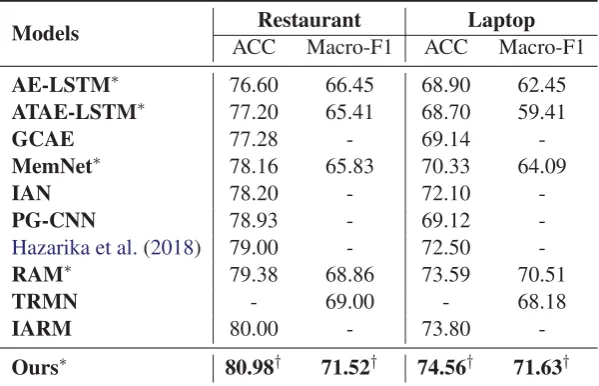
• IARM (Majumder et al., 2018) also
con-Models Restaurant Laptop
ACC Macro-F1 ACC Macro-F1
AE-LSTM∗ 76.60 66.45 68.90 62.45
ATAE-LSTM∗ 77.20 65.41 68.70 59.41
GCAE 77.28 - 69.14
-MemNet∗ 78.16 65.83 70.33 64.09
IAN 78.20 - 72.10
-PG-CNN 78.93 - 69.12
-Hazarika et al.(2018) 79.00 - 72.50
-RAM∗ 79.38 68.86 73.59 70.51
TRMN - 69.00 - 68.18
IARM 80.00 - 73.80
[image:6.595.149.449.63.256.2]-Ours∗ 80.98† 71.52† 74.56† 71.63†
Table 2: Comparisons with baselines and ablation experiments (%). The best results are in bold. The model with ∗means its result is the average value of 5 runs. The result with†means statistical significant at the level of 0.05 with the baselines tagged by∗.
centrates on inter-target dependencies by memory networks, instead of vanilla LSTM structure used in the model proposed byHazarika et al.(2018).
The comparisons with baseline methods are shown in Table 2. Our model significantly out-performs all the baselines. Except forAE-LSTM,
GCAE andPG-CNN, the other baseline models adopt attention mechanism to evaluate the correla-tion between target and context words. However, the attention score for each word is distributed si-multaneously according to simple computation by weight matrices. In our model, we intend to esti-mate the probability of being an opinion word at each time step based on the history information, such as previous soft labels and cell states, to take each word into account individually. Indeed, our model achieves significant improvements over the attention-based baseline models.
Moreover, we find that several baseline methods are based on memory networks, such asMemNet,
RAM, TRMNandIARM. Note that the memo-ries of these models are all based on the general sentence-level representations which might lose individual consideration and dilute the informa-tion of opinion words. Thus, it is better to take advantage of the history contexts and current word representation to consider each token individually instead of the overall sentence-level information.
Also, from the fact that IAN, which consid-ers the interaction between target and context to-kens, performs better thanAE-LSTMand ATAE-LSTM, we observe the importance of interaction
in this task. ThoughGCAEdoes not take context-aware representations into account, it still per-forms better than AE-LSTM and ATAE-LSTM
do. It demonstrates the effectiveness of GTRU and further justifies the necessity of interaction be-tween target and context. In our model, we em-phasize the interaction when fusing the target rep-resentation with the context word reprep-resentations and evaluating the correlation with targets to de-cide which information we should focus on more. The convolution layer has been proved to be good at extracting local active features. How-ever, the convolution based modelGCAEand PG-CNN behave poorly in this task because vanilla convolution based models tend to find the salient features in the whole sentence rather than figure out the active features which are strongly asso-ciated with the target. Intuitively, closer words are more likely to modify the given target, and some of the previous state-of-the-art models also consider the relative position factors. There-fore, inspired by them, we apply a convolution based model combined with position information to achieve better performance.
4.3 Ablation Study
Models Restaurant Laptop
ACC Macro-F1 ACC Macro-F1
Ours 80.98‡ 71.52‡ 74.56‡ 71.63‡
with Hard Labels 78.34 68.17 73.14 69.01
with Attention 79.01 68.61 73.35 69.18
w/o Convolution Layer 79.15 68.45 73.28 69.24
w/o Soft Labels 79.34 68.37 73.62 69.52
w/o History Information 79.53 67.98 73.07 69.17
with AVG 80.29 69.65 73.84 70.31
[image:7.595.133.464.64.217.2]w/o Positional Weights 80.54 69.95 73.65 70.44
Table 3: The results of ablation tests (%). The best results are in bold. w/o History Informationindicates the soft label approach without consideration of history information. with AVGindicates the target representation is replaced by the averaged target embeddings. The result with‡means statistical significant at the level of 0.05.
that we use the soft label approach based on his-tory information, such as previous soft labels and cell states, instead of using attention scores. To further confirm the effectiveness of the soft label strategy, we replace it with attention mechanism, which treats the target representation as a query and uses a weight matrix to compute the correla-tion between target and context words. The ex-perimental results show that the accuracy drops over 1.97% and 1.21% and Macro-F1 score drops 2.91% and 2.45% respectively. It strongly proves the effectiveness of our soft label strategy and the better performance can be attributed to the careful consideration of each word at each time step. Ad-ditionally, we compare our model with w/o His-tory Information, which does not feed previous time step’s soft label and cell states information into the input of the current time step and simply uses a weight matrix to project the hidden outputs to the values of soft labels. The improvements show that the history information is indispensable for the task. The whole process of determining the soft label value in our model is fairly similar to the process of people reading a sentence and predict-ing the sentiments for targets discussed in Section
1. Besides, our model outperformswith Hard La-bels, where the value of the label is either 0 or 1, because the soft approach can alleviate the prop-agation problem caused by hard decision. More-over, our model greatly improves the performance compared with w/o Soft Labels. Obviously, the history-based soft label approach has great effects.
As mentioned before, the interaction between target and context is important in this task. Com-pared with the model with AVG, our model has
Figure 2: Effect ofβon two datasets.
better performance on the two datasets for the tar-get representation of our model contains contex-tual information and thus is more informative. The results indeed prove the usefulness of strengthen-ing interaction. Lastly, without the convolution layer, the performance drops 1.83%, 1.28% on ac-curacy and 3.07%, 2.39% on Macro-F1 score re-spectively, suggesting that the convolution layer is capable of extracting active features for sentiment classification. Using relative distance information, our model greatly improves the performance of
w/o Positional Weights. It indicates that position-aware information is beneficial to our model.
4.4 Impact of Rate of Decaying on Positional Weights
[image:7.595.312.520.286.381.2]models on two datasets even if we do not opti-mize on β, suggesting that the other components of our model are effective. Besides, we observe that the performance tends to get better beforeβ reaches 40, and there is a downward trend after it. Whenβ equals 10, the rate of decaying is rel-atively fast. Since there are some long sentences in the datasets, the positional weights would lead to the loss of word information and result in worse performance. When β is large, like 100, the rate is slow and the positional weights may negligibly affect the classification process. Thus, it is neces-sary to choose a proper value forβ.
4.5 Case Study
To further manifest the performance of our pro-posed model, we choose a case and show it in a heatmap form. In this case, the input sentence is “Thedishtastes bad but itsvegetableis delicious though it looks ugly.”and the given target is“ veg-etable”. There are two targets and three important sentiment words (“bad”,“delicious”and“ugly”) in the sentence. The challenge the model faces is to find out which sentiment word contributes more to the sentiment polarity of “vegetable”. The upper part of Figure3is the visualization re-sult of with Attention instead of using our pro-posed soft label strategy. We can easily find that the model attends on all the three sentiment words listed before, especially on“bad”and“ugly”, and wrongly predicts the sentiment as a negative one. It partially justifies attention mechanism’s ability of extracting the sentiment words, but the wrong prediction could be attributed to the simultaneous weight distribution of attention scores and lack of individual consideration on each word.
Our proposed soft label approach is a good solu-tion that could deal with the difficulty of matching multiple opinion words to the given target. The lower part indicates the visualization result of the value of soft labels and represents the process of soft label computation from the beginning of the sentence to the end. Besides, the proportions of history informationgiare all above 0.4, except for those of“bad”and“delicious”, which are 0.217 and 0.105 respectively. The relatively small value means that there might be a sentiment change in the place of the word. When the model browses to the word“bad”, as words before do not con-tain strong emotions, the cell states are now com-bined with the sentiment information of “bad”.
When turning to “delicious”, the model recog-nizes that“delicious”is more relevant to the target while competing with the previous memory. Thus, its soft label’s value becomes higher than that of “bad”and the word accounts for relatively great proportion of the cell states. Lastly, the model considers the cell states containing the information of “delicious” are more closely connected with the target than the word“ugly”is. As a result, the value of the soft label of“ugly”is low. Since the value of the soft label of“delicious”is the highest among those of all the other tokens in the sentence, the model predicts the sentiment correctly. The complex case strongly demonstrates the effective-ness of finding correct opinion words for target.
5 Error Analysis
Though our model achieves good performance by adopting the soft label strategy, we find that our model fails to predict the sentiment correctly in some cases. For example, when predicting the sentiment of the target “staff” in the sentence “The staff should be a bit more friendly.”, our model tends to classify the sentiment as a posi-tive one because of the opinion word“friendly”. Actually, the modal verb“should”represents the implicit meaning that the staff is not friendly and the customer hopes the staff could change the atti-tude towards customers. Therefore, there is still a room for our model to mine the kind of im-plicit semantics, not only based on the exim-plicit opinion words. Additionally, we choose to detect the sentiment of“startup times” in the sentence “Startup timesare incredibly long: over two min-utes.” and find that our model wrongly predicts the sentiment as a positive one. Though“long” is usually used to praise the quality of battery, it represents negative meaning when modifying the “startup times”. The fact that the same opinion word represents totally different sentiments in dif-ferent contexts may lead to the error.
6 Conclusion and Future Work
The dish tastes bad but its vegetable is delicious though it looks ugly
with Attention Prediction: Negative
[image:9.595.75.524.69.178.2]Our model Prediction: Positive
Figure 3: Case study of our proposed model andwith Attentiondescribed in Section4.3. The given target is
“vegetable” and the sentiment towards it is positive. The deeper the blue is, the bigger the values of attention scores and soft labels are. Notice that the values of soft labels are normalized and they do not contain any position information.
the future, taking the encountered errors into ac-count, we will do further researches on mining im-plicit semantics and distinguishing different senti-ments expressed by the same opinion word in var-ious kinds of contexts.
Acknowledgement
We would like to thank the anonymous reviewers for the helpful discussions and suggestions. This work is supported by National Natural Science Foundation of China under Grant No.61876004, No.61751201 and M1752013. The corresponding author of this paper is Baobao Chang.
References
Sasha Blair-Goldensohn, Kerry Hannan, Ryan McDon-ald, Tyler Neylon, George A Reis, and Jeff Reynar. 2008. Building a sentiment summarizer for local service reviews. InWWW workshop on NLP in the information explosion era, volume 14, pages 339– 348.
Peng Chen, Zhongqian Sun, Lidong Bing, and Wei Yang. 2017. Recurrent attention network on mem-ory for aspect sentiment analysis. InProceedings of the 2017 Conference on Empirical Methods in Nat-ural Language Processing, pages 452–461. Associ-ation for ComputAssoci-ational Linguistics.
Shuqin Gu, Lipeng Zhang, Yuexian Hou, and Yin Song. 2018. A position-aware bidirectional atten-tion network for aspect-level sentiment analysis. In
Proceedings of the 27th International Conference on Computational Linguistics, pages 774–784. Associ-ation for ComputAssoci-ational Linguistics.
Devamanyu Hazarika, Soujanya Poria, Prateek Vij, Gangeshwar Krishnamurthy, Erik Cambria, and Roger Zimmermann. 2018. Modeling inter-aspect dependencies for aspect-based sentiment analysis. InProceedings of the 2018 Conference of the North
American Chapter of the Association for Computa-tional Linguistics: Human Language Technologies, Volume 2 (Short Papers), pages 266–270. Associa-tion for ComputaAssocia-tional Linguistics.
Sepp Hochreiter and J¨urgen Schmidhuber. 1997. Long short-term memory. Neural computation, 9(8):1735–1780.
Binxuan Huang and Kathleen Carley. 2018. Parameter-ized convolutional neural networks for aspect level sentiment classification. InProceedings of the 2018 Conference on Empirical Methods in Natural Lan-guage Processing, pages 1091–1096. Association for Computational Linguistics.
Binxuan Huang, Yanglan Ou, and Kathleen M. Car-ley. 2018. Aspect level sentiment classification with attention-over-attention neural networks. InSocial, Cultural, and Behavioral Modeling - 11th Interna-tional Conference, SBP-BRiMS 2018, Washington, DC, USA, July 10-13, 2018, Proceedings, pages 197–206.
Long Jiang, Mo Yu, Ming Zhou, Xiaohua Liu, and Tiejun Zhao. 2011. Target-dependent twitter senti-ment classification. InProceedings of the 49th An-nual Meeting of the Association for Computational Linguistics: Human Language Technologies-Volume 1, pages 151–160. Association for Computational Linguistics.
Rie Johnson and Tong Zhang. 2015. Semi-supervised convolutional neural networks for text categoriza-tion via region embedding. InAdvances in neural information processing systems, pages 919–927. Yoon Kim. 2014. Convolutional neural networks for
sentence classification. InProceedings of the 2014 Conference on Empirical Methods in Natural Lan-guage Processing (EMNLP), pages 1746–1751. As-sociation for Computational Linguistics.
Svetlana Kiritchenko, Xiaodan Zhu, Colin Cherry, and Saif Mohammad. 2014. Nrc-canada-2014: Detect-ing aspects and sentiment in customer reviews. In
Proceedings of the 8th International Workshop on Semantic Evaluation (SemEval 2014), pages 437– 442.
Yann LeCun, Bernhard Boser, John S Denker, Don-nie Henderson, Richard E Howard, Wayne Hubbard, and Lawrence D Jackel. 1989. Backpropagation ap-plied to handwritten zip code recognition. Neural computation, 1(4):541–551.
Xin Li, Lidong Bing, Wai Lam, and Bei Shi. 2018. Transformation networks for target-oriented senti-ment classification. InProceedings of the 56th An-nual Meeting of the Association for Computational Linguistics (Volume 1: Long Papers), pages 946– 956. Association for Computational Linguistics. Jiangming Liu and Yue Zhang. 2017. Attention
mod-eling for targeted sentiment. InProceedings of the 15th Conference of the European Chapter of the As-sociation for Computational Linguistics: Volume 2, Short Papers, pages 572–577. Association for Com-putational Linguistics.
Dehong Ma, Sujian Li, Xiaodong Zhang, and Houfeng Wang. 2017. Interactive attention networks for aspect-level sentiment classification. In Proceed-ings of the Twenty-Sixth International Joint Con-ference on Artificial Intelligence, IJCAI 2017, Mel-bourne, Australia, August 19-25, 2017, pages 4068– 4074.
Navonil Majumder, Soujanya Poria, Alexander Gel-bukh, Md Shad Akhtar, Erik Cambria, and Asif Ek-bal. 2018. Iarm: Inter-aspect relation modeling with memory networks in aspect-based sentiment analy-sis. InProceedings of the 2018 Conference on Em-pirical Methods in Natural Language Processing, pages 3402–3411.
Jeffrey Pennington, Richard Socher, and Christopher Manning. 2014. Glove: Global vectors for word representation. In Proceedings of the 2014 Con-ference on Empirical Methods in Natural Language Processing (EMNLP), pages 1532–1543. Associa-tion for ComputaAssocia-tional Linguistics.
Maria Pontiki, Dimitris Galanis, John Pavlopoulos, Harris Papageorgiou, Ion Androutsopoulos, and Suresh Manandhar. 2014. Semeval-2014 task 4: As-pect based sentiment analysis. InProceedings of the 8th International Workshop on Semantic Evaluation (SemEval 2014), pages 27–35, Dublin, Ireland. As-sociation for Computational Linguistics and Dublin City University.
Mike Schuster and Kuldip K Paliwal. 1997. Bidirec-tional recurrent neural networks. IEEE Transactions on Signal Processing, 45(11):2673–2681.
Duyu Tang, Bing Qin, Xiaocheng Feng, and Ting Liu. 2016a. Effective lstms for target-dependent sen-timent classification. In Proceedings of COLING
2016, the 26th International Conference on Compu-tational Linguistics: Technical Papers, pages 3298– 3307. The COLING 2016 Organizing Committee. Duyu Tang, Bing Qin, and Ting Liu. 2016b. Aspect
level sentiment classification with deep memory net-work. In Proceedings of the 2016 Conference on Empirical Methods in Natural Language Process-ing, pages 214–224. Association for Computational Linguistics.
Yi Tay, Luu Anh Tuan, and Siu Cheung Hui. 2017. Dyadic memory networks for aspect-based senti-ment analysis. In Proceedings of the 2017 ACM on Conference on Information and Knowledge Man-agement, CIKM 2017, Singapore, November 06 - 10, 2017, pages 107–116.
Shuai Wang, Sahisnu Mazumder, Bing Liu, Mianwei Zhou, and Yi Chang. 2018. Target-sensitive mem-ory networks for aspect sentiment classification. In
Proceedings of the 56th Annual Meeting of the As-sociation for Computational Linguistics (Volume 1: Long Papers), volume 1, pages 957–967.
Yequan Wang, Minlie Huang, Xiaoyan Zhu, and Li Zhao. 2016. Attention-based lstm for aspect-level sentiment classification. InProceedings of the 2016 Conference on Empirical Methods in Natural Lan-guage Processing, pages 606–615. Association for Computational Linguistics.
Wei Xue and Tao Li. 2018. Aspect based sentiment analysis with gated convolutional networks. In Pro-ceedings of the 56th Annual Meeting of the Associa-tion for ComputaAssocia-tional Linguistics (Volume 1: Long Papers), pages 2514–2523. Association for Compu-tational Linguistics.