Proceedings of NAACL-HLT 2018, pages 340–345
Identifying the Most Dominant Event in a News Article by Mining Event
Coreference Relations
Prafulla Kumar Choubey, Kaushik Raju, Ruihong Huang Department of Computer Science and Engineering
Texas A&M University
(prafulla.choubey, kaushik.raju, huangrh)@tamu.edu
Abstract
Identifying the most dominant and central event of a document, which governs and con-nects other foreground and background events in the document, is useful for many applica-tions, such as text summarization, storyline generation and text segmentation. We ob-served that the central event of a document usually has many coreferential event mentions that are scattered throughout the document for enabling a smooth transition of subtopics. Our empirical experiments, using gold event coref-erence relations, have shown that the central event of a document can be well identified by mining properties of event coreference chains. But the performance drops when switching to system predicted event coreference relations. In addition, we found that the central event can be more accurately identified by further con-sidering the number of sub-events as well as the realis status of an event.
1 Introduction
According to the grounding principles (Grimes, 1975), a document consists of foreground events that form the skeleton of the story and move the story forward, and background events that add supportive information. Studies have shown that a foreground event tends to be the most impor-tant event in a sentence, which is usually the event that appears in the main clause, is active voiced, and has a high transitivity1 (Decker, 1985). But
among multiple foreground events, which one is most central to the overall story? We propose a new task of detecting the most dominant event in a news article, which is an event assumed to gov-ern and connect other foreground events and back-ground events. In other words, removal of the cen-tral event can break the entirety of a document and
1High transitivity events have certain properties, are
voli-tional, affirmative, realis etc.
Figure 1: An example document to illustrate the cen-tral event of a document. Red colored words are foreground events, blue colored words are background events and mentions of the central event are in bold.
decompose the document into sections describing disjoint sets of situations. Identifying the central event of a document is clearly important for a wide range of NLP applications, including text summa-rization, storyline generation and text segmenta-tion.
The intuitive observation is that the central event of a document usually has a large number of coreferential event mentions and those coref-erential mentions are spread throughout the doc-ument. In Figure1, the paragraphs 1-4 each de-scribe a relatively independent subtopic and the re-peated mentions of the central event “demonstra-tion” throughout the document enable a smooth flow of information. For the same reason, identi-fying the central event facilitates partitioning text into coherent segments. But note that, the central event may not be the most newsworthy event that serves as the trigger for writing an article, and thus may not appear in the title or in the first sentence of a new article. As illustrated in this example, the trigger event is “protesters leave capitol”, while
the central event is “demonstration”, the event that effectively connects other foreground events and background events and makes the story an entirety. To systematically verify these observations, we annotated central events in news articles taken from two publicly available datasets, the richer event description (RED) (O’Gorman et al.,2016) and KBP 2015 (Mitamura et al., 2015) corpora. While whether each news article has only one cen-tral event is arguable, our two annotators agreed on the same central event in 97 out of 104 (93%) documents that we annotated. We then designed several rule-based methods to identify the central event by exploiting human annotated event coref-erence relations. Experimental results showed that indeed in around 75% of the documents in both corpora, the central event either has the largest number of coreferential event mentions or has the largest stretch size (i.e., the number of sentences between the first mention and the last mention of the central event) in the discourse. In addition, we found that the central event can be more accu-rately identified by further considering the num-ber of sub-events as well as the realis status of an event, which indicate if an event is an actual specific event or a generic event etc. The evalua-tion shows that the insightful rules outperform sev-eral strong baseline approaches, including sevsev-eral heuristic based methods and random walk based event ranking methods, as well as two regression classifiers that integrate these rules as features.
2 Related Work
Many previous works studied the parameters that determine the overall quality of an individ-ual event, including actindivid-ualization (Tasaku,1981), transitivity (Hopper and Thompson, 1980; Tsun-oda, 1985) and the broader concept of eventive-ness (Monahan and Brunson, 2014). However, these atomic qualities defined for an individual event are inadequate in distinguishing the key foreground event in a document.
In concurrent works, Decker (1985); Kay and Aylett (1996) focused on distinguishing fore-ground events from backfore-ground events in a sen-tence and proposed that the most important event within a sentence is usually the event that appears in the main clause, is active voiced, and has a high transitivity. Upadhyay et al.(2016) applied these rules to identifying the trigger event of a news ar-ticle by identifying the most important event in a
human-generated document summary.
Recognizing document-level central events has been shown important for text summarization. Fi-latova and Hatzivassiloglou (2004a,b) used nor-malized frequencies of co-referential event men-tions as parameters to prioritize events to be in-cluded in a summary and found that this helped in generating better text summaries, despite its being an elementary measure. Our experiments showed that in addition to the number of co-referential event mentions, discourse layout features includ-ing both the stretch of an event chain and early presences of event mentions are key factors in identifying the central event of a document.
Graph-based methods (Mihalcea and Tarau, 2004) have been widely used to identify keywords and phrases in a document by constructing a word/ phrase graph and applying random walk algo-rithms (Brin and Page,2012) on the graph. We im-plemented random walk based methods for iden-tifying the central event as well, which however did not perform well. Mainly, the random walk based ranking strategy determines the importance of an events based on the importance of its related events in a document graph, which does not ef-fectively capture discourse layout features of co-referential event mentions, which are important for identifying the central event of a document.
3 Central Event Annotations
We annotated central events for 30 news articles from the RED corpus2 and 74 news articles from
the KBP 2015 corpus3. We asked two annotators
to identify the most dominant event that connects other foreground and background events. Both the documents and the gold event mentions for each document inherited from the previous RED and KBP annotations were provided to annotators. The annotators were instructed to select only one event as the central event. For 26 documents from the RED corpus and 71 documents from the KBP
2The RED corpus contains 95 documents in total.
How-ever, 65 documents are news summaries, discussion forum posts or web posts. The central event as defined should only be considered for natural coherent texts, therefore, the anno-tations were only conducted for the 30 news articles in the corpus.
3The KBP 2015 corpus contains 158 documents, where
corpus, both annotators identified the same central event. For the other 7 documents, where the two annotators disagreed on the central event, we kept the annotations from the first annotator.
4 Characteristics of Central Events We analyzed the distributional properties of cen-tral events in the first 10 documents from the RED corpus. The findings are summarized below.
Frequent and Extended Repetitions: As shown in Figure 1, the central event is usually repeated throughout the document. This observation can also be accounted to the way humans produce and comprehend language. Language is inherently se-quential and a writer repeats the same event to re-mind the readers about the main event. Therefore, the frequent and extended repetitions of the cen-tral event facilitate to minimize the cognitive effort needed by the reader for understanding a text.
Early Presences: News articles mostly begin with a summary of important events and continue to elaborate them in subsequent paragraphs. To some extent, the objective of initial paragraphs is to di-rect readers’ attention toward the main subject. Therefore, while the central event may not always appear in the title or in the first sentence of a new article, the central event often appears early in the beginning paragraphs.
Sub-events: Being the most dominant event in a document, the central event often has many sub-events that are present to elaborate and support the central event.
Event Realis Status: Central events are usually specific and have actually occurred. This event at-tribute has been defined as the contextual modality in RED corpus4 and realis status in KBP corpus5
and we observed that this attribute is “Actual” for the majority of central events.
5 Central Event Identification
Inspired by the identified characteristics of central events, we designed rule-based classifiers that rely on the following four ranking critera.
Size Rank: calculated using the number of coref-erential event mentions in a event coreference chain. The event having the largest number of coreferential mentions is ranked the highest.
4defines 4 types of contextual modality, namely, actual,
hypothetical, uncertain/ hedged and generic
5defines 3 realis status types, namely, actual, generic and
other
Stretch Rank: based on the number of sentences between the first and the last mention of an event. The event with the largest stretch size is ranked the highest.
Position Rank: based on the sentence number in which an event was first mentioned. This measure is to capture the characteristic that central events tend to appear early in a document.
Enriched Size Rank: This rank is based on the sum of the number of coreferential mentions for an event and the number of its sub-events.
Input: central event candidates,EZ, ET, EP, EE, ER Output:Ecenter
Ecenter:=φ
Coreference
Ecenter:=EZ∩ET∩EP
ifEcenter==φ: Ecenter:= (EZ∪ET)∩EP
ifEcenter==φ: Ecenter:=EP
returnEcenter
Coreference + Subevent
Ecenter:=EZ∩ET∩EP ∩EE
ifEcenter==φ: Ecenter:= (EZ∪ET)∩EP∩EE
ifEcenter==φ: Ecenter:=EP∩EE
ifEcenter==φ: Ecenter:=EP
returnEcenter
Coreference + Subevent + Realis Ecenter:=EZ∩ET∩EP ∩EE∩ER
ifEcenter ==φ: Ecenter := (EZ∪ET)∩EP ∩
EE∩ER
ifEcenter==φ: Ecenter:=EP∩EE∩ER
ifEcenter==φ: Ecenter:=EP∩EE
ifEcenter==φ: Ecenter:=EP
returnEcenter
5.1 Rule Based Classifiers
First, we identify central event candidates by re-quiring their size rank in the top three positions. Note that more than three events may be selected if there are ties in any of the top three positions. Then, we identify the central event in the can-didate set by requiring different combinations of the highest ranks, including the highest size rank
EZ, highest stretch rankET, highest position rank EP and highest enriched size rank EE. In
addi-tion, we identify an event setER which includes
5.2 Statistical Regression Classifiers
We trained a linear as well as a nonlinear regres-sion classifier to integrate the same set of rank-ing rules as features for identifyrank-ing central events, by using the standard ordinary least squareslinear regression(Galton,1886) model and the epsilon-support vector regression (SVR) (Vapnik, 1995) model with radial basis function kernel respec-tively. Input to both the linear and nonlinear regression classifiers consists of 20 (19) dimen-sional vector, 4 dimendimen-sional categorical vector for each of the size, stretch, position and enriched size ranks and 4 (3) dimensional categorical vec-tor for realis attribute for RED (KBP) corpus. The models were implemented using scikit-learn mod-ule (Pedregosa et al., 2011). The SVR classifier usesrbfkernel with γ coefficient of 0.05 and all
other parameters are left to be the default values.
5.3 Coreference: Predicted
We further used system predicted coreference re-lations to calculate size, stretch and position ranks and used them to identify central events, where coreference relations were predicted by a neural network based pairwise classifier using event lem-mas, parts-of-speech tags and event arguments as features. The classifier was trained on the corpus used in the Event Nugget Detection and Corefer-ence task in the TAC KBP 2016 (Ellis et al.,2015). Specifically, the classifier uses a common neu-ral layer shared between two event mentions that embed event lemma and parts-of-speech tags and then calculates cosine similarity, absolute and eu-clidean distances between two event embeddings. Classifier also includes a neural layer component to embed event arguments that are overlapped be-tween the two event mentions. Its output layer takes the calculated cosine similarity, euclidean and absolute distances between event mention em-beddings as well as the embedding of the over-lapped event arguments as input, and output a con-fidence score to indicate the similarity of the two event mentions6. We used 300 dimensional word
embeddings (Pennington et al.,2014) and one hot 377dimensional pos tag embeddings. In addition,
we used (Lewis et al.,2015) for semantic role la-beling to obtain event arguments.
6We implemented our classifier using the Keras
li-brary (Chollet,2015)
7Corresponding to the unique 36 POS tags based on the
Stanford POS tagger (Toutanova et al.,2003) and an addi-tional ’padding’.
6 Evaluation
6.1 Baseline Systems
Three Heuristics Based Classifiers: The three systemsMain event: Headline,First event: First sentenceandMain event: First sentencechose the main event (syntactic root) in headline, the first event in the first sentence and the main event (syn-tactic root) in the first sentence as the center event respectively.
Random Walk Based Ranking Systems: imple-mented the random walk based vertex ranking al-gorithm (Mihalcea and Tarau, 2004) on graphs generated using human annotated event relations. The motivation is to decide the importance of an event mention within an event graph of a docu-ment8based on the importance of its related event
mentions9. The system Random walk: All Re-lationsuses coreference, sub-event, set/ member, temporal and causal relations to build the graph while the system Random walk: Coref+SE only considers event coreference and sub-event rela-tions. We evaluate both systems on documents from the RED corpus only as it extensively an-notates event relations which yields a connected graph for each document. However, the graphs generated for documents in the KBP corpus often contain many disconnected components and thus are not suitable for these systems.
6.2 Results
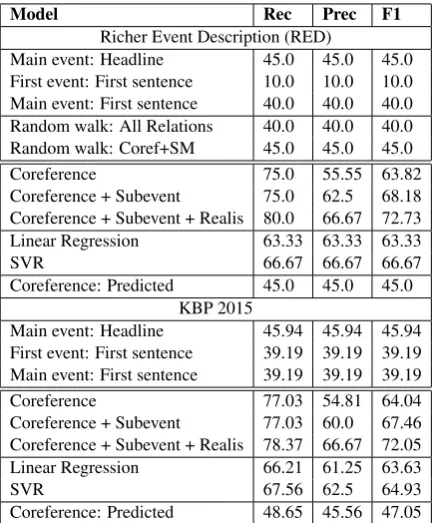
We evaluated all the systems using the rest 20 doc-uments from the RED corpus and all the 74
docu-8We build an event graph for a document by using
undi-rected edges for coreference relations and diundi-rected edges for other relations including set/ member, sub-event, temporal and causal relations. This is mainly meant to retain the sym-metrical property of coreference relations. Moreover, since coreference link can easily create cycles in the graph, we uti-lize its transitivity property and link all the coreferent event mentions to its first instance in the document only.
9We rank event mentions by using the vertex scoring
al-gorithm proposed inBrin and Page(2012).
S(Vi) = (1−d) +d
X
j=IN(Vi) 1 |OU T(Vj)|
S(Vj) (1)
whereIN(Vi)andOU T(Vj)represent the set of event
men-tions that are predecessors and successors toVirespectively.
Model Rec Prec F1
Richer Event Description (RED)
Main event: Headline 45.0 45.0 45.0 First event: First sentence 10.0 10.0 10.0 Main event: First sentence 40.0 40.0 40.0 Random walk: All Relations 40.0 40.0 40.0 Random walk: Coref+SM 45.0 45.0 45.0
Coreference 75.0 55.55 63.82
Coreference + Subevent 75.0 62.5 68.18 Coreference + Subevent + Realis 80.0 66.67 72.73 Linear Regression 63.33 63.33 63.33
SVR 66.67 66.67 66.67
Coreference: Predicted 45.0 45.0 45.0 KBP 2015
Main event: Headline 45.94 45.94 45.94 First event: First sentence 39.19 39.19 39.19 Main event: First sentence 39.19 39.19 39.19
Coreference 77.03 54.81 64.04
Coreference + Subevent 77.03 60.0 67.46 Coreference + Subevent + Realis 78.37 66.67 72.05 Linear Regression 66.21 61.25 63.63
SVR 67.56 62.5 64.93
[image:5.595.73.291.61.323.2]Coreference: Predicted 48.65 45.56 47.05
Table 1: Experimental Results.
ments from the KBP 2015 corpus. The two regres-sion classifiers were evaluated using 5-fold cross-validation on each corpus. We expect a system to identify only one central event for each document. If a system predicts more than one central event, we will penalize the system on precision strictly and treat each wrongly predicted event as a false hit. Table1shows the comparison results.
The heuristic based systems obtained a low re-call on both corpora, which indicates that simple heuristics miss a large proportion of cases. Both random walk based systems suffered from a low recall of 40-45% as well when applied to the RED corpus, due to the fact that graph-based ranking models do not effectively capture discourse layout features of co-referential event mentions.
In contrast, the rule based system Coreference
achieved the recall above 75% on both corpora when using annotated event coreference relations. The system Coreference + Subevent + Realis
further improves the precision of central event identification by over 11% on both corpora af-ter considering subevents and the realis status in the rules, which facilitate accurate identification of the central event among multiple foreground events. The high recall and precision indicate that the insightful rules exploiting properties of event chains are able to capture the overall texture in the discourse. Then compared with rule based
systems, the two statistical classifiers that inte-grate the same set of rules as features do not fur-ther improve the central event identification per-formance. But when using system predicted noisy event coreference relations, the rule based system
Coreference: Predicted performed dramatically worse than its counterpart using gold event chains (systemCoreference + Subevent + Realis). This is unsurprising though considering the relatively low performance of current event coreference res-olution systems.
6.3 Analysis
To gain a better understanding of how noise in sys-tem predicted event coreference links influences central event identification performance, we an-alyzed the documents where the system Coref-erence: Predicted failed to identify the central event. We found that both types of event coref-erence resolution errors, missed corefcoref-erence links as well as wrong links, cause problems, especially in calculating the Size Rank and the Stretch Rank for an event. Specifically, the first type of errors can demote both ranks of the correct central event while the second type of errors can wrongly pro-mote one of the two ranks for non-central events.
7 Conclusions
We have presented a new task of identifying the central event for a document. Based on our an-notations, we discussed the role of central events in enabling a coherent discourse and the distri-butional characteristics of central events. We es-pecially emphasized on the importance of event coreference in identifying central events. Inspired by these observations, we designed a rule-based classifier that achieved high recall and precision in identifying central events. The low perfor-mance of the classifier using system predicted event coreference relations indicates that signifi-cant efforts are needed to further improve event coreference resolution performance in the future.
Acknowledgments
References
Sergey Brin and Lawrence Page. 2012. Reprint of: The anatomy of a large-scale hypertextual web search engine.Computer networks56(18):3825–3833.
Franc¸ois Chollet. 2015. Keras. https://github. com/fchollet/keras.
Nan Decker. 1985. The use of syntactic clues in dis-course processing. InProceedings of the 23rd an-nual meeting on Association for Computational Lin-guistics. Association for Computational Linguistics, pages 315–323.
Joe Ellis, Jeremy Getman, Dana Fore, Neil Kuster, Zhiyi Song, Ann Bies, and Stephanie Strassel. 2015. Overview of linguistic resources for the tac kbp 2015 evaluations: Methodologies and results. In Proceed-ings of TAC KBP 2015 Workshop, National Institute of Standards and Technology. pages 16–17.
Elena Filatova and Vasileios Hatzivassiloglou. 2004a. Event-based extractive summarization. In Pro-ceedings of ACL Workshop on Summarization. Barcelona, Spain., volume 111.
Elena Filatova and Vasileios Hatzivassiloglou. 2004b. A formal model for information selection in multi-sentence text extraction. In Proceedings of the 20th international conference on Computational Linguistics. Association for Computational Linguis-tics, page 397.
Francis Galton. 1886. Regression towards mediocrity in hereditary stature. The Journal of the Anthro-pological Institute of Great Britain and Ireland 15:246–263.
Joseph Evans Grimes. 1975. The thread of discourse, volume 207. Walter de Gruyter.
Paul J Hopper and Sandra A Thompson. 1980. Tran-sitivity in grammar and discourse. languagepages 251–299.
Roderick Kay and Ruth Aylett. 1996. Transitivity and foregrounding in news articles: Experiments in
in-formation retrieval and automatic summarising. In
Proceedings of the 34th Annual Meeting on Associ-ation for ComputAssoci-ational Linguistics. AssociAssoci-ation for Computational Linguistics, Stroudsburg, PA, USA, ACL ’96, pages 369–371. https://doi.org/ 10.3115/981863.981918.
Mike Lewis, Luheng He, and Luke Zettlemoyer. 2015. Joint a* ccg parsing and semantic role labelling. In EMNLP. pages 1444–1454.
Rada Mihalcea and Paul Tarau. 2004. Textrank: Bring-ing order into text. In EMNLP. volume 4, pages 404–411.
Teruko Mitamura, Zhengzhong Liu, and Eduard Hovy. 2015. Overview of tac kbp 2015 event nugget track. InText Analysis Conference.
Sean Monahan and Mary Brunson. 2014. Qualities of eventiveness. InProceedings of the Second Work-shop on EVENTS: Definition, Detection, Corefer-ence, and Representation. pages 59–67.
Tim O’Gorman, Kristin Wright-Bettner, and Martha Palmer. 2016. Richer event description: Integrating event coreference with temporal, causal and bridg-ing annotation. Computing News Storylinespage 47.
F. Pedregosa, G. Varoquaux, A. Gramfort, V. Michel, B. Thirion, O. Grisel, M. Blondel, P. Pretten-hofer, R. Weiss, V. Dubourg, J. Vanderplas, A. Pas-sos, D. Cournapeau, M. Brucher, M. Perrot, and E. Duchesnay. 2011. Scikit-learn: Machine learning in Python. Journal of Machine Learning Research 12:2825–2830.
Jeffrey Pennington, Richard Socher, and Christopher D Manning. 2014. Glove: Global vectors for word representation. InEMNLP. volume 14, pages 1532– 1543.
Tsunoda Tasaku. 1981. Split case-marking patterns in verb-types and tense/aspect/mood.Linguistics 19(5-6):389–438.
K. Toutanova, D. Klein, C. Manning, and Y. Singer. 2003. Feature-Rich Part-of-Speech Tagging with a Cyclic Dependency Network. InProceedings of HLT-NAACL 2003.
Tasaku Tsunoda. 1985. Remarks on transitivity. Jour-nal of linguisticspages 385–396.
Shyam Upadhyay, Christos Christodoulopoulos, and Dan Roth. 2016. ” making the news”: Identifying noteworthy events in news articles. InProceedings of the Fourth Workshop on Events. pages 1–7. Vladimir N. Vapnik. 1995. The Nature of Statistical