Review Article
Effects of goal directed therapy for adult patients in
sepsis: a systemic review and meta-analysis of
randomized controlled trials
Xiabing Lang, Yi Yang, Ping Zhang, Wenhua Lei, Jianghua Chen
Kidney Disease Center, The First Affiliated Hospital, College of Medicine, Zhejiang University, Hangzhou, P. R.
China
Received October 26, 2016; Accepted December 29, 2016; Epub March 15, 2017; Published March 30, 2017
Abstract: Backgroud:The effectiveness of goal directed therapy (GDT) as a key strategy to decrease mortality is uncertain among patients with sepsis or septic shock. Objective and methods: We conducted a systematic review and meta-analysis using the MEDLINE database (1996 through April 2015), EMBASE (1988 through April 2015). Randomized controlled trials comparing outcome with or without GDT to decrease mortality among adult patients
with sepsis or septic shock were identified. Results: 15 studies (5356 participants) were included. GDT decreased
the overall mortality for adult patients with sepsis compared to the control group (risk ratio [RR]=0.86; 95% CI=0.76 to 0.97; P=0.02; I2=56%) with marginal statistical significance. GDT also associated with shorter length of ICU stay (mean difference, -1.56; 95% CI=-3.06- -0.07; P<0.00001), more dobutamine use (RR=2.80; 95% CI=1.24-6.33; P=0.01; I2=95%). But there was no difference in length of hospital stay, incidence of MODS, renal dysfunction and
amount of intravenous fluid. The timing and pretreatment prior to randomization for resuscitation suggested that a mortality benefit was enhanced in the subgroup of EGDT without administration of fluids prior to randomization (6
trials; RR=0.73; 95% CI=0.65-0.82; P<0.00001; I2=0%). No benefit of GDT was seen if there was a pretreatment
with intravenous fluids prior to randomization (3 trials; RR=1.02; 95% CI=0.91-1.15; P=0.72; I2=0%) or GDT more than 6 hours (6 trials; RR=0.90; 95% CI=0.66-1.23; P=0.53; I2=59%). Conclusion: GDT might be beneficial for the
adult patients undergoing sepsis. Early fluid resuscitation rather than the specific protocols for resuscitation have more benefit in sepsis management.
Keywords: Goal directed therapy, sepsis, septic shock, mortality, intravenous fluid, organ failure, meta
Introduction
Sepsis and septic shock are the most common and severe cause of morbidity and mortality among critically ill patient [1]. The reported annual incidence in adults is up to 300 cases per 100,000 population [2-4]. It often compli-cates with multiple organ dysfunction syn-drome (MODS), especially acute kidney injury (AKI), leading to a worse prognosis.
Goal-directed therapy (GDT) is therapeutic
measures including intravenous fluids, red cell
transfusion and vasoactive drug
administra-tion, aiming to achieve specific haemodynamic
goals. GDT has been confers a protective action on surgical patients to decreased perioperative complications [5], including the risk of renal
dysfunction [6]. It has also been used for sepsis
or septic shock in the intensive care unit (ICU)
or emergency department (ED). The Surviving Sepsis Campaign guidelines recommend early initiation of GDT (EGDT), which the GDT is initi-ated within 6 hours for septic patient [7]. This is largely supported by the results of the Rivers and colleagues [8]. This single-center
random-ized controlled trial (RCT) showed the signifi -cantly reduction of mortality in those treated according to a 6-hour protocol of EGDT com-pared to the usual care group (30.5% vs. 46.5%). However, 3 large RCTs lately had
con-flicting results [9-11]. Published data are still
To addressing these questions, we systemati-cally evaluating the available evidence and per-formed a meta-analysis of RCTs. We focused on the effects of GDT (or EGDT) on the survival of adult patients with sepsis or septic shock. As the secondary objectives, we also assessed
the differences in the length of ICU and hospi -tal stays, the incidence of organ dysfunction,
the intravenous fluid and dobutamine use in
these trials.
Materials and methods Search strategy
Electronic searches were performed using MEDLINE (1966 through April 2015) and EMBASE (1988 through April 2015). The follow-ing Medical Subject Headfollow-ings terms and text words were used: sepsis, septic*, pyemia*, pyo-hemia*, pyaemia*, directedtherapy,
goal-directed resuscitation, GDT, fluid administra -tion. We also searched the references of the included studies and recent review articles. There were no language restrictions. To ascer-tain the inclusion criteria conformity, 2 of the authors (P.Z. and L.WH.) independently ana-lyzed titles and abstracts of these articles. The full text was reviewed if the title and abstract was unclear with regard to its admissibility. We used the Cochrane Collaboration methodol-ogy to undertake [12], and follow the PRISMA
adult patients with sepsis or septic shock or a subgroup of the trial population; (4) The studies had to reported the overall mortality rate. The primary outcome measure was the overall mortality, which means the hospital mortality or the only data of mortality if there was only one time point. Secondary outcome measures
included the length of ICU and hospital stay,
incidence of organ dysfunction, the amount of
intravenous fluid and incidence of dobutamine
use.
Data extraction
We used a standardized data extraction form and two reviewers (P.Z. and L.XB.) extracted data separately from the including studies. When there were any discrepancies between the 2 reviewers, an arbitrator (Y.Y.) made a deci-sion by discusdeci-sion with them. And they also assessed each studies and extracted data about demographic characteristics of patients, clinical setting, protocol for GDT and control therapy, hospital mortality, incidence of organ
dysfunction, the amount of intravenous fluids
and incidence of dobutamine use. Study validity assessment
[image:2.612.89.376.71.299.2]Studies included in the meta-analysis were evaluated for methodological quality using the
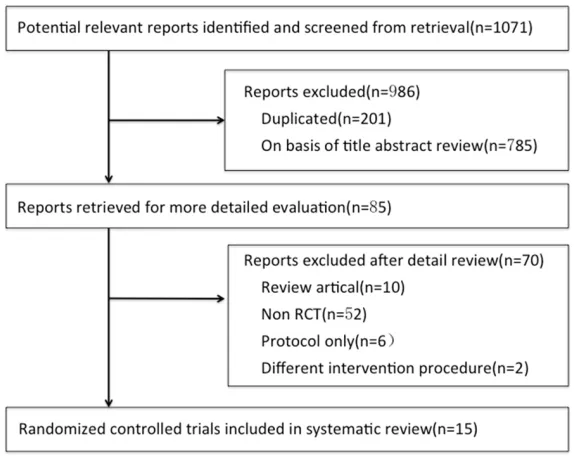
Figure 1. Flowchart of article selection. Abbreviation: RCT, randomized con-trolled trial.
(Preferred Reporting Items for Systematic Reviews and Meta-Analyses) statement to report our meta-analysis [13]. Since it was a meta-analysis, there was no need to have ethical approval and patient consent.
Study selection
Eligible studies had the follow-ing characteristics: (1) they were randomized controlled trials of GDT for sepsis or
sep-tic shock; (2) GDT was defined
as therapeutic measures in-
cluding intravenous fluids, red
cell transfusion and vasoac-tive drug administration to
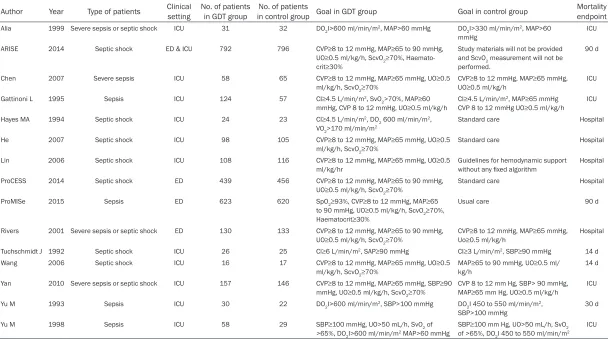
Table 1. Demographic data of included trials
Author Year Type of patients Clinical setting No. of patients in GDT group in control group Goal in GDT groupNo. of patients Goal in control group Mortality endpoint
Alia 1999 Severe sepsis or septic shock ICU 31 32 DO2I>600 ml/min/m2, MAP>60 mmHg DO
2I>330 ml/min/m2, MAP>60 mmHg
ICU
ARISE 2014 Septic shock ED & ICU 792 796 CVP≥8 to 12 mmHg, MAP≥65 to 90 mmHg, UO≥0.5 ml/kg/h, ScvO2≥70%, Haemato
-crit≥30%
Study materials will not be provided and ScvO2 measurement will not be performed.
90 d
Chen 2007 Severe sepsis ICU 58 65 CVP≥8 to 12 mmHg, MAP≥65 mmHg, UO≥0.5
ml/kg/h, ScvO2≥70%
CVP≥8 to 12 mmHg, MAP≥65 mmHg, UO≥0.5 ml/kg/h
ICU
Gattinoni L 1995 Sepsis ICU 124 57 CI≥4.5 L/min/m2, SvO
2>70%, MAP≥60
mmHg, CVP 8 to 12 mmHg, UO≥0.5 ml/kg/h
CI≥4.5 L/min/m2, MAP≥65 mmHg
CVP 8 to 12 mmHg UO≥0.5 ml/kg/h ICU
Hayes MA 1994 Septic shock ICU 24 23 CI≥4.5 L/min/m2, DO
2 600 ml/min/m2, VO2>170 ml/min/m2
Standard care Hospital
He 2007 Septic shock ICU 98 105 CVP≥8 to 12 mmHg, MAP≥65 mmHg, UO≥0.5
ml/kg/h, ScvO2≥70% Standard care Hospital
Lin 2006 Septic shock ICU 108 116 CVP≥8 to 12 mmHg, MAP≥65 mmHg, UO≥0.5
ml/kg/hr
Guidelines for hemodynamic support
without any fixed algorithm
Hospital
ProCESS 2014 Septic shock ED 439 456 CVP≥8 to 12 mmHg, MAP≥65 to 90 mmHg,
UO≥0.5 ml/kg/h, ScvO2≥70%
Standard care Hospital
ProMISe 2015 Sepsis ED 623 620 SpO2≥93%, CVP≥8 to 12 mmHg, MAP≥65
to 90 mmHg, UO≥0.5 ml/kg/h, ScvO2≥70%, Haematocrit≥30%
Usual care 90 d
Rivers 2001 Severe sepsis or septic shock ED 130 133 CVP≥8 to 12 mmHg, MAP≥65 to 90 mmHg, UO≥0.5 ml/kg/h, ScvO2≥70%
CVP≥8 to 12 mmHg, MAP≥65 mmHg, Uo≥0.5 ml/kg/h
Hospital
Tuchschmidt J 1992 Septic shock ICU 26 25 Cl≥6 L/min/m2, SAP≥90 mmHg CI≥3 L/min/m2, SBP≥90 mmHg 14 d
Wang 2006 Septic shock ICU 16 17 CVP≥8 to 12 mmHg, MAP≥65 mmHg, UO≥0.5
ml/kg/h, ScvO2≥70%
MAP≥65 to 90 mmHg, UO≥0.5 ml/
kg/h
14 d
Yan 2010 Severe sepsis or septic shock ICU 157 146 CVP≥8 to 12 mmHg, MAP≥65 mmHg, SBP≥90
mmHg, UO≥0.5 ml/kg/h, ScvO2≥70% CVP 8 to 12 mm Hg, SBP> 90 mmHg, MAP≥65 mm Hg, UO≥0.5 ml/kg/h ICU
Yu M 1993 Sepsis ICU 30 22 DO2I>600 ml/min/m2, SBP>100 mmHg DO2I 450 to 550 ml/min/m2,
SBP>100 mmHg 30 d
Yu M 1998 Sepsis ICU 58 29 SBP≥100 mmHg, UO>50 mL/h, SvO2 of
>65%, DO2I>600 ml/min/m2 MAP>60 mmHg
SBP≥100 mm Hg, UO>50 mL/h, SvO2
of >65%, DO2I 450 to 550 ml/min/m2
ICU
Abbreviations: ProCESS, Protocolized Care for Early Septic Shock; ARISE, Australasian Resuscitation In Sepsis Evaluation Randomised Controlled Trial; ProMISe, Protocolised Management in Sepsis; ED, Emergency department; ICU, Intensive
care unit; GDT, Goal-directed therapy; CI, Cardiac index; CVP, Central venous pressure; DO2, Oxygen delivery; DO2I, Oxygen delivery index; MAP, Mean arterial pressure; SBP, Systolic blood pressure; ScvO2, Central venous oxygen saturation;
Table 2. Quality assessment of included trials
Study publication Randomization methodYear of Allocation concealment Blinding dropouts describedWithdrawals and treat analysis
Intention-to-Alia 1999 A table of random numbers. Sealed envelopes Single blind Yes Yes
ARISE 2014 Permuted-block method Centralized telephone interactive voice-response system Single blind Yes Yes
Chen 2007 Unclear Unclear Single blind Yes Yes
Gattinoni 1995 Permuted-block algorithm Telephone Single blind Yes Yes
Hayes 1994 A table of random numbers. Unclear Single blind Yes Yes
He 2007 Unclear Unclear Single blind Yes Yes
Lin 2006 Computer-generated blocks Sealed envelopes Single blind Yes Yes
ProCESS 2014 Variable block sizes of 3, 6, or 9 Centralized Web-based program Single blind Yes Yes
ProMISe 2015 Randomized permuted blocks 24-hour telephone ran- domization Single blind Yes Yes
Rivers 2001 Computer-generated blocks Sealed envelopes Single blind Yes Yes
Tuchschmidt 1992 Unclear Unclear Single blind Yes Yes
Wang 2006 Unclear Unclear Single blind Yes Yes
Yan 2010 Random numbers by SAS program Unclear Single blind Yes Yes
Yu M 1993 A table of random numbers. Unclear Single blind Yes Yes
Yu M 1998 Unclear Unclear Single blind Yes Yes
criteria of the Jadad composite scale (random-ization, blinding and withdrawals, and drop outs) [14]. Allocation concealment and inten-tion-to-treat analysis also were assessed. Data analysis and synthesis
We used risk ratio (RR) with 95% confidence
interval (CI) for dichotomous outcomes and mean difference with 95% CI for continuous outcomes. To determine the robustness of our pooled effects, we compared our primary anal-ysis in random-effects model by the Mantel-Haenszel method. The mean difference was analysis with Intervese variance method. We assessed statistical heterogeneity using I2 tests and determined the percentage of total variation across studies using Higgins I2 statis-tic. I2 values >25%, 50%, and 75% were consid-ered evidence of low, moderate, and severe statistical heterogeneity, respectively. Analyses were carried out with the RevMan 5.3 software.
Results
Search results and study characteristics
The search strategy identified 1071 articles, of
which 986 were excluded because they were either nonrandomized studies or evaluated interventions or outcomes that were not
rele-vant to this review. Full-text assessment of 85
potentially relevant articles identified 15 eligi -ble trials (Figure 1) [8-11, 15-25]; all 15 were full-length articles.
There were 4115 participants in total enrolled in the 15 studies, including 3 studies in patients enrolled from the ED [8, 9, 11], 11 studies in
patients enrolled from ICU [15-25], and 1 stud -ies in patients enrolled from both emergency
department and ICU [10]. The published date
was from 1992 to 2015. The GDT method var-ied among studies: EGDT for resuscitation was reported in 9 trials [8-11, 21-25], while late or unclear timing of GDT was assessed in 6 trials [15-20]. Among the EGDT group, 3 trails [9-11]
conducted a pretreatment with intravenous flu -ids prior to randomization. All trails reported the overall mortality while only 7 trails men-tioned MODS [8, 16, 17, 20-24] and 6 trails mentioned the renal dysfunction [9, 16, 18-21]. Key characteristics of the included studies are summarized in Table 1.
Quality assessment and risk of bias in includ -ed studies
The quality of the included studies was assessed separately by 2 of the authors (Y.Y. and C.JH) using criteria of the Jadad composite scale. 8 (53%) studies met allocation conceal-ment criteria [8-11, 18, 20, 21], and all (100%) studies met the intention-to-treat analysis
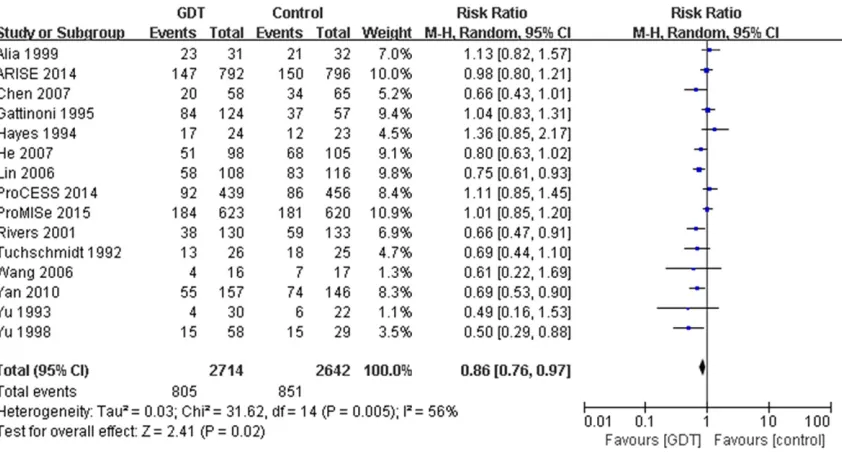
crite-Figure 2. Comparison of GDT versus control group for the overall mortality. Abbreviations: GDT, goal directed
[image:5.612.100.521.71.297.2]ria. The overall details of quality assessment are listed in Table 2.
Primary outcome: overall mortality
The data of overall mortality were available in all 15 trails. In the GDT group, the overall mor-tality was 29.7%, while in the control group the
mortality was significantly higher, which was
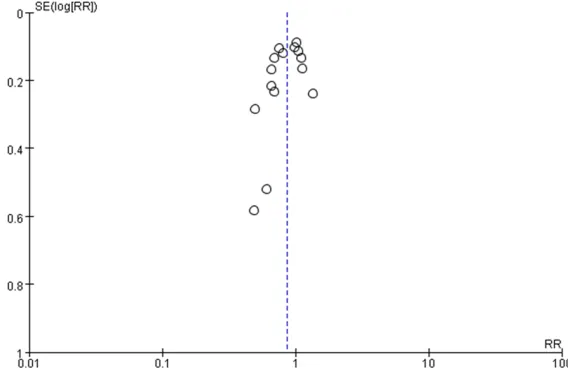
32.2% (RR=0.86; 95% CI=0.76-0.97; P=0.02; I2=56%) (Figure 2). Then we conducted the sen-sitivity analysis by omit study one by one, and found exclusion of any study did not change the RR much. And there was no evidence of publi-cation bias by assessing funnel plot (Figure 4). Subgroup analysis
It is important to note that the present result should be regarded with caution because
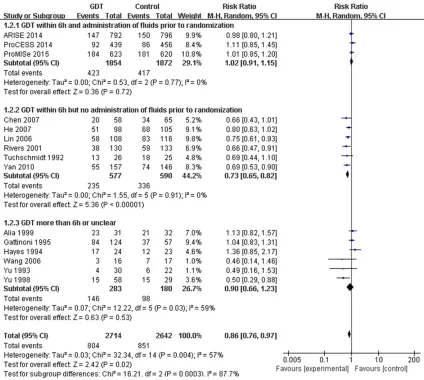
dif-ferent initiated time and resuscitation protocol were applied. So we analyzed the subgroup according to the timing of GDT and the pretreat-ment prior to randomization for resuscitation,
which suggested that a mortality benefit was
seen only in the subgroup of EGDT but no
administration of fluid prior to randomization (6
trials; RR=0.73; 95% CI=0.65-0.82; P<0.00001; I2=0%) (Figure 3). No difference was seen in the subgroup of late or unclear timing of GDT (7 tri-als; RR=0.90; 95% CI=0.66-1.23; P=0.53; I2=59%), or in the subgroup of EGDT and
admin-istration of fluids prior to randomization (3 tri -als; RR=1.02; 95% CI=0.91-1.15; P=0.72; I2=0%).
Length of ICU and hospital stays
Six trials (n=2757 participants) reported mean
length of ICU stays and 5 trials (n=2484) report
-Figure 3. Subgroup analyses of overall mortality. Abbreviations: GDT, goal directed therapy; CI, confidence interval;
[image:6.612.94.518.71.451.2]ed mean hospital stays. The length of ICU stay
of GDT group was shorter than the control group (mean difference, -1.56; 95% CI, -3.06,
-0.07; P=0.04). However, there was no signifi -cant difference between the 2 arms in length of hospital stay (mean difference, -0.36; 95% CI, -0.66, 1.38; P=0.49). (Supplementary Figures 1, 2).
Incidence of MODS
Data regarding MODS were available for 7 trials included in the meta-analysis. Of patients undergoing GDT, the risk of MODS was no dif-ference compared to the control group (RR=0.78; 95% CI=0.60-1.01; P=0.06). There was statistical heterogeneity noted among the included trials (heterogeneity X2=19.44; I2=69%; P=0.003; Supplementary Figure 3). Incidence of renal dysfunction
Data regarding renal dysfunction incidence were available for 6 trials included in the meta-analysis. Of patients undergoing GDT, the risk of dysfunction was no difference compared to the control group (RR=0.94; 95% CI=0.73-1.20, P=0.60). There was low statistical heterogene-ity noted among the included trials (heteroge-neity X2=7.01; I2=29%; P=0.22; Supplementary Figure 4).
Use of dobutamine
There are 8 trials reported data on dobutamine use. There was high s heterogeneity among
those trials, even though GDT was significantly
Discussion
GDT is sure to have benefit in high-risk surgical
patients [5, 6], and we wonder to know its
ben-efit in critically ill patients with sepsis. In this
present study, we reviewed existing random-ized controlled trials to test the hypothesis that
GDT gain the mortality benefits. We included
15 RCTs, in which 3 were the latest and largest trails. The result showed GDT can reduce
over-all mortality significantly, although the hetero -geneity was high. So the in-depth subgroup
analysis conducted and showed that benefit
was only in the subgroup of EGDT but no
admin-istration of fluid prior to randomization. Besides, GDT could reduce the length of ICU duration.
GDT has been proposed because clinicians
should consider of both the benefit and the
harmful effects of resuscitation. It includes
intravenous fluids, red cell transfusion and
vasoactive drug administration to achieve
[image:7.612.88.372.73.262.2]spe-cific haemodynamic goals. GDT is proved to have important benefit in surgical patients. However, its benefit in sepsis patients was not as much definite. Several trials and meta-anly -sis support the guidelines of ACCM/PALS with ScvO2 goal-directed resuscitation [26-28]. However, the results of the latest three trails (ProCESS, ARISE and ProMISe) [9-11] had dif-ferent sound. This provoked concerns about comparing them with the other trails included in previous meta analysis [27]. The high risk of bias due to the uncertain methodology of some of the trials cannot be eliminated. Even with the subgroup analysis of GDT within 6 hours, there
Figure 4. Funnel plot of the effect goal-directed therapy on overall mortality.
associated with dobutamine use (RR=2.80; 95% CI=1.24-6.33; P=0.01; I2=95%; Supp- lementary Figure 5).
Mean intravenous fluid vol -ume
There are 5 trails reported available data on mean
intra-venous fluid volume within the first 6 hours. In those trails GDT was no significantly asso
-ciated with intravenous fluid volume within the first 6
was still low statistical heterogeneity. Therefore, along with the new randomized controlled trials published, an updated meta-analysis evaluat-ing the effect of GDT for the treatment of sepsis was needed.
There is no doubt the timing of GDT should be considerate when performed the subgroup
analysis. And considering of the fluids given
prior to randomization in the latest three trials,
the ‘usual care’ appears to have early fluid
resuscitation. Therefore, we used both the tim-ing of GDT and the pretreatment prior to ran-domization for resuscitation to perform the subgroup analysis. The result showed that
ben-efit was only in the subgroup of EGDT but no administration of fluid prior to randomization. When the control group had early fluid resusci
-tation, the mortality benefit of GDT disap -peared. And by conducted the subgroup analy-sis, we reduced the heterogeneity a lot.
Certainly, this reflected the impact of early fluid resuscitation rather than the specific protocols
for resuscitation in sepsis management.
We and others suggest that GDT significantly
reduces overall mortality in patients with sep-sis. However, the secondary outcomes like the
length of ICU and hospital stays, renal dysfunc -tion, MODS should also be considerate. Here
we try to figure it out in our analysis. We found the GDT group had shorter length of ICU dura -tion. However, the available raw data from
these trials were insufficient to draw a certain
conclusion because of the high heterogeneity.
Likewise, we did not find a significant reduction
in MODS and renal dysfunction in the GDT group compared with the control group.
Although our meta-analysis provided informa-tion more about the details of GDT in septic patients, the present meta-analysis had sever-al limitations that should be considered. First, as described earlier, the protocols adopted in the trials included in the present meta-analysis were different. Although all the adopted
proto-cols of GDT focus on the fluid management are
similar, and we have accounted for this hetero-geneity by using a random-effects model and performing subgroup analysis, we still should use caution when drawing conclusions. Besides, we didn’t consider the effect of other therapy such as initiation of antibiotics on mor-tality. Secondary, outcomes of the included tri-als were different. Most trails use the
in-hospi-tal morin-hospi-tality but still some trails has different endpoint. Moreover, although many trials
reported length of ICU and hospital stay, MODS and kidney dysfunction events, and the fluid
and dobutamine use in the case and control groups, there might still be outcome reporting bias.
GDT might be beneficial for the adult patients undergoing sepsis. Early fluid resuscitation rather than the specific protocols for resuscita
-tion have more benefit in sepsis management.
Acknowledgements
Research is supported by Key Projects in the National Science & Technology Pillar Program in the twelveth Five-year Plan Period (No. 2011BAI60B07).
Disclosure of conflict of interest None.
Address correspondence to:Jianghua Chen, Kidney
Disease Center, The First Affiliated Hospital, College
of Medicine, Zhejiang University, Hangzhou, P. R.
China. Tel: +8657 187 236 992; Fax: +8657 187 236 992; E-mail: [email protected]
References
[1] Ricci Z, Polito A, Polito A and Ronco C. The im-plications and management of septic acute kidney injury. Nat Rev Nephrol 2011; 7: 218-225.
[2] Angus DC and van der Poll T. Severe sepsis and septic shock. N Engl J Med 2013; 369: 840-851.
[3] Gaieski DF, Edwards JM, Kallan MJ and Carr BG. Benchmarking the incidence and mortality
of severe sepsis in the United States. Crit Care
Med 2013; 41: 1167-1174.
[4] Jawad I, Luksic I and Rafnsson SB. Assessing available information on the burden of sepsis: global estimates of incidence, prevalence and mortality. J Glob Health 2012; 2: 010404. [5] Cecconi M, Corredor C, Arulkumaran N, Abuella
G, Ball J, Grounds RM, Hamilton M and Rhodes A. Clinical review: goal-directed therapy-what is the evidence in surgical patients? The effect on different risk groups. Crit Care 2013; 17: 209.
[7] Dellinger RP, Levy MM, Rhodes A, Annane D, Gerlach H, Opal SM, Sevransky JE, Sprung CL, Douglas IS, Jaeschke R, Osborn TM, Nunnally ME, Townsend SR, Reinhart K, Kleinpell RM, Angus DC, Deutschman CS, Machado FR, Rubenfeld GD, Webb SA, Beale RJ, Vincent JL, Moreno R; Surviving Sepsis Campaign Guidelines Committee including The Pediatric Subgroup. Surviving sepsis campaign: interna-tional guidelines for management of severe sepsis and septic shock: 2012. Crit Care Med 2013; 41: 580-637.
[8] Rivers E, Nguyen B, Havstad S, Ressler J, Muzzin A, Knoblich B, Peterson E, Tomlanovich M; Early Goal-Directed Therapy Collaborative Group. Early goal-directed therapy in the treat-ment of severe sepsis and septic shock. N Engl J Med 2001; 345: 1368-1377.
[9] Pro CI, Yealy DM, Kellum JA, Huang DT, Barnato AE, Weissfeld LA, Pike F, Terndrup T, Wang HE, Hou PC, LoVecchio F, Filbin MR, Shapiro NI and Angus DC. A randomized trial of protocol-based care for early septic shock. N Engl J Med 2014; 370: 1683-1693.
[10] Investigators A, Group ACT, Peake SL, Delaney A, Bailey M, Bellomo R, Cameron PA, Cooper DJ, Higgins AM, Holdgate A, Howe BD, Webb SA and Williams P. Goal-directed resuscitation for patients with early septic shock. N Engl J Med 2014; 371: 1496-1506.
[11] Mouncey PR, Osborn TM, Power GS, Harrison DA, Sadique MZ, Grieve RD, Jahan R, Harvey SE, Bell D, Bion JF, Coats TJ, Singer M, Young JD, Rowan KM; ProMISe Trial Investigators. Trial of early, goal-directed resuscitation for septic shock. N Engl J Med 2015; 372: 1301-1311.
[12] Higgins JPT, Green S (editors). Cochrane hand-book for systematic reviews of interventions version 5.1.0 [updated March 2011]. The Cochrane Collaboration, 2011. Available from http://www.cochrane-handbook.org.
[13] Moher D, Liberati A, Tetzlaff J, Altman DG; PRISMA Group. Preferred reporting items for systematic reviews and meta-analyses: the PRISMA statement. BMJ 2009; 339: b2535. [14] Jadad AR, Moore RA, Carroll D, Jenkinson C,
Reynolds DJ, Gavaghan DJ and McQuay HJ. Assessing the quality of reports of randomized clinical trials: is blinding necessary? Control Clin Trials 1996; 17: 1-12.
[15] Tuchschmidt J, Fried J, Astiz M and Rackow E. Elevation of cardiac output and oxygen delivery improves outcome in septic shock. Chest 1992; 102: 216-220.
[16] Yu M, Levy MM, Smith P, Takiguchi SA, Miyasaki A and Myers SA. Effect of maximizing oxygen
delivery on morbidity and mortality rates in critically ill patients: a prospective, random-ized, controlled study. Crit Care Med 1993; 21: 830-838.
[17] Hayes MA, Timmins AC, Yau EH, Palazzo M, Hinds CJ and Watson D. Elevation of systemic oxygen delivery in the treatment of critically ill patients. N Engl J Med 1994; 330: 1717-1722. [18] Gattinoni L, Brazzi L, Pelosi P, Latini R, Tognoni
G, Pesenti A and Fumagalli R. A trial of goal-oriented hemodynamic therapy in critically ill patients. SvO2 Collaborative Group. N Engl J Med 1995; 333: 1025-1032.
[19] Yu M, Burchell S, Hasaniya NW, Takanishi DM, Myers SA and Takiguchi SA. Relationship of mortality to increasing oxygen delivery in patients>or =50 years of age: a prospective, randomized trial. Crit Care Med 1998; 26: 1011-1019.
[20] Alia I, Esteban A, Gordo F, Lorente JA, Diaz C, Rodriguez JA and Frutos F. A randomized and controlled trial of the effect of treatment aimed at maximizing oxygen delivery in patients with severe sepsis or septic shock. Chest 1999; 115: 453-461.
[21] Lin SM, Huang CD, Lin HC, Liu CY, Wang CH
and Kuo HP. A modified goal-directed protocol
improves clinical outcomes in intensive care unit patients with septic shock: a randomized controlled trial. Shock 2006; 26: 551-557. [22] Wang XZ, Lu CJ, Gao FQ, Li XH, Yan WF and
Ning FY. [Efficacy of goal-directed therapy in
the treatment of septic shock]. Zhongguo Wei Zhong Bing Ji Jiu Yi Xue 2006; 18: 661-664. [23] Chen ZQ, Jin YH, Chen H, Fu WJ, Yang H and
Wang RT. [Early goal-directed therapy lowers the incidence, severity and mortality of multi-ple organ dysfunction syndrome]. Nan Fang Yi Ke Da Xue Xue Bao 2007; 27: 1892-1895. [24] He ZY, Gao Y, Wang XR and Hang YN. [Clinical
evaluation of execution of early goal directed therapy in septic shock]. Zhongguo Wei Zhong Bing Ji Jiu Yi Xue 2007; 19: 14-16.
[25] Early Goal-Directed Therapy Collaborative Group of Zhejiang Province. [The effect of early goal-directed therapy on treatment of critical patients with severe sepsis/septic shock: a multi-center, prospective, randomized, con-trolled study]. Zhongguo Wei Zhong Bing Ji Jiu Yi Xue 2010; 22: 331-334.
[27] Gu WJ, Wang F, Bakker J, Tang L and Liu JC. The effect of goal-directed therapy on mortality in patients with sepsis-earlier is better: a meta-analysis of randomized controlled trials. Crit Care 2014; 18: 570.
Supplementary Figure 1. Meta-analysis of mean difference for length of ICU stay.
Supplementary Figure 2. Meta-analysis of mean difference for length of hospital stay.
Supplementary Figure 3. Meta-analysis of incidence of MODS.
Supplementary Figure 5. Meta-analysis of incidence of dobutamine use.