RACAI: Unsupervised WSD experiments @ SemEval-2, Task #17
Radu Ion
Institute for AI, Romanian Academy
13, Calea 13 Septembrie, Bucharest
050711, Romania
[email protected]
Dan
Ş
tef
ă
nescu
Institute for AI, Romanian Academy
13, Calea 13 Septembrie, Bucharest
050711, Romania
[email protected]
Abstract
This paper documents the participation of the Research Institute for Artificial Intelligence of the Romanian Academy (RACAI) to the Task 17 – All-words Word Sense Disambiguation on a Specific Domain, of the SemEval-2 com-petition. We describe three unsupervised WSD systems that make extensive use of the Prince-ton WordNet (WN) structure and WordNet Domains in order to perform the disambigua-tion. The best of them has been ranked the 12th by the task organizers out of 29 judged runs.
1
Introduction
Referring to the last SemEval (SemEval-1, (Agirre et al., 2007a)) and to our recent work (Ion and Ştefănescu, 2009), unsupervised Word Sense Disambiguation (WSD) is still at the bot-tom of WSD systems ranking with a significant loss in performance when compared to super-vised approaches. With Task #17 @ SemEval-2, this observation is (probably1) reinforced but another issue is re-brought to light: the difficulty of supervised WSD systems to adapt to a given domain (Agirre et al., 2009). With general scores lower with at least 3% than 3 years ago in Task #17 @ SemEval-1 which was a supposedly hard-er task (genhard-eral, no particular domain WSD was required for all words), we observe that super-vised WSD is certainly more difficult to imple-ment in a real world application.
Our unsupervised WSD approach benefited from the specification of this year’s Task #17 which was a domain-limited WSD, meaning that the disambiguation would be applied to content words drawn from a specific domain: the sur-rounding environment. We worked under the assumption that a term of the given domain
1 At the time of the writing we only know the systems
rank-ing without the supervised/unsupervised distinction.
would have the same meaning with all its occur-rences throughout the text. This hypothesis has been put forth by Yarowsky (1993) as the “one sense per discourse” hypothesis (OSPD for short).
The task organizers offered a set of back-ground documents with no sense annotations to the competitors who want to train/tune their sys-tems using data from the same domain as the official test set. Working with the OSPD hypo-thesis, we set off to construct/test domain specif-ic WSD models from/on this corpus using the WordNet Domains (Bentivogli et al., 2004). For testing purposes, we have constructed an in-house gold standard from this corpus that com-prises of 1601 occurrences of 204 terms of the “surrounding environment” domain that have been automatically extracted with the highest confidence. We have observed that our gold standard (which has been independently anno-tated by 3 annotators but on non-overlapping sections which led to having no inter-annotator agreement scores) obeys the OSPD hypothesis which we think that is appropriate to domain-limited WSD.
In what follows, we will briefly acknowledge the usage of WordNet Domains in WSD, we will then describe the construction of the corpus of the background documents including here the creation of an in-house gold standard, we will then briefly describe our three WSD algorithms and finally we will conclude with a discussion on the ranking of our runs among the 29 evaluated by the task organizers.
2
Related Work
WordNet Domains is a hierarchy of labels that have been assigned to WN synsets in a one to (possible) many relationship (but the frequent case is a single WN domain for a synset). A do-main is the name of an area of knowledge that is recognized as unitary (Bentivogli et al., 2004).
Thus labels such as “architecture”, “sport” or “medicine” are mapped onto synsets like “arch(4)-noun”, “playing(2)-noun” or “chron-ic(1)-adjective” because of the fact that the re-spective concept evokes the domain.
WordNet Domains have been used in various ways to perform WSD. The main usage of this mapping is that the domains naturally create a clustering of the WN senses of a literal thus of-fering a sense inventory that is much coarser than the fine sense distinctions of WN. For instance, senses 1 (“a flat-bottomed motor vehicle that can travel on land or water”) and 2 (“an airplane designed to take off and land on water”) of the noun “amphibian” are both mapped to the do-main “transport” but the 3rd sense of the same noun is mapped onto the domains “ani-mals/biology” being the “cold-blooded verte-brate typically living on land but breeding in water; aquatic larvae undergo metamorphosis into adult form” (definitions from version 2.0 of the WN).
Vázquez et al. (2004) use WordNet Domains to derive a new resource they call the Relevant Domains in which, using WordNet glosses, they extract the most representative words for a given domain. Thus, for a word w and a domain d, the Association Ratio formula between w and d is
)
(
P
)
|
(
P
log
)
|
(
P
)
,
(
AR
2w
d
w
d
w
d
w
=
⋅
in which, for each synset its gloss has been POS tagged and lemmatized. The probabilities are computed counting pairs w,d in glosses (each gloss has an associated d domain via its synset).
Using the Relevant Domains, the WSD proce-dure for a given word w in its context C (a 100 words window centered in w), computes a simi-larity measure between two vectors of AR scores: the first vector is the vector of AR scores of the sentence in which w appears and the other is the vector of domain scores computed for the gloss of a sense of w (both vectors are norma-lized such that they contain the same domains). The highest similarity gives the sense of w that is closest to the domain vector of C. With this me-thod, Vázquez et al. obtain a precision of 0.54 and a recall of 0.43 at the SensEval-2, English All-Words Task placing them in the 10th position out of 22 systems where the best one (a super-vised system) achieved a 0.69 precision and an equal recall.
Another approach to WSD using the WordNet Domains is that of Magnini et al. (2002). The
method is remarkably similar to the previous one in that the description of the vectors and the se-lection of the assigned sense is the same. What differs, is the weights that are assigned to each domain in the vector. Magnini et al. distinguish between text vectors (C vectors in the previous presentation) and sense vectors. Text (or context) vector weights are computed comparing domain frequency in the context with the domain fre-quency over the entire corpus (see Magnini et al. (2002) for details). Sense vectors are derived from sense-annotated data which qualifies this method as a supervised one. The results that have been reported at the same task the previous algo-rithm participated (SensEval-2, English All-Words Task), are: precision 0.748 and recall 0.357 (12th place).
Both the methods presented here are very sim-ple and easy to adapt to different domains. One of our methods (RACAI-1, see below) is even simpler (because it makes the OSPD simplifying assumption) and performs with approximately the same accuracy as any of these methods judg-ing by the rank of the system and the total num-ber of participants.
3
Using the Background Documents
collection
Task #17 organizers have offered a set of back-ground documents for training/tuning/testing purposes. The corpus consists of 124 files from the “surrounding environment” domain that have been collected in the framework of the Kyoto Project (http://www.kyoto-project.eu/).
First, we have assembled the files into a single corpus in order to be able to apply some cleaning procedures. These procedures involved the re-moval of the paragraphs in which the proportion of letters (Perl character class “[A-Za-z_-]”) was less than 0.8 because the text contained a lot of noise in form of lines of numbers and other symbols which probably belonged to tables. The next stage was to have the corpus POS-tagged, lemmatized and chunked using the TTL web ser-vice (Tufiş et al., 2008). The resulting file is an XML encoded corpus which contains 136456 sentences with 2654446 tokens out of which 348896 are punctuation tokens.
ex-traction algorithm which considers that terms, as opposed to words that are not domain specific, are not evenly distributed throughout the corpus. To formalize this, the corpus is a vector of lem-mas
C
=
[
l
1,
l
2,
K
,
l
N]
and for each unique lem-mal
j,
1
≤
j
≤
N
, we compute the mean of the absolute differences of its indexes in C asm j k
j j
N k
j l l m j m k l l
l f
k j
≠ < < ∀ ∧ = −
−
= ≤
∑
< ≤ , , ,1 ) ( 1
µ
where
f
(
l
j)
is the frequency ofl
j in C. We also compute the standard deviation of these dif-ferences from the mean as2 ) (
) (
1
2
− − − = ≤
∑
< ≤j N k j
l f
k
j
µ
σ
in the same conditions as above.
With the mean and standard deviation of in-dexes differences of a content word lemma com-puted, we construct a list of all content word lemmas that is sorted in descending order by the quantity
σ
/
µ
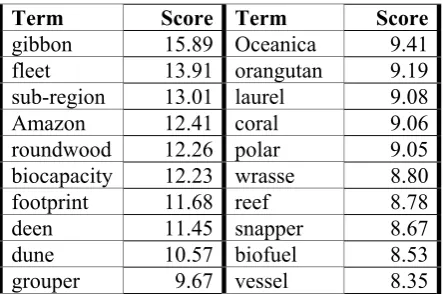
which we take as a measure of the evenness of a content word lemma distribution. Thus, lemmas that are in the top of this list are likely to be terms of the domain of the corpus (in our case, the “surrounding environment” do-main). Table 1 contains the first 20 automatically extracted terms along with their term score.Having the list of terms of our domain, we have selected the first ambiguous 210 (which have more than 1 sense in WN) and constructed a test set in which each term has (at least) 10 oc-currences in order to obtain a test corpus with at least 2000 occurrences of the terms of the “sur-rounding environment” domain. A large part of these occurrences have been independently sense-annotated by 3 annotators which worked on disjoint sets of terms (70 terms each) in order to finish as soon as possible. In the end we ma-naged to annotate 1601 occurrences correspond-ing to 204 terms.
When the gold standard for the test set was ready, we checked to see if the OSPD hypothesis holds. In order to determine if it does, we com-puted the average number of annotated different senses per term which is 1.36. In addition, consi-dering the fact that out of 204 annotated terms, 145 are annotated with a single sense, we may state that in this case, the OSPD hypothesis holds.
[image:3.595.306.528.69.216.2]Term Score Term Score gibbon 15.89 Oceanica 9.41 fleet 13.91 orangutan 9.19 sub-region 13.01 laurel 9.08 Amazon 12.41 coral 9.06 roundwood 12.26 polar 9.05 biocapacity 12.23 wrasse 8.80 footprint 11.68 reef 8.78 deen 11.45 snapper 8.67 dune 10.57 biofuel 8.53 grouper 9.67 vessel 8.35
Table 1: The first 20 automatically extracted terms of the “surrounding environment” domain
4
The Description of the Systems
Since we are committed to assign a unique sense per word in the test set, we might as well try to automatically induce a WSD model from the background corpus in which, for each lemma along with its POS tag that also exists in WN, a single sense is listed that is derived from the cor-pus. Then, for any test set of the same domain, the algorithm would give the sense from the WSD model to any of the occurrences of the lemma.
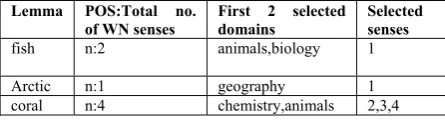
What we actually did, was to find a list of most frequent 2 WN domains (frequency count extracted from the whole corpus) for each lemma with its POS tag, and using these, to list all senses of the lemma that are mapped onto these 2 domains (thus obtaining a reduction of the aver-age number of senses per word). The steps of the algorithm for the creation of the WSD model are: 1. in the given corpus, for each lemma l and its POS-tag p normalized to WN POS notation (“n” for nouns, “v” for verbs, “a” for adjectives and “b” for ad-verbs), for each of its senses from WN, increase by 1 each frequency of each mapped domain;
the same reduction thus contradicting our hypo-thesis that the average ambiguity degree of terms would be reduced more than the average ambigu-ity degree of all words in the corpus. This result might be due to the fact that the “factotum” do-main is very frequent (much more frequent than any of the other domains).
Lemma POS:Total no. of WN senses
First 2 selected domains
Selected senses
fish n:2 animals,biology 1
Arctic n:1 geography 1
[image:4.595.71.294.172.232.2]coral n:4 chemistry,animals 2,3,4
Table 2: A sample of the WSD model built from the background corpus
In what follows, we will present our 3 systems that use WSD models derived from the test sets (both the in-house and the official ones). In the Results section we will explain this choice.
4.1 RACAI-1: WordNet Domains-driven, Most Frequent Sense
The first system, as its name suggests, is very simple: using the WSD model, it chooses the most frequent sense (MFS) of the lemma l with POS p according to WN (that is, the lowest num-bered sense from the list of senses the lemma has in the WSD model).
Trying this method on our in-house developed test set, we obtain encouraging results: the over-all accuracy (precision is equal with the recover-all because all test set occurrences are tried) is at least 4% over the general MFS baseline (sense no. 1 in all cases). The Results section gives de-tails.
4.2 RACAI-2: The Lexical Chains Selection With this system, we have tried to select only one sense (not necessarily the most frequent one) of lemma l with POS p from the WSD model. The selection procedure is based on lexical chains computation between senses of the target word (the word to be disambiguated) and the content words in its sentence in a manner that will be explained below.
We have used the lexical chains description and computation method described in (Ion and
Ştefănescu, 2009). To reiterate, a lexical chain is not simply a set of topically related words but becomes a path of synsets in the WordNet hie-rarchy. The lexical chain procedure is a function of two WN synsets, LXC(s1, s2), that returns a semantic relation path that one can follow to
reach s2 from s1. On the path from s2 to s1 there are k synsets (k ≥ 0) and between 2 adjacent syn-sets there is a WN semantic relation. Each lexical chain can be assigned a certain score that we in-terpret as a measure of the semantic similarity (SS) between s1 and s2 (see (Ion and Ştefănescu, 2009) and (Moldovan and Novischi, 2002) for more details). Thus, the higher the value of SS(s1, s2), the higher the semantic similarity be-tween s1 and s2.
We have observed that using RACAI-1 on our in-house test set but allowing it to select the most frequent 2 senses of lemma l with POS p from the WSD model, we obtain a whopping 82% accuracy. With this observation, we tried to pro-gram RACAI-2 to make a binary selection from the first 2 most frequent senses of lemma l with POS p from the WSD model in order to approach the 82% percent accuracy limit which would have been a very good result. The algorithm is as follows: for a lemma l with POS p and a lemma lc with POS pc from the context (sentence) of l, compute the best lexical chain between any of the first 2 senses of l and any of the first 2 senses of lc according to the WSD model. If the first 2 senses of l are a and b and the first 2 senses of lc are x and y and the best lexical chain score has been found between a and y for instance, then credit sense a of l with SS(a, y). Sum over all lc from the context of l and select that sense of l which has a maximum semantic similarity with the context.
4.3 RACAI-3: Interpretation-based Sense Assignment
This system tries to generate all the possible sense assignments (called interpretations) to the lemmas in a sentence. Thus, in principle, for each content word lemma, all its WN senses are considered thus generating an exponential explo-sion of the sense assignments that can be attri-buted to a sentence. If we have N content word lemmas which have k senses on average, we ob-tain a search space of kN interpretations which have to be scored.
Using the observation mentioned above that the first 2 senses of a lemma according to the WSD model yields a performance of 82%, brings the search space to 2N but for a large N, it is still too big.
a search space of at most
M
⋅
2
10of smaller in-terpretations. The best interpretation per each segment would thus be a part of the best interpre-tation of the sentence. Next, we describe how we score an interpretation.For each sense s of a lemma l with POS p (from the first 2 senses of l listed in the WSD model) we compute an associated set of content words (lemmas) from the following sources:
• all content word lemmas extracted from the sense s corresponding gloss (disre-garding the auxiliary verbs);
• all literals of the synset in which lemma l with sense s exists;
• all literals of the synsets that are linked with the synset l(s) by a relation of the fol-lowing type: hypernym, near_antonym, eng_derivative, hyponym, meronym, ho-lonym, similar_to, derived;
• all content word lemmas extracted from the glosses corresponding to synsets that are linked with the l(s) synset by a relation of the following type: hypernym, eng_derivative, similar_to, derived; With this feature set V of a sense s belonging to lemma l with POS p, for a given interpretation (a specific assignment of senses to each lemma in a segment), its score S (initially 0) is computed iteratively (for two adjacent position i and i + 1 in the segment) as
1 1
1, V V V V
V S
S← + i∩ i+ i+ ← i∪ i+
where the |X| function is the cardinality function on the set X and ← is the assignment operator.
5
Results
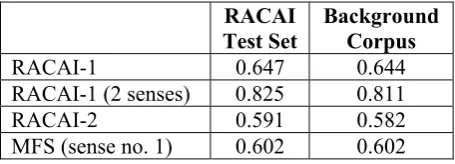
In order to run our WSD algorithms, we had to extract WSD models. We tested the accuracy of the disambiguation (onto the in-house developed gold standard) with RACAI-1 and RACAI-2 sys-tems (RACAI-3 was not ready at that time) with models extracted a) from the whole background corpus and b) from the in-house developed test set (named here the RACAI test set, see section 3). The results are reported in Table 3 along with RACAI-1 system returning the first 2 senses of a lemma from the WSD model and the general MFS baseline.
As we can see, the results with the WSD mod-el extracted from the test set are marginally bet-ter than the other results. This was the reason for which we chose to extract the WSD model from
the official test set as opposed to using the WSD model extracted from the background corpus.
RACAI Test Set
Background Corpus
RACAI-1 0.647 0.644
RACAI-1 (2 senses) 0.825 0.811
RACAI-2 0.591 0.582
[image:5.595.306.534.108.190.2]MFS (sense no. 1) 0.602 0.602
Table 3: RACAI systems results (accuracy) on the RACAI test set
However, we did not research the possibility of adding the official test set to either the RACAI test set or the background corpus and extract WSD models from there.
[image:5.595.306.530.563.633.2]The official test set (named the SEMEVAL test set here) contains 1398 occurrences of con-tent words for disambiguation, out of which 366 are occurrences of verbs and 1032 are occur-rences of nouns. These occuroccur-rences correspond to 428 lemmas. Inspecting these lemmas, we have found that there are many of them which are not domain specific (in our case, specific to the “surrounding environment” domain). For instance, the verb to “be” is at the top of the list with 99 occurrences. It is followed by the noun “index” with 32 occurrences and by the noun “network” with 22 occurrences. With fewer oc-currences follow “use”, “include”, “show”, “pro-vide”, “part” and so on. Of course, the SEMEV-AL test set includes proper terms of the designat-ed domain such as “area” (61 occurrences), “species” (58 occurrences), “nature” (31 occur-rences), “ocean”, “sea”, “water”, “planet”, etc.
Table 4 lists our official results on the SE-MEVAL test set.
Precision Recall Rank RACAI-1 0.461 0.46 #12 RACAI-2 0.351 0.35 #25 RACAI-3 0.433 0.431 #18
MFS 0.505 0.505 #6
Table 4: RACAI systems results (accuracy) on the SEMEVAL test set
Se-mEval-2 competition which was won by a sys-tem that achieved a precision of 0.57 and a recall of 0.555.
The differences with the runs on the RACAI test set are significant but this can be explained by the fact that our WordNet Domains WSD me-thod cannot cope with general (domain indepen-dent) WSD requirements in which the “one sense per discourse” hypothesis does not necessarily hold.
6 Conclusions
Regarding the 3 systems that we entered in the Task #17 @ SemEval-2, we think that the lexical chains algorithm (RACAI-2) is the most promis-ing even if it scored the lowest of the three. We attribute its poor performances to the lexical chains computation, especially to the weights of the WN semantic relations that make up a chain. Also, we will extend our research regarding the correctness of lexical chains (the degree to which a human judge will appreciate as correct or evoc-ative or as common knowledge a semantic path between two synsets).
We also want to check if our three systems make the same mistakes or not in order to devise a way in which we can combine their outputs.
RACAI is at the second participation in the SemEval series of WSD competitions. We are committed to improving the unsupervised WSD technology which, we think, is more easily adaptable and usable in real world applications. We hope that SemEval-3 will reveal significant improvements in this direction.
Acknowledgments
The work reported here was supported by the Romanian Ministry of Education and Research through the STAR project (no. 742/19.01.2009).
References
Eneko Agirre, Lluís Màrquez and Richard Wicen-towski, Eds., 2007. Proceedings of Semeval-2007 Workshop. Prague, Czech Republic: Association for Computational Linguistics, 2007.
Eneko Agirre, Oier Lopez de Lacalle, Christiane Fell-baum, Andrea Marchetti, Antonio Toral, Piek Vos-sen. 2009. SemEval-2010 Task 17: All-words Word Sense Disambiguation on a Specific Domain. In Proceedings of NAACL workshop on Semantic Evaluations (SEW-2009). Boulder,Colorado, 2009. Luisa Bentivogli, Pamela Forner, Bernardo Magnini
and Emanuele Pianta. 2004. Revising WordNet Domains Hierarchy: Semantics, Coverage, and
Balancing. In COLING 2004 Workshop on "Multi-lingual Linguistic Resources", Geneva, Switzer-land, August 28, 2004, pp. 101-108.
Radu Ion and Dan Ştefănescu. 2009. Unsupervised Word Sense Disambiguation with Lexical Chains and Graph-based Context Formalization. In Zyg-munt Vetulani, editor, Proceedings of the 4th guage and Technology Conference: Human Lan-guage Technologies as a Challenge for Computer Science and Linguistics, pages 190–194, Poznań, Poland, November 6–8 2009. Wydawnictwo Poznańskie Sp.
Bernardo Magnini, Carlo Strapparava, Giovanni Pezzulo, Alfio Gliozzo. 2002. The role of domain information in Word Sense Disambiguation. Natu-ral Language Engineering, 8(4), 359—373, De-cember 2002.
Dan Moldovan and Adrian Novischi. 2002. Lexical chains for question answering. In Proceedings of the 19th International Conference on Computation-al Linguistics, August 24 – September 01, 2002, Taipei, Taiwan, pp. 1—7.
Dan Tufiş, Radu Ion, Alexandru Ceauşu and Dan Ştefănescu. 2008. RACAI's Linguistic Web Servic-es. In Proceedings of the 6th Language Resources and Evaluation Conference – LREC 2008, Marra-kech, Morocco, May 2008. ELRA – European Language Ressources Association. ISBN 2-9517408-4-0.
Sonia Vázquez, Andrés Montoyo and German Ri-gau. 2004. Using Relevant Domains Resource for Word Sense Disambiguation. In Proceedings of the International Conference on Artificial Intelligence (IC-AI'04), Las Vegas, Nevada, 2004.