SemEval-2013 Task 9 : Extraction of Drug-Drug Interactions from
Biomedical Texts (DDIExtraction 2013)
Isabel Segura-Bedmar, Paloma Mart´ınez, Mar´ıa Herrero-Zazo
Universidad Carlos III de Madrid Av. Universidad, 30, Legan´es 28911, Spain
{isegura,pmf}@inf.uc3m.es, [email protected]
Abstract
The DDIExtraction 2013 task concerns the recognition of drugs and extraction of drug-drug interactions that appear in biomedical literature. We propose two subtasks for the DDIExtraction 2013 Shared Task challenge: 1) the recognition and classification of drug names and 2) the extraction and classification of their interactions. Both subtasks have been very successful in participation and results. There were 14 teams who submitted a total of 38 runs. The best result reported for the first subtask was F1 of 71.5% and 65.1% for the second one.
1 Introduction
The definition of drug-drug interaction (DDI) is broadly described as a change in the effects of one drug by the presence of another drug (Baxter and Stockely, 2010). The detection of DDIs is an im-portant research area in patient safety since these in-teractions can become very dangerous and increase health care costs. Drug interactions are frequently reported in journals, making medical literature the most effective source for their detection (Aronson, 2007). Therefore, Information Extraction (IE) can be of great benefit in the pharmaceutical industry al-lowing identification and extraction of relevant in-formation on DDIs and providing an interesting way of reducing the time spent by health care profession-als on reviewing the literature.
The DDIExtraction 2013 follows up on a first event organized in 2011, DDIExtraction 2011 (Segura-Bedmar et al., 2011b) whose main
goal was the detection of drug-drug interactions from biomedical texts. The new edition includes in addition to DDI extraction also a supporting task, the recognition and classification of pharmacologi-cal substances. DDIExtraction 2013 is designed to address the extraction of DDIs as a whole, but di-vided into two subtasks to allow separate evaluation of the performance for different aspects of the prob-lem. The shared task includes two challenges:
• Task 9.1: Recognition and classification of pharmacological substances.
• Task 9.2: Extraction of drug-drug interactions.
Additionally, while the datasets used for the DDIExtraction 2011 task were composed by texts describing DDIs from the DrugBank database(Wishart et al., 2006), the new datasets for DDIExtraction 2013 also include MedLine abstracts in order to deal with different types of texts and language styles.
This shared task has been conceived with a dual objective: advancing the state-of-the-art of text-mining techniques applied to the pharmacological domain, and providing a common framework for evaluation of the participating systems and other re-searchers interested in the task.
In the next section we describe the DDI corpus used in this task. Sections 3 and 4 focus on the de-scription of the task 9.1 and 9.2 respectively. Finally, Section 5 draws the conclusions and future work.
2 The DDI Corpus
The DDIExtraction 2013 task relies on the DDI cor-pus, which is a semantically annotated corpus of
documents describing drug-drug interactions from the DrugBank database and MedLine abstracts on the subject of drug-drug interactions.
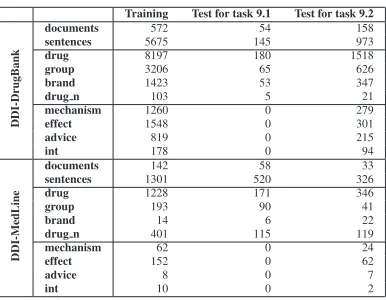
The DDI corpus consists of 1,017 texts (784 DrugBank texts and 233 MedLine abstracts) and was manually annotated with a total of 18,491 phar-macological substances and 5,021 drug-drug inter-actions (see Table 1). A detailed description of the method used to collect and process documents can be found in (Segura-Bedmar et al., 2011a). The cor-pus is distributed in XML documents following the unified format for PPI corpora proposed by Pyysalo et al., (2008) (see Figure 1). A detailed description and analysis of the DDI corpus and its methodology are included in an article currently under review by BioInformatics journal.1
The corpus was split in order to build the datasets for the training and evaluation of the different par-ticipating systems. Approximately 77% of the DDI corpus documents were randomly selected for the training dataset and the remaining (142 DrugBank texts and 91 MedLine abstracts) was used for the test dataset. The training dataset is the same for both subtasks since it contains entity and DDI annota-tions. The test dataset for the task 9.1 was formed by discarding documents which contained DDI annota-tions. Entity annotations were removed from this dataset to be used by participants. The remaining documents (that is, those containing some interac-tion) were used to create the test dataset for task 9.2. Since entity annotations are not removed from these documents, the test dataset for the task 9.2 can also be used as additional training data for the task 9.1.
3 Task 9.1: Recognition and classification
of pharmacological substances.
This task concerns the named entity extraction of pharmacological substances in text. This named en-tity task is a crucial first step for information ex-traction of drug-drug interactions. In this task, four types of pharmacological substances are defined:
drug (generic drug names), brand (branded drug names), group(drug group names) anddrug-n (ac-tive substances not approved for human use). For a
1M. Herrero-Zazo, I. Segura-Bedmar, P. Mart´ınez. 2013.
The DDI Corpus: an annotated corpus with pharmacological substances and drug-drug interactions, submitted to BioInfor-matics
Training Test for task 9.1 Test for task 9.2
D
D
I-D
ru
g
Ba
n
k
documents 572 54 158
sentences 5675 145 973
drug 8197 180 1518
group 3206 65 626
brand 1423 53 347
drug n 103 5 21
mechanism 1260 0 279
effect 1548 0 301
advice 819 0 215
int 178 0 94
D
D
I-Me
d
Li
n
e
documents 142 58 33
sentences 1301 520 326
drug 1228 171 346
group 193 90 41
brand 14 6 22
drug n 401 115 119
mechanism 62 0 24
effect 152 0 62
advice 8 0 7
[image:2.612.328.521.58.208.2]int 10 0 2
Table 1: Basic statistics on the DDI corpus.
more detailed description, the reader is directed to our annotation guidelines.2
For evaluation, a part of the DDI corpus consist-ing of 52 documents from DrugBank and 58 Med-Line abstracts, is provided with the gold annota-tion hidden. The goal for participating systems is to recreate the gold annotation. Each participant sys-tem must output an ASCII list of reported entities, one per line, and formatted as:
IdSentence|startOffset-endOffset|text|type
Thus, for each recognized entity, each line must contain the id of the sentence where this entity ap-pears, the position of the first character and the one of the last character of the entity in the sentence, the text of the entity, and its type. When the entity is a discontinuous name (eg. aluminumand magnesium
hydroxide), this second field must contain the start and end positions of all parts of the entity separated by semicolon. Multiple mentions from the same sen-tence should appear on separate lines.
3.1 Evaluation Metrics
This section describes the methodology that is used to evaluate the performance of the participating sys-tems in task 9.1.
The major forums of the Named Entity Recogni-tion and ClassificaRecogni-tion (NERC) research community (such as MUC-7 (Chinchor and Robinson, 1997), CoNLL 2003 (Tjong Kim Sang and De Meulder, 2003) or ACE07 have proposed several techniques to assess the performance of NERC systems. While
2
Figure 1: Example of an annotated document of the DDI corpus.
Team Affiliation Description
T
a
sk
9
.1
LASIGE(Grego et al., 2013) University of Lisbon, Portugal Conditional random fields
NLM LHC National Library of Medicine, USA Dictionary-based approach
UEM UC3M(Sanchez-Cisneros and Aparicio, 2013) European U. of Madrid, Carlos III University of Madrid, Spain Ontology-based approach
UMCC DLSI(Collazo et al., 2013) Matanzas University, Cuba j48 classifier
UTurku(Bj¨orne et al., 2013) University of Turku, Finland SVM classifier (TEES system)
WBI NER(Rockt¨aschel et al., 2013) Humboldt University of Berlin, Germany Conditional random fields
T
a
sk
9
.2
FBK-irst (Chowdhury and Lavelli, 2013c) FBK-irst, Italy hybrid kernel + scope of negations and semantic roles
NIL UCM(Bokharaeian, 2013) Complutense University of Madrid, Spain SVM classifier (Weka SMO)
SCAI(Bobi´c et al., 2013) Fraunhofer SCAI, Germany SVM classifier (LibLINEAR)
UC3M(Sanchez-Cisneros, 2013) Carlos III University of Madrid, Spain Shallow Linguistic Kernel
UCOLORADO SOM(Hailu et al., 2013) University of Colorado School of Medicine, USA SVM classifier (LIBSVM)
UTurku(Bj¨orne et al., 2013) University of Turku, Finland SVM classifier (TEES system)
UWM-TRIADS(Rastegar-Mojarad et al., 2013) University of Wisconsin-Milwaukee, USA Two-stage SVM
WBI DDI(Thomas et al., 2013) Humboldt University of Berlin, Germany Ensemble of SVMs
Table 2: Short description of the teams.
ACE evaluation is very complex because its scores are not intuitive, MUC and CoNLL 2003 used the standard precision/recall/f-score metrics to compare their participating systems. The main shared tasks in the biomedical domain have continued using these metrics to evaluate the outputs of their participant teams.
System performance should be scored automat-ically by how well the generated pharmacological substance list corresponds to the gold-standard an-notations. In our task, we evaluate the results of the participating systems according to several evalu-ation criteria. Firstly, we propose a strict evaluevalu-ation, which does not only demand exact boundary match, but also requires that both mentions have the same entity type. We are aware that this strict criterion may be too restrictive for our overall goal (extrac-tion of drug interac(extrac-tions) because it misses partial matches, which can provide useful information for a DDI extraction system. Our evaluation metrics should score if a system is able to identify the ex-act span of an entity (regardless of the type) and if it is able to assign the correct entity type (regardless
of the boundaries). Thus, our evaluation script will output four sets of scores according to:
1. Strict evaluation (exact-boundary and type matching).
2. Exact boundary matching (regardless to the type).
3. Partial boundary matching (regardless to the type).
4. Type matching (some overlap between the tagged entity and the gold entitity is required).
Evaluation results are reported using the standard precision/recall/f-score metrics. We refer the reader to (Chinchor and Sundheim, 1993) for a more de-tailed description of these metrics.
[image:3.612.79.534.243.352.2]takes into account all possible types of errors made by a NERC system.
Additionally, we calculate precision, recall and f-measure for each entity type and then their macro-average measures are provided. Calculating these metrics for each entity type allows us to evalu-ate the level of difficulty of recognizing each en-tity type. In addition to this, since not all enen-tity types have the same frequency, we can better as-sess the performance of the algorithms proposed by the participating systems. This is mainly because the results achieved on the most frequent entity type have a much greater impact on overall performance than those obtained on the entity types with few in-stances.
3.2 Results and Discussion
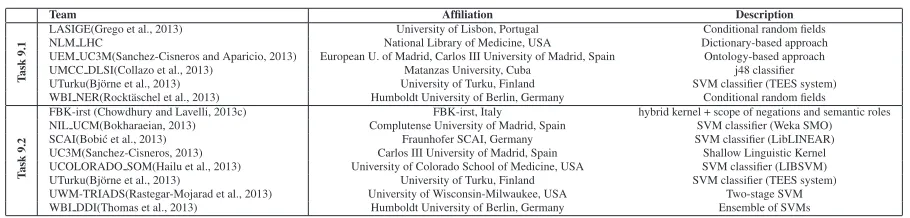
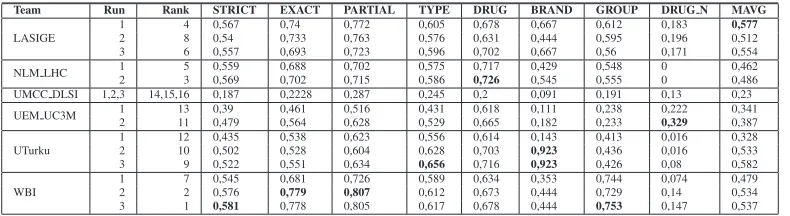
Participants could send a maximum of three system runs. After downloading the test datasets, they had a maximum of two weeks to upload the results. A total of 6 teams participated, submitting 16 system runs. Table 2 lists the teams, their affiliations and a brief description of their approaches. Due to the lack of space we cannot describe them in this paper. Tables 3, 4 and 5 show the F1 scores for each run in alphabetic order. The reader can find the full ranking information on the SemEval-2013 Task 9 website3.
The best results were achieved by the WBI team with a conditional random field. They em-ployed a domain-independent feature set along with features generated from the output of ChemSpot (Rockt¨aschel et al., 2012), an existing chemical named entity recognition tool, as well as a collection of domain-specific resources. Its model was trained on the training dataset as well as on en-tities of the test dataset for task 9.2. The second top best performing team developed a dictionary-based approach combining biomedical resources such as DrugBank, the ATC classification system,4 or MeSH,5 among others. Regarding the classifi-cation of each entity type, we observed that brand drugs were easier to recognize than the other types. This could be due to the fact that when a drug is mar-keted by a pharmaceutical company, its brand name is carefully selected to be short, unique and easy to
3
http://www.cs.york.ac.uk/semeval-2013/task9/
4http://www.whocc.no/atc ddd index/ 5
http://www.ncbi.nlm.nih.gov/mesh
remember (Boring, 1997). On the other hand, sub-stances not approved for human use (drug-n) were more difficult, due to the greater variation and com-plexity in their naming. In fact, the UEM UC3M team was the only team who obtained an F1 measure greater than 0 on the DDI-DrugBank dataset. Also, this may indicate that this type is less clearly defined than the others in the annotation guidelines. Another possible reason is that the presence of such sub-stances in this dataset is very scarce (less than 1%). It is interesting that almost every participating sys-tem was better in detecting and classifying entities of a particular class compared to all other systems. For instance, on the whole dataset the dictionary-based system from NLM LHC had it strengths atdrug en-tities, UEM UC3M at drug N entities, UTurku at
brandentities and WBI NER atgroupentities. Finally, the results on the DDI-DrugBank dataset are much better than those obtained on the DDI-MedLine dataset. While DDI-DrugBank texts focus on the description of drugs and their interactions, the main topic of DDI-MedLine texts would not neces-sarily be on DDIs. Coupled with this, it is not al-ways trivial to distinguish between substances that should be classified as pharmacological substances and those who should not. This is due to the ambi-guity of some pharmacological terms. For example,
insulinis a hormone produced by the pancreas, but can also be synthesized in the laboratory and used as drug to treat insulin-dependent diabetes mellitus. The participating systems should be able to deter-mine if the text is describing a substance originated within the organism or, on the contrary, it describes a process in which the substance is used for a specific purpose and thus should be identified as pharmaco-logical substance.
4 Task 9.2: Extraction of drug-drug
interactions.
Team Run Rank STRICT EXACT PARTIAL TYPE DRUG BRAND GROUP DRUG N MAVG
LASIGE
1 6 0,656 0,781 0,808 0,69 0,741 0,581 0,712 0,171 0,577
2 9 0,639 0,775 0,801 0,672 0,716 0,541 0,696 0,182 0,571
3 10 0,612 0,715 0,741 0,647 0,728 0,354 0,647 0,16 0,498
NLM LHC 1 4 0,698 0,784 0,801 0,722 0,803 0,809 0,646 0 0,57
2 3 0,704 0,792 0,807 0,726 0,81 0,846 0,643 0 0,581
UMCC DLSI 1,2,3 14,15,16 0,275 0,3049 0,367 0,334 0,297 0,313 0,257 0,124 0,311
UEM UC3M 1 13 0,458 0,528 0,585 0,51 0,718 0,075 0,291 0,185 0,351
2 12 0,529 0,609 0,669 0,589 0,752 0,094 0,291 0,264 0,38
UTurku
1 11 0,579 0,639 0,719 0,701 0,721 0,603 0,478 0,016 0,468
2 8 0,641 0,659 0,731 0,766 0,784 0,901 0,495 0,015 0,557
3 7 0,648 0,666 0,743 0,777 0,783 0,912 0,485 0,076 0,604
WBI
1 5 0,692 0,772 0,807 0,729 0,768 0,787 0,761 0,071 0,615
2 2 0,708 0,831 0,855 0,741 0,786 0,803 0,757 0,134 0,643
[image:5.612.109.504.92.199.2]3 1 0,715 0,833 0,856 0,748 0,79 0,836 0,776 0,141 0,652
Table 3: F1 scores for task 9.1 on the whole test dataset (DDI-MedLine + DDI-DrugBank). (MAVG for macro-average). Each run is ranked by STRICT performance.
Team Run Rank STRICT EXACT PARTIAL TYPE DRUG BRAND GROUP DRUG N MAVG
LASIGE
1 8 0,771 0,834 0,855 0,799 0,817 0,571 0,833 0 0,563
2 9 0,771 0,831 0,852 0,799 0,823 0,553 0,824 0 0,568
3 11 0,682 0,744 0,764 0,713 0,757 0,314 0,756 0 0,47
NLM LHC 1 2 0,869 0,902 0,922 0,902 0,909 0,907 0,766 0 0,646
2 3 0,869 0,903 0,919 0,896 0,911 0,907 0,754 0 0,644
UMCC DLSI 1,2,3 14,15,16 0,424 0,4447 0,504 0,487 0,456 0,429 0,371 0 0,351
UEM UC3M 1 13 0,561 0,632 0,69 0,632 0,827 0,056 0,362 0,022 0,354
2 12 0,595 0,667 0,721 0,667 0,842 0,063 0,366 0,028 0,37
UTurku
1 10 0,739 0,753 0,827 0,864 0,829 0,735 0,553 0 0,531
2 6 0,785 0,795 0,863 0,908 0,858 0,898 0,559 0 0,581
3 7 0,781 0,787 0,858 0,905 0,847 0,911 0,551 0 0,578
WBI
1 5 0,86 0,877 0,9 0,89 0,905 0,857 0,782 0 0,636
2 4 0,868 0,894 0,914 0,897 0,909 0,865 0,794 0 0,642
[image:5.612.110.506.307.416.2]3 1 0,878 0,901 0,917 0,908 0,912 0,904 0,806 0 0,656
Table 4: F1 scores for task 9.1 on the DDI-DrugBank test data. (MAVG for macro-average). Each run is ranked by STRICT performance.
Team Run Rank STRICT EXACT PARTIAL TYPE DRUG BRAND GROUP DRUG N MAVG
LASIGE
1 4 0,567 0,74 0,772 0,605 0,678 0,667 0,612 0,183 0,577
2 8 0,54 0,733 0,763 0,576 0,631 0,444 0,595 0,196 0,512
3 6 0,557 0,693 0,723 0,596 0,702 0,667 0,56 0,171 0,554
NLM LHC 1 5 0,559 0,688 0,702 0,575 0,717 0,429 0,548 0 0,462
2 3 0,569 0,702 0,715 0,586 0,726 0,545 0,555 0 0,486
UMCC DLSI 1,2,3 14,15,16 0,187 0,2228 0,287 0,245 0,2 0,091 0,191 0,13 0,23
UEM UC3M 1 13 0,39 0,461 0,516 0,431 0,618 0,111 0,238 0,222 0,341
2 11 0,479 0,564 0,628 0,529 0,665 0,182 0,233 0,329 0,387
UTurku
1 12 0,435 0,538 0,623 0,556 0,614 0,143 0,413 0,016 0,328
2 10 0,502 0,528 0,604 0,628 0,703 0,923 0,436 0,016 0,533
3 9 0,522 0,551 0,634 0,656 0,716 0,923 0,426 0,08 0,582
WBI
1 7 0,545 0,681 0,726 0,589 0,634 0,353 0,744 0,074 0,479
2 2 0,576 0,779 0,807 0,612 0,673 0,444 0,729 0,14 0,534
3 1 0,581 0,778 0,805 0,617 0,678 0,444 0,753 0,147 0,537
[image:5.612.111.506.521.629.2]types can be found in our annotation guidelines6. Gold standard annotations (correct, human-created annotations) of pharmacological substances are provided to participants both for training and test data. The test data for this subtask consists of 158 DrugBank documents and 33 MedLine abstracts. Each participant system must output an ASCII list including all pairs of drugs in each sentence, one per line (multiple DDIs from the same sentence should appear on separate lines), its prediction (1 if the pair is a DDI and 0 otherwise) and its type (label null
when the prediction value is 0), and formatted as: IdSentence|IdDrug1|IdDrug2|prediction|type
4.1 Evaluation Metrics
Evaluation is relation-oriented and based on the standard precision, recall and F-score metrics. A DDI is correctly detected only if the system is able to assign the correct prediction label and the correct type to it. In other words, a pair is correct only if both prediction and type are correct. The perfor-mance of systems to identify those pairs of drugs interacting (regardless of the type) is also evaluated. This allows us to assess the progress made with re-gard to the previous edition, which only dealt with the detection of DDIs.
Additionally, we are interested in assessing which drug interaction types are most difficult to detect. Thus, we calculate precision, recall and F1 for each DDI type and then their macro-average measures are provided. While micro-averaged F1 is calculated by constructing a global contingency table and then calculating precision and recall, macro-averaged F-score is calculated by first calculating precision and recall for each type and then taking the average of these results.
Evaluating each DDI type separately allows us to assess the level of difficulty of detecting and classi-fying each type of interaction. Additionally, it is im-portant to note that the scores achieved on the most frequent DDI type have a much greater impact on overall performance than those achieved on the DDI types with few instances. Therefore, by calculating scores for each type of DDI, we can better assess the performance of the algorithms proposed by the
6
http://www.cs.york.ac.uk/semeval-2013/task9/
participating systems.
4.2 Results and Discussion
The task of extracting drug-drug interactions from biomedical texts has attracted the participation of 8 teams (see Table 2) who submitted 22 runs. Tables 6, 7 and 8 show the results for each run in alphabetic order. Due to the lack of space, the performance information is only shown in terms of F1 score. The reader can find the full ranking information on the SemEval-2013 Task 9 website7.
Most of the participating systems were built on support vector machines. In general, approaches based on non-linear kernels methods achieved better results than linear SVMs. As in the previous edition of DDIExtraction, most systems have used primarily syntactic information. However, semantic informa-tion has been poorly used.
The best results were submitted by the team from FBK-irst. They applied a novel hybrid kernel based RE approach described in Chowdhury (2013a). They also exploited the scope of negations and semantic roles for negative instance filtering as proposed in (Chowdhury and Lavelli, 2013b) and (Chowdhury and Lavelli, 2012). The second best results were obtained by the WBI team from the Humboldt University of Berlin. Its system com-bines several kernel methods (APG (Airola et al., 2008) and Shallow Linguistic Kernel (SL) (Giuliano et al., 2006) among others), the Turku Event Ex-traction system (TEES) (Bj¨orne et al., 2011)8 and the Moara system (Neves et al., 2009). These two teams were also the top two ranked teams in DDIEx-traction 2011. For a more detailed description, the reader is encouraged to read the papers of the partic-ipants in the proceedings book.
While the DDIExtraction 2011 shared task con-centrated efforts on the detection of DDIs, this new DDIExtraction 2013 task involved not only the de-tection of DDIs, but also their classification. Al-though the results of DDIExtraction 2011 are not di-rectly comparable with the ones reported in DDIEx-traction 2013 due to the use of different training and test datasets in each edition, it should be noted that there has been a significant improvement in the
de-7http://www.cs.york.ac.uk/semeval-2013/task9/ 8
Team Run Rank CLA DEC MEC EFF ADV INT MAVG
FBK-irst
1 3 0.638 0.8 0.679 0.662 0.692 0.363 0.602
2 1 0.651 0.8 0.679 0.628 0.692 0.547 0.648
3 2 0.648 0.8 0.627 0.662 0.692 0.547 0.644
NIL UCM 1 12 0.517 0.588 0.515 0.489 0.613 0.427 0.535
2 10 0.548 0.656 0.531 0.556 0.61 0.393 0.526
SCAI
1 14 0.46 0.69 0.446 0.459 0.562 0.02 0.423
2 16 0.452 0.683 0.441 0.44 0.559 0.021 0.448
3 15 0.458 0.704 0.45 0.462 0.54 0.02 0.411
UC3M 1 11 0.529 0.676 0.48 0.547 0.575 0.5 0.534
2 21 0.294 0.537 0.268 0.286 0.325 0.402 0.335
UCOLORADO SOM
1 22 0.214 0.492 0.109 0.25 0.219 0.097 0.215
2 20 0.334 0.504 0.361 0.311 0.381 0.333 0.407
3 19 0.336 0.491 0.335 0.313 0.42 0.329 0.38
UTurku
1 9 0.581 0.684 0.578 0.585 0.606 0.503 0.572
2 7 0.594 0.696 0.582 0.6 0.63 0.507 0.587
3 8 0.582 0.699 0.569 0.593 0.608 0.511 0.577
UWM-TRIADS
1 17 0.449 0.581 0.413 0.446 0.502 0.397 0.451
2 13 0.47 0.599 0.446 0.449 0.532 0.421 0.472
3 18 0.432 0.564 0.442 0.383 0.537 0.292 0.444
WBI
1 6 0.599 0.736 0.602 0.604 0.618 0.516 0.588
2 5 0.601 0.745 0.616 0.595 0.637 0.49 0.588
[image:7.612.161.452.67.231.2]3 4 0.609 0.759 0.618 0.61 0.632 0.51 0.597
Table 6: F1 scores for Task 9.2 on the whole test dataset (DDI-MedLine + DDI-DrugBank). DEC for Detection, CLA for detection and classification, MEC formechanismtype, EFF foreffecttype, ADV foradvicetype, INT forinttype and MAVG for macro-average. Each run is ranked by CLA performance.
Team Run Rank CLA DEC MEC EFF ADV INT MAVG
FBK-irst
1 3 0.663 0.827 0.705 0.699 0.705 0.376 0.624
2 1 0.676 0.827 0.705 0.664 0.705 0.545 0.672
3 2 0.673 0.827 0.655 0.699 0.705 0.545 0.667
NIL UCM 1 12 0.54 0.615 0.527 0.525 0.625 0.444 0.565
2 10 0.573 0.68 0.552 0.597 0.619 0.408 0.55
SCAI
1 15 0.464 0.711 0.449 0.459 0.57 0.021 0.461
2 16 0.463 0.71 0.445 0.458 0.569 0.021 0.46
3 14 0.473 0.734 0.468 0.482 0.551 0.021 0.439
UC3M 1 11 0.555 0.703 0.493 0.593 0.59 0.51 0.561
2 21 0.306 0.549 0.274 0.302 0.334 0.426 0.352
UCOLORADO SOM
1 22 0.218 0.508 0.115 0.251 0.24 0.098 0.228
2 20 0.341 0.518 0.373 0.313 0.398 0.344 0.425
3 19 0.349 0.511 0.353 0.324 0.429 0.327 0.394
UTurku
1 8 0.608 0.712 0.6 0.63 0.617 0.522 0.6
2 7 0.62 0.724 0.605 0.644 0.638 0.522 0.614
3 9 0.608 0.726 0.591 0.635 0.617 0.522 0.601
UWM-TRIADS
1 17 0.462 0.596 0.43 0.459 0.509 0.405 0.463
2 13 0.485 0.616 0.467 0.466 0.536 0.425 0.486
3 18 0.445 0.573 0.469 0.39 0.544 0.29 0.46
WBI
1 6 0.624 0.762 0.621 0.645 0.634 0.52 0.61
2 5 0.627 0.775 0.636 0.636 0.652 0.5 0.611
[image:7.612.159.455.296.459.2]3 4 0.632 0.783 0.629 0.652 0.65 0.513 0.617
Table 7: F1 scores for task 9.2 on the DDI-DrugBank test dataset. Each run is ranked by CLA performance.
Team Run Rank CLA DEC MEC EFF ADV INT MAVG
FBK-irst
1 4 0.387 0.53 0.383 0.436 0.286 0.211 0.406
2 3 0.398 0.53 0.383 0.407 0.286 0.571 0.436
3 2 0.398 0.53 0.339 0.436 0.286 0.571 0.44
NIL UCM 1 20 0.19 0.206 0.286 0.186 0 0 0.121
2 19 0.219 0.336 0.143 0.271 0 0 0.11
SCAI
1 1 0.42 0.462 0.412 0.458 0.2 0 0.269
2 8 0.323 0.369 0.389 0.333 0 0 0.182
3 6 0.341 0.474 0.31 0.379 0.222 0 0.229
UC3M 1 15 0.274 0.406 0.333 0.267 0 0.364 0.268
2 22 0.186 0.421 0.222 0.171 0.143 0 0.149
UCOLORADO SOM
1 21 0.188 0.37 0.042 0.241 0 0 0.073
2 14 0.275 0.394 0.258 0.302 0.138 0 0.177
3 17 0.244 0.356 0.194 0.255 0.222 0.4 0.272
UTurku
1 18 0.242 0.339 0.258 0.256 0.2 0 0.18
2 16 0.262 0.344 0.214 0.278 0.364 0 0.224
3 13 0.286 0.376 0.286 0.289 0.333 0 0.232
UWM-TRIADS
1 10 0.312 0.419 0.233 0.36 0.267 0 0.219
2 9 0.319 0.436 0.233 0.34 0.421 0.333 0.345
3 11 0.306 0.479 0.247 0.326 0.381 0.333 0.33
WBI
1 7 0.336 0.456 0.368 0.344 0.154 0.4 0.334
2 12 0.304 0.406 0.343 0.318 0.167 0 0.209
3 5 0.365 0.503 0.476 0.347 0.143 0.4 0.353
[image:7.612.159.454.502.667.2]tection of DDIs: F1 has a remarkable increase from 65.74% (the best F1-score in DDIExtraction 2011) to 80% (seeDECcolumn of Table 6). The increase of the size of the corpus made for DDIExtraction 2013 and of the quality of their annotations may have contributed significantly to this improvement.
However, the results for the detection and classifi-cation for DDIs did not exceed an F1 of 65.1%. Ta-ble 6 suggests that some type of DDIs are more diffi-cult to classify than others. The best F1 ranges from 69.2% foradviceto 54.7% forint. One possible ex-planation for this could be that recommendations or advice regarding a drug interaction are typically de-scribed by very similar text patterns such asDRUG should not be used in combination with DRUG or
Caution should be observed when DRUG is admin-istered with DRUG.
Regarding results for theintrelationship, it should be noted that the proportion of instances of this re-lationship (5.6%) in the DDI corpus is much smaller than those of the rest of the relations (41.1% for ef-fect, 32.3% formechanismand 20.9% foradvice).
As stated earlier, one of the differences from the previous edition is that the corpus developed for DDIExtraction 2013 is made up of texts from two different sources: MedLine and the DrugBank database. Thus, the different approaches can be evaluated on two different styles of biomedical texts. While MedLine abstracts are usually written in ex-tremely scientific language, texts from DrugBank are written in a less technical form of the language (similar to the language used in package inserts). In-deed, this may be the reason why the results on the DDI-DrugBank dataset are much better than those obtained on the DDI-MedLine dataset (see Tables 7 and 8).
5 Conclusions
The DDIExtraction 2011 task concentrated efforts on the novel aspects of the DDI extraction task, the drug recognition was assumed and the annotations for drugs were provided to the participants. This new DDIExtraction 2013 task pursues the detec-tion and classificadetec-tion of drug interacdetec-tions as well as the recognition and classification of pharmaco-logical substances. The task attracted broad interest from the community. A total of 14 teams from 7
dif-ferent countries participated, submitted a total of 38 runs, exceeding the participation of DDIExtraction 2011 (10 teams). The participating systems demon-strated substantial progress at the established DDI extraction task on DrugBank texts and showed that their methods also obtain good results for MedLine abstracts.
The results that the participating systems have re-ported show successful approaches to this difficult task, and the advantages of non-linear kernel-based methods over linear SVMs for extraction of DDIs. In the named entity task, the participating systems perform well in recognizing generic drugs, brand drugs and groups of drugs, but they fail in recogniz-ing active substances not approved for human use. Although the results are positive, there is still much room to improve in both subtasks. We have ac-complished our goal of providing a framework and a benchmark data set to allow for comparisons of methods for the recognition of pharmacological sub-stances and detection and classification of drug-drug interactions from biomedical texts.
We would like that our test dataset can still serve as the basis for fair and stable evaluation after the task. Thus, we have decided that the full gold an-notations for the test data are not available for the moment. We plan to make available a web service where researchers can test their methods on the test dataset and compare their results with the DDIEx-traction 2013 task participants.
Acknowledgments
This research work has been supported by the Re-gional Government of Madrid under the Research Network MA2VICMR (S2009/TIC-1542), by the Spanish Ministry of Education under the project MULTIMEDICA (TIN2010-20644-C03-01). Addi-tionally, we would like to thank all participants for their efforts and to congratulate them to their inter-esting work.
References
JK. Aronson. 2007. Communicating information about drug interactions. British Journal of Clinical Pharma-cology, 63(6):637–639, June.
K. Baxter and I.H. Stockely. 2010. Stockley’s drug inter-actions.8th ed.London:Pharmaceutical Press. J. Bj¨orne, J. Heimonen, F. Ginter, A. Airola, T. Pahikkala,
and T. Salakoski. 2011. Extracting contextualized complex biological events with graph-based feature sets.Computational Intelligence, 27(4):541–557. J. Bj¨orne, S. Kaewphan, and T. Salakoski. 2013.
UTurku: Drug Named Entity Detection and Drug-drug Interaction Extraction Using SVM Classification and Domain Knowledge. InProceedings of the 7th Inter-national Workshop on Semantic Evaluation (SemEval 2013).
T. Bobi´c, J. Fluck, and M. Hofmann-Apitius. 2013. SCAI: Extracting drug-drug interactions using a rich feature vector. InProceedings of the 7th International Workshop on Semantic Evaluation (SemEval 2013). A. Bokharaeian, B.and D´ıaz. 2013. NIL UCM:
Extract-ing Drug-Drug interactions from text through combi-nation of sequence and tree kernels. InProceedings of the 7th International Workshop on Semantic Evalua-tion (SemEval 2013).
D. Boring. 1997. The development and adop-tion of nonproprietary, established, and proprietary names for pharmaceuticals. Drug information journal, 31(3):621–634.
N. Chinchor and P. Robinson. 1997. Muc-7 named entity task definition. InProceedings of the 7th Conference on Message Understanding.
N. Chinchor and B. Sundheim. 1993. Muc-5 evalua-tion metrics. InProceedings of the 5th conference on Message understanding, pages 69–78. Association for Computational Linguistics.
MFM. Chowdhury and A. Lavelli. 2012. Impact of less skewed distributions on efficiency and effective-ness of biomedical relation extraction. InProceedings of COLING 2012.
MFM. Chowdhury and A. Lavelli. 2013b. Exploiting the scope of negations and heterogeneous features for relation extraction: Case study drug-drug interaction extraction. InProceedings of NAACL 2013.
M.F.M. Chowdhury and A. Lavelli. 2013c. FBK-irst : A Multi-Phase Kernel Based Approach for Drug-Drug Interaction Detection and Classification that Ex-ploits Linguistic Information. In Proceedings of the 7th International Workshop on Semantic Evaluation (SemEval 2013).
MFM. Chowdhury. 2013a. Improving the Effectiveness of Information Extraction from Biomedical Text. Ph.d. dissertation, University of Trento.
A. Collazo, A. Ceballo, D Puig, Y. Guti´errez, J. Abreu, J P´erez, A. Fern´andez-Orqu´ın, A. Montoyo, R. Mu˜noz, and F. Camara. 2013. UMCC DLSI-(DDI): Seman-tic and Lexical features for detection and classification Drugs in biomedical texts. InProceedings of the 7th International Workshop on Semantic Evaluation (Se-mEval 2013).
C. Giuliano, A. Lavelli, and L. Romano. 2006. Ex-ploiting shallow linguistic information for relation ex-traction from biomedical literature. InProceedings of the Eleventh Conference of the European Chapter of the Association for Computational Linguistics (EACL-2006), pages 401–408.
T. Grego, F. Pinto, and F.M. Couto. 2013. LASIGE: us-ing Conditional Random Fields and ChEBI ontology. InProceedings of the 7th International Workshop on Semantic Evaluation (SemEval 2013).
N.D. Hailu, L.E. Hunter, and K.B. Cohen. 2013. UColorado SOM: Extraction of Drug-Drug Interac-tions from Biomedical Text using Knowledge-rich and Knowledge-poor Features. InProceedings of the 7th International Workshop on Semantic Evaluation (Se-mEval 2013).
ML. Neves, JM. Carazo, and A. Pascual-Montano. 2009. Extraction of biomedical events using case-based rea-soning. InProceedings of the Workshop on BioNLP: Shared Task, pages 68–76. Association for Computa-tional Linguistics.
S. Pyysalo, A. Airola, J. Heimonen, J. Bjorne, F. Gin-ter, and T. Salakoski. 2008. Comparative analysis of five protein-protein interaction corpora. BMC bioin-formatics, 9(Suppl 3):S6.
M. Rastegar-Mojarad, R. D. Boyce, and R. Prasad. 2013. UWM-TRIADS: Classifying Drug-Drug Interactions with Two-Stage SVM and Post-Processing. In Pro-ceedings of the 7th International Workshop on Seman-tic Evaluation (SemEval 2013).
T. Rockt¨aschel, M. Weidlich, and U. Leser. 2012. Chemspot: a hybrid system for chemical named entity recognition.Bioinformatics, 28(12):1633–1640. T. Rockt¨aschel, T. Huber, M. Weidlich, and U. Leser.
2013. WBI-NER: The impact of domain-specific fea-tures on the performance of identifying and classifying mentions of drugs. InProceedings of the 7th Inter-national Workshop on Semantic Evaluation (SemEval 2013).
D. Sanchez-Cisneros and F. Aparicio. 2013. UEM-UC3M: An Ontology-based named entity recognition system for biomedical texts. InProceedings of the 7th International Workshop on Semantic Evaluation (Se-mEval 2013).
texts. In Proceedings of the 7th International Work-shop on Semantic Evaluation (SemEval 2013). I. Segura-Bedmar, P. Mart´ınez, and C. de Pablo-S´anchez.
2011a. Using a shallow linguistic kernel for drug-drug interaction extraction. Journal of Biomedical Infor-matics, 44(5):789 – 804.
I. Segura-Bedmar, P. Martınez, and D. S´anchez-Cisneros. 2011b. The 1st ddiextraction-2011 challenge task: Extraction of drug-drug interactions from biomedical texts. In Proceedings of DDIExtraction-2011 chal-lenge task, pages 1–9.
P. Thomas, M. Neves, T. Rockt¨aschel, and U. Leser. 2013. WBI-DDI: Drug-Drug Interaction Extraction using Majority Voting. InProceedings of the 7th Inter-national Workshop on Semantic Evaluation (SemEval 2013).
E.F. Tjong Kim Sang and F. De Meulder. 2003. Intro-duction to the CoNLL-2003 shared task: Language-independent named entity recognition. InProceedings of the seventh conference on Natural language learn-ing at HLT-NAACL 2003-Volume 4, pages 142–147. Association for Computational Linguistics.