Proceedings of the 3rd Workshop on Evaluating Vector Space Representations for NLP, pages 70–76 70
Syntactic Interchangeability in Word Embedding Models
Daniel Hershcovich Assaf Toledo Alon Halfon Noam Slonim
IBM Research
{alonhal,noams}@il.ibm.com
Abstract
Nearest neighbors in word embedding mod-els are commonly observed to be semantically similar, but the relations between them can vary greatly. We investigate the extent to which word embedding models preserve syn-tactic interchangeability, as reflected by dis-tances between word vectors, and the effect of hyper-parameters—context window size in particular. We use part of speech (POS) as a proxy for syntactic interchangeability, as gen-erally speaking, words with the same POS are syntactically valid in the same contexts. We also investigate the relationship between in-terchangeability and similarity as judged by commonly-used word similarity benchmarks, and correlate the result with the performance of word embedding models on these bench-marks. Our results will inform future research and applications in the selection of word em-bedding model, suggesting a principle for an appropriate selection of the context window size parameter depending on the use-case.
1 Introduction
Word embedding algorithms (Mikolov et al.,2013; Pennington et al.,2014;Levy et al.,2015) attempt to capture the semantic space of words in a metric space of real-valued vectors. While it is common knowledge that the hyper-parameters used to train these models affects the semantic properties of the distances arising from them (Bansal et al.,2014; Lin et al.,2015;Goldberg,2016;Lison and Kutu-zov,2017), and indeed, it has been shown that they capture many different semantic relations (Yang and Powers,2006;Agirre et al.,2009), little has been done to quantifythe effect of model hyper-parameters on output tendencies. Here we begin to answer this question, evaluating fastText (Bo-janowski et al.,2017) on benchmarks designed to measure how well a model captures the degree of similarity between words (§2).
In our experiments, we investigate howsyntactic interchangeabilityof words, represented by their part of speech (§3), is expressed in word embed-ding models and evaluation benchmarks.
Based on the distributional hypothesis (Harris, 1954), word embeddings are learned from text by first extracting co-occurrences—finding, for each word token, all words within a context window around it, whose size (or maximal size) is a hyper-parameter of the training algorithm. Word vectors are then learned by predicting these co-occurrences or factorizing a co-occurrence matrix.
We discover a clear relationship between the con-text window size hyper-parameter and the perfor-mance of a word embedding model in estimating the similarity between words. To try to explain this relationship, we quantify how syntactic inter-changeability is reflected in each benchmark, and its relation to the context window size. Our experi-ments reveal that context window size is negatively correlated with the number of same-POS words among the nearest neighbors of words, but that this fact is not enough to explain the complex interac-tion between context window size and performance on word similarity benchmarks.1
2 Word Similarity and Relatedness
Many benchmarks have been proposed for the eval-uation of unsupervised word representations. In general, they can be divided into intrinsic and ex-trinsic evaluation methods (Schnabel et al.,2015; Chiu et al.,2016;Jastrzebski et al.,2017;Alshargi et al.,2018;Bakarov,2018). While most datasets report the semantic similarity between words, many datasets actually capture semantic relatedness (Hill et al.,2015;Avraham and Goldberg,2016), or more complex relations such as analogy or the ability to
1Our code and data are available athttps://github.
(a) CBOW (b) SGNS
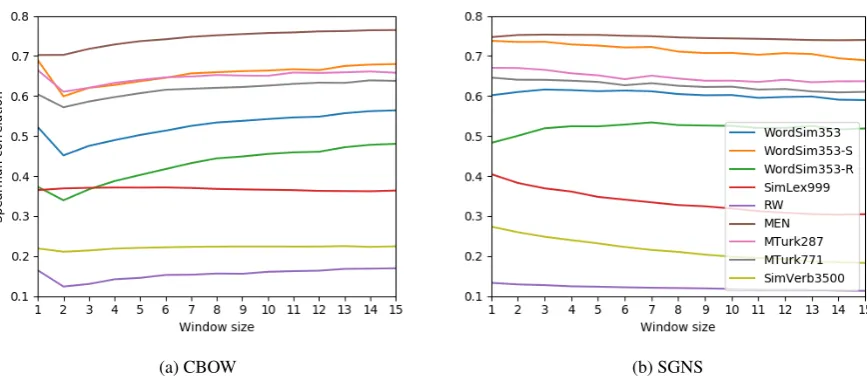
Figure 1: Performance of the CBOW (a) and SGNS (b) algorithms on each benchmark, for each window size, measured by Spearman correlation between the benchmark score and the word embedding cosine similarity.
categorize words based on the distributed represen-tation encoded in word embeddings. We focus on similarity and relatedness, and evaluate word em-bedding models on several common benchmarks.
2.1 Data
We learn word embeddings from English Wikipedia, using a dump from May 1, 2017.2 The data is preprocessed using a publicly available preprocessing script,3 extracting text, removing nonalphanumeric characters, converting digits to text, and lowercasing the text.
Benchmarks. We use the following benchmarks: WordSim-353 (Finkelstein et al.,2001) and its par-tition into WordSim-353-Sim (Agirre et al.,2009) and WordSim-353-Rel (Zesch et al.,2008), Sim-Lex999 (Hill et al.,2015), Rare Words (RW; Lu-ong et al.,2013), MEN (Bruni et al.,2012), MTurk-287 (Radinsky et al.,2011), MTurk-771 (Halawi et al.,2012), and SimVerb-3500 (Gerz et al.,2016). See Table1for the size of each benchmark.
2.2 Hyper-parameters
We use fastText (Bojanowski et al.,2017) to learn 300-dimensional word embedding models, using both the CBOW (continuous bag-of-words) and SGNS (skip-gram with negative sampling) algo-rithms (Mikolov et al.,2013). The context window size varies from 1 up to 15. We include only all
2
https://dumps.wikimedia.org/enwiki
3http://mattmahoney.net/dc/textdata.
html
words occurring 500 times or more (including func-tion words), to avoid very rare words or uncommon spelling errors from skewing the results. All other hyper-parameters are set to their default values.
2.3 Evaluation on Benchmarks
To investigate the effect of window size on a model’s performance on the benchmarks, we eval-uate each model on each benchmark, using cosine similarity as the model’s prediction for each pair. The performance is measured by Spearman corre-lation between the benchmark score and the word embedding cosine similarity (Levy et al.,2015).
Results. Figure1displays the performance of the CBOW and SGNS algorithms on each benchmark, with window sizes 1 to 15. Apart from a small dip between windows 1 and 2 for CBOW, the perfor-mance is either nearly constant, or changes nearly monotonically with window size in each setting.
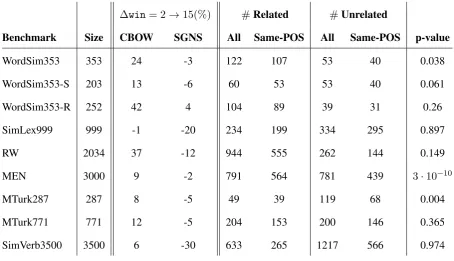
The relative improvement (or deterioration), in percents, with the increase of window size from 2 to 15, are shown in Table1(∆win= 2→15(%)). Interestingly, CBOW exhibits a positive correlation of window size with model’s performance for all benchmarks but SimLex999, while performance for SGNS barely changes with window size, except for SimLex999 and SimVerb3500, where we see a strongnegativecorrelation.
win-∆win= 2→15(%) #Related #Unrelated
Benchmark Size CBOW SGNS All Same-POS All Same-POS p-value
WordSim353 353 24 -3 122 107 53 40 0.038
WordSim353-S 203 13 -6 60 53 53 40 0.061
WordSim353-R 252 42 4 104 89 39 31 0.26
SimLex999 999 -1 -20 234 199 334 295 0.897
RW 2034 37 -12 944 555 262 144 0.149
MEN 3000 9 -2 791 564 781 439 3·10−10
MTurk287 287 8 -5 49 39 119 68 0.004
MTurk771 771 12 -5 204 153 200 146 0.365
[image:3.595.71.526.61.322.2]SimVerb3500 3500 6 -30 633 265 1217 566 0.974
Table 1: Analysis of interchangeability (by same-POS) in word similarity and relatedness benchmarks.∆win= 2→15(%)is the relative change, in percents, of the model’s performance (by Spearman correlation) when going from window size 2 to window size 15, for the CBOW and SGNS algorithms (§2.3).RelatedandUnrelatedare the top and bottom 30% of the pairs, by benchmark score, respectively.P-valueis calculated using the hypergeometric test, comparing the enrichment of interchangeable pairs within related pairs, with a background of all related and unrelated pairs (§3.1).
dow size is related to the model’s implicitly learned concept of part of speech, we investigate this idea in the next section.
3 Syntactic Interchangeability
A word’s part of speech (also known as syntac-tic category) is determined by syntacsyntac-tic distribu-tion, and conveys information about how a word functions in the sentence (Carnie,2002). We can generally substitute each word in a sentence with various words that are of the same part of speech, but not words that are of different parts of speech. While the same syntactic function can sometimes be fulfilled by words of various parts of speech or possibly longer phrases (such as adverbs and prepositional phrases, or multi-word expressions), part of speech is nonetheless a very good proxy for syntactic distribution (Mohammad and Pedersen, 2004).
Related to our work, Vuli´c et al.(2017) intro-duced a framework for automatic selection of spe-cific context configurations for word embedding models per part of speech, improving performance on the SimLex999 benchmark. We take a different approach, investigating existing word embedding
models and the way in which part of speech is reflected in them.
We define two words to be (syntactically) inter-changeableif they share the same part of speech. We quantify interchangeability as a property of a word embedding model, as the proportion of words with the same part of speech within the list of nearest neighbors (that is, the most simi-lar words according to the model) for each word in a pre-determined vocabulary. The higher the interchangeability ratio is, the more importance we assume the model implicitly places on interchange-ability for the calculation of word similarity.
3.1 Interchangeability Analysis in Word Similarity Benchmarks
Interchangeability enrichment. Given the bi-nary classification obtained from the human-annotated scores for each benchmark, we can find the enrichment of interchangeable pairs among related pairs. We use spaCy 2.0.114 (with the en_core_web_smmodel) to annotate the POS for each word in each benchmark pair (tagging them in isolation to select the most probable POS), and look at the set of same-POS pairs in the bench-mark. For each of the benchmarks, we calculate a p-value using the hypergeometric test, comparing the enrichment of same-POS pairs within related pairs, with a background distribution of all related and unrelated pairs (ignoring ones in the middle 40% range of scores).
Results. Table 1 shows the enrichment of in-terchangeable pairs among related and unrelated pairs for each benchmark. For WordSim353, MEN and MTurk287, the set of related pairs contains significantly more interchangeable pairs than the background set (p <0.05),5suggesting that these benchmarks are particularly sensitive to POS.
3.2 Nearest Neighbor Analysis
To try and relate the results from §2.3and §3.1, we measure the relation between window size and interchangeability by analyzing nearest neighbors in word embedding models. In our experiment, the nearest neighborsof a word are the words with the highest cosine similarity between their vectors.
Collecting pivots. We create a word list for each of the three most common parts of speech: nouns, adjectives and verbs. For each POS, we list all lemmas of all synsets of that POS from WordNet (Miller,1998). To “purify” the lists and avoid noise from homonyms, we remove from each list any lemma that also belongs to a synset from another POS. As a further cleaning step, we use spaCy to tag each word, and only keep words for which the spaCy POS agrees with the WordNet POS. Without context, spaCy will likely choose the most common POS based on its training corpus, which is different from WordNet, increasing the robustness.
This process results in 6407uniquely-noun, 2784 uniquely-adjectiveand 1460uniquely-verbwords, which we refer to as ourpivot lists.
4https://spacy.io
5The fact that not all pairs in SimLex999 and SimVerb3500
are judged as interchangeable in our experiment is due to ambiguity: for some words, spaCy selected a POS which is not the one intended when constructing the benchmark.
Algo- NOUN ADJ VERB
rithm 1 15 r 1 15 r 1 15 r
CBOW 79 70 -0.96 72 48 -0.93 55 41 -0.91
[image:4.595.308.524.60.153.2]SGNS 78 66 -0.95 66 39 -0.94 51 41 -0.92
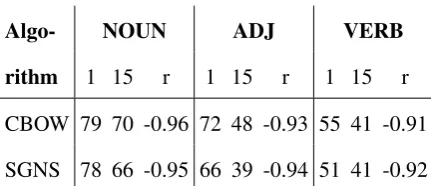
Table 2: Percentage of interchangeable neighbors per pivot POS for the smallest (1) and largest (15) win-dows in our experiment, for the CBOW and SGNS algo-rithms. The number of interchangeable neighbors has a strong negative Pearson correlation (r) with window size for windows 1 to 15 (p <0.01, two-tailed t-test).
Calculating nearest neighbor POS. We find the 100 nearest neighbors for each word in our pivot lists, according to each fastText model with windows 1 through 15. We filter these neighbors to keep only words in the spaCy vocabulary, and inspect the remaining top 10. Again using spaCy, we tag the POS of each neighbor in the result. We subsequently calculate a histogram, for each POS x, of itsneighbor-POSy, that is, the POS assigned to the neighbors of words with POSx.
Results. Table2shows the results of this experi-ment. For nouns, adjectives and verbs, we consis-tently see a decrease in the number of same-POS neighbors when we increase the window size, rela-tive to the total number of nearest neighbors.
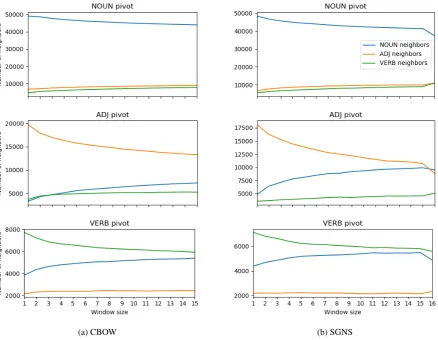
Figure2shows the the absolute number of neigh-bors per algorithm, pivot POS and neighbor POS, for all window sizes we experimented with. The number of nearest neighbors of the same POS is consistently decreasing with window size, while the number of nearest neighbors of other POS are increasing or unaffected.
(a) CBOW (b) SGNS
Figure 2: Number of neighbor per POS for each pivot POS and for each window size, for the CBOW (a) and SGNS (b) algorithms. The number of same-POS neighbors is consistently decreasing with window size.
POS should not play a role in these benchmarks, then models with a bias toward syntactic inter-changeability (i.e., models with lower windows) should performworseon these benchmarks.
4 Conclusion
We investigated the effect of the context window size hyper-parameter on the performance on word similarity benchmarks. We showed that (1) increas-ing the window size results in a lower probabil-ity of interchangeable nearest neighbors for both CBOW and SGNS algorithms; (2) in some widely used benchmarks, syntactic interchangeability in-creases the probability of similarity or relatedness; (3) increasing the window size typically improves performance in predicting similarity or relatedness for CBOW, but has little impact on SGNS.
SimLex999 and SimVerb3500 proved to be ex-ceptions to both (2) and (3), since all pairs in them are interchangeable by construction, but on them, increasing the window size has no effect for CBOW and negative impact for SGNS.
This contradiction is presented as a challenge to the community, and could perhaps be explained by other factors affected by window size.
Our investigation focused on a specific relation between words, namely whether they share a part of speech. Many other relations are of interest to the NLP community, such as syntactic dependency relations, and semantic relations like hypernymy and synonymy. Furthermore, a similar analysis could be applied to other word embedding hyper-parameters, such as the vector dimension. While we used a constant vector dimension of 300 in our experiments, it is an open question whether models with different vector dimensions differ with respect to their tendency to capture different word relations. Future work will extend our analysis to other relations and hyper-parameters.
Acknowledgments
References
Eneko Agirre, Enrique Alfonseca, Keith Hall, Jana Kravalova, Marius Pa¸sca, and Aitor Soroa. 2009. A study on similarity and relatedness using distribu-tional and wordnet-based approaches. In Proceed-ings of Human Language Technologies: The 2009 Annual Conference of the North American Chap-ter of the Association for Computational Linguis-tics, pages 19–27. Association for Computational Linguistics.
Faisal Alshargi, Saeedeh Shekarpour, Tommaso Soru, Amit Sheth, and Uwe Quasthoff. 2018. Con-cept2vec: Metrics for evaluating quality of em-beddings for ontological concepts. arXiv preprint arXiv:1803.04488.
Oded Avraham and Yoav Goldberg. 2016. Improving reliability of word similarity evaluation by redesign-ing annotation task and performance measure. arXiv preprint arXiv:1611.03641.
Amir Bakarov. 2018. A survey of word em-beddings evaluation methods. arXiv preprint arXiv:1801.09536.
Mohit Bansal, Kevin Gimpel, and Karen Livescu. 2014. Tailoring continuous word representations for depen-dency parsing. InProceedings of the 52nd Annual Meeting of the Association for Computational Lin-guistics (Volume 2: Short Papers), volume 2, pages 809–815.
Piotr Bojanowski, Edouard Grave, Armand Joulin, and Tomas Mikolov. 2017. Enriching word vectors with subword information. Transactions of the Associa-tion for ComputaAssocia-tional Linguistics, 5:135–146.
Elia Bruni, Gemma Boleda, Marco Baroni, and Nam-Khanh Tran. 2012. Distributional semantics in tech-nicolor. In Proceedings of the 50th Annual Meet-ing of the Association for Computational LMeet-inguistics: Long Papers-Volume 1, pages 136–145. Association for Computational Linguistics.
Andrew Carnie. 2002. Syntax: A Generative Introduc-tion (Introducing Linguistics). Blackwell Publish-ing.
Billy Chiu, Anna Korhonen, and Sampo Pyysalo. 2016. Intrinsic evaluation of word vectors fails to predict extrinsic performance. In Proceedings of the 1st Workshop on Evaluating Vector-Space Representa-tions for NLP, pages 1–6.
Lev Finkelstein, Evgeniy Gabrilovich, Yossi Matias, Ehud Rivlin, Zach Solan, Gadi Wolfman, and Ey-tan Ruppin. 2001. Placing search in context: The concept revisited. InProceedings of the 10th inter-national conference on World Wide Web, pages 406– 414. ACM.
Daniela Gerz, Ivan Vuli´c, Felix Hill, Roi Reichart, and Anna Korhonen. 2016. SimVerb-3500: A Large-Scale Evaluation Set of Verb Similarity. InEMNLP.
Yoav Goldberg. 2016. A primer on neural network models for natural language processing.
Guy Halawi, Gideon Dror, Evgeniy Gabrilovich, and Yehuda Koren. 2012. Large-scale learning of word relatedness with constraints. In Proceedings of the 18th ACM SIGKDD international conference on Knowledge discovery and data mining, pages 1406– 1414. ACM.
Zellig S Harris. 1954. Distributional structure. Word, 10(2-3):146–162.
Felix Hill, Roi Reichart, and Anna Korhonen. 2015. Simlex-999: Evaluating semantic models with (gen-uine) similarity estimation. Computational Linguis-tics, 41(4):665–695.
Stanisław Jastrzebski, Damian Le´sniak, and Woj-ciech Marian Czarnecki. 2017. How to evaluate word embeddings? on importance of data effi-ciency and simple supervised tasks. arXiv preprint arXiv:1702.02170.
Omer Levy, Yoav Goldberg, and Ido Dagan. 2015. Im-proving distributional similarity with lessons learned from word embeddings. Transactions of the Associ-ation for ComputAssoci-ational Linguistics, 3:211–225.
Chu-Cheng Lin, Waleed Ammar, Chris Dyer, and Lori Levin. 2015. Unsupervised pos induction with word embeddings. arXiv preprint arXiv:1503.06760.
Pierre Lison and Andrey Kutuzov. 2017. Redefin-ing context windows for word embeddRedefin-ing models: An experimental study. InProceedings of the 21st Nordic Conference on Computational Linguistics, pages 284–288. Association for Computational Lin-guistics.
Thang Luong, Richard Socher, and Christopher Man-ning. 2013. Better word representations with re-cursive neural networks for morphology. In Pro-ceedings of the Seventeenth Conference on Computa-tional Natural Language Learning, pages 104–113.
Tomas Mikolov, Kai Chen, Greg Corrado, and Jef-frey Dean. 2013. Efficient estimation of word representations in vector space. arXiv preprint arXiv:1301.3781.
George Miller. 1998. WordNet: An electronic lexical database. MIT press.
Saif Mohammad and Ted Pedersen. 2004. Combining lexical and syntactic features for supervised word sense disambiguation. InProceedings of the Eighth Conference on Computational Natural Language Learning (CoNLL-2004) at HLT-NAACL 2004.
Kira Radinsky, Eugene Agichtein, Evgeniy Gabrilovich, and Shaul Markovitch. 2011. A word at a time: computing word relatedness using temporal semantic analysis. In Proceedings of the 20th international conference on World wide web, pages 337–346. ACM.
Tobias Schnabel, Igor Labutov, David Mimno, and Thorsten Joachims. 2015. Evaluation methods for unsupervised word embeddings. InProceedings of the 2015 Conference on Empirical Methods in Natu-ral Language Processing, pages 298–307.
Ivan Vuli´c, Roy Schwartz, Ari Rappoport, Roi Reichart, and Anna Korhonen. 2017. Automatic selection of context configurations for improved class-specific word representations. In Proceedings of the 21st Conference on Computational Natural Language Learning (CoNLL 2017), pages 112–122, Vancou-ver, Canada. Association for Computational Linguis-tics.
Dongqiang Yang and David Martin Powers. 2006. Verb similarity on the taxonomy of wordnet. In Pro-ceedings of GWC.