Learnability and Overgeneration in Computational Syntax
Yiding Hao Department of Linguistics Department of Computer Science
Yale University [email protected]
Abstract
This paper addresses the hypothesis that un-natural patterns generated by grammar for-malisms can be eliminated on the grounds that they are unlearnable. I consider three ex-amples of formal languages thought to rep-resent dependencies unattested in natural lan-guage syntax, and show that all three can be learned by grammar induction algorithms fol-lowing the Distributional Learning paradigm ofClark and Eyraud(2007). While learnable language classes are restrictive by necessity (Gold, 1967), these facts suggest that learn-ability alone may be insufficient for addressing concerns of overgeneration in syntax. 1 Introduction
A longstanding debate in linguistics concerns the division of labor in language acquisition between innate universal assumptions about natural lan-guage and the learner’s ability to recognize pat-terns in data. Therationalist position, famously championed by the Principles and Parameters framework, follows the Poverty of the Stimulus ar-gument (POS,Chomsky,1965,1968,1971,1980) in assuming a rich Universal Grammar (UG) that allows individual languages to vary along a nar-row range of dimensions. On the other hand, the Distributional Learning paradigm of grammatical inference (Clark and Eyraud,2007) has shown that it is possible to createempiricistrepresentations of grammar optimized for extracting generalizations from data with theoretical guarantees of conver-gence.
Recent advances in mathematical linguistics have suggested that the rationalist–empiricist de-bate may be of interest to the program of formally characterizing the typology of syntax. Shieber’s (1985) argument that Swiss German is not context-free shows that substantial expressive power is needed in order to adequately describe
syntactic phenomena. At the same time, the class of context-free languages and its extensions in-clude pathological dependencies unattested in nat-ural language.Kobele(2011), for instance, shows that the context-free Merge operation allows Min-imalist Grammars (MGs) to define languages that require every syntactically well-formed sentence to have at least one semantic type conflict. In light of this overgeneration problem, learnability has been proposed as a possible way to refine exist-ing language classes so as to better align with em-pirical facts. Under such an approach, UG spec-ifies the formalism in which grammars are repre-sented, while language acquisition is modelled by a grammar induction algorithm that correctly con-verges on a subset of the possible grammars. Since no strict superclass of the finite languages admits a general learning procedure (Gold,1967), there necessarily exist languages that are permitted by UG but that cannot be learned by the language ac-quisition algorithm.
This paper takes some preliminary steps toward evaluating the potential of learnability to produce restricted language classes that exclude unnatu-ral patterns. Recent work in Distributional Learn-ing has produced a hierarchy of context-free and multiple context-free language classes defined by learning algorithms. I examine three examples of unnatural patterns—structure-independent con-straints on sentence length, free word order with unbounded crossing dependencies, and unlimited copying of deep context-free structure—and show that these patterns appear in small classes of the learnable hierarchy. This suggests that current ap-proaches to grammar induction for syntax may fail to yield learnability-based accounts for the ab-sence of these patterns in syntactic typology.
After basic definitions and notation are pre-sented in Section 2, Section 3 introduces the learn-able language classes considered in this paper.
The three unnatural patterns, drawn fromGraf’s (2013) discussion of overgeneration in MGs, are defined in Section 4. There, it will be shown that the three patterns exist within the language classes from Section 3. Section 5 concludes with a discus-sion of these facts and their relationship with the rationalist–empiricist debate.
2 Preliminaries
As usual, Ndenotes the set of nonnegative inte-gers, and for any setA,P(A) denotes the power set ofA. Unless otherwise specified, the letterΣ denotes a finite alphabet. The length of a stringx
is denoted by|x|, andεdenotes the empty string.
For eacha∈Σ,|x|adenotes the number of
occur-rences ofainx. Alphabet symbols are identified
with strings of length1. For stringsaandb,ab de-notes the concatenation ofaandb. As usual, this notation is extended elementwise to sets of strings. Fork ∈N,αk denotesαconcatenated with itself k-many times;α≤k denotes!ki=0αi; α∗ denotes
!∞
i=0αi; andα+ denotesα∗\{ε}. This notation
does not apply to(Σ∗)k, which denotes the
carte-sian product"k
i=1Σ∗. Thelength of a tuplex =
⟨x1, x2, . . . , xk⟩ is defined as |x| := #ki=1|xi|.
Fora∈Σ,|x|adenotes|x1x2. . . xk|a.
For k ∈ N, ak-context over Σ is a (k+ 1) -tuple of strings⟨c0, c1, . . . , ck⟩ ∈(Σ∗)k, denoted c0!c1!. . .!ck. For setsL1, L2, . . . , Lk ⊆ Σ∗, L0!L1!. . .!Lk denotes the cartesian product
"k
i=0Li. Thewrapping operation⊙betweenk
-contexts andk-tuples of strings is defined by
c0!c1!. . .!ck⊙ ⟨x1, x2, . . . , xk⟩
:=c0x1c1x2c2. . . xkck
and extended elementwise to sets of contexts and sets of strings. Forα ∈ (Σ∗)k ∪P$(Σ∗)k%and L ⊆ Σ∗, thecontexts of αwith respect toL are defined to be the set
α|L⟩:=&c∈(Σ∗)k+1'''c⊙α⊆L(,
with the “⊆” above replaced by “∈” whenα ∈
(Σ∗)k. Forγ ∈(Σ∗)k+1∪P$(Σ∗)k+1%, we define
the set
γ⟨L|:=&x∈(Σ∗)k'''γ⊙x⊆L(,
with the “⊆” above replaced by “∈” when γ ∈ (Σ∗)k+1. When the identity of the languageLis
clear from context, we may denoteα|L⟩byα◃and γ⟨L|byγ▹.
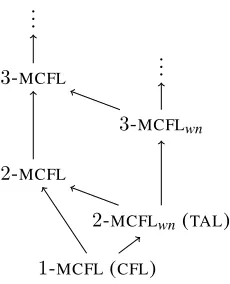
1-MCFL(CFL) 2-MCFL
3-MCFL ...
2-MCFLwn(TAL) 3-MCFLwn
[image:2.612.360.475.63.205.2]...
Figure 1: The MCFL hierarchy.
2.1 Multiple Context-Free Grammars
This paper considersmultiple context-free gram-mars (MCFGs, Seki et al., 1991), a mildly context-sensitive (MCS) formalism equivalent to MGs (Harkema,2001;Michaelis,2001). MCFGs are a generalization of context-free grammars (CFGs) in which nonterminals derive tuples of strings. Whereas CFG rules concatenate strings derived from nonterminals on their right-hand sides, MCFGs interleave nonterminal-derived tu-ples. Let us consider an example to illustrate how MCFGs generate strings.
Example 1. The following four rules define an MCFG generating the copy languageL ={ww | w∈ {a, b}∗}. The start symbol isS.
S(xy)←T(x, y) (2a)
T(ax, ay)←T(x, y) (2b)
T(bx, by)←T(x, y) (2c)
T(ε, ε)← (2d)
A rule of the form
A(y)←B1(x1)B2(x2). . . Bn(xn)
is interpreted as an axiom stating that if each non-terminal Bi on the right-hand side generates the
tuplexi, then the nonterminalAon the left-hand
side generates the tupley. In rule (2d), the right-hand side is empty; this means that we assumeT
to generate the tuple⟨ε, ε⟩.
The stringabab ∈ Lis derived as follows. By rule (2d),T generates⟨ε, ε⟩. By (2c),T generates
⟨b, b⟩. By (2b),T generates⟨ab, ab⟩. By (2a), the start symbolSgeneratesabab.
one another. These functions must satisfy a condi-tion known aslinearity, which asserts that MCFG rules cannot copy their inputs.1
Definition 3. Fix k ∈ N. Consider a function
f : "ki=1(Σ∗)di → (Σ∗)d0. For each i, write xi =⟨xi,1, xi,2, . . . , xi,di⟩. We say thatf is a lin-ear functionif it is of the form
f(x1,x2, . . . ,xk) =⟨α1, α2, . . . , αd0⟩,
where the concatenated stringα = α1α2. . . αd0 satisfies the following criteria:
• α contains exactly one occurrence of each
variablexi,j; and
• for each i and j, xi,j occurs to the left of xi,j+1inα.2
Furthermore, we say thatfiswell-nestedif there
are no indicesi,j,i′,j′, andj′′, withi ̸= i′and j′ ̸= j′′, such that the variable xi′,j′ occurs
be-tweenxi,jandxi,j+1inα, butxi′,j′′ does not. Definition 4. A multiple context-free gram-mar (MCFG) is an ordered quadruple G = ⟨N,Σ, R, I⟩, where
• N is a finite set ofnonterminals;
• Σis a finite set ofterminals;
• I ⊆N is the set ofstart symbols; and
• letting F be the set of all linear functions, R⊆N×F×N∗is a finite set ofrules.
We always assume thatN andΣare disjoint. Each nonterminalA ∈ N is associated with a number dim(A)known as itsdimension. All start symbols must have dimension1. We denote each ruler = ⟨A, f, B1B2. . . Bk⟩by
A(y)←B1(x1)B2(x2). . . Bk(xk),
where eachxiis adim(Bi)-tuple of variables and
y = f(x1,x2, . . . ,xk). We say that r is
well-nestediffis well-nested.
1While individual MCFG rules cannot copy, Example 1 shows that MCFGs can perform copying by combining sev-eral different rules.
2Technically, the definition of linear functions only re-quires thatα contain at least one occurrence of eachxi,j. Seki et al.(1991) andKracht(2003) show that the other as-sumptions can be made without changing the generative ca-pacity of MCFGs.
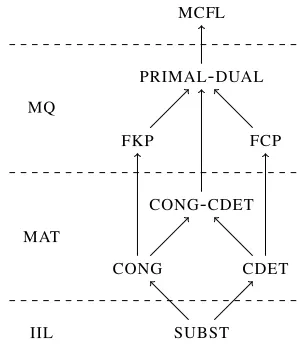
SUBST
CONG CDET
CONG-CDET
FKP FCP
PRIMAL-DUAL MCFL
IIL MAT
[image:3.612.341.490.59.231.2]MQ
Figure 2: The hierarchy of Distributionally Learnable MCFLs (seeClark and Yoshinaka 2016).
We say thatGis ak-multiple context free
gram-mar(k-MCFG) if every nonterminal has dimen-sion at mostk. We say thatGiswell-nestedif ev-ery rule inRis well-nested. For each nonterminal
A, we define L(G, A) ⊆ (Σ∗)dim(A) as follows. For each ruleA(y)←B1(x1)B2(x2). . . Bk(xk)
with y = f(x1,x2, . . . ,xk), if zi ∈ L(G, Bi)
for each i, then f(z1,z2, . . . ,zk) ∈ L(G, A).
Identifying 1-tuples with strings, the language generated by G is the language L(G) := !
S∈IL(G, S). We say that a languageL ⊆ Σ∗
is ak-multiple context-free language(k-MCFL) if it is generated by a k-MCFG. We say that L is
well-nestedifGis well-nested.
MCFLs naturally subsume other common lan-guage classes: the class of context-free lanlan-guages (CFLs) is the same as the class of1-MCFLs, while the class of tree-adjoining languages (TALs) is the same as the class of well-nested 2-MCFLs (Kanazawa,2009b). Seki et al.(1991) and Ram-bow and Satta (1999) prove a separation re-sult showing thatk-MCFLs are strictly contained
within the class of(k+ 1)-MCFLs. This MCFL
hierarchy, along with its well-nested counterpart (Kanazawa,2009a), is shown in Figure 1.
3 Learnable Classes of Languages
The theory of learnability considered here is based on the Identification in the Limit (IIL) model of Gold(1967). Under this paradigm, the learner re-ceives an infinite data stream containing all pos-sible strings drawn from a target languageL,
each string, the learner must guess a grammar for
L. We consider a class of languagesC ⊆ P(Σ∗) to be learnable if there is a learner whose guesses converge to a correct grammar forLfor any target L∈Cand any presentation of the strings ofL.
IIL-learning of formal languages was pioneered by Angluin (1982), who gave an algorithm that learns the class of regular languages satisfying a criterion known as reversibility. While the full class of regular languages is not learnable un-der the IIL paradigm, Angluin (1987) showed that learner can learn all regular languages if it is equipped with a minimally adequate teacher (MAT): a black-box oracle that answers certain questions about the target language. These al-gorithms were extended to CFLs by Clark and Eyraud(2007) andClark(2010), respectively, and to MCFLs byYoshinaka (2011a) andYoshinaka and Clark (2012), respectively. Since the MAT-learning algorithm fails to learn the full classes of CFLs and MCFLs, further results byYoshinaka (2011b),Yoshinaka(2012), andClark and Yoshi-naka (2012) expand the MAT-learnable classes via algorithms usingmembership queries (MQs). These learnable language classes are visually sum-marized in Figure 2.
The remainder of this section formally defines several classes of MCFLs. Subsection 3.1 defines the IIL-learnablesubstitutableMCFLs (“SUBST” in Figure 2), the MCFL analogue ofAngluin’s re-versible regular languages. Subsection 3.2 defines the MAT-learnablecongruentialMCFLs (“CONG” in Figure 2). Subsection 3.3 defines two MQ-learnable classes of MCFLs: those generated by MCFGs with thefinite kernel property (“FKP” in Figure 2) and those generated by MCFGs with the finite context property(“FCP” in Figure 2).
3.1 Substitutable Languages
The IIL algorithms of Clark and Eyraud (2007) and Yoshinaka (2011a) rely upon the strong as-sumption that whenever twok-tuplesxandy ap-pear in the same context—i.e.,x◃∩y◃ ̸= ∅— they must be generated by the samek-dimensional
nonterminal. This property is known as substi-tutability.
Definition 5. Fork ∈ N, a languageL ⊆ Σ∗is
k-substitutable if for allk-tuples x,y ∈ (Σ∗)k, eitherx|L⟩=y|L⟩orx|L⟩∩y|L⟩=∅.
For each k, a language L induces an
equiva-lence relation ≡k
L on (Σ∗)k in which x ≡kL y
if and only ifx◃ = y◃. The grammarG
con-structed by the algorithm identifies each nonter-minalAwith an equivalence class[a]of≡dim(L A), so thata ∈ L(G, A) ⊆ [a]. It turns out that
lin-ear functions map tuples of subsets of equivalence classes to subsets of equivalence classes, allow-ing nonterminals to combine with one another via MCFG rules.
When L is a k-substitutable k-MCFL, the
learner determines whether or not x and y are equivalent based on whether or not a common con-text in x◃∩ y◃ has been observed so far, with the understanding that such a context must ap-pear in the data eventually. At each time step, the learner finds all equivalence classes seen so far, and constructs all rules such that a representative from the equivalence class on the left-hand side has been observed in the data. The learner con-verges when the data contain enough equivalence classes to construct a correct grammar forL.
3.2 Congruential Languages
InClark(2010) andYoshinaka and Clark(2012), the learner again identifies each nonterminal A
with an equivalence class of ≡dim(L A) and seeks
to find all equivalence classes needed to construct the grammar. Without the assumption of substi-tutability, the learner relies on the minimally ade-quate teacher to determine which tuples are equiv-alent. To do this, the learner asks the teacher two types of questions: membership queries(Is
x∈L?) andequivalence queries(What is an ex-ample of a string inL\L(G)?). At each time step, an equivalence query is used to identify an equiv-alence class not covered by an existing nontermi-nal, and membership queries are used to construct all possible rules involving the new nonterminal. Note that training data are not needed, since the learner asks the teacher for data through equiv-alence queries. MCFGs constructed through this procedure are known ascongruentialMCFGs.
Definition 6. Ak-MCFGGiscongruentialif for every nonterminalA,L(G, A)is completely con-tained within an equivalence class of≡dim(L(G)A). A
k-MCFL is congruential if it is generated by a
congruentialk-MCFG.
3.3 The FKP and the FCP
The learning algorithms for the substitutable and congruential CFLs and MCFLs attempt to find equivalence classes of≡k
Clark and Yoshinaka (2012) generalize beyond this approach by dropping the requirement that nonterminals correspond to equivalence classes. Instead, each nonterminalA is identified with a
finite set of strings or contexts with the same dis-tribution asA.
Definition 7. Fixk∈N. An MCFGGhas thek -finite kernel property(k-FKP) if for every
nonter-minalAofG, there existsKA ⊆ (Σ∗)dimAsuch that|KA| ≤ k andL(G, A)◃ = KA◃. Ghas the k-finite context property(k-FCP) if for every
non-terminalA, there existsCA⊆(Σ∗)dim(A)+1such
that|CA| ≤kandL(G, A)◃▹ =CA▹.3
At each time step, the learner constructs non-terminals by considering all possible size-k sets of tuples or contexts. The learner constructs rules
r=A(y)←B1(x1)B2(x2). . . Bn(xn)by
deter-mining whether or not the right-hand side and the left-hand side have the same distribution. This is done heuristically by asking membership queries for strings of the form c ⊙ f(b1,b2, . . . ,bn),
wheref is the linear function associated withr. WhenLis assumed to have thek-FKP,cis drawn from the contexts inKA◃observed so far, and for
eachi,bi∈KBi. WhenLis assumed to have the
k-FCP,c ∈ CA, while eachbi is drawn from the
substrings inCB▹
iobserved so far. 4 Overgeneration
The formal problem of overgeneration has a long history in linguistics, starting from Peters and Ritchie’s (1973) proof that Transformational Grammars can generate all recursively enumer-able languages. Recent interest in the overgener-ation problem arises from the model-theoretic ap-proach pioneered byRogers(1994,1998) for the formalization of syntactic theories. Relying upon the equivalence of monadic second-order (MSO) logic over trees with tree automata (Thatcher and Wright, 1968), Rogers constructs a context-free implementation ofRizzi’s (1990) constraint-based Relativized Minimality theory by stating the con-straints in MSO logic. Morawietz(2008) extends the model-theoretic approach to MCS formalisms by combining MSO constraints on derivation trees with MSO-definable transductions from derivation trees to derived structures. Considering the case of MGs, Kobele (2011) and Graf (2011) show
3The definition presented here is for theweakversions of the FKP and the FCP. Other versions of these properties are discussed inKanazawa and Yoshinaka(2017).
that MG derivation trees are closed under inter-section with arbitrary MSO constraints, andGraf (2012) shows that complex movement operations can be added to MGs by enhancing the transduc-tion from derivatransduc-tion trees to derived trees. These closure properties allow Graf (2013) to develop a full MG-based treatment of Minimalist syntax withinMorawietz’s framework, showing that Min-imalist constraints on derivation trees and derived trees, as well as transderivational constraints, can be implemented using Merge by carefully choos-ing categories and selection features for lexical items.
These findings have highlighted the relevance of overgeneration to mainstream Minimalist syn-tax. As discussed in Graf (2017), existing con-straints on movement can be circumvented by us-ing Merge to create non-local dependencies. On the other hand, any pathological pattern is a logi-cally possible MG as long as it is MSO-definable. Illustrating the latter point,Graf(2013, pp. 117– 118) identifies three kinds of unnatural dependen-cies that can be generated by MGs:
(8) a. patterns sensitive to “non-linguistic” information, such as the number of words in a sentence;
b. languages with completely free word order, subject to no restrictions; and c. creating arbitrarily many copies of
context-free structure.
In Subsections 4.1 and 4.2, I show that the pat-terns described in (8a) and (8b), respectively, can be represented as substitutable MCFLs. In Sub-section 4.3, we will see that the arbitrary copying of (8c) is not congruential, but it can be generated by an MCFG with both the2-FKP and the1-FCP.
4.1 Structure-Independent Patterns
One of the earliest motivations for the rationalist position is the observation that syntactic depen-dencies are universally sensitive to constituency structure.Chomsky(1968) argues:
ab-stract structure as a system of phrases. . . . Yet no human language contains structure-independent operations . . . . The language-learner knows that [such operations] need not be considered as tentative hypotheses.
Examples of “structure-independent” patterns typically consist of operations whose targets are based on arithmetic criteria. One such example ap-pears in the passage quoted above, where Chom-skyimagines an auxiliary-fronting operation tar-geting the first auxiliary in a sentence. This pro-duces the ungrammatical question (9b) from the corresponding declarative (9a).
(9) a. The subjects who will act as con-trols will be paid.
b. * Will the subjects whotact as con-trols will be paid?
c. Will the subjects who will act as controlstbe paid?
Along these lines, Graf imagines a requirement that the length of a sentence or phrase be a mul-tiple of some fixed numbern.
Definition 10. For eachn >0, let us define
MODn:={x| |x| ≡0 modn}.
Despite its structure-independence, MODn is
easily shown to be substitutable.
Proposition 11. MODnisk-substitutable for
ev-eryk∈Nandn >0.
Proof. For anyk-tuplexandk-contextc,c⊙x∈ MODn if and only if|c|+|x|is a multiple ofn.
Therefore,
x◃={c| |c| ≡ −|x| mod n}.
It is clear that for any x,y ∈ (Σ∗)k, x◃ and
y◃ are either equal or disjoint, so MODn is k
-substitutable for everyk. 4.2 Free Word Order
FollowingShieber’s (1985) argument that Swiss German is not context-free, Joshi (1985) pro-posed the MCS languages as a characterization of the possible natural languages. This class is defined by grammar formalisms that admit a polynomial-time parsing algorithm, exhibit con-stant growth, and express limited cross-serial pendencies. The notion of “limited cross-serial de-pendencies” was left vague, butJoshi et al.(1990, 1991) provide some elaboration:
[MCS grammars] capture only certain kinds of dependencies, e.g., nested de-pendencies and certain limited kinds of crossing dependencies (e.g., in the sub-ordinate clause constructions in Dutch or some variations of them, but perhaps not in the so-calledMIX(or Bach) lan-guage . . . [).]
The languageMIXmentioned above is the focus of this subsection.
Definition 12. The languageMIXis defined as
MIX :={x∈ {a, b, c}∗| |x|a =|x|b=|x|c}.
According toJoshi(1985),MIX“represents the extreme case of the degree of free word order permitted in a language,” and is therefore “lin-guistically not relevant.” The fact that MIX is a 2-MCFL but not a TAL (Salvati, 2011, 2015; Kanazawa and Salvati,2012) has been used to ar-gue that the TALs are a more suitable formaliza-tion of the MCS languages than the MCFLs. This kind of reasoning may be seen as a rationalist po-sition asserting thatMIXis not a possible natural language because UG requires natural languages to be TALs. An empiricist account for the absence of MIX-like natural languages might claim that the learners fail to converge onMIXeven though MIXis allowed by UG. However, it turns out that MIX is substitutable, so such an account would not be supported by Distributional Learning as a model of language acquisition.
Proposition 13 (Clark and Yoshinaka, 2016).
MIXisk-substitutable for everyk∈N.
Proof. Suppose c ⊙x,c⊙ y,d ⊙ x ∈ MIX. We want to show that d⊙y ∈ MIX. To that end, observe that for any context γ and symbol i∈ {a, b, c},
|γ⊙y|i=|γ⊙x|i− |x|i+|y|i. (14)
Takingγ=c, we obtain
−|x|i+|y|i=|c⊙y|i− |c⊙x|i.
Next, we takeγ =dand substitute the above into (14), giving us
|d⊙y|i=|d⊙x|i+|c⊙y|i− |c⊙x|i.
Since the terms on the right-hand side have the same value for alli, so must the left-hand side.
4.3 Copying
The third unnatural dependency thatGraf consid-ers is represented by thedouble-copying language COPY3(D1).
Definition 15. ForL⊆Σ∗andn∈N, define
COPYn(L) :={(x#)n|x∈L},
where#∈/Σ.4
Definition 16. The languageD1 is the language
generated by the following1-MCFG.
S(xy)←S(x)S(y)
S([x])←S(x)
S(ε)←
Copy languages have two interpretations in mathematical linguistics. On the one hand, COPY2({a, b}∗) represents the cross-serial
de-pendencies found in Swiss German, since it is a homomorphic image of the embedded-clause verb–argument sequences that Shieber shows is not context-free. On the other hand, the idea of copying structure often appears explicitly in syn-tactic analyses. Kobele (2006), for instance, ar-gues that Yoruba has a relative clause construction that involves copying VPs. Apart from overtly attested instances of copying, Merchant (1999, 2001) develops a theory of sluicing in which CPs are copied and their TP complements are deleted. It turns out that Distributional Learning can distin-guish between these two interpretations of copy-ing.
Proposition 17. COPYn(L)is a congruentialn
-MCFL if and only ifLis regular.5
If we consider non-regularLs to represent
copy-ing of structure, then only the former interpreta-tion is captured by the congruentialn-MCFLs. Lemma 18. Letx=⟨x1, x2, . . . , xm⟩, withm≤ n. If|x|# < n, then either|xi|# ≥2for somei,
x|COPYn(L)⟩ =∅, orxbelongs to a finite equiv-alence class of≡m
COPYn(L).
Proof. Suppose x◃ ̸= ∅, |xi|# ≤ 1 for all i,
and|x|# ≤ n−2. Then, x has a contextc =
c0!c1!. . .!cn such that|ci|# ≥ 2for somei.
Writingci =l#w#r, observe that everyy ∈c▹
satisfiesc⊙y = (w#)n. There are only finitely
4The language considered inGraf(2013) does not have a final#. However, adding the final#allowsCOPYn(L)to be congruential whenLis regular (Proposition 17).
5However, it is easy to show thatCOPY
n({aibi |i ≥
0})is a congruential(n+ 1)-MCFL.
many suchys, so only finitely many strings may share the contextcwithx.
Next, suppose thatx◃̸=∅,|xi|#≤1for alli,
and|x|# = n−1. Then, we have|xp|# = 0for
somep, and fori ̸= pwe can writexi = yi#zi
with|yi|# = |zi|# = 0. Lety be the longestyi
andz be the longestzi, and letym+1 =z0 := ε.
Observe thatc∈x◃if and only ifc⊙x= (w#)n
for somew∈zΣ∗y∩zp
−1Σ∗xpΣ∗yp+1. Thus, if
x′◃ = x◃, then x′ = ⟨x′1, x′2, . . . , x′m⟩, where
xq′ =xpfor someq,x′i =yi′#zi′fori̸=q,yis the
longesty′i, zis the longestzi′,y′q+1 = yq+1, and
z′q−1 = zp−1. There are only finitely many such
x′, so the lemma follows.
Proof of Proposition 17. First, suppose L is
reg-ular. Let M be the minimal right-to-left
deter-ministic finite-state automaton recognizingL. We
can construct an MCFGGforCOPYn(L)as
fol-lows. The nonterminals of G are the states of
M. If Ais the start state ofM, then G has the ruleA(#,#, . . . ,#) ←. If M transitions from
state B to stateA after readinga, then G has a
ruleA(ax1, ax2, . . . , axn)← B(x1, x2, . . . , xn).
Finally, for each accept state S of M, G has a
start symbol IS and a rule IS(x1x2. . . xn) ←
S(x1, x2, . . . , xn). It is clear that for eachx ∈ L(G, IS),x◃={!}. Observe that for each
non-terminal A of G, L(G, A) is the set of strings (w#)nsuch thatM is in stateAafter readingw.
Thus, elements ofL(G, A)are of the form(w#)n. For each such(w#)n, we have
((w#)n)◃={c!c!. . .!c|cw∈L}.
SinceMis minimal, if(u#)n,(v#)n∈L(G, A),
then by the Myhill–Nerode Theorem we must have
{c|cu∈L}={c|cv∈L},
thus
((u#)n)◃={c!c!. . .!c|cu∈L} ={c!c!. . .!c|cv∈L}
= ((v#)n)◃.
This means thatGis congruential.
Now, suppose COPYn(L) is generated by a
congruentialn-MCFGG. By Lemma 18, with-out loss of generality each copy of w ∈ L in (w#)n ∈ COPY
n(L) is generated exclusively
using rules of the form
←B(x1, x2, . . . , xn),
where li, ri ∈ Σ∗ for each i and L(G, B) ⊆
(Σ∗#Σ∗)n. Sincex
1 must already contain a#,
such rules can only append a constant string to the left of the first copy ofw, so the set of possiblews
must be regular.
Graf argues that COPY3(D1) is unnatural
because “embeddings of unbounded depth are copied and fully realized in three distinct posi-tions in the utterance.” According to Proposi-tion 17, the property of unbounded depth disqual-ifies COPY3(D1) from congruentiality, but the
existence of more than two copies does not, as long asCOPY3(D1)is generated by a3-MCFG.
COPY3(D1)is still learnable, however, because
it belongs to the class of3-MCFLs defined by the FKP and the FCP.
Proposition 19. COPY3(D1)is generated by a
3-MCFGGwith the2-FKP and the1-FCP.
Proof. Gis defined as follows.
S(x#y#z#)←T(x, y, z)
T(x1x2, y1y2, z1z2)←T(x1, y1, z1)
T(x2, y2, z2)
T([x],[y],[z])←T(x, y, z)
T(ε, ε, ε)←
We have
L(G, S)◃= COPY3(D1)◃={!}={###}◃
L(G, T)◃={⟨w, w, w⟩ |w∈D1}◃
=&l!r#l!r#l!r#'''l!r∈D⟨D1|
1
(
={⟨[[]],[[]],[[]]⟩,
⟨[][],[][],[][]⟩}◃,
soGhas the2-FKP.6We also have
L(G, S)◃▹={!}▹
L(G, T)◃▹={!#!#!#}▹,
soGhas the1-FCP.
5 Conclusion
We have seen that MODn and MIX are k
-substitutable for every k, while COPY3(D1) is
generated by a3-MCFG with the2-FKP and the 6Gdoes not have the1-FKP because for any
⟨x, x, x⟩ ∈
L(G, T)◃▹,x!#!x#x!#∈ ⟨x, x, x⟩◃\L(G, T)◃.
1-FCP. If the Distributional Learning hierarchy of Figure 2 is taken to be a measure of complex-ity, then we may conclude from these facts that MODn and MIX are very simple from the
per-spective of learnability. Proposition 17 gives us the interesting result that in general, the com-plexity of COPYn(L) with respect to
learnabil-ity is related to the language-theoretic complexlearnabil-ity ofL, so thatCOPY3(D1)is slightly more
com-plex than the congruential languages. Since natu-ral language grammars are not congruential,7any class in the learnable hierarchy that might plau-sibly include natural language syntax would also likely includeMODn,MIX, andCOPY3(D1).
The discussions in Subsections 4.2 and 4.3 should be contrasted with language-theoretic anal-yses of MIX and COPY3(D1), respectively.
As mentioned previously, MIX falls outside the TALs, which is identical to the well-nested 2-MCFLs. Similarly,Kanazawa and Salvati(2010) show that COPY3(D1) is not a well-nested n
-MCFL for anyn. The criterion of well-nestedness,
then, provides an elegant rationalist explanation for the absence ofMIX- orCOPY3(D1)-like
nat-ural languages. Such a criterion could also be jus-tified on functionalist grounds, since well-nested MCFGs admit a more efficient parsing algorithm than MCFGs in general (G´omez-Rodr´ıguez et al., 2010). While the well-nestedness requirement does not eliminate MODn, an anonymous
re-viewer observes that intersecting the language of a CFG withMODnincreases the size of that CFG
by a factor ofn2. Thus, whennis large, languages
withMODn-like dependencies may be eliminated
by functionalist considerations regarding grammar size.
The case of MODn shows that the regular
languages capture many patterns that do not re-semble natural language dependencies. Although the inclusion of the regular languages in nat-ural language has traditionally been taken for granted,8recent work on thesubregular hierarchy has shown that markedness constraints in phono-tactics and morphophono-tactics typically belong to re-stricted, IIL-learnable subclasses of the regular languages (Heinz et al., 2011; Aks¨enova et al., 7For example, congruentiality would preclude the possi-bility of a single word such aseffectoraffecthaving the distri-bution of both a noun and a verb if nonterminals are identified with syntactic categories.
2016) that formalize notions of locality. It may be the case that a refinement of the regular lan-guages is needed for syntax as well. While the study of the equivalence relation≡kLmay be seen
as an algebraic treatment of the notion of structure (Clark,2015), the learnability of MODn may
re-veal a point of divergence between the algebraic approach and the intuitive notion of syntactic con-stituencies.
In conclusion, this paper has shown that the restricted language classes in the Distributional Learning hierarchy are rich enough to raise the very questions of overgeneration that they were hypothesized to solve. While Distributional Learning does not provide a learnability-based ac-count for the typological absence of patterns mod-elled byMODn,MIX, orCOPY3(D1), all three
patterns can plausibly be eliminated on rationalist or functionalist grounds. These findings suggest that learnability may play a smaller role in deter-mining natural language typology than once ex-pected.
References
Al¨ena Aks¨enova, Thomas Graf, and Sedigheh Moradi. 2016. Morphotactics as Tier-Based Strictly Local Dependencies. In Proceedings of the 14th SIG-MORPHON Workshop on Computational Research in Phonetics, Phonology, and Morphology, pages 121–130, Berlin, Germany. Association for Compu-tational Linguistics.
Dana Angluin. 1982. Inference of Reversible Lan-guages. Journal of the Association for Computing Machinery, 29(3):741–765.
Dana Angluin. 1987. Learning Regular Sets from Queries and Counterexamples. Information and Computation, 75(2):87–106.
Noam Chomsky. 1965. Aspects of the Theory of Syn-tax, 1 edition. MIT Press, Cambridge, MA.
Noam Chomsky. 1968.Language and Mind, 1 edition. Harcourt, Brace & World, New York, NY.
Noam Chomsky. 1971. Problems of Knowledge and Freedom: The Russell Lectures, 1 edition. Pantheon Books, New York, NY.
Noam Chomsky. 1980. On Cognitive Structures and their Development: A Reply to Piaget. In Pi-atelli M. Palmerini, editor,Language and Learning: The Debate Between Jean Piaget and Noam Chom-sky, pages 35–54. Routledge & Kegan Paul, London, United Kingdom.
Alexander Clark. 2010. Distributional Learning of Some Context-Free Languages with a Minimally Adequate Teacher. InGrammatical Inference: The-oretical Results and Applications, pages 24–37, Va-lencia, Spain. Springer Berlin Heidelberg.
Alexander Clark. 2015. The syntactic concept lat-tice: Another algebraic theory of the context-free languages? Journal of Logic and Computation, 25(5):1203–1229.
Alexander Clark and R´emi Eyraud. 2007. Polynomial Identification in the Limit of Substitutable Context-free Languages. Journal of Machine Learning Re-search, 8(Aug):1725–1745.
Alexander Clark and Ryo Yoshinaka. 2012. Beyond Semilinearity: Distributional Learning of Parallel Multiple Context-free Grammars. InProceedings of the Eleventh International Conference on Grammat-ical Inference, PMLR 21:1-3, 2012, volume 21 of Proceedings of Machine Learning Research, pages 84–96, College Park, MD. PMLR.
Alexander Clark and Ryo Yoshinaka. 2016. Dis-tributional Learning of Context-Free and Multiple Context-Free Grammars. In Jeffrey Heinz and Jos´e M. Sempere, editors,Topics in Grammatical In-ference, pages 143–172. Springer Berlin Heidelberg, Berlin, Germany.
E Mark Gold. 1967. Language identification in the limit.Information and Control, 10(5):447–474.
Carlos G´omez-Rodr´ıguez, Marco Kuhlmann, and Gior-gio Satta. 2010. Efficient Parsing of Well-Nested Linear Context-Free Rewriting Systems. InHuman Language Technologies: The 2010 Annual Confer-ence of the North American Chapter of the Asso-ciation for Computational Linguistics, pages 276– 284, Los Angeles, CA. Association for Computa-tional Linguistics.
Thomas Graf. 2011. Closure Properties of Minimalist Derivation Tree Languages. InLogical Aspects of Computational Linguistics: 6th International Con-ference, LACL 2011, Montpellier, France, June 29 – July 1, 2011. Proceedings, pages 96–111, Berlin, Germany. Springer Berlin Heidelberg.
Thomas Graf. 2012. Movement-Generalized Mini-malist Grammars. In 7th International Confer-ence, LACL 2012, Nantes, France, July 2-4, 2012. Proceedings, volume 7351 of Lecture Notes in Computer Science, pages 58–73, Berlin, Germany. Springer Berlin Heidelberg.
Thomas Graf. 2013.Local and Transderivational Con-straints in Syntax and Semantics. PhD Dissertation, University of California, Los Angeles, Los Angeles, CA.
Henk Harkema. 2001.A Characterization of Minimal-ist Languages. InLogical Aspects of Computational Linguistics: 4th International Conference, LACL 2001 Le Croisic, France, June 27–29, 2001 Proceed-ings, pages 193–211, Berlin, Germany. Springer Berlin Heidelberg.
Jeffrey Heinz, Chetan Rawal, and Herbert G. Tan-ner. 2011. Tier-based Strictly Local Constraints for Phonology. InProceedings of the 49th Annual Meeting of the Association for Computational Lin-guistics: Human Language Technologies, pages 58– 64, Portland, OR. Association for Computational Linguistics.
Aravind K. Joshi. 1985. Tree adjoining grammars: How much context-sensitivity is required to provide reasonable structural descriptions? In Arnold M. Zwicky, David R. Dowty, and Lauri Karttunen, ed-itors, Natural Language Parsing: Psychological, Computational, and Theoretical Perspectives, Stud-ies in Natural Language Processing, pages 206–250. Cambridge University Press, Cambridge, United Kingdom.
Aravind K. Joshi, K. Vijay Shanker, and David Weir. 1990. The Convergence of Mildly Context-Sensitive Grammar Formalisms. Technical Report MS-CIS-90-01, University of Pennsylvania Department of Computer and Information Science, Philadelphia, PA.
Aravind K. Joshi, K. Vijay Shanker, and David Weir. 1991. The Convergence of Mildly Context-Sensitive Grammar Formalisms. In Stuart M. Shieber, Peter Sells, and Thomas Wasow, editors,Foundational Is-sues in Natural Language Processing, System De-velopment Foundation Benchmark Series, pages 31– 81. MIT Press, Cambridge, MA.
Makoto Kanazawa. 2009a. The Convergence of Well-Nested Mildly Context-Sensitive Grammar For-malisms.
Makoto Kanazawa. 2009b. The Pumping Lemma for Well-Nested Multiple Context-Free Languages. In Developments in Language Theory: 13th Interna-tional Conference, DLT 2009, Stuttgart, Germany, June 30-July 3, 2009. Proceedings, volume 5583 of Lecture Notes in Computer Science, pages 312–325, Berlin, Germany. Springer Berlin Heidelberg.
Makoto Kanazawa and Sylvain Salvati. 2010. The Copying Power of Well-Nested Multiple Context-Free Grammars. In Language and Automata The-ory and Applications: 4th International Conference, LATA 2010, Trier, Germany, May 24-28, 2010. Pro-ceedings, volume 6031 of Lecture Notes in Com-puter Science, pages 344–355, Berlin, Germany. Springer Berlin Heidelberg.
Makoto Kanazawa and Sylvain Salvati. 2012. MIX Is Not a Tree-Adjoining Language. InProceedings of the 50th Annual Meeting of the Association for
Computational Linguistics, volume 1, pages 666– 674, Jeju, South Korea. Association for Computa-tional Linguistics.
Makoto Kanazawa and Ryo Yoshinaka. 2017. The Strong, Weak, and Very Weak Finite Context and Kernel Properties. In Language and Automata Theory and Applications: 11th International Con-ference, LATA 2017, Ume˚a, Sweden, March 6-9, 2017, Proceedings, pages 77–88, Cham, Switzer-land. Springer International Publishing.
Gregory M. Kobele. 2006. Generating Copies: An In-vestigation into Structural Identity in Language and Grammar. PhD Dissertation, University of Califor-nia, Los Angeles, Los Angeles, CA.
Gregory M. Kobele. 2011.Minimalist Tree Languages Are Closed Under Intersection with Recognizable Tree Languages. In Logical Aspects of Compu-tational Linguistics: 6th International Conference, LACL 2011, Montpellier, France, June 29 – July 1, 2011. Proceedings, pages 129–144, Berlin, Ger-many. Springer Berlin Heidelberg.
Marcus Kracht. 2003. The Mathematics of Language. Number 63 in Studies in Generative Grammar. De Gruyter Mouton, Berlin, Germany.
Jason Merchant. 1999. The Syntax of Silence: Sluic-ing, Islands, and Identity in Ellipsis. PhD Disser-tation, University of California, Santa Cruz, Santa Cruz, CA.
Jason Merchant. 2001.The Syntax of Silence: Sluicing, Islands, and the Theory of Ellipsis, 1 edition. Ox-ford Studies in Theoretical Linguistics. OxOx-ford Uni-versity Press, Oxford, United Kingdom.
Jens Michaelis. 2001. Derivational Minimalism Is Mildly Context–Sensitive. In Logical Aspects of Computational Linguistics: Third International Conference, LACL’98 Grenoble, France, Decem-ber 14–16, 1998 Selected Papers, pages 179–198, Berlin, Germany. Springer Berlin Heidelberg. Frank Morawietz. 2008. Two-Step Approaches to
Nat-ural Language Formalism, 1 edition. Number 64 in Studies in Generative Grammar. De Gruyter Mou-ton, Berlin, Germany.
P. Stanley Peters and R. W. Ritchie. 1973.On the gen-erative power of transformational grammars. Infor-mation Sciences, 6(Supplement C):49–83.
Owen Rambow and Giorgio Satta. 1999. Independent parallelism in finite copying parallel rewriting sys-tems. Theoretical Computer Science, 223(1):87– 120.
Luigi Rizzi. 1990.Relativized Minimality. Number 16 in Linguistic Inquiry Monographs. MIT Press, Cam-bridge, MA.
James Rogers. 1998. A Descriptive Approach to Language-Theoretic Complexity. Studies in Logic, Language, and Information. CSLI Publications, Stanford, CA.
Sylvain Salvati. 2011. MIX is a 2-MCFL and the word problem inZ2is solved by a third-order collapsible
pushdown automaton.
Sylvain Salvati. 2015.MIX is a 2-MCFL and the word problem in Z2 is captured by the IO and the OI hier-archies. Journal of Computer and System Sciences, 81(7):1252–1277.
Hiroyuki Seki, Takashi Matsumura, Mamoru Fujii, and Tadao Kasami. 1991. On multiple context-free grammars. Theoretical Computer Science, 88(2):191–229.
Stuart M. Shieber. 1985.Evidence against the context-freeness of natural language. Linguistics and Phi-losophy, 8(3):333–343.
J. W. Thatcher and J. B. Wright. 1968.Generalized Fi-nite Automata Theory with an Application to a Deci-sion Problem of Second-Order Logic.Mathematical systems theory, 2(1):57–81.
Ryo Yoshinaka. 2011a. Efficient learning of multiple context-free languages with multidimensional sub-stitutability from positive data. Theoretical Com-puter Science, 412(19):1821–1831.
Ryo Yoshinaka. 2011b. Towards Dual Approaches for Learning Context-Free Grammars Based on Syntac-tic Concept LatSyntac-tices. InDevelopments in Language Theory: 15th International Conference, DLT 2011, Milan, Italy, July 19-22, 2011. Proceedings, pages 429–440, Berlin, Germany. Springer Berlin Heidel-berg.
Ryo Yoshinaka. 2012. Integration of the Dual Ap-proaches in the Distributional Learning of Context-Free Grammars. In6th International Conference, LATA 2012, A Coru˜na, Spain, March 5-9, 2012. Pro-ceedings, volume 7183 of Lecture Notes in Com-puter Science, pages 538–550, Berlin, Germany. Springer Berlin Heidelberg.