155
Tree-Structured Semantic Encoder with Knowledge Sharing
for Domain Adaptation in Natural Language Generation
Bo-Hsiang Tseng,†Paweł Budzianowski,†Yen-Chen Wu†Milica Gaˇsi´c‡
†University of Cambridge‡Heinrich Heine Univeristy D¨usseldorf
[email protected], [email protected]
Abstract
Domain adaptation in natural language gener-ation (NLG) remains challenging because of the high complexity of input semantics across domains and limited data of a target domain. This is particularly the case for dialogue sys-tems, where we want to be able to seamlessly include new domains into the conversation. Therefore, it is crucial for generation models to share knowledge across domains for the ef-fective adaptation from one domain to another. In this study, we exploit a tree-structured se-mantic encoder to capture the internal struc-ture of complex semantic representations re-quired for multi-domain dialogues in order to facilitate knowledge sharing across domains. In addition, a layer-wise attention mechanism between the tree encoder and the decoder is adopted to further improve the model’s capa-bility. The automatic evaluation results show that our model outperforms previous methods in terms of the BLEU score and the slot er-ror rate, in particular when the adaptation data is limited. In subjective evaluation, human judges tend to prefer the sentences generated by our model, rating them more highly on in-formativeness and naturalness than other sys-tems.
1 Introduction
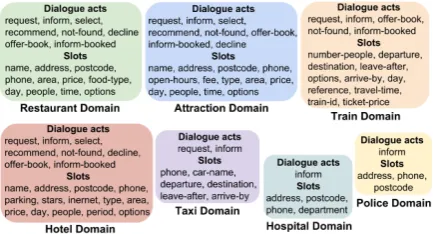
Building open-domain Spoken Dialogue Systems (SDS) remains challenging. This is partially be-cause of the difficulty of collecting sufficient data for all domains and the high complexity of nat-ural language. Typical SDSs are designed based on a pre-defined ontology (Figure1) which might cover knowledge spanning over multiple domains and topics (Young et al.,2013).
A crucial component of a Spoken Dialogue Sys-tem is the Natural Language Generation (NLG) module, which generates the text that is finally presented to the user. NLG is especially
challeng-Figure 1: The ontology for multi-domain spoken dia-logue systems.
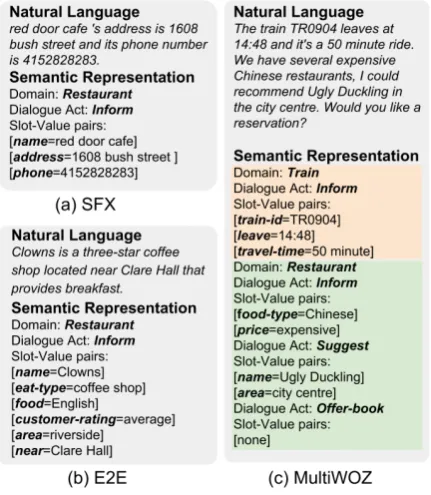
ing when building a multi-domain dialogue sys-tems. Given a semantic representation (SR), the task for NLG is to generate natural language con-veying the information encoded in the SR. Typ-ically, an SR is composed of a set of slot-value pairs and a dialogue act consistent with an ontol-ogy. A dialogue act represents the intention of the system output and the slots provide domain-dependent information. Figure 2 presents exam-ples of SRs with their corresponding natural lan-guage representations in various datasets.
The input semantics has its own hierarchical structure in which there are different sets of slot-value pairs under different dialogue acts across various domains. Modelling the semantic struc-ture might be helpful for sharing information across domains and achieve better performance for domain adaptation. However, prior work encodes semantic representation in a flat way such as us-ing a binary vector (Wen et al.,2015a,b) or using a sequential model such as an LSTM (Duˇsek and Jurcıcek, 2016;Tran and Nguyen, 2017). In that case, the structure of semantics is not fully cap-tured by these encoding methods. This might limit models’ performance especially when adapting to a new domain.
[image:1.595.308.525.222.339.2]lever-Figure 2: Examples of semantic representations in (a) SFX dataset (Wen et al., 2015b), (b) E2E dataset (Novikova et al., 2017) and (c) MultiWOZ dataset (Budzianowski et al.,2018).
aging the semantic structure for NLG domain adaptation in dialogue systems. We present a geration model with a tree-structured semantic en-coder that models the internal structure of the se-mantic representation to facilitate knowledge shar-ing across domains. Moreover, we propose a layer-wise attention mechanism to improve the generation performance. We perform experiments on the multi-domain Wizard-of-Oz corpus (Mul-tiWOZ) (Budzianowski et al.,2018) and with hu-man subjects. The results show that the proposed model outperforms previous methods on both au-tomatic metrics and with human evaluation, sug-gesting that modelling the semantic structure can facilitate domain adaptation. To the best of our knowledge, this work is the first study exploiting the tree LSTM (Tai et al.,2015) to model the input semantics of NLG in spoken dialogue systems.
2 Related Work
Recently, recurrent neural network-based NLG models have shown their powerful capability and flexibility compared to traditional approaches that depend on hand-crafted rules in dialogue systems. A key development was the heuristic gate which turns off the slots that are already generated in the output sentence (Wen et al.,2015a). Subsequently, the semantically conditioned LSTM (SCLSTM)
(Wen et al., 2015b) was proposed with an extra reading gate in the LSTM cell to let the model au-tomatically learn to control the binary represen-tation of the semantics during generation. The sequence-to-sequence (seq2seq) model (Cho et al., 2014;Sutskever et al.,2014) with attention mech-anism (Bahdanau et al., 2014) that has achieved huge success in machine translation has also been applied to the NLG task. In (Duˇsek and Jurcıcek, 2016) the slot-value pairs in the semantics were treated as a sequence and encoded by LSTM. Based on the seq2seq model, in (Tran et al.,2017; Tran and Nguyen, 2017) the refinement gate was introduced to modify the input words and hidden states in the decoder by considering the attention result. Different training strategies were studied in prior work. The hierarchical decoding method was proposed by considering the linguistic pattern of the generated sentence (Su et al., 2018). The variational-based model was proposed to learn the latent variable from both natural language and se-mantics (Tseng et al.,2018).Lampouras and Vla-chos (2016) proposed to use imitation learning to train NLG models, where the Locally Opti-mal Learning to Search framework was adopted to train against non-decomposable loss functions.
Domain adaptation has been widely studied in different areas such as machine translation (Koehn and Schroeder,2007;Foster et al.,2010), part of speech tagging (Blitzer et al.,2006) and dialogue state tracking (Mrkˇsi´c et al.,2015) in spoken dia-logue systems. In NLG for spoken diadia-logue sys-tems, the trainable sentence planner proposed in (Walker et al., 2002;Stent et al., 2004) provides the flexibility of adapting to different domains. Subsequently, generators that can tailor user pref-erences (Walker et al., 2007) or learn their per-sonality traits (Mairesse and Walker,2008,2011; Oraby et al., 2018) were proposed. To achieve multi-domain NLG, exploiting the shared knowl-edge between domains is important to handle un-seen semantics. A multi-step procedure to train a multi-domain NLG model was proposed in (Wen et al.,2016). Adversarial learning is used in (Tran and Nguyen,2018) in which two critics were in-troduced during model adaptation.
3 Model
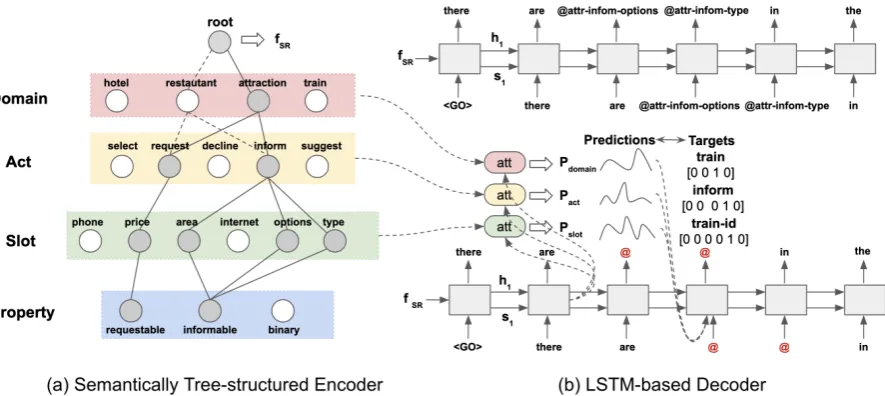
[image:2.595.74.290.64.312.2]tree-Figure 3: The overview of our generation model. The tree-structured semantic encoder (a) encodes semantic representation to obtain semantic embeddingfSR. Each node in the tree denotes a vector representation for that
token. Grey node means it is activated during encoding with the corresponding token specified in the semantics. The LSTM-based decoder without layer-wise attention ((b), above) and with layer-wise attention ((b), below) takes
fSRas an initial state to generate natural language. The example utterance here is”there are @attraction-inform-options @attraction-inform-type in the @attraction-inform-area, do you have a price range in mind?”
structured semantic encoder extracts a semantic embedding from the semantics in a bottom-up fashion. The obtained embedding is then fed into the decoder as a condition to generate natural lan-guage with corresponding delexicalised tokens1. In addition, we further propose a layer-wise at-tention mechanism between the tree-structured se-mantic encoder and the decoder. The proposed at-tention mechanism further improves the model’s ability to generate the correct information when adapting to a new domain with limited data.
3.1 Tree-Structured Semantic Encoder
There exists a hierarchical relationship between dialogue acts and slot-value pairs within various domains. Inspired by the tree-structured LSTM (Tai et al., 2015) that encodes natural language by capturing its syntactic properties, we propose a tree-structured semantic encoder to encode the semantic representation (SR) by exploiting its in-ternal hierarchy.
3.1.1 Tree Hierarchy
Figure3(a) illustrates our tree-structured seman-tic encoder. The hierarchy of the tree represents
1
Each value in a natural language utterance is replaced by a delexicalised token in the format@domain-act-slot. For instance, the informed restaurant Golden House will be replaced by the token@restaurant-inform-name. The mapping from values to delexicalised tokens is called delexicalisation. The inverse process is called lexicalisation.
the ontology with each layer symbolizing a dif-ferent level of information. At each layer, a node denotes a possible type defined by the ontology. Given an SR, each slot-value pair is associated with a dialogue act (DA) within a domain. This relationship is modelled by the links between dif-ferent layers in a tree as parents and children. For instance, the node denoting slotname is the child of the node denoting DAsuggestand DA
suggestis the child of the node representing do-mainrestaurant. In addition, a slot can be re-questable,informableorbinary. Each of them be-haves differently in natural language2. Each leaf node denotes a property that describes a slot. As a result, given an SR there is a one-to-one mapping between SR and its corresponding tree and a path from the root to a leaf node describes a slot-value pair along with its domain, DA, slot and property of slot information.
3.1.2 Semantic Representation Encoding
Given a tree representing an SR, each node j of the LSTM contains input, forget and output gates ij,fj andoj respectively to obtain its hidden state
and memory cellhj andcj. With a set of children
C(j), the non-leaf nodejhas two sources of input:
2For instance, the utterance with a
requestableslotarea
[image:3.595.80.523.63.261.2](a) the token embeddingej3and (b) children states
hk,ck. The transition equations are as following:
˜ hj =
X
k∈C(j) hk,
˜ cj =
X
k∈C(j) ck,
ij =σ(WE(i)ej+UE(i)˜hj+b(Ei)),
fj =σ(WE(f)ej+UE(f)˜hj+b(Ef)),
oj =σ(WE(o)ej+UE(o)˜hj +b(Eo)),
gj = tanh(WE(g)ej+UE(g)h˜j+b(Eg)),
cj =ij◦gj+fj◦˜cj,
hj =oj◦tanh(cj),
where k is the children index, ˜hj and ˜cj are the
sum of children’s hidden states and memory cells respectively.
The semantic embedding is obtained in a bottom-up fashion. Starting from the leaf nodes with their corresponding embeddings, the infor-mation is propagated from the property layer through the slot layer, act layer and domain layer to the root. The hidden state at the root is the final semantic embeddingfSRfor the SR and it will be
used to condition the decoder during generation. During domain adaptation, the model might have seen some semantics in source domain (de-noted by dash lines in the tree encoder in Figure 3) that shares a partial tree structure with the se-mantics in the target domain. For instance, the SR informing about options, type and area in restau-rant domain shares partial tree structure with the SR informing about the same information in at-traction domain. Modelling semantic structure by the tree encoder benefits knowledge sharing across domains.
3.2 Decoder
Figure 3 (b) presents the LSTM-based decoder with two introduced gates. The representation of the semantics,st, is initialised by the semantic
em-bedding fSR and then updated at each time step
duration generation. Updating the semantics at each step is crucial to avoiding generating redun-dant or missing information in the SR. As in stan-dard LSTMs, the transition equations of memory
3All the domains, dialogue acts and slots appearing in an SR are viewed as tokens and encoded in the 1-hot vec-tors. The 1-hot vectors are then passed through an embedding layer to attain the token embeddings as inputs to the nodes.
cellctare as following:
it=σ(WD(i)xt+UD(i)ht−1+b(Di)),
ft=σ(WD(f)xt+UD(f)ht−1+b(Df)),
ot=σ(WD(o)xt+UD(o)ht−1+b(Do)),
gt= tanh(WD(g)xt+UD(g)ht−1+b(Dg)),
ct=it◦gt+ft◦ct−1.
The two introduced gates, reading gatertand
writ-ing gate wt, are responsible for updating the
se-mantic statest. The reading gate determines what
information should be kept from the semantics at previous time step, while the writing gate decides what new information should be added into the current semantic state:
rt=σ(WD(r)xt+UD(r)ht−1+VD(r)st−1+b(Dr)),
wt=σ(WD(w)xt+UD(w)ht−1+VD(w)st−1+b(Dw)),
dt= tanh(WD(d)xt+UD(d)ht−1+VD(d)st−1+b(Dd)),
st=wt◦dt+rt◦st−1.
The hidden state ht is then defined as the
weighted sum of the memory cell and the semantic state with the output gate as weight:
ht=ot◦tanh(ct) + (1−ot)◦tanh(st).
The probability of the word labelyt at each time
steptis formed by a applying a softmax classifier that takes the hidden statehtas input:
p(yt|x<t, fSR) =softmax(W(s)ht).
The objective function is the standard negative log-likelihood:
J(θ) =−X t
logp(yt|x<t, fSR). (1)
3.3 Layer-wise Attention Mechanism
Whenever the decoder generates the token @4, the semanticsstis used to drive an attention
mech-anism with hidden states in the different layers of the tree to obtain distributions over domainsp(dt),
dialogue actsp(at)and slotsp(st)respectively:
p(dt|x<t, st) =
exp(score(st, hd))
P
d0∈Dexp(score(st, hd0)),
p(at|x<t, st) =
exp(score(st, ha))
P
a0∈Aexp(score(st, ha0)),
p(st|x<t, st) =
exp(score(st, hs))
P
s0∈Sexp(score(st, hs0)),
wherehd, ha andhs are the hidden states of
do-main, dialogue act and slots in the tree encoder. D,AandSare the sets of domains, dialogue acts and slots defined in the ontology respectively. The score function used to calculate the similarity be-tween two vectors is defined as following:
score(f, h) =fTh.
The distributions p(dt), p(at) and p(st) are then
used to predict domain, dialogue act and slot at time steptby taking the argmax operation to form the delexicalised tokens @domain-act-slot
back into the generated sentence.
In order to avoid generating redundant or miss-ing information in a given SR, the three predicted distributions are fed into next time step to augment the original input word5to condition the model on what information has already been generated.
During training, the error signals between pre-dicted distributions and the true labels for domain, dialogue act and slot are added to the objective function. The objective function for the genera-tion model with layer-wise attengenera-tion mechanism is defined as following:
Jatt(θ) =J(θ)−
X
t0
(logp(dt0|x<t0, st0)
+ logp(at0|x<t0, st0) + logp(st0|x<t0, st0)),
where J(θ) is the original objective function in equation 1 and t0 is the index for the time step where each token@is generated.
4With the layer-wise attention mechanism, all values in the natural language are replaced by the same delex-icalised token @ instead of the tokens in the format
@domain-act-slot, and the corresponding information regarding domain, dialogue act and slot will be used as sig-nals to guide the decoder to predict the correct information.
[image:5.595.308.526.85.137.2]5Only at the next time step of generating delexicalised to-ken@the input is the concatenation of the word vector xt and three predicted distributions. In any other time steps, the input is the word vector padded with zeros.
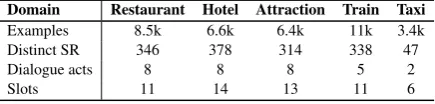
Table 1: The data statistics for each domain.
Domain Restaurant Hotel Attraction Train Taxi
Examples 8.5k 6.6k 6.4k 11k 3.4k Distinct SR 346 378 314 338 47
Dialogue acts 8 8 8 5 2
Slots 11 14 13 11 6
4 Experimental Results 4.1 Dataset
We perform our experiments with the Multi-Domain Wizard-of-Oz (MultiWOZ) dataset (Budzianowski et al.,2018) that is a rich dialogue dataset spanning over 7 domains. There are 10438 dialogues and over 115k turns in total. The dataset contains a high level of complexity and naturalness which is suitable for developing multi-domain NLG models. There are multiple utterances in a single turn with an average of 18 words, 1.6 dialogue acts and 2.9 slots per turn. Some turns provide information for more than 1 domain. Comparing with previous NLG datasets which contain only 1 utterance in a turn with 1 dialogue act within 1 domain, the MultiWOZ dataset provides significantly more complexity and makes NLG more challenging. The number of examples, distinct semantic representation (SR) and numbers of dialogue acts and slots are reported in Table 1. The data split for train, dev and test is 3:1:1. The details of the ontology is presented in Figure1.
4.2 Experimental Setup
The generators are implemented using the Pytorch library (Paszke et al., 2017). Our code is pub-lic6. The number of hidden units in the LSTMs is 100 with 1 hidden layer. The dropout rate is 0.25 and the Adam optimizer is used. The learning rate is 0.0025 for the models trained from scratch, and 0.001 for the models adapted from one domain to another in adaptation exper-iments. Beam search is used during decoding with a beam size 10. For automatic metrics, the BLEU scores and the slot error rate (SER) used in (Wen et al., 2015b) are reported. The SER is used to evaluate how accurate a generated sen-tence is in terms of conveying the desired infor-mation in the given semantic representation (SR). The SER is defined as: (p +q)/N, where p, q are the numbers of missing and redundant slots
6https://github.com/andy194673/
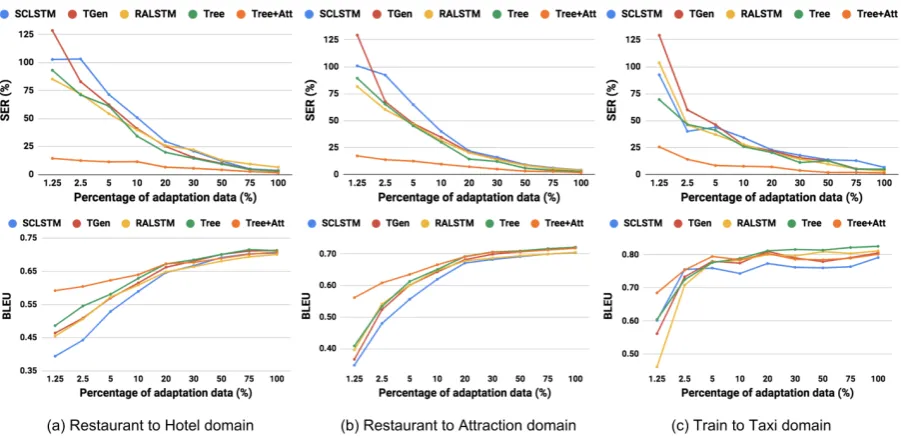
Figure 4: Domain adaptation experiments in three different settings. (a) adapting to hotel from restaurant domain. (b) adapting to attraction from restaurant domain. (c) adapting to taxi from train domain.
in a generated sentence, and N is the number of total slots that a generated sentence should con-tain. The results are averaged over 10 samples and 5 random initialised seeds. As explained above each delexicalised slot token in an utter-ance is in the format of @domain-act-slot. When calculating the SER, the predicted slot to-ken is correct only if its domain, dialogue act and slot information are all correct. For exam-ple, if there is a desired slot area under dia-logue actinformwithinrestaurantdomain in SR, the model needs to generate the token
@restaurant-inform-area.
The tree-structured semantic encoder (Tree) and the variant with attention (Tree+Att) are com-pared against three baselines: (1) the semantically-conditioned LSTM (SCLSTM) that has an extra gate to update the binary vector of the seman-tic representation (Wen et al., 2015b); (2) TGen that is a seq2seq model with attention mecha-nism mapping SR into a word sequence (Duˇsek and Jurcıcek,2016); (3) a refinement adjustment LSTM (RALSTM) that is an improved seq2seq model with a refinement gate and an adjustment gate in the decoder (Tran and Nguyen,2017).
As the decoding method is slightly different be-tween our model Tree+Att and baseline models7, in order to guarantee the optimised baseline sys-tems, we also trained baseline models in the same
7Tree+Att only generates token@and reply on attention results to form the complete slot token while baseline models directly generate slot tokens.
decoding way as Tree+Att to only predict@with three additional classifiers for domain, act and slot prediction. However, baseline models obtains bet-ter performance by the original decoding method so we keep that in the following experiments. All the models are optimized by selecting the best one based on the validation set result.
4.3 Automatic Evaluation
In order to examine the models’ ability to share knowledge between domains, we performed ex-periments in three domain adaptation scenarios: (a) adapting to hotel from restaurant domain; (b) adapting to attraction from restaurant domain and (c) adapting to taxi from train domain. The adap-tation models were fine-tuned with adapadap-tation data based on the models trained on source domain8. The SER results are presented in the first row of Figure 4. Generally, our model without atten-tion (Tree) performs similarly with RALSTM but better than TGen and SCLSTM. With the layer-wise attention mechanism, our model (Tree+Att) improves significantly and performs better than baselines at all different levels of adaptation data amount. Especially when the adaptation data used is only 1.25%, the SER is reduced from above 75% to around 25%. We found that this is because baseline models tend to predict the slots with the wrong dialogue act or in the wrong domain as the
Table 2: Human evaluation for utterance quality in three adaptation settings: Restaurant (Rest.) to Hotel domain; Restaurant to Attraction (Attr.) domain and Train to Taxi domain. Informativeness (Info.) and Nat-uralness (Nat.) are reported (rating out of 5).
Model Rest. to Hotel Rest. to Attr. Train to Taxi
Info. Nat. Info. Nat. Info. Nat.
SCLSTM 2.96 3.85 2.81 3.69 3.05 4.26
TGen 2.87 3.33 3.00 3.23 3.42 3.90 RALSTM 2.79 3.48 2.91 3.40 3.48 3.15 Tree 3.08 3.54 3.38 3.41 3.81 3.81 Tree+Att 4.04 4.10 4.30 3.92 4.29 3.78
limited adaptation data makes it difficult to learn the sentence pattern in the target domain. How-ever, with the layer-wise attention mechanism, our model is able to pay attention on the information at different levels in the tree to make the correct predictions. (See more details in section 5 with error analysis and visualisation of attention distri-butions.) A similar trend can be observed in the BLEU results in the second row of Figure4.
4.4 Human Evaluation
Because automatic evaluation such as BLEU may not consistently agree with human perception (Stent et al.,2005), we performed human testing via the Amazon Mechanical Turk service. We showed MTurk workers the generated sentences in adaptation experiments with adaptation data from 1.25% to 10% as we focus on the models’ per-formance with limited adaptation data. Five mod-els were compared together by showing, for each model, the 2 sentences with the highest probabil-ities out of the 10 generated sentences by beam search. The workers were asked to score each sen-tence from 1 (bad) to 5 (good) in terms of its infor-mativeness and naturalness. The informativeness
is defined as the degree to which the generated sentence contains all the information specified in the given semantic representation (SR) without conveying extra information and thenaturalnessis defined as whether the sentence is natural like hu-man language. Ipeirotis et al.(2010) pointed out that malicious workers might take advantage of the difficulty of verifying the results and therefore submit answers with low quality. In order to filter out submissions with bad quality, we also asked them to score the ground truth sentence and an ar-tificial sentence containing irrelevant information to the SR. If the worker gave ground truth sentence a low score (< 3) or gave the artificial sentence a high score (> 3) in terms of informativeness, the
submission was discarded.
The results pertaining to informativeness and naturalness are reported in Table2in three adapta-tion settings: Restaurant (Rest.) to Hotel domain; Restaurant to Attraction (Attr.) domain and Train to Taxi domain. For informativeness, our mod-els (both Tree+Att & Tree) outperform all base-line models in the different settings. This result is consistent with the slot error rate of the auto-matic evaluation reported in Figure4and indicates that the tree-structured semantic encoder does help the model to produce utterances with the correct information. For naturalness, Tree+Att performs the best in two settings, while SCLSTM performs better when adapting to taxi domain. This might be because SCLSTM is good at generating utter-ances with simple patterns and the taxi domain is relatively easy due to its low number of combi-nations of SR9. When adapting to more complex domains such as hotel or attraction, our models provide both informative and natural utterances. Table3presents example semantic representations with corresponding ground truth sentence and the top-1 utterance generated by each model.
5 Error Analysis and Observation
In order to investigate what type of testing data our model performs better on, we divide all test set into two subsets -seen andunseen. If the se-mantics of a testing example appear in the training set, the example is defined asseen. Otherwise, the example is marked asunseen. Table4reports the number of seen and unseen examples and the num-ber of wrong utterances (at least 1 missing or re-dundant slot) generated by each model with differ-ent amount of adaptation data when adapting from restaurant to hotel domain. With more adaptation data, more SRs of testing examples appear in the training set. We observe that our model obtains better generalisation ability for unseen SRs. For instance, with 1.25% adaptation data, Tree+Att generates 134 wrong utterances out of 902 unseen semantics (14.8%). However, the baseline models such as SCLSTM produces 729 wrong sentences out of 902 semantics (80.5%). We hypothesize that our model is more capable of learning sen-tence patterns from source domain and generate correct content for domain adaptation. For exam-ple, when adapting from restaurant to hotel do-main (see Table3- Hotel column), Tree+Att
Table 3: Example semantic representations (SR) with ground truth sentences in two adaptation settings with 1.25% adaptation data and the top-1 sentences generated by each model. Both are adapted from restaurant domain. The slot-value pairs are in bold. Each generated sentence is followed by a brief description to explain if the sentence correctly conveys the information in the SR.
Domain Attraction Hotel
Semantic Representation
Dialogue Act:Inform
Slot-Value pairs: [Area:west] [Options:five] [Type:colleges]
Dialogue Act:Request
Slot-Value pairs: [Price=?]
Dialogue Act:Inform
Slot-Value pairs: [Options=two] Dialogue Act:Select
Slot-Value pairs:
[type1=guesthouse] [type2=hotel]
Ground Truth there arefive collegesin thewest.
do you mind paying an entrance fee ?
i havetwo, would you prefer aguesthouseorhotel?
SCLSTM what type of place are you looking for ?
(miss 3 slots & request wrong)
what area would you like to stay in ?(miss 3 slots)
TGen there are located in the . do you have a price
range in mind ?(miss 3 slots)
i have found options. would you prefer or ?(miss 3 slots)
RALSTM we havefive collegesin thewestarea . do you
have an attraction type in mind ?(request wrong)
i havetwooptions.
do you have a preference ?(miss 2 slots)
Tree there arefive collegesin thewest. do you have an
area of town you would prefer ?(request wrong)
i have foundtwooptions for you. do you have a preference ?(miss 2 slots)
Tree+Att there arefive collegesin thewest.
do you have a price range in mind ?(correct)
[image:8.595.307.528.361.440.2]i havetwooptions for you. would you preferguesthouseorhotel?(correct)
Table 4: Error analysis - number of examples in the testing set and the number of wrong generated utter-ances (at least 1 missing or redundant slot) by each model in different adaptation data scenarios. The test-ing example is defined as seen if its semantics appears in the training set.
Percentage 1.25% 5% 10% 50%
Testing examples
seen unseen seen unseen seen unseen seen unseen
439 902 858 483 1069 272 1330 11
SCLSTM 248 729 307 412 302 190 111 5
TGen 309 741 176 353 178 168 102 6
Tree+Att 10 134 31 103 60 55 76 3
rectly learns to generalize from the training sen-tence: ”i have two options for you, would you pre-fer American or Chinese” in restaurant domain. However, SCLSTM fails to produce a similar sen-tence pattern.
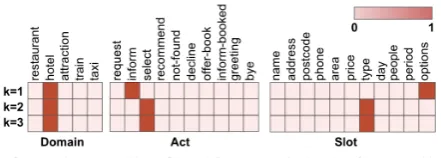
Figure 5 shows the example of visualisation of layer-wise attention distributions over domains, acts and slots generated by the Tree+Att model. The model is confident of generating the correct slot tokens with the distinct peaks indicated by the dark red color in the attention distributions even though the adaptation data used is simply 1.25%.
6 Conclusion and Future Work
This paper investigates the possibility of leverag-ing internal structure of input semantics for NLG domain adaptation in dialogue systems. The pro-posed tree-structured semantic encoder is able to
Figure 5: The visualisation of the layer-wise attention distributions over domains, acts and slots at each time stepkwhen slot token is generated and the generated utterance with lexicalised values in the parentheses. The color shades signify the attention weight.
Acknowledgments
Bo-Hsiang Tseng is supported by Cambridge Trust and the Ministry of Education, Taiwan. This work was partly funded by an Alexander von Humboldt Sofja Kovalevskaja grant.
References
Dzmitry Bahdanau, Kyunghyun Cho, and Yoshua Ben-gio. 2014. Neural machine translation by jointly learning to align and translate. arXiv preprint arXiv:1409.0473.
John Blitzer, Ryan McDonald, and Fernando Pereira. 2006. Domain adaptation with structural correspon-dence learning. InProceedings of the 2006 confer-ence on empirical methods in natural language pro-cessing, pages 120–128. Association for Computa-tional Linguistics.
Paweł Budzianowski, Tsung-Hsien Wen, Bo-Hsiang Tseng, I˜nigo Casanueva, Stefan Ultes, Osman Ra-madan, and Milica Gasic. 2018. Multiwoz-a large-scale multi-domain wizard-of-oz dataset for task-oriented dialogue modelling. InProceedings of the 2018 Conference on Empirical Methods in Natural Language Processing, pages 5016–5026.
Kyunghyun Cho, Bart Merrienboer, Caglar Gulcehre, Fethi Bougares, Holger Schwenk, and Yoshua Ben-gio. 2014. Learning phrase representations using rnn encoder-decoder for statistical machine transla-tion. InEMNLP.
Ondrej Duˇsek and Filip Jurcıcek. 2016. Sequence-to-sequence generation for spoken dialogue via deep syntax trees and strings. InThe 54th Annual Meet-ing of the Association for Computational LMeet-inguis- Linguis-tics, page 45.
George Foster, Cyril Goutte, and Roland Kuhn. 2010. Discriminative instance weighting for domain adap-tation in statistical machine translation. In Proceed-ings of the 2010 conference on empirical methods in natural language processing, pages 451–459. Asso-ciation for Computational Linguistics.
Panagiotis G Ipeirotis, Foster Provost, and Jing Wang. 2010. Quality management on amazon mechanical turk. InProceedings of the ACM SIGKDD workshop on human computation, pages 64–67. ACM.
Philipp Koehn and Josh Schroeder. 2007. Experiments in domain adaptation for statistical machine trans-lation. InProceedings of the second workshop on statistical machine translation, pages 224–227. As-sociation for Computational Linguistics.
Gerasimos Lampouras and Andreas Vlachos. 2016. Imitation learning for language generation from un-aligned data. In Proceedings of COLING 2016, the 26th International Conference on Computational Linguistics: Technical Papers, pages 1101–1112.
Franc¸ois Mairesse and Marilyn Walker. 2008. Train-able generation of big-five personality styles through data-driven parameter estimation. Proceedings of ACL-08: HLT, pages 165–173.
Franc¸ois Mairesse and Marilyn A Walker. 2011. Con-trolling user perceptions of linguistic style: Train-able generation of personality traits. Computational Linguistics, 37(3):455–488.
Nikola Mrkˇsi´c, Diarmuid ´O S´eaghdha, Blaise Thom-son, Milica Gasic, Pei-Hao Su, David Vandyke, Tsung-Hsien Wen, and Steve Young. 2015. Multi-domain dialog state tracking using recurrent neural networks. InProceedings of the 53rd Annual Meet-ing of the Association for Computational LMeet-inguistics and the 7th International Joint Conference on Natu-ral Language Processing (Volume 2: Short Papers), volume 2, pages 794–799.
Jekaterina Novikova, Ondˇrej Duˇsek, and Verena Rieser. 2017. The E2E dataset: New challenges for end-to-end generation. In Proceedings of the 18th Annual Meeting of the Special Interest Group on Discourse and Dialogue, Saarbr¨ucken, Germany. ArXiv:1706.09254.
Shereen Oraby, Lena Reed, Shubhangi Tandon, TS Sharath, Stephanie Lukin, and Marilyn Walker. 2018. Controlling personality-based stylistic varia-tion with neural natural language generators. arXiv preprint arXiv:1805.08352.
Adam Paszke, Sam Gross, Soumith Chintala, Gre-gory Chanan, Edward Yang, Zachary DeVito, Zem-ing Lin, Alban Desmaison, Luca Antiga, and Adam Lerer. 2017. Automatic differentiation in pytorch. InNIPS-W.
Amanda Stent, Matthew Marge, and Mohit Singhai. 2005. Evaluating evaluation methods for generation in the presence of variation. In International Con-ference on Intelligent Text Processing and Compu-tational Linguistics, pages 341–351. Springer.
Amanda Stent, Rashmi Prasad, and Marilyn Walker. 2004. Trainable sentence planning for complex in-formation presentation in spoken dialog systems. In
Proceedings of the 42nd annual meeting on associa-tion for computaassocia-tional linguistics, page 79. Associ-ation for ComputAssoci-ational Linguistics.
Shang-Yu Su, Kai-Ling Lo, Yi-Ting Yeh, and Yun-Nung Chen. 2018. Natural language generation by hierarchical decoding with linguistic patterns. arXiv preprint arXiv:1808.02747.
Ilya Sutskever, Oriol Vinyals, and Quoc V Le. 2014. Sequence to sequence learning with neural net-works. InAdvances in neural information process-ing systems, pages 3104–3112.
from tree-structured long short-term memory net-works. In Proceedings of the 53rd Annual Meet-ing of the Association for Computational LMeet-inguistics and the 7th International Joint Conference on Natu-ral Language Processing (Volume 1: Long Papers), volume 1, pages 1556–1566.
Van-Khanh Tran and Le-Minh Nguyen. 2017. Natural language generation for spoken dialogue system us-ing rnn encoder-decoder networks. InProceedings of the 21st Conference on Computational Natural Language Learning (CoNLL 2017), pages 442–451.
Van-Khanh Tran and Le-Minh Nguyen. 2018. Adver-sarial domain adaptation for variational neural lan-guage generation in dialogue systems. In Proceed-ings of the 27th International Conference on Com-putational Linguistics, pages 1205–1217.
Van-Khanh Tran, Le-Minh Nguyen, and Satoshi Tojo. 2017. Neural-based natural language generation in dialogue using rnn encoder-decoder with semantic aggregation. In Proceedings of the 18th Annual SIGdial Meeting on Discourse and Dialogue, pages 231–240.
Bo-Hsiang Tseng, Florian Kreyssig, Paweł Budzianowski, I˜nigo Casanueva, Yen-Chen Wu, Stefan Ultes, and Milica Gasic. 2018. Variational cross-domain natural language generation for spoken dialogue systems. In Proceedings of the 19th Annual SIGdial Meeting on Discourse and Dialogue, pages 338–343.
Marilyn A Walker, Owen C Rambow, and Monica Ro-gati. 2002. Training a sentence planner for spoken dialogue using boosting. Computer Speech & Lan-guage, 16(3-4):409–433.
Marilyn A Walker, Amanda Stent, Franc¸ois Mairesse, and Rashmi Prasad. 2007. Individual and domain adaptation in sentence planning for dialogue. Jour-nal of Artificial Intelligence Research, 30:413–456.
Tsung-Hsien Wen, Milica Gaˇsic, Dongho Kim, Nikola Mrkˇsic, Pei-Hao Su, David Vandyke, and Steve Young. 2015a. Stochastic language generation in di-alogue using recurrent neural networks with convo-lutional sentence reranking. In16th Annual Meeting of the Special Interest Group on Discourse and Dia-logue, page 275.
Tsung-Hsien Wen, Milica Gaˇsi´c, Nikola Mrkˇsi´c, Lina M. Rojas-Barahona, Pei-Hao Su, David Vandyke, and Steve Young. 2016. Multi-domain neural net-work language generation for spoken dialogue sys-tems. In Proceedings of the 2016 Conference on North American Chapter of the Association for Computational Linguistics (NAACL). Association for Computational Linguistics.
Tsung-Hsien Wen, Milica Gaˇsi´c, Nikola Mrkˇsi´c, Pei-Hao Su, David Vandyke, and Steve Young. 2015b. Semantically conditioned lstm-based natural lan-guage generation for spoken dialogue systems.
In Proceedings of the 2015 Conference on Em-pirical Methods in Natural Language Processing (EMNLP). Association for Computational Linguis-tics.