Paving the Way to a Large-scale Pseudosense-annotated Dataset
Mohammad Taher Pilehvar and Roberto Navigli Department of Computer Science
Sapienza University of Rome
{pilehvar,navigli}@di.uniroma1.it
Abstract
In this paper we propose a new approach to the generation of pseudowords, i.e., artificial words which model real polysemous words. Our approach simultaneously addresses the two important issues that hamper the gener-ation of large pseudosense-annotated datasets: semantic awareness and coverage. We eval-uate these pseudowords from three different perspectives showing that they can be used as reliable substitutes for their real counterparts.
1 Introduction
A fundamental problem in computational linguis-tics is the paucity of manually annotated data, such as part-of-speech tagged sentences, treebanks, and logical forms, which exist only for few languages (Ide et al., 2010). A case in point is the lack of abundant sense annotated data, which hampers the performance and coverage of lexical semantic tasks such as Word Sense Disambiguation (Navigli, 2009; Navigli, 2012, WSD) and semantic role labeling (Gildea and Jurafsky, 2002). A possible way to break this bottleneck is to use pseudowords, i.e., arti-ficial words constructed by conflating a set of unam-biguous words, with the aim of modeling polysemy in real ambiguous words. The idea of pseudowords was originally proposed by Gale et al. (1992) and Sch¨utze (1992) for WSD evaluation, but later found application in other tasks such as selectional prefer-ences (Erk, 2007; Bergsma et al., 2008; Chambers and Jurafsky, 2010), Word Sense Induction (Bor-dag, 2006; Di Marco and Navigli, 2013) or studies
concerning the effects of the amount of data on ma-chine learning for natural language disambiguation (Banko and Brill, 2001). Being made up of monose-mous words, pseudowords can potentially be used to create large amounts of pseudosense-annotated data at virtually no cost, hence enabling large-scale stud-ies in lexical semantics. Unfortunately, though, the extent of their usability for such a purpose is ham-pered by two main issues: semantic awareness and wide coverage.
Semantic awareness corresponds to the constraint that pseudowords, in order to be realistic, are ex-pected to have senses which are in a semantic rela-tionship (thus modeling systematic polysemy). Re-cent work has focused on this issue and, by exploit-ing either specific lexical hierarchies (Nakov and Hearst, 2003; Lu et al., 2006), or the WordNet struc-ture (Otrusina and Smrz, 2010), have succeeded in generating pseudowords which are comparable to real words in terms of disambiguation difficulty. The second challenge is coverage, which corresponds to the number of distinct pseudowords an algorithm can generate. When coupled with the semantic awareness issue, wide coverage is hampered by the difficulty in generating thousands of pseudowords which mimic existing polysemous words.
Unfortunately, none of the existing approaches to the generation of pseudowords can meet both these challenges simultaneously, and this has hindered the generation of a large pseudosense-annotated dataset. For instance, approaches which exploit the monosemous neighbors of a target sense in Word-Net (Otrusina and Smrz, 2010) can be used to gener-ate pseudowords with good semantic awareness, but
they have low coverage of ambiguous nouns when many pseudosense-tagged sentences are needed (cf. Section 2.1.1).
In this paper we propose a new approach, based on Personalized PageRank, which simultaneously addresses the two above-mentioned issues concern-ing the generation of pseudowords (i.e., seman-tic awareness and coverage), and hence enables the generation of large-scale pseudosense-annotated datasets. We perform three different experiments to show that our pseudowords are good at modeling ex-isting ambiguous words in terms of disambiguation difficulty, representativeness of real senses and dis-tinguishability of the artificial senses. As a byprod-uct of this work, we generate a large dataset that pro-vides 1000 tagged sentences for each of the 15,935 pseudowords modeled after real ambiguous nouns in WordNet 3.0.
2 Pseudowords
A pseudowordp=w1*w2*. . . *wnis an
artificially-generated ambiguous word of polysemy degree n
which is usually created by conflatingnunique un-ambiguous words wi called pseudosenses. For
in-stance, airplane*river is a pseudoword with two meanings explicitly identified by its pseudosenses: airplaneandriver. Pseudowords are particularly in-teresting as they can be used to introduce controlled artificial ambiguity into a corpus. Given a pseu-doword pand an untagged corpus C, this artificial tagging is achieved by substituting all occurrences of
wiinCwithpfor each pseudosensei∈ {1, . . . , n}.
As a result, each occurrence of the pseudowordpis tagged with the underlying sensewi. As an example,
consider the following two sentences:
a1. The Wright brothers invented theairplane.
a2. The Nile is the longestriverin the world.
If we replace the individual occurrences of air-planeandriverwith the pseudowordairplane*river while noting the replaced term as the corresponding sense, we obtain the following pseudosense-tagged sentences:
b1. The Wright brothers invented theairplane*river.
b2. The Nile is the longestairplane*riverin the world.
As a result of this procedure, we obtain a corpus of sentences containing the occurrences of an arti-ficially ambiguous word p, for each of which we know its correct sense annotationwi. Virtually any
number of pseudowords can be created, resulting in a large pseudosense-annotated corpus. An obvious restriction on the choice of pseudosenses is that they need to be unambiguous, so as to avoid the introduc-tion of uncontrolled ambiguity. Another constraint is that the constituentwimust satisfy a minimum
oc-currence frequency in the corpusC. This minimum frequency corresponds to the number of annotated sentences that are requested for the task of interest which will exploit the resulting annotated corpus.
An immediate way of generating a pseudoword would be to randomly select its constituents from the set of all monosemous words given by a lexi-con (e.g., WordNet). However, lexi-constructing a pseu-doword by merely combining a random set of unam-biguous words selected on the basis of their falling in the same range of occurrence frequency (Sch¨utze, 1992), or leveraging homophones and OCR ambi-guities (Yarowsky, 1993), does not provide a suit-able model of a real polysemous word (Gaustad, 2001; Nakov and Hearst, 2003). This is because in the real world different senses, unless they are homonymous, share some semantic or pragmatic re-lation. Therefore, random pseudowords will typ-ically model only homonymous distinctions (such as thecentimeter vs. curium senses of cm), while they will fall short of modeling systematic polysemy (such as the lack vs. insufficiency senses of defi-ciency).
2.1 Semantically-aware Pseudowords
In order to cope with the above-mentioned lim-its of random pseudowords, an artificial word has to model an existing word by providing a one-to-one correspondence between each pseudosense and a corresponding sense of the modeled word. For instance, the pseudoword lack*shortfall is a good model of the real word deficiency in that its pseu-dosenses preserve the meanings of their correspond-ing real word’s senses. We call this kind of artificial words semantically-aware pseudowords.
Minimum Polysemy
Overall Frequency 2 3 4 5 6 7 8 9 10 11 12 >12
0 87 82 74 71 67 70 60 64 45 46 44 28 83
500 41 31 24 15 12 13 10 7 7 0 0 0 35
[image:3.612.139.477.63.125.2]1000 31 20 16 7 4 6 4 3 0 0 0 0 25
Table 1: Ambiguous noun coverage percentage of vicinity-based pseudowords by degree of polysemy for different values of minimum pseudosense occurrence frequency in Gigaword.
semantically-aware pseudowords. In what follows we focus on nominal pseudowords, and leave the ex-tension to other parts of speech to future work.
2.1.1 Vicinity-based Pseudowords
A computational lexicon such as WordNet (Fell-baum, 1998) can be used as the basis for the automatic generation of semantically-aware pseu-dowords, an idea which was first proposed by Otrusina and Smrz (2010). WordNet can be viewed as a graph in which synsets act as nodes and the lexi-cal and semantic relationships among them as edges. Given a sense, the approach looks into its surround-ing synsets in the WordNet graph in order to find a related monosemous term that can represent that sense. As search space, the approach considers: the other literals in the same synset, the genus phrase from its textual definition, direct siblings, and di-rect hyponyms. If no monosemous candidate can be found, this space is further extended to hypernyms and meronyms. Hereafter, we term this approach as vicinity-based.
For example, consider the generation process of the vicinity-based pseudoword corresponding to the term coke, which has three senses in WordNet 3.0. There exist multiple monosemous candidates for each sense: dozens of candidates (such asbiomass and butane) in the direct siblings’ vicinity of the first sense,coca cola,pepsi, andpepsi colafor the second sense, and nose candy and coca cola for the third sense. Among these candidates Otrusina and Smrz (2010) select those whose occurrence fre-quency ratio in a given text corpus is most similar to that of the senses of the corresponding real word as given by a sense-annotated corpus. Clearly, a suffi-ciently large sense-tagged corpus is required for cal-culating the occurrence frequency of the individual senses of a word. This is a limitation of the vicinity-based approach.
In addition, as we mentioned earlier, we need pseudowords that can enable the generation of large-scale pseudosense-tagged corpora. For this to be achieved, each pseudosense is required to occur with a relatively high frequency in a given text corpus. The vicinity-based approach can, however, identify at best only a few representatives for each pseu-dosense, thus undermining its ability to cover many ambiguous nouns. Table 1 shows the percentage of ambiguous nouns in WordNet that can be mod-eled using the vicinity-based approach when differ-ent minimum numbers of annotated sdiffer-entences are requested, i.e. each pseudosense is required to oc-cur in at least 0 (i.e., no minimum frequency restric-tion), 500, or 1000 unique sentences in the reference corpus (we use Gigaword (Graff and Cieri, 2003) in our experiments). In the Table, beside the over-all coverage percentage, we present the coverage by degree of polysemy and for three different values of minimum pseudosense occurrence frequency. Even though the overall coverage is over 80% when no re-striction on minimum frequency is considered (first row in the Table), this high coverage drops rapidly when we request some hundred sentences per sense. For instance, only 25% of the ambiguous nouns in WordNet can be modeled using this approach when a minimum frequency of 1000 noun occurrences is required (last row of Table 1), with most of the cov-ered words having low polysemy (in fact about 93% of them are either 2- or 3-sense nouns). This se-vere limitation of the vicinity-based approach hin-ders a wide-coverage modeling of ambiguous nouns in WordNet, thus preventing it from being an op-tion for the generaop-tion of a large-scale pseudosense-annotated dataset.
2.1.2 Similarity-based Pseudowords
The vicinity-based pseudoword generation ap-proach works on local subgraphs of WordNet, con-sidering mostly all those candidates which are in a direct relationship with a real sensesi, and treating
them as potentially good representatives ofsi. We
propose an extension to this approach which exploits the WordNet semantic network in its entirety, hence enabling us to determine a graded degree of similar-ity betweensi and all the senses of all other words
in WordNet.
We chose a graph-based similarity measure for two reasons: firstly, it comes as a natural exten-sion of the vicinity-based method, and, secondly, al-ternative context-based methods such as Lin’s mea-sure (Lin, 1998) have been shown to require a wide-coverage sense-tagged dataset in order to calculate similarities on a sense-by-sense basis for all words in the lexicon (Otrusina and Smrz, 2010). As our sim-ilarity measure we selected the Personalized PageR-ank (Haveliwala, 2002, PPR) algorithm. PPR basi-cally computes the probability according to which a random walker at a specific node in a graph would visit an arbitrary node in the same graph. The al-gorithm estimates, for a specific node in a graph, a probability distribution (called PPR vector) which determines the importance of any given node in the graph for that specific node. When applied to a semantic graph, this importance can be interpreted as semantic similarity. PPR has previously been used as a core component for semantic similarity1 (Hughes and Ramage, 2007; Agirre et al., 2009) and Word Sense Disambiguation (Agirre and Soroa, 2009).
Algorithm 1 shows the procedure for the genera-tion of our similarity-based pseudowords. The algo-rithm takes an ambiguous wordwas input, and out-puts its corresponding similarity-based pseudoword
Pw whoseith pseudosense models theith sense of
w, together with a confidence score which we detail below.
Givenw, the algorithm iterates over the synsets corresponding to its individual senses (lines 4-13) and finds the most suitable pseudosenses forPw. For
1
Top-ranking synsets will contain words which are most likely similar to the target sense, whereas we move to a graded notion of relatedness as far as lower-ranking ones are concerned (Agirre et al., 2009).
Algorithm 1Generate a similarity-based pseudoword Input: an ambiguous wordwin WordNet
Output: a “similarity-based” pseudowordPw a confidence scoreaverageRank
1: Pw← ∅ 2: totalRank←0
3: i←1
4: for eachs∈Synsets(w)
5: similarSynsets←PersonalizedPageRank(s)
6: sortsimilarSynsetsin descending order 7: for eachs0∈similarSynsets
8: totalRank←totalRank+ 1
9: for eachw0∈SynsetLiterals(s0)
10: if|Synsets(w0)|=1&Freq(w0)>minFreqthen 11: Pw ←Pw∪ {(i, w0)}
12: break
13: i←i+ 1
14: averageRank←totalRank/|Synsets(w)| 15: return (Pw,averageRank)
each synsetsofw, we start the PPR algorithm from
s(line 5) and collect the probability distribution vec-tor output by PPR (similarSynsetsin the algorithm), which determines the probability of reaching each synset in WordNet starting from s. We then sort this vector (line 6) and check if each of its nomi-nal synsets (s0) contains a monosemous word (line 10). This search continues until a suitable candi-date is found that satisfies a certain minimum oc-currence frequencyminFreq. When this occurs, the selected monosemous candidatew0 is saved as the corresponding pseudosense for theith sense of Pw
(line 11). We iterate these steps for all synsets ofw. In line 14 we calculate theaverageRank, a value given by the average of synset positions in the simi-larSynsetslists from which the pseudosenses ofPw
are picked out. We later use this value as a confi-dence score while evaluating our pseudowords. Fi-nally, the algorithm returns the corresponding pseu-dowordPw along with its averageRankscore (line
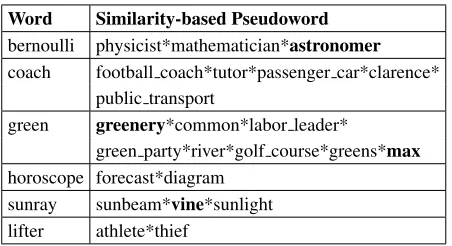
15). We show in Table 2 some examples of ambigu-ous words together with their similarity-based pseu-dowords.
Word Similarity-based Pseudoword
bernoulli physicist*mathematician*astronomer
coach football coach*tutor*passenger car*clarence* public transport
green greenery*common*labor leader*
green party*river*golf course*greens*max
horoscope forecast*diagram sunray sunbeam*vine*sunlight lifter athlete*thief
Table 2: Similarity-based pseudowords generated for six different nouns in WordNet 3.0 (with minimum fre-quency of 1000 occurrences in Gigaword). Pseudosenses which could not be modeled using the vicinity-based ap-proach are shown in bold.
verify this, we analyzed theaverageRankvalues out-put by Algorithm 1. Table 3 shows for each poly-semy degree and for three different values of min-Freq, the mean and mode statistics of the averageR-ank scores of the generated similarity-based pseu-dowords for all the 15,935 polysemous nouns in WordNet 3.0. As expected, the higher the number of required sentences per pseudosense (minFreq), the further the algorithm descends through the list simi-larSynsetsto select a pseudosense. However, as can be seen from the mode statistics in the Table, even when minFreq is set to a large value, most of the pseudosenses are picked from the highest-ranking positions in thesimilarSynsetslist.
3 Evaluation
Our novel similarity-based algorithm for the gen-eration of pseudowords inherently tackles the cov-erage issue. To test whether our generated pseu-dowords also cope with the issue of semantic aware-ness we carried out three separate evaluations so as to assess their strength in modeling semantic properties of their corresponding real senses from different perspectives. These will be described in the next three subsections. Since our aim was to leverage pseudowords for the creation of a large-scale pseudosense-annotated dataset, we performed evaluations on pseudowords generated withminFreq per pseudosense set to 1000 (i.e., we can gener-ate at least 1000 annotgener-ated sentences for each pseu-dosense).
minFreq 0 500 1000
poly. mean mode mean mode mean mode 2 2.0 1.0 14.8 2.0 25.4 4.0 3 2.3 1.7 13.4 2.7 21.0 5.5 4 2.3 1.8 12.3 5.8 19.8 6.8 5 2.3 1.8 12.9 5.6 20.0 10.0 6 2.4 2.0 13.7 4.5 18.7 8.8 7 2.3 2.1 11.5 6.3 16.0 6.1 8 2.2 1.8 11.3 9.6 17.2 10.8 9 2.4 2.0 10.7 10.9 15.6 15.1 10 2.2 2.0 10.1 7.0 14.3 12.1 11 2.4 2.1 10.2 7.1 14.2 17.3 12 2.5 2.4 11.0 4.4 14.4 14.4
[image:5.612.76.302.63.186.2]>12 2.6 1.0 9.3 2.0 13.7 4.0 overall 2.1 1.0 14.1 2.0 23.4 4.0
Table 3: Statistics ofaverageRankscores for the full set of 15,935 similarity-based pseudowords modeled after ambiguous nouns in WordNet 3.0: we show mean and mode statistics for three different values of minimum oc-currence frequency (0, 500, and 1000). We show the av-erage value in the case of multiple modes.
3.1 Disambiguation Difficulty of Pseudowords
Our first experiment is an extrinsic evaluation of pseudowords. Ideally, pseudowords are expected to show a similar degree of difficulty to real ambigu-ous words in a disambiguation task (Otrusina and Smrz, 2010; Lu et al., 2006). We thus experimen-tally tested this assumption on similarity-based and random pseudowords. Given its low coverage, we excluded the vicinity-based approach from this ex-periment.
[image:5.612.315.535.63.234.2]with minFreq = 1000, the similarity-based pseu-dowords corresponding to these 20 nouns, as well as a set of 20 random pseudowords with the same polysemy degrees. We note that, in this setting, the vicinity-based approach could only generate pseu-dowords corresponding to 5 of the 20 nouns.
In order to create the datasets for our experiments, for each of our similarity-based and random pseu-dowords, we sampled unique sentences from the En-glish Gigaword corpus (Graff and Cieri, 2003) ac-cording to the same sense distributions given by the Senseval-3 training and test datasets for the corre-sponding real word. Next, we performed WSD on our three datasets, namely: the Senseval-3 dataset of real words, and the two artificially sense-tagged datasets for the similarity-based and random pseu-dowords. As our WSD system for this experiment, we used It Makes Sense (IMS), a state-of-the-art su-pervised WSD system (Zhong and Ng, 2010).
WSD recall2 performance values on the above-mentioned datasets are shown in Table 4. For the random setting, in order to ensure stability, the re-sults are averaged on a set of 25 different pseu-dowords modeling a given ambiguous noun. We can see from the Table that the overall system performance with the similarity-based pseudowords (75.14%) is much closer to the real setting (73.26%) than it is with random pseudowords (78.80%). For random pseudowords, the overall recall over 25 runs ranges from 75.40% to 80.80%.
Moreover, the similarity-based approach exhibits a closer WSD recall performance to that of real data (|RE−SB| column in the table) for 15 of the 20 nouns (shown in bold in the Table). Accordingly, the overall sum of the differences (distance) between the recall values is 129.3 for similarity-based pseu-dowords, which is considerably lower than the 196.4 for random pseudowords (averaged over 25 runs whose distances range from 158.3 to 262.0).
To further corroborate our findings, we calculated the Pearson’srcorrelation between recall values on real words with those obtained on the corresponding pseudowords. Similarity-based pseudowords obtain the high correlation of 0.74, whereas this value drops to 0.54 for random pseudowords. Even worse, we
2
Since in our experiments the WSD system always provides an answer for each item in the test set, the values of precision, recall andF1will be equal.
Word RE SB RND |RE−SB| |RE−RND|
argument 50.44 68.79 77.15 18.35 26.71
arm 92.30 85.69 88.11 6.61 4.19
atmosphere 70.52 69.15 80.44 1.37 10.32 audience 81.28 73.74 83.76 7.54 4.22
bank 85.76 83.07 82.46 2.69 3.99
degree 78.42 81.58 80.59 3.16 4.35 difference 62.46 61.43 75.17 1.03 12.90 difficulty 52.72 51.82 67.23 0.90 14.97
disc 78.62 76.48 78.07 2.14 6.18
image 71.78 75.76 81.50 3.98 10.02 interest 77.34 73.19 71.70 4.15 6.85 judgment 55.64 66.87 59.64 11.23 9.01
organization 80.36 72.86 78.65 7.50 3.65
paper 60.84 66.29 73.14 5.45 12.59
party 82.94 80.00 81.04 2.94 3.74
performance 58.56 64.76 73.86 6.20 15.52
plan 88.42 85.41 87.39 3.01 3.12
shelter 58.48 74.75 80.21 16.27 21.73
sort 67.64 88.15 77.37 20.51 9.73
[image:6.612.315.534.64.309.2]source 63.46 67.74 66.26 4.28 7.03 overall 73.26 75.14 78.80 129.31 196.35 Table 4: Recall percentage of IMS on the 20 nouns of the Senseval-3 lexical-sample test set (RE) compared to the corresponding similarity-based (SB) and random (RND) pseudowords. The last 2 columns show absolute differ-ences between the real and the two pseudoword settings.
observed a high variation of correlation (in the range of [0.18, 0.67]) over the 25 sets of random pseu-dowords (0.54 being the average).
3.2 Representative Power of Pseudosenses
The ideal case for pseudosenses would be that of being in a synonymous relationship with the cor-responding real sense, i.e., selected from the same WordNet synset. But given that many of the Word-Net synsets do not contain monosemous terms, the similarity-based approach often needs to look fur-ther into ofur-ther related synsets to find a suitable pseu-dosense. To get a clear idea of the exact statistics, we went through all our similarity-based pseudowords and, for each pseudosensewi, checked the
relation-ship in WordNet between the synset containing wi
minFreq 0 500 1000
Relation type
Synonyms 33.0 7.6 5.4 Hypernyms 33.4 16.1 13.0
Hyponyms 9.1 6.1 4.9
Meronyms 0.2 0.2 0.2
[image:7.612.84.290.63.148.2]Siblings 8.2 17.2 16.6 Indirect relations 16.1 52.8 59.9
Table 5: Percentage of similarity-based pseudosenses ob-tained from different types of WordNet relations.
(hypernym and hyponyms). However, this percent-age drops to about 23% whenminFreq= 1000. This suggests that many of our pseudosenses are mod-eled from indirect relations when higher values of minFreqare used. This can potentially increase the risk of an undesirable modeling in which meanings are not properly preserved. For this reason, we car-ried out another experiment to assess the representa-tive power of similarity-based pseudosenses. To this end, we randomly sampled 110 pseudowords (from the entire set of 15,935 pseudowords generated with minimum frequency of 1000), 10 for each degree of polysemy, from 2 to 12, totaling 770 pseudosenses. Then we presented each of these pseudowords3 to two annotators who were asked to judge the degree of representativeness of its pseudosenses based on the following scores: 1: completely unrelated, 2: somewhat related, 3: good substitute, or 4: perfect substitute.
As an example, the scores assigned by the two annotators to different pseudosenses of the pseu-doword generated for the noun representative are shown in Table 6. The overall representativeness score for each pseudoword is calculated by aver-aging the scores assigned to its individual pseu-dosenses. For instance, the overall scores calculated for the pseudowordrepresentativeare 3.75 and 3.50 (as given by the two annotators). The first row in Table 7 shows the average representativeness scores for each degree of polysemy on the full set of 770 pseudosenses. It can be seen that the score remains around 3.0 for all polysemy degrees from 2 to 12. Despite the fact that only one fifth of pseudosenses are taken from synonyms, hypernyms and hyponyms (when minFreq is 1000, cf. Table 5), the overall
3
For each pseudoword, we provided annotators with the cor-responding real word, as well as its synsets and glosses as given by WordNet.
Sense Definition (in short)
Scor
e
1
Scor
e
2
{Synset}
>Corresponding Pseudosense
a person who represents others
3 3
{representative}
>negotiator
an advocate who represents someone else’s policy
4 4
{spokesperson, interpreter, representative, voice}
>spokesperson
a member of the U.S. House of Representatives
4 4
{congressman, congresswoman, representative}
>congressman
an item of information that is typical of a group
4 3
{example, illustration, instance, representative}
>case in point
[image:7.612.313.537.65.254.2]average score 3.75 3.50
Table 6: Examples of representativeness scores assigned by the annotators to pseudosenses of the term representa-tive.
representativeness score of 3.12 shows that most of these pseudosenses can be considered as good sub-stitutes for their corresponding real senses. There-fore we conclude that not only does our similarity-based pseudoword generation approach extend the coverage of the vicinity-based method from 25% to 100% (when minFreq = 1000), but also that the pseudosenses coming from more distant synsets as ranked by PPR are still good representatives on av-erage.
3.3 Distinguishability of Pseudosenses
In addition to assessing the representativeness of pseudosenses, their degree of distinguishability has to be determined. In other words, we have to de-termine how easily each pseudosense can be distin-guished from the others in a pseudoword. Our rea-son for having such an experiment is readily illus-trated by way of an example: consider the similarity-based pseudoword philanthropist*benefactor4 cor-responding to the noundonor5. Even though both pseudosenses are good representatives for their cor-responding senses, the distinguishability of the two
4
From WordNet: “Philanthropist: someone who makes charitable donations intended to increase human well-being”; “Benefactor: a person who helps people or institutions (espe-cially with financial help)”.
5donor
Polysemy 2 3 4 5 6 7 8 9 10 11 12 Overall Representativeness score 3.3 3.4 3.1 3.1 2.9 3.1 2.9 2.8 3.3 3.1 3.3 3.12 Distinguishability score 0.90 0.83 0.83 0.82 0.81 0.77 0.75 0.73 0.80 0.71 0.70 0.79
Table 7: Average representativeness and distinguishability scores for pseudosenses of different polysemy classes (scores range from 1 to 4 for representativeness and from 0 to 1 for distinguishability evaluation).
real senses is not preserved in the pseudoword. For instance, benefactor is a suitable pseudosense for both senses ofdonor, whereasphilanthropistcannot be used in the blood donation sense.
Therefore we carried out another manual evalua-tion to test the efficacy of pseudowords in preserving the distinguishability of senses of real words. To this end, for each pseudowordPw (from the same set of
110 sampled pseudowords used in Section 3.2) we presented its corresponding pseudosenses in random order to two annotators and asked them to associate each pseudosense with the most appropriate Word-Net sense of the real word w. Then we calculated a distinguishability score for each polysemy degree by dividing the number of correct mappings by the total number of senses.
For instance, for the similarity-based pseudoword corresponding to the word representative (shown in Table 6), we provided the shuffled list of pseu-dosenses [spokesperson, case in point, negotiator, congressman] to each annotator and asked them to sort the list according to the WordNet sense inven-tory ofrepresentative(i.e., map each pseudosense to its most suitable real sense). Both annotators cor-rectly mapped all pseudosenses of this pseudoword; hence, the distinguishability score given by each an-notator for this pseudoword was 4/4 = 1.
The average distinguishability scores for each de-gree of polysemy, as well as the overall score, is shown in Table 7 (second row). Each value is an average of the scores obtained from the two an-notators. It can be seen that the distinguishability score decreases for higher degrees of polysemy. The score, however, remains above 0.70 with highly-polysemous pseudowords. The overall score of 0.79 shows that similarity-based pseudowords effectively preserve the distinguishability of senses of their real counterparts. In other words, they do not tend to have over-generalized pseudosenses which cover more than one sense.
4 Related Work
The idea of pseudowords dates back to 1992, when it was first proposed as a means of generating large amounts of artificially annotated evaluation data for WSD algorithms (Gale et al., 1992; Sch¨utze, 1992). However, as mentioned earlier in Section 2, con-structing a pseudoword by combining a random set of unambiguous words, as was done in these early works, can not model systematic polysemy (Gaus-tad, 2001; Nakov and Hearst, 2003), since differ-ent senses of a real ambiguous word, unless it is homonymous, share some semantic or pragmatic re-lation.
Several researchers addressed the issue of produc-ing semantically-aware pseudowords that can model semantic relationships between senses. Nakov and Hearst (2003) used lexical category mem-bership from a medical term hierarchy (extracted from MeSH6 (Medical Subject Headings)) to cre-ate “more plausibly-motivcre-ated” pseudowords. By considering the frequency distributions from lexi-cal category co-occurrence, they produced a set of pseudowords which were closer to real ambiguous words in terms of disambiguation difficulty than random pseudowords. However, this approach re-quires a specific hierarchical lexicon and falls short of creating many pseudowords with high polysemy (the authors report generating pseudowords with two senses only).
More recent work has focused on the identifica-tion of monosemous representatives in the surround-ing of a sense, i.e., selected among concepts directly related to the given sense. Lu et al. (2006) mod-eled senses of a real ambiguous word by picking out the most similar monosemous morpheme from a Chinese hierarchical lexicon. Pseudowords are then constructed by conflating these morphemes accord-ingly. However, this method leverages a specific Chinese hierarchical lexicon, in which different
lev-6
els of the hierarchy correspond to different levels of sense granularity. A more flexible technique is pro-posed by Otrusina and Smrz (2010) who model am-biguous words in WordNet. Their vicinity-based ap-proach searches the surroundings of each particular sense in the WordNet graph in order to find an un-ambiguous representative for that sense. However, as we described in Section 2.1.1, while the approach addresses the semantic awareness issue, it falls short of providing a high coverage, an issue which we tackle in our novel similarity-based approach.
5 Conclusion and Future Work
In this paper we proposed a new technique for the generation of pseudowords which, in contrast to existing work, can simultaneously tackle the two major issues associated with pseudowords, i.e., se-mantic awareness and coverage. Our approach can be used to model any given ambiguous noun in WordNet, hence enabling the generation of large-scale pseudosense-annotated datasets for thousands of pseudowords. We performed three experiments to evaluate the reliability of our pseudowords. We showed that the similarity-based pseudowords are highly correlated with their real counterparts in terms of disambiguation difficulty. Further evalua-tions demonstrated that this approach is able to pro-vide a good semantic modeling of individual senses of real words while preserving their distinguishabil-ity.
We are releasing to the research community the entire set of 15,935 pseudowords, i.e., for all WordNet polysemous nouns (http://lcl.
uniroma1.it/pseudowords/). This set of
pseudowords (together with the English Gigaword corpus) can be used to generate a large pseudosense-tagged dataset containing ≥1000 annotated sen-tences for every sense of all the pseudowords mod-eled after real ambiguous nouns in WordNet. The resulting dataset could be a good complement for MASC (Ide et al., 2010) which, being human-created, can provide 1000 sense-annotated sentences for just a few words.
We hope that the availability of this resource will enable large-scale experiments in tasks such as se-mantic role labeling, sese-mantic parsing, and Word Sense Disambiguation. Specifically, as future work,
we plan to utilize the generated pseudosense-tagged dataset to perform an in-depth study of different WSD paradigms. We also plan to extend our work to other part-of-speech tags.
Acknowledgments
The authors gratefully acknowledge the support of the ERC Starting Grant MultiJEDI No. 259234.
References
Eneko Agirre and Aitor Soroa. 2009. Personalizing PageRank for word sense disambiguation. In Proceed-ings of the 12th Conference of the European Chap-ter of the Association for Computational Linguistics, EACL ’09, pages 33–41, Athens, Greece.
Eneko Agirre, Enrique Alfonseca, Keith Hall, Jana Kravalova, Marius Pas¸ca, and Aitor Soroa. 2009. A study on similarity and relatedness using distribu-tional and WordNet-based approaches. In Proceed-ings of Human Language Technologies: The 2009 An-nual Conference of the North American Chapter of the Association for Computational Linguistics, NAACL ’09, pages 19–27, Boulder, Colorado.
Michele Banko and Eric Brill. 2001. Scaling to very very large corpora for natural language disambigua-tion. InProceedings of the 39th Annual Meeting on Association for Computational Linguistics, ACL ’01, pages 26–33, Toulouse, France.
Shane Bergsma, Dekang Lin, and Randy Goebel. 2008. Discriminative learning of selectional preference from unlabeled text. InProceedings of the Conference on Empirical Methods in Natural Language Processing, EMNLP ’08, pages 59–68, Honolulu, Hawaii. Stefan Bordag. 2006. Word Sense Induction:
Triplet-based clustering and automatic evaluation. In Pro-ceedings of the 11th Conference on European chap-ter of the Association for Computational Linguistics, EACL ’06, pages 137–144, Trento, Italy.
Nathanael Chambers and Dan Jurafsky. 2010. Improv-ing the use of pseudo-words for evaluatImprov-ing selectional preferences. InProceedings of the 48th Annual Meet-ing of the Association for Computational LMeet-inguistics, ACL ’10, pages 445–453, Uppsala, Sweden.
Antonio Di Marco and Roberto Navigli. 2013. Cluster-ing and diversifyCluster-ing Web search results with graph-based Word Sense Induction.Computational Linguis-tics, 39(4).
Annual Meeting of the Association of Computational Linguistics, ACL ’07, pages 216–223, Prague, Czech Republic.
Christiane Fellbaum, editor. 1998. WordNet: An Elec-tronic Database. MIT Press, Cambridge, MA. William Gale, Kenneth Church, and David Yarowsky.
1992. Work on statistical methods for Word Sense Disambiguation. In Proceedings of the AAAI Fall Symposium on Probabilistic Approaches to Natural Language, pages 54–60, Menlo Park, CA.
Tanja Gaustad. 2001. Statistical corpus-based Word Sense Disambiguation: Pseudowords vs real ambigu-ous words. In Companion Volume to the Proceed-ings of the 39th Annual Meeting of the Association for Computational Linguistics Proceedings ot the Stu-dent Research Workshop, ACL/EACL ’01, pages 61– 66, Toulouse, France.
Daniel Gildea and Daniel Jurafsky. 2002. Automatic la-beling of semantic roles. Computational Linguistics, 28(3):245–288.
David Graff and Christopher Cieri. 2003. English Giga-word, LDC2003T05. InLinguistic Data Consortium, Philadelphia.
Taher H. Haveliwala. 2002. Topic-sensitive PageRank. In Proceedings of 11th International Conference on World Wide Web, WWW ’02, pages 517–526, Hon-olulu, Hawaii, USA.
Thad Hughes and Daniel Ramage. 2007. Lexical seman-tic relatedness with random graph walks. In Proceed-ings of the 2007 Joint Conference on Empirical Meth-ods in Natural Language Processing and Computa-tional Natural Language Learning, EMNLP-CoNLL ’07, pages 581–589, Prague, Czech Republic.
Nancy Ide, Collin F. Baker, Christiane Fellbaum, and Re-becca J. Passonneau. 2010. The manually annotated sub-corpus: A community resource for and by the peo-ple. InProceedings of the 48th Annual Meeting of the Association for Computational Linguistics (Short Pa-pers), pages 68–73, Uppsala, Sweden.
Dekang Lin. 1998. An information-theoretic definition of similarity. InProceedings of the Fifteenth Interna-tional Conference on Machine Learning, ICML ’98, pages 296–304, Madison, USA.
Zhimao Lu, Haifeng Wang, Jianmin Yao, Ting Liu, and Sheng Li. 2006. An equivalent pseudoword solution to Chinese Word Sense Disambiguation. In Proceed-ings of the 21st International Conference on Computa-tional Linguistics and the 44th annual meeting of the Association for Computational Linguistics, ACL ’06, pages 457–464, Sydney, Australia.
Rada Mihalcea, Timothy Chklovski, and Adam Kilgar-riff. 2004. The Senseval-3 English lexical sample task. InProceedings of Senseval-3: The Third Inter-national Workshop on the Evaluation of Systems for
the Semantic Analysis of Text, pages 25–28, Barcelona, Spain.
Preslav I. Nakov and Marti A. Hearst. 2003. Category-based pseudowords. In Proceedings of the Confer-ence of the North American Chapter of the Association of Computational Linguistics – short papers, HLT-NAACL ’03, pages 67–69, Edmonton, Canada. Roberto Navigli. 2009. Word Sense Disambiguation: A
survey.ACM Computing Surveys, 41(2):1–69. Roberto Navigli. 2012. A quick tour of word sense
disambiguation, induction and related approaches. In Proceedings of the 38th Conference on Current Trends in Theory and Practice of Computer Science, SOF-SEM ’12, pages 115–129, Spindleruv Mlyn, Czech Republic.
Lubomir Otrusina and Pavel Smrz. 2010. A new ap-proach to pseudoword generation. InProceedings of the International Conference on Language Resources and Evaluation, LREC’10, pages 1195–1199, Valletta, Malta.
Hinrich Sch¨utze. 1992. Dimensions of meaning. In Supercomputing ’92: Proceedings of the 1992 ACM/IEEE conference on Supercomputing, pages 787–796, Minneapolis, Minnesota, USA.
David Yarowsky. 1993. One sense per collocation. InProceedings of the 3rd DARPA Workshop on Hu-man Language Technology, pages 266–271, Princeton, New Jersey.