Implicitly Intersecting Weighted Automata using Dual Decomposition
∗Michael J. Paul and Jason Eisner
Department of Computer Science / Johns Hopkins University Baltimore, MD 21218, USA
{mpaul,jason}@cs.jhu.edu
Abstract
We propose an algorithm to find the best path through an intersection of arbitrarily many weighted automata, without actually perform-ing the intersection. The algorithm is based on dual decomposition: the automata attempt to agree on a string by communicating about fea-tures of the string. We demonstrate the algo-rithm on the Steiner consensus string problem, both on synthetic data and on consensus de-coding for speech recognition. This involves implicitly intersecting up to 100 automata.
1 Introduction
Many tasks in natural language processing in-volve functions that assign scores—such as log-probabilities—to candidate strings or sequences. Often such a function can be represented compactly as a weighted finite state automaton (WFSA). Find-ing the best-scorFind-ing strFind-ing accordFind-ing to a WFSA is straightforward using standard best-path algorithms. It is common to construct a scoring WFSA by combining two or more simpler WFSAs, taking ad-vantage of the closure properties of WFSAs. For ex-ample, consider noisy channel approaches to speech recognition (Pereira and Riley, 1997) or machine translation (Knight and Al-Onaizan, 1998). Given an input f, the score of a possible English tran-scription or translationeis the sum of its language model score logp(e) and its channel model score
logp(f |e). If each of these functions ofeis repre-sented as a WFSA, then their sum is reprerepre-sented as the intersection of those two WFSAs.
WFSA intersection corresponds to constraint con-junction, and hence is often a mathematically natu-ral way to specify a solution to a problem involving
∗
The authors are grateful to Damianos Karakos for provid-ing tools and data for the ASR experiments. This work was supported in part by an NSF Graduate Research Fellowship.
multiple soft constraints on a desired string. Unfor-tunately, the intersection may be computationally in-efficient in practice. The intersection ofK WFSAs havingn1, n2, . . . , nKstates may haven1·n2· · ·nK
states in the worst case.1
In this paper, we propose a more efficient method for finding the best path in an intersection without actually computing the full intersection. Our ap-proach is based ondual decomposition, a combina-torial optimization technique that was recently intro-duced to the vision (Komodakis et al., 2007) and lan-guage processing communities (Rush et al., 2010; Koo et al., 2010). Our idea is to interrogate the several WFSAs separately, repeatedly visiting each WFSA to seek a high-scoring path in each WFSA that agrees with the current paths found in the other WSFAs. This iterative negotiation is reminiscent of message-passing algorithms (Sontag et al., 2008), while the queries to the WFSAs are reminiscent of loss-augmented inference (Taskar et al., 2005).
We remark that a general solution whose asymp-totic worst-case runtime beat that of naive intersec-tion would have important implicaintersec-tions for com-plexity theory (Karakostas et al., 2003). Our ap-proach is not such a solution. We have no worst-case bounds on how long dual decomposition will take to converge in our setting, and indeed it can fail to con-verge altogether.2 However, when it does converge, we have a “certificate” that the solution is optimal.
Dual decomposition is usually regarded as a method for finding an optimal vector in Rd,
sub-ject to several constraints. However, it is not ob-vious how best to represent strings as vectors—they
1
Most regular expression operators combine WFSA sizes additively. It is primarily intersection and its close relative, composition, that do so multiplicatively, leading to inefficiency when two large WFSAs are combined, and to exponential blowup when many WFSAs are combined. Yet these operations are crucially important in practice.
2
An example that oscillates can be constructed along lines similar to the one given by Rush et al. (2010).
have unbounded length, and furthermore the abso-lute position of a symbol is not usually significant in evaluating its contribution to the score.3 One con-tribution of this work is that we propose a general, flexible scheme for converting strings to feature vec-tors on which the WFSAs must agree. In principle the number of features may be infinite, but the set of “active” features is expanded only as needed un-til the algorithm converges. Our experiments use a particular instantiation of our general scheme, based onn-gram features.
We apply our method to a particular task: finding the Steiner consensus string (Gusfield, 1997) that has low total edit distance to a number of given, un-aligned strings. As an illustration, we are pleased to report that “alia” and “aian” are the consensus popular names for girls and boys born in the U.S. in 2010. We use this technique for consensus decoding from speech recognition lattices, and to reconstruct the common source of up to 100 strings corrupted by random noise. Explicit intersection would be astro-nomically expensivein these cases. We demonstrate that our approach tends to converge rather quickly, and that it finds good solutions quickly in any case.
2 Preliminaries
2.1 Weighted Finite State Automata
A weighted finite state automaton (WFSA) over the finite alphabetΣis an FSA that has a cost or weight associated with each arc. We consider the case of real-valued weights in the tropical semiring. This is a fancy way of saying that the weight of a path is the sum of its arc weights, and that the weight of a string is the minimum weight of all its accepting paths (or ∞if there are none).
When we intersect two WFSAsF andG, the ef-fect is to add string weights:(F∩G)(x) =F(x) + G(x). Our problem is to find thex thatminimizes
this sum, but without constructingF ∩Gto run a shortest-path algorithm on it.
2.2 Dual Decomposition
The trick in dual decomposition is to decompose an intractable global problem into two or more
3Such difficulties are typical when trying to apply structured prediction or optimization techniques to predict linguistic ob-jects such as strings or trees, rather than vectors.
tractable subproblems that can be solved indepen-dently. If we can somehow combine the solutions from the subproblems into a “valid” solution to the global problem, then we can avoid optimizing the joint problem directly. A valid solution is one in which the individual solutions of each subproblem all agree on the variables which are shared in the joint problem. For example, if we are combining a parser with a part-of-speech tagger, the tag assign-ments from both models must agree in the final so-lution (Rush et al., 2010); if we are intersecting a translation model with a language model, then it is the words that must agree (Rush and Collins, 2011). More formally, suppose we want to find a global solution that is jointly optimized among K sub-problems: argminxPK
k=1fk(x). Suppose that x
ranges over vectors. Introducing an auxiliary vari-ablexk for each subproblemfk allows us to
equiv-alently formulate this as the following constrained optimization problem:
argmin {x,x1,...,xK}
K
X
k=1
fk(xk) s.t.(∀k)xk=x (1)
Foranyset of vectorsλkthat sum to 0,PKk=1λk=
0, Komodakis et al. (2007) show that the following Lagrangian dual is a lower bound on (1):4
min {x1,...,xK}
K
X
k=1
fk(xk) +λk·xk (2)
where the Lagrange multiplier vectors λk can be
used to penalize solutions that do not satisfy the agreement constraints(∀k)xk = x. Our goal is to
maximize this lower bound and hope that the result does satisfy the constraints. The graphs in Fig. 2 illustrate how we increase the lower bound over time, using a subgradient algorithm to adjust theλ’s. At each subgradient step, (2) can be computed by choosing eachxk= argminxkfk(xk) +λk·xk
sep-arately. In effect, each subproblem makes an inde-pendent predictionxkinfluenced byλk, and if these
outputs do not yet satisfy the agreement constraints, then the λk are adjusted to encourage the
subprob-lems to agree on the next iteration. See Sontag et al. (2011) for a detailed tutorial on dual decomposition.
4The objective in (2) can always be made as small as in (1) by choosing the vectors(x1, . . . xK)that minimize (1) (because
thenP
3 WFSAs and Dual Decomposition
GivenK WFSAs,F1, . . . , FK, we are interested in
finding the stringx which has the best score in the intersectionF1∩. . .∩FK. The lowest-cost string in
the intersection of allKmachines is defined as:
argmin
x
X
k
Fk(x) (3)
As explained above, the trick in dual decomposi-tion is to recast (3) as independent problems of the form argminx
kFk(xk), subject to constraints that
allxkare the same. However, it is not so clear how
to define agreement constraints on strings. Perhaps a natural formulation is thatFkshould be urged to
favor stringsxk that would be read byFk0 along a
similar path to that ofxk0. ButFkcannot keep track
of the state ofFk0 for allk0 without solving the full
intersection—precisely what we are trying to avoid. Instead of requiring the stringsxk to be equal as
in (1), we will require theirfeaturesto be equal:
(∀k)γ(xk) =γ(x) (4)
Of course, we must define the features. We will use an infinite feature vectorγ(x)that completely char-acterizesx, so that agreement of the feature vectors implies agreement of the strings. At each subgradi-ent step, however, we will only allow finitely many elements ofλkto become nonzero, so only a finite
portion ofγ(xk)needs to be computed.5
We will define these “active” features of a string
x by constructing some unweighted deterministic FSA,G(described in§4). The active features of x
are determined by the collection of arcs on the ac-cepting path ofx inG. Thus, to satisfy the agree-ment constraint, xi andxj must be accepted using
the same arcs ofG(or more generally, arcs that have the same features).
We relax the constraints by introducing a col-lection λ = λ1, . . . , λK of Lagrange multipliers,
5
The simplest scheme would define a binary feature for each string inΣ∗. Then the nonzero elements ofλk would
spec-ify punishments and rewards for outputting various strings that had been encountered at earlier iterations: “Try subproblemk again, and try harder not to outputmichaelthis time, as it still didn’t agree with other subproblems: tryjasoninstead.” This scheme would converge glacially if at all. We instead focus on featurizations that let subproblems negotiate aboutsubstrings: “Try again, avoidingmiif possible and favoringjainstead.”
and definingGλk(x)such that the features ofGare
weighted by the vectorλk(allof whose nonzero
el-ements must correspond to features inG). As in (2), we assumeλ ∈ Λ, where Λ = {λ : P
kλk = 0}.
This gives the objective:
h(λ) = min {x1,...,xK}
X
k
(Fk(xk) +Gλk(xk)) (5)
This minimization fully decomposes intoK sub-problems that can be solved independently. Thekth subproblem is to findargminx
k Fk(xk) +Gλk(xk),
which is straightforward to solve with finite-state methods. It is the string on the lowest-cost path through Hk = Fk ∩Gλk, as found with standard
path algorithms (Mohri, 2002).
The dual problem we wish to solve is
maxλ∈Λh(λ), where h(λ) itself is a min over {x1, . . . , xK}. We optimizeλvia projected
subgra-dient ascent (Komodakis et al., 2007). The update equation forλkat iterationtis then:
λ(kt+1) =λ(kt)+ηt γ(x(kt))−
P
k0γ(x(kt0))
K !
(6)
whereηt >0is the step size at iterationt. This
up-date is intuitive. It moves away from the current so-lution and toward the average soso-lution (where they differ), by increasing the cost of the former’s fea-tures and reducing the cost of the latter’s feafea-tures.
This update may be very dense, however, since
γ(x) is an infinite vector. So we usually only up-date the elements ofλkthat correspond to the small
finite set of active features (the other elements are still “frozen” at 0), denotedΘ. This is still a valid subgradient step. This strategy is incorrect only if the updates for all active features are 0—in other words, only if we have achieved equality of the cur-rently active features and yet still the {xk} do not
agree. In that case, we must choose some inactive features that are still unequal and allow the subgra-dient step to update theirλcoefficients to nonzero, making them active. At the next step of optimiza-tion, we must expandGto consider this enlarged set of active features.
4 The Agreement Machine
The agreement machine (or constraint machine)G
strings on which we enforce agreement. There are a number of different topologies forGthat might be considered, with varying degrees of efficiency and utility. Constructing G essentially amounts to fea-ture engineering; as such, it is unlikely that there is a universally optimal topology of G. Neverthe-less, there are clearlybad ways to build G, as not all topologies are guaranteed to lead to an optimal solution. In this section, we lay out some abstract guidelines for appropriateGconstruction, before we describe specific topologies in the later subsections. Most importantly, we should design Gso that it accepts all strings inF1∩. . .∩FK. This is to ensure
that it accepts the string that is the optimal solution to the joint problem. IfGdid not accept that string, then neither wouldHk =Fk∩G, and our algorithm
would not be able to find it.
Even ifHkcan accept the optimal string, it is
pos-sible that this string would never be the best path in this machine, regardless ofλ. For example, suppose
Gis a single-state machine with self-loops accept-ing each symbol in the alphabet (i.e. a unigram ma-chine). SupposeHk outputs the stringaaa in the
current iteration, but we would like the machines to converge toaaaaa. We would lower the weight of
λato encourageHkto output more of the symbola.
However, ifHkhas a cyclic topology, then it could
happen that a negative value of λa could create a
negative-weight cycle, in which the lowest-cost path throughHkis infinitely long. It might be that
adjust-ing λa can change the best string to eitheraaa or aaaaaaaaa. . . (depending on whether a cycle af-ter the initial aaahas positive or negative weight), but never the optimal aaaaa. On the other hand, if Ginstead encoded 5-grams, this would not be a problem because a path through a 5-gram machine could acceptaaaaawithout traversing a cycle.
Finally, agreeing on (active) features does not necessarily mean that allxkare the same string. For
example, if we again use a unigramG(that is,Θ = Σ, the set of unigrams), thenγΘ(abc) =γΘ(cba), whereγΘ returns a feature vector where all but the active features are zeroed out. In this instance, we satisfy the constraints imposed by G, even though we have not satisfied the constraint we truly care about: that the strings agree.
To summarize, we will aim to chooseΘsuch that
Ghas the following characteristics:
1. The languageL(Fk∩G) =L(Fk); i.e.Gdoes
not restrict the set of strings accepted byFk.
2. WhenγΘ(xi) =γΘ(xj), typicallyxi =xj.
3. ∃λ∈Λs.t.argminxFk(x) +Gλk(x) =
argminxP
k0Fk0(x), i.e., the optimal string
can be the best path inFk∩G.6 This may not
be the case ifGis cyclic.
The first of these is required during every itera-tion of the algorithm in order to maintain optimality guarantees. However, even if we do not satisfy the latter two points, we may get lucky and the strings themselves will agree upon convergence, and no fur-ther work is required. Furfur-thermore, the unigram ma-chineGused in the above examples, despite break-ing these requirements, has the advantage of bebreak-ing very efficient to intersect with F. This motivates our “active feature” strategy of using a simpleG ini-tially, and incrementally altering it as needed, for ex-ample if we satisfy the constraints but the strings do not yet match. We discuss this in§4.2.
4.1 N-Gram Construction ofG
In principle, it is valid to use anyGthat satisfies the guidelines above, but in practice, some topologies will lead to faster convergence than others.
Perhaps the most obvious form is a simple vector encoding of strings, e.g. “aat position 1”, “bat po-sition 2”, and so on. As a WFSA, this would simply have one state represent each position, with arcs for each symbol going from positionitoi+ 1. This is essentially a unigram machine where the loops have been “unrolled” to also keep track of position.
However, early experiments showed that with this topology forG, our algorithm converged very slowly, if at all. What goes wrong? The problem stems from the fact that the strings are unaligned and of varying length, and it is difficult to get the strings to agree quickly at specific positions. For example, if two subproblems havebat positions 6 and 8 in the current iteration, they might agree at position 7—but our features don’t encourage this. The Lagrangian update would discourage accepting b at 6 and en-couragebat 8 (and vice versa), without giving credit
for meeting in the middle. Further, these features do not encourage the subproblems to preserve the rela-tive order of neighboring symbols, and strings which are almost the same but slightly misaligned will be penalized essentially everywhere. This is an ineffec-tive way for the subproblems to communicate.
In this paper, we focus on the feature set we found to work the best in our experiments: the strings should agree on theirn-gram features, such as “number of occurrences of the bigramab.” Even if we don’t yet know precisely whereabshould ap-pear in the string, we can still move toward conver-gence if we try to force the subproblems to agree on whether and how oftenabappears at all.
To encoden-gram features in a WFSA, each state represents the(n−1)-gram history, and all arcs leav-ing the state represent the final symbol in the n -gram, weighted by the score of that n-gram. The machine will also contain start and end states, with appropriate transitions to/from the n-gram states. For example, if the trigram abc has weight λabc,
then the trigram machine will encode this as an arc with the symbolcleaving the state representingab, and this arc will have weight λabc. If our feature
set also contains 1- and 2-grams, then the arc in this example would incorporate the weights of all of the corresponding features:λabc+λbc+λc.
A drawback is that these features give no infor-mation aboutwherein the string then-grams should occur. In a long string, we might want to encour-age or discourencour-age ann-gram in a certain “region” of the string. Our features can only encourage or dis-courage iteverywherein the string, which may lead to slow convergence. Nevertheless, in our particular experimental settings, we find that this works better than other topologies we have considered.
Sparse N-Gram Encoding A full n-gram lan-guage model requires ≈ |Σ|n arcs to encode as a
WFSA. This could be quite expensive. Fortunately, large n-gram models can be compacted by using failure arcs (φ-arcs) to encodebackoff (Allauzen et al., 2003). These arcs act as -transitions that can be taken only when no other transition is available. They allow us to encode the sparse subset of n -grams that have nonzero Lagrangians. We encodeG
such that all features whoseλvalue is 0 will back off to the next largest n-gram having nonzero weight.
This form of G still accepts Σ∗ and has the same weights as a dense representation, but could require substantially fewer states.
4.2 Incrementally ExpandingG
As mentioned above, we may need to alterGas we go along. Intuitively, we may want to start with fea-tures that are cheap to encode, to move the param-eters λ to a good part of the solution space, then incrementally bring in more expensive features as needed. Shorter n-grams require a smallerG and will require a shorter runtime per iteration, but if they are too short to be informative, then they may require many more iterations to reach convergence. In an extreme case, we may reach a point where the subproblems all agree on n-grams currently in
Θ, but the actual strings still do not match. Wait-ing until we hit such a point may be unnecessarily slow. We experimented with periodically increas-ingn(e.g. adding trigrams to the feature set if we haven’t converged with bigrams after a fixed num-ber of iterations), but this is expensive, and it is not clear how to define a schedule for increasing the or-der ofn. We instead present a simple and effective heuristic for bringing in more features.
The idea is that if the subproblem solutions cur-rently disagree on counts of the bigrams ab and
bc, then anabcfeature may be unnecessary, since the subproblems could still make progress with only these bigram constraints. However, once the sub-problems agree on these two bigrams, but disagree on trigramabc, we bring this into the feature setΘ. More generally, we add an(n+ 1)-gram to the fea-ture set if the current strings disagree on its counts despite agreeing on its n-gram prefix and n-gram suffix (which need not necessarily beΘ). This se-lectivelybrings in largern-grams to target portions of the strings that may require longer context, while keeping the agreement machine small.
Algorithm 1 gives pseudocode for our complete algorithm when usingn-gram features with this in-cremental strategy. To summarize, we solve for each
xk using the currentλk, and if all the strings agree,
we return them as the optimal solution. Otherwise, we updateλkand repeat. At each iteration, we check
forn-gram agreement, and bring in select(n+ 1) -grams to the feature set as appropriate.
Algorithm 1 The dual decomposition algorithm withn-gram features.
InitializeΘto some initial set ofn-gram features. fort= 1toT do
fork= 1toKdo
Solve xk = argminx(Fk ∩ Gλk)(x) with a shortest-path algorithm
end for
if(∀i, j)xi =xjthen return {x1, . . . , xK} else
Θ = Θ∪ {z ∈Σ∗ :allxk agree on the features corresponding to the length-(|z| −1)prefix and suffix ofz, but not onzitself}
fork= 1toKdo
Updateλkaccording to equation (6)
CreateGλkto encode the featuresΘ end for
end if end for
need to expand G, which we omit from the pseu-docode for conciseness. If bothFkandGare cyclic,
then there is a chance that there will be a negative-weight cycle inFk∩Gλk. (If at least one of these
ma-chines is acyclic, then this is not a problem, because their intersection yields a finite set.) In the case of a negative-weight cycle, the best path is infinitely long, and so the algorithm will either return an error or fail to terminate. If this happens, then we need to backtrack, and either decrease the subgradient step size to avoid moving into this territory, or alterGto expand the cycles. This can be done by unrolling loops to keep track of more information—when en-codingn-gram features withG, this amounts to ex-pandingGto encode higher order n-grams. When using a sparseGwithφ-arcs, it may also be neces-sary to increase the minimum n-gram history that is used for back-off. For example, instead of al-lowing bigrams to back off to unigrams, we might forceG to encode the full set of bigrams (not just bigrams with nonzero λ) in order to avoid cycles in the lower order states. Our strategy for avoiding negative-weight cycles is detailed in§5.1.
5 Experiments with Consensus Decoding
To best highlight the utility of our approach, we con-sider applications that must (implicitly) intersect a large number of WFSAs. We will demonstrate that,
in many cases, our algorithm converges to an exact solution on problems involving 10, 25, and even 100 machines, all of which would be hopeless to solve by taking the full intersection.
We focus on the problem of solving for the Steiner consensus string: given a set ofK strings, find the string inΣ∗ that has minimal total edit distance to all strings in the set. This is an NP-hard problem that can be solved as an intersection ofKmachines, as we will describe in §5.2. The consensus string also gives an implicit multiple sequence alignment, as we discuss in§6.
We begin with the application of minimum Bayes risk decoding of speech lattices, which we show can reduce to the consensus string problem. We then ex-plore the consensus problem in depth by applying it to a variety of different inputs.
5.1 Experimental Details
We initialize Θ to include both unigrams and bi-grams, as we find that unigrams alone are not pro-ductive features in these experiments. As we expand
Θ, we allow it to includen-grams up to length five. We run our algorithm for a maximum of 1000 iter-ations, using a subgradient step size ofα/(t+ 500)
at iterationt, which satisfies the general properties to guarantee asymptotic convergence (Spall, 2003). We initializeαto 1 and 10 in the two subsections, re-spectively. We halveαwhenever we hit a negative-weight cycle and need to backtrack. If we still get negative-weight cycles afterα≤10−4then we reset
αand increase the minimum order ofnwhich is en-coded inG. (Ifnis already at our maximum of five, then we simply end without converging.) In the case of non-convergence after 1000 iterations, we select the best string (according to the objective) from the set of strings that were solutions to any subproblem at any point during optimization.
Our implementation uses OpenFST 1.2.8 (Al-lauzen et al., 2007).
5.2 Minimum Bayes Risk Decoding for ASR
P
wπ(w)`(x, w) for some loss function ` (Bickel
and Doksum, 2006). Minimum Bayes risk decoding (Goel and Byrne, 2003) involves choosing thexthat minimizes the Bayes risk, rather than simply choos-ing thexthat maximizesπ(x)as in MAP decoding. As a reasonable approximation, we will take the expectation over just the stringsw1, . . . , wKthat are
most probable under π. A common loss function is the Levenshtein distance because this is generally used to measure the word error rate of ASR output. Thus, we seek a consensus transcription
argmin
x K
X
k=1
πkd(x, wk) (7)
that minimizes a weighted sum of edit distances to all of the top-K strings, where high edit distance to more probable strings is more strongly penal-ized. Here d(x, w) is the unweighted Levenshtein distance between two strings, andπk = π(wk). If
each πk = 1/K, then argminx is known as the
Steiner consensus string, which is NP-hard to find (Sim and Park, 2003). Equation (7) is a weighted generalization of the Steiner problem.
Given an input string wk, it is straightforward
to define our WFSAFk such that Fk(x)computes
πkd(x, wk). A direct construction of Fk is as
fol-lows. First, create a “straight line” WFSA whose single path accepts (only)wk; each each state
corre-sponds to a position inwk. These arcs all have cost
0. Now add various arcs with cost πk that permit
edit operations. For each arc labeled with a symbol
a ∈ Σ, add competing “substitution” arcs labeled with the other symbols inΣ, and a competing “dele-tion” arc labeled with; these have the same source and target as the original arc. Also, at each state, add a self-loop labeled with each symbol inΣ; these are “insertion” arcs. Each arc that deviates fromwkhas
a cost ofπk, and thus the lowest-cost path through
Fkacceptingxhas weightπkd(x, wk).
The consensus objective in Equation (7) can be solved by finding the lowest-cost path inF1∩. . .∩
FK, and we can solve this best-path problem using
the dual decomposition algorithm described above.
5.2.1 Experiments
We ran our algorithm on Broadcast News data, us-ing 226 lattices produced by the IBM Attila decoder
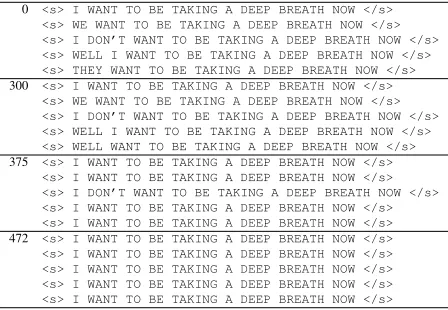
0 <s> I WANT TO BE TAKING A DEEP BREATH NOW </s> <s> WE WANT TO BE TAKING A DEEP BREATH NOW </s> <s> I DON’T WANT TO BE TAKING A DEEP BREATH NOW </s> <s> WELL I WANT TO BE TAKING A DEEP BREATH NOW </s> <s> THEY WANT TO BE TAKING A DEEP BREATH NOW </s>
300 <s> I WANT TO BE TAKING A DEEP BREATH NOW </s> <s> WE WANT TO BE TAKING A DEEP BREATH NOW </s> <s> I DON’T WANT TO BE TAKING A DEEP BREATH NOW </s> <s> WELL I WANT TO BE TAKING A DEEP BREATH NOW </s> <s> WELL WANT TO BE TAKING A DEEP BREATH NOW </s>
375 <s> I WANT TO BE TAKING A DEEP BREATH NOW </s> <s> I WANT TO BE TAKING A DEEP BREATH NOW </s> <s> I DON’T WANT TO BE TAKING A DEEP BREATH NOW </s> <s> I WANT TO BE TAKING A DEEP BREATH NOW </s> <s> I WANT TO BE TAKING A DEEP BREATH NOW </s>
[image:7.612.315.539.55.210.2]472 <s> I WANT TO BE TAKING A DEEP BREATH NOW </s> <s> I WANT TO BE TAKING A DEEP BREATH NOW </s> <s> I WANT TO BE TAKING A DEEP BREATH NOW </s> <s> I WANT TO BE TAKING A DEEP BREATH NOW </s> <s> I WANT TO BE TAKING A DEEP BREATH NOW </s>
Figure 1: Example run of the consensus problem on
K= 25strings on a Broadcast News utterance, showing
x1, . . . , x5at the 0th, 300th, 375th, and 472nd iterations.
(Chen et al., 2006; Soltau et al., 2010) on a subset of the NIST dev04f data, using models trained by Zweig et al. (2011). For each lattice, we found the consensus of the topK = 25strings.
85% of the problems converged within 1000 it-erations, with an average of 147.4 iterations. We found that the true consensus was often the most likely string underπ, but not always—this was true 70% of the time. In the Bayes risk objective we are optimizing in equation (7)—the expected loss—our approach averaged a score of 1.59, while always tak-ing the top strtak-ing gives only a slightly worse average of 1.66. 8% of the problems encountered negative-weight cycles, which were all resolved either by de-creasing the step size or encoding largern-grams.
5.3 Investigating Consensus Performance with Synthetic Data
The above experiments demonstrate that we can ex-actly find the best path in the intersection of 25 machines—an intersection that could not feasibly be constructed in practice. However, these experiments do not exhaustively explore how dual decomposition behaves on the Steiner string problem in general.
0 5 10 15 20
Runtime (s)
0 10 20 30 40 50 60 70 80 90
Score
K=50,`=10,|Σ|=10,µ=0.2
Primal Dual
0 10 20 30 40 50 60
Runtime (s)
0 10 20 30 40 50
Score
K=10,`=15,|Σ|=20,µ=0.4
Primal Dual
0 5 10 15 20 25 30 35
Runtime (s)
0 5 10 15 20 25 30 35 40
Score
K=5,`=50,|Σ|=5,µ=0.1
[image:8.612.81.535.53.179.2]Primal Dual
Figure 2: The algorithm’s behavior on three specific consensus problems. The curves show the current values of the primal bound (based on the best string at the current iteration) and dual boundh(λ). The horizontal axis shows runtime. Red upper triangles are placed every 10 iterations, while blue lower triangles are placed for every 10% increase in the size of the feature setΘ.
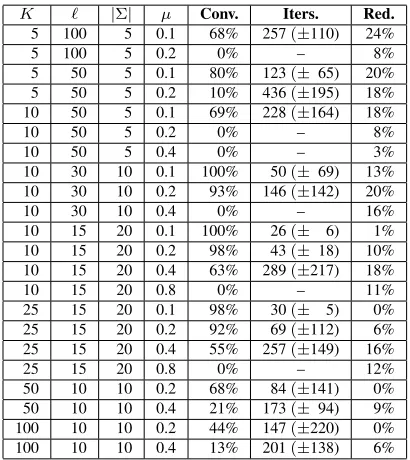
K ` |Σ| µ Conv. Iters. Red.
5 100 5 0.1 68% 257(±110) 24%
5 100 5 0.2 0% – 8%
5 50 5 0.1 80% 123(± 65) 20% 5 50 5 0.2 10% 436(±195) 18% 10 50 5 0.1 69% 228(±164) 18%
10 50 5 0.2 0% – 8%
10 50 5 0.4 0% – 3%
[image:8.612.83.288.245.475.2]10 30 10 0.1 100% 50(± 69) 13% 10 30 10 0.2 93% 146(±142) 20% 10 30 10 0.4 0% – 16% 10 15 20 0.1 100% 26(± 6) 1% 10 15 20 0.2 98% 43(± 18) 10% 10 15 20 0.4 63% 289(±217) 18% 10 15 20 0.8 0% – 11% 25 15 20 0.1 98% 30(± 5) 0% 25 15 20 0.2 92% 69(±112) 6% 25 15 20 0.4 55% 257(±149) 16% 25 15 20 0.8 0% – 12% 50 10 10 0.2 68% 84(±141) 0% 50 10 10 0.4 21% 173(± 94) 9% 100 10 10 0.2 44% 147(±220) 0% 100 10 10 0.4 13% 201(±138) 6%
Table 1: A summary of results for various consensus problems, as described in§5.3.
is so small thatn-grams are likely to be repeated in many parts of the strings, and the lack of position in-formation in our features could make it hard to reach agreement. Another interesting case is when the in-put strings have little or nothing in common—can we still converge to an optimal consensus in a rea-sonable number of iterations?
We can investigate many different cases by cre-ating synthetic data, where we tune the number of input stringsK, the length of the strings, the size of the vocabulary|Σ|, as well as how similar the strings are. We do this by randomly generating a base string
x∗ ∈ Σ` of length`. We then generate K random
strings w1, . . . , wK, each by passing x∗ through a
noisy edit channel, where each position has inde-pendent probabilityµ of making an edit. For each position in x∗, we uniformly sample once among the three types of edits (substitution, insertion, dele-tion), and in the case of the first two, we uniformly sample from the vocabulary (excluding the current symbol for substitution). The largerµ, the more mu-tated the strings will be. For smallµor largeK, the optimal consensus ofw1, . . . , wKwill usually bex∗.
Table 1 shows results under various settings. Each line presents the percentage of 100 examples that converge within the iteration limit, the average num-ber of iterations to convergence (± standard devi-ation) for those that converged, and the reduction in the objective value that is obtained over a sim-ple baseline of choosing the best string in the input set, to show how much progress the algorithm makes between the 0th and final iteration.
As expected, a higher mutation probability slows convergence in all cases, as does having longer in-put strings. These results also confirm our hypothe-sis that a small alphabet would lead to slow conver-gence when using smalln-gram features. For these types of strings, which might show up in biological data, one would likely need more informative con-straints than position-agnosticn-grams.
cur-rent iteration, and the dual objective (5) that our al-gorithm is maximizing. The dual problem (which is concave in λ) lower bounds the primal. If the two functions ever touch, we know the solution to the dual problem is in the set of feasible solutions to the original primal problem we are attempting to solve, and indeed must be optimal. The figure shows that the dual function always has an initial value of 0, since we initialize each λk = 0, and then Fk will
simply return the inputwkas its best solution (since
wkhas zero distance to itself). As the algorithm
be-gins to enforce the agreement constraints, the value of the relaxed dual problem gradually worsens, until it fully satisfies the constraints.
These plots indicate the number of iterations that have passed and the number of active features. We see that the time per iteration increases as the num-ber of features increases, as expected, because more (and longer)n-grams are being encoded byG.
The three patterns shown are typical of almost all the trials we examined. When the solution is in the original input set (a likely occurrence for largeKor small µ·`), the primal value will be optimal from the start, and our algorithm only has toproveits op-timality. For more challenging problems, the primal solution may jump around in quality at each iteration before settling into a stable part of the space.
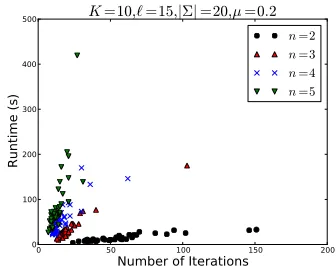
To investigate how different n-gram sizes affect convergence rates, we experiment with using the en-tire set of n-grams (for a fixed n) for the duration of the optimization procedure. Figure 3 shows con-vergence rates (based on both iterations and run-time) of different values ofnfor one set of param-eters. While bigrams are very fast (average runtime of 14s among those that converged), this converged within 1000 iterations only 78% of the time, and the remaining 22% end up bringing down the av-erage speed (with an overall avav-erage runtime over a minute). All largern-grams converged every time; trigrams had an average runtime of 32s. Our algo-rithm, which begins with bigrams but brings in more features (up to 5-grams) as needed, had an average runtime of 19s (with 98% convergence).
6 Discussion and Future Work
An important (and motivating) property of La-grangian relaxation methods is the certificate of
op-0 50 100 150 200
Number of Iterations
0 100 200 300 400 500
Runtime (s)
K=10,`=15,|Σ|=20,µ=0.2 n=2
n=3
n=4
[image:9.612.341.509.53.186.2]n=5
Figure 3: Convergence rates for a fixed set ofn-grams.
timality. Even in instances where approximate algo-rithms perform well, it could be useful to have a true optimality guarantee. For example, our algorithm can be used to produce reference solutions, which are important to have for research purposes.
Under a sum-of-pairs Levenshtein objective, the exact multi-sequence alignment can be directly ob-tained from the Steiner consensus string and vice versa (Gusfield, 1997). This implies that our ex-act algorithm could be also used to find exex-act multi-sequence alignments, an important problem in nat-ural language processing (Barzilay and Lee, 2003) and computational biology (Durbin et al., 2006) that is almost always solved with approximate methods.
We have noted that some constraints are more useful than others. Position-specific information is hard to agree on and leads to slow convergence, while puren-gram constraints do not work as well for long strings where the position may be impor-tant. One avenue we are investigating is the use of a non-deterministicG, which would allow us to encode latent variables (Dreyer et al., 2008), such as loosely defined “regions” within a string, and to allow for the encoding of alignments between the input strings. We would also like to extend these methods to other combinatorial optimization prob-lems involving strings, such as inference in graphi-cal models over strings (Dreyer and Eisner, 2009).
References
Cyril Allauzen, Mehryar Mohri, and Brian Roark. 2003. Generalized algorithms for constructing statistical lan-guage models. In Proceedings of the 41st Annual Meeting of the Association for Computational Linguis-tics, pages 40–47.
Cyril Allauzen, Michael Riley, Johan Schalkwyk, Woj-ciech Skut, and Mehryar Mohri. 2007. OpenFst: A general and efficient weighted finite-state transducer library. InProceedings of the 12th International Con-ference on Implementation and Application of Au-tomata, CIAA’07, pages 11–23.
Regina Barzilay and Lillian Lee. 2003. Learning to paraphrase: An unsupervised approach using multiple-sequence alignment. InProceedings of the 2003 Con-ference of the North American Chapter of the Associ-ation for ComputAssoci-ational Linguistics on Human Lan-guage Technology - Volume 1, NAACL ’03, pages 16– 23.
Peter J. Bickel and Kjell A. Doksum. 2006. Mathemat-ical Statistics: Basic Ideas and Selected Topics, vol-ume 1. Pearson Prentice Hall.
Stanley F. Chen, Brian Kingsbury, Lidia Mangu, Daniel Povey, George Saon, Hagen Soltau, and Geoffrey Zweig. 2006. Advances in speech transcription at IBM under the DARPA EARS program. IEEE Trans-actions on Audio, Speech & Language Processing, 14(5):1596–1608.
Markus Dreyer and Jason Eisner. 2009. Graphical mod-els over multiple strings. InProceedings of the 2009 Conference on Empirical Methods in Natural Lan-guage Processing, EMNLP ’09, pages 101–110. As-sociation for Computational Linguistics.
Markus Dreyer, Jason R. Smith, and Jason Eisner. 2008. Latent-variable modeling of string transductions with finite-state methods. InProceedings of the Conference on Empirical Methods in Natural Language Process-ing (EMNLP), pages 1080–1089, Honolulu, October. R. Durbin, S. Eddy, A. Krogh, and G. Mitchison. 2006.
Biological Sequence Analysis. Cambridge University Press.
Vaibhava Goel and William J. Byrne. 2003. Mini-mum Bayes risk methods in automatic speech recog-nition. In Wu Chou and Biing-Hwang Juan, editors,
Pattern Recognition in Speech and Language Process-ing. CRC Press.
Dan Gusfield. 1997. Algorithms on Strings, Trees, and Sequences: Computer Science and Computational Bi-ology. Cambridge University Press.
George Karakostas, Richard J Lipton, and Anastasios Vi-glas. 2003. On the complexity of intersecting finite state automata and NL versus NP. Theoretical Com-puter Science, pages 257–274.
Kevin Knight and Yaser Al-Onaizan. 1998. Translation with finite-state devices. InAMTA’98, pages 421–437. N. Komodakis, N. Paragios, and G. Tziritas. 2007. MRF optimization via dual decomposition: Message-Passing revisited. In Computer Vision, 2007. ICCV 2007. IEEE 11th International Conference on, pages 1–8.
Terry Koo, Alexander M. Rush, Michael Collins, Tommi Jaakkola, and David Sontag. 2010. Dual decompo-sition for parsing with non-projective head automata. In Proceedings of the 2010 Conference on Empirical Methods in Natural Language Processing, EMNLP ’10, pages 1288–1298.
Mehryar Mohri. 2002. Semiring frameworks and algo-rithms for shortest-distance problems. J. Autom. Lang. Comb., 7:321–350, January.
Fernando C. N. Pereira and Michael Riley. 1997. Speech recognition by composition of weighted finite au-tomata. CoRR.
Alexander M. Rush and Michael Collins. 2011. Exact decoding of syntactic translation models through La-grangian relaxation. InProceedings of the 49th An-nual Meeting of the Association for Computational Linguistics: Human Language Technologies - Volume 1, HLT ’11, pages 72–82.
Alexander M. Rush, David Sontag, Michael Collins, and Tommi Jaakkola. 2010. On dual decomposition and linear programming relaxations for natural language processing. InProceedings of the 2010 Conference on Empirical Methods in Natural Language Processing, EMNLP ’10, pages 1–11.
Jeong Seop Sim and Kunsoo Park. 2003. The consen-sus string problem for a metric is NP-complete. J. of Discrete Algorithms, 1:111–117, February.
H. Soltau, G. Saon, and B. Kingsbury. 2010. The IBM Attila speech recognition toolkit. InProc. IEEE Work-shop on Spoken Language Technology, pages 97–102. David Sontag, Talya Meltzer, Amir Globerson, Yair Weiss, and Tommi Jaakkola. 2008. Tightening LP relaxations for MAP using message-passing. In24th Conference in Uncertainty in Artificial Intelligence, pages 503–510. AUAI Press.
David Sontag, Amir Globerson, and Tommi Jaakkola. 2011. Introduction to dual decomposition for in-ference. In Suvrit Sra, Sebastian Nowozin, and Stephen J. Wright, editors,Optimization for Machine Learning. MIT Press.
James C. Spall. 2003. Introduction to Stochastic Search and Optimization. John Wiley & Sons, Inc., New York, NY, USA, 1 edition.
the 22nd international conference on Machine learn-ing, ICML ’05, pages 896–903.