Universal Dependencies for Afrikaans
Peter Dirix1, Liesbeth Augustinus1,2, Daniel van Niekerk3, and Frank Van Eynde1 1University of Leuven, Centre for Computational Linguistics,[email protected]
2FWO-Vlaanderen
3North West University, Centre for Text Technology,[email protected]
Abstract
The Universal Dependencies (UD) project aims to develop a consistent annotation framework for treebanks across many lan-guages. In this paper we present the UD scheme for Afrikaans and we describe the conversion of the AfriBooms treebank to this new format. We will compare the con-version to UD to the concon-version of related syntactic structures in typologically simi-lar languages.
1 Introduction
Afrikaans is a West Germanic language spoken by about 7 million people in South Africa, Namibia and a worldwide diaspora, mainly in English-speaking countries. It is one of the eleven of-ficial languages in South Africa and a main lin-gua franca in both South Africa and neighbouring Namibia.
Until recently, not many NLP tools were avail-able for Afrikaans. Pilon (2005) developed a fine-grained morpho-syntactic tag set and trained a ver-sion of the TnT tagger (Brants, 2000) on a man-ually corrected set of ca 20K words. This tag-ger was used to annotate the 58M-word Taalkom-missie corpus.1 The annotated corpus was sub-sequently put into a search tool (Augustinus and Dirix, 2013). The first small Afrikaans treebank was only created in 2015 in the context of the the AfriBooms project (Augustinus et al., 2016).
We will discuss the setup of the AfriBooms treebank in Section 2 and continue with a short overview of Universal Dependencies in Sec-tion 3. The UD language-specific descripSec-tion for Afrikaans as well as the conversion to the UD scheme will be given in Section 4. Section 5 con-cludes and discusses some plans for future work.
1Taalkommissiekorpus, version 1.1 (2011), published by
CText, North-West University, Potchefstroom.
2 AfriBooms treebank
The basis for the development of the AfriBooms treebank is a filtered subset of the Afrikaans part of the NCHLT Annotated Text Corpora.2 It contains ca 49K tokens of PoS tagged government domain documents.
The original PoS annotation of the NCHLT cor-pus was based on a fine-grained tag set (Pilon, 2005). As some of the information in that tag set turned out to be superfluous for determining the sentence dependency structure, the PoS tag set was simplified to a largely universal set of PoS tags (Petrov et al., 2012). This was done in order to facilitate the syntactic annotation process for the human annotators. For example, 17 classes of verb PoS tags, distinguishing present and past tense; main verbs and auxiliaries; copular verbs, transi-tive verbs, intransitransi-tive verbs and verbs requiring a prepositional phrase for main verbs; separable and inseparable verbs; and finally for auxiliaries the type (modal, auxiliary of tense, auxiliary of as-pect, auxiliary of mode) were all mapped to one tagVERB. Table 1 presents the resulting tag set.
The simplified corpus was syntactically anno-tated with the first version of an Afrikaans parser.3 In a next step, the annotations were manually checked by one primary annotator while a subset containing 943 words was double-checked by a second annotator. The inter-annotator agreement (IAA) is calculated in terms of labelled attach-ment score (LAS) and unlabelled attachattach-ment score (UAS) averaged over words (Nivre et al., 2007). The LAS is 82.5%, while the UAS is 88.9%.
2Afrikaans NCHLT Annotated Text Corpora, edition 1.0,
created by M. Puttkammer, M. Schlemmer and R. Bekker and available through the South African Language Resource Management Agency, Potchefstroom, ISRLN 139-586-400-050-9.
3The parser was retrained afterwards on the resulting
tree-bank.
AB POSTAG FREQUENCY DESCRIPTION
ADJ 2781 Adjectives
ADP 5561 Adpositions
ADV 1481 Adverbs
CONJ 2616 Conjunctions
DET 4113 Determiners
NOUN 9964 Nouns (including proper nouns)
NUM 635 Numerals
PRON 3561 Pronouns
PRT 1677 Particles
PUNCT 4028 Punctuation
VERB 6720 Verbs (including auxiliary verbs)
[image:2.595.72.548.62.242.2]X 758 Catch-all class (including abbreviations and interjections amongst others)
Table 1: The PoS tag set and its frequencies in the AfriBooms treebank
AB DEPENDENCY TAG FREQ. DESCRIPTION
dep 1009 dependent
dep:punct 4497 punctuation dep:root 1870 root
dep:aux 2534 auxiliary (verb) dep:conj 2359 conjunct
dep:cc 1886 coordination (e.g. to conjunctions) dep:arg 1130 argument dep:arg:subj 2605 subject dep:arg:comp 3 complement dep:arg:comp:obj 3763 object dep:arg:comp:obj:dobj 111 direct object dep:arg:comp:obj:iobj 0 indirect object dep:arg:comp:obj:pobj 6106 object of preposition dep:arg:comp:compl 0 complementiser dep:arg:comp:mark 5 marker (introducing
adverbial clause) dep:arg:comp:rel 0 relative (introducing
relative clause) dep:arg:comp:acomp 0 adjectival complement dep:mod 11120 modifier
dep:mod:advcl 0 adverbial clause modifier dep:mod:tmod 0 temporal modifier dep:mod:amod 2447 adjectival modifier dep:mod:num 462 numeric modifier dep:mod:number 0 element of compound
number
dep:mod:appos 0 appositional modifier dep:mod:abbrev 63 abbreviation modifier dep:mod:adv 0 adverbial modifier dep:mod:adv:neg 0 negation modifier dep:mod:poss 830 possession modifier dep:mod:prt 1375 phrasal verb particle dep:mod:det 5101 determiner
dep:mod:prep 0 prepositional modifier
Table 2: The Stanford dependency tag set and its frequencies in the AfriBooms treebank
For the dependency relations, a subset of the Stanford tag set was adopted, applying the conven-tions of De Marneffe (2006; 2008). An overview of the dependency tags together with their fre-quencies is given in Table 2.
The figures in Table 2 show that the annotators often fell back onto more generic tags such asdep,
dep:arganddep:mod, resulting in a large amount of syntactic relations that could have been further specified.
All sentences in the treebank are validated ac-cording to the following principles:
• Graph completeness: Each sentence must
form a single complete graph, i.e. all words must be reachable from the root node.
• Dependence restriction: Words may have
multiple dependents and each phrase has at most one head.
• Projectivity: Connection lines between words should not cross each other.
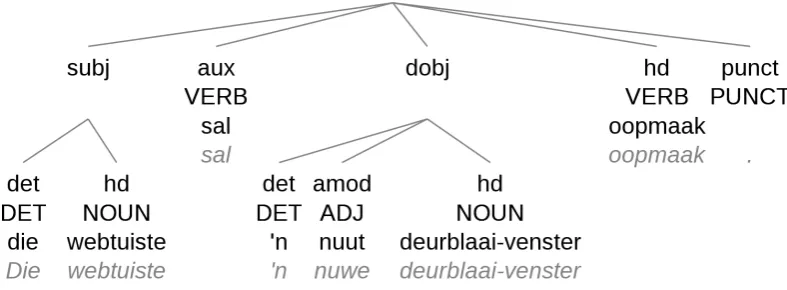
The treebank was delivered in the Folia-XML format (van den Bosch et al., 2007). An exam-ple of a sentence from the AfriBooms treebank is given in Figure 1. It visualizes the PoS tag and de-pendency annotation for the sentence Die webtu-iste sal ‘n nuwe deurblaai-venster oopmaak.‘The website will open a new browser window’.
[image:2.595.74.290.296.691.2]Figure 1: An example sentence taken from the AfriBooms treebank
3 Universal Dependencies
Universal Dependencies (UD) is a project devel-oping cross-language consistent treebank annota-tion for as many languages as possible, aiming to facilitate multilingual or language-independent parser development, cross-lingual learning, and linguistic research from a language typology per-spective (Nivre et al., 2016). The annotation scheme is based on a combination of adapted (uni-versal) Stanford dependencies (de Marneffe et al., 2006; de Marneffe and Manning, 2008), Google universal PoS tags (Petrov et al., 2012), and the Interset interlingua for morphosyntactic tag sets (Zeman, 2008). The general philosophy is to pro-vide a universal inventory of categories and guide-lines to facilitate consistent annotation of simi-lar constructions across languages, and allowing language-specific extensions when necessary to encode specific features. Guidelines for version 2.0 as well as the treebanks released in this ver-sion are published on the project’s website.4
Universal dependencies describe dependency relations between words. For most languages, white space determines what a token is. Apart from contractions and clitics, words are not seg-mented. The use of multi-word tokens is limited to a few fixed expressions that function as adverbs or adpositions.
UD treebanks are represented in the CoNLL-U format, which is an adaptation of the older CoNLL-X format. This format is a tab-separated text file with ten columns. The first three columns respectively contain the position of the token in the
4https://universaldependencies.org
sentence, the token and its lemma. Lemmas are defined as the dictionary form of the token, which depends on the language. For example verb lem-mas are typically represented by the infinitive, but in Greek the indicative present first person singu-lar is employed. Column 4 contains the universal PoS tag. The morphosyntactic annotation of the pre-converted treebank, if any, can be put in col-umn 5. The universal and language-specific mor-phological features describing number, case, per-son, gender, mood, tense etc. in the column 6. Column 7 indicates the head of the current token in reference to its position in the sentence (column 1). Column 8 contains the universal dependency relation, while column 9 (optionally) contains an enhanced dependency graph in the form of head-dependency relation pairs. Any other type of an-notation can be placed in column 10. Fields should never be empty and may have an underscore as place-holder if necessary. Figure 2 presents the sentence in Figure 1 in the UD format.
4 Converting AfriBooms to the UDT format
4.1 Language-specific definitions for Afrikaans
gen-1 Die die DET LB Definite=Def|PronType=Art 2 det _ _
2 webtuiste webtuiste NOUN NSE Number=Sing 7 nsubj _ _
3 sal sal AUX VTUOM Tense=Pres|VerbForm=Fin,Inf|VerbType=Mod 7 aux _ _
4 ’n ’n DET LO Definite=Ind|PronType=Art 6 det _ _
5 nuwe nuut ADJ ASA AdjType=Attr|Case=Nom|Degree=Pos 6 amod _ _ 6 deurblaai-venster deurblaai-venster NOUN NSE Number=Sing 7 obj _ _ 7 oopmaak oopmaak VERB VTHSG Subcat=Tran|Tense=Pres|VerbForm=Fin,Inf 0 root _ _
[image:4.595.77.523.63.147.2]8 . . PUNCT ZE _ 7 punct _ _
Figure 2: Example for an Afrikaans sentence in the UDT format
eral Indo-European ones, but also very specific (West) Germanic characteristics such as extensive nominal compounding, separability of compound verbs, and extensive diminutive formation.
4.1.1 PoS tags and morphological features
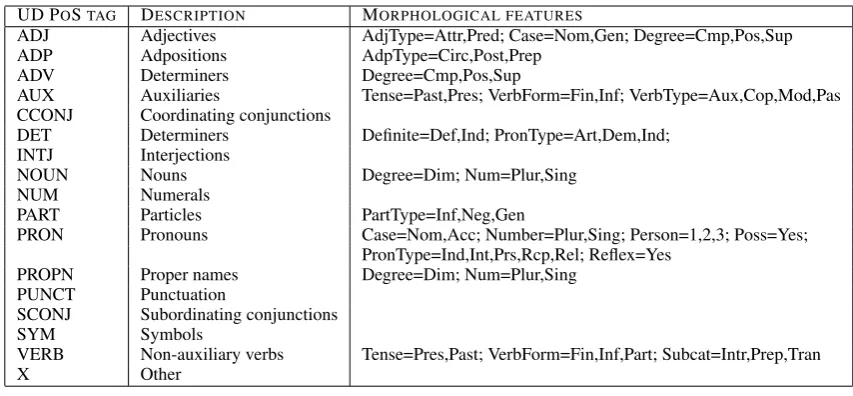
The Afrikaans Universal PoS tags and features are listed in Table 3.
Nouns For nouns (NOUN) and proper names (PROPN), we introduce a feature Degree next to number. As in in Dutch, this is in order to cover the extensive possibilities of diminutive forma-tion, e.g. huis ‘house’ gets huisie ‘little house’ and Jan (‘John’) has Jantjie ‘little John’. Be-sides this language-specific feature, we need the
Numfeature, but notCaseas Afrikaans has hardly any remainders of the old Germanic case sys-tem. The genitive is expressed by the particlese, which is covered by the feature PartType=Gen
for particles. There are still a few fixed expres-sions inherited from Dutch, like ter ere van ‘in honour of’, which will be considered as multi-word adverbials or prepositions. We will treat fixed Latin expressions such asex aequosimilarly. We do not include the difference between com-mon nouns, measurement nouns, collectives and abstract nouns, which was present in the original tag set, as most of those tags did not occur in the training set of the tagger anyway. Pluralia tanta will be represented as ‘plural’ nouns.
Adjectives Adjectives (ADJ) have degrees of comparison like most other Indo-European lan-guages. We introduce theCasefeature to cover for the formal, archaic genitive forms likeiets interes-sants‘something interesting’ (Donaldson, 1993). Other archaic accusative or dative forms might oc-cur in fixed expressions (e.g. te geleëner tyd‘at the proper time’), but as there are very few, these expressions are also considered multi-word adver-bials. In addition to these features we need to in-troduce a new language-specific featureAdjType
to account for the fact that most adjectives have a different form depending on whether they are used attributively or predicatively, e.g. ’n eerlike kêrel (‘an honest guy’) vs.dié kêrel is eerlik(‘this guy is honest’). This is only relevant for the nominative case. The forms are indistinguishable in the com-parative and superlative, but as our original tag set does make the distinction, we propose to keep it. As prescribed in the UD guidelines, ordinal num-bers form part of adjectives.
Adverbs For adverbs (ADV), we only keep the differences in degree and we will not introduce features to describe the type of adverb (temporal, modal, etc.) at this point.
Verbs Verbs (VERB) have a very simple mor-phology in Afrikaans. Apart from a few auxil-iaries and modals, verbs only have one present form, which also serves as infinitive, and a past participle, which is used in the formation of the past tense. The verbwees ‘to be’ has a separate infinitive next to the present formis‘is’, while it also has an old preterite form to express the past (was ‘was’), just like some modals. Present and past participles are considered as adjectives when they behave as such. An indication of the distinc-tion native speakers make between past participles and their (declinable) adjectival forms, is the fact that the old Dutch strong forms can only be used in adjectival positions and not to form the past tense (Donaldson, 1993). For example, one cannot saydie kind word aangenome, onlydie kind word aangeneem ‘the child is adopted’. However, one can saydie kind is aangenome, in which case this is analysed as a combination of the copula and a predicative complement, next todie kind is aange-neem, which means ‘The child has been adopted’. The strong form often has a more figurative or ab-stract meaning, as in ’n gebroke hart (‘a broken heart’) vs. ’n gebreekte bord (‘a broken plate’) (Conradie, 2017).
intro-UD POSTAG DESCRIPTION MORPHOLOGICAL FEATURES
ADJ Adjectives AdjType=Attr,Pred; Case=Nom,Gen; Degree=Cmp,Pos,Sup
ADP Adpositions AdpType=Circ,Post,Prep
ADV Determiners Degree=Cmp,Pos,Sup
AUX Auxiliaries Tense=Past,Pres; VerbForm=Fin,Inf; VerbType=Aux,Cop,Mod,Pas CCONJ Coordinating conjunctions
DET Determiners Definite=Def,Ind; PronType=Art,Dem,Ind; INTJ Interjections
NOUN Nouns Degree=Dim; Num=Plur,Sing
NUM Numerals
PART Particles PartType=Inf,Neg,Gen
PRON Pronouns Case=Nom,Acc; Number=Plur,Sing; Person=1,2,3; Poss=Yes; PronType=Ind,Int,Prs,Rcp,Rel; Reflex=Yes
PROPN Proper names Degree=Dim; Num=Plur,Sing PUNCT Punctuation
SCONJ Subordinating conjunctions
SYM Symbols
VERB Non-auxiliary verbs Tense=Pres,Past; VerbForm=Fin,Inf,Part; Subcat=Intr,Prep,Tran
[image:5.595.83.510.60.258.2]X Other
Table 3: Afrikaans Universal PoS tags and their potential morphosyntactic feature values
duce theVerbTypefeature to distinguish between copular verbs, modal verbs, the passive auxiliaries word‘be’ (present) andwees(past), and other aux-iliaries. This is similar to the Dutch treatment, apart from the introduction of the passive voice category. Like Dutch and German, Afrikaans has separable verbs, i.e. verbs that are actually com-pounds of a particle (or sometimes an adjective or a noun) and another verb. In verb-initial clauses, the two parts get separated and the particle moves to the end of the clause. An example isEk gaan die huis binne ‘I enter the house’ with the separable verbbinnegaan‘to enter’ (literally ‘inside go’).5
Pronouns and determiners Pronouns are treated in a similar way as in Dutch. Possessive and reflexive pronouns are considered a subset of the personal pronouns and have person and number features. We do not indicate the gender of third person pronouns. On top of this, we distinguish relative, interrogative, indefinite, and reciprocal pronouns as a part of the PRON class. Demonstrative pronouns are put in the DET class together with indefinite determiners and articles, as required by the UD guidelines. For articles, the distinction between definite and indefinite articles is indicated by theDefinitefeature.
Adpositions We also follow the Dutch annota-tions in defining three types of adposiannota-tions (ADP): prepositions, postpositions and circumpositions, 5In verb-final clauses, the verb is placed at the end of the
clause after the particle, and the two are (usually) treated as a single orthographic unit. Compare the verb-initial construc-tion to a construcconstruc-tion with a subordinate clause:Hy sien dat ek die huis binnegaan‘He sees that I enter the house’.
encoded with theAdpType.
Particles We introduce three types of particles (PART):te ‘to’ introducing the infinitive (denoted by Inf), the genitive particle se ‘his/her/their’ (similarly used as ’s in English and denoted by
Gen, and the negative particle nie ‘not’ which is used in most negative sentences in addition to a negative adverb or determiner (Huddlestone, 2010).
Remaining PoS tags The other PoS tags for nu-merals (NUM), coordinating conjunctions (CCONJ), subordinating conjunction (SSCONJ), interjections (INTJ), punctuation (PUNCT), symbols (SYM), and the remainder class (X) do not have any additional features.
Contracted forms One common contraction is the colloquial disfor dit is(the expletive ‘it is’), which needs to be split. Note that this construction does not appear in AfriBooms treebank.
4.1.2 Dependency relations
UD POSTAG MORPHOLOGICAL FEATURES FREQ. EXAMPLE
ADJ AdjType=Attr|Case=Nom|Degree=Cmp 34 minder
ADJ AdjType=Attr|Case=Nom|Degree=Pos 2321 tweede
ADJ AdjType=Attr|Case=Nom|Degree=Sup 41 doeltreffendste
ADJ AdjType=Pred|Case=Nom|Degree=Cmp 20 vinniger
ADJ AdjType=Pred|Case=Nom|Degree=Pos 419 nuttig
ADJ AdjType=Pred|Case=Nom|Degree=Sup 5 hoogste
ADP AdpType=Prep 5604 in
ADV Degree=Cmp 54 beter
ADV Degree=Pos 1728 vandag
ADV Degree=Sup 11 mees
AUX Tense=Past|VerbForm=Fin|VerbType=Cop 54 was
AUX Tense=Past|VerbForm=Fin|VerbType=Mod 20 wou
AUX Tense=Past|VerbForm=Fin|VerbType=Pas 266 is
AUX Tense=Pres|VerbForm=Fin,Inf|VerbType=Aux 384 het
AUX Tense=Pres|VerbForm=Fin,Inf|VerbType=Cop 608 is
AUX Tense=Pres|VerbForm=Fin,Inf|VerbType=Mod 1049 sal
AUX Tense=Pres|VerbForm=Fin,Inf|VerbType=Pas 543 word
CCONJ _ 1768 en
DET Definite=Def|PronType=Art 3237 die
DET Definite=Ind|PronType=Art 876 ’n
DET PronType=Dem 396 hierdie
DET PronType=Ind 315 baie
NOUN Degree=Dim|Number=Plur 5 koekies
NOUN Degree=Dim|Number=Sing 9 koekie
NOUN Number=Plur 2610 blaaiers
NOUN Number=Sing 6784 toegang
NUM _ 197 twee
PART PartType=Gen 152 se
PART PartType=Inf 836 te
PART PartType=Neg 244 nie
PRON Case=Acc,Nom|Number=Plur|Person=1|PronType=Prs 470 ons
PRON Case=Acc,Nom|Number=Plur|Person=2|PronType=Prs 4 julle
PRON Case=Acc,Nom|Number=Plur|Person=3|PronType=Prs 96 hulle
PRON Case=Acc|Number=Sing|Person=1|PronType=Prs 8 my
PRON Case=Acc|Number=Sing|Person=2|PronType=Prs 19 jou
PRON Case=Acc|Number=Sing|Person=3|PronType=Prs 13 haar
PRON Case=Nom|Number=Sing|Person=1|PronType=Prs 66 ek
PRON Case=Nom|Number=Sing|Person=2|PronType=Prs 186 u
PRON Case=Nom|Number=Sing|Person=3|PronType=Prs 350 dit
PRON Number=Plur|Person=1|Poss=Yes|PronType=Prs 308 ons
PRON Number=Plur|Person=1|PronType=Prs|Reflex=Yes 13 ons
PRON Number=Plur|Person=3|Poss=Yes|PronType=Prs 89 hul
PRON Number=Plur|Person=3|PronType=Prs|Reflex=Yes 3 hulself
PRON Number=Sing|Person=1|Poss=Yes|PronType=Prs 10 my
PRON Number=Sing|Person=2|Poss=Yes|PronType=Prs 90 jou
PRON Number=Sing|Person=2|PronType=Prs|Reflex=Yes 1 jouself
PRON Number=Sing|Person=3|Poss=Yes|PronType=Prs 56 sy
PRON Number=Sing|Person=3|PronType=Prs|Reflex=Yes 12 homself
PRON PronType=Ind 307 enige
PRON PronType=Int 20 wat
PRON PronType=Rcp 6 mekaar
PRON PronType=Rel 1116 wat
PROPN Number=Sing 463 Suid-Afrika
PUNCT _ 4027 .
SCONJ _ 946 as
SYM _ 435 R5
VERB Subcat=Intr|Tense=Past|VerbForm=Part 64 gedemonstreer
VERB Subcat=Intr|Tense=Pres|VerbForm=Fin,Inf 547 werk
VERB Subcat=Prep|Tense=Pres|VerbForm=Fin,Inf 25 voldoen
VERB Subcat=Tran|Tense=Past|VerbForm=Part 725 gemeet
VERB Subcat=Tran|Tense=Pres|VerbForm=Fin,Inf 2445 ontdek
[image:6.595.114.483.71.699.2]X _ 385 DRK
This means that in general content words are the head instead of function words, e.g. nouns are the head of prepositional phrases. The aim of this principle is to allow for maximal comparabil-ity across languages. In addition to the obligatory dependency relations, it is possible to add an en-hanced dependency graph to this scheme with a more complete basis for semantic interpretation.6
For instance, the regular dependency relations lack a dependency relation between raised subjects and an embedded verb. It is possible to encode this kind of information in the enhanced dependency graph.
The UD scheme defines 37 types of relations, of which 24 are actual dependency relations. The taxonomy for the latter is organized along two di-mensions, which can be represented in the form of a matrix.7 The first dimension corresponds to functional categories in relation to the head (core arguments of clausal predicates, non-core dependents of clausal predicates, and dependents of nominals) whereas the second dimension cor-responds to the structural categories of the depen-dent (nominals, clauses, modifiers, and function words).
Additionally, there are 13 relations that are not dependency relations in the narrow sense. It con-cerns relations for analyzing coordination, mul-tiword expressions, ellipsis, and special relations for concepts such as root, punctuation and multi-word expressions.
Afrikaans shares many syntactic features with Dutch and German. It has, for instance, verb-second in main clauses but verb-final in (most) subordinate clauses (Biberauer, 2003); and there is the occurrence of substitute infinitives, also known as Infinitivus Pro Participio or IPP (Augustinus and Dirix, 2013). Afrikaans also has particular features such as double negation (Huddlestone, 2010).
In principle, all types of Universal Depen-dency relations can be applied to Afrikaans. The only exception is the classifier relation (clf), as Afrikaans has no grammaticalized classifier sys-tem. As in Dutch and German, we introduce the
compound:prt relation for compounds of which a part has been elided, e.g. in- en uitvoer‘import and export’, as well as for the particle of sepa-rable verbs. We also introduce nsubj:passand 6
http://universaldependencies.org/u/overview/enhanced-syntax.html
7http://universaldependencies.org/u/dep/
csubj:passfor the subjects of passive verbs, us-ingword(present) oris(past) as auxiliary.
4.2 Conversion and issues
As described in section 2 the original NCHLT cor-pus was available with original more fine-grained tags of the NCHLT corpus. We reintroduced those features in the AfriBooms treebank in order to pre-pare for conversion to UD, as they contain mor-phological information which is required by the UD guidelines. In general, we kept the morpho-logical features used in UD releases for other lan-guages. Most of the original morphological tags have been converted to UD features, but we did not do this for the types of adverbs or the type of nouns, and as well as the types of symbols and punctuation marks, as these were semantic in stead of morphosyntactic features. The XML format of AfriBooms treebank was converted into a tab-separated format, which facilitates the conversion to the CoNLL-U format considerably. The actual conversion was done using a Perl script.
4.2.1 PoS tags and morphological features
At the level of PoS tags and features there were hardly any disambiguation issues. Pronouns that have the same form in their base and oblique forms have aCase=Nom,Accfeature which could be disambiguated manually. We have not done this yet. This is also the case for the feature
VerbForm=Fin,Inf which is assigned to most verbs including auxiliaries, as the form of the present tense is identical to the infinitive.
The counts for the PoS tags and their morpho-logical features in the automatically converted ver-sion of AfriBooms can be found in Table 4.
As the AfriBooms treebank is relatively small, not all possible morphological forms occur in the treebank, e.g. the genitive form of articles and their comparatives. This will obviously inhibit au-tomated parser training.
4.2.2 Dependency relations
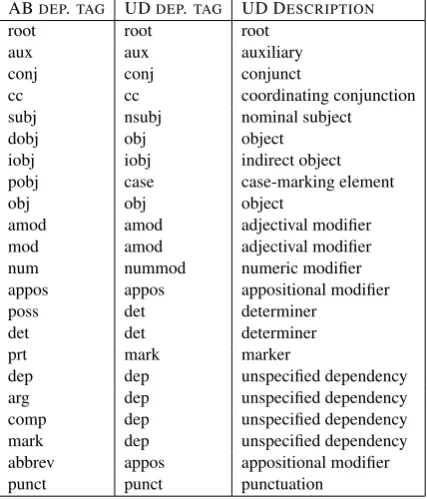
Table 5 lists the initial mapping of the dependency relations. Compared to the conversion of the PoS tags and morphological features, the conversion of the dependency relations was less straightforward, as some structural conversion was needed.
treebank and we can only provide mappings for dependencies occurring in that treebank.
ABDEP.TAG UDDEP.TAG UD DESCRIPTION
root root root
aux aux auxiliary
conj conj conjunct
cc cc coordinating conjunction
subj nsubj nominal subject
dobj obj object
iobj iobj indirect object
pobj case case-marking element
obj obj object
amod amod adjectival modifier mod amod adjectival modifier
num nummod numeric modifier
appos appos appositional modifier
poss det determiner
det det determiner
prt mark marker
dep dep unspecified dependency
arg dep unspecified dependency
comp dep unspecified dependency
mark dep unspecified dependency
abbrev appos appositional modifier
[image:8.595.75.289.110.360.2]punct punct punctuation
Table 5: Initial mapping between the AfriBooms and UDT dependency relations
The second problem with respect to the auto-mated conversion is the underspecification of de-pendency relations in the AfriBooms treebank. The UD relations only have one generic tag (dep), while the dependencies used in the AfriBooms treebank have several levels of underspecification, e.g. mod, arg, obj (see Table 2). Those rela-tions need to be either specified automatically or manually. In Dutch, there were actually similar is-sues with underspecification; when possible they were resolved in an automated way (Bouma and van Noord, 2017).
The third issue is that the human annotators of the AfriBooms treebank did not consistently fol-low the content word primacy principle. For in-stance in the case of prepositional phrases they as-signed the head status to the preposition, which means we had to flip the dependency relation be-tween them and have the noun point to the gov-ernor of the phrase. The dependency relation was set to nmodorobl, depending on the PoS of the governor. A similar issue exists for copular con-structions: the verb is assigned the head of the re-lation, while the predicative complement is iden-tified as an object. Again, we changed the depen-dency relation, making the nonverbal predicate the
head (mostly the root of the sentence), introducing thecoprelation and switching the governor of the subject to the nonverbal predicate. Similarly, we had to fix possessive constructions likeleerders se vermoë(‘learners’ ability’), to make sure the pos-sessive particle had thecaserelation, and swap-ping the relation between the two nouns, making the second one the governor and giving it the de-pendency relation of the former one, while giving the former one thenmodrelation. Another depen-dency relation that had to swap its head, are thecc
types for conjunctions, which need to point to the following noun (phrase) and not to the preceding one.
The fourth problem is that some relations are not distinguished in the original AfriBooms an-notation. A number of them could be (semi-)au-tomatically introduced. For instance, as the orig-inal treebank annotations do not make a distinc-tion betweennsubj(nominal subject) andcsubj
(clausal subject), we converted them all tonsubj
and replaced them afterwards tocsubjif the gov-ernor of the subject is either a verb or an auxiliary. Furthermore, we introduced compound:prt for compounds with partial elision, as mentioned in the previous section. In order to do this, we again had to swap the dependency relation and change the governors of all the tokens depending on the partially elided compound, as the first part of the expression was treated as the head in the Afri-Booms treebank. The result needs to be reviewed manually, as there are also phrases consisting of more than one compound with partial elision (e.g. klein-, medium- en mikro-ondernemings– ‘small, medium and micro-enterprises’), and phrases of the type besigheids- en ander sektore (‘business and other sectors’), which stands for besigheidsek-tor en ander sekbesigheidsek-tore. In the latter example the first item is a partially elided compound, but the second part consists of an adjective followed by a noun, which is also the elided part of the first compound. In addition, we introduced aux:pass for pas-sive auxiliaries based on their morphological fea-tures, and specifiednsubj:passfor the nominal subject of those verbs. We also introducediobj
for a list of ca 30 verbs for which the indirect ob-ject is introduced with the preposition aan. Fi-nally, we also specified theflatrelation in multi-word named entities.
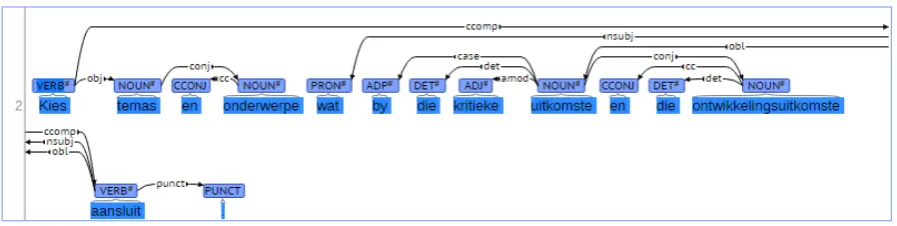
re-Figure 3: Example for an Afrikaans sentence after automated conversion in the UDT format: ‘Choose themes and subjects that link with the critical outcomes and the developmental outcomes.’
lation in the original treebank.
We also fixed the dependency relation of verbs following the particletetoxcomp, as the original treebank did not distinguish between nominal and clausal constituents. Furthermore, we also had to flip the dependency relation between relative pro-nouns and the content verb of the relative sentence, and made sure the verb has thexcompdependency relation.
[image:9.595.74.523.68.181.2] [image:9.595.308.525.379.703.2]All of this patching work was done using an ad-ditional Perl script which we ran after the initial conversion. As mentioned in section 2 the Afri-Booms treebank contains many genericdep rela-tions, which need to be further specified. Even though the patching work greatly reduced the number of generic items, many of them should be manually reviewed. This is currently in progress. An example of a converted sentence is given in Figure 3.
As a final step, the converted treebank was val-idated using the UDT tools available on GitHub.8 Table 6 presents the final figures of each de-pendency relation category after conversion and patching.
5 Conclusion and future work
We created a UD treebank for Afrikaans using an automated conversion scheme from the exist-ing AfriBooms treebank. It is a small treebank of about 49K words consisting of governments docu-ments. Due to its small size and the specific genre, it does not contain all possible dependency rela-tions and morphological feature values.
As many of the dependency relations were un-derspecified in the original treebank, the next step
8https://github.com/UniversalDependencies/
tools
consists of a manual check. We furthermore plan to train parsers for the annotation of both the de-pendency relations and the morphological infor-mation. Those parsers will be used to create more annotated data, for starters from Wikipedia, but possibly also for other text types, such as the Taalkommissie corpus. A (small) part of those data could be verified manually in order to im-prove parsing accuracy.
UDDEP.TAG FREQ. DESCRIPTION
advmod 1780 adverbial modifier amod 5080 adjectival modifier appos 63 appositional modifier
aux 1663 auxiliary
aux:pass 854 passive auxiliary case 5890 case-marking element cc 1886 coordinating conjunction ccomp 905 clausal complement compound:prt 408 separable verb particle /
elided part of a compound
conj 2001 conjunct
cop 149 copula
csubj 3 clausal subject
csubj:pass 0 clausal subject of passive verb dep 1668 unspecified dependency
det 5775 deterniner
flat 231 flat multiword expression iobj 53 indirect object
mark 1051 marker
nmod 2948 nominal modifier nsubj 3010 nominal subject
nsubj:pass 500 nominal subject of passive verb nummod 461 numeric modifier
obj 2804 object
obl 2728 oblique nominal punct 4497 punctuation
root 1903 root
[image:9.595.308.523.381.704.2]xcomp 965 open clausal complement
References
Liesbeth Augustinus and Peter Dirix. 2013. The IPP effect in Afrikaans: a corpus analysis. In Proceed-ings of the 19th Nordic Conference of Computa-tional Linguistics (NODALIDA 2013) - NEALT Pro-ceedings Series 16, pages 213–225, Oslo.
Liesbeth Augustinus, Peter Dirix, Daniel Van Niekerk, Ineke Schuurman, Vincent Vandeghinste, Frank Van Eynde, and Gerhard Van Huyssteen. 2016. Afri-Booms: An Online Treebank for Afrikaans. In Pro-ceedings of the Tenth International Conference on
Language Resources and Evaluation (LREC 2016),
pages 677–682, Portorož. European Language Re-sources Association (ELRA).
Theresa Biberauer. 2003. Verb Second (V2) in Afrikaans: a Minimalist investigation of word-order
variation. Ph.D. thesis, University of Cambridge,
Cambridge.
Gosse Bouma and Gertjan van Noord. 2017. Increas-ing return on annotation investment: the automatic construction of a Universal Dependency Treebank for Dutch. In Proceedings of the Universal De-pendencies Workshop at the 21st Nordic Conference
of Computational Linguistics (NODALIDA 2017),
Gothenburg.
Thorsten Brants. 2000. TnT – A Statistical Part-of-Speech Tagger. InProceedings of the Sixth Applied Natural Language Processing Conference (ANLP-2000), pages 224–231, Seattle.
Jac Conradie. 2017. The re-inflecting of Afrikaans. Paper given at the Germanic Sandwich 2017, Mün-ster.
Marie-Catherine de Marneffe and Christopher D. Man-ning. 2008. The Stanford typed dependencies repre-sentation. InProceedings of the Workshop on Cross-Framework and Cross-Domain Parser Evaluation at
COLING 2008, pages 1–8, Manchester, UK.
Marie-Catherine de Marneffe, Bill MacCartney, and Christopher D. Manning. 2006. Generating Typed Dependency Parses from Phrase Structure Parses. In
Proceedings of the 6th International Conference on
Language Resources and Evaluation (LREC 2006),
pages 449–454, Genoa. European Language Re-sources Association (ELRA).
Bruce C. Donaldson. 1993. A Grammar of Afrikaans. Mouton de Gruyter, Berlin/New York.
Kate Huddlestone. 2010. Negative Indefinites in Afrikaans. Ph.D. thesis, Utrecht University.
Joakim Nivre, Johan Hall, Sandra Kübler, Ryan Mc-Donald, Jens Nilsson, Sebastian Riedel, and Deniz Yuret. 2007. The CoNLL 2007 shared task on de-pendency parsing. In Proceedings of the CoNLL
shared task session of EMNLP-CoNLL, pages 915–
932.
Joakim Nivre, Marie-Catherine de Marneffe, Filip Gin-ter, Yoav Goldberg, Jan Hajiˇc, Christopher D. Man-ning, Ryan McDonald, Slav Petrov, Sampo Pyysalo, Natalia Silveira, Reut Tsarfaty, and Daniel Zeman. 2016. Universal Dependencies v1: A Multilingual Treebank Collection. InProceedings of the Tenth In-ternational Conference on Language Resources and
Evaluation (LREC 2016), pages 1659–1666,
Por-torož. European Language Resources Association (ELRA).
Slav Petrov, Dipanjan Das, and Ryan McDonald. 2012. A Universal Part-of-Speech Tagset. In Proceed-ings of the 8th International Conference on
Lan-guage Resources and Evaluation (LREC 2012),
pages 2089–2096, Istanbul. European Language Re-sources Association (ELRA).
Suléne Pilon. 2005. Outomatiese Afrikaanse woord-soortetikettering. Master’s thesis, North-West Uni-versity, Potchefstroom.
Antal van den Bosch, Bertjan Busser, Sander Canisius, and Walter Daelemans. 2007. An efficient memory-based morphosyntactic tagger and parser for Dutch.
In Computational Linguistics in the Netherlands:
Selected papers from the Seventeenth CLIN Meeting, pages 191–206, LOT, Utrecht.
Daniel Zeman. 2008. Reusable Tagset Conversion Using Tagset Drivers. In Proceedings of the 6th International Conference on Language Resources
and Evaluation (LREC 2008), pages 213–218,