Classifier Stacking for Native Language Identification
Wen Li
Department of Linguistics Indiana University Bloomington, IN, USA
Liang Zou
Department of Mathematics Indiana University Bloomington, IN, USA [email protected]
Abstract
This paper reports our contribution (team WLZ) to the NLI Shared Task 2017 (essay track). We first extract lexical and syntac-tic features from the essays, perform fea-ture weighting and selection, and train lin-ear support vector machine (SVM) classi-fiers each on an individual feature type. The output of base classifiers, as proba-bilities for each class, are then fed into a multilayer perceptron to predict the native language of the author. We also report the performance of each feature type, as well as the best features of a type. Our system achieves an accuracy of 86.55%, which is among the best performing systems of this shared task.
1 Introduction
Native language identification (NLI) is the task of determining an author’s native language (L1) based on their writings in a second language (L2). NLI works under the assumption that an author’s L1 will dispose them towards particular language production patterns in their L2, as influenced by their native language. This relates to cross-linguistic influence (CLI), a key topic in the field of second language acquisition (SLA) that ana-lyzes transfer effects from the L1 on later learned languages (Malmasi,2016). The identification of L1-specific features has been used to study lan-guage transfer effects in second-lanlan-guage acqui-sition (Malmasi and Dras, 2014), which is use-ful for developing pedagogical material, teaching methods, L1-specific instructions and generating learner feedback that is tailored to their native lan-guage.
The first NLI shared task was held in 2013 (Tetreault et al., 2013), and the winner team
re-ported an accuracy of 83.6% on the test data using an SVM classifier with over 400,000 unique fea-tures consisting of lexical and POSn-grams occur-ring in at least two texts in the training set (Jarvis et al.,2013). In addition ton-gram features, other researchers have also explored syntactic features (Bykh and Meurers, 2014) and the use of string kernels (Ionescu et al.,2014).
All NLI shared tasks to date have been based on L2 English data, but NLI research has been ex-tended to at least six other non-English languages (Malmasi and Dras, 2015). In addition to us-ing the written responses, a recent trend has been the use of speech transcripts and audio features for dialect identification (Malmasi et al., 2016). The combination of transcripts and acoustic fea-tures has also provided good results for dialect identification (Zampieri et al., 2017). Following this trend, the 2016 Computational Paralinguistics Challenge (Schuller et al.,2016) also included an NLI task based on the spoken response. The NLI Shared Task 2017 attempts to combine these ap-proaches by including a written response (essay) and a spoken response (speech transcript and i-vector acoustic features) for each subject. The task also allows for the fusion of all features.
Ensemble methods using multiple classifiers have proven to be one of the most successful ap-proaches for the task of NLI (Malmasi and Dras,
2017), and researchers have reported better results using stacking than a single classifier in other text classification tasks (e.g.,Liu et al.,2016). In this work we present a stacking model using lexical and syntactic features for NLI Shared Task 2017 (Malmasi et al., 2017), report the performance of different feature types, and show the best fea-tures in each type. The feafea-tures we use in the fi-nal model include character/word/stem n-grams, function wordn-grams, and dependency parses.
2 Data
The data set we use for NLI Shared Task 2017 (see details inMalmasi et al.,2017) includes En-glish essays written by test takers who partici-pated in a standardized assessment of English pro-ficiency for academic purposes. The 11 native languages of the test takers are: Arabic (ARA), Chinese (CHI), French (FRE), German (GER), Hindi (HIN), Italian (ITA), Japanese (JPN), Ko-rean (KOR), Spanish (SPA), Telugu (TEL), and Turkish (TUR). There are 11,000 essays (1,000 per L1) in the training partition (Train), 1,100 (100 per L1) in the development partition (Dev), and 1,100 (100 per L1) in the test partition (Test). All essays are available in both original and tokenized texts.
3 Methods 3.1 Features
We usetf-idf weightingfor all the features in this work, since we observe better results than other feature representations, namely binary represen-tation and frequency-based represenrepresen-tation. For most of the feature types, we also select k-best features with chi-square metric instead of using all of them. Previous research has reported fea-ture selection could improve the classification ac-curacy (Liu et al.,2014), and we notice the same trend for this task. In preliminary experiments fea-ture selection increases the accuracy by around 1-3% for each feature type. The k value for each feature type varies with regard to the total ber of features, and we choose the selected num-ber of features based on their performance on the Dev set (trained on Train set). Both tf-idf weight-ing and feature selection are realized with Scikit-Learn (Pedregosa et al.,2011).
Character n-grams We extract character 3-7 grams from the tokenized text, and each is repre-sented as a feature type (denoted by Char3-7). We also experiment with character 8-9 grams but do not include them in the final model, since adding them does not improve the accuracy.
Word n-grams We extract word uni-, bi-, and tri-grams from the tokenized text, and each is rep-resented as a feature type (denoted by Word1-3). Lemma n-grams We use the WordNet Lem-matizer in NLTK (Bird, 2006) to lemmatize the tokenized essays, and then extract lemma uni-,
bi-, and tri-grams as feature types (denoted by Lemma1-3). However, we do not include these features in the final model, since adding them does not improve the accuracy.
Stem n-grams We first stem the tokenized text with Porter stemmer using NLTK, and then extract stem uni-, bi-, and tri-grams as feature types (de-noted by Stem1-3).
POSn-grams We use the Stanford POS tagger (Toutanova et al., 2003) to tag the tokenized es-says, and then extract POS uni-, bi-, and tri-grams as feature types (denoted by POS1-3). However, we do not include these features in the final model, since adding them does not improve the accuracy. Function word n-grams We use the Stanford POS tagger to tag the tokenized essays first, and then extract the function words by their POS tags (which are tagged as auxiliary verbs, conjunctions, determiners, pronouns, etc.). Function word uni-, bi-, and tri-grams are used as features (denoted by FW1-3).
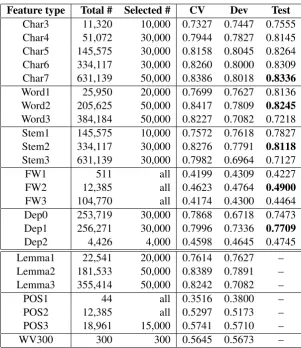
Feature type Total # Selected # CV Dev Test Char3 11,320 10,000 0.7327 0.7447 0.7555 Char4 51,072 30,000 0.7944 0.7827 0.8145 Char5 145,575 30,000 0.8158 0.8045 0.8264 Char6 334,117 30,000 0.8260 0.8000 0.8309 Char7 631,139 50,000 0.8386 0.8018 0.8336 Word1 25,950 20,000 0.7699 0.7627 0.8136 Word2 205,625 50,000 0.8417 0.7809 0.8245 Word3 384,184 50,000 0.8227 0.7082 0.7218 Stem1 145,575 10,000 0.7572 0.7618 0.7827 Stem2 334,117 30,000 0.8276 0.7791 0.8118 Stem3 631,139 30,000 0.7982 0.6964 0.7127
FW1 511 all 0.4199 0.4309 0.4227
FW2 12,385 all 0.4623 0.4764 0.4900 FW3 104,770 all 0.4174 0.4300 0.4464 Dep0 253,719 30,000 0.7868 0.6718 0.7473 Dep1 256,271 30,000 0.7996 0.7336 0.7709 Dep2 4,426 4,000 0.4598 0.4645 0.4745 Lemma1 22,541 20,000 0.7614 0.7627 – Lemma2 181,533 50,000 0.8389 0.7891 – Lemma3 355,414 50,000 0.8242 0.7082 –
POS1 44 all 0.3516 0.3800 –
POS2 12,385 all 0.5297 0.5173 –
POS3 18,961 15,000 0.5741 0.5710 –
[image:3.595.147.449.59.408.2]WV300 300 300 0.5645 0.5673 –
Table 1: Total number of features, selected number of features, and accuracy of each feature type. CV: 10-fold cross validation on Train; Dev: trained on Train, tested on Dev; Test: trained on Train and Dev, tested on Test. Best performance of a feature group on Test is in bold.
3.2 Classifiers
We use linear SVM (implemented by Scikit-Learn) as the base classifier for the feature types mentioned above. We set C=0.8 for Char3, Word1, Stem1, FW1-3, and Dep2, and use default settings for other parameters. Experiments on other feature types use the default setting: C=1.0, L2 penalty, squared hinge loss, etc. For each feature type, we run 10-fold cross validation on Train and test on Dev to decide the number of selected features we would like to use for the final system.
To combine the output of probabilities from base classifiers and predict the final label, one method is to concatenate all the probabilities and feed into a classifier to generate the final predic-tion. We examine the performance ofmultilayer perceptron(MLP), linear SVM, Linear Discrimi-nant Analysis (LDA), and MLP performs the best. We try different hidden layer sizes, and finally use one hidden layer of 100 perceptrons. Since MLP produces different results in every run, our final
results using MLP contains the average results of 10 runs to reduce the variance.
We also try combining the probabilities mathe-matically: 1) summing up the probabilities from all feature types and taking the maximum as final prediction (denoted by SumProbs); 2) summing up the logarithmized probabilities from all feature types and taking the maximum as final prediction (denoted by LogSumProbs).
We run cross validation on Train and Dev to decide which feature types to include in the final model.
4 Results
4.1 Results by feature type
We can see that the total number of features is very large for some feature types, which makes feature selection necessary. However, we choose the number of features by their performance on Dev and cross validation on Train, so there is no guarantee that we have the optimal number of se-lected features.
The features that perform comparatively well on Test set are: Char7, Word2, Stem2, FW2, and Dep1. We believe that bigrams perform better than unigrams or trigrams in general, because they con-sider context more than unigrams and generalize better than trigrams.
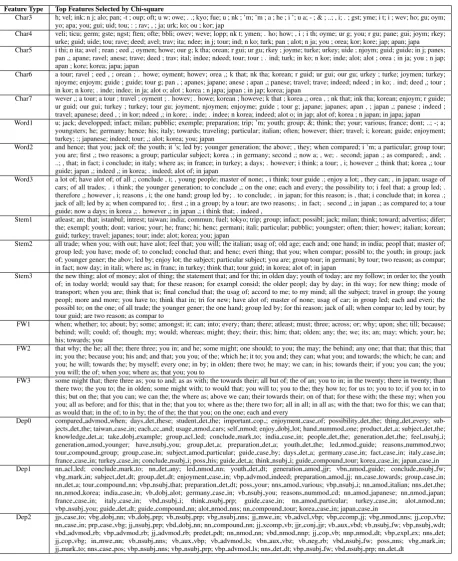
We also show the top features for each feature type ranked by Chi-square in Table4, in the hope that it would be helpful for researchers interested in SLA or at least provide some insights to the readers. We notice that among the wordn-grams are some country related words such as “italy” and “in japan”, as well as some common expressions such as “in order to” and “more and more”.
4.2 Final results
The Word Unigram baseline in Table2is achieved by using normalized frequency of all the word un-igrams (which occurred at least three times in the essays) as features, and linear SVM as the classi-fier.
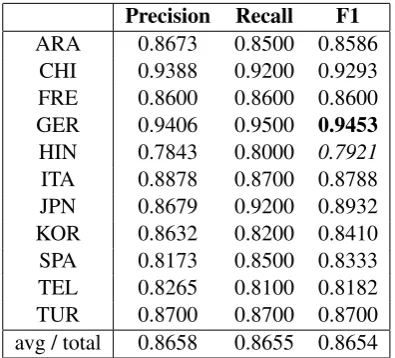
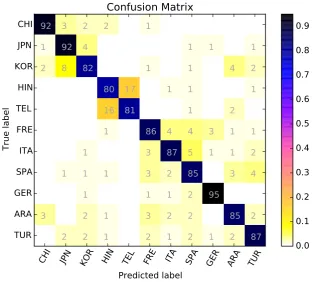
We try different methods of combining the out-put of probabilities by base classifiers and report their performance in Table 2. MLP and linear SVM are the best combiners among our exper-iments (other classifiers include random forest, LDA, logistic regression). When not using a clas-sifier, summing up the logarithmized probabilities achieves better results than summing up the prob-abilities directly. The detailed evaluation of our best performing system is shown in Table 3, and the confusion matrix is shown in Figure1.
From the confusion matrix we observe a few quite distinctive language groups: CHI, JPN, and KOR; HIN and TEL; FRE, ITA, and SPA. We suppose the confusion between languages results more from cultural than linguistic reasons. For instance, HIN and TEL are mutually misclassi-fied in a lot of cases, while HIN belongs to Indo-European language family and TEL belongs to Dravidian. Similarly, CHI, JPN, and KOR come from three different language families, but they are in a cluster where one is often misclassified as an-other.
System F1 (macro) Accuracy Random Baseline 0.0909 0.0909 Word Unigram 0.7104 0.7109
MLP 0.8654 0.8655
LinearSVM 0.8593 0.8591
LogSumProbs 0.8564 0.8565
SumProbs 0.8554 0.8555
[image:4.595.311.523.63.171.2]LDA 0.8446 0.8445
Table 2: Final results using different combining methods. Trained on Train and Dev, tested on Test.
Precision Recall F1 ARA 0.8673 0.8500 0.8586
CHI 0.9388 0.9200 0.9293 FRE 0.8600 0.8600 0.8600 GER 0.9406 0.9500 0.9453 HIN 0.7843 0.8000 0.7921
ITA 0.8878 0.8700 0.8788 JPN 0.8679 0.9200 0.8932 KOR 0.8632 0.8200 0.8410 SPA 0.8173 0.8500 0.8333 TEL 0.8265 0.8100 0.8182 TUR 0.8700 0.8700 0.8700 avg / total 0.8658 0.8655 0.8654 Table 3: Detailed evaluation of our best perform-ing system. Trained on Train and Dev, tested on Test. Best and worst F1 in bold and italics.
5 Discussion and future work
We explore the performance of different feature types for NLI in this work. Among the features types we examine, character/word/lemma/stemn -grams have the best individual performance. De-pendency parses are also informative with respect to the native language of the author. POS n -grams might be too general for this task, achieving around 50% accuracy alone. Word embeddings are good indicators for text classification tasks such as sentiment analysis, which relies heavily on the semantics of the content. NLI is not only about the semantics of the text but also involves writing style (e.g., the use of expressions and sen-tence structure). We suppose this justifies the per-formance of using word embeddings as features.
[image:4.595.318.516.220.399.2]CHI JPN KOR HIN TEL FRE ITA SPA GER ARA TUR
Predicted label
CHI
JPN
KOR
HIN
TEL
FRE
ITA
SPA
GER
ARA
TUR
True label
92 3 2 2
1
1 92 4
1 1
1
2 8 82
1
1
4 2
80 17
1 1
1
16 81
1
2
1
86 4 4 3 1 1
1
3 87 5 1 1 2
1 1 1
3 2 85
3 4
1
1 1 2 95
3
2 1
3 2 2
85 2
2 2 1
2 1 2 1 2 87
Confusion Matrix
[image:5.595.143.456.65.347.2]0.0
0.1
0.2
0.3
0.4
0.5
0.6
0.7
0.8
0.9
Figure 1: Confusion matrix of our best performing model.
with best individual performance, adding one and another. We do not include a feature type if it does not improve the accuracy on cross valida-tion, and thus we cannot guarantee the optimiza-tion of performance on the test data. This pro-cess is very time consuming, and we believe there should be a better way of doing so. At the same time we observe adding lemman-grams does not help, although lemman-grams achieve very high accuracy by themselves. We believe the reason is that lemman-grams are overlapping with wordn -grams a lot, so they do not contribute more to the final prediction. We should keep in mind that good classifiers for ensemble learning need both accu-racy and diversity. It remains unclear why func-tion words (with accuracy of around 40%-50%) help more than POSn-grams or word embeddings, though.
We notice MLP improves the system perfor-mance over linear SVM as a combiner. For an individual feature type, MLP also performs bet-ter than linear SVM in most cases; however, we choose linear SVM as the base classifier, since it has better balance between speed and accuracy. MLP is roughly ten times slower than linear SVM when we run the experiments. This points us to the use of neural networks, since MLP is one of
the simplest neural architecture. We would like to explore more about neural networks for NLI in fu-ture.
Another direction of future work may be to-wards a different architecture of combing various feature types. Ensemble methods have been stud-ied quite a lot in text classification tasks; however, building an ensemble classifier is hardly an end-to-end task. We would like to explore how we can make the system smarter and learn by itself with less human input.
Feature Type Top Features Selected by Chi-square
Char3 h; vel; ink; n j; alo; pan; -t ; oup; oft; u w; owe; . .; kyo; fue; u ; nk ; ’m; ’m ; a ; he ; i ’; u a; - ; & ; ..; , i; . ; gst; yme; i t; i ; wev; ho; gu; oym; yo; apa; you; gui; uid; tou; : ; rav; , ; ja; urk; ko; ou ; kor; jap
Char4 veli; ticu; germ; gste; ngst; ften; ofte; bbli; owev; weve; lopp; nk t; ymen; . ho; how; , i ; i th; oyme; ur g; you; r gu; pane; gui; joym; rkey; urke; guid; uide; tou; rave; deed; avel; trav; ita; ndee; in j; tour; ind; n ko; turk; pan ; alot; n ja; you ; orea; kor; kore; jap; apan; japa Char5 i thi; n ita; avel ; rean ; eed ,; oymen; howe; our g; k tha; orean; r gui; ur gu; rkey ; joyme; turke; urkey; uide ; njoym; guid; guide; in j; panes;
pan ,; apane; ravel; anese; trave; deed ; trav; ital; indee; ndeed; tour; tour ; . ind; turk; in ko; n kor; inde; alot; alot ; orea ; in ja; you ; n jap; apan ; kore; korea; japa; japan
Char6 a tour; ravel ; eed , ; orean ; . howe; oyment; howev; orea ,; k that; nk tha; korean; r guid; ur gui; our gu; urkey ; turke; joymen; turkey; njoyme; enjoym; guide ; guide; tour g; pan , ; apanes; japane; anese ; apan ,; panese; travel; trave; indeed; ndeed ; in ko; . ind; deed ,; tour ; in kor; n kore; . inde; indee; in ja; alot o; alot ; korea ; n japa; japan ; in jap; korea; japan
Char7 wever ,; a tour; a tour ; travel ; oyment ; . howev; . howe; korean ; howeve; k that ; korea ,; orea , ; nk that; ink tha; korean; enjoym; r guide; ur guid; our gui; turkey ; turkey; tour gu; joyment; njoymen; enjoyme; guide ; tour g; japane; japanes; apan , ; japan ,; panese ; indeed ; travel; apanese; deed , ; in kor; ndeed ,; in kore; . inde; . indee; n korea; indeed; alot o; in jap; alot of; korea ; n japan; in japa; japan Word1 u; jack; developped; infact; milan; pubblic; exemple; preparation; trip; ’m; youth; group; &; think; the; your; various; france; dont; ..; -; a;
youngsters; he; germany; hence; his; italy; towards; traveling; particular; italian; often; however; thier; travel; i; korean; guide; enjoyment; turkey; :; japanese; indeed; tour; ,; alot; korea; you; japan
Word2 and hence; that you; jack of; the youth; it ’s; led by; younger generation; the above; , they; when compared; i ’m; a particular; group tour; you are; first ,; two reasons; a group; particular subject; korea .; in germany; second ,; now a; , we; . second; japan .; as compared; , and; . ..; , that; in fact; i conclude; in italy; where as; in france; in turkey; a days; . however; i think; a tour; , i; however ,; think that; korea ,; tour guide; japan ,; indeed ,; in korea; . indeed; alot of; in japan
Word3 a lot of; have alot of; of all ,; conclude , i; , young people; master of none; , i think; tour guide .; enjoy a lot; , they can; , in japan; usage of cars; of all trades; . i think; the younger generation; to conclude ,; on the one; each and every; the possibility to; i feel that; a group led; . therefore ,; however , i; reasons , i; the one hand; group led by; . to conclude; . in japan; for this reason; is , that; i conclude that; in korea .; jack of all; led by a; when compared to; . first ,; in a group; by a tour; are two reasons; . in fact; . second ,; in japan .; as compared to; a tour guide; now a days; in korea ,; . however ,; in japan ,; i think that; . indeed ,
Stem1 atleast; an; that; istanbul; intrest; taiwan; india; commun; fuel; tokyo; trip; group; infact; possibl; jack; milan; think; toward; advertiss; difer; the; exempl; youth; dont; variou; your; he; franc; hi; henc; germani; itali; particular; pubblic; youngster; often; thier; howev; italian; korean; guid; turkey; travel; japanes; tour; inde; alot; korea; you; japan
Stem2 all trade; when you; with out; have alot; feel that; you will; the italian; usag of; old age; each and; one hand; in india; peopl that; master of; group led; you have; mode of; to conclud; conclud that; and henc; everi thing; that you; when compar; possibl to; the youth; in group; jack of; younger gener; the abov; led by; enjoy lot; the subject; particular subject; you are; group tour; in germani; by tour; two reason; as compar; in fact; now day; in itali; where as; in franc; in turkey; think that; tour guid; in korea; alot of; in japan
Stem3 the new thing; alot of money; alot of thing; the statement that; and for thi; in olden day; youth of today; are my follow; in order to; the youth of; in today world; would say that; for these reason; for exampl consid; the older peopl; day by day; in thi way; for new thing; mode of transport; when you are; think that is; final conclud that; the usag of; accord to me; to my mind; all the subject; travel in group; the young peopl; more and more; you have to; think that in; tri for new; have alot of; master of none; usag of car; in group led; each and everi; the possibl to; on the one; of all trade; the younger gener; the one hand; group led by; for thi reason; jack of all; when compar to; led by tour; by tour guid; are two reason; as compar to
FW1 when; whether; to; about; by; some; amongst; it; can; into; every; than; there; atleast; must; three; across; or; why; upon; she; till; because; behind; will; could; of; though; my; would; whereas; might; they; their; this; him; that; olden; any; the; we; its; an; may; which; your; he; his; towards; you
FW2 that why; the he; all the; there three; you in; and he; some might; one should; to you; the may; the behind; any one; that that; that this; that in; you the; because you; his and; and that; you you; of the; which he; it to; you and; they can; what you; and towards; the which; he can; and you; he will; towards the; by myself; every one; in by; in olden; there two; he may; we can; in his; towards their; if you; you can; the you; you will; the of; when you; where as; that you; you to
FW3 some might that; there three as; you to and; as as with; the towards their; all but of; the of an; you to in; in the twenty; there in twenty; than there two; the you to; the in olden; some might with; to would that; you will to; you to the; they how to; for us to; you to to; if you to; in to this; but on the; that you can; we can the; the where as; above we can; their towards their; on of that; for these with; the these my; when you you; all as before; and for this; that in the; that you to; where as the; there two for; all in all; in all as; with the that; two for this; we can that; as would that; in the of; to in by; the of the; the that you; on the one; each and every
Dep0 compared advmod when; days det these; student det the; important cop ; enjoyment case of; possibility det the; thing det every; sub-jects det the; taiwan case in; each cc and; usage nmod cars; self nmod; enjoy dobj lot; hand nummod one; product det a; subject det the; knowledge det a; take dobj example; group acl led; conclude mark to; india case in; people det the; generation det the; feel nsubj i; generation amod younger; have nsubj you; group det a; preparation det a; youth det the; led nmod guide; reasons nummod two; tour compound group; group case in; subject amod particular; guide case by; days det a; germany case in; fact case in; italy case in; france case in; turkey case in; conclude nsubj i; poss his; guide det a; think nsubj i; guide compound tour; korea case in; japan case in Dep1 nn acl led; conclude mark to; nn det any; led nmod nn; youth det dt; generation amod jjr; vbn nmod guide; conclude nsubj fw;
vbg mark in; subject det dt; group det dt; enjoyment case in; vbp advmod indeed; preparation amod jj; nn case towards; group case in; nn det a; tour compound nn; vbp nsubj that; preparation det dt; poss your; nns amod various; vbp nsubj i; nn amod italian; nns det the; nn nmod korea; india case in; vb dobj alot; germany case in; vb nsubj you; reasons nummod cd; nn amod japanese; nn nmod japan; france case in; italy case in; vbd nsubj i; think nsubj prp; guide case in; nn amod particular; turkey case in; alot nmod nn; vbp nsubj you; guide det dt; guide compound nn; alot nmod nns; nn compound tour; korea case in; japan case in
[image:6.595.74.533.123.685.2]Dep2 jjs case to; vbg dobj nn; vb dobj prp; vb nsubj prp; vbg nsubj nns; jj mwe in; vb advcl vbp; vbp ccomp jj; vbg nmod nns; jj cop vbz; nn case in; prp case vbg; jj nsubj prp; vbd dobj nn; nn compound nn; jj xcomp vb; jjr conj jjr; vb aux vbd; vb nsubj fw; vbp nsubj wdt; vbd advmod rb; vbp advmod rb; jj advmod rb; predet pdt; nn nmod nn; vbd nmod nnp; jj cop vb; nnp nmod dt; vbp expl ex; nns det; jj cop vbg; in mwe nn; vb nsubj nns; vb aux vbp; vb advmod ls; vbn aux vbz; vb neg rb; vbd nsubj fw; poss nns; vbg mark in; jj mark to; nns case pos; vbp nsubj nns; vbp nsubj prp; vbp advmod ls; nns det dt; vbp nsubj fw; vbd nsubj prp; nn det dt
References
Steven Bird. 2006. Nltk: the natural language toolkit.
In Proceedings of the COLING/ACL on
Interac-tive presentation sessions. Association for
Compu-tational Linguistics, pages 69–72.
Serhiy Bykh and Detmar Meurers. 2014. Exploring Syntactic Features for Native Language Identifica-tion: A Variationist Perspective on Feature Encod-ing and Ensemble Optimization. In Proceedings of COLING 2014, the 25th International Confer-ence on Computational Linguistics: Technical Pa-pers. Dublin, Ireland, pages 1962–1973.
Radu Tudor Ionescu, Marius Popescu, and Aoife Cahill. 2014. Can characters reveal your native lan-guage? A language-independent approach to native language identification. InProceedings of the 2014 Conference on Empirical Methods in Natural
Lan-guage Processing (EMNLP). Association for
Com-putational Linguistics.
Scott Jarvis, Yves Bestgen, and Steve Pepper. 2013. Maximizing Classification Accuracy in Native Lan-guage Identification. InProceedings of the Eighth Workshop on Innovative Use of NLP for Building
Educational Applications. Association for
Compu-tational Linguistics, Atlanta, Georgia, pages 111– 118.
Dan Klein and Christopher D Manning. 2003. Accu-rate unlexicalized parsing. In Proceedings of the 41st Annual Meeting on Association for
Computa-tional Linguistics-Volume 1. Association for
Com-putational Linguistics, pages 423–430.
Can Liu, Chun Guo, Daniel Dakota, Sridhar Ra-jagopalan, Wen Li, Sandra K¨ubler, and Ning Yu. 2014. “My curiosity was satisfied, but not in a good way”: Predicting user ratings for online recipes.
InProceedings of the Second Workshop on Natural
Language Processing for Social Media (SocialNLP).
Dublin, Ireland, pages 12–21.
Can Liu, Wen Li, Bradford Demarest, Yue Chen, Sara Couture, Daniel Dakota, Nikita Haduong, Noah Kaufman, Andrew Lamont, Manan Pancholi, Ken-neth Steimel, and Sandra K¨ubler. 2016. IUCL at SemEval-2016 Task 6: An Ensemble Model for Stance Detection in Twitter. In Proceedings of
SemEval-2016. San Diego, California, pages 394–
400.
Shervin Malmasi. 2016. Native Language
Identifica-tion: Explorations and Applications. Ph.D. thesis.
http://hdl.handle.net/1959.14/1110919.
Shervin Malmasi and Mark Dras. 2014. Language Transfer Hypotheses with Linear SVM Weights. In
2014 Conference on Empirical Methods in Natural
Language Processing (EMNLP). Doha, Qatar, pages
1385–1390.
Shervin Malmasi and Mark Dras. 2015. Multilingual Native Language Identification. In Natural
Lan-guage Engineering.
Shervin Malmasi and Mark Dras. 2017. Native Lan-guage Identification using Stacked Generalization.
arXiv preprint arXiv:1703.06541.
Shervin Malmasi, Keelan Evanini, Aoife Cahill, Joel Tetreault, Robert Pugh, Christopher Hamill, Diane Napolitano, and Yao Qian. 2017. A Report on the 2017 Native Language Identification Shared Task.
In Proceedings of the 12th Workshop on Building
Educational Applications Using NLP. Association
for Computational Linguistics, Copenhagen, Den-mark.
Shervin Malmasi, Marcos Zampieri, Nikola Ljubeˇsi´c, Preslav Nakov, Ahmed Ali, and J¨org Tiedemann. 2016. Discriminating between Similar Languages and Arabic Dialect Identification: A Report on the Third DSL Shared Task. InProceedings of the
Var-Dial Workshop. Osaka, Japan.
F. Pedregosa, G. Varoquaux, A. Gramfort, V. Michel, B. Thirion, O. Grisel, M. Blondel, P. Pretten-hofer, R. Weiss, V. Dubourg, J. Vanderplas, A. Pas-sos, D. Cournapeau, M. Brucher, M. Perrot, and E. Duchesnay. 2011. Scikit-learn: Machine learning in Python. Journal of Machine Learning Research
12:2825–2830.
Jeffrey Pennington, Richard Socher, and Christopher D Manning. 2014. Glove: Global vectors for word representation. InEMNLP. volume 14, pages 1532– 1543.
Radim ˇReh˚uˇrek and Petr Sojka. 2010. Software Frame-work for Topic Modelling with Large Corpora. In
Proceedings of the LREC 2010 Workshop on New
Challenges for NLP Frameworks. ELRA, Valletta,
Malta, pages 45–50. http://is.muni.cz/
publication/884893/en.
Bjrn Schuller, Stefan Steidl, Anton Batliner, Ju-lia Hirschberg, Judee K. Burgoon, Alice Baird, Aaron Elkins, Yue Zhang, Eduardo Coutinho, and Keelan Evanini. 2016. The INTER-SPEECH 2016 Computational Paralinguistics Challenge: Deception, Sincerity & Native Lan-guage. In Interspeech 2016. pages 2001–2005.
https://doi.org/10.21437/Interspeech.2016-129.
Joel Tetreault, Daniel Blanchard, and Aoife Cahill. 2013. A Report on the First Native Language Iden-tification Shared Task. InProceedings of the Eighth Workshop on Building Educational Applications
Us-ing NLP. Association for Computational
Linguis-tics, Atlanta, GA, USA.
Kristina Toutanova, Dan Klein, Christopher D Man-ning, and Yoram Singer. 2003. Feature-rich part-of-speech tagging with a cyclic dependency network.
InProceedings of the 2003 Conference of the North
American Chapter of the Association for Computa-tional Linguistics on Human Language
Technology-Volume 1. Association for Computational
Marcos Zampieri, Shervin Malmasi, Nikola Ljubeˇsi´c, Preslav Nakov, Ahmed Ali, J¨org Tiedemann, Yves Scherrer, and No¨emi Aepli. 2017. Findings of the VarDial Evaluation Campaign 2017. InProceedings of the Fourth Workshop on NLP for Similar
Lan-guages, Varieties and Dialects (VarDial). Valencia,