Topic Model Stability for Hierarchical Summarization
John E. Miller and Kathleen F. McCoy Computer & Information Sciences University of Delaware, Newark, DE 19711
[email protected],[email protected]
Abstract
We envisioned responsive generic hierar-chical text summarization with summaries organized by topic and paragraph based on hierarchical structure topic models. But we had to be sure that topic models were stable for the sampled corpora. To that end we developed a methodology for aligning multiple hierarchical structure topic mod-els run over the same corpus under simi-lar conditions, calculating a representative centroid model, and reporting stability of the centroid model. We ran stability exper-iments for standard corpora and a develop-ment corpus of Global Warming articles. We found flatand hierarchicalstructures of two levels plus the root offer stable cen-troid models, buthierarchicalstructures of three levels plus the root didn’t seem stable enough for use in hierarchical summariza-tion.
1 Introduction
We envisioned a responsive generic hierarchical text summarization process for complex subjects and multiple page documents with resulting text summaries organized by topic and paragraph. In-formation extraction and summary construction would be based on hierarchical structure topic models learned in the analysis phase.1The hierar-chicaltopic structure would provide the organiza-tion as well as the informaorganiza-tion quantity budget and extraction criteria for sections and paragraphs in hierarchical summarization. Initial attempts along this path offered promise for a more coherent and organized summary for a small corpus of Global
1Phases are the somewhat standard: corpus preparation, analysis, information extraction, summary construction.
Warming articles from (Live Science, 2015) ver-sus that obtained byflattopic structures.
However, multiple analyses of the same Global Warming corpus and various standard corpora un-der similar conditions renun-dered seemingly differ-ent hierarchical topic models. Model differences remained even after transforming and reducing models based on required summary size and other extrinsic summary requirements. So we decided to examine topic model stability with the goal of assuring that stable, representative, and credible topic models would be produced in our analysis phase. This paper documents our effort at assuring hierarchical topic model stability for hierarchical summarization.
It is inherent in Bayesian probabilistic topic modeling and similar methods that repeat analyses of the same corpus under the same conditions give different results. But we must have substantially similar results to do credible hierarchical summa-rization (or other application). We require topic model stability, i.e., similar topic models for anal-yses performed under similar conditions. Without stable results, we do not know which analyses to believe, if any, and we mistrust the methodology itself. Furthermore, any application of the result-ing topic model is not credible.
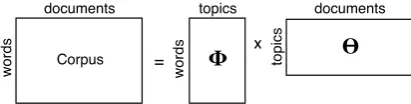
Organization of Paper Bayesian probabilisitic topic analysis (§2.1) expresses a corpus as the ma-trix product of topic compositions of words with document mixtures of topics. Inflattopic analy-sis, the matrix of topic-word compositions is orga-nized as a flat vector of individual topics. With hi-erarchicalstructure topic analysis, the topics take on a hierarchical tree structure.
Topic model quality (§2.2) is typically assessed by predictive likelihood of words for a test corpus or by assessment of topic coherence. Our stabil-ity assessment methodology seems largely
plementary to quality assessment.
The Hungarian assignment algorithm (Kuhn, 1955) has been used for aligningflattopic model pairs (§2.3), based on a cost matrix of pairwise topic alignments. We will use a pairwise topic similarity measure for populating the Hungarian algorithm’s cost matrix.
Topic models, including hierarchical models, are being used to construct text summaries (§2.4), including hierarchical text summaries. This pro-vides sufficient reason to want to assure the stabil-ity offlatandhierarchicalstructure topic models. We introduce the particularflatandhierarchical structure topic models (§3.1) used for this paper.
In a simple yet significant innovation, we ex-tend topic alignment (§3.2) to hierarchical struc-ture topic model pairs via a recursive application of the Hungarian assignment algorithm starting with root topics of the model pair. Surprisingly, we find time complexity of thehierarchicaltopic structure improves versus flat structure with in-creasing level of the hierarchy.2
We measure stability (§3.3) as alignment (pro-portion of aligned topics), similarity (weighted co-sine similarity over topic compositions), and di-vergence (Jensen-Shannon didi-vergence over topic distributions). Measures are defined for flat and then extended tohierarchicalstructure topic mod-els.
The more topic models in the study, the more credible the stability analysis, since we are align-ing more models and measuralign-ing stability based on more analyses. For complex problems, however, more models also makes it more likely we would encounter alternative topic models, just as human topic modelers might. We perform agglomerative clustering on topic model similarity (§3.4) to test whether models form a single or multiple stable topic model groups, or are unstable.
For each cluster, we align models and calculate topic frequency weighted centroids (§3.5) of topic-word compositions for aligned topics. Then we as-sess stability versus the centroid model (§3.6) sim-ilarly to that done previously for model pairs.
We demonstrate the methodology (§4) overflat andhierarchicalstructure models in an 18 run fac-torial experiment on three corpora, and in a sepa-ratead hoc16 run experiment on a larger corpus.
We return to our work on hierarchical
summa-2Software engineering already knows this – that hierar-chical structure is less time complex than monolithic.
rization (§5) now armed with stable hierarchical topic models and examine our next steps as well as options for further research.
2 Previous Work
We use Bayesian probabilistic topic modeling in the analysis phase of our hierarchical summariza-tion process. Here we briefly review topic model-ing, topic model quality, topic model stability, and use of topic models in hierarchical summarization.
2.1 Topic Models
The Latent Dirichlet analysis (LDA) Bayesian probabilistic topic model, introduced and popular-ized by Blei et al.(2003); Griffiths and Steyvers (2004), factors a corpus of document-word occur-rences as the matrix product of topic compositions of words and document mixtures of topics (figure 1). The topic structure isflat and the number of topics,K, and vocabulary size,V, are fixed. In the generative probabilistic model, topic-word com-positions are distributed symmetric Dirichlet with parameterη, and document-topic mixtures are dis-tributed Dirichlet with concentration parameterα.
Corpus
w
o
rd
s
documents
w
o
rd
s
topics documents
to
p
ics
=
x 𝚹
[image:2.595.312.518.408.460.2]𝚽
Figure 1: Topic Model Factorization of Corpus
Teh et al. (2005, 2006) generalized the LDA model in two important ways: (1) the number of topics,K, is made open ended by treating the topic model as a Dirichlet process (DP) with growth parameter γ for sampling a new topic, and (2) documents are sampled from Dirichlet processes (DPs) which are themselves sampled from corpus DPs thus forming hierarchical Dirichlet processes, HDPs, even while the topic structure remainsflat. Blei et al. (2010) developedhierarchical topic analysis where the generative model of the cor-pus consists of a hierarchy of nested Dirichlet pro-cesses (DPs) and each document is generated as a single non-branching path down the corpus hier-archical structure. Stay-or-gostochastic switches are used at each document node to determine whether tostayon the current topic orgoto a topic further down the tree.
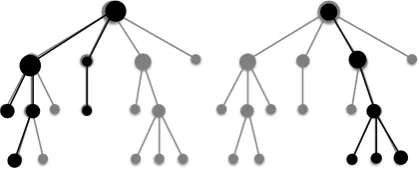
Dirichlet process model with branching in both the document and global models. In figure2, the grey represents the corpus tree and the black overlaid trees the individual document trees. Each docu-ment parent node is a DP sampled from its corre-sponding corpus node DP. Analysis infers the cor-pus topic structure and compositions, and docu-ment topic mixtures andstay-or-goswitches.
Figure 2: Hierarchical Corpus Structure
2.2 Quality
Predictive log likelihood for words, test LL(x), is a popular measure of topic analysis quality. Test LL(x) shows the predictability of words on test data given the model fit to training data (corpus topics and compositions). While not a stability measure, test LL(x) does give an objective indi-cation of predictability. Teh et al. (2007) pro-vides formulas for calculating test LL(x) for the flattopic structure in both Gibbs sampler and vari-ational inference analysis methods.
Assessing quality of individual topics can be as simple as noting topics below a minimum fre-quency or comparing divergence of topics from any of uniform, corpus, or power distributions of word frequencies. More powerful methods assess individual and aggregate topic coherence. The current standard is to measure coherence by normalized pairwise mutual information (NPMI) (Aletras and Stevenson, 2013; Lau et al., 2014; R¨oder et al., 2015) versus pairwise probabilities calculated from some very large pertinent corpus.
We view test likelihood and topic coherence as largely complementary to topic model stability.
2.3 Topic Alignment and Stability
Topic models must be aligned on topics before as-sessing stability. de Wall and Barnard(2008) cal-culates similarity weights between topics from dif-ferent models over documents, constructs a cost matrix from negative similarity weights, and ap-plies the Hungarian assignment algorithm (Kuhn, 1955) to determine the optimal pairwise topic
model alignment. Stability is defined as the cor-relation between aligned topics over documents.
Greene et al. (2014) calculates the average of Jaccard scores on sets of popular word ranks be-tween topic combinations of a topic model pair, and determines the model agreement (i.e., stabil-ity) as the average over topics of Jaccard scores resulting from the optimal topic alignment by the Hungarian assignment algorithm.
Chuang et al.(2015) notes that model alignment is “ill-defined and computationally intractable” with multiple-to-multiple mappings between top-ics, and adopts the solution of mapping topics up-to-onetopic.3
Yang et al. (2016) aligns topics for flat topic structures also using the Hungarian assignment al-gorithm andup-to-onetopic correspondence. Sta-bility is measured as agreement between token topic assignments over aligned topic models.
We use the Hungarian algorithm and the up-to-one topic correspondence. We choose to em-phasize topic correspondence based on topic word compositions, as in the generative model, and so base our cost matrix on similarity of topic word compositions between models.
2.4 Topic Model Based Summarization
Haghighi and Vanderwende(2009) examined sev-eral hybrid topic models using LDA as a build-ing block and demonstrated the superior efficacy of their hybrid model (general topic, general con-tent topic, detail concon-tent topics, and document specific topics) in constructing short summaries for Document Understanding Conferences (U.S. Department of Commerce: National Institute of Standards and Technology,2015). Delort and Al-fonseca(2011);Mason and Charniak(2011) used similar models in short summaries for the Text Analysis Conferences (of Commerce: National In-stitute of Standards and Technology,2010,2011). Celikyilmaz and Hakkani-Tur(2010,2011) used a more generalhierarchicalLDA topic model struc-ture, doinghierarchicalsummarization for longer summaries. Christensen et al. (2014) developed “hierarchical summarization” using temporal hier-archical clustering and budgeting summary com-ponent size by cluster.
We use a more general hierarchical structured Bayesian topic model similar to Paisley et al.
(2015). Essential for any of these related hierar-chical topic model or cluster based methods is the stability of the model used to drive summarization.
3 Methodology
We present a process for aligning topic models and measuring topic model stability for both flat and hierarchicalstructure cases. The resulting stable hierarchical structure topic centroid model would be further transformed to take into account extrin-sic summarization requirements.
Stability – Measurement Process
1. Infer multiple topic models for the same cor-pus run under similar conditions.
2. Determine pairwise topic model alignments.
3. Calculate stability over pairs.
4. Cluster topic models using agglomerative clustering over pairwise stability.
5. For each cluster:
(a) Align member topic models and calcu-late topic model centroids.
(b) Align member topic models with topic centroid model.
(c) Calculate stability of topic models with topic centroid model.
6. Interpret stability results.
3.1 Topic Modeling
For a flat topic structure, we use a Gibbs sam-pler implementation of Teh et al. (2006) hierar-chical Dirichlet processes (HDP). For a hierarchi-caltopic structure, we use a Gibbs sampler imple-mentation of a simplified version ofPaisley et al. (2015)’s nested hierarchical Dirichlet processes. Our simplified model and Gibbs sampler drops the use ofstay-or-gostochastic switches at each doc-ument Dirichlet process (DP) node. See supple-mental notes (Supplemental,2017b).
3.2 Pairwise Topic Model Alignment
From a set ofM topic models, allM(M −1)/2 model pairs are aligned based on topic pair assign-ment costs. Assignassign-ment cost between topics from distinct model pairs is calculated as
costk,l =−(mk/N)(nl/N)∗cosSim(mk,nl),
where(k, l)indexes topics from model pairs,mk and nl are topic frequencies, N is corpus size, mk and nl are vectors of word frequencies for topic pair (k, l), and cosSim calculates the co-sine similarity.4 By using topic frequency ratios in the cost, similar frequency topics are preferred. Since weak similarities are not useful, we censor cosSim≤.25and substitute zero for their cost.
FlatTopic Models Pairwise costs are assembled into a cost matrix indexed by(k, l)and the optimal cost assignment of the model pair is determined by the Hungarian assignment algorithm. For un-equal numbers of topics, vectors of zero (maxi-mum) costs are substituted for nonexistent topics.
Hierarchical Topic Models Hierarchical topic structures are single rooted branching trees of depth L where the root is depth 0. Each tree node includes a topic of word compositions, and each non-leaf tree node includes a Dirichlet pro-cess (DP) of topic mixtures. We restrict hierarchi-cal topic structure alignment to require: (1) roots must align, and (2) aligned child branches must align in their ancestors. With these restrictions, we developed Minimize Subtree Cost (algorithm 1) applying the Hungarian algorithm to DP (non-leaf) nodes of the hierarchical topic structure.
MethodminimizeSubtreeCostis invoked ini-tially for model pair roots,(σ0, τ0)and recursively
thereafter for subtree pairs, (σ, τ). If either sub-tree is a leaf the topic alignment cost is returned. For internal nodes, a cost matrix is constructed be-tween the child nodes for the subtrees, the Hun-garian assignment algorithm is invoked to get the optimum cost alignment for the subtrees, the topic cost is added to the subtree costs, and this result is returned. Filling the subtree cost matrix calcu-lates the cost of aligning properties between model pairs of subtree children by minimizing subtree costs for each child pair. Thus calculating subtree costs and filling subtree costs togetherrecursively
span the entire solution space for hierarchical topic alignment. See supplemental java snippets ( Sup-plemental,2017a).
Time Complexity Forflattopic structures, topic alignment time complexity is O(K2(V + K)),
Algorithm 1Minimize Subtree Cost
Require: Treesσ, τ
*Method: minimizeSubtreeCost(σ, τ)*
ifisLeaf(σ)orisLeaf(τ)then return topicCost(σ, τ)
else
costs←fillSubtreeCosts(σ, τ)
return topicCost(σ, τ)
+HungarianAssignment(costs)
end if
*Method: fillSubtreeCosts(σ, τ)*
fork= 0toσ.children.sizedo forl= 0toτ.children.sizedo
costs[k, l]←minimizeSubtreeCost (σ.children[k],τ.children[l])
end for end for return costs
V words giving O(K2V), and the Hungarian
assignment algorithm which minimizes cost has time complexityO(K3)(Kuhn,1955).
Level 1 in the hierarchical structure is simi-lar to theflat topic structure. Time complexity is O(B2(V+B)), with branching factor,B, in place
of number of topics, K. Each increment in level increases by a factor ofB2the tree node pairs from
the parent level. The resulting time complexity for levellbeyond the root is thenO(B2l(V+B)). For B >1the final level dominates the order calcula-tion, and so the time complexity for ahierarchical structure of depthLisO(B2L(V +B)).
We compare this with the time complexity for the flat structure alignment problem by express-ing K as though from a flattened hierarchical structure, K = (1 −BL+1)/(1−B).5 Then, O(K2(V+K)) =O([(1−BL+1)/(1−B)]2(V+
[(1−BL+1)/(1−B)])). For B > 1the terms
with B in the ratio dominate, and so expressing flatstructure inhierarchicalterms gives time com-plexityO(B2L(V +BL)). Cost of assignment for flatis greater by a factor ofBL−1versus a
compa-rablehierarchicalstructure.
This is a surprising result! We had expected hi-erarchical structure to add time complexity, but in-stead it reduces time complexity with increasing level compared to a corresponding flat structure. Alignment of topics between hierarchical
struc-5Sum of geometric series,PL
l=0Bl, for a branching tree.
tures is less time complex than forflatstructures.
3.3 Pairwise Stability
Given the topic model alignment, we calculate alignment, similarity, and divergence measures. Table1givesa prioriand preliminary calibration study interpretations of the stability measures.
Proportion Aligned Alignment is calculated as, pAlign = K0/[(K
σ +Kτ)/2], where K0 is the number of aligned topics, andKσ andKτ are the number of topics for each model.
Weighted Similarity Similarity is calculated as topic frequency weighted similarity of the topic word compositions of the(σ, τ)model pair,6
wtSimσ,τ =
X
(k,l)∈ aligned
mk+nl
2N cosSim(mk,nl),
where(k, l)indexes topics from theflator hierar-chicallyaligned model pair, mk andnl are topic frequencies,N is the corpus size,mkandnl are vectors of word frequencies for topic pair (k, l), andcosSimcalculates the cosine similarity. Only aligned topics are added to the wtSim, but the corpus size includes all observations, so the fewer aligned topics, the lower the weighted similarity. For thehierarchicalmodel we require that ances-tors are also aligned.
Divergence Divergence is calculated as the Jensen-Shannon divergence (JSD) between topic frequency distributions for model pairs. Distribu-tions are calculated as follows: (1) modelσ topic frequency counts are assembled in arraysby topic indexk, (2) frequencies of unaligned topics from σ are set to zero with the sum of frequencies of unaligned topics set insK where K is the maxi-mum number of topics for the(σ, τ) model pair, (3) modelτ topic frequency counts are assembled in arraytby topic indexl, (4) frequencies of un-aligned topics fromτ are set to zero with the sum of frequencies of unaligned topics set intK+1, and
(5) topic frequencies intare reordered according to the alignment mapping between(σ, τ). Thus, aligned topics coincide with respect to their po-sitions ins,t and unaligned frequencies are kept separate between models. Divergence is calcu-lated as
JSD(s||t) = 1/2(KLD(s||m) +KLD(t||m)),
Basis Value Interpretation
a priori alignment= 1 full alignment calibration alignment≈0.6 useful alignment a priori similarity= 1 full similarity calibration similarity≈0.6 useful similarity calibration similarity≈0.25 marginal similarity a priori divergence= 0 full convergence calibration divergence≈0.1 strong convergence calibration divergence≈0.4 strong divergence
Table 1: Preliminary interpretation of stability
wherem= (s+t)/2andKLDis the Kullback-Leibler divergence. For thehierarchicalmodel we require that ancestors are also aligned.
3.4 Cluster Topic Models
There are multiple ways in which topics can be organized and assigned - whether performed auto-matically or by human experts. So we test whether model pairs align to a single stable model group, or if multiple stable groups can be identified.
We use group-average agglomerative clustering (Manning et al.,2008) on pairwise weighted simi-larity,wtSim, to form model clusters. This results in compact clusters maximizing separation tween clusters while minimizing the distance be-tween the cluster centroid and its members. Clus-tering begins with each model forming its own cluster and ends when either all models form a single cluster or no more clusters can be formed that meetwtSim > cutP oint, wherewtSimis the average weighted similarity. Output is a list of clusters where each cluster includes a list of mod-els ordered by entry into the cluster andwtSim.
Agglomerative clustering is fast and simple; pairwise similarity scores do not have to be recal-culated after each clustering step. However, we don’t know what are the similarities or differences between clusters without inspecting them.
3.5 Form Topic Centroid Models
With only one cluster, no unclustered models, and good similarity, the models seem stable. We form topic centroids and report this centroid model as the representative topic model. With multiple clusters, we should consider the appropriateness of multiple solutions – perhaps corresponding to multiple human solutions. We form centroids for each topic and report centroid models as represen-tative of the clusters. The occurrence of many un-clustered models would indicate instability.
Controls specify a censor limit for similarity be-low which topics do not merge into a centroid,
and a minimum number of models and minimum topic frequency below which topics drop from the centroid topic model. While a cluster may have several models, not all topics need not be aligned across all models.
Form Topic Centroid Model (algorithm 2) forms cluster centroid models by copying the cluster centroid from the initial model and then aligning and entering individual models into the centroid iteratively based on their or-der of entry into the cluster. The method optimizeSubtreeMap, a variation on the pre-vious minimizeSubtreeCost(algorithm 1), returns the topic correspondence mapping. Topics which do not meet the topic similarity censor limit (wtSim < .25) are not aligned. Unaligned top-ics are provisionally added to the centroid model in case subsequent models in the list have similar topics. After the centroid model is formed, top-ics which to not meet a minimum topic frequency limit or minimum number of topic models limit are dropped.
Algorithm 2Form Topic Centroid Model
Require: Cluster list of treesλ *Method: formCentroidModel(λ)* µ←λ0
fori= 1toλ.sizedo
mapping←optimizeSubtreeMap(µ, λi) for alltopic∈λido
iftopic∈mappingthen
index←mapping.indexOf(topic) aggregateTopic(µ, λi, index, topic) else
addTopic(µ, λi, topic) end if
end for end for
for alltopic∈µdo
iffailsDropLimits(topic)then
drop(µ, topic)
end if end for
3.6 Centroid Model Stability
3.7 Use in Hierarchical Summarization
The final product is a single stable centroid model, when one exists. The stable centroid model shows the topic structure, the proportional importance of each topic, and the word composition of each topic as a discrete probability distribution. In our hierar-chical summarization process, this centroid model would be further transformed (nested, pruned, ag-gregated) by taking into account extrinsic require-ments of summary size, and paragraph and sub-paragraph structure. The resulting topic structure model would be used to extract information pro-portionally for each topic, and organize the section and paragraph structured summary.
If the centroid model is not stable, then hier-archical summarization would not be credible. If there are multiple identifiable stable clusters, then their centroid models become candidates for orga-nizing the hierarchical summary.
4 Stability Experiments
The purpose of the stability experiments is to demonstrate the methodology over corpora forflat andhierarchicalstructures. When stable centroid models result from replicate topic analyses, they can credibly be transformed to take into account extrinsic summarization requirements, and carried forward to the information extraction phase of our hierarchical summarization process.
4.1 Corpora
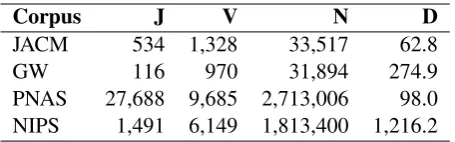
Corpora used in this study are Journal of the ACM (JACM) abstracts from years 1987-2000, Global Warming (GW) articles for the year 2015 (Live Science,2015), Proceedings of the National Academy of Sciences (PNAS) abstracts for years 1991-2001 (Ponweiser et al., 2015), Neural In-formation Processing Systems (NIPS) proceed-ings for years 1988-1999 from (Lichman, 2013). PNAS and GW texts were lemmatized. Stop words and words with frequency less than ten were removed. JACM and GW are small cor-pora; JACM has very small abstracts while GW has short articles; PNAS has numerous abstracts and NIPS has longer articles.
4.2 Experimental Design
An 18 run factorial design (3 corpora x 3 levels x 2 growth rates) crosses JACM, GW, and PNAS corpora, with flat(L=0) andhierarchical(L=2,3) topic structures, and topicgrowthrates to achieve
Corpus J V N D
JACM 534 1,328 33,517 62.8
GW 116 970 31,894 274.9
[image:7.595.307.535.62.133.2]PNAS 27,688 9,685 2,713,006 98.0 NIPS 1,491 6,149 1,813,400 1,216.2
Table 2: Corpora Characteristics.
J=document count, V=vocabulary size, N=corpus size, D=average document size.
two different topic count ranges. Four replicate topic analyses were run at each factorial setting. For training, our simplified Gibbs sampler used α=1.0 andη=0.01 with optimization. The growth parameterγ was set to create topic counts at low (L), medium (M), and high (H) ranges.
Separately, an ad hoc experiment was per-formed on a set of 16 trials on the NIPS corpus with hierarchical (L=3) model using similar train-ing control setttrain-ings. This experiment demonstrates the occurrence of multiple clusters.
4.3 Results - Factorial Design
Stability analysis was performed for each exper-imental group of replicates. Topics were not aligned whenwtSim < .25, clustering terminated when when avgW tSim < cutP oint = .5,7 and topics were dropped from the cluster centroid model whennModelk<2.
Table 3 shows the results for the factorial de-sign with corpus, hierarchical topic structure (L), and growth rate (γ). Results reported are num-ber of topics in training model (K), and stabil-ity measures of number (K’) and proportion of topics aligned (pAlign) in centroid model, aver-age weighted similarity (wtSim), and hierarchi-cal Jensen-Shannon divergence (hJSD). Ideal re-sults based ona priorivalues (table 1) would be pAlign≈1,wtSim≈1,hJSD≈0.
We expected simpler would be more stable (Ockham’s razor), such that more levels and top-ics give poorer stability. This is largely confirmed by stability measures in that greater hierarchy lev-els and greater topic count modlev-els generally had poorer stability measures. Hierarchical L=3 mod-els and with the JACM corpus especially showed poorer stability.
Model Train Stability
L γ K K’ pAlign wtSim hJSD
JACM
0 M 70.3 70.5 1.00 0.867 0.028
2 M 78.0 66.0 0.85 0.839 0.052
3 M 84.8 48.2 0.57 0.682 0.128
0 H 106.8 106.8 1.00 0.851 0.034
2 H 104.5 87.2 0.83 0.831 0.062
3 H 108.5 46.7 0.43 0.700 0.157
GW
0 M 65.8 65.8 1.00 0.869 0.030
2 M 73.8 72.0 0.98 0.894 0.028
3 M 82.3 59.8 0.73 0.762 0.100
0 H 99.0 98.2 0.99 0.871 0.023
2 H 108.0 89.8 0.83 0.824 0.081
3 H 105.8 62.8 0.59 0.726 0.133
PNAS
0 L 86.8 86.5 0.99 0.930 0.013
2 L 76.8 72.3 0.94 0.905 0.052
3 L 76.3 58.8 0.77 0.732 0.137
0 M 135.0 134.0 0.99 0.920 0.017 2 M 140.3 122.5 0.87 0.875 0.071
[image:8.595.72.292.61.379.2]3 M 134.3 92.2 0.69 0.752 0.143
Table 3: Experimental results - stability.
4.4 Results -Ad hocDesign - NIPS
We analyzed a set of 16 trials on the NIPS corpus run under somewhat similar conditions with topic counts in the 90 to 200 range with hierarchical L=3. Given the corpus size, non-equality of con-ditions, and diversity of topic counts, we weren’t surprised to find multiple distinct clusters.
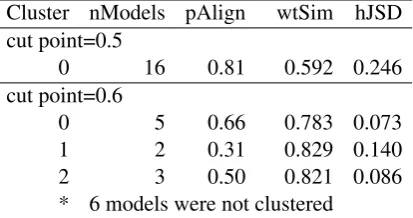
Stability analysis was performed with control settings: topics not aligned for wtSim < .25, clustering terminated forwtSim < cutP oint = .5or.6, and topics dropped from the cluster cen-troid model for nModelk < 2. Results are re-ported in table4. AtcutP oint = 0.5, all models formed one cluster; atcutP oint= 0.6, three sep-arate clusters were identified and six models were not joined to any cluster. Proportion of aligned topics declined (nModelk <2is a more stringent test when there are only 2 or 3 models in the clus-ter), but similarity and divergence measures were substantially improved for each of the three sepa-rate clusters.
4.5 Impact on Hierarchical Summarization
For corpora in the factorial design, both flat and hierarchal L=2 topic structures resulted in good
Cluster nModels pAlign wtSim hJSD cut point=0.5
0 16 0.81 0.592 0.246
cut point=0.6
0 5 0.66 0.783 0.073
1 2 0.31 0.829 0.140
2 3 0.50 0.821 0.086
[image:8.595.314.521.63.172.2]* 6 models were not clustered
Table 4: Ad hocstability experiment on NIPS.
stability (high alignment and similarity with little divergence), so the centroid topic model can cred-ibly be carried forward for use in our hierarchi-cal summarization process. The hierarchihierarchi-cal L=3 models are generally less stable.
The NIPS stability analysis for a single cluster shows moderate similarity of models and moder-ate divergence of topic distributions, while more restrictive clustering reveals three separate clusters and six unassigned models. This bears further in-vestigation.
5 Discussion We have:
• placed modeling hierarchical topic structure in the analysis phase of our hierarchical text summarization process;
• established the importance of a stable topic model for use in the analysis phase;
• developed a methodology for aligning and measuring stability of topic models;
• defined innovative and simple hierarchical topic structure model alignment via a recur-sive algorithm applying the Hungarian algo-rithm to individual Dirichlet processes; • quantified time complexity of our
hierarchi-cal alignment algorithm and showed reduced time complexity at increasing hierarchical level versusflattopic structures;
• developed alignment, similarity, and diver-gence stability measures for hierarchical topic structures;
• applied agglomerative clustering to form co-herent groups of topic models:
– calculated centroid model stability;
• demonstrated the methodology, finding cred-ible models for flat and hierarchical L=2 structures;
• demonstrated the methodology on a large set ofhierarchicalL=3 topic models run on the NIPS corpus, finding multiple coherent clus-ters plus unclustered models;
• mentioned parenthetically work on a pilot calibration study for stability measures;
Future Work There is work to be done on topic model stability, model alignment, and stability measurement:
• apply our methodology to larger, more varied models and different inference methods;
• improve, expand, and publish calibration studies beyond our pilot;
• explore other topic model alignment cost measures;
• further improve topic alignment including options other thanup-to-onematching;
• improve hierarchical structure topic model stability.
Summarization - Next Step We further trans-form the hierarchical topic structure taking into ac-count extrinsic summarization requirements. The product from the analysis phase is a hierarchi-cal structure topic model where each topic in-cludes its proportional representation of the cor-pus and a composition of words given as a dis-crete probability distribution. This structure is used in information extraction, where topic com-positions match information from the corpus, e.g., sentences, and proportional representation budgets the quantity of information to be extracted for each topic. The transformed topic structure organizes summary topic and paragraph structure.
Conclusion Our topic model stability methodol-ogy lets us diagnose and compute “usable” hierar-chical topic models for collections of long docu-ments. This is an essential and “attractive starting point towards hierarchical text summarization.”8
8Thanks to reviewer for this concise statement of benefit.
References
Nikolaos Aletras and Mark Stevenson. 2013. Eval-uating topic coherence using distributional seman-tics. InProceedings of the 10th International Con-ference on Computational Semantics (IWCS 2013) – Long Papers, pages 13–22. Association for Compu-tational Linguistics.
David M. Blei, Thomas L. Griffiths, and Michael I. Jor-dan. 2010. The nested chinese restaurant process and bayesian nonparametric inference of topic hier-archies. J. ACM, 57(2):7:1–7:30.
David M. Blei, Andrew Y. Ng, and Michael I. Jordan. 2003. Latent dirichlet allocation. J. Mach. Learn. Res., 3:993–1022.
Asli Celikyilmaz and Dilek Hakkani-Tur. 2010. A hy-brid hierarchical model for multi-document summa-rization. InProceedings of the 48th Annual Meeting of the Association for Computational Linguistics, ACL ’10, pages 815–824, Stroudsburg, PA, USA. Association for Computational Linguistics.
Asli Celikyilmaz and Dilek Hakkani-Tur. 2011. Dis-covery of topically coherent sentences for extrac-tive summarization. InProceedings of the 49th An-nual Meeting of the Association for Computational Linguistics: Human Language Technologies, pages 491–499, Portland, Oregon, USA. Association for Computational Linguistics.
Janara Christensen, Stephen Soderland, Gagan Bansal, and Mausam. 2014. Hierarchical summarization: Scaling up multi-document summarization. In Pro-ceedings of the 52nd Annual Meeting of the Associ-ation for ComputAssoci-ational Linguistics. Association for Computational Linguistics.
Jason Chuang, Margaret E Roberts, Brandon M Stew-art, Rebecca Weiss, Dustin Tingley, Justin Grim-mer, and Jeffrey Heer. 2015. Topiccheck: Interac-tive alignment for assessing topic model stability. In Proceedings of NAACL-HLT, pages 175–184.
Jean-Yves Delort and Enrique Alfonseca. 2011. De-scription of the google update summarizer at TAC-2011. In Proceedings of the Fourth Text Analy-sis Conference, TAC 2011, Gaithersburg, Maryland, USA, November 14-15, 2011. NIST.
Derek Greene, Derek O’Callaghan, and Padraig Cun-ningham. 2014. How many topics? stability analysis for topic models. In Machine Learning and Knowledge Discovery in Databases - European Conference, ECML PKDD 2014, Nancy, France, September 15-19, 2014. Proceedings, Part I, volume 8724 ofLecture Notes in Computer Science, pages 498–513. Springer Berlin Heidelberg.
Aria Haghighi and Lucy Vanderwende. 2009. Explor-ing content models for multi-document summariza-tion. In Proceedings of Human Language Tech-nologies: The 2009 Annual Conference of the North American Chapter of the Association for Compu-tational Linguistics, NAACL ’09, pages 362–370, Stroudsburg, PA, USA. Association for Computa-tional Linguistics.
Harold W. Kuhn. 1955. The hungarian method for the assignment problem. Naval Research Logistics Quarterly, 2:83–97.
Jey Han Lau, David Newman, and Timothy Baldwin. 2014. Machine reading tea leaves: Automatically evaluating topic coherence and topic model quality. InProceedings of the 14th Conference of the Euro-pean Chapter of the Association for Computational Linguistics, EACL 2014, April 26-30, 2014, Gothen-burg, Sweden, pages 530–539.
M. Lichman. 2013.UCI machine learning repository. Live Science. 2015. Live Science. Online at
live-science.com.
Christopher D. Manning, Prabhakar Raghavan, and Hinrich Sch¨utze. 2008. Introduction to Information Retrieval. Cambridge University Press, Cambridge, UK.
Rebecca Mason and Eugene Charniak. 2011. Ex-tractive multi-document summaries should explic-itly not contain document-specific content. In Pro-ceedings of the Workshop on Automatic Summariza-tion for Different Genres, Media, and Languages, WASDGML ’11, pages 49–54, Stroudsburg, PA, USA. Association for Computational Linguistics. John William Paisley, Chong Wang, David M. Blei, and
Michael I. Jordan. 2015. Nested hierarchical dirich-let processes. IEEE Trans. Pattern Anal. Mach. In-tell., 37(2):256–270.
Martin Ponweiser, Bettina Gr¨un, and Kurt Hornik. 2015. Finding scientific topics revisited. In Maur-izio Carpita, Eugenio Brentari, and El Mostafa Qan-nari, editors,Advances in Latent Variables, Studies in Theoretical and Applied Statistics, pages 93–100. Springer International Publishing.
Michael R¨oder, Andreas Both, and Alexander Hinneb-urg. 2015. Exploring the space of topic coherence measures. InProceedings of the Eighth ACM Inter-national Conference on Web Search and Data Min-ing, WSDM ’15, pages 399–408, New York, NY, USA. ACM.
U.S. Department of Commerce: National Institute of Standards and Technology. 2010. Text analysis con-ference 2010 – summarization track.
U.S. Department of Commerce: National Institute of Standards and Technology. 2011. Text analysis con-ference 2011 – summarization track.
Supplemental. 2017a. Hierarchicaltopicagreementx-tra.java, hierarchicalmodelstorextra.java. Supple-mental material for EMNLP Summarization work-shop 2017 - java snippets on topic model alignment. Request from author by email.
Supplemental. 2017b. Topicmodeltheoryxtra.pdf. Supplemental material for EMNLP Summarization workshop 2017 - Topic model theory. Request from author by email.
Y. W. Teh, M. I. Jordan, M. J. Beal, and D. M. Blei. 2005. Sharing clusters among related groups: Hier-archical Dirichlet processes. InAdvances in Neural Information Processing Systems, volume 17. Yee Whye Teh, Michael I. Jordan, Matthew J. Beal,
and David M. Blei. 2006. Hierarchical dirichlet pro-cesses. Journal of the American Statistical Associa-tion, 101(476):1566–1581.
Yee Whye Teh, Kenichi Kurihara, and Max Welling. 2007. Collapsed variational inference for hdp. In NIPS, pages 1481–1488. Curran Associates, Inc. U.S. Department of Commerce: National Institute of
Standards and Technology. 2015. Document under-standing conferences.
Alta de Wall and Etienne Barnard. 2008. Evaluating topic models with stability. In19th Annual Sympo-sium of the Pattern Recognition Association of South Africa. Pattern Recognition Association of South Africa.