Improved Abusive Comment Moderation with User Embeddings
John Pavlopoulos Prodromos Malakasiotis
Juli Bakagianni Straintek, Athens, Greece {ip, mm, jb}@straintek.com
Ion Androutsopoulos Department of Informatics Athens University of Economics
and Business, Greece
Abstract
Experimenting with a dataset of approxi-mately 1.6M user comments from a Greek news sports portal, we explore how a state of the artRNN-based moderation method
can be improved by adding user embed-dings, user type embedembed-dings, user biases, or user type biases. We observe improve-ments in all cases, with user embeddings leading to the biggest performance gains. 1 Introduction
News portals often allow their readers to comment on articles, in order to get feedback, engage their readers, and build customer loyalty. User com-ments, however, can also be abusive (e.g., bully-ing, profanity, hate speech), damaging the reputa-tion of news portals, making them liable to fines (e.g., when hosting comments encouraging illegal actions), and putting off readers. Large news por-tals often employ moderators, who are frequently overwhelmed by the volume and abusiveness of comments.1 Readers are disappointed when
non-abusive comments do not appear quickly online because of moderation delays. Smaller news por-tals may be unable to employ moderators, and some are forced to shut down their comments.2
In previous work (Pavlopoulos et al., 2017a), we introduced a new dataset of approx. 1.6M manually moderated user comments from a Greek sports news portal, called Gazzetta, which we made publicly available.3 Experimenting on that
dataset and the datasets of Wulczyn et al. (2017), which contain moderated English Wikipedia com-ments, we showed that a method based on a Recur-rent Neural Network (RNN) outperforms DETOX
1See, for example,https://goo.gl/WTQyio. 2Seehttps://goo.gl/2eKdeE.
3The portal is http://www.gazzetta.gr/. In-structions to download the dataset will become available at
http://nlp.cs.aueb.gr/software.html.
(Wulczyn et al.,2017), the previous state of the art in automatic user content moderation.4 Our
pre-vious work, however, considered only the texts of the comments, ignoring user-specific information (e.g., number of previously accepted or rejected comments of each user). Here we adduser embed-dings oruser type embeddingsto our RNN-based
method, i.e., dense vectors that represent individ-ual users or user types, similarly to word embed-dings that represent words (Mikolov et al.,2013; Pennington et al.,2014). Experiments on Gazzetta comments show that both user embeddings and user type embeddings improve the performance of our RNN-based method, with user embeddings
helping more. User-specific or user-type-specific
scalar biasesalso help to a lesser extent. 2 Dataset
We first discuss the dataset we used, to help acquaint the reader with the problem. The dataset contains Greek comments from Gazzetta (Pavlopoulos et al., 2017a). There are approxi-mately 1.45M training comments (covering Jan. 1, 2015 to Oct. 6, 2016); we call themG-TRAIN
(Ta-ble1). An additional set of 60,900 comments (Oct. 7 to Nov. 11, 2016) was split to development set (G-DEV, 29,700 comments) and test set (G-TEST,
29,700).5 Each comment has a gold label
(‘ac-cept’, ‘reject’). The userIDof the author of each
comment is also available, but user IDs were not
used in our previous work.
When experimenting with user type embed-dings or biases, we group the users into the
fol-4Two of the co-authors of Wulczyn et al. (2017) are with Jigsaw, who recently announced Perspective, a system to de-tect toxic comments. Perspective is not the same asDETOX
(personal communication), but we were unable to obtain sci-entific articles describing it.
5The remaining 1,500 comments are not used here. Smaller subsets of G-TRAINandG-TESTare also available (Pavlopoulos et al.,2017a), but are not used in this paper. The Wikipedia comment datasets of Wulczyn et al. (2017) cannot be used here, because they do not provide userIDs.
Dataset/Split AcceptedGold LabelRejected Green Comments Per User TypeYellow Red Unknown Total
G-TRAIN 960,378 (66%) 489,222 (34%) 724,247 (50%) 585,622 (40%) 43,702 (3%) 96,029 (7%) 1.45M G-DEV 20,236 (68%) 9,464 (32%) 14,378 (48%) 10,964 (37%) 546 (2%) 3,812 (13%) 29,700
[image:2.595.98.503.61.114.2]G-TEST 20,064 (68%) 9,636 (32%) 14,559 (49%) 10,681 (36%) 621 (2%) 3,839 (13%) 29,700
Table 1: Comment statistics of the dataset used.
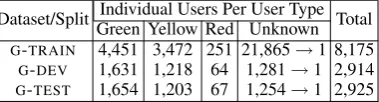
Dataset/Split Individual Users Per User Type TotalGreen Yellow Red Unknown
G-TRAIN 4,451 3,472 251 21,865→1 8,175
G-DEV 1,631 1,218 64 1,281→1 2,914
[image:2.595.87.277.146.197.2]G-TEST 1,654 1,203 67 1,254→1 2,925
Table 2: User statistics of the dataset used. lowing types.T(u)is the number of training com-ments posted by user (ID) u. R(u) is the ratio of
training comments posted byuthat were rejected. Red:Users withT(u)>10andR(u)≥0.66. Yellow:T(u)>10and0.33< R(u)<0.66. Green:T(u)>10andR(u)≤0.33.
Unknown:Users withT(u)≤10.
Table2shows the number of users per type.
3 Methods
RNN: This is theRNN-based method of our
previ-ous work (Pavlopoulos et al.,2017a). It is a chain ofGRUcells (Cho et al.,2014) that transforms the
tokens w1. . . , wk of each comment to the
hid-den states h1. . . , hk (hi ∈ Rm). Once hk has
been computed, a logistic regression (LR) layer
es-timates the probability that commentcshould be rejected:
PRNN(reject|c) =σ(Wphk+b) (1)
σis the sigmoid function,Wp ∈R1×m,b∈R.6
ueRNN: This is theRNN-based method withuser
embeddingsadded. Each useruof the training set withT(u) >10is mapped to a user-specific em-bedding vu ∈ Rd. Users with T(u) ≤ 10 are
mapped to a single ‘unknown’ user embedding. TheLRlayer is modified as follows;vu is the
em-bedding of the author ofc; andWv ∈R1×d.
PueRNN(reject|c) =σ(Wphk+Wvvu+b) (2)
teRNN: This is theRNN-based method withuser
type embeddings added. Each user type t is mapped to a user type embeddingvt ∈ Rd. The 6In our previous work (Pavlopoulos et al.,2017a), we also considered a variant ofRNN, calleda-RNN, with an attention mechanism. We do not considera-RNNhere to save space.
LR layer is modified as follows, where vt is the
embedding of the type of the author ofc.
PteRNN(reject|c) =σ(Wphk+Wvvt+b) (3)
ubRNN: This is theRNN-based method withuser
biasesadded. Each useruof the training set with
T(u) >10is mapped to a user-specific biasbu ∈
R. Users withT(u) ≤ 10are mapped to a single ‘unknown’ user bias. TheLRlayer is modified as
follows, wherebuis the bias of the author ofc. PubRNN(reject|c) =σ(Wphk+bu) (4)
We expectedubRNN to learn higher (or lower)bu
biases for users whose posts were frequently re-jected (accepted) in the training data, biasing the system towards rejecting (accepting) their posts. tbRNN: This is the RNN-based method with user
type biases. Each user typetis mapped to a user type bias bt ∈ R. The LR layer is modified as
follows;btis the bias of the type of the author. PtbRNN(reject|c) =σ(Wphk+bt) (5)
We expectedtbRNNto learn a higherbtfor the red
user type (frequently rejected), and a lowerbtfor
the green user type (frequently accepted), with the biases of the other two types in between.
In all methods above, we use 300-dimensional word embeddings, user and user type embeddings withd = 300dimensions, andm = 128 hidden units in the GRU cells, as in our previous
experi-ments (Pavlopoulos et al.,2017a), where we tuned all hyper-parameters on 2% held-out training com-ments. Early stopping evaluates on the same held-out subset. User and user type embeddings are randomly initialized and updated by backpropa-gation. Word embeddings are initialized to the
WORD2VEC embeddings of our previous work
System G-DEV G-TEST
ueRNN 80.68(±0.11) 80.71(±0.13)
ubRNN 80.54 (±0.09) 80.53 (±0.08) teRNN 80.37 (±0.05) 80.41 (±0.09)
tbRNN 80.33 (±0.12) 80.32 (±0.05)
RNN 79.40 (±0.08) 79.24 (±0.05)
[image:3.595.103.261.61.147.2]uBASE 67.61 68.57 tBASE 63.16 63.82
Table 3: AUCscores. Standard error in brackets. Bengio,2010) for other parameters, cross-entropy loss, and Adam (Kingma and Ba,2015).7
uBASE: For a commentcauthored by useru, this
baseline returns the rejection rateR(u) of the au-thor’s training comments, if there areT(u) > 10
training comments ofu, and 0.5 otherwise.
PuBASE(reject|c) = {
R(u), ifT(u)>10 0.5, ifT(u)≤10
tBASE:This baseline returns the following
proba-bilities, considering the user typetof the author.
PtBASE(reject|c) =
1,iftis Red
0.5,iftis Yellow
0.5,iftis Unknown
0,iftis Green 4 Results and Discussion
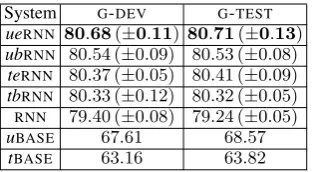
Table 3 shows the AUC scores (area under ROC
curve) of the methods considered. UsingAUC
al-lows us to compare directly to the results of our previous work (Pavlopoulos et al.,2017a) and the work of Wulczyn et al. (2017). Also,AUC
consid-ers performance at multiple classification thresh-oldst(rejecting commentcwhenP(reject|c)≥t, for different tvalues), which gives a more com-plete picture compared to reporting precision, re-call, or F-scores for a particulartonly. Accuracy is not an appropriate measure here, because of class imbalance (Table1). For methods that involve ran-dom initializations (all but the baselines), the re-sults are averaged over three repetitions; we also report the standard error across the repetitions.
User-specific information always improves our originalRNN-based method (Table3), but the best
results are obtained by adding user embeddings (ueRNN). Figure1visualizes the user embeddings
learned byueRNN. The two dimensions of Fig.1
correspond to the two principal components of the user embeddings, obtained viaPCA.The colors and
numeric labels reflect the rejection rates R(u) of
7We used Keras (http://keras.io/) with the Ten-sorFlow back-end (http://www.tensorflow.org/).
Figure 1: User embeddings learned byueRNN (2
principal components). Color represents the rejec-tion rateR(u)of the user’s training comments.
the corresponding users. Moving from left to right in Fig. 1, the rejection rate increases, indicating that the user embeddings ofueRNNcapture mostly
the rejection rateR(u). This rate (a single scalar value per user) can also be captured by the sim-pler user-specific biases ofubRNN, which explains
why ubRNN also performs well (second best
re-sults in Table 3). Nevertheless, ueRNN performs
better than ubRNN, suggesting that user
embed-dings capture more information than just a user-specific rejection rate bias.8
Three of the user types (Red, Yellow, Green) in effect also measure R(u), but in discretized form (three bins), which also explains why user type embeddings (teRNN) also perform well (third
best method). The performance oftbRNNis close
to that of teRNN, suggesting again that most of
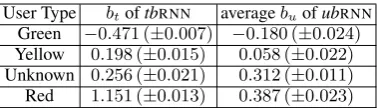
the information captured by user type embeddings can also be captured by simpler scalar user-type-specific biases. The user type biasesbtlearned by
tbRNNare shown in Table4. The bias of the Red
type is the largest, the bias of the Green type is the smallest, and the biases of the Unknown and Yel-low types are in between, as expected (Section3). The same observations hold for the average user-specific biasesbulearned byubRNN(Table4).
Overall, Table 3indicates that user-specific in-formation (ueRNN,ubRNN) is better than user-type
information (teRNN,tbRNN), and that embeddings
(ueRNN, teRNN) are better than the scalar biases
(ubRNN,tbRNN), though the differences are small.
All the RNN-based methods outperform the two
baselines (uBASE,tBASE), which do not consider
the texts of the comments.
Let us provide a couple of examples, to illus-trate the role of user-specific information. We
[image:3.595.310.526.63.175.2]User Type btoftbRNN averagebuofubRNN
[image:4.595.86.275.61.115.2]Green −0.471 (±0.007) −0.180 (±0.024) Yellow 0.198 (±0.015) 0.058 (±0.022) Unknown 0.256 (±0.021) 0.312 (±0.011) Red 1.151 (±0.013) 0.387 (±0.023) Table 4: Biases learned and standard error. countered a comment saying just “Ooooh, down to Pireaus. . . ” (translated from Greek), which the moderator had rejected, because it is the beginning of an abusive slogan. The rejection probability of
RNNwas only 0.34, presumably because there are
no clearly abusive expressions in the comment, but the rejection probability ofueRNN was 0.72,
be-cause the author had a very high rejection rate. On the other hand, another comment said “Indeed, I know nothing about the filth of Greek soccer.” (translated, apparently not a sarcastic comment). The original RNNmethod marginally rejected the
comment (rejection probability 0.57), presumably because of the ‘filth’ (comments talking about the filth of some sport or championship are often re-jected), but ueRNN gave it a very low rejection
probability (0.15), because the author of the com-ment had a very low rejection rate.
5 Related work
In previous work (Pavlopoulos et al.,2017a), we showed that our RNN-based method outperforms DETOX (Wulczyn et al., 2017), the previous state
of the art in user content moderation. DETOX
uses character or wordn-gram features, no user-specific information, and an LRorMLPclassifier.
Other related work on abusive content moderation was reviewed extensively in our previous work (Pavlopoulos et al.,2017a). Here we focus on pre-vious work that considered user-specific features and user embeddings.
Dadvar et al. (2013) detect cyberbullying in YouTube comments, using an SVM and features
examining the content of each comment (e.g., sec-ond person pronouns followed by profane words, common bullying words), but also the profile and history of the author of the comment (e.g., age, fre-quency of profane words in past posts). Waseem et al. (2016) detect hate speech tweets. Their best method is anLRclassifier, with charactern-grams
and a feature indicating the gender of the author; adding the location of the author did not help.
Cheng et al. (2015) predict which users will be banned from on-line communities. Their best sys-tem uses a Random Forest or LR classifier, with
features examining the average readability and sentiment of each user’s past posts, the past activ-ity of each user (e.g., number of posts daily, pro-portion of posts that are replies), and the reactions of the community to the past actions of each user (e.g., up-votes, number of posts rejected). Lee et al. (2014) and Napoles et al. (2017) include simi-lar user-specific features in classifiers intended to detect high quality on-line discussions.
Amir et al. (2016) detect sarcasm in tweets. Their best system uses a word-based Convolu-tional Neural Network (CNN). The feature
vec-tor produced by theCNN(representing the content
of the tweet) is concatenated with the user em-bedding of the author, and passed on to an MLP
that classifies the tweet as sarcastic or not. This method outperforms a previous state of the art sarcasm detection method (Bamman and Smith, 2015) that relies on an LR classifier with
hand-crafted content and user-specific features. We use an RNN instead of a CNN, and we feed the
com-ment and user embeddings to a simpler LR layer
(Eq.2), instead of anMLP. Amir et al. discard
un-known users, unlike our experiments, and consider only sarcasm, whereas moderation also involves profanity, hate speech, bullying, threats etc.
User embeddings have also been used in: con-versational agents (Li et al.,2016); sentiment anal-ysis (Chen et al.,2016); retweet prediction (Zhang et al., 2016); predicting which topics a user is likely to tweet about, the accounts a user may want to follow, and the age, gender, political affiliation of Twitter users (Benton et al.,2016).
Our previous work (Pavlopoulos et al., 2017a) also discussed how machine learning can be used insemi-automaticmoderation, by letting modera-tors focus on ‘difficult’ comments and automati-cally handling comments that are easier to accept or reject. In more recent work (Pavlopoulos et al., 2017b) we also explored how an attention mech-anism can be used to highlight possibly abusive words or phrases when showing ‘difficult’ com-ments to moderators.
6 Conclusions
Experimenting with a dataset of approx. 1.6M user comments from a Greek sports news portal, we ex-plored how a state of the artRNN-based
all cases, but user embeddings were the best. We plan to compareueRNNtoCNN-based
meth-ods that employ user embeddings (Amir et al., 2016), after replacing the LRlayer of ueRNN by
anMLPto allow non-linear combinations of
com-ment and user embeddings.
Acknowledgments
This work was funded by Google’s Digital News Initiative (project ML2P, contract 362826).9 We
are grateful to Gazzetta for the data they pro-vided. We also thank Gazzetta’s moderators for their feedback, insights, and advice.
References
S. Amir, B. C. Wallace, H. Lyu, P. Carvalho, and Mario J. M. J. Silva. 2016. Modelling context with user embeddings for sarcasm detection in social me-dia. In Proceedings of CoNLL, pages 167–177, Berlin, Germany.
D. Bamman and N.A. Smith. 2015. Contextualized sar-casm detection on Twitter. InProc. of the 9th In-ternational Conference on Web and Social Media, pages 574–577, Oxford, UK.
A. Benton, R. Arora, and M. Dredze. 2016. Learning multiview embeddings of Twitter users. InProc. of ACL, pages 14–19, Berlin, Germany.
H. Chen, M. Sun, C. Tu, Y. Lin, and Z. Liu. 2016. Neural sentiment classification with user and prod-uct attention. InProc. of EMNLP, pages 1650–1659, Austin, TX.
J. Cheng, C. Danescu-Niculescu-Mizil, and J. Leskovec. 2015. Antisocial behavior in on-line discussion communities. In Proc. of the International AAAI Conference on Web and Social Media, pages 61–70, Oxford University, England. K. Cho, B. van Merrienboer, C. Gulcehre, D.
Bah-danau, F. Bougares, H. Schwenk, and Y. Bengio. 2014. Learning phrase representations using RNN encoder–decoder for statistical machine translation. InEMNLP, pages 1724–1734, Doha, Qatar.
M. Dadvar, D. Trieschnigg, R. Ordelman, and F. de Jong. 2013. Improving cyberbullying detec-tion with user context. In ECIR, pages 693–696, Moscow, Russia.
X. Glorot and Y. Bengio. 2010. Understanding the dif-ficulty of training deep feedforward neural networks. InProc. of the International Conference on Artificial Intelligence and Statistics, pages 249–256, Sardinia, Italy.
9Seehttps://digitalnewsinitiative.com/.
D. P. Kingma and J. Ba. 2015. Adam: A method for stochastic optimization. InICLR, San Diego, CA. J.-T. Lee, M.-C. Yang, and H.-C. Rim. 2014.
Discov-ering high-quality threaded discussions in online fo-rums.Journal of Computer Science and Technology, 29(3):519–531.
J. Li, M. Galley, Chris C. Brockett, G. Spithourakis, J. Gao, and B. Dolan. 2016. A persona-based neural conversation model. In Proc. of ACL, pages 994– 1003, Berlin, Germany.
L. J. P. van der Maaten and G. E. Hinton. 2008. Visual-izing data using t-SNE. Journal of Machine Learn-ing Research, 9:2579–2605.
T. Mikolov, W.-t. Yih, and G. Zweig. 2013. Linguis-tic regularities in continuous space word representa-tions. InNAACL-HLT, pages 746–751, Atlanta, GA. C. Napoles, A. Pappu, and J. Tetreault. 2017. Automat-ically identifying good conversations online (yes, they do exist!). In Proc. of the International AAAI Conference on Web and Social Media.
J. Pavlopoulos, P. Malakasiotis, and Androutsopoulos I. 2017a. Deep learning for user comment modera-tion. InProc. of the ACL Workshop on Abusive Lan-guage Online, Vancouver, Canada.
J. Pavlopoulos, P. Malakasiotis, and Androutsopoulos I. 2017b. Deeper attention to abusive user content moderation. InEMNLP, Copenhagen, Denmark. J. Pennington, R. Socher, and C. Manning. 2014.
GloVe: Global vectors for word representation. In
EMNLP, pages 1532–1543, Doha, Qatar.
Z. Waseem and D. Hovy. 2016. Hateful symbols or hateful people? Predictive features for hate speech detection on Twitter. In Proc. of NAACL Student Research Workshop, pages 88–93, San Diego, CA. E. Wulczyn, N. Thain, and L. Dixon. 2017. Ex
machina: Personal attacks seen at scale. InWWW, pages 1391–1399, Perth, Australia.