Biomedical Event Trigger Identification Using Bidirectional Recurrent
Neural Network Based Models
Patchigolla V S S Rahul, Sunil Kumar Sahu, Ashish Anand Department of Computer Science and Engineering Indian Institute of Technology Guwahati, Assam, India
{sunil.sahu, anand.ashish}@iitg.ernet.in
Abstract
Biomedical events describe complex inter-actions between various biomedical enti-ties. Event trigger is a word or a phrase which typically signifies the occurrence of an event. Event trigger identification is an important first step in all event extraction methods. However many of the current approaches either rely on complex hand-crafted features or consider features only within a window. In this paper we pro-pose a method that takes the advantage of recurrent neural network (RNN) to ex-tract higher level features present across the sentence. Thus hidden state represen-tation of RNN along with word and entity type embedding as features avoid relying on the complex hand-crafted features gen-erated using various NLP toolkits. Our ex-periments have shown to achieve state-of-art F1-score on Multi Level Event Extrac-tion (MLEE) corpus. We have also per-formed category-wise analysis of the re-sult and discussed the importance of var-ious features in trigger identification task.
1 Introduction
Biomedical events play an important role in im-proving biomedical research in many ways. Some of its applications include pathway curation (Ohta et al., 2013) and development of domain spe-cific semantic search engine (Ananiadou et al.,
2015). So as to gain attraction among researchers many challenges such as BioNLP’09 (Kim et al.,
2009), BioNLP’11 (Kim et al.,2011), BioNLP’13 (N´edellec et al., 2013) have been organized and many novel methods have also been proposed ad-dressing these tasks.
Figure 1:Example of a complex biomedical event
An event can be defined as a combination of a trigger word and arbitrary number of argu-ments. Figure 1 shows two events with trigger words as “Inhibition” and “Angiogenesis” of trig-ger types “Negative Regulation” and “Blood Vessel Development” respectively. Pipelined based ap-proaches for biomedical event extraction include event trigger identification followed by event ar-gument identification. Analysis in multiple stud-ies (Wang et al.,2016b;Zhou et al.,2014) reveal that more than 60% of event extraction errors are caused due to incorrect trigger identification.
Existing event trigger identification models can be broadly categorized in two ways: rule based approaches and machine learning based approaches. Rule based approaches use various strategies including pattern matching and regular expression to define rules (Vlachos et al., 2009). However, defining these rules are very difficult, time consuming and requires domain knowledge. The overall performance of the task depends on the quality of rules defined. These approaches of-ten fail to generalize for new datasets when com-pared with machine learning based approaches. Machine learning based approaches treat the trig-ger identification problem as a word level classi-fication problem, where many features from the data are extracted using various NLP toolkits (Pyysalo et al.,2012;Zhou et al.,2014) or learned automatically (Wang et al.,2016a,b).
MLEE corpus. We also have performed category-wise analysis and investigate the importance of different features in trigger identification task.
2 Related Work
Many approaches have been proposed to ad-dress the problem of event trigger identification.
Pyysalo et al.(2012) proposed a model where var-ious hand-crafted features are extracted from the processed data and fed into a Support Vector Ma-chine (SVM) to perform final classification. Zhou et al.(2014) proposed a novel framework for trig-ger identification where embedding features of the word combined with hand-crafted features are fed to SVM for final classification using multiple ker-nel learning.Wei et al.(2015) proposed a pipeline method on BioNLP’13 corpus based on Condi-tional Random Field (CRF) and Support vector machine (SVM) where the CRF is used to tag valid triggers and SVM is finally used to identify the trigger type. The above methods rely on var-ious NLP toolkits to extract the hand-crafted fea-tures which leads to error propagation thus affect-ing the classifier’s performance. These methods often need to tailor different features for different tasks, thus not making them generalizable. Most of the hand-crafted features are also traditionally sparse one-hot features vector which fail to cap-ture the semantic information.
Wang et al. (2016b) proposed a neural net-work model where dependency based word em-beddings (Levy and Goldberg,2014) within a win-dow around the word are fed into a feed for-ward neural network (FFNN) (Collobert et al.,
2011) to perform final classification. Wang et al.
(2016a) proposed another model based on convo-lutional neural network (CNN) where word and entity mention features of words within a window around the word are fed to a CNN to perform fi-nal classification. Although both of the methods have achieved good performance they fail to cap-ture feacap-tures outside the window.
3 Model Architecture
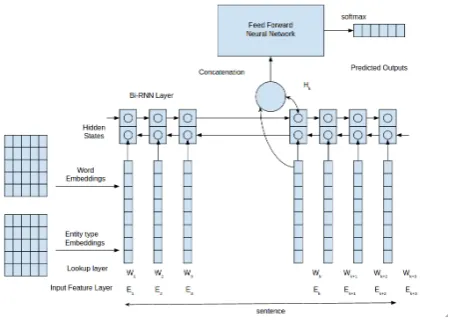
[image:2.595.311.538.73.234.2]We present our model based on bidirectional RNN as shown in Figure2for the trigger identification task. The proposed model detects trigger word as well as their type. Our model uses embedding fea-tures of words in the input layer and learns higher level representations in the subsequent layers and
Figure 2:Model Architecture
makes use of both the input layer and higher level features to perform the final classification. We now briefly explain about each component of our model.
3.1 Input Feature Layer
For every word in the sentence we extract two features, exact word w ∈ W and entity typee∈ E. HereW refers the dictionary of words andE
refers to dictionary of entities. Apart from all the entities,Ealso contains aN oneentity type which indicates absence of an entity. In some cases the entity might span through multiple words, in that case we assign every word spanned by that entity the same entity type.
3.2 Embedding or Lookup Layer
In this layer every input feature is mapped to a dense feature vector. Let us say that Ew and Ee
be the embedding matrices of W and E respec-tively. The features obtained from these embed-ding matrices are concatenated and treated as the final word-level feature (l) of the model.
The Ew ∈ Rnw×dw embedding matrix is ini-tialized with pre-trained word embeddings andEe
∈ Rne×de embedding matrix is initialized with
random values. Herenw,ne refer to length of the
word dictionary and entity type dictionary respec-tively anddw, de refer to dimension of word and
entity type embedding respectively.
3.3 Bidirectional RNN Layer
periments as they handle the vanishing and ex-ploding gradient problem (Pascanu et al., 2012) in a better way. We use bidirectional version of RNN (Graves, 2013) where for every word for-ward RNN captures features from the past and the backward RNN captures features from future, in-herently each word has information about whole sentence.
3.4 Feed Forward Neural Network
The hidden state of the bidirectional RNN layer acts as sentence-level feature (g), the word and entity type embeddings (l) act as a word-level features, are both concatenated (1) and passed through a series of hidden layers (2), (3) with dropout (Srivastava et al., 2014) and an output layer. In the output layer, the number of neurons are equal to the number of trigger labels. Finally we useSof tmaxfunction (4) to obtain probabil-ity score for each class.
f =gk⊕lk (1)
h0 = tanh(W0f+b0) (2)
hi = tanh(Wihi−1+bi) (3)
p(y|x) =Sof tmax(Wohi+bo) (4)
Here k refers to the kth word of the sentence, i
refers to theith hidden layer in the network and
⊕refers to concatenation operation. Wi,Wo and
bi,bo are parameters of the hidden and output
lay-ers of the network respectively.
3.5 Training and Hyperparameters
We use cross entropy loss function and the model is trained using stochastic gradient descent. The implementation1 of the model is done in python language usingT heano(Bergstra et al.,2010) li-brary. We use pre-trained word embeddings ob-tained byMoen et al.(2013) usingword2vectool (Mikolov et al.,2013).
We use training and development set for hyper-parameter selection. We use word embeddings of 200dimension, entity type embeddings of50 di-mension, RNN hidden state dimension of250and 2 hidden layers with dimension 150and100. In both the hidden layers we use dropout of0.2.
1Implementation is available at https: //github.com/rahulpatchigolla/
EventTriggerDetection
4 Experiments and discussion
4.1 Dataset Description
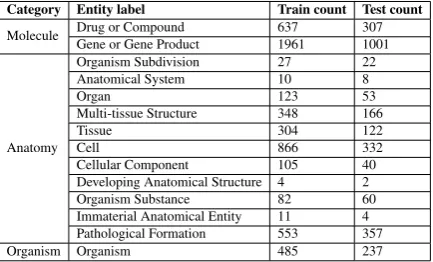
We use MLEE (Pyysalo et al., 2012) corpus for performing our trigger identification experiments. Unlike other corpora on event extraction it covers events across various levels from molecular to or-ganism level. The events in this corpus are broadly divided into 4 categories namely “Anatomical”, “Molecular”, “General”, “Planned” which are further divided into 19 sub-categories as shown in Table1. Here our task is to identify correct sub-category of an event. The entity types associated with the dataset are summarized in Table2.
Category Trigger label Train count Test count
Anatomical
Cell Proliferation (CELLP) 82 43
Development (DEV) 202 98
Blood Vessel Development (BVD) 540 305
Death (DTH) 57 36
Breakdown (BRK) 44 23
Remodeling (REMDL) 22 10
Growth (GRO) 107 56
Molecular
Synthesis (SYN) 13 4
Gene Expression (GENEXP) 210 132 Transcription (TRANS) 16 7
Catabolism (CATA) 20 4
Phosphorylation (PHO) 26 3 Dephosphorylation (DEPHO) 2 1
General
Localization (LOC) 282 133
Binding (BIND) 102 56
Regulation (REG) 362 178
[image:3.595.307.524.266.436.2]Positive Regulation (PREG) 654 312 Negative Regulation (NREG) 450 233 Planned Planned Process (PLP) 407 175
Table 1:Statistics of event triggers in MLEE corpus
Category Entity label Train count Test count
Molecule Drug or Compound 637 307 Gene or Gene Product 1961 1001
Anatomy
Organism Subdivision 27 22 Anatomical System 10 8
Organ 123 53
Multi-tissue Structure 348 166
Tissue 304 122
Cell 866 332
Cellular Component 105 40 Developing Anatomical Structure 4 2 Organism Substance 82 60 Immaterial Anatomical Entity 11 4 Pathological Formation 553 357
[image:3.595.308.525.483.614.2]Organism Organism 485 237
Table 2:Statistics of entities in MLEE corpus
4.2 Experimental Design
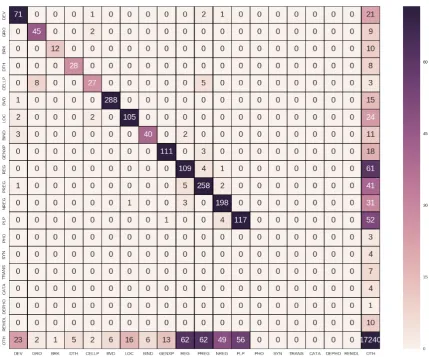
Figure 3:Confusion matrix of trigger classes with abbreviations mentioned in Table1
We have used micro averaged F1-score as the evaluation metric and evaluated the performance of the model by ignoring the trigger classes with counts≤10 in test set while training and consid-ered them directly as false-negative while testing.
4.3 Performance comparison with Baseline Models
We compare our results with baseline models shown in Table3. Pyysalo et al.(2012) defined a SVM based classifier with hand-crafted features.
Zhou et al.(2014) also defined a SVM based clas-sifier with word embeddings and hand-crafted fea-tures. Wang et al.(2016a) defined window based CNN classifier. Apart from the proposed models we also compare our results with two more base-line methods FFNN and CNNψwhich are our im-plementations. Here FFNN is a window based feed forward neural network where embedding features of words within the window are used to predict the trigger label (Collobert et al., 2011). We chose window size as3 (one word from left
and one word from right) after tuning it in vali-dation set. CNNψ is our implementation of win-dow based CNN classifier proposed byWang et al.
(2016a) due to unavailability of their code in pub-lic domain. Our proposed model have shown slight improvement in F1-score when compared with baseline models. The proposed model’s abil-ity to capture the context of the whole sentence is likely to be one of the reasons of improvement in performance.
We perform one-side t-test over5 runs of F1-Scores to verify our proposed model’s perfor-mance when compared with FFNN and CNNΨ. The p value of the proposed model (GRU) when compared with FFNN and CNNψare8.57×10−07 and 1.178× 10⁻¹⁰ respectively. This indicates statistically superior performance of the proposed model.
4.4 Category Wise Performance Analysis
Method Precision Recall F1-Score
SVM (Pyysalo et al.,2012) 81.44 69.48 75.67 SVM+We(Zhou et al.,2014) 80.60 74.23 77.82
CNN (Wang et al.,2016a) 80.67 76.76 78.67 FFNN 77.53 75.55 76.53 CNNψ 80.75 69.36 74.62
Proposed (LSTM) 78.58 78.84 78.71
[image:5.595.72.290.62.148.2]Proposed (GRU) 79.78 78.45 79.11
Table 3:Comparison of performance of our model with base-line models
model’s performance in anatomical and molecu-larcategories are better thangeneralandplanned
categories. We can also infer from the confusion matrix shown in Figure3thatpositive regulation,
negative regulationandregulationamonggeneral
category and planned category triggers are caus-ing many false positives and false negatives thus degrading the model’s performance.
Trigger Category Precision Recall F1-Score Anatomical 88.86 83.06 85.87
Molecular 88.80 73.51 80.43 General 75.69 78.53 77.09 Planned 67.63 67.24 67.43 Overall 79.78 78.45 79.11
Table 4:Category wise performance of the model
4.5 Further Analysis
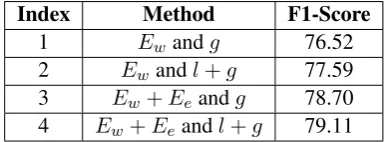
In this section we investigate the importance of various features and model variants as shown in Table5. HereEw andEerefer to using word and
entity type embedding as a feature in the model,l
andgrefer to using word-level and sentence-level feature respectively for the final prediction. For example,Ew +Eeandgmeans using both word
and entity type embedding as the input feature for the model andgmeans only using the global fea-ture (hidden state of RNN) for final prediction.
Index Method F1-Score
1 Ew andg 76.52
2 Ewandl+g 77.59
3 Ew+Eeandg 78.70
[image:5.595.312.521.212.339.2]4 Ew+Eeandl+g 79.11
Table 5: Affect on F1-Score based on feature analysis and model variants
Examples in Table 6 illustrate importance of features used in best performing models. In phrase 1 the word “knockdown”, is a part of an en-tity namely “round about knockdown endothelial
cells” of type “Cell” and in phrase 2 it is trigger word of type “Planned Process”, methods 1 and 2 failed to differentiate both of them because of no knowledge about the entity type. In phrase 3 “ im-paired” is a trigger word of type “Negative Regu-lation” methods 1 and 3 failed to correctly iden-tify but when reinforced with word-level feature the model succeeded in identification. So, we can say thatEefeature andl+gmodel variant help in
improving the model’s performance.
Index Phrase
1
silencing of directional migration inround about knockdown endothelial cells
2 we show that PSMA inhibition
knockdownor deficiency decrease
3
display altered maternal hormone concentrations indicative of an
impairedtrophoblast capacity
Table 6:Example phrases for Further Analysis
5 Conclusion and Future Work
In this paper we have proposed a novel approach for trigger identification by learning higher level features using RNN. Our experiments have shown to achieve state-of-art results on MLEE corpus. In future we would like to perform complete event extraction using deep learning techniques.
References
Sophia Ananiadou, Paul Thompson, Raheel Nawaz, John McNaught, and Douglas B Kell. 2015. Event-based text mining for biology and func-tional genomics. Briefings in functional genomics 14(3):213–230.
James Bergstra, Olivier Breuleux, Fr´ed´eric Bastien, Pascal Lamblin, Razvan Pascanu, Guillaume Des-jardins, Joseph Turian, David Warde-Farley, and Yoshua Bengio. 2010. Theano: A cpu and gpu math compiler in python. InProc. 9th Python in Science Conf. pages 1–7.
Junyoung Chung, C¸ aglar G¨ulc¸ehre, KyungHyun Cho, and Yoshua Bengio. 2014. Empirical evaluation of gated recurrent neural networks on sequence model-ing.CoRRabs/1412.3555.
[image:5.595.84.279.595.666.2]Alex Graves. 2013. Generating sequences with recur-rent neural networks. CoRRabs/1308.0850.
Sepp Hochreiter and J¨urgen Schmidhuber. 1997. Long short-term memory. Neural Comput. pages 1735– 1780.
Jin-Dong Kim, Tomoko Ohta, Sampo Pyysalo, Yoshi-nobu Kano, and Jun’ichi Tsujii. 2009. Overview of bionlp’09 shared task on event extraction. In Proceedings of the Workshop on Current Trends in Biomedical Natural Language Processing: Shared Task. Association for Computational Linguistics, pages 1–9.
Jin-Dong Kim, Sampo Pyysalo, Tomoko Ohta, Robert Bossy, Ngan Nguyen, and Jun’ichi Tsujii. 2011. Overview of bionlp shared task 2011. In Proceed-ings of the BioNLP Shared Task 2011 Workshop. As-sociation for Computational Linguistics, pages 1–6.
Omer Levy and Yoav Goldberg. 2014. Dependency-based word embeddings. InACL 2014. pages 302– 308.
Tomas Mikolov, Ilya Sutskever, Kai Chen, Greg S Cor-rado, and Jeff Dean. 2013. Distributed representa-tions of words and phrases and their compositional-ity. InAdvances in neural information processing systems. pages 3111–3119.
Hans Moen, Sampo Pyysalo, Filip Ginter, Tapio Salakoski, and Sophia Ananiadou. 2013. Distribu-tional semantics resources for biomedical text pro-cessing.
Claire N´edellec, Robert Bossy, Jin-Dong Kim, Jung-Jae Kim, Tomoko Ohta, Sampo Pyysalo, and Pierre Zweigenbaum. 2013. Overview of bionlp shared task 2013. In Proceedings of the BioNLP Shared Task 2013 Workshop. Association for Computational Linguistics, pages 1–7.
Tomoko Ohta, Sampo Pyysalo, Rafal Rak, Andrew Rowley, Hong-Woo Chun, Sung-Jae Jung, Chang-hoo Jeong, Sung-pil Choi, and Sophia Ananiadou. 2013. Overview of the pathway curation (pc) task of bionlp shared task 2013 .
Razvan Pascanu, Tomas Mikolov, and Yoshua Bengio. 2012. Understanding the exploding gradient prob-lem. CoRR, abs/1211.5063.
Sampo Pyysalo, Tomoko Ohta, Makoto Miwa, Han-Cheol Cho, Jun’ichi Tsujii, and Sophia Ananiadou. 2012. Event extraction across multiple levels of bi-ological organization. Bioinformatics 28(18):575– 581.
Nitish Srivastava, Geoffrey E Hinton, Alex Krizhevsky, Ilya Sutskever, and Ruslan Salakhutdinov. 2014. Dropout: a simple way to prevent neural networks from overfitting. Journal of Machine Learning Re-search15(1):1929–1958.
Andreas Vlachos, Paula Buttery, Diarmuid O S´eaghdha, and Ted Briscoe. 2009. Biomedical event extraction without training data. In Pro-ceedings of the Workshop on Current Trends in Biomedical Natural Language Processing: Shared Task. Association for Computational Linguistics, pages 37–40.
Jian Wang, Honglei Li, Yuan An, Hongfei Lin, and Zhi-hao Yang. 2016a. Biomedical event trigger detec-tion based on convoludetec-tional neural network. Inter-national Journal of Data Mining and Bioinformatics 15(3):195–213.
Jian Wang, Jianhai Zhang, Yuan An, Hongfei Lin, Zhi-hao Yang, Yijia Zhang, and Yuanyuan Sun. 2016b. Biomedical event trigger detection by dependency-based word embedding. BMC Medical Genomics 9(2):45.
Xiaomei Wei, Qin Zhu, Chen Lyu, Kai Ren, and Bo Chen. 2015. A hybrid method to extract triggers in biomedical events. Journal of Digital Information Management13(4):299.