NTUCLE: Developing a Corpus of Learner English to Provide Writing
Support for Engineering Students
Roger V. P. Winder,♡Joe MacKinnon,♡Shu Yun Li,♡Benedict Lin,♡
Carmel Heah,♡Luís Morgado da Costa,♦Takayuki Kuribayashi,♠and Francis Bond♠ ♡Language and Communication Centre,♠Linguistics and Multilingual Studies
♡♠School of Humanities,
♦Global Asia, Interdisciplinary Graduate School
Nanyang Technological University, Singapore [email protected]
Abstract
This paper describes the creation of a new annotated learner corpus. The aim is to use this corpus to develop an automated sys-tem for corrective feedback on students’ writing. With this system, students will be able to receive timely feedback on lan-guage errors before they submit their as-signments for grading. A corpus of assign-ments submitted by first year engineering students was compiled, and a new error tag set for the NTU Corpus of Learner English (NTUCLE) was developed based on that of the NUS Corpus of Learner English (NU-CLE), as well as marking rubrics used at NTU. After a description of the corpus, er-ror tag set and annotation process, the pa-per presents the results of the annotation exercise as well as follow up actions. The final error tag set, which is significantly larger than that for the NUCLE error cate-gories, is then presented before a brief con-clusion summarising our experience and future plans.
1 Introduction
In this paper, we report on a new project which involves the creation of a new annotated Learner Corpus (LC), and which aims to develop an auto-mated system for corrective feedback at Nanyang Technological University (NTU), Singapore. The goal of this system is to provide immediate feed-back to students on possible errors in syntax, gram-mar and lexis, as well as possible style problems, in their assignment drafts.
In this project, we follow studies such asNagata
(1996), which shows that it is not the medium itself (e.g. a computer, a book, a lecturer, etc.) that de-termines success in learning, it is the quality of the
feedback produced by that medium that affects the results. This is why a language teacher is likely to be a better medium than a book, and the same rea-son why a properly designed Computer Assisted Language Learning (CALL) system can also be a better medium than writing guidelines, assuming that such systems can provide timely and construc-tive feedback to the learner.
Given our current course design and manpower constraints, students are much more likely to learn from the system’s automated feedback than from receiving the same feedback from tutors, which will take longer, after an assignment has been submitted and graded. The immediate feedback through the automated system will enable students to address the possible errors before submitting the final versions for assessment. Consequently, stu-dents are more likely to take the feedback seri-ously because it can be used to improve the qual-ity of the assignment before it is submitted (Price et al.,2010). Furthermore, this automated system will enable tutors to focus more attention on areas that require human judgement in their feedback, such as content, organization and use of rhetorical strategies.
To develop the system, we have tagged an LC of 180 written assignments for a course entitled Engi-neering Communication I, taught at NTU. We then developed an error coding system based on the 27 labels used in the NUS Corpus of Learner English (NUCLE,Dahlmeier et al.,2013) because of sim-ilarities in the demographic profile of the partici-pating learners. However, we removed some cat-egories and expanded others so the final list con-sists of 53 labels. Part of this was to include cat-egories that are not purely grammatical, but per-tain to matters of writing style which we are con-cerned about, some of which can be automatically detected. These include not only obvious style issues such as the use of contractions and
quial words or expressions but also more subtle ones such as overly long and convoluted sentences and missing parallel clause structures. In this, our corpus distinguishes itself from the Cambridge Learner Corpus (CLC, Nicholls, 2003), NUCLE and other corpora which focus solely on grammar.
Our primary motivation for assembling the NTU Corpus of Learner English (NTUCLE), in other words, is to help individual students to identify their language and style problems, and to rectify these on their own. This is unlike the broader in-tentions of the CLC, whose error coding and anal-ysis is intended to provide “lexicographers, re-searchers, ELT [English Language Teaching] au-thors and examiners with easy, direct information which they can interpret and use for widely varying purposes” (Nicholls,2003). Similarly, our initial motivation differs from that of the NUCLE, whose goal is to provide a large data resource for research purposes, and for development of grammatical er-ror correction systems (Ng et al.,2014).
Our ultimate goal is also different from many current Natural Language Processing (NLP) projects, which appear to focus on building auto-mated grammatical correction tools, with the holy grail of a “complete end-to-end application” that can identify and correct mistakes for the writers, with a high degree of precision (see Ng et al.,
2014). Instead, the goal for NTUCLE was to de-velop a system that will be able to prompt students to review possible mistakes in their writing drafts and correct them on their own. This will allow learners to participate more meaningfully in the error correction process and to actively identify and choose from multiple options which are often available and would be considered acceptable by different annotators (Rozovskaya and Roth,
2010).
Finally, NTUCLE differs from other similar cor-pora in its narrower focus on a specific genre (i.e. technical proposals) and target students (i.e. Sin-gaporean engineering undergraduates). Neverthe-less, we foresee that our project might be expanded to include other genres and groups of learners, though sub categorisation of specific groups of learners and genres will be ensured.
We have now completed annotation of the cor-pus, and are currently using this to develop the tem for providing feedback to students. This sys-tem will detect and tag potential errors in drafts submitted by students, and identify likely errors
using our categories. It will not correct any er-ror, but will prompt, with different degrees of con-fidence, students to consider whether corrections are needed. In this way, we hope to encourage stu-dents to adopt a more independent and critical ap-proach to error correction. We also hope to enable a pedagogy focused on timely, high quality feed-back to students.
This paper discusses the completed phases of our new LC primarily from the perspective of pro-fessional English instructors. In Section 2, we de-scribe the compilation of the corpus and the estab-lishment of initial error tag set. We then describe in Section 3 the annotation process, before present-ing in Section 4 the outcomes of our initial anno-tation, including findings on the most frequent er-rors identified, inter-annotator differences in tag-ging and how we resolved them. Section 5 high-lights our revised error tag set. We conclude with a brief note on the corpus release, followed by a summary of our experience and our future plans for the corpus.
2 Corpus and Error Tag Set
2.1 Corpus Compilation
Approval was obtained from the university’s In-stitutional Review Board for the research protocol and the use of students’ written assignments, sub-ject to the students’ consent. Over three semesters (from 2015 to 2016), 349 students gave written consent, and their assignments were retrieved for the corpus.
Of the assignments retrieved, we selected only files in doc/docx format, because it would be dif-ficult to automate text extraction, while preserving headings, paragraphs, style and sentence bound-aries for the other formats (e.g. pdf). We ended up with 273 documents from which we tagged only a random sample of 180 documents, due to time and manpower constraints. The 93 untagged doc-uments were kept to test the error-detecting system under development.
service or process, or an improvement of an exist-ing one. The instructions for the assignment spec-ify a structure for the proposal consisting of seven sections: background, problem, solution, benefits, implementation, costs/budget and conclusion.
2.2 Initial annotation schema
We next developed a preliminary error tag set by referring to NUCLE (Dahlmeier et al., 2013) as well as marking rubrics used at NTU. Six anno-tators, all professional English instructors, then tagged the same selected paper from the data set using this tag set. After conferring and reviewing the error tags and agreeing on what constituted an error in the student’s paper, we created a modified tag set with 15 broad categories covering 50 er-ror labels. This is much larger than the NUCLE tag set, which has 13 broad categories and 27 error labels, though we were conscious of how exces-sive granularity could lead to greater difficulty in applying the annotation schema to the documents (Nagata et al.,2011). Below are the ways in which we modified the NUCLE tag set:
Removed two broad categories:
(a) ‘Redundancy’ because tags created in other categories dealt with this issue more specifi-cally, and
(b) ‘Word Choice’ replaced with ‘Words (lexi-cal)’ to reflect a broadening of the category.
Created three additional categories:
(c) ‘Expression’, covering two tags, ‘Awkward expression’ (not used in NUCLE) and ‘Un-clear expression’ (similar to ‘Un‘Un-clear mean-ing’ under ‘Others’ in NUCLE);
(d) ‘Prepositions’, with three tags (NUCLE cov-ers prepositions under a single tag for ‘Wrong collocation/idioms/prepositions’); and (e) ‘Style’, with two tags unique to NTUCLE
(‘StyF’ for overly formal words or expres-sions and ‘StySh’ for inappropriate shifts in style and formality), and one other tag (‘StyC’ for inappropriate use of casual or colloquial words or expressions) similar to ‘Wtone’ for ‘Tone’ under ‘Word Choice’ in NUCLE.
Added tags in most categories, through:
(f) specifying whether an error involved some-thing missing, unnecessary or inappropriate (for ‘Articles, determiners’, ‘Prepositions’, ‘Pronouns’, ‘Verbs’ and ‘Words’), similar to the use of ‘insertion’/‘missing’, ‘dele-tion’/‘unnecessary’ and ‘replacement’ tags in other projects (see Bryant et al., 2017;
Ro-zovskaya and Roth,2010);
(g) expanding tags that were collapsed in NU-CLE (e.g. two separate tags for run-on sen-tences and comma splices instead of one, and more specific tags for case, punctuation, spacing and spelling instead of the generic ‘Mechanics’); and
(h) creating new tags such as ‘VVoice’ (for wrong choices of active or passive voice), ‘NCount’ (for wrong forms of count-able/uncountable nouns), and ‘SMMod’ (for misplaced modifiers) based on errors we have found from experience to be common in our students’ writing.
Reduced the error tags in ‘Others’:
(i) replacing the tag ‘Unclear meaning’ with the tag ‘ExpUC’ (for ’Unclear expression’) in our new ‘Expressions’ category.
3 Annotation Process
From the 180 documents collected (see2.1), each of the 6 annotators was randomly assigned 40 doc-uments, ensuring that 20 of these 40 documents were overlapped evenly with two other annota-tors (i.e. 10 documents overlapped with another annotator, and another 10 documents overlapped with a second annotator). Each annotator tagged the assigned scripts independently, and the identi-ties of the other annotators tagging the same docu-ments were not revealed. Annotators were also not aware which samples were being double tagged with other annotators. The double tagging was done to check accuracy and inter-annotator agree-ment.
A total of 60 documents were double annotated. Annotators were instructed to tag every error iden-tified as specifically as possible, and to use more than one tag for the same set of words if there were multiple ways of tagging the error. While we acknowledge that it would also have been useful to correct the errors identified, this was not done because of the complexity of the task, especially in identifying all possible options for correcting each error while preserving the student’s intended meaning (Sakaguchi et al.,2017). Unfortunately, this would have required more time and resources than were available.
3.1 Annotation Tool
Anno-tation Environment (Bond et al.,2015). We used the open source platform to build an extra layer to the annotation environment, allowing us to tag the documents with our own tag-set (discussed in2.2
and presented in5).
The annotators used this new system to tag each document by sentence, in ascending order. Al-though the system currently only allows tagging sentence by sentence, (i.e. annotators could work on only one sentence at a time on-screen), anno-tators had access to the full text of each document so that they could identify errors in context (e.g. errors in pronouns with referents in earlier sen-tences).
To tag each error, annotators could select a sin-gle word, a contiguous word-string (e.g. a phrase), a set of non-contiguous words (e.g. a pronoun and its referent earlier or later in the sentence), or the entire sentence. Multiple errors could be tagged for each sentence. Total and partial overlap of er-rors within the same sentence were allowed and encouraged. This happened, for example, when the same span of words could be corrected in more than one way (i.e. two error tags were assigned to the same span of words), or when a smaller error occurred within a larger error (e.g. an agreement error inside an overly long sentence). Errors were tagged at the level of word tokens, which means that sub-word units could not be selected. Missing words were indicated by tagging the words sur-rounding the location of the hypothesized miss-ing word. A text-box was provided for each er-ror, which could be used to correct it or to leave comments (e.g. to flag referents that should be anonymized). A screshot of the annotation en-vironment is shown in Fig1.
4 Results and Annotation Issues
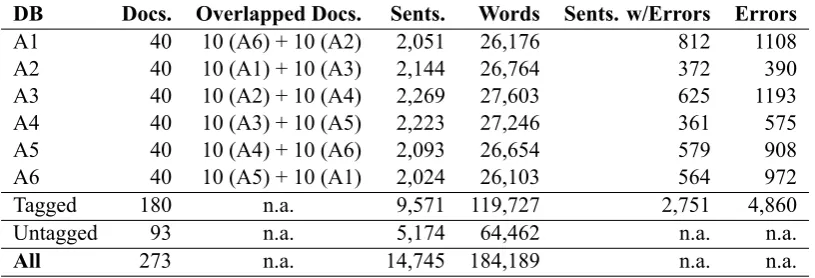
The results of the annotation exercise revealed a wide range in the number of errors tagged by each annotator, from 380 (Annotator 2) to 1,183 (An-notator 3), as shown in Table1. This is not un-usual and similar differences have been observed in other annotation exercises (see, for example,
Bryant and Ng, 2015). Further discussion sug-gested that the differences are likely to be due to different levels of sensitivity to particular er-rors and different tagging practices, including de-cisions about which particular word, phrase, clause or even sentence to tag with a single label. Annota-tors also differed in the frequency with which they
tagged the same word or word string with different tags to acknowledge different ways of identifying errors. It is also possible, but unlikely, that par-ticular annotators may have received assignments from weaker students – since the assignments were distributed randomly across annotators.
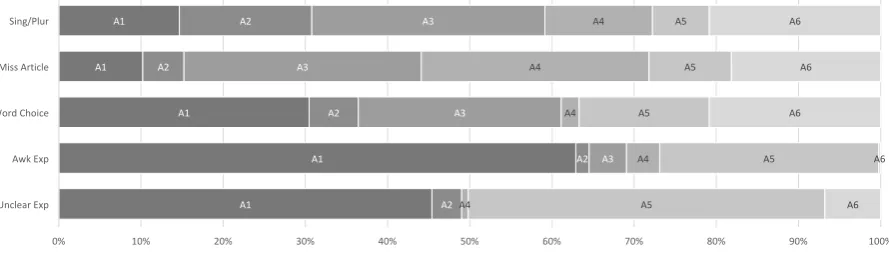
As Table1also indicates, three annotators (A2, A3 and A6) were highly similar in their tagging patterns in relation to the three main error cat-egories tagged, namely ‘singular/plural forms’, ‘missing article/determiner’ and ‘word choice’ – which were also the top three error categories over-all. Two others (A1 and A5) also had similar top three error categories (‘word choice’, ‘awkward expression’ and ‘unclear expression’) but these were the third, fourth and fifth most common er-ror categories tagged overall.
The five most common errors, distributed by an-notators, are shown in Figure 2: errors in using singular or plural forms, omitting articles or deter-miners, choosing inappropriate words, using awk-ward expressions and using unclear expressions. However, the annotators appeared to have had dif-ferent emphases in their annotation. While over-all, strictly grammatical errors (i.e. use of singu-lar/plural forms and omission of articles and deter-miners) were the most commonly identified, anno-tators 1 and 5 identified far more errors in ‘expres-sion’ (unclear/awkward), which may relate more to issues in semantics or idiomaticity.
4.1 Double Tagging
As has been mentioned earlier, 60 documents were double tagged. In many cases, both annotators tagged the same errors in the same sentences, ei-ther for exactly the same word strings or for word strings with some overlapping words. However, there were also significant differences, such as dif-ferent word strings tagged for the same error type, or the same word string tagged for different error types.
Interestingly, although two pairs of annotators (A3+A4, and A5+A6) had relatively high degrees of overlap in using the same error tags, they also had relatively high degrees of discrepancy in as-signing error tags to the same word strings. This suggests that while they had a strong common un-derstanding of some error tags, they quite possibly also had rather different interpretations of others, or that they had quite different foci where the word strings may have more than one error type.
Figure 1: Annotation tool developed for the corpus annotation, as an extension of IMI
A# No. Errors Most Common Error 2nd Most Common Error 3rd Most Common Error
A1 1,101 awkward expression (21%) word choice (11%) unclear expression (10%)
A2 380 singular/plural forms (22%) word choice (7%) missing article/det. (6%)
A3 1,183 singular/plural forms (12%) missing article/det. (10%) word choice (8%)
A4 556 missing article/det. (21%) singular/plural forms (11%) verb form (9%)
A5 908 unclear expression (12%) awkward expression (11%) word choice (7%)
A6 972 singular/plural forms (11%) word choice (9%) missing article/det. (9%)
Total 5,100 singular/plural forms (10%) missing article/det. (8%) word choice (8%)
Table 1: Top errors by annotator (before harmonisation)
A1
A1 A1
A1 A1
A2
A2 A2
A2
A2
A3 A3
A3
A3
A4
A4 A4
A4 A4
A5
A5 A5
A5 A5
A6 A6 A6
A6 A6
0% 10% 20% 30% 40% 50% 60% 70% 80% 90% 100% Unclear Exp
[image:5.595.77.522.573.703.2]Awk Exp Word Choice Miss Article Sing/Plur
of different error tags assigned to the same exact sentence spans (words, expressions, etc.). In most cases, it was agreed that one or both of the anno-tators had made a mistake, either unintentionally, or through misunderstanding or misapplying a tag. The relevant word strings were then re-tagged with the correct tags. In a few instances, either tag could apply, e.g. However, trolley has its own limita-tions, which can be construed as either ‘NNum’ (However, trolleys have their own limitations) or ‘AMiss’ (However, a trolley has its own limita-tions). In yet a few others, both tags apply, i.e. there are two errors conflated in the same word set (e.g.For example, individual seats for individ-ual cubical will be installed with motion sensor., where there is both an ‘MSpel’ (cubical to cubi-cle) and ‘NNum’ (cubical tocubicles) error). In both these kinds of cases, we agreed that both tags should remain, in the first instance because there are two ways of correcting the error, and in the sec-ond, because there are two overlapping errors.
Some differences arose because the annotators involved found it difficult to use existing tags. In many of these instances, one annotator tagged the error under ‘Others’ and provided his or her own labels or comments. From these, we identified new categories for tagging, namely ‘StyMood’ for the inappropriate use of imperatives or interrogatives, ‘SLong’ for overly long sentences, and ‘SConv’ for convoluted sentences.
We understand that such differences could have been avoided, and the tagging process made more efficient had the annotators been given more de-tailed guidelines or met for a more extensive stan-dardisation exercise prior to annotation. However, as an exercise to test natural discrepancies in hu-man tagging, this was a useful exercise. Given that our final goal is to emulate human feedback, while providing constructive feedback on issues lectur-ers usually highlight in student assignments, it was an important part of our experiment to allow this kind of naturalistic tagging, which captures differ-ences in grading expectations, editing experience and perceptions of acceptable or exemplary lan-guage use (Daudaravicius et al.,2016;Rozovskaya and Roth,2010). Consequently, to be able to cre-ate a useful error-feedback system, we wanted to restrain ourselves from creating a highly mechani-cal process to assign tags – even at the cost of inter-annotator agreement.
The annotators also discussed their own ‘pet
peeves’ in the texts they annotated. Among those most commonly shared was the problem of overly long sentences that made comprehension difficult. This reinforced the need for the category ‘SLong’. Another commonly shared ‘pet peeve’ was the in-appropriate over-use of certain colloquial words and informal clichés, tackle (to mean study, ad-dressorsolvea problem) andhassle(to mean in-convenience or the like) being two of the most common. Another new category ‘StyWch’ for the use of casual or colloquial words and expressions was created to tag such words.
Our observations of instances tagged for inap-propriate style also helped us to identify the spe-cific ways in which this problem was realized in linguistic form, leading to a further two new cate-gories – ‘StyContr’ for the use of contractions and ‘StyPron’ for the use of first and second person pronouns.
5 Revised Error Tag Set
The review of the annotation exercise resulted in an amended error tag set with the same 15 cate-gories but with 53 tags. After the amendments, the tag discrepancies mentioned in4.1were resolved. Based on the discussion above and the results of the initial tagging, errors that had been tagged un-der the ‘Style’ category were re-tagged with one of the tags available in the final tag set.
Table3presents our final error tag set, with an indication of the frequency of each error type in the corpus after re-tagging. The ‘Source’ column indicates how the tags were created:
• ‘Sub-divided’: broader NUCLE tags that were sub-divided to be more specific
• ‘Modified’: NUCLE tags that were modified slightly to be more specific
• ‘Moved’: NUCLE tags that were moved to other categories
• ‘NUCLE’: NUCLE tags that were not changed
• ‘Re-named’: NUCLE tags that were re-named to fit the NTUCLE schema
• ‘NTUCLE’: tags created for NTUCLE
6 Corpus Release
The corpus described above will soon be available at the following url:
http://compling.hss.ntu.edu.sg/ntucle.
et al.,2015). All anonymised data will be released under an Attribution 4.0 International license (CC BY 4.0),1in conformity with our IRB and the stu-dents’ consent.
Table 2 provides a quick overview of the cor-pus to be released: number of documents, over-laps, number of sentences, number of word tokens, number of sentences that contain at least one error label, and the total number of errors included in each database.
We will release the six individual databases, each tagged by a different professional English in-structor, along with a compiled database of the 180 documents tagged, merging documents that were double tagged. While the compiled database has more traditional usages, we believe the individ-ual databases can be used to further analyse and discuss individual differences between annotators. Lastly, we will also release a database with the re-maining untagged documents.
7 Conclusion
Based on the NUCLE, we have started the NTU Corpus of Learner English using written assign-ments submitted by first year engineering students. This corpus will be used to develop an automated system for corrective feedback which is expected to cultivate greater student autonomy and critical awareness in error correction when writing. Our system will be piloted and tested with the next round of submissions for the same writing assign-ment used to develop the corpus. We plan to add these submissions to the corpus, and keep expand-ing it.
For our corpus, we have developed a new learner error tag set with 53 tags, which is sig-nificantly larger than NUCLE’s. This is to meet the specific needs and goals of this corpus, the de-velopment of the online tool for corrective feed-back without automated correction. As expected, there were significant differences among the an-notators in applying the initial tag set, with some annotators being more or less sensitive to particu-lar errors than others. In samples that were dou-ble tagged, there were both overlaps and differ-ences in the words tagged and the error tags used. We discussed and resolved all instances where the same word strings were tagged differently, and re-tagged the word strings. We agreed unanimously that the annotation process could have been
im-1https://creativecommons.org/licenses/by/4.0/
proved if more detailed guidelines or brief training had been provided to the annotators prior to anno-tation. At the same time, the goal of building an automated system for corrective feedback of stu-dent’s writing, as mentioned above, invited us to firstly acknowledge the low inter-annotator agree-ment and different foci of professional instructors when correcting student assignments.
We believe that our annotated corpus can be a useful new learner corpus, which can complement and advance on the purposes of corpora such as NUCLE, and we hope to expand it with other gen-res and learners in the near future. We would like to have the opportunity to further revise and har-monize the annotations in the corpus, and we also acknowledge that it would be beneficial to pro-vide corrections for the identified errors. Unfor-tunately, this will be dependent on the availability of resources.
All compiled, we are releasing, under an open li-cense, 273 anonymised student assignments, com-prising over 14,700 sentences. Roughly 65% of this corpus has been tagged using our newly pro-posed tagset (available in Table3).
Acknowledgments
This research is supported by Nanyang Techno-logical University’s EdeX Teaching and Learning Grant administered through the Teaching, Learn-ing and Pedagogy Division (TLPD) and the MOE TRF grant Syntactic Well-Formedness Diagnosis and Error-Based Coaching in Computer Assisted Language Learning using Machine Translation Technology. We thank the reviewers for their comprehensive comments. We would also like to acknowledge the valuable contributions of Boon Tien Lim in the earlier phases of the project.
References
Francis Bond, Luís Morgado da Costa, and Tuan Anh Le. 2015. IMI – A multilingual semantic
annota-tion environment. In Proceedings of the 53rd
An-nual Meeting of the Association for Computational Linguistics and the 7th International Joint Confer-ence on Natural Language Processing of the Asian Federation of Natural Language Processing, System Demonstrations (ACL 2015), pages 7–12, Beijing, China.
DB Docs. Overlapped Docs. Sents. Words Sents. w/Errors Errors
A1 40 10 (A6) + 10 (A2) 2,051 26,176 812 1108
A2 40 10 (A1) + 10 (A3) 2,144 26,764 372 390
A3 40 10 (A2) + 10 (A4) 2,269 27,603 625 1193
A4 40 10 (A3) + 10 (A5) 2,223 27,246 361 575
A5 40 10 (A4) + 10 (A6) 2,093 26,654 579 908
A6 40 10 (A5) + 10 (A1) 2,024 26,103 564 972
Tagged 180 n.a. 9,571 119,727 2,751 4,860
Untagged 93 n.a. 5,174 64,462 n.a. n.a.
[image:8.595.96.504.62.201.2]All 273 n.a. 14,745 184,189 n.a. n.a.
Table 2: Corpus Statistics
for Computational Linguistics, pages 793–805, Van-couver, Canada. Association for Computational Lin-guistics.
Christopher Bryant and Hwee Tou Ng. 2015. How far are we from fully automatic high quality grammati-cal error correction? InProceedings of the 53rd An-nual Meeting of the Association for Computational Linguistics and the 7th International Joint Confer-ence on Natural Language Processing (Volume 1: Long Papers), pages 697–707, Beijing, China. As-sociation for Computational Linguistics.
Daniel Dahlmeier, Hwee Tou Ng, and Siew Mei Wu. 2013. Building a large annotated corpus of learner English: The NUS corpus of learner English. In BEA@ NAACL-HLT, pages 22–31.
Vidas Daudaravicius, Rafael E. Banchs, Elena Volod-ina, and Courtney Napoles. 2016. A report on the au-tomatic evaluation of scientific writing shared task. InProceedings of the 11th Workshop on Innovative Use of NLP for Building Educational Applications, pages 53–62, San Diego, CA. Association for Com-putational Linguistics.
Noriko Nagata. 1996. Computer vs. workbook instruc-tion in second language acquisiinstruc-tion. CALICO jour-nal, 14(1):53–75.
Ryo Nagata, Edward Whittaker, and Vera Sheinman. 2011. Creating a manually error-tagged and
shallow-parsed learner corpus. InProceedings of the 49th
Annual Meeting of the Association for Computa-tional Linguistics: Human Language Technologies, pages 1210–1219, Portland, Oregon, USA. Associa-tion for ComputaAssocia-tional Linguistics.
Hwee Tou Ng, Siew Mei Wu, Ted Briscoe, Christian Hadiwinoto, Raymond Hendy Susanto, and Christo-pher Bryant. 2014. The CoNLL-2014 shared task on grammatical error correction. InCoNLL Shared Task, pages 1–14.
Diane Nicholls. 2003. The Cambridge learner corpus: Error coding and analysis for lexicography and elt. InProceedings of the Corpus Linguistics 2003 con-ference, volume 16, pages 572–581.
Margaret Price, Karen Handley, Jill Millar, and Berry O’Donovan. 2010. Feedback: all that effort, but what is the effect? Assessment & Evaluation in Higher Education, 35(3):277–289.
Alla Rozovskaya and Dan Roth. 2010. Annotating esl
errors: Challenges and rewards. InProceedings of
the NAACL HLT 2010 Fifth Workshop on Innovative Use of NLP for Building Educational Applications, pages 28–36, Los Angeles, California. Association for Computational Linguistics.
Keisuke Sakaguchi, Courtney Napoles, and Joel Tetreault. 2017. Gec into the future: Where are we
going and how do we get there? In Proceedings
Categories Tags Explanation Freq. Source
Articles, determiners
ACh Wrong choice of article/determiner 69 Expanded
A development of a new product is required
AMiss Missing article/determiner 449 Expanded
a stall with [a] shorter queue
AUnn Unnecessary article/determiner 144 Expanded
two holes in the two of the sides
Citations CitForm Incorrect citation form 100 Expanded
(Sim, R. 2013)
CitMiss Missing citation 6 Expanded
According to a study [citation], Singaporean students ...
Expression ExpAw Awkward expression (meaning is clear) 366 NTUCLE
paths are of high human traffic
ExpUC Unclear expression (meaning is unclear) 249 Moved
A rubbish bin to test our idea as well as human resources from the companies
Mechanics
MCase Wrong use of upper or lower case 98 Expanded
The Rubbish bin is a common object
MPunc Punctuation error 190 Expanded
This[,] in turn[,] would create an orderly environment
MSpace Missing or unnecessary space 27 Expanded
They can not be used in open areas
MSpel Spelling error 58 Expanded
a cold and quite environment
Nouns
NCount Wrong form of countable/uncountable noun 77 NTUCLE
Users can exchange notes and advices
NNum Wrong choice of singular/plural form of the noun 525 NUCLE
one of his speech
NPoss Wrong choice of possessive form 22 NUCLE
the timers can be adjusted to workers[’] feedback
Prepositions
PreCh Wrong choice of preposition 227 Expanded
at the comfort of his home
PreMiss Missing preposition 53 Expanded
EasyGrip will be a great addition [to] every household
PreUnn Unnecessary preposition 54 Expanded
video tutorials can be played to teach users on how to use the mouse
Pronouns
ProAgr Pronoun and reference do not agree in num-ber/person/gender
88 Re-named
An electrostatic precipitator works by absorbing dirty air, passing them through ionising electrodes
ProCh Wrong choice of pronoun 32 Expanded
they things tend to slip off their mind easily
ProMiss Missing pronoun 21 Expanded
5 ‘X’s will identify owners as irresponsible and deny [them] a pet.
ProRef Unclear reference for pronoun 92 Modified
The components can be mounted onto a circuit board, which is covered with a plastic housing once it is completed.
ProUnn Unnecessary pronoun 8 Expanded
Categories Tags Explanation Freq. Source
Sentence structure
SComS Comma splice 40 Expanded
The wobbling table can cause food and drinks to be spilled out of their containers, writing can become messy.
SConv Convoluted sentence - NTUCLE
Rubbish bins are facing one problem in crowded areas where bins fill up quickly that cleaners have hard time discerning as there are too many bins, and only come at fixed timings to clear the rubbish currently.
SDMod Dangling modifier 16 Expanded
Looking at the bigger picture, a canteen can efficiently accommodate more diners in a given time.
SFrag Sentence fragment 58 NUCLE
Thus, showing that our students have a huge desire to always learn something new.
SLong Overly long sentence 14 NTUCLE
However, they would not be able to do the required printing if they possess an EZ-link card that has insufficient stored monetary value and hence may require the assistance of friends by borrowing their EZ-link cards, or make their way back to (...) [+38 words]
SMMod Misplaced modifier 11 NTUCLE
An ideal conducive learning environment is essential as it facilitates effective teaching and learning process coupled with a well-equipped lecture theatre
SPar Parallelism missing 37 NUCLE
students will find it a hassle to go through emails and calling to find out more
SRun Run-on sentence 26 Expanded
there is an increase in commuters for public transport[;] this leads to higher congestion in public transport
SSub Problematic subordinate clause 25 NUCLE
The immediate benefited [sic] ones would be the needy groups, directly solving their food shortage.
Style
StyContr Contractions 25 NTUCLE
It’s a rectangular device
StyF Overly formal words or expressions 1 NTUCLE
To solve the aforementioned problems
StyMood Inappropriate use of interrogatives and imperatives 13 NTUCLE
Establish a collaboration with an existing music-streaming app.
StyPron Inappropriate use of first and second person pro-nouns
9 NTUCLE
I could not manage to find the cost of one EZ link top up machine
StyWch Casual or colloquial words or expressions 92 NTUCLE
some find it a hassle to search for an available power socket
Subject-verb
agreement SubVA Subject and verb do not agree in number and/or per-son 148 NUCLE
Categories Tags Explanation Freq. Source
Transitions
TCh Wrong choice of link words/phrases 50 Expanded
Hence users will also be able to purchase a UV light, where they can use it to identify areas which were not cleaned properly
TMiss Missing link words/phrases 26 Expanded
The food owners select the nearest food centre, [and] fill in their address and contact number.
TUnn Unnecessary link words/phrases 34 Expanded
Skipping lunch can cause students to be distracted by hunger and thus affecting academic performance.
Verbs
VForm Wrong form of the verb 231 NUCLE
NTU is rank 13th in the world
VMiss Missing verb 23 NUCLE
The files they need [?] directly streamed to their computer.
VMod Missing, inappropriate or unnecessary modal 138 NUCLE
To produce the application, the following steps are taken:
VTense Verb tense 121 NUCLE
Each year Nanyang Technological University (NTU) welcomed approx-imately 4,500 students into their freshmen year
VVoice Wrong choice of active or passive voice 27 NTUCLE
The phenomenon of overcrowding of Canteen B has been existed for a long time.
Word order PosAd Wrong position of adjective/adverb 3 Re-named
vacuum cleaners can be used to clean narrow spaces also
PosW Incorrect word order 13 Re-named
the problem of dropping things off the desk
Words (lexical)
WCh Wrong choice of word 411 NTUCLE
The air conditioner is an electric appliance that alternates the surround-ing temperature.
WColloc Words do not collocate 73 NTUCLE
Find assistance from Sistic to sell tickets
WForm Wrong form of the word 96 NUCLE
Rentascoot™ is environmental friendly
WMiss Missing words 95 NTUCLE
This system can simplify [?] and reduce the time of packing away [?].
WUnn Unnecessary words 195 NTUCLE
... which poses severe risks to nature as well as human health issues
[image:11.595.74.528.124.663.2]Others Oth Other errors requiring correction 140 NUCLE