Original Article
A herbal formula Erchen decoction for non-alcoholic
fatty liver disease: a systematic review and
meta-analysis of randomized controlled trials
Wanshu Li1, Yan Wu2, Wenzai Ge1, Li Fan1, Wei Sun3
Departments of 1Pharmacy, 2Critical Care Medicine, Ningbo Municipal Hospital of Traditional Chinese Medicine,
Ningbo, P. R. China; 3Department of Pharmacy, The Second Affiliated Hospital and Yuying Children’s Hospital of
Wenzhou Medical University, Wenzhou, P. R. China
Received March 16, 2017; Accepted April 28, 2017; Epub June 15, 2017; Published June 30, 2017
Abstract:Background and objective: Erchen Decoction (ECD) is a traditional Chinese medicinal formula, which is
often used in the treatment of a variety of diseases. This systematic review aims to evaluate the efficacy of ECD in
treating non-alcoholic fatty liver (NAFLD) disease according to the PRISMA systematic review standard. Methods:
English and Chinese databases were searched from database inception to February 2017 without language restric-tion. Results: Seven RCTs with 1951 participants were included. Patients receiving ECD with conventional treatment
showed a significant increase in clinical improvement, compared with participants receiving conventional treatment
alone (RR=1.25, 95% CI: 1.13 to 1.38, P<0.00001, I2=54%). Conclusion: Although a consistent result that ECD might be more effective than conventional treatment in treating NAFLD in this study, further RCTs of higher quality,
larger scale and longer follow-up periods are still required to identify the efficacy of ECD.
Keywords: Erchen decoction, non-alcoholic fatty liver disease, meta-analysis
Introduction
The disease spectrum of non-alcoholic fatty liver disease (NAFLD) includes non-alcoholic simple fatty liver (NAFL) and non-alcoholic ste-atohepatitis (NASH) [1], affecting about one-third of the population in the Western world and Asia [2, 3]. The diagnosis of NAFLD was made on the basis of ultrasound evidence of fatty
liver with no statistically significant alcohol con -sumption [4], and is particularly associated with metabolic syndrome including obesity, hypertension, hyperglycemia, insulin resista- nce (IR), dyslipidaemia and hyperuricemia [5, 6]. Morbidity of NAFLD increase constantly in population, and it is a principal cause of chronic hepatic disease and lacks effective treatment [7]. Therefore, the drug of curative effect for NAFLD is needed to overcome the disease. Erchen decoction (ECD), containing four com-monly used herbs (Pinelliae Rhizoma, Citri Reticulatae Pericarpium, Poria and Radix Gl-
ycyrrhizae), was first recorded in a classic clini -cal Traditional Chinese Medicine (TCM) book titled The Taiping Huimin Heji Jufang [8]. ECD is used in the treatment of a variety of diseases caused by retention of phlegm dampness, including obesity, hypertension, hyperglycemia and hyperuricemia.The component of ECD has been shown to reduce low-density lipoprotein (LDL) oxidation in atherosclerotic mice and in hypercholesterolemic and normal lipidemia humans [9].
Whether ECD has beneficial effects on
pati-ents with NAFLD is unknown, and recent stud-ies have shown inconsistent results on the
efficacy of ECD for treating NAFLD. To better
Methods
Search strategy
Search of English and Chinese databases was performed. Databases included PubMed, EMBASE, the Cochrane Library, Chinese Bio- medical Database (CBM), China National Knowledge Infrastructure (CNKI), Chongqing VIP (CQVIP), Chinese Biomedical Literature Database (CBM) and Wanfang Medicine Online (WFMO), from database inception to February 2017 without language restriction. The follow-ing search terms were used: (Erchen tang or Erchen decoction) and (Non-alcoholic Fatty Liver Disease or NAFLD or Fatty Liver, Nona- lcoholic or Nonalcoholic Fatty Liver Disease or Liver, Nonalcoholic Fatty or Fatty Livers, Nonalcoholic or Livers, Nonalcoholic Fatty or Nonalcoholic Fatty Liver or Nonalcoholic Fatty Livers or Nonalcoholic Steatohepatitis or Nonalcoholic Steatohepatitides or Steatohe- patitides, Nonalcoholic or Steatohepatitis, Nonalcoholic). Furthermore, we also reviewed the reference lists in the retrieved articles and recent reviews to search for additional studies that potentially met the study criteria.
Eligibility criteria
Inclusion criteria were: (1) completed RCTs pub-lished in English or Chinese, with or without blinding; (2) individuals suffering from NAFLD that has been diagnosed by histology or
sug-gestive imaging findings; (3) erchen decoction
was given alone or combined with conventional treatment, and compared with conventional treatment or plus placebo (where the same intervention was used in both treatment and comparator groups) and (4) studies with at
could not be extracted by current mathematical methods.
Study selection and data extraction
All of the articles were searched by two
investi-gators (LF and YW) according to the predefined
criteria utilizing a standardized data
abstrac-tion form. The form included details of the first
author’s name, publication year, the number of cases and controls, average age, name and component of Chinese herbs, treatment of the control group, treatment duration and adverse events. To get the details in some studies, emails or phone calls were made to contact the original authors for searching the missing data.
Quality assessment
Two researchers (LF and YW) independently assessed methodological quality of the includ-ed studies using the Cochrane risk of bias assessment tool with a potential risk of bias of high, low or unclear. Differences were resolved by agreement after discussion with WS. Studies were assessed based on the following domains: (1) random sequence generation; (2) allocation concealment; (3) blinding of participants, per-sonnel and outcome assessors; (4) incomplete outcome data; (5) selective outcome reporting; and (6) other bias. Studies were assessed as low risk, high risk or unclear risk of bias for each domain.
Data analysis
[image:2.612.93.376.71.234.2]All statistical analyses were performed in Review Manager (RevMan) Version 5.3. The pri-mary outcome (total effective rate) was pre-sented as a dichotomous variable (prepre-sented
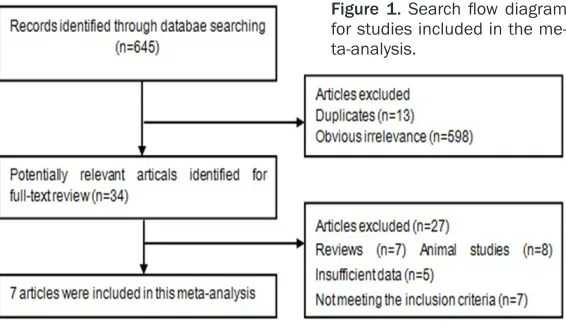
Figure 1. Search flow diagram
for studies included in the me-ta-analysis.
least 30 subjects to provide enough evidence to approve the outcomes.
Exclusion criteria
The following studies were excluded: (1) reports that did not qualify as an RCT; (2) par-ticipants with alcoholic or drug induced, genetic or viral causes of liver injury; (3) stud-ies or case reports enrolling <30 subjects, or manuscripts
without sufficient data; and
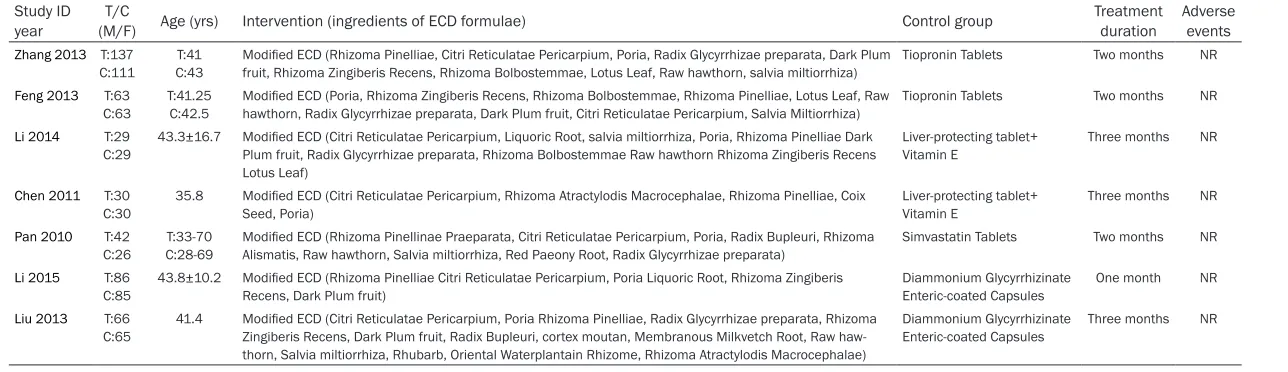
Table 1. Summary of randomized controlled trials included in the meta-analysis Study ID
year (M/F)T/C Age (yrs) Intervention (ingredients of ECD formulae) Control group Treatmentduration Adverse events
Zhang 2013 T:137 C:111
T:41 C:43
Modified ECD (Rhizoma Pinelliae, Citri Reticulatae Pericarpium, Poria, Radix Glycyrrhizae preparata, Dark Plum
fruit, Rhizoma Zingiberis Recens, Rhizoma Bolbostemmae, Lotus Leaf, Raw hawthorn, salvia miltiorrhiza)
Tiopronin Tablets Two months NR
Feng 2013 T:63 C:63
T:41.25 C:42.5
Modified ECD (Poria, Rhizoma Zingiberis Recens, Rhizoma Bolbostemmae, Rhizoma Pinelliae, Lotus Leaf, Raw
hawthorn, Radix Glycyrrhizae preparata, Dark Plum fruit, Citri Reticulatae Pericarpium, Salvia Miltiorrhiza)
Tiopronin Tablets Two months NR
Li 2014 T:29
C:29 43.3±16.7 Modified ECD (Citri Reticulatae Pericarpium, Liquoric Root, salvia miltiorrhiza, Poria, Rhizoma Pinelliae Dark Plum fruit, Radix Glycyrrhizae preparata, Rhizoma Bolbostemmae Raw hawthorn Rhizoma Zingiberis Recens Lotus Leaf)
Liver-protecting tablet+
Vitamin E Three months NR
Chen 2011 T:30 C:30
35.8 Modified ECD (Citri Reticulatae Pericarpium, Rhizoma Atractylodis Macrocephalae, Rhizoma Pinelliae, Coix
Seed, Poria)
Liver-protecting tablet+ Vitamin E
Three months NR
Pan 2010 T:42
C:26 T:33-70C:28-69 Modified ECD (Rhizoma Pinellinae Praeparata, Citri Reticulatae Pericarpium, Poria, Radix Bupleuri, Rhizoma Alismatis, Raw hawthorn, Salvia miltiorrhiza, Red Paeony Root, Radix Glycyrrhizae preparata) Simvastatin Tablets Two months NR Li 2015 T:86
C:85 43.8±10.2 Modified ECD (Rhizoma Pinelliae Citri Reticulatae Pericarpium, Poria Liquoric Root, Rhizoma Zingiberis Recens, Dark Plum fruit) Diammonium Glycyrrhizinate Enteric-coated Capsules One month NR Liu 2013 T:66
C:65
41.4 Modified ECD (Citri Reticulatae Pericarpium, Poria Rhizoma Pinelliae, Radix Glycyrrhizae preparata, Rhizoma
Zingiberis Recens, Dark Plum fruit,Radix Bupleuri, cortex moutan, Membranous Milkvetch Root, Raw
haw-thorn, Salvia miltiorrhiza, Rhubarb, Oriental Waterplantain Rhizome, Rhizoma Atractylodis Macrocephalae)
Diammonium Glycyrrhizinate Enteric-coated Capsules
Three months NR
as RR with 95% CI). The secondary outcomes (TC, TG, ALT) were assessed as continuous vari-ables (presented as MD and 95% CI). To calcu-late statistical heterogeneity, the Cochrane’s Q test and I2 statistic were used. When I2 statistic was less than 50% and the P value was more than 0.1, heterogeneity was considered to be
low. In cases of low heterogeneity, a fixed effect
model was used to pool data; otherwise, a ran-dom-effects model was applied.
Results
Literature search
A total of 654 abstracts were retrieved throu- gh the electronic databases dated up to Fe- bruary 2017. After initial screening of titles and abstracts using the aforementioned
crite-ria, 34 articles were identified for full-text
review. Of these, 27 were further excluded, leaving seven eligible articles [10-16], and a
flow chart presenting the study selection pro -cess is shown in Figure 1. Hence, seven arti-cles involving 862 participants were included in
our final meta-analysis. All of the studies were
conducted in China. The characteristics of them included in the studies were presented in Table 1.
Study characteristics
The studies included 862 participants, of whom 453 were randomized to ECD treatment and 409 to conventional group. The size of the stud-ies varied greatly, the largest study with 248 participants, and the smallest study only had
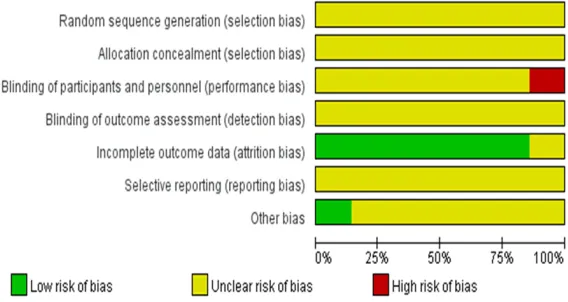
allocation concealment. No trials performed blinding of participants nor mentioned blinding of outcome assessment. Six trials reported all outcomes without missing data [10, 11, 13-16]. All of the studies were published in China, so we could not exclude potential publication bias.
Outcome measures
Assessment of clinical effectiveness is an investigator rated judgment, usually divided into three different levels, including markedly effective, effective and ineffective, based on improvement in type-B ultrasonic of fatty liver, blood lipids and liver function. The reference basis for clinical improvement was the diagnos-tic criteria of the Chinese Medical Association for nonalcoholic fatty liver disease [13]. These scales are widely used to evaluate clinical
efficacy of NAFLD in China.
Seven studies reported the clinical efficacy.
Patients receiving ECD with conventional
treat-ment showed a significant increase in clinical
improvement, compared with participants re- ceiving conventional treatment alone (RR=1.25, 95% CI: 1.13 to 1.38, P<0.00001, I2=54%) (Figure 3). Conventional therapies included Tiopronin, Liver-protecting + Vitamin E, Sim- vastatin and Diammonium Glycyrrhizinate Enteric-coated.
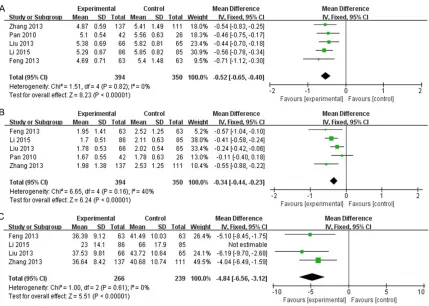
TC was reported in 5/7 studies. Overall, ECD-treated patients showed only a statistically
sig-nificant (P<0.00001) decrease in TC
[image:4.612.92.376.73.224.2](MD=-0.52 IU/L; 95% CI: -0.65 to -0.40; I2=0%) compared to the control group (Figure 4A). TG
Figure 2. Risk of bias summary: review authors’ judgments about each risk of bias item for each included study.
58 participants. The treat-ment duration in the included studies ranged from one month to three months. The composition of each treat-ment group was listed in detail, and all of them were
modified ECD.
Methodological quality and risk of bias
activity was evaluated in the included studies.
A statistically significant reduction was
obser-ved in TG in ECD-treated patients (MD=-0.34 IU/L; 95% CI: -0.44 to -0.23; I2=40%) (Figure
[image:5.612.94.520.74.257.2]4B). ALT activity was reported in three studies, showing a marked reduction (P<0.00001) in ECD-treated patients (MD=-4.84 mmol/L; 95% CI: -6.56 to -3.12; I2=0) (Figure 4C).
Figure 3. Meta-analysis of the association between Erchen decoction and NAFLD using a random-effects model and
a standardized mean difference with a 95% confidence interval.
[image:5.612.93.522.310.616.2]Risk of bias
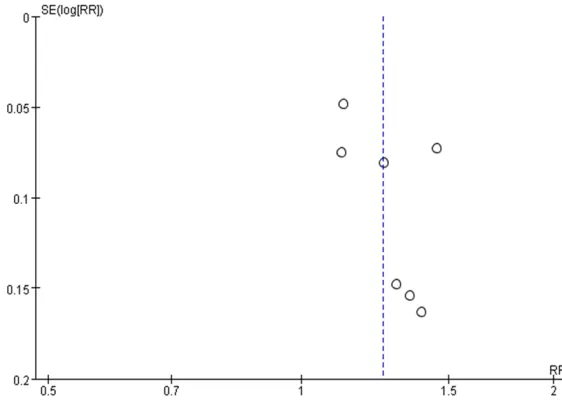
To determine the potential bias of included studies, the funnel plot was generated in Figure 5. The funnel plot was not perfectly symmetri-cal, suggesting that there might be slight publi-cation bias.
Discussion
This is a systematic analysis to explore the effi -cacy and safety of ECD for NAFLD. Seven RCTs with 862 participants were included to assess the effects of ECD on NAFLD patients. The pooled analyses showed that ECD therapy was more effective than routine western therapy in
improving clinical efficacy, including TC, TG and
ALT. However, when we analyzed the subjects
with AST, significant difference has not been
found. This may be because only two trials with limited data analyzed the AST in ECD supplementation.
In the present study, we conducted this review
to assess the efficacy and safety of ECD for the
treatment of NAFLD in 4 main Chinese lan-guage databases and 3 main English lanlan-guage databases. To the best of our knowledge, this
is the first English language systematic review
and meta-analysis of RCTs for ECD in treating NAFLD. Compared with the previous study, the strengths of our meta-analysis include the large sample size, which minimized selection bias and led to the relatively stable risk estimation.
searched, but all the seven trials were pub-lished in Chinese, leading to publishing bias. The sample size was so small, which could cause exaggerated of weakened results. Therefore, multicenter RCTs with large-scale and long-term follow-up should be conducted to provide more evidence.
Disclosure of conflict of interest
None.
Address correspondence to: Wei Sun, Department
of Pharmacy, The Second Affiliated Hospital and
Yuying Children’s Hospital of Wenzhou Medical University, Wenzhou 325027, P. R. China. Tel: +86 139 6880 3162; E-mail: [email protected]
References
[1] Arulanandan A, Loomba R. Non-invasive
test-ing for NASH and NASH with advanced fibrosis:
are we there yet? Curr Hepatol Rep 2015; 14: 109-18.
[2] Loomba R, Sanyal AJ. The global NAFLD epi-demic. Nat Rev Gastroenterol Hepatol 2013; 10: 686-90.
[3] Vernon G, Baranova A, Younossi ZM. System-atic review: the epidemiology and natural his-tory of non-alcoholic fatty liver disease and non-alcoholic steatohepatitis in adults. Ali-ment Pharmacol Ther 2011; 34: 274-85. [4] Riquelme A, Arrese M, Soza A, Morales A,
[image:6.612.90.371.73.279.2]Bau-drand R, Perez-Ayuso RM, González R, Alvarez M, Hernández V, García-Zattera MJ, Otarola F, Medina B, Rigotti A, Miquel JF, Marshall G,
Figure 5. Funnel plot to detect publication bias.
The meta-analysis in our st- udy has its own limitations. Most of the trials were with poor methodology according to the current evaluative stan-dards. Although all the includ-ed trials statinclud-ed randomiza-tion, none of them mentioned the detailed randomization method. Allocation conceal-ment and blind method were also not mentioned in all the trials. High proportions of pos-itive outcomes were often reported in some Asian coun-tries, so reporting bias and publication bias could not be excluded [17].
Nervi F. Non-alcoholic fatty liver disease and its association with obesity, insulin resistance and increased serum levels of C-reactive pro-tein in Hispanics. Liver Int 2009; 29: 82-8. [5] Vogt B, Bochud M, Burnier M. The association
of aldosterone with obesity-related hyperten-sion and the metabolic syndrome. Semin Nephrol 2007; 27: 529-37.
[6] Onat A, Can G, Hergenc G, Yazici M, Karabulut A, Albayrak S. Serum apolipoprotein B predicts dyslipidemia, metabolic syndrome and, in women, hypertension and diabetes,
indepen-dent of markers of central obesity and inflam -mation. Int J Obes (Lond) 2007; 31: 1119-25. [7] Ma ZZ, Lu LG. [Cholesterol metabolism and
non-alcoholic steatohepatitis]. Zhonghua Gan Zang Bing Za Zhi 2016; 24: 623-27.
[8] Gao BZ, Chen JC, Liao LH, Xu JQ, Lin XF, Ding SS. Erchen decoction prevents high-fat diet in-duced metabolic disorders in C57BL/6 mice. Evid Based Complement Alternat Med 2015; 2015: 501272.
[9] Fogelman Y, Gaitini D, Carmeli E. Antiathero-sclerotic effects of licorice extract supplemen-tation on hypercholesterolemic patients: de-creased CIMT, reduced plasma lipid levels, and decreased blood pressure. Food Nutr Res 2016; 60: 30830.
[10] Zhang P. Clinical research on treating
137cas-es of non-alcoholic fatty liver with modified
Erchen decoction. Jiangsu Jouranl of Tradit Chi Med 2013 45; 33-34.
[11] Feng HY. Clinical observation on treating 127cases of non-alcoholic fatty liver with
mod-ified Erchen decoction. Asia-Pacific Tradit Med
2013; 9: 170-171.
[12] Li W. Clinical observation on treating 29 cases
of non-alcoholic fatty liver with modified Erch -en decoction. Hunan J Tradit Chin Med 2014; 1: 44-45.
[13] Chen YJ. Clinical observation on treating 30 cases of non-alcoholic fatty liver with Erchen decoction. Chin J Chin Med 2011; 14: 37. [14] Pan FM, Gui Z. Clinical observation on treating
42 cases of hyperlipidemia non-alcoholic fatty liver with Erchen decoction. J Yangtze Univ Nat Sci Edit 2010; 4: 13-14.
[15] Li GA, Fu GA, Huang YN. Clinical observation on treating 86 cases of non-alcoholic fatty liver
with modified Erchen decoction combination
with diammonium glycyrrhizinate enteric-coat-ed capsules. Hunan J Tradit Chin Menteric-coat-ed 2015; 7: 46-47.
[16] Liu Y, Chen L, Tang DM. Clinical observation on
treating non-alcoholic fatty liver with modified
Erchen decoction combination with diammo-nium glycyrrhizinate enteric-coated capsules. J Changchun Univ Chin Med 2013; 4: 672-674. [17] Vickers A, Goyal N, Harland R, Rees R. Do