Drug Extraction from the Web:
Summarizing Drug Experiences with Multi-Dimensional Topic Models
Michael J. Paul and Mark Dredze
Human Language Technology Center of Excellence Center for Language and Speech Processing
Johns Hopkins University Baltimore, MD 21218
{mpaul,mdredze}@cs.jhu.edu
Abstract
Multi-dimensional latent text models, such as factorial LDA(f-LDA), capture multiple fac-tors of corpora, creating structured output for researchers to better understand the contents of a corpus. We consider such models for clinical research of new recreational drugs and trends, an important application for mining current information for healthcare workers. We use a “three-dimensional” f-LDA variant to jointly model combinations of drug (mari-juana, salvia, etc.), aspect (effects, chemistry, etc.) and route of administration (smoking, oral, etc.) Since a purely unsupervised topic model is unlikely to discover these specific factors of interest, we develop a novel method of incorporating prior knowledge by leverag-ing user generated tags as priors in our model. We demonstrate that this model can be used as an exploratory tool for learning about these drugs from the Web by applying it to the task of extractive summarization. In addition to providing useful output for this important pub-lic health task, our prior-enriched model pro-vides a framework for the application of f-LDA to other tasks.
1 Introduction
Topic models aid exploration of the main thematic elements of large text corpora by revealing latent structure and producing a high level semantic view (Blei et al., 2003). Topic models have been used for understanding the contents of a corpus and identify-ing interestidentify-ing aspects of a collection for more in-depth analysis (Talley et al., 2011; Mimno, 2011). While standard topic models assume a flat seman-tic structure, there are potentially many dimen-sions of a corpus that contribute to word choice,
such as sentiment, perspective and ideology (Mei et al., 2007; Paul and Girju, 2010; Eisenstein et al., 2011). Rather than studying these factors in isola-tion,multi-dimensionaltopic models can consider multiple factors jointly.
Paul and Dredze (2012b) introduced factorial LDA (f-LDA), a general framework for multi-dimensional text models that capture an arbitrary number of factors (explained in§3). While a stan-dard topic model learns distributions over “topics” in documents, f-LDA learns distributions over com-binations of multiple factors (e.g. topic, perspec-tive) called tuples (e.g. (HEALTHCARE,LIBERAL)). While f-LDA can model factors without supervision, it has not been used in situations where the user has prior information about the factors.
In this paper we consider a setting where the user has prior knowledge about the end application: min-ing recreational drug trends from user forums, an important clinical research problem (§2). We show how to incorporate available information from these forums into f-LDA as a novel hierarchical prior over the model parameters, guiding the model toward the desired output (§3.1).
We then demonstrate the model’s utility in ex-ploring a corpus in a targeted manner by using it to automatically extract interesting sentences from the text, a simple form of extractive multi-document summarization (Goldstein et al., 2000). In the same way that topic models can be used for aspect-specific summarization (Titov and McDonald, 2008; Haghighi and Vanderwende, 2009), we use f-LDA to extract snippets corresponding to fine-grained in-formation patterns. Our results demonstrate that our multi-dimensional modeling approach targets more informative text than a simpler model (§4).
2 Analyzing Drug Trends on the Web
Recreational drug use imposes a significant burden on the health infrastructure of the United States and other countries. Accurate information on drugs, us-age profiles and side effects are necessary for sup-porting a range of healthcare activities, such as ad-diction treatment programs, toxin diagnosis, preven-tion and awareness campaigns, and public policy. These activities rely on up-to-date information on drug trends, but it is increasingly difficult to keep up with current drug information, as distribution and information-sharing of novel drugs is easier than ever via the web (Wax, 2002). For the third con-secutive year, a record number of new drugs (49) were detected in Europe in 2011 (EMCDDA, 2012). About two-thirds of these new drugs were synthetic cannabinoids (used as legal marijuana substitutes), which led to 11,000 hospitalizations in the U.S. in 2010 (SAMHSA, 2012). Treatment is complicated by the fact that novel substances like these may have unknown side effects and other properties.
Accurate information on drug trends can be ob-tained by speaking directly with users, e.g. focus groups and interviews (Reyes et al., 2012; Hout and Bingham, 2012), but such studies are slow and costly, and can fail to identify the emergence of new drug classes, such as mephedrone (Dunn et al., 2011). More recently, researchers have begun to recognize clinical value in information obtained from the web (Corazza et al., 2011). By (manu-ally) analyzing YouTube videos, Drugs-Forum (dis-cussed below), and other social media websites and online communities, researchers have uncovered de-tails about the use, effects, and popularity of a va-riety of new and emerging drugs (Morgan et al., 2010; Corazza et al., 2012; Gallagher et al., 2012), and comprehensive drug reviews now include non-standard sources such as web forums in addition to standard sources (Hill and Thomas, 2011).
Organizing and understanding forums requires significant effort. We propose automated tools to aid in the exploration and analysis of these data. While topic models are a natural fit for corpus exploration (Eisenstein et al., 2012; Chaney and Blei, 2012), and have been used for similar public health applications (Paul and Dredze, 2011), online forums can be orga-nized in many ways beyond topic. Guided by
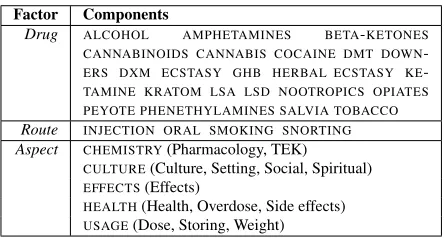
do-Factor Components
Drug ALCOHOL AMPHETAMINES BETA-KETONES CANNABINOIDS CANNABIS COCAINE DMT DOWN
-ERS DXM ECSTASY GHB HERBAL ECSTASY KE
-TAMINE KRATOM LSA LSD NOOTROPICS OPIATES PEYOTE PHENETHYLAMINES SALVIA TOBACCO Route INJECTION ORAL SMOKING SNORTING Aspect CHEMISTRY(Pharmacology, TEK)
CULTURE(Culture, Setting, Social, Spiritual)
EFFECTS(Effects)
HEALTH(Health, Overdose, Side effects)
[image:2.612.316.538.58.177.2]USAGE(Dose, Storing, Weight)
Table 1: The three factors of our model (details in§3.1). The forum tags shown in parentheses are grouped to-gether to form aspects.
main experts, we seek to model forums as a combi-nation of drug type, route of intake (oral, injection, etc.) and aspect (cultural settings, drug chemistry, etc.) A multi-dimensional topic model can jointly capture these factors, providing a more informative understanding of the data, and can be used to pro-duce fine-grained information such as the effects of taking a particular drug orally. Our hope is that mod-els such as f-LDA can lead to exploratory tools that aide researchers in learning about new drugs.
2.1 Corpus: Drugs-Forum
Our data set is taken fromdrugs-forum.com, a site active for more than 10 years with over 100,000 members and more than 1 million monthly readers. The site is an information hub where people can freely discuss recreational drugs with psychoactive effects, ranging from coffee to heroin, hosting in-formation and discussions on specific drugs, as well as drug-related politics, law, news, recovery and ad-diction. With current information on a variety of drugs and an extensive archive, Drugs-Forum pro-vides an ideal information source for public health researchers (Corazza et al., 2012).
3 Multi-Dimensional Text Models
Clinical researchers are interested in specific infor-mation about drug usage, includingdrugtype,route of administration, and other aspects of drug use (e.g. dosage, side effects). Rather than considering these factors independently, we would like to model these in a way that can capture interesting interac-tions between all three factors, because the effects and other aspects of drugs can vary by route of ad-ministration. Oral consumption of drugs often pro-duces longer lasting but milder effects than injec-tion or smoking, for example. Many mephedrone users report nose bleeds and nasal pain as a health effect of snorting the drug: this could be modeled as the triple (MEPHEDRONE,SNORTING,HEALTH), a particular combination of all three factors.
To this end, we utilize the multi-dimensional text model factorial LDA (f-LDA) (Paul and Dredze, 2012b), which jointly models multiple semantic fac-torsor dimensions. In this section we summarize f-LDA, then we describe an extension which incorpo-rates user-generated metadata into the model (§3.1). In a standard topic model such as LDA (Blei et al., 2003), each word token is associated with a la-tent “topic” variable. f-LDA is conceptually similar to LDA except that rather than a single topic vari-able, each token is associated with aK-dimensional vectorof latent variables. In a three-dimensional f-LDA model, each token has three latent variables— drug, route, and aspect in this case.
In f-LDA, each document has a distribution over all possible K-tuples (rather than topics), and each K-tuple is associated with its own word distribution. Under this model, words are gen-erated by first sampling a tuple from the docu-ment’s tuple distribution, then sampling a word from that tuple’s word distribution. In our three-dimensional model, we will considertriplessuch as (CANNABIS,SMOKING,EFFECTS).
Formally, each document has a distribution θ(d)
over triples, and each token is associated with a la-tent vector~zof sizeK=3. (We’ll describe the model in terms of the three factors we are modeling in this paper, but f-LDA generalizes toKdimensions.) The Cartesian product of the three factors forms a set of triples and the vector~z references three discrete components to form a triple~t= (t1, t2, t3). The
car-α
αd
θ φ
ω η
b γ
z w
D N K
K K
Q kZk
Q kZk P
[image:3.612.333.523.58.161.2]kZk
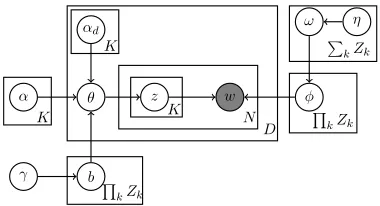
Figure 1: The graphical model for f-LDA augmented with priors η learned from labeled data (§3.1). In this work,K= 3.
dinality of each dimension (denotedZk) is the
num-ber of drugs, routes, and aspects, as shown in Table 1. Each triple has a corresponding word distribution
φ~t. The graphical model is shown in Figure 1.
One would expect that triples that have com-ponents in common should have similar word distributions: (CANNABIS,SMOKING,EFFECTS) is expected to have some commonalities with (CANNABIS,ORAL,EFFECTS). f-LDA models this
intuition by sharing parameters across priors for triples which share components: all triples with
CANNABIS as the drug include cannabis-specific
parameters in the prior, and all triples withSMOK
-INGas the route have smoking-specific parameters. Formally,φ~t(the word distribution for tuple~t) has a
Dirichlet(ˆω(~t)) prior, where for each word win the vector,ωˆw(~t)is a log-linear function:
ˆ
ωw(~t),expω(B)+ω(0)w +ωt1w(drug)+ωt2w(route)+ω(t3waspect)
(1) where ω(B) is a corpus-wide precision scalar (the bias),ωw(0) is a corpus-specific bias for wordw, and ωt(k)
kw is a bias parameter for wordwfor component tk of thekth factor. That is, each drug, route, and
aspect has a weight vector over the vocabulary, and the prior for a particular triple is influenced by the weight vectors of each of the three factors. The
ωparameters are all independent and normally dis-tributed around 0 (effectively L2 regularization).
ˆ
α~(d)
t for each triple~tdefined as:
ˆ
α(~d) t ,exp
α(B)+αt1(D,drug)+α(t1d,drug)
+α(t2D,route)+α(t2d,route)
+α(t3D,aspect)+α(t3d,aspect) (2)
Similar to the ω formulation, α(B) is a global bias parameter, while the αD vectors are corpus-wide weight vectors and αd are document-specific weight vectors over the components of each fac-tor. Structuring the prior in this way models the intuition that if a triple with a particular compo-nent has high probability, other triples containing that component are likely to also have high proba-bility. For example, if a message discusses triples of the form (CANNABIS,*,EFFECTS), it is more likely to discuss (CANNABIS,*,HEALTH) than (CO
-CAINE,*,HEALTH), because the message is about cannabis.
Finally, Bis a 3-dimensional array that encodes a sparsity pattern over the space of possible triples. This is used to accommodate triples that can be gen-erated by the model but are not supported by the data. For example, not all routes of administration may be applicable to certain drugs, or certain aspects of a drug may happen to not be discussed in the fo-rum. Each element b~t of the array is a real-valued
scalar in(0,1)which is multiplied withαˆ~(d)
t to
ad-just the prior for that triple. If the b value is near 0 for a particular triple, then it will have very low prior probability. Thebvalues have Beta(γ0,γ1)
pri-ors (γ <1) which encourage them to be near 0 or 1, so that they function as binary variables.
Posterior inference and parameter estimation con-sist of a Monte Carlo EM algorithm that alternates between an iteration of collapsed Gibbs sampler on the ~z variables (E-step), and an iteration of gradi-ent ascgradi-ent on theαandωhyperparameters (M-step). See Paul and Dredze (2012b) for more details.
3.1 Tags and Word Priors
In an unsupervised setting, there is no reason f-LDA would actually infer parameters corresponding to the three factors we have been describing. However, the forums include metadata that can help guide the model: the messages are organized into forums cor-responding to drug type (factor 1), and some threads
COCAINE SNORTING HEALTH η(Prior overω)
coke snort kidney
cocaine snorting hcv crack snorted pains
cola nose symptoms COCAINE
blow nasal guidelines SNORTING
lines drip diet HEALTH
ω(Prior overφ) φ(Posterior)
coke snort symptoms nose
cocaine snorting long-term cocaine crack snorted depression coke
[image:4.612.323.533.60.203.2]cola passages disorder blood rocks nostril schizophrenia water coca insufflating severe pain
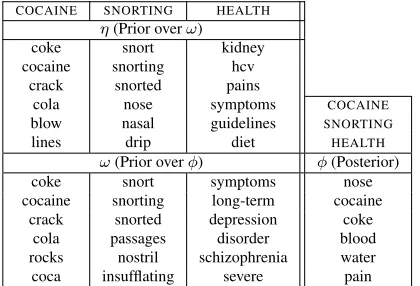
Figure 2: Example of parameters learned by f-LDA. The highest weight words in the ω and η vectors for three components are shown on the left. These are combined to form the prior for the word distributionφ. The tripling of (COCAINE,SNORTING,HEALTH) results in high proba-bility words about nose bleeds and nasal damage.
are tagged with labels corresponding to routes of ad-ministration and other aspects (factors 2 and 3). Tags for aspects are manually grouped into components: e.g. USAGE(tags: Dose, Storing, Weight). Table 1 shows the factors and components in our model.
One could simply use these tags as labels in a sim-ple supervised model—this will be our experimental baseline (§4.1). However, this approach has limita-tions in that most documents are missing labels (less than a third of our corpus contains one of the labels in Table 1) and many messages discuss several com-ponents, not just the one implied by the tag. For example, a message tagged “Side effects” may talk about both side effects and dosage. While a super-vised classifier may attribute all words to a single tag, f-LDA learns per-token assignments.
We will instead use the tags to inform the priors over our f-LDA word distribution parameters. We do this with a two-stage approach. First, we use the tags to train parameters of a related but simplified model. We then use the learned parameters as priors over the corresponding f-LDA parameters.
is to fixω asη, forcing the component weights to match the provided weights. However, in our caseη
will only be an approximation of the optimal com-ponent parameters since it is estimated from incom-plete data (only some messages have tags) and theη
vectors are learned using an approximate model (see below). Instead, these weight vectors will merely guide learning as prior knowledge over model pa-rametersω. While f-LDA assumes eachωis drawn from a0-mean Gaussian, we alter the means of the appropriateωparameters to useη.
ωw(0) ∼ N(ηw(0), σ2);ωiw(k)∼ N(ηiw(k), σ2) (3)
Recall thatω(0)w are corpus-wide bias parameters for
each word andωiw(k) are component-specific param-eters for each word. This yields a hierarchical prior in whichη parameterizes the prior overω, whileω
parameterizes the prior over φ (the word distribu-tions). The resultingωparameters can vary from the provided priors to adapt to the data. An example of learned parameters is shown in Figure 2, illustrating the hierarchical process behind this model.
Learning the Priors In various applications, pri-ors can come from many different sources, such as labeled data (Jagarlamudi et al., 2012). We learn the prior meansη from tagged messages. However, these parameters imply a latent division of responsi-bility for observed words: some are present because of the tag while others are general words in the cor-pus. As a result, they must be estimated.
We learn these parameters from the tagged mes-sages using SAGE, which model words in a docu-ment as combinations of background and topic word distributions. Eisenstein et al. (2011) present SAGE models for Naive Bayes (one class per document), admixture models (one class per token), and admix-ture models where tokens come from multiple fac-tors. We combine the first and third models, such that a document has multiple factors which are given as labels across the entire document—the drug type and the tag, which could correspond to a component of either the route or aspect factors. We posit the following model of text generation per document:
P(wordw|drug=i,factorf =j) (4)
= exp(η
(0)
w +ηiw(drug)+η(jwf)) P
w0exp(η (0) w0 +η
(drug) iw0 +η
(f) jw0)
This log-linear model has a similar form as Eq. 1, but with two factors instead of three, and it is a distribution rather than a Dirichlet vector. As in SAGE, we fixη(0)to be the observed vector of cor-pus log-frequencies over the vocabulary, which acts as an “overall” weight vector, while parameter esti-mation yields η(if), the logit parameters for the ith component of factorf.1 These parameters are then used as the mean of the Gaussian priors overω.
Standard optimization methods can be used to es-timate these parameters. The partial derivative of the likelihood with respect to the parameterηiw(drug)is:
∂
∂ηiw(drug)
=X
f X
j∈f
c(i, j, w)−π(i, j, w)c(i, j,∗)
(5) wherec(i, j, w) is the number of times wordw ap-pears in documents labeled withi(drug) andj(tag), andπ(i, j, w) denotes the probability given by (4). The partial derivative of eachηj(f)is similar.
4 Experiments with Topic Modeling for
Extractive Summarization
Our corpus consists of messages from
drugs-forum.com (§2.1). The site catego-rizes threads into many forums and subforums, including some on specific drugs, which are cat-egorized hierarchically. We treated higher-level categories with pharmacologically similar drugs as a single drug type (e.g.OPIOIDS,AMPHETAMINES);
for others we took the finest-granularity subforum as the drug type. We selected 22 popular drugs and from these forums we crawled 410K messages. We selected a subset of tags to form components for the route and aspect factors. (Some tags were too general or infrequent to be useful.) A list of the tags and drugs used appears in Table 1. We also included a GENERAL component in the latter two factors to model word usage which does not pertain to a particular route or aspect; the prior parameters
ηfor these components were simply set to0. We wish to demonstrate that our modified f-LDA model can be used to discover useful information in the text. One way to demonstrate this is by using the model to extract relevant snippets of text from the
1SAGE models sparsity on the weights via a Laplacian prior.
forums, which will form the basis of our evaluation experiments. Our goal is not to build a complete summarization system, but rather to use the model to direct researchers to interesting messages.
While we model all 22 drugs, our summa-rization experiments will focus on five drugs which have been studied only relatively recently:
mephedrone and MDPV (β-ketones),
Bromo-Dragonfly (synthetic phenethylamines), Spice/K2 (synthetic cannabinoids), and salvia divinorum. We will consider these drugs in particular because these are the five drugs for which technical reports were created by the EU Psychonaut Project (Schifano et al., 2006), an online database of novel and emerg-ing drugs, whose information is collected by reademerg-ing drug websites, including Drugs-Forum. Extensive technical reports were written about these five pop-ular drugs, and we can use these reports to produce reference summaries for our experiments (§4.2).
Of these five drugs, only salvia has its own sub-forum; the others belong to subforums representing the broader categories shown in parentheses. We simply model the drug type as a proxy for the spe-cific drug, as most of the drugs in each category have similar effects and properties. The first two drugs are both in the same subforum, so for the purpose of our model we treat mephedrone and MDPV as the single drug type,β-ketones. These two drugs are grouped together during summarization (§4.2), but the corre-sponding reference summaries incorporate excepts from the technical reports on both drugs.
4.1 Model Setup
Of the four drug types being considered for summa-rization, our data set contains 12K messages with one of the tags in Table 1 and 30K without. Of those without tags, we set aside 5K as development data. There are also over 300K messages (140K tagged) from the remaining 18 drug types: some of these messages are utilized when training f-LDA. Even though we only consider four drug types in our experiments, our intuition is that it can be benefi-cial to model other drugs as well, because this will help to learn parameters for the various aspects and routes of administration. Our model of the effects of mephedrone can be informed by also modeling the effects of other stimulants such as cocaine.
Each message was treated as a document, and we
only used documents with at least five word tokens after stop words, low-frequency words, and punc-tuation were removed. The preprocessed data sets contained an average of 45 tokens per document.
Below, we describe two f-LDA variants as well as the baseline used in our experiments.
Baseline Our baseline model is a unigram lan-guage model trained on the subset of messages which are tagged. We treat the drug subforum as a label for the drug factor, and each message’s tag is used as a label for either the route or aspect fac-tor. For example, the word distribution for the pair (SALVIA,EFFECTS) is estimated as the empirical dis-tribution from messages posted in the salvia forum and tagged with “Effects.” We use add-λ smooth-ing whereλis chosen to optimize likelihood on the held-out development set.
This is a two-dimensional model, since we explic-itly model pairs such as (MEPHEDRONE,SNORTING)
or (SALVIA,EFFECTS). However, we also cre-ated word distributions for triples such as (SALVIA,ORAL,EFFECTS) by taking a mixture
of the corresponding pairs: in this example, we estimate the unigram distribution from salvia documents tagged with either “Oral” or “Effects.”
Factorial LDA Because f-LDA does not rely on tagged data (the tags are only used to create priors), we can run inference on larger sets of data. The drawback is that despite these priors, it is still mostly unsupervised and we want to be careful to ensure the model will learn the patterns we care about. We thus add some reasonable constraints to the parame-ter space to guide the model further.
Reference Text System Snippet
Mephedrone (β-ketones/Bath salts)
It is recommended by users that Mephedrone be taken on an empty stomach. Doses usually vary between 100mg–1g.
• If it is SWIYs first time using Mephedrone SWIM recommends a 100mg oral dose on an empty stomach.
Reported negative side effects include: • Loss of appetite.
• Dehydration and dry mouth
• Tense jaw, mild muscle clenching, stiff neck, and bruxia (teeth grinding)
• Anxiety and paranoia
• Increase in mean body temperature (sweat-ing/Mephedrone sweat and hot flushes) • Elevated heart rate (tachycardia) and blood
pressure, and chest pains
• Dermatitis like symptoms (Itch and rash)
• Neutral side effects: Lack of appetite, occasional loss of visual focus, [...] weight loss, possible diuretic. Negative side effects: Grinding teeth, “Cotton mouth”, unable to acheive orgasm • Aside from his last session he has never experienced any
neg-ative symptoms at all, no raised heart beat, vasoconstriction , sweating, headaches, paranoia e.t.c nothing at all except some-times cold hands the next day.
• lot of people report that anxiety and paranoia are some of the side effects of taking mephedrone [...] is it also possible that alot of the chest pains people are experiencing is due to anxiety? • moisturize the affected areas of skin twice daily with E45 or a
similar unperfumed dermatalogical lotion.
Salvia divinorum
Sublingual ingestion of the leaf (quid): reduces intensity of effects and can taste disgusting. When Salvia is consumed as a smokeable for-mulation the duration of the trip lasts 30 min-utes or less, whereas if Salvia is consumed sub-lingually the effects lasts for 1 hour or more.
• The taste of sublingual salvia is foul and it is easy to have a dud trip unless large amounts of it are used.
• SWIM has heard from many other users that chewing the fresh leaves of the Salvia plant allow for a much longer and mellower trip. [...] SWIM has read that a trip this way can last anywhere from a half on hour or longer.
Dried leaves and/or salvia extract are smoked (using a butane lighter) either by pipe (consid-ered to be the most effective but is consid(consid-ered to be quite painful) or water bong.
• 2. Use a water pipe. Its harsh and needs to be smoked hot so this should be self explanatory. 3. Use a torch style lighter [...] Salvinorin A has a VERY high boiling point (around 700 degrees F I believe) so a regular bic just wont do it
Salvia is appealing to recreational users be-cause of intense, unique, hallucinatory effects. Brief hallucinations occur rapidly after admin-istration and are typically very vivid. Users re-port weird thoughts, feelings of unreality, feel-ings of immersion in bizarre non-Euclidian di-mensions/geometries, feelings of floating.
• He noticed very clear [closed eye visuals], which looked similar to patterns on a persian rug, or ethnic oriental design. SWIM felt as if he was moving around, that he had got up and run and fallen, and that falling had shattered the space around his body as if I’d fallen through many glass framed pictures [...] • I was aware of my body and my friends and my life below, but
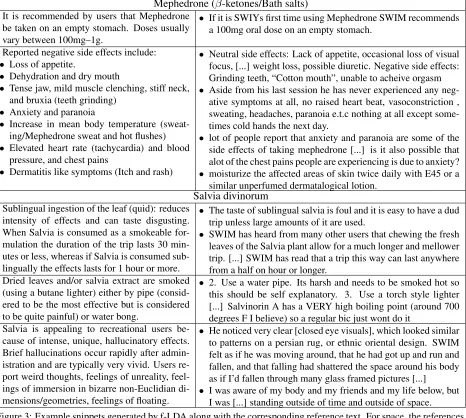
[image:7.612.76.542.76.494.2]I was [...] standing outside of time and outside of space. Figure 3: Example snippets generated by f-LDA along with the corresponding reference text. For space, the references and snippets shown have been shortened in some cases. “SWIM” and “SWIY” stand for “someone who isn’t me/you” and are used to avoid self-incrimination on the web forum.
2009), in which tags are used to restrict the space of allowed topics in a document.
We use f-LDA as a three-dimensional model which explicitly models triples, but we also obtain distributions for pairs such as (SALVIA,EFFECTS) by marginalizing across all distributions of the form (SALVIA,∗,EFFECTS). We trained f-LDA on two dif-ferent data sets, yielding the following models:
• f-LDA-1: We use the 12K messages with tags and fill the set out with 13K messages with tags uniformly sampled from the 18 other drugs, for a total of 25K messages.
• f-LDA-2: We use all 37K messages (many without tags) and fill the set out with 63K mes-sages with tags uniformly sampled from the 18 other drugs, for a total of 100K messages.
to the GENERAL components. We initialized ω to
its prior mean (Eq. 3), while the variance σ2 and
the initialization of biasω(B)are chosen to optimize likelihood on the held-out development set.
We optimized the hyperparameters and sparsity array using gradient descent after each Gibbs sweep. We use a decreasing step size ofa/(t+1000), where
t is the current iteration anda=10 for α and 1 for
ω and the sparsity values. To learn priors η, we ran our version of SAGE for 100 iterations of gra-dient ascent (fixed step size of 0.1). See Paul and Dredze (2012a) for examples of parameters (the top words associated with various triples) learned by this model on this corpus.
4.2 Summary Generation
We created twelve reference summaries by edit-ing together excerpts from the five Psychonaut Project reports ((Psychonaut), 2009). Each refer-ence is matched to drug-specific pairs and triples. For example, a paragraph describing the dif-ferences in effects of salvia between smoking and oral routes was matched to distributions for (SALVIA,EFFECTS), (SALVIA,SMOKING,EFFECTS), (SALVIA,ORAL,EFFECTS). Descriptions of creat-ing tinctures and blotters for oral consumption were matched to (SALVIA,ORAL,CHEMISTRY). We con-sider pairs in addition to triples because not all sum-maries correspond to particular routes or aspects.
For each tuple-specific word distribution (a pair or a triple), we create a “summary” by extracting a set of five text snippets which minimize KL-divergence to the target word distribution. We consider all over-lapping text windows of widths {10,15,20} in the corpus as candidate snippets. Following Haghighi and Vanderwende (2009), we greedily add snippets one by one with the lowest KL-divergence at each step until we have added five.
We only considered candidate snippets within the subforum for the particular drug, and snippets are based on the preprocessed topic model input with no stop words. Before presenting snippets to users, we then map the snippets back to the raw text by taking all sentences which are at least partly spanned by the window of tokens. Because each reference may be matched to more than one tuple, there may be more than five snippets which correspond to a reference.
1 2 3 4 5
0 50 100 150 200 250
Count
Histogram of Annotator Scores
[image:8.612.330.521.56.209.2]Random
Baseline
f-LDA-1
f-LDA-2
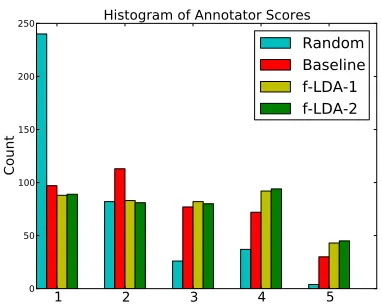
Figure 4: The distribution of annotator scores (§4.3.1). The “Random” counts have been scaled to fit the same range as the other systems, since fewer random snippets were shown to annotators.
4.3 Experimental Results
Recall that the reports used as reference summaries were themselves created by reading web forums. Our hypothesis is that f-LDA could be used as an exploratory tool to expedite the creation of these re-ports. Thus in our evaluation we want to measure how useful the extracted snippets would be in in-forming the writing of such reports. We performed both human and automatic evaluation on the sum-maries generated by f-LDA (variants 1 and 2) as well as our baseline. We also included randomly selected snippets as a control (five per reference).
Example output is shown in Figure 3.
4.3.1 Human Judgments of Quality
Three annotators were presented snippets pooled from all four systems we are evaluating alongside the corresponding reference text. Within each set corresponding to a reference summary, the snippets were shown in a random order. Annotators were asked to judge each snippet independently on a 5-point Likert scale as to how useful each snippet would be in writing the reference text.
Rand. Base. f-LDA-1 f-LDA-2
Annotator Scores
Mean 1.67 2.55 2.79 2.81
Pairs only n/a 2.58 2.79 2.72 Triples only n/a 2.50 2.80 2.95
ROUGE
[image:9.612.72.302.61.160.2]1-gram .112 .326 .355 .327 2-gram .023 .072 .085 .084
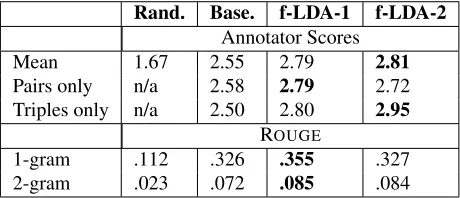
Table 2: Summary quality evaluation across four systems.
to word distributions for pairs versus word distri-butions for triples. The gap in scores between f-LDA and the baseline increases when we look at the scores for only triples: f-LDA beats the baseline by a margin of 0.45 for snippets matched to triples and 0.21 for pairs. This suggests that we produce better triples by modeling them jointly. For triples, f-LDA-2 (which uses more data) beats f-LDA-1 (which uses only tagged data), while the reverse is true for pairs. While some of the randomly selected control snippets happened to be useful, the scores for these snippets were much lower than those extracted through model-based systems. This suggests that exploring the forums in a targeted way (e.g. through our topic model approach) would be more efficient than exploring the data in a non-targeted way (akin to the random approach).
Finally, we asked two expert annotators (faculty members in psychiatry and behavioral pharmacol-ogy, who have used drug forums in the past to study emerging drugs) to rate the snippets corresponding to mephedrone/MDPV. The best f-LDA system had an average score of 2.57 compared to a baseline score of 2.45 and random score of 1.63.
4.3.2 Automatic Evaluation of Recall
The human judgments effectively measured a form of precision, as the quality of snippets were judged by their correspondence to the reference text, without regard to how much of the reference text was covered by all snippets. We also used the au-tomatic evaluation metric ROUGE (Lin, 2004) as a rough estimate of summary recall: this metric com-putes the percentage ofn-grams in the reference text that appeared in the generated summaries.
We computed ROUGE for both 1-grams and 2-grams. When computingn-gram counts, we applied Porter’s stemmer to all tokens. We excluded stop
words from 1-gram counts but included them in 2-gram counts where we care about longer phrases.2
Results are shown in Table 2. We find that f-LDA-1 has the highest score for both f-LDA-1- and 2-grams, sug-gesting that it is extracting a more diverse set of relevant snippets. When performing a paired t-test across the 12 reference summaries, we find that f-LDA is better than the baseline with p-values 0.14 and 0.10 for 1-gram and 2-gram recall, respectively. f-LDA’s recall advantage may come from the fact that it learns from a larger amount of data and it may learn more diverse word distributions by di-rectly modeling triples. f-LDA-1 had slightly better recall (under ROUGE), while f-LDA-2 was slightly better according to the human annotators.
5 Conclusion
We have proposed exploratory tools for the analy-sis of online drug communities. Such communi-ties are an emerging source of drug research, but manually browsing through large corpora is imprac-tical and important information could be missed. We have demonstrated that topic models are capa-ble of modeling informative portions of text, and in particular multi-dimensional topic models can tar-get desired structures such as the combination of as-pect and route of administration for each drug. We have presented an extension to factorial LDA tai-lored to a particular application and data set which was demonstrated to induce desired properties. As a technical contribution, this study lays out practical guidelines for customizing and incorporating prior knowledge into multi-dimensional text models.
Acknowledgments
We are grateful to Dr. Margaret S. Chisolm and Dr. Ryan Vandrey from the Johns Hopkins School of Medicine for providing the mephedrone/MDPV annotations, and Alex Lamb and Hieu Tran for as-sisting with the full annotations. We also thank Dr. Matthew W. Johnson for additional advice, and the anonymous reviewers for helpful feedback and sug-gestions. This research was partly supported by an NSF Graduate Research Fellowship.
2
References
D. Blei, A. Ng, and M. Jordan. 2003. Latent Dirichlet allocation.JMLR.
A. Chaney and D. Blei. 2012. Visualizing topic models. InICWSM.
O. Corazza, F. Schifano, M. Farre, P. Deluca, Z. Davey, C. Drummond, M. Torrens, Z. Demetrovics, L. Di Fu-ria, L. Flesland, et al. 2011. Designer drugs on the Internet: a phenomenon out-of-control? The emer-gence of hallucinogenic drug Bromo-Dragonfly. Cur-rent Clinical Pharmacology, 6(2):125–129.
Ornella Corazza, Fabrizio Schifano, Pierluigi Simonato, Suzanne Fergus, Sulaf Assi, Jacqueline Stair, John Corkery, Giuseppina Trincas, Paolo Deluca, Zoe Davey, Ursula Blaszko, Zsolt Demetrovics, Jacek Moskalewicz, Aurora Enea, Giuditta di Melchiorre, Barbara Mervo, Lucia di Furia, Magi Farre, Liv Fles-land, Manuela Pasinetti, Cinzia Pezzolesi, Agnieszka Pisarska, Harry Shapiro, Holger Siemann, Arvid Skutle, Aurora Enea, Giuditta di Melchiorre, Elias Sferrazza, Marta Torrens, Peer van der Kreeft, Daniela Zummo, and Norbert Scherbaum. 2012. Phenomenon of new drugs on the Internet: the case of ketamine derivative methoxetamine. Human Psychopharmacol-ogy: Clinical and Experimental, 27(2):145–149. Matthew Dunn, Raimondo Bruno, Lucinda Burns, and
Amanda Roxburgh. 2011. Effectiveness of and chal-lenges faced by surveillance systems. Drug Testing and Analysis, 3(9):635–641.
J. Eisenstein, A. Ahmed, and E. P. Xing. 2011. Sparse additive generative models of text. InICML.
Jacob Eisenstein, Duen Horng “Polo” Chau, Aniket Kit-tur, and Eric P. Xing. 2012. Topicviz: Semantic navigation of document collections. InCHI Work-in-Progress Paper.
EMCDDA. 2012. 2012 annual report on the state of the drugs problem in Europe. European Monitoring Centre for Drugs and Drug Addiction, Lisbon. Cathal T. Gallagher, Sulaf Assi, Jacqueline L. Stair,
Suzanne Fergus, Ornella Corazza, John M. Corkery, and Fabrizio Schifano. 2012. 5,6-methylenedioxy-2-aminoindane: from laboratory curiosity to ‘legal high’. Human Psychopharmacology: Clinical and Experi-mental, 27(2):106–112.
Jade Goldstein, Vibhu Mittal, Jaime Carbonell, and Mark Kantrowitz. 2000. Multi-document summarization by sentence extraction. In Proceedings of the 2000 NAACL-ANLP Workshop on Automatic summariza-tion, pages 40–48.
Aria Haghighi and Lucy Vanderwende. 2009. Exploring content models for multi-document summarization. In NAACL ’09: Proceedings of Human Language Tech-nologies: The 2009 Annual Conference of the North
American Chapter of the Association for Computa-tional Linguistics, pages 362–370.
Simon L. Hill and Simon H. L. Thomas. 2011. Clin-ical toxicology of newer recreational drugs. Clinical Toxicology, 49(8):705–719.
Marie Claire Van Hout and Tim Bingham. 2012. Costly turn on: Patterns of use and perceived consequences of mephedrone based head shop products amongst Irish injectors. International Journal of Drug Policy. Jagadeesh Jagarlamudi, Hal Daum´e III, and Raghavendra
Udupa. 2012. Incorporating lexical priors into topic models. InEACL.
Chin-Yew Lin. 2004. Rouge: A package for automatic evaluation of summaries. In Stan Szpakowicz Marie-Francine Moens, editor,Text Summarization Branches Out: Proceedings of the ACL-04 Workshop, pages 74– 81, Barcelona, Spain, July.
Q. Mei, X. Ling, M. Wondra, H. Su, and C. Zhai. 2007. Topic sentiment mixture: modeling facets and opin-ions in weblogs. InWWW.
David Mimno. 2011. Reconstructing Pompeian house-holds. InUAI.
Elizabeth M. Morgan, Chareen Snelson, and Patt Elison-Bowers. 2010. Image and video disclosure of sub-stance use on social media websites. Computers in Human Behavior, 26(6):1405–1411. Online Interac-tivity: Role of Technology in Behavior Change. Michael J. Paul and Mark Dredze. 2011. You are what
you Tweet: Analyzing Twitter for public health. In5th International AAAI Conference on Weblogs and Social Media (ICWSM).
Michael J. Paul and Mark Dredze. 2012a. Experiment-ing with drugs (and topic models): Multi-dimensional exploration of recreational drug discussions. InAAAI 2012 Fall Symposium on Information Retrieval and Knowledge Discovery in Biomedical Text.
Michael J. Paul and Mark Dredze. 2012b. Factorial LDA: Sparse multi-dimensional text models. In Neu-ral Information Processing Systems (NIPS).
M. Paul and R. Girju. 2010. A two-dimensional topic-aspect model for discovering multi-faceted topics. In AAAI.
Psychonaut WebMapping Research Group (Psycho-naut). 2009. Bromo-Dragonfly, MDPV, Spice, Mephodrone, and Salvia Divinorum reports. http://www.psychonautproject.eu/technical.php. Institute of Psychiatry, King’s College London. Daniel Ramage, David Hall, Ramesh Nallapati, and
Christopher D. Manning. 2009. Labeled lda: a super-vised topic model for credit attribution in multi-labeled corpora. InEMNLP, pages 248–256.
xylazine as a new drug of abuse and its health con-sequences among drug users in Puerto Rico. Journal of Urban Health, pages 1–8.
SAMHSA. 2012. The DAWN report. http://www.samhsa.gov/data/2k12/DAWN105/SR105-synthetic-marijuana.pdf, December 4.
Fabrizio Schifano, Paolo Deluca, Alex Baldacchino, Teuvo Peltoniemi, Norbert Scherbaum, Marta Tor-rens, Magi Farr˜o, Irene Flores, Mariangela Rossi, Dorte Eastwood, Claude Guionnet, Salman Rawaf, Lisa Agosti, Lucia Di Furia, Raffaella Brigada, Aino Majava, Holger Siemann, Mauro Leoni, Antonella Tomasin, Francesco Rovetto, and A. Hamid Ghodse. 2006. Drugs on the web: the Psychonaut 2002 EU project. Progress in Neuro-Psychopharmacology and Biological Psychiatry, 30(4):640 – 646.
Edmund Talley, David Newman, Bruce Herr II, Hanna Wallach, Gully Burns, Miriam Leenders, and Andrew McCallum. 2011. A database of National Institutes of Health (NIH) research using machine learned cate-gories and graphically clustered grant awards. Nature Methods.
Ivan Titov and Ryan McDonald. 2008. Modeling on-line reviews with multi-grain topic models. In Interna-tional World Wide Web Conference (WWW), Beijing. P.M. Wax. 2002. Just a click away: Recreational drug