0RELOH3UR[LHV
Benjamin Aziz, B.Sc.
A dissertation submitted to the University of Dublin, in partial fulfillment of
the requirements for the degree of Master of Science in Computer Science.
'HFODUDWLRQ
I declare that the work described in this dissertation is, except where otherwise stated,
entirely my own work and has not been submitted as an exercise for a degree at this or
any other university.
Signed: ________________________ Benjamin Aziz 17 September 1999
3HUPLVVLRQWROHQGDQGRUFRS\
I agree that Trinity College Library may lend or copy this dissertation upon request.
Signed: ________________________
Benjamin Aziz
$FNQRZOHGJHPHQWV
I would like to thank my supervisor, Mr. Christian Jensen, for his support and advice
without which this work would not have been possible. I would also like to thank the
teaching staff for all the knowledge they imparted to me throughout year.
Finally, I would like to thank my loving dad and mom for their support and
6XPPDU\
One of the important issues that are quite often a challenge in modern distributed systems
is the issue of adaptability.
The need for adaptability rises from the fact that these systems are very much open,
heterogeneous environments encompassing a wide range of hardware/software products
from an ever-increasing number of vendors. Therefore, mechanisms are needed that
allow these products to live and interact dynamically in a way that satisfies the different
performance and functionality requirements of their heterogeneous environments.
The Mobile Proxies (MP) project provides one such mechanism for client/server systems
that are integrated using the Common Object Request Broker Architecture (CORBA)
technology. The system achieves adaptability by exposing the low-level data traffic,
exchanged between clients and servers, to different functionality-manipulating programs,
each capable of modifying the data traffic in such a way that adaptability is achieved
between client and server environments.
The system design relies on two major principles: The first is the well-known proxy
principle, defined by Shapiro in 1986, and implemented in a number of middleware
technologies including CORBA. The other is the concept of interceptors defined by the
Object Management Group (OMG) as part of the CORBA v2.3 specification. These
interceptors allow the above-mentioned exposure of the low-level data.
The system combines these two principles such that a client is allowed to specialize the
proxy it has by downloading from the server, another proxy that performs some extra
functionality. The MP system then informs the server of the downloaded proxy, allowing
it in turn to specialize itself with the same type of functionality.
Two aspects of adaptability were taken into consideration when developing the system
and the functionality extensions it offers. The first is performance, which aims at
minimizing the communication overhead using performance-enhancement techniques
like compression. The second is security, where the issues of confidentiality, message
integrity, and trust of downloaded code were all taken into consideration using digital
7DEOHRI&RQWHQWV
Chapter One: Introduction 1
1.1 The Adaptability Problem 1
1.1.1 What is Adaptability? 1
1.1.2 How Important is Adaptability? 2
1.1.3 An Example 3
1.2 The Aim of the MP Project 4
Chapter Two: Survey 7
2.1 The Proxy Principle 8
2.1.1 Overview 8
2.2 The Common Object Request 10
Broker Architecture (CORBA)
2.2.1 Overview 10
2.3 The Jini™ Technology 13
2.3.1 Overview 13
2.3.2 Jini™ Goals 14
2.3.3 Why Java? 15
2.3.4 Jini™ System Structure 16
2.3.5 Jini and Mobile Proxies 17
2.4 Reliable Multicast proXy (RMX) 19
2.4.1 Overview 19
2.4.2 RMX Architecture 20
2.5 SPIN Operating System 22
2.5.1 Overview 22
2.5.2 SPIN System Design 23
2.5.3 Related Concepts 24
2.6 Spring Operating System 24
2.6.1 Overview 24
2.6.2 Spring System Structure 25
2.6.3 Related Concepts 27
Chapter Three: System Design 28
3.1 Overview of the General Scene 28
3.1.1 The Application 29
3.1.2 The ORB 29
3.1.3 The Environmental Repository 29
3.2 Five Steps to Adaptability 30
3.2.1 Step One 30
3.2.2 Steps Two and Three 31
3.2.3 Step Four 32
3.2.4 Step Five 33
3.2.5 The Problem of Concurrency 34
3.3 The MP System Design 36
3.3.1 The Client Adapter 36
3.3.2 The ORB Adapter 37
3.3.3 The Proxy Loader 37
3.3.4 The Class Loaders 37
3.3.5 The Server Adapter 38
3.4 The Functionality Design 38
3.4.1 The Functionality Tree 40
Chapter Four: System Implementation 43
4.1 Overview of the Implementation 43
4.2 The MobileProxies Package 44
4.2.1 Class MobileProxies.ClientEnvAdapter 44 4.2.2 Class MobileProxies.MobileProxyFactory 45 4.2.3 Class MobileProxies.ProxyLoader 46 4.2.4 Class MobileProxies.ServerEnvAdapter 46 4.2.5 Class MobileProxies.ServerIOCallback 47 4.2.6 Class MobileProxies.DummyTransformer 47 4.2.7 Class MobileProxies.MultiClassLoader 47 4.2.8 Class MobileProxies.FileClassLoader 48 4.2.9 Class MobileProxies.URLClassLoader 48 4.2.10 Class MobileProxies.PrivateKeys 49 4.2.11 Interface MobileProxies.Adaptable 49
4.3 The Functionality Tree Implementation 49
4.3.1 The Interceptors Level 50
4.3.2 The Functionality Level 51
4.4 The Environmental Repository and 52
The Decision Objects
4.4.1 The Decision Object 52
4.4.2 The Environmental Repository 52
4.5 The Runtime Interaction 53
Chapter Five: System Evaluation 58
5.1 The Application 58
5.1.1 Overview 58
5.2 Results of the Compression Functionality 62
5.2.1 Overview 62
5.2.2 The Results 64
5.3 Results of the Security Functionality 69
5.4 Concluding Points 71
Chapter Six: Conclusion 72
6.1 Review of the Adaptability Problem 72
6.2 Review of the MP System 73
6.3 Review of the Evaluation Results 74
6.4 Future Work 75
Appendix: Performance Results 76
A.1 Compression Performance Results 76
A.1.1 The PDF Files 76
A.1.2 The Repetitive-Number Files 78
A.2 Security Performance Results 79
References 81
List of Figures
Figure 1.1: An example of adaptability 3
Figure 2.1: The Proxy in a Distributed System 9
Figure 2.2: The Object Management Group 10
Object Management Architecture
Figure 2.3: The CORBA model 11
Figure 2.4: The Request- and Message- level Interceptors 12
Figure 2.5: An entity discovering a Jini federation 17
Figure 2.6: The RMX model 21
Figure 2.7: An invocation in Spring Operating System 26
Figure 3.1: The Mobile Proxies System and other entities 30
Figure 3.2: 31
1. The Client MPS sending an Environmental object
2. The decision-making process in the Environmental Repository
3. The Client MPS receiving a Decision object
Figure 3.3: 32
4. The Client MPS downloads the adaptable proxy, then
5. It sends the Decision object to the Server MPS
Figure 3.4: The interaction between the client 33
and the server using the MP system
Figure 3.5: Concurrency in the MP system 35
Figure 3.6: The different modules of the MP system 36
Figure 3.7: The MP system functionality tree 40
Figure 3.8: Adaptable proxies, interceptors 41
and functionality objects in action
Figure 4.1: Runtime Interaction 1 53
Figure 4.2: Runtime Interaction 2 54
Figure 4.3: Runtime Interaction 3 56
Figure 5.1: The file-sending application 60
Figure 5.2: Different time delays suffered by the data 63
Figure 5.3: The FileTransfer.sendData time with and 64
without the MP system for the PDF files
Figure 5.4: The DataTransfer.DataClient application time with 65
and without the MP system for the PDF files
Figure 5.5: The compression time versus the transmission time 65
for the FileTransfer.sendData method using
the MP system for the PDF files
Figure 5.6: The Breakeven point v. Network Speed 67
Figure 5.7: The FileTransfer.sendData time with and without 68
the MP system for the repetitive-number files
Figure 5.8: The DataTransfer.DataClient application time 68
with and without the MP system for
the repetitive-number files
Figure 5.9: The compression time versus the transmission time 69
for the FileTransfer.sendData method using
&KDSWHU2QH
,QWURGXFWLRQ
The rapid advances in modern computer science have facilitated the development of a
wide range of distributed technologies ranging from office-wide local area networks
(LANs) to the worldwide Internet. These technologies form a sophisticated environment
that encompasses every type of products (hardware and software) from an
ever-increasing number of vendors.
Being such an open environment means that changes take place so rapidly. New
products being added, old ones removed or upgraded, new standards, protocols and data
formats emerging all the time. It is in fact a very dynamic and heterogeneous
environment, and unless some mechanisms are devised to respond to these changes, the
integrity of the whole system is in question.
One of the technical answers to this problem is adaptability.
The Mobile Proxies (MP) project is one of many attempts that aimed at achieving
adaptability in distributed systems.
In this chapter, a general introduction will be made to the problem of adaptability,
explaining it with a simple example, and then clarifying the goal that is sought from this
project.
1.1 The Adaptability Problem
1.1.1 What is adaptability?
At the most basic level, adaptability may be defined as being the ability to alter a course
of action when new information becomes available [www1]. It might also be defined as
the ability of some entity to adjust (or adapt) itself to the requirements and capabilities of
In computer terms, a software entity, such as a client, a server, or a peer may have to
change its state and/or behavior whenever it interacts with another new entity. This
change may be necessary to make the interaction possible on one hand, and then carried
out in the best possible way (or at least to some acceptable level of satisfaction) on the
other hand.
The issue of adaptability rises from the fact that modern computer systems are
heterogeneous environments comprising a wide range of hardware/software products
from different vendors. This variety of products is driven by the openness of these
systems and it eventually raises the question of how adaptable entities living in such a
changing environment are, and at which level(s) of detail. Such a question can only be
answered once it is determined how satisfying a certain entity is performing in its
environment.
1.1.2 How Important is Adaptability?
To answer this question, it is necessary to realize what is really required of our entity.
This can be seen as either a matter of survival, where unless the entity adapts itself to the
rapidly changing environment, it won’t be able to continue in service and will have to be
changed by another more “adapting” entity. On the other hand, adaptability could only
be a matter of reaching some level of satisfaction in its performance, or in other words a
Quality of Service (QoS) level. Or even going one step further and trying to achieve a
best effort level of service. In either case, adaptability is desirable since it lengthens the
service lifetime, saves effort, time, and money.
Another important result of adaptability is to offer more flexibility and more freedom,
and hence facilitating mobility. It allows mobile systems to configure themselves
dynamically depending on the environment they are living in at the time and react
quickly to any changes in that environment. [Katz 1994] looks at the issue of adaptation
and mobility in wireless information systems where the awareness of the location and
1.1.3 An Example
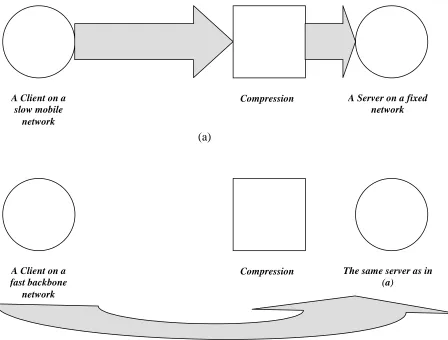
Let’s take one example of how adaptability can be used to optimize the interaction
between two entities. In our case, assume a client-server application where the server is
running on a host on a fixed network, and its client is running on a slow mobile network.
With the server being aware of the two environments, it might for example use some
performance enhancement techniques, like compression, to minimize the amount of data
being exchanged with the client and hence optimizing the use of the slow mobile network
[image:13.595.81.529.283.623.2]the client is running on.
Figure 1.1: An example of adaptability.
A Server on a fixed network Compression
A Client on a slow mobile
network
A Client on a fast backbone
network
The same server as in (a)
Compression (a)
Now another situation can occur with another client trying to interact with the same
server. This client is running on a fast backbone network for which compression would
be an overhead rather than performance raising. The server in this scenario, equipped
with knowledge of the client’s environment would have to adjust itself automatically to
the new situation and switch, for example, to another mode of operation. In this new
mode no compression is employed and data is exchanged directly knowing that this will
yield a better performance than if that data were compressed.
With this ability of the server to switch its modes according to the different clients it’s
interacting with means that the server is an adaptable one, and it’s trying to achieve the
optimal interaction with its clients. Figure 1.1 illustrates this example, where the server
in (a) is using compression in its communication with the client. In (b), the same server
has “adapted” to the new client and its new environment.
1.2 The Aim of the MP Project
Many of the middleware distributed paradigms today that are used to integrate
applications across a wide range of languages, operating systems, and network
architectures offer a good level of transparency that hides the underlying details and helps
ease the programmers task.
An application, for example, would not normally be aware of the data traffic that is going
in and out of the application, and therefore cannot control it. However, it is this
cross-level accessibility that would help some sort of intelligent adaptability that is at a high
level (i.e.; the applications level) and yet it controls the low level details (i.e.; the byte
level).
OMG’s Common Object Request Broker Architecture (CORBA), which will be
overviewed quickly in next chapter, defines the principle of interceptors, which expose to
the high level of applications, the low level bytes that are moving around between the
client and the server. These bytes once controlled and adjusted can enhance the
if the application is running on two networks separated widely by untrusted foreign
networks.
Another feature that is used by CORBA and is quite popular among other technologies as
well, like Remote Procedure Calls (RPC) and Java Remote Method Invocation (RMI) is
the proxy feature introduced by [Shapiro 1986] and also overviewed in next chapter.
A proxy represents the server locally at the client. It offers taking care of the low-level
details of requests and replies including the marshalling and unmarshalling of the data
sent. What it doesn’t offer is the access to those details, something that is possible with
interceptors.
The idea of this project is to implement a mechanism that combines the proxy principle
with interceptors and so it can be used to achieve adaptability between CORBA client
and server environments.
Any number of interceptors can be built each encapsulating a certain performance- or
security-enhancement functionality, like compression or encryption, that will be used in
modifying the traffic going out of and coming in to the client or server processes. A
number of functionality extensions can even be combined into one interceptor.
Once these interceptors have been built, they can be used to specialize any other piece of
code, including proxies. Therefore a number of proxies will come up to represent some
service and each will be rightly equipped to adapt a different client environment.
As we mentioned earlier, the project aims at building a system that offers a mechanism
by which a CORBA proxy, written in Java, will be specialized dynamically at runtime by
downloading different interceptors from the server depending on a previous decision.
This decision could have been reached through some interaction between the client and
either the server or a third entity that acts for example, as a repository containing
knowledge about the server’s environment. This entity should be able to reach a
decision, after examining the client’s environment, as to what functionality best suits the
client. Once the client is aware of this decision it can use the MP system to adapt to the
Two aspects of adaptability will be tackled. The first is performance, where the delay
incurred in sending and receiving data is cut by employing compression. The other
aspect is security, where a client may be running on a foreign network and hence all the
data sent and received would be susceptible to attacks from outside. Therefore,
encryption and digital signatures would be necessary to ensure the integrity and
authenticity of the all the messages exchanged with the server.
Iona’s OrbixWeb was chosen as the framework for this project because of the many
features it offers including its implementation of the principle of interceptors in the form
of filters and transformers.
On the other hand, Java 1.1 was used as then programming environment, because of the
&KDSWHU7ZR
6XUYH\
In this chapter, a number of concepts and technologies will be overviewed that have a
direct relationship to the project.
The first is the proxy principle introduced by Shapiro in a paper in 1986 [Shapiro 1986]
that appeared earlier in Nelson’s Remote Procedure Calls (RPC) [Nelson 1981]. The
paper defines the meaning of a proxy and its functionality as well as its properties in a
distributed system.
The proxy principle reappears in a number of modern middleware technologies of which
CORBA (Common Object Request Broker Architecture) is one of them and that provides
the general framework under which this project is built. CORBA will be overviewed
with a particular emphasis on the concept of interceptors, which, along with the concept
of proxies, constitute the two most important tools used in building the MP system and
reaching the goals behind it.
Also a number of other technologies are included to help make the overall picture clearer
and complete as to where the project started from, and what were the options available
before any real implementation took place. The chapter also shows where the system
stands in terms of what it tries to achieve and how those goals were tackled by other
technologies.
The first of these is the Jini™ technology put forward by Sun as a new approach to
distributed computing that, as we feel, has a number of common features with our
system, including mobility although, it is used in a different context.
Then there is the RMX (Reliable Multicast proXy) architecture, which aims at achieving
adaptability among client/server environments but at the level of IP multicast.
Two operating systems will also be overviewed, the first of these is Spin operating
[www3]. The system can be dynamically specialized to offer a different interface to meet
the requirements and performance of different applications and hence can be considered
an adaptable system.
The final system that is included in this chapter is Sun’s Spring system, which uses the
concept of proxies in network communication between a client and a server. These
proxies use different communication protocols and a host can have any number of them,
using the one that suits the other host with which communication session is established.
This could be envisioned as a form of adaptability, although in a completely different
context than the one with which the MP system is concerned.
2.1 The Proxy Principle
2.1.1 Overview
The first piece of work that directly relates to this project is the proxy principle as
introduced by Shapiro. The principle is widely used in modern distributed systems since
it reconciles flexibility with the capability of encapsulating a structured object behind a
black-box boundary.
The principle states that:” in order for a client to avail of some service, it must first
acquire a proxy for that service; the proxy being the only visible interface to the service.”
Which means that the principle is built on an object oriented model of computation,
which well adapts to distributed systems, since it allows to abstract processes, processors,
services, resources, and virtually everything into one concept, namely that of the object.
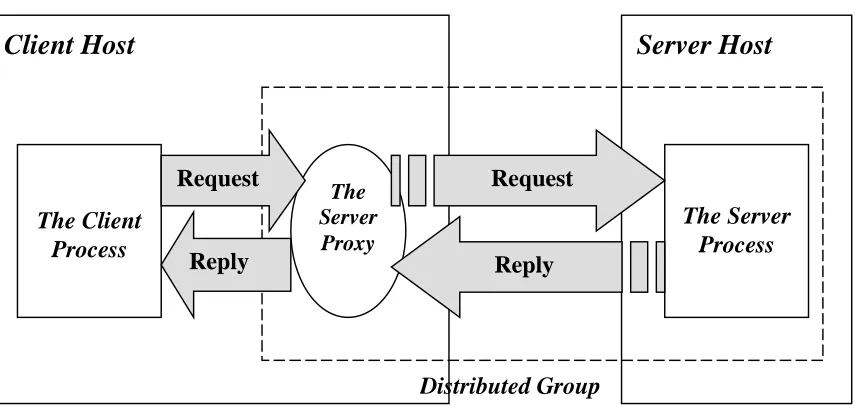
When an object is represented by a proxy, it’s called the proxy’s principal, and together,
they form a single distributed object called a group, as shown in figure 2.1.
Several properties for the proxy were mentioned in the paper, including the locality
property, which states that the proxy is always local to its client, and so the network
becomes transparent and all accesses are local from the client view. Also the proxy
encapsulates the service and hence becomes the only way to avail of that service, and it
also deals with all the marshalling of the data into a network-compatible format that is
Other properties were mentioned like the access protocol property, where a proxy
enforces a certain order on the client calls, the capability property, where it tests the
validity of calls before being dispatched to the server. Also the trusted communication
property, since both the proxy and its server had originated from the same source, and
finally the protocol encapsulation property, where the protocol between the server and
the proxy is hidden from the client.
An important consequence of the principle is whether it allows for the implementation of
open distributed systems, which are characterized by their ability for interprocess
communication, which facilitates resource sharing and makes them extensible and
independent from specific vendors. The encapsulation property touches on this matter
although it does not state explicitly its appropriateness for the heterogeneous
environments, which are a characteristic of open, distributed systems.
Concluding, the main idea behind the proxy principle is for the client to delegate the
responsibility of accessing a service (delivering the request and obtaining the result) to a
local proxy. This frees the client from many worries that rise from remote service
invocations, and it allows the implementation of the service to be changed without
[image:19.595.84.513.483.687.2]informing its clients.
Figure 2.1: The Proxy in a Distributed System.
Server Host
Client Host
The Server
Proxy
The Client Process
The Server Process
Request
Reply
Request
Reply
2.2 The Common Object Request Broker Architecture (CORBA)
2.2.1 Overview
CORBA is a standard devised by the Object Management Group (OMG) [www4]
representing an influential implementation of the Object Request Broker (ORB)
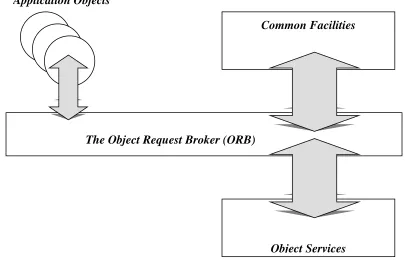
middleware. It is part of a wider architecture the OMG has dubbed, which is the Object
Management Architecture (OMA). The two architectures are shown in figures 2.2 and
2.3.
The OMA provides a reference model within which standards are developed. It uses
OMG’s object model, which provides the object semantics for specifying the visible
[image:20.595.86.491.332.592.2]characteristics of objects in a standard and implementation independent way.
Figure 2.2: The Object Management Group Object Management Architecture
The ORB as shown from figure 2.2 lies at the heart of the OMA: It is the communication
mechanism enabling objects to send and receive messages in a distributed, heterogeneous
environment. Around the ORB are various services, all provided by classes and objects,
which are invoked via well-defined interfaces. The language used to write these
interfaces is another standard OMG has devised, called the Interface Definition Language
The Object Request Broker (ORB)
Common Facilities
(IDL). This language achieves both location transparency (representing objects by object
references) and programming language transparency, hence allowing the implementation
behind the interface to be in one of several programming languages.
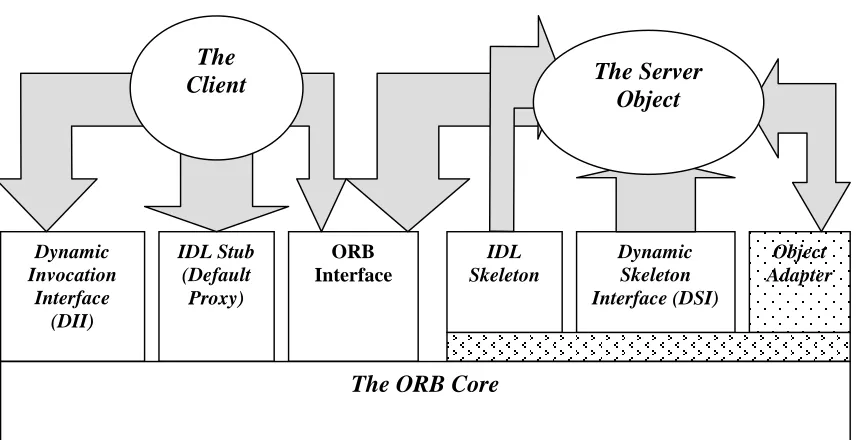
CORBA on the other hand portrays how the OMA can be implemented, and especially
the ORB part of it. It gives an abstract definition of the ORB’s functionality as a bus that
conveys requests from CORBA clients to CORBA object implementations (which is the
term used to describe an object that implements some service) leaving the actual
[image:21.595.85.513.297.517.2]implementation of the ORB to different vendors.
Figure 2.3: The CORBA model
The ORB is seen as composed of a number of components:
• The IDL Stub, which is the code generated for a specific IDL interface to allow static invocations to operations in that interface. It basically acts as a proxy to the
implementation object.
• The Dynamic Invocation Interface (DII) which is a way for making dynamic
invocations at runtime without any prior knowledge of the IDL interface. The
Interface Repository (IR) may then be queried to obtain information about the
operations and their parameters. Dynamic
Invocation Interface
(DII)
IDL Stub (Default
Proxy)
IDL Skeleton
Dynamic Skeleton Interface (DSI)
ORB Interface
Object Adapter
The ORB Core The
Client The Server
• The ORB Interface which offers an interface to miscellaneous services from the to clients and servers.
• The IDL skeleton, which is the code, generated for a specific IDL interface that invokes object implementations of that type.
• The Dynamic Skeleton Interface (DSI) which is a generic interface allowing interpretation of incoming requests to a server for IDL types that were unknown at
compile time.
• And finally, the Object Adapter, which defines standard interfaces to servers because the ORB Core is free to be implemented in a variety of ways (depending on the
vendor). Recently the Portable Object Adapter (POA) replaced the old standard
known as the Basic Object Adapter (BOA).
In addition to the above components, which are basically part of the ORB Core, there
exists another major part known as the ORB Services. These services are built on top of
the core part and they provide additional level of transparency and functionality to the
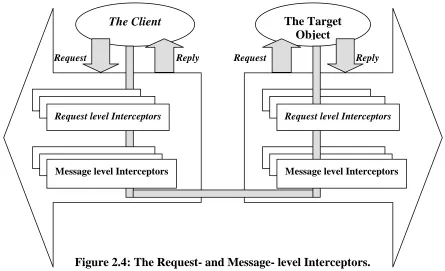
[image:22.595.75.520.439.710.2]application making the ORB look as if it’s a higher level entity.
Figure 2.4: The Request- and Message- level Interceptors.
The Client The Target
Object
Request level Interceptors
Message level Interceptors Message level Interceptors
Request level Interceptors
One of these services is the Security Service, which defines, under the Replaceable
Security option, the concept of Interceptors. The specification of interceptors as well as
their uses is described in [CORBA/IIOP v2.3 Spec. 1999] and figure 2.4 shows the two
types of interceptors: The Request level, and the Message level interceptors. The Request
level interceptor acts at a higher level (on the Request object) than the Message level
interceptor does. However, the latter is the one of direct interest to the MP project since
it allows access to the specific details of a message and hence permits certain
performance and/or security measures to act upon it just before it is sent over the
network.
2.3 The Jini™ Technology
2.3.1 Overview
Jini™ technology brought with it a new approach to distributed computing which, as
claimed, will change the traditional view of what computers are and how software should
be written for them.
The new technology is based on an extremely simple-to-use computing power distributed
across a diverse collection of devices all connected by a network and each able to share
with others’ resources. This view replaces the old notion of peripherals and applications
with that of network-available services and clients that use those services, all forming a
flexible distributed system that can change easily over time.
Many factors played a major role in developing this view. The fact that networks are an
expensive resource that live long and that are the central connecting tissues of all the
modern computing systems, had to be taken into consideration by the developers of
Jini™ Technology. Components, both hardware and software, are constantly added and
removed making it increasingly difficult to update these networks as a single entity.
Therefore, support for changing and updating network components, and the way these
components interact, without having to shut down the whole network each time (which is
an expensive and a difficult process) had to be provided.
A direct result of the above situation, and the fact that the new technology builds around
cannot be assumed by the users or the developers to have been designed especially for
that device. In fact, that code and data are often constructed and gathered well before the
device is designed or built.
Jini™ arose from a Sun research and development project that started in 1994 and that
was committed to dramatically simplifying the interaction among networked components.
The project was the inspiration of Sun cofounder and vice president Bill Joy who, with a
small team of engineers, worked for four years to develop the new paradigm for
distributed computing. And the result was small, very efficient, well-designed, and
powerful Java-based software that does not exceed 48K of Java software binaries.
2.3.2 Jini™ Goals
On top of the list of goals that Joy’s team maintained was to make adding an electronic
device to a network as easy as plugging in the base unit of a new cordless phone. Jim
Waldo, the chief architect, puts it in his own word [Byous 1999]: “One of the keys behind
the Jini system is that we have tried to erase the distinction between hardware and
software.” This implies that basically anything with a processor, some memory, and a
network connection, is allowed to offer services to other entities in the network or to use
the services that are so offered. This class of devices includes not only computers, but
also most of the things people usually think of as peripherals, like printers, storage
devices, and specialized hardware. The potential is also there to include other classes of
devices, such as cell phones, personal digital assistants, and microprocessor-controlled
devices, like televisions, stereo systems, and even, modern thermostats.
The other goal that was as well important was to facilitate distributed computing by
creating federations or communities of shared data, storage, and computing power, hence
allowing users to easily access the needed power and features of any device on the
network no matter what their individual capabilities are. Mike Clary, director of the
Jini™ project describes it: “With Jini technology, computing power could become a
service where computers on a network rent their ‘brains’ or processors out to other
computers.” This concept promotes the idea of spontaneous networking, where any
number of entities can combine spontaneously together for a period of time to avail of
The size of today’s networks and their rapid growth impose a final goal, or consequence
of the above goals. If every device (including embedded ones) is given the chance to be
part of the Jini structure, this will introduce the problem of scalability, probably, to levels
previously never thought of. In other words, a Jini network has to be able to scale and
adapt the increasing number of components that might be connected to it.
In short words, the Jini system aims at enabling users to share services and resources over
a network, regardless of the location, the nature (being hardware or software), or the
capabilities of those services and resources. Therefore simplifying the task of building,
maintaining, and altering a network of devices, software, and users.
2.3.3 Why Java?
To know why Java was chosen as the language of the system comes as no surprise. Java
offers a number of attractive features that help in achieving what Jini is aiming at. These
include for example, code mobility where a program can be executed anywhere after
being compiled into byte codes. This has promoted Java’s slogan:
“write-once-run-everywhere”. This allows code to be moved from somewhere else and loaded
dynamically into a running program, hence allowing a new state and behavior to be
added. Nonetheless, it also introduces serious security risk regarding the trust of the
mobile code, but this issue has been solved to a certain degree by Java’s security model
and its extensions.
The other feature of Java is the homogeneous environment it provides to its applications
by turning an otherwise heterogeneous network of computing entities into a
homogeneous collection of Java Virtual Machines (JVM). This will ensure a consistent
environment in which the Jini system can exist, allowing services to be able to run in
their clients’ environments.
As indicated above, the security model of Java would be another attractive features that
enables the Jini technology maintain safety through referential integrity, array-bounds
checking, and type safety. In addition to allowing fine-grain control of the operations
that can be performed by any program.
In general terms, the combination of code mobility, homogeneity, and security, allows
a spontaneous form of networking and allowing for the introduction of new services that
will extend the functionality of the federation.
2.3.4 Jini™ System Structure
The Jini system can be seen as composed of three high level components: The
infrastructure, the programming model, and the services. Each of these components is
regarded as a logical extension of the Java language to a fully distributed case.
The infrastructure defines the minimal core technology required to build a Jini federation.
It consists of three parts: A distributed security system, which builds on the Java Remote
Method Invocation (RMI) and extends the basic Java Virtual Machine security model.
Discovery and join protocols that allow different entities to discover and join a Jini
federation. Finally, a lookup service, which acts as a repository that contains information
about other services that are part of the federation, and allows clients to avail of those
services.
The programming model is a set of interfaces that enable the construction of reliable
services including those that are part of the infrastructure and those that join it later. It is
implemented as three sets of interfaces that are meant to extend Java in a way that will
permit connecting objects to the model in a robust and flexible way. The first of these
sets defines a distributed event model that is an extension of the standard Java event
model in JavaBeans™ and that enables event-based communication between Jini
services. The second set is a two-phase-commit protocol, which is a simplified
distributed version of the Java transaction service that allows Jini applications to
coordinate state changes. Finally, the last set of interfaces defines the notion of leasing,
which was developed especially for problems in resource allocation and reclamation in
distributed systems that might arise from entities leaving the federation. The leasing
model is a duration-based, renewable model.
The final component that defines a Jini system is the services component which is
enabled by the first two components. A service appears as an object with a well defined
set of operations that constitute its interface and that is determined by the type of the
service itself. A service may be used by other services or by clients interacting with the
service (like the JavaSpaces™), and a transaction manager, which enables entities to
participate in a Jini transaction protocol.
Sun’s Jini™ Architecture Specification [Jini™ Architecture Spec. 1999] provides a good
description of the Jini structure including its relationship with the Java language.
2.3.5 Jini and Mobile Proxies
The notion of proxies is a central one to the Jini technology enabling the idea of
spontaneous formation of entities into a federation and for other entities to join that
federation and use the services advertised in it.
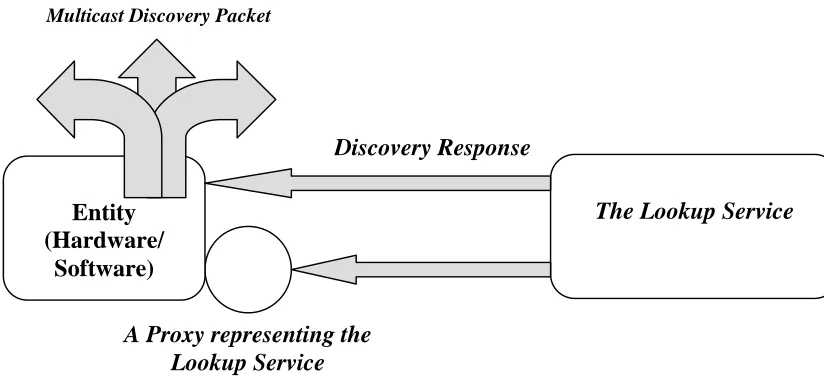
An entity that wants to join a Jini federation sends out a discovery request as a multicast
packet to some network asking for any lookup services in it. Upon receipt of that request,
a lookup service responds by sending back a proxy that represents that lookup service to
the requesting entity. This happens by downloading the proxy dynamically from the
lookup service to the requester with enough information that allows the latter to proceed.
This process is clarified in figure 2.5. The entity then proceeds to the next stage in which
it either decides to join the federation as a service, whereby it’ll be required to place a
proxy object representing it in the lookup service, or avails itself of some service(s) in the
[image:27.595.98.510.495.687.2]federation, in which case it behaves as a mere client.
Figure 2.5: An entity discovering a Jini federation Entity
(Hardware/ Software)
The Lookup Service
Multicast Discovery Packet
A Proxy representing the Lookup Service
This ability to download code at runtime is what distinguishes Jini proxies from proxies
used in other distributed technologies such as CORBA. A CORBA client for example,
has to know beforehand what the interface of the service it wants to use looks like. In
other words, it is linked statically to the proxy of that service, and the communication
knowledge between the proxy and the service is built into the client, despite the fact that
this knowledge is hidden from the client (the protocol encapsulation property, section
2.1). This implies that any changes made to this communication protocol have to be
coordinated in both the client and the service.
The mobility aspect of Jini’s proxies allows such changes to be private to the service and
the code sent to the client by that service. Effectively, these changes are only propagated
as needed without the client being aware of them.
Unlike Jini, which is a complete standalone distributed paradigm; the MP system is only
part of the CORBA middleware. However, the one important common feature between
the two is the mobility feature that allows information to be sent to the client depending
on some previous requirement. This requirement in the case of Jini is merely the need to
use some service. In the case of the MP system, it is the need to adapt the client and
service environments. Therefore, the nature of the downloaded code is different in the
two cases. In the MP system, unlike Jini, the client has to have beforehand a proxy to the
service it wants to use (called the default proxy). The downloaded proxies then are only
used to specialize the original, default proxy, in a way that will meet certain
environmental needs regarding performance or security, between the client and the
service. Jini proxies on the other hand are not used in the context of adaptability,
although the potential is very much there, and the technology as well.
Jini’s lookup service could also play a role in the MP system, although in a different way,
acting this time as an environmental repository that holds information about the clients
and services environments. Then it would respond to queries by sending a
2.4 Reliable Multicast proXy (RMX)
2.4.1 Overview
RMX is a generic model, presented by a number of researchers at Computer Science
department, UC Berkley [Chawathe et al 1998] as a solution to the adaptability problem
in heterogeneous environments during reliable multicast sessions.
The solution tackles the heterogeneity problem with a hybrid model that relies both on
end-to-end loss recovery mechanisms and an intelligent and application-aware adaptation
carried out within the network.
In multicast communication, the data sent by some source will be delivered to a number
of interested receivers according to a multicast routing tree. And although multicasting
offers enormous savings in bandwidth (especially for large-scale communication), it is
challenged by the fact that the environments for those receivers as well as the connecting
network are very much disparate. Consequently, a communication source is potentially
confronted with a wide range of path characteristics to each receiver, for example,
different delays, link rates, and packet losses. In addition to that, the source cannot
simply modify its stream transmission to satisfy the conflicting requirements of different
paths and the heterogeneous end-users.
So, the proxy model is adopted to actively transform the transmission to each receiver in
a way that will bridge the gap between the end environments and any route requirements.
Moreover, this will even allow communication, in the first place, among otherwise
incompatible receivers.
The model suggests a twofold solution. First, it relaxes the semantics of reliability,
lifting the constraint that all receivers advance uniformly with the sender’s data stream,
and allowing each receiver to define its own level of reliability. The second is
decoupling the members of the reliable multicast session through a proxy-based
communication model.
The end receivers will interact with the proxy to customize their transport decisions and
reliability semantics in a fine-grained, application-specific fashion, using
2.4.2 RMX Architecture
A number of features characterize the RMX design. These include the exposure of
application-specific information to optimize the receiver/network adaptation process and
to tune the transport protocol, otherwise known as the cross-level optimization or
information accessibility (as mentioned in 1.2) and the leveraging of the data semantics
when creating data adaptation algorithms
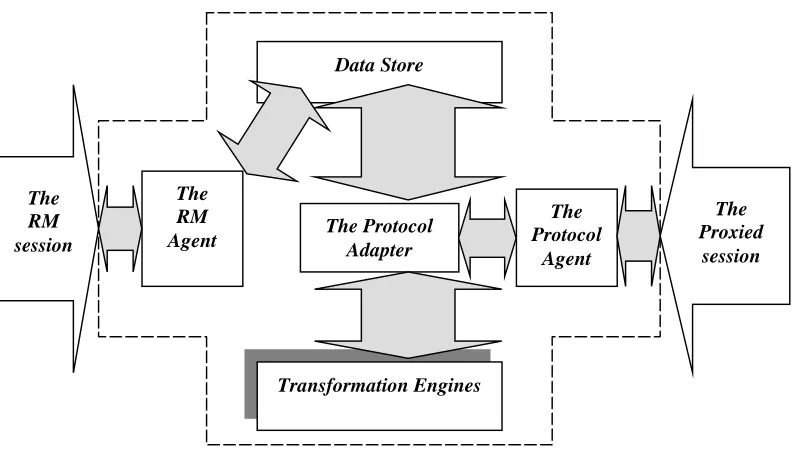
The model basically splits the communication session into two sub-sessions: the RM
session (or the main multicast session) and the proxied session. The RM agent interfaces
with the RM session whereas the Protocol agent interfaces with the proxied session. The
model also has a Protocol Adapter that uses transformation engines in transforming the
data store between the formats of the two sessions. This architecture is shown in figure
2.6.
The RM agent participates in the RM session on behalf of the RMX client (the receiver)
handling all the details of the communication protocol. At the same time, it builds a data
store of all the data that is part of the reliable session. Both the main and the proxied
sessions update the data store, with the RM agent adding the main session data and
propagating the proxied session data. The RM agent uses loss recovery mechanisms in
the event that the store is lost due to a system crash, recovering the data from other agents
that have participated in the reliable multicast session.
The Protocol Adapter and the Protocol Agent provide the interface to the proxied session.
The Protocol agent implementing the actual communication protocol used with the
clients. It could be a totally different protocol than the one used in the RM session. The
Protocol Agent is designed based on Application level Framing (ALF) principles and the
characteristics of the proxied clients and the network separating them. On the other hand,
the RM Agent may only apply simple congestion control techniques to limit the
transmission rate.
The Protocol Adapter is the most sophisticated element in the RMX model. It not only
provides the required functionality for heterogeneous environments, but also relies
Figure 2.6: The RMX model
The Protocol Adapter also maintains a connection object for every client connected to the
proxy, which encapsulates the state of that client at the proxy. This up-to-date
information is used to assist the Protocol Adapter in the adaptation process. This process
mainly appears in three forms of dynamic adaptation: rate adaptation which reduces the
data flow rate, data transformation which transforms the format of the data, and protocol
conversion which switches between different reliable multicast protocols depending on
application-level information.
In addition to the above architecture, the model also describes how an RMX client locates
an RMX point of contact inside a network using the Scalable Network Service (SNS)
architecture also developed in UC Berkeley [Chawathe, Brewer 1998].
2.4.3 Related Concepts
The RMX model is an attempt to achieve adaptability at the network level for reliable
multicast sessions, which is related to the overall adaptability problem that the MP
system tries to solve but in a different context, i.e. that of the CORBA environments.
The model brings forward a number of related concepts and features apart from the
common adaptability goal. It uses a proxy-based design that adjusts the data flow The
RM session
The Proxied
session Data Store
The Protocol Adapter The
RM Agent
The Protocol
Agent
between the sender and the receivers depending on the different environments, the state
of the network, and application-level characteristics.
However, the term proxy is used to convey the simple meaning of an intermediary
between the client and the server, which is somehow different than the view adopted in
middleware systems that a proxy as a representative of a service having the exact
interface and being local to the client.
In the context of CORBA, RMX would fall in the same classification as an interceptor
that has access to the low level data bytes of the application. Nonetheless, RMX also has
access to application level information, which adds more complexity to it than a mere
interceptor.
The model also touches on performance-enhancement techniques like compression, and
transport-layer-specific techniques like protocol conversion and data flow rate control.
Compression in particular was used in the MP project as an example of controlling the
output from the client to the server and vice versa. The security aspect was left out of the
RMX model.
2.5 SPIN Operating System
2.5.1 Overview
SPIN operating system was developed by a group of researchers [Bershad et al 1995]
from UC Berkley as a project sponsored by the Advanced Research Projects Agency
(ARPA), the National Science Foundation (NSF) in 1995.
The project was aimed at designing an operating system that could be dynamically
specialized and extended so that it could (safely) meet performance and functionality
requirements of the applications using it.
Such requirements are often poorly matched by operating systems and therefore result in
either the application not working well, or not working at all. For example, modern
operating systems employ disk buffering and paging algorithms that could pose potential
performance degradation for certain types of applications like database applications.
high-throughput parallel applications. Other applications have their own special needs
that are not always met by operating systems, like multimedia clients and servers, fault
tolerant systems, and real-time-data applications.
SPIN is described as an extensible operating system that can provide an extension
infrastructure, represented by a set of interfaces, to its applications in such a way that will
best meet the demands of those applications. These extensions allow the application to
“specialize” the underlying operating system and to grant fine-grained access to system
resources in a safe and low-cost way. This access has to be controlled to ensure safety,
whereas good performance is only achieved by low communication overhead between
the extensions and the operating system kernel.
2.5.2 SPIN System Design
The design of SPIN relies basically on four techniques implemented at the level of the
language in which it was written, or it runtime. These techniques are Co-location, which
enables communication between the system and the set of extensions to have a low
overhead. Also enforced modularity, through which modules are isolated from one
another by boundaries that are well defined by their interfaces. Extensions were written
in Modula-31, a modular programming language. The other technique used was the
logical protected domains2, which ensured that extensions were executed in separate
namespaces protecting their effects from other programs. And finally, extensions were
only allowed to execute in response to system events, which described potential actions
in the system, like a virtual memory page fault or the scheduling of a thread. This is
termed as the dynamic call binding.
However, it should be noted that these techniques do not guarantee extensibility. It is
only guaranteed by the infrastructure functionality provided by the set of extensions and
accessed through the exported interfaces.
1 v-Promela is a recent Visual Object-Oriented language proposed for SPIN, see [Leue et al 1999]. 2
In general, SPIN system design encompasses two models, the protection model and the
extension model. The protection model controls the set of operations that can be applied
to resources. It ensures that a process can only access the memory within a particular set
of virtual addresses. It makes use of the notion of capabilities, which are unforgeable
references to a resource. As mentioned above, the protected domains are used in defining
the set of accessible names available to an execution context.
The extension model provides a controlled communication facility between the
extensions and the core system operating system allowing for a variety of interaction
styles.
These two models provide the framework for managing interfaces between services
within the system.
2.5.3 Related Concepts
The SPIN operating system is an adaptable, dynamic, flexible system providing different
functionality extensions to the applications using it. In other words, it aims at adapting
the needs of those applications although this adaptability is more at the high level of
applications rather than the low level environment adaptation that represents the goal of
the MP project. However, the extensibility represented by the set of interfaces, each
providing a different functionality appears in the form of the mobile proxies, each of
which carries with it a different form of specialization when sent to the client. The
difference should be noted though in the two systems, since SPIN is an operating system,
whereas MP is part of an integrating middleware, i.e. CORBA.
2.6 Spring Operating System
2.6.1 Overview
Spring is a highly modular, distributed, multi-threaded operating system that not only
supports object-oriented applications but also is object-oriented in itself.
The system was developed in Sun Microsystems Laboratories by a group of researchers
[Mitchell et al 1993] who were working on a clean sheet design for a new operating
many of the good features of Unix as possible, like good performance, memory
protection, and network interoperability. However, it would improve in areas that
suffered from problems, like the cost of maintenance, the inflexible security aspect, and
the difficulty of supporting time-critical media.
Because the design was a fresh one, the opportunity was there to make full use of the best
available technology to come out with an open and flexible system, that is able to evolve
and be extended by different vendors. Such a system would have to pay attention to the
different components that construct it and the interfaces between them. This requirement
immediately dictated a system structured around the notion of objects that are defined by
strong interfaces specifying what these objects do and leaving the actual implementation
open. These interfaces allowed operation invocations to be type safe, secure, and
uniform, whether the client invoking a method is in the same address space, in another
address space, or on a different machine altogether.
Further, in order that these interfaces are defined without tying them to a particular
programming language (and hence undermining the openness of the system), an Interface
Definition Language (IDL) was used. This language is basically the same as the one
adopted by OMG.
2.6.2 Spring System Structure
Spring is designed using the microkernel approach. The kernel supports basic cross
domain invocations and threads, low-level machine-dependent handling, as well as basic
virtual memory support for memory mapping and physical memory management.
A typical Spring node runs several system servers in addition to the kernel. Two of these
run in the kernel mode: The nucleus and the virtual memory manager.
The nucleus manages process and inter-process communication, and it supports three
basic abstractions: domains, which are analogous to Unix processes, threads, which
execute within domains, and doors which support object-oriented calls and provide entry
points between domains.
The virtual memory manger controls the memory management hardware. The rest of the
system services, including naming, paging, network IO, file systems, keyboard
These services are available on all the nodes in a distributed system and basically provide
access to the system resources they manage through their interfaces allowing clients to
use those resources in a safe way by invoking operations on these interfaces.
Also appearing in the Spring structure are network proxies that support invocations
among objects across the network. However, they are normal user-mode server domains
that receive no special support from the nucleus. A Spring machine might have any
number of them, that speak different network protocols.
Spring proxies transparently forward door invocations between domains on different
machines with neither the client nor the server being aware of their existence. Network
addresses and handles are used in identifying these proxies and the doors using them.
Figure 2.7 shows how an invocation is routed from the client to the server through doors
[image:36.595.85.521.361.537.2]and network proxies.
Figure 2.7: An invocation in Spring Operating System [Mitchell et al 1993]
[Nelson et al 1993] provides a further outlook into the structure of the Spring file system
and the Spring virtual memory system respectively.
Client Domain
Nucleus B Door Y
Server Domain Proxy
A
Nucleus A Door X Proxy
2.6.3 Related Concepts
The Spring operating system is another example of how proxies can be used as
intermediaries between client/server communication. Although Spring proxies have a
limited functionality regarding adaptability at the low level of data bytes, yet it could be
argued that they are working at the protocol level simply by having the system use the
suitable proxy depending on what protocol the server speaks. This however is the only
common concept that would fall into the same set of concepts that the MP system relies
&KDSWHU7KUHH
6\VWHP'HVLJQ
In this chapter, a high level description of the MP system design is given with all its
major parts and the way these parts combine to make up the system.
Also described are the performance and security techniques employed in providing
distributed applications that use the system, with the extra functionality needed by those
applications to enhance the interaction between different components of the application.
The chapter begins with an overview of the general scene in which the MP system works
and the other entities with which it interacts.
One of these entities is the Environmental Repository, which alongside the
Environmental and Decision objects, will also be overviewed but only in general without
going into further details, as it does not form a part of the project, but is rather a separate
system that deserves its own research.
3.1 Overview of the General Scene
The MP system basically provides a mechanism by which applications using the CORBA
middleware can adapt to different environments and meet the different requirements of
the applications. However, in order for the MP system to meet its expected goals and
become fully functional, other parties are assumed to exist.
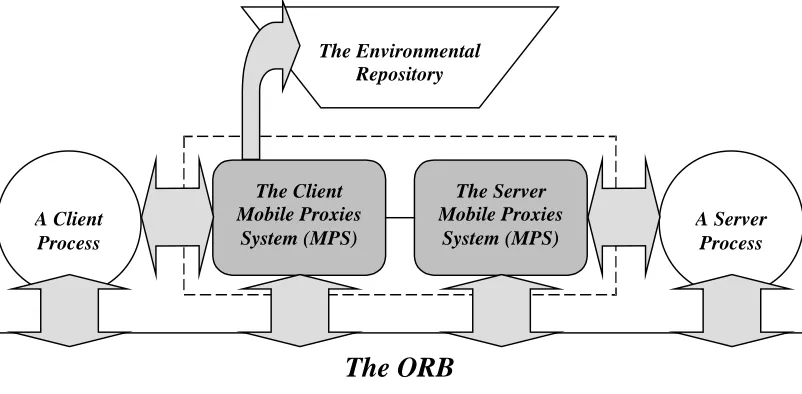
The overall scene is depicted in figure 3.1 with basically three major entities that the MP
system has to interact with. These are:
• The Application
• The Object Request Broker (ORB)
3.1.1 The Application
This is just an ordinary CORBA-integrated application, comprising a client process that
uses a server object reachable through the ORB. The client makes all the method
invocations through the local proxy that represents the server object1.
The server process will also be the provider of a number of adaptable proxies2. These
proxies carry the same exact interface of the server process but also implement a certain
interface that will make them adaptable.
The current version of the MP system only supports applications using OrbixWeb from
Iona.
3.1.2 The ORB
The ORB was briefly discussed in section 2.2 being the integrating bus that carries the
requests sent from clients to different server objects living in the CORBA environment.
3.1.3 The Environmental Repository
Finally, there is the Environmental Repository, a new concept suggested throughout this
project that is meant to fill two roles. The first is being a holder for the description of
different services and the environments in which these services live. The second is to
compare this description with that of the clients willing to avail of these services in a
decision-making process.
The description of the services and their environments could be some form of Meta data
that must be standardized in order for the description to be valid across different
repositories and the clients interacting with them.
The Environmental objects will be used to represent the description of different
environments. This description could be a set of parameters or variables that control the
state of these objects and that reflect the state of the environment they represent. They
will also contain Application Level Data (ALD) necessary for the decision-making
process. The outcome of the latter process would then be embedded in a Decision object.
The Environmental Repository might use any techniques in reaching its decision, ranging
from simple if-then rules, to high-level intelligent methods like Case Base Reasoning
(CBR).
It is important to note that the MP system will be part of both the client and the server
processes. These two parts will be referred to as the Client MPS and the Server MPS
respectively. They basically provide a set of APIs that the client and the server processes
[image:40.595.108.509.265.462.2]will have to call in order to initiate and end the adaptation process.
Figure 3.1: The Mobile Proxies System and other entities
3.2 Five Steps to Adaptability
3.2.1 Step One
The first step in the interaction process between different entities starts with the Client
MPS contacting the Environmental Repository on behalf of the client process and
supplying it with an Environmental Object. This object will describe the client’s
environment as well as any other parameters that would be useful in deciding the
necessary functionality that will control the flow of data between the client and server.
This point marks the beginning of the adaptation process. The Environmental
Repository
A Client Process
A Server Process The Client
Mobile Proxies System (MPS)
The ORB
The Server Mobile Proxies
3.2.2 Steps Two and Three
The repository then undergoes a decision-making process that ends with a decision made
as to what functionality should be used. This decision will then be passed to the Client
MPS in the form of a Decision object. This is shown in figure 3.2.
The Decision object will normally hold the decision as a URL pointing to the location of
the adaptable proxy at the server site. Along with the URL will also be its digital
signature, which will be used in verifying the source of that URL. The object may also
hold other information related to the server, such as any digital keys or certificates that
would be necessary for security purposes, such as authentication or message
confidentiality, specially that code mobility is involved.
Again the emphasis here is on the fact that these objects, as well as the Environmental
ones, have to have a standard format that will be compatible everywhere, regardless of
the application or the environment it’s built in.
Figure 3.2:
4. The Client MPS sending an Environmental object
5. The decision-making process in the Environmental Repository
6. The Client MPS receiving a Decision object The
Environmental Repository
The Mobile Proxies (MP)
System A Client
Process
The Client Process
Environmental
Object 1
3 Decision Object Decision-making process
3.2.3 Step Four
The next step involves the Client MPS downloading the adaptable proxy along with any
code referenced by it from the server process and then installing it in the client process.
This step is depicted in figure 3.3.
The code mobility aspect was preferred to the other choice, i.e. the client having all the
necessary adaptable proxies locally stored (just as it has the default proxy) and loaded at
runtime into the JVM. Being mobile meant that the same advantages mentioned in
section 2.3.3 would be retained, as well as, adding an extra advantage, i.e. that of
extensibility.
Figure 3.3:
6. The Client MPS downloads the adaptable proxy, then
7. It sends the Decision object to the Server MPS
Extensibility here refers to the fact that the server is free to implement as many of the
adaptable proxies as it wishes without having to notify the client. New proxies can be
added and older ones removed depending on the necessity. This also allows for a
lightweight client that does not have, at compilation time, more than the default proxy
generated by the CORBA IDL compiler. The Mobile
Proxies (MP) System
The Client Object
The Client Process
The Mobile Proxies (MP)
System
The Server Process
The Server Object
The ORB
Adaptable Proxy
Decision Object
4
3.2.4 Step Five
After downloading the necessary code, the Client MPS will send the Decision object
across to the Server MPS through the ORB. This will distribute the knowledge of the
outcome of the decision-making process between the client and the server processes and
so an agreement will have been reached as to what functionality should both sides use to
best match their needs.
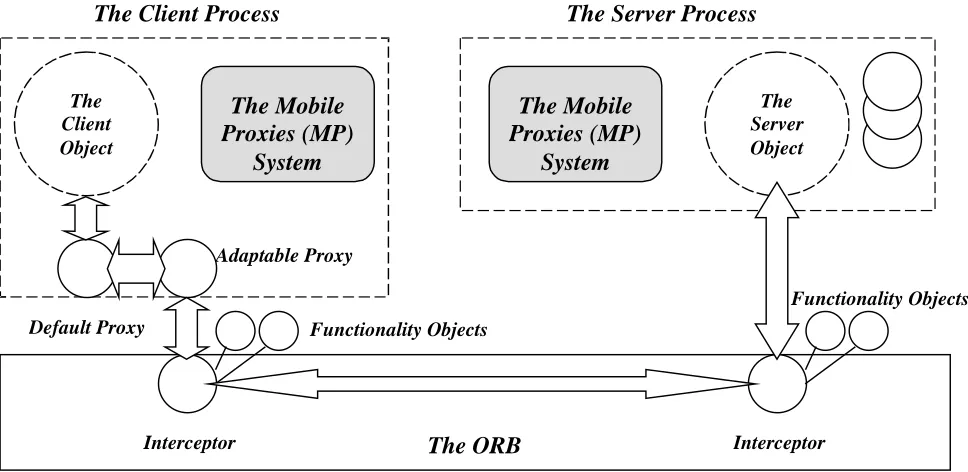
The Client MPS will then call a method in the adaptable proxy to install the necessary
interceptor in the client process. The same thing takes place on the server side, with the
Server MPS installing another interceptor that complements the client-side interceptor.
These interceptors are only used to expose the low-level data bytes running between the
two processes. A number of objects each implementing a different functionality is then
used to modify and control these bytes. The functionality of these objects is defined
[image:43.595.79.563.380.616.2]through a set of interfaces.
Figure 3.4: The interaction between the client
and the server using the MP system
It is important to keep in mind that all these objects are downloaded as necessary from
the server site at runtime.
The Mobile Proxies (MP)
System
The Client Object
The Client Process
The Mobile Proxies (MP)
System
The Server Process
The Server Object
The ORB
Adaptable Proxy
Default Proxy
Interceptor
Functionality Objects
Functionality Objects
![Figure 2.7: An invocation in Spring Operating System [Mitchell et al 1993]](https://thumb-us.123doks.com/thumbv2/123dok_us/1408291.676186/36.595.85.521.361.537/figure-invocation-spring-operating-mitchell-et-al.webp)