Improving the Quality of Minority Class Identification in Dialog Act Tagging
Adinoyi Omuya 10gen
New York, NY, USA [email protected]
Vinodkumar Prabhakaran CS, Columbia University
New York, NY, USA [email protected]
Owen Rambow CCLS, Columbia University
New York, NY, USA [email protected]
Abstract
We present a method of improving the perfor-mance of dialog act tagging in identifying mi-nority classes by using per-class feature opti-mization and a method of choosing the class based not on confidence, but on a cascade of classifiers. We show that it gives a minor-ity class F-measure error reduction of 22.8%, while also reducing the error for other classes and the overall error by about 10%.
1 Introduction
In this paper, we discuss dialog act tagging, the task of assigning a dialog act to an utterance, where a dialog act (DA) is a high-level categorization of the pragmatic meaning of the utterance. Our data is email. Our starting point is the tagger described in (Hu et al., 2009), which uses a standard multi-class classifier based on support vector machines (SVMs). While the performance of this system is pretty good as measured by accuracy, it performs badly on the DA REQUEST-ACTION, which is a rare class. Multi-class SVMs are typically implemented as a set of SVMs, one per class, with the overall choice of class being determined by the SVM with the highest con-fidence (“one-against-all”). Multi-class SVMs are typically packaged as a single system, whose inner workings are ignored by the NLP researcher. In this paper we show that, for our problem of DA classi-fication, we can boost the performance of the rare classes (while maintaining the overall performance) by performing feature optimization separately for each individual classifier. But we also show that we
can achieve an all-around error reduction by alter-ing the method by which the multi-class classifier combines the individual SVMs. This new method of combination is a simple cascade: we run the in-dividual classifiers in ascending order of frequency of the classes in the training corpus; the first classi-fier to classify the data point positively determines the choice of the overall classifier. If no classifier classifies the data point positively, we use the usual confidence-based method. This new method obtains a 22.8% error reduction for the minority class, and around 10% error reduction for the other classes and for the overall classifier.
This paper is structured as follows. We start out by discussing related work (Section 2). We then present our data in Section 3, and in Section 4 we present the experiments with our systems and the re-sults. We report the results of an extrinsic evaluation in Section 5, and conclude.
2 Related Work
Dialog act (DA) annotations and tagging, inspired by the speech act theory of Austin (1975) and Searle (1976), have been used in the NLP community to un-derstand and model dialog. Initial work was done on spoken interactions (see for example (Stolcke et al., 2000)). Recently, studies have explored dialog act tagging in written interactions such as emails (Co-hen et al., 2004), forums (Kim et al., 2006; Kim et al., 2010b), instant messaging (Kim et al., 2010a) and Twitter (Zhang et al., 2012). Most DA tagging systems for written interactions use a message/post level tagging scheme, and allow multiple tags for each message/post. In such a tagging scheme,
vidual binary classifiers for each tag are independent of one another. However, recent studies have found merit in segmenting each message into functional units and assigning a single DA to each segment (Hu et al., 2009). Our work falls in this paradigm (we choose a single DA for smaller textual units). We build on the work by (Hu et al., 2009); we improve their dialog act predicting performance on minority classes using per-class feature optimization.
3 Data
In this study, we use the email corpus presented in (Hu et al., 2009), which is manually annotated for DA tags. The corpus contains 122 email threads with a total of 360 messages and 20,740 word to-kens. This set of email threads is chosen from a ver-sion of the Enron email corpus with some missing messages restored from other emails in which they were quoted (Yeh and Harnly, 2006; Agarwal et al., 2012). Most emails are concerned with exchanging information, scheduling meetings, or solving prob-lems, but there are also purely social emails.
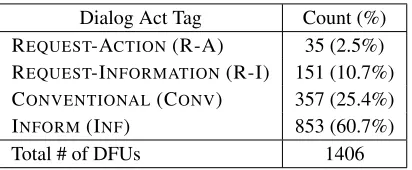
Dialog Act Tag Count (%) REQUEST-ACTION(R-A) 35 (2.5%) REQUEST-INFORMATION(R-I) 151 (10.7%) CONVENTIONAL(CONV) 357 (25.4%) INFORM(INF) 853 (60.7%)
[image:2.612.84.290.376.461.2]Total # of DFUs 1406
Table 1: Annotation statistics
Each message in the thread is segmented into Di-alog Functional Units (DFUs). A DFU is a con-tiguous span within an email message which has a coherent communicative intention. Each DFU is assigned a single DA label which is one of the following: REQUEST-ACTION (R-A), REQUEST
-INFORMATION (R-I), CONVENTIONAL (CONV) and INFORM(INF). There are three other DA labels — INFORM-OFFLINE, COMMIT, and NODA for no
dialog act — which occurred 5 or fewer times in the corpus. We ignore these DA labels in this paper. The corpus also contains links between the DFUs, but we do not use those annotations in this study. Table 1 presents the distribution of DA labels in our corpus. We now describe each of the DAs we consider in our experiments.
In a REQUEST-ACTION, the writer signals her desire that the reader perform some non-communicative act, i.e., an act that cannot in itself be part of the dialogue. For example, a writer can ask the reader to write a report or make coffee.
In a REQUEST-INFORMATION, the writer signals her desire that the reader perform a specific com-municative act, namely that he provide information (either facts or opinion).
In an INFORM, the writer conveys information, or more precisely, the writer signals that her desire that the reader adopt a certain belief. It covers many dif-ferent types of information that can be conveyed in-cluding answers to questions, beliefs (committed or not), attitudes, and elaborations on prior DAs.
A CONVENTIONALdialog act does not signal any specific communicative intention on the part of the writer, but rather it helps structure and thus facilitate the communication. Examples include greetings, in-troductions, expressions of gratitude, etc.
4 System
We developed four systems for our experiments: a baseline (BAS) system which is close to the system described in (Hu et al., 2009), and three variants of our novel divide and conquer (DAC) system. Fea-tures used in both systems are extracted as explained in Section 4.2. Section 4.3 describes the baseline system, the basic DAC system, and two variations of the DAC system.
4.1 Experimental Framework
In all our experiments, we use linear kernel Sup-port Vector Machines (SVM). However, across the systems, there are differences in how we use them. Our framework was built with the ClearTK toolkit (Ogren et al., 2008) with its wrapper for SVMLight (Joachims, 1999). The ClearTK wrapper internally shifts the prediction threshold based on posterior probabilistic scores calculated using the algorithm of Lin et al. (2007). We report results from 5-fold cross validation performed on the entire corpus.
4.2 Feature Engineering
message-level. Lexical features consists of n-grams of words, n-grams of POS tags, mixed n-grams of closed class words and POS tags (Prabhakaran et al., 2012), as well as a small set of specialized features — Start-POS/Lemma (POS tag and lemma of the first word), LastPOS/Lemma (POS tag and lemma of the last word), MDCount (number of modal verbs in the DFU) and QuestionMark (is there a question mark in the DFU). We used the POS tags produced by the OpenNLP POS tagger. Verbal features capture the position and identity of the first verb in the DFU. Fi-nally, message-level features capture aspects of the location of the DFU in the message and of the mes-sage in the thread (relative position and size). In optimizing each system, we first performed an ex-haustive search across all combinations of features within each category. For the lexical n-gram fea-tures we varied the n-gram window from 1 to 5. This step gave us the best performing feature combination within each category. In a second step, we found the best combination of categories, using the previously determined features for each category. In this pa-per, we do not report best performing feature sets for each configuration, due to lack of space.
4.3 Experiments
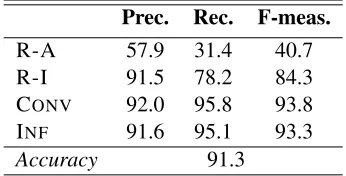
Baseline (BAS) System This system uses the ClearTK built-in one-versus-all multiclass SVM in prediction. Internally, the multi-class SVM builds a set of binary classifiers, one for each dialog act. For a given test instance, the classifier that obtains the highest probability score determines the overall prediction. We performed feature optimization on the whole multiclass classifier (as described in Sec-tion 4.2), i.e., the same set of features was available to all component classifiers. We optimized for tem accuracy. Table 2 shows results using this sys-tem. In this and all tables, we give the performance of the system on the four DAs, using precision, re-call, and F-measure. The DAs are listed in ascend-ing order of frequency in the corpus (least frequent DA first). We also give an overall accuracy evalua-tion. As we can see, detecting REQUEST-ACTIONis much harder than detecting the other DAs.
Basic Divide and Conquer (DAC) System Like the BAS system, the DAC system also builds a bi-nary classifier for each dialog act separately, and the
Prec. Rec. F-meas.
R-A 57.9 31.4 40.7 R-I 91.5 78.2 84.3 CONV 92.0 95.8 93.8
INF 91.6 95.1 93.3
[image:3.612.340.513.58.146.2]Accuracy 91.3
Table 2: Results for baseline (BAS) system (standard multiclass SVM)
component classifier with highest probability score determines the overall prediction. The crucial dif-ference in the DAC system is that the feature opti-mization is performed for each component classifier separately. Each component classifier is optimized for F-measure. Table 3 shows results using this sys-tem.
Prec. Recall F-meas. ER
R-A 66.7 40.0 50.0 15.6 R-I 91.5 78.2 84.3 0.0 CONV 93.9 94.1 94.0 2.6 INF 91.4 96.1 93.7 5.7
Accuracy 91.7 4.9
Table 3: Results for basic DAC system (per-class feature optimization followed by maximum confidence based choice); “ER” refers to error reduction in percent over standard multiclass SVM (Table 2)
Minority Preference (DACMP) System This
sys-tem is exactly the same as the basic DAC syssys-tem except for one crucial difference: overall classifica-tion is biased towards a specified minority class. If the minority class binary classifier predicts true, this system chooses the minority class as the predicted class. In cases where the minority class classifier predicts false, it backs off to the basic DAC system after removing the minority class classifier from the confidence tally. Table 4 shows our results using REQUEST-ACTIONas the minority class.
Cascading Minority Preference (DACCMP) System
[image:3.612.318.536.304.392.2]Prec. Recall F-meas. ER
R-A 66.7 45.7 54.2 22.8 R-I 91.5 78.2 84.3 0.0 CONV 93.9 94.1 94.0 2.6
INF 91.6 96.0 93.8 6.5
[image:4.612.79.295.59.147.2]Accuracy 91.8 5.7
Table 4: Results for minority-preference DAC system — DACMP(first consult REQUEST-ACTIONtagger, then
de-fault to choice by maximum confidence); “ER” refers to error reduction in percent over standard multiclass SVM (Table 2)
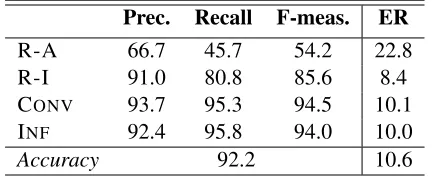
true, for a given instance, it then assigns this class as the predicted class. The subsequent classifiers in the list are not run. If all classifiers predict false, we back off to the basic DAC system, i.e., the compo-nent classifier with highest probability score deter-mines the overall prediction. We ordered the list of classes in the ascending order of their frequencies in the training data. This ordering is driven by the ob-servation that the less frequent classes are also hard to predict correctly. Table 5 shows our results using the ordered list: (REQUEST-ACTION, REQUEST -INFORMATION, CONVENTIONAL, INFORM).
Prec. Recall F-meas. ER
R-A 66.7 45.7 54.2 22.8 R-I 91.0 80.8 85.6 8.4 CONV 93.7 95.3 94.5 10.1 INF 92.4 95.8 94.0 10.0
Accuracy 92.2 10.6
Table 5: Results for cascading minority-preference DAC system — DACCMP (consult classifiers in reverse order
of frequency of class); “ER” refers to error reduction in percent over standard multiclass SVM (Table 2)
4.4 Discussion
As shown in Table 3, the basic DAC system obtained a 15.6% F-measure error reduction for the minor-ity class REQUEST-ACTION over the BAS system. It also improves performance of two other classes — CONVENTIONAL and INFORM, and obtaines a
4.9% error reduction on overall accuracy. Recall here that the only difference between the DAC sys-tem and the BAS syssys-tem is the per-class feature op-timization and therefore this must be the reason for
this boost in performance. When we turn to DACMP,
we see that the performance on the minority class REQUEST-ACTION is further enhanced, with an F-measure error reduction of 22.8%; the overall ac-curacy improves slightly with an error reduction of 5.7%. Finally, DACCMPfurther improves the
perfor-mance. Since the method of choosing the minor-ity class REQUEST-ACTION does not change over
DACMP, the F-measure error reduction remains the
same. However, now all three other classes also im-prove their performance, and we obtain a 10.6% er-ror reduction on overall accuracy over the baseline system.
Following (Guyon et al., 2002), we performed a post-hoc analysis by inspecting the feature weights of the best performing models created for each in-dividual classifier in the DAC system. Table 6 lists some interesting features chosen during feature opti-mization for the individual SVMs. We selected them from the top 25 features in terms of absolute value of feature weights.
Some features help distinguish different DA cat-egories. For example, the feature QuestionMark
is the feature with the highest negative weight for INFORM, but has the highest positive weight for REQUEST-INFORMATION. Features likefyiand pe-riod (.) have high positive weights for INFORM
and high negative weights for CONVENTIONAL. Some other features are important only for certain classes. For e.g.,please andVB NN are important for REQUEST-ACTION, but not so for other classes. Overall, the most discriminating features for both INFORM and CONVENTIONAL are mostly word ngrams, while those for REQUEST-ACTION and REQUEST-INFORMATION are mostly POS ngrams. This shows why our approach of per-class feature optimization is important to boost the classification performance.
Another interesting observation is that the least frequent category, REQUEST-ACTION, has the least
[image:4.612.78.294.405.494.2]REQUEST-ACTION REQUEST-INFORMATION CONVENTIONAL INFORM
please (0.9) QuestionMark (6.6) StartPOS NNP (2.7) QuestionMark (-3.0) VB NN (0.7) BOS PRP (-1.2) thanks (2.3) thanks (-2.2)
you VB (0.3) WRB (1.0) . (-2.0) . (2.2) PRP (-0.3) PRP VBP (-0.9) fyi (-2.0) fyi (1.9) MD PRP VB (0.3) BOS MD (0.8) , (0.9) you (-1.0) will (-0.2) BOS DT (-0.7) QuestionMark (-0.8) can you (-0.9)
Table 6: Post-hoc analysis on the models built by the DAC system: some of the top features with corresponding feature weights in parentheses, for each individual tagger. (POS tags are capitalized; BOS stands for Beginning Of Sentence)
5 Extrinsic Evaluation
In this section, we perform an extrinsic evaluation for the dialog act tagger presented in Section 4 by applying it to the task of identifying Overt Displays of Power (ODP) in emails, proposed by Prabhakaran et al. (2012). The task is to identify utterances where the linguistic form introduces additional constraints on its responses, beyond those introduced by the general dialog act. The dialog act features were found to be useful and the best performing system obtained an F-measure of 65.8 using gold dialog act tags. For our extrinsic evaluation, we retrained the ODP tagger using dialog act tags predicted by our BAS and DACCMPsystems instead of gold
dia-log acts. ODP tagger uses the same dataset as ours for training. In the cross validation step, we made sure that the test folds for ODP were excluded from training the taggers to obtain DA tags. At each ODP cross validation step, we trained a BAS or DACCMP
tagger using ODP’s training folds for that step and used tags produced by that tagger for both training and testing the ODP tagger for that step. Table 7 lists the results obtained.
Prec. Rec. F-meas.
No-DA 55.7 45.4 50.0
Gold-DA 75.8 58.1 65.8
BAS-DA 60.6 46.5 52.6
DACCMP-DA 67.2 45.4 54.2
Table 7: Results for ODP system using various sources of DA tags
Using BAS tagged DA, the F-measure of ODP system reduced by 13.2 points to 52.6 from using gold dialog acts (F=65.8). Using DACCMP, the
F-measure improved over BAS by 1.6 points to 54.2. This constitutes an error reduction of 12.1%, tak-ing the system ustak-ing gold DA tags as the reference. This improvement is noteworthy, given the fact that the overall error reduction obtained by DACCMPover
BAS in the DA tagging was around 10.6%. Also, the DACCMP-based ODP system obtained an error
reduc-tion of about 26.6% over a system that does not use the DA features at all (F=50.0).
6 Conclusion
We presented a method of improving the perfor-mance of dialog act tagging in identifying minority classes by using per-class feature optimization and choosing the class based on a cascade of classifiers. We showed that it gives a minority class F-measure error reduction of 22.8% while also reducing the er-ror on other classes and the overall erer-ror by around 10%. We also presented an extrinsic evaluation of this technique on detecting Overt Displays of Power in dialog, where we achieve an error reduction of 12.1% over using the standard multiclass SVM to generate dialog act tags.
Acknowledgements
References
Apoorv Agarwal, Adinoyi Omuya, Aaron Harnly, and Owen Rambow. 2012. A Comprehensive Gold Stan-dard for the Enron Organizational Hierarchy. In Pro-ceedings of the 50th Annual Meeting of the Associa-tion for ComputaAssocia-tional Linguistics (Volume 2: Short Papers), pages 161–165, Jeju Island, Korea, July. As-sociation for Computational Linguistics.
J. L. Austin. 1975. How to Do Things with Words. Har-vard University Press, Cambridge, Mass.
William W. Cohen, Vitor R. Carvalho, and Tom M. Mitchell. 2004. Learning to Classify Email into “Speech Acts” . In Dekang Lin and Dekai Wu, ed-itors, Proceedings of EMNLP 2004, pages 309–316, Barcelona, Spain, July. Association for Computational Linguistics.
Isabelle Guyon, Jason Weston, Stephen Barnhill, and Vladimir Vapnik. 2002. Gene Selection for Cancer Classification using Support Vector Machines. Mach. Learn., 46:389–422, March.
Jun Hu, Rebecca Passonneau, and Owen Rambow. 2009. Contrasting the Interaction Structure of an Email and a Telephone Corpus: A Machine Learning Approach to Annotation of Dialogue Function Units. In Pro-ceedings of the SIGDIAL 2009 Conference, London, UK, September. Association for Computational Lin-guistics.
Thorsten Joachims. 1999. Making Large-Scale SVM Learning Practical. In Bernhard Sch¨olkopf, Christo-pher J.C. Burges, and A. Smola, editors, Advances in Kernel Methods - Support Vector Learning, Cam-bridge, MA, USA. MIT Press.
J. Kim, G. Chern, D. Feng, E. Shaw, and E. Hovy. 2006. Mining and Assessing Discussions on the Web Through Speech Act Analysis. InProceedings of the Workshop on Web Content Mining with Human Lan-guage Technologies at the 5th International Semantic Web Conference.
S.N. Kim, L. Cavedon, and T. Baldwin. 2010a. Classify-ing Dialogue Acts in One-on-one Live Chats. In Pro-ceedings of the 2010 Conference on Empirical Meth-ods in Natural Language Processing, pages 862–871. Association for Computational Linguistics.
S.N. Kim, L. Wang, and T. Baldwin. 2010b. Tagging and Linking Web Forum Posts. In Proceedings of the Fourteenth Conference on Computational Natural Language Learning, pages 192–202. Association for Computational Linguistics.
Hsuan-Tien Lin, Chih-Jen Lin, and Ruby C. Weng. 2007. A Note on Platt’s Probabilistic Outputs for Support Vector Machines. Mach. Learn., 68:267–276, Octo-ber.
Philip V. Ogren, Philipp G. Wetzler, and Steven Bethard. 2008. ClearTK: A UIMA toolkit for statistical natural language processing. InTowards Enhanced Interoper-ability for Large HLT Systems: UIMA for NLP work-shop at Language Resources and Evaluation Confer-ence (LREC).
Vinodkumar Prabhakaran, Owen Rambow, and Mona Diab. 2012. Predicting Overt Display of Power in Written Dialogs. InHuman Language Technologies: The 2012 Annual Conference of the North American Chapter of the Association for Computational Linguis-tics, Montreal, Canada, June. Association for Compu-tational Linguistics.
J.R. Searle. 1976. A Classification of Illocutionary Acts.
Language in society, 5(01):1–23.
A. Stolcke, K. Ries, N. Coccaro, E. Shriberg, R. Bates, D. Jurafsky, P. Taylor, R. Martin, C.V. Ess-Dykema, and M. Meteer. 2000. Dialogue Act Modeling for Automatic Tagging and Recognition of Conversational Speech.Computational linguistics, 26(3):339–373. J.Y. Yeh and A. Harnly. 2006. Email Thread Reassembly
Using Similarity Matching. In Third Conference on Email and Anti-Spam (CEAS), pages 27–28.