Assessing the Ability of LSTMs to Learn Syntax-Sensitive Dependencies
Tal Linzen1,2 Emmanuel Dupoux1
LSCP1& IJN2, CNRS,
EHESS and ENS, PSL Research University
{tal.linzen,
emmanuel.dupoux}@ens.fr
Yoav Goldberg
Computer Science Department Bar Ilan University
Abstract
The success of long short-term memory (LSTM) neural networks in language process-ing is typically attributed to their ability to capture long-distance statistical regularities. Linguistic regularities are often sensitive to syntactic structure; can such dependencies be captured by LSTMs, which do not have ex-plicit structural representations? We begin ad-dressing this question using number agreement in English subject-verb dependencies. We probe the architecture’s grammatical compe-tence both using training objectives with an explicit grammatical target (number prediction, grammaticality judgments) and using language models. In the strongly supervised settings, the LSTM achieved very high overall accu-racy (less than 1% errors), but errors increased when sequential and structural information con-flicted. The frequency of such errors rose sharply in the language-modeling setting. We conclude that LSTMs can capture a non-trivial amount of grammatical structure given targeted supervision, but stronger architectures may be required to further reduce errors; furthermore, the language modeling signal is insufficient for capturing syntax-sensitive dependencies, and should be supplemented with more direct supervision if such dependencies need to be captured.
1 Introduction
Recurrent neural networks (RNNs) are highly effec-tive models of sequential data (Elman, 1990). The rapid adoption of RNNs in NLP systems in recent years, in particular of RNNs with gating mecha-nisms such as long short-term memory (LSTM) units
(Hochreiter and Schmidhuber, 1997) or gated recur-rent units (GRU) (Cho et al., 2014), has led to sig-nificant gains in language modeling (Mikolov et al., 2010; Sundermeyer et al., 2012), parsing (Vinyals et al., 2015; Kiperwasser and Goldberg, 2016; Dyer et al., 2016), machine translation (Bahdanau et al., 2015) and other tasks.
The effectiveness of RNNs1 is attributed to their ability to capture statistical contingencies that may span an arbitrary number of words. The wordFrance, for example, is more likely to occur somewhere in a sentence that begins withParisthan in a sentence that begins withPenguins. The fact that an arbitrary number of words can intervene between the mutually predictive words implies that they cannot be captured by models with a fixed window such asn-gram
mod-els, but can in principle be captured by RNNs, which do not have an architecturally fixed limit on depen-dency length.
RNNs are sequence models: they do not explicitly incorporate syntactic structure. Indeed, many word co-occurrence statistics can be captured by treating the sentence as an unstructured list of words (Paris
-France); it is therefore unsurprising that RNNs can
learn them well. Other dependencies, however, are sensitive to the syntactic structure of the sentence (Chomsky, 1965; Everaert et al., 2015). To what extent can RNNs learn to model such phenomena based only on sequential cues?
Previous research has shown that RNNs (in particu-lar LSTMs) can learn artificial context-free languages (Gers and Schmidhuber, 2001) as well as nesting and
1In this work we use the term RNN to refer to the entire
class of sequential recurrent neural networks. Instances of the class include long short-term memory networks (LSTM) and the Simple Recurrent Network (SRN) due to Elman (1990).
521
indentation in a programming language (Karpathy et al., 2016). The goal of the present work is to probe their ability to learnnatural languagehierarchical (syntactic) structures from a corpus without syntactic annotations. As a first step, we focus on a particular dependency that is commonly regarded as evidence for hierarchical structure in human language: English subject-verb agreement, the phenomenon in which the form of a verb depends on whether the subject is singular or plural (the kids playbutthe kid plays; see additional details in Section 2). If an RNN-based model succeeded in learning this dependency, that would indicate that it can learn to approximate or even faithfully implement syntactic structure.
Our main interest is in whether LSTMs have the
capacityto learn structural dependencies from a
nat-ural corpus. We therefore begin by addressing this question under the most favorable conditions: train-ing with explicit supervision. In the setttrain-ing with the strongest supervision, which we refer to as the num-ber prediction task, we train it directly on the task of guessing the number of a verb based on the words that preceded it (Sections 3 and 4). We further experiment with a grammaticality judgment training objective, in which we provide the model with full sentences an-notated as to whether or not they violate subject-verb number agreement, without an indication of the locus of the violation (Section 5). Finally, we trained the model without any grammatical supervision, using a language modeling objective (predicting the next word).
Our quantitative results (Section 4) and qualitative analysis (Section 7) indicate that most naturally oc-curring agreement cases in the Wikipedia corpus are easy: they can be resolved without syntactic informa-tion, based only on the sequence of nouns preceding the verb. This leads to high overall accuracy in all models. Most of our experiments focus on the super-vised number prediction model. The accuracy of this model was lower on harder cases, which require the model to encode or approximate structural infortion; nevertheless, it succeeded in recovering the ma-jority of agreement cases even when four nouns of the opposite number intervened between the subject and the verb (17% errors). Baseline models failed spec-tacularly on these hard cases, performing far below chance levels. Fine-grained analysis revealed that mistakes are much more common when no overt cues
to syntactic structure (in particular function words) are available, as is the case in noun-noun compounds and reduced relative clauses. This indicates that the number prediction model indeed managed to capture a decent amount of syntactic knowledge, but was overly reliant on function words.
Error rates increased only mildly when we switched to more indirect supervision consisting only of sentence-level grammaticality annotations without an indication of the crucial verb. By contrast, the language model trained without explicit grammati-cal supervision performed worse than chance on the harder agreement prediction cases. Even a state-of-the-art large-scale language model (Jozefowicz et al., 2016) was highly sensitive to recent but struc-turally irrelevant nouns, making more than five times as many mistakes as the number prediction model on these harder cases. These results suggest that explicit supervision is necessary for learning the agreement dependency using this architecture, limiting its plau-sibility as a model of child language acquisition (El-man, 1990). From a more applied perspective, this result suggests that for tasks in which it is desirable to capture syntactic dependencies (e.g., machine trans-lation or language generation), language modeling objectives should be supplemented by supervision signals that directly capture the desired behavior.
2 Background: Subject-Verb Agreement as Evidence for Syntactic Structure The form of an English third-person present tense verb depends on whether the head of the syntactic
subjectis plural or singular:2
(1) a. Thekey ison the table. b. *Thekey areon the table. c. *Thekeys ison the table. d. Thekeys areon the table.
While in these examples the subject’s head is adjacent to the verb, in general the two can be separated by some sentential material:3
2Identifying the head of the subject is typically
straightfor-ward. In what follows we will use the shorthand “the subject” to refer to the head of the subject.
3In the examples, the subject and the corresponding verb
(2) Thekeysto the cabinetareon the table.
Given a syntactic parse of the sentence and a verb, it is straightforward to identify the head of the subject that corresponds to that verb, and use that information to determine the number of the verb (Figure 1).
The keys to the cabinet are on the table
det
nsubj
prep pobjdet prep pobjdet
[image:3.612.91.283.142.214.2]root
Figure 1: The form of the verb is determined by the head of the subject, which is directly connected to it via annsubjedge. Other nouns that intervene between the head of the subject and the verb (here
cabinetis such a noun) are irrelevant for determining
the form of the verb and need to be ignored.
By contrast, models that are insensitive to structure may run into substantial difficulties capturing this de-pendency. One potential issue is that there is no limit to the complexity of the subject NP, and any number of sentence-level modifiers and parentheticals—and therefore an arbitrary number of words—can appear between the subject and the verb:
(3) Thebuildingon the far right that’s quite old and run downisthe Kilgore Bank Building.
This property of the dependency entails that it can-not be captured by ann-gram model with a fixedn.
RNNs are in principle able to capture dependencies of an unbounded length; however, it is an empirical question whether or not they will learn to do so in practice when trained on a natural corpus.
A more fundamental challenge that the depen-dency poses for structure-insensitive models is the possibility ofagreement attraction errors(Bock and Miller, 1991). The correct form in (3) could be se-lected using simple heuristics such as “agree with the most recent noun”, which are readily available to sequence models. In general, however, such heuris-tics are unreliable, since other nouns can intervene between the subject and the verb in the linear se-quence of the sentence. Those intervening nouns can have the same number as the subject, as in (4), or the opposite number as in (5)-(7):
(4) Alluvialsoilscarried in thefloodwatersadd
nutrients to the floodplains.
(5) The only championshipbannersthat are cur-rently displayed within the building arefor national or NCAA Championships.
(6) Thelengthof the forewingsis12-13. (7) Yet the ratio of men who survive to the
women and children who surviveisnot clear in this story.
Intervening nouns with the opposite number from the subject are calledagreement attractors. The poten-tial presence of agreement attractors entails that the model must identify the head of the syntactic subject that corresponds to a given verb in order to choose the correct inflected form of that verb.
Given the difficulty in identifying the subject from the linear sequence of the sentence, dependencies such as subject-verb agreement serve as an argument for structured syntactic representations in humans (Everaert et al., 2015); they may challenge models such as RNNs that do not have pre-wired syntac-tic representations. We note that subject-verb num-ber agreement is only one of a numnum-ber of structure-sensitive dependencies; other examples include nega-tive polarity items (e.g.,any) and reflexive pronouns
(herself). Nonetheless, a model’s success in learning
subject-verb agreement would be highly suggestive of its ability to master hierarchical structure.
3 The Number Prediction Task
To what extent can a sequence model learn to be sensi-tive to the hierarchical structure of natural language? To study this question, we propose thenumber
pre-dictiontask. In this task, the model sees the sentence
up to but not including a present-tense verb, e.g.:
(8) The keys to the cabinet
It then needs to guess the number of the following verb (a binary choice, eitherPLURALorSINGULAR). We examine variations on this task in Section 5.
In order to perform well on this task, the model needs to encode the concepts ofsyntactic number
andsyntactic subjecthood: it needs to learn that some
illus-trated in Section 2, correctly identifying the subject that corresponds to a particular verb often requires sensitivity to hierarchical syntax.
Data: An appealing property of the number predic-tion task is that we can generate practically unlimited training and testing examples for this task by query-ing a corpus for sentences with present-tense verbs, and noting the number of the verb. Importantly, we do not need to correctly identify the subject in order to create a training or test example. We generated a corpus of∼1.35 million number prediction problems based on Wikipedia, of which∼121,500 (9%) were
used for training,∼13,500 (1%) for validation, and the remaining∼1.21 million (90%) were reserved for testing.4 The large number of test sentences was necessary to ensure that we had a good variety of test sentences representing less common constructions (see Section 4).5
Model and baselines: We encode words as
one-hot vectors: the model does not have access to the characters that make up the word. Those vectors are then embedded into a 50-dimensional vector space. An LSTM with 50 hidden units reads those embed-ding vectors in sequence; the state of the LSTM at the end of the sequence is then fed into a logistic regression classifier. The network is trained6 in an end-to-end fashion, including the word embeddings.7 To isolate the effect of syntactic structure, we also consider a baseline which is exposed only to the nouns in the sentence, in the order in which they appeared originally, and is then asked to predict the number of the following verb. The goal of this
base-4We limited our search to sentences that were shorter than
50 words. Whenever a sentence had more than one subject-verb dependency, we selected one of the dependencies at random.
5Code and data are available at http://tallinzen.
net/projects/lstm_agreement.
6The network was optimized using Adam (Kingma and Ba,
2015) and early stopping based on validation set error. We trained the number prediction model 20 times with different random initializations, and report accuracy averaged across all runs. The models described in Sections 5 and 6 are based on 10 runs, with the exception of the language model, which is slower to train and was trained once.
7The size of the vocabulary was capped at 10000 (after
low-ercasing). Infrequent words were replaced with their part of speech (Penn Treebank tagset, which explicitly encodes number distinctions); this was the case for 9.6% of all tokens and 7.1% of the subjects.
line is to withhold the syntactic information carried by function words, verbs and other parts of speech. We explore two variations on this baseline: one that only receives common nouns (dogs, pipe), and an-other that also receives pronouns (he) and proper nouns (France). We refer to these as thenoun-only
baselines.
4 Number Prediction Results
Overall accuracy: Accuracy was very high over-all: the system made an incorrect number prediction only in 0.83% of the dependencies. The noun-only baselines performed significantly worse: 4.2% errors for the common-nouns case and 4.5% errors for the all-nouns case. This suggests that function words, verbs and other syntactically informative elements play an important role in the model’s ability to cor-rectly predict the verb’s number. However, while the noun-only baselines made more than four times as many mistakes as the number prediction system, their still-low absolute error rate indicates that around 95% of agreement dependencies can be captured based solely on the sequence of nouns preceding the verb. This is perhaps unsurprising: sentences are often short and the verb is often directly adjacent to the sub-ject, making the identification of the subject simple. To gain deeper insight into the syntactic capabilities of the model, then, the rest of this section investigates its performance on more challenging dependencies.8
Distance: We first examine whether the network shows evidence of generalizing to dependencies where the subject and the verb are far apart. We focus in this analysis on simpler cases where no nouns in-tervened between the subject and the verb. As Figure 2a shows, performance did not degrade considerably when the distance between the subject and the verb grew up to 15 words (there were very few longer dependencies). This indicates that the network gen-eralized the dependency from the common distances of 0 and 1 to rare distances of 10 and more.
Agreement attractors: We next examine how the model’s error rate was affected by nouns that inter-vened between the subject and the verb in the linear
8These properties of the dependencies were identified by
(a)
2 4 6 8 10 12 14 Distance (no intervening nouns) 0%
10% 20% 30% 40% 50%
Error rate
(b)
Plural subject Singular subject 0%
5% 10% 15% 20%
Error rate
Last intervening noun None Plural Singular
(c)
0 1 2 3 4
Count of attractors 0%
20% 40% 60% 80% 100%
Error rate
Baseline (common nouns)
Number prediction
Majority class
Random guess
(d)
No relative clauseWith relativizerWithout relativizer
0% 20% 40% 60% 80% 100%
Error rate Majority
Random
(e)
0 1 2 3 4 5 6 7
Count of attractors
100 101 102 103 104 105 106 107
Count of dependencies
All Homogeneous
(f)
2 1 0 1 2
PC1
0.6 0.0 0.6
PC2
[image:5.612.74.526.54.257.2]Plural Singular
Figure 2: (a-d)Error rates of the LSTM number prediction model as a function of: (a) distance between the subject and the verb, in dependencies that have no intervening nouns; (b) presence and number of last intervening noun; (c) count of attractors in dependencies with homogeneous intervention; (d) presence of a relative clause with and without an overt relativizer in dependencies with homogeneous intervention and exactly one attractor. All error bars represent 95% binomial confidence intervals.
(e-f)Additional plots: (e) count of attractors per dependency in the corpus (note that the y-axis is on a log scale); (f) embeddings of singular and plural nouns, projected onto their first two principal components.
order of the sentence. We first focus on whether or not there were any intervening nouns, and if there were, whether the number of the subject differed from the number of the last intervening noun—the type of noun that would trip up the simple heuristic of agreeing with the most recent noun.
As Figure 2b shows, a last intervening noun of the same number as the subject increased error rates only moderately, from 0.4% to 0.7% in singular subjects and from 1% to 1.4% in plural subjects. On the other hand, when the last intervening noun was an agree-ment attractor, error rates increased by almost an order of magnitude (to 6.5% and 5.4% respectively). Note, however, that even an error rate of 6.5% is quite impressive considering uninformed strategies such as random guessing (50% error rate), always assigning the more common class label (32% error rate, since 32% of the subjects in our corpus are plu-ral) and the number-of-most-recent-noun heuristic (100% error rate). The noun-only LSTM baselines performed much worse in agreement attraction cases, with error rates of 46.4% (common nouns) and 40% (all nouns).
We next tested whether the effect of attractors is cumulative, by focusing on dependencies with multi-ple attractors. To avoid cases in which the effect of an attractor is offset by an intervening noun with the same number as the subject, we restricted our search to dependencies in which all of the intervening nouns had the same number, which we termdependencies
with homogeneous intervention. For example, (9) has
homogeneous intervention whereas (10) does not:
(9) Therosesin the vase by the doorarered.
(10) Therosesin the vase by thechairsarered.
Relative clauses: We now look in greater detail into the network’s performance when the words that intervened between the subject and verb contained a relative clause. Relative clauses with attractors are likely to be fairly challenging, for several rea-sons. They typically contain a verb that agrees with the attractor, reinforcing the misleading cue to noun number. The attractor is often itself a subject of an irrelevant verb, making a potential “agree with the most recent subject” strategy unreliable. Finally, the existence of a relative clause is sometimes not overtly indicated by a function word (relativizer), as in (11) (for comparison, see the minimally different (12)):
(11) The landmarks this article lists here are
also run-of-the-mill and not notable. (12) Thelandmarks that this article lists here
arealso run-of-the-mill and not notable.
For data sparsity reasons we restricted our attention to dependencies with a single attractor and no other intervening nouns. As Figure 2d shows, attraction errors were more frequent in dependencies with an overt relative clause (9.9% errors) than in dependen-cies without a relative clause (3.2%), and consider-ably more frequent when the relative clause was not introduced by an overt relativizer (25%). As in the case of multiple attractors, however, while the model struggled with the more difficult dependencies, its performance was much better than random guessing, and slightly better than a majority-class strategy.
Word representations: We explored the
50-dimensional word representations acquired by the model by performing a principal component anal-ysis. We assigned a part-of-speech (POS) to each word based on the word’s most common POS in the corpus. We only considered relatively unambiguous words, in which a single POS accounted for more than 90% of the word’s occurrences in the corpus. Figure 2f shows that the first principal component corresponded almost perfectly to the expected num-ber of the noun, suggesting that the model learned the number of specific words very well; recall that the model did not have access during training to noun number annotations or to morphological suffixes such as-sthat could be used to identify plurals.
Visualizing the network’s activations: We start investigating the inner workings of the number pdiction network by analyzing its activation in re-sponse to particular syntactic constructions. To sim-plify the analysis, we deviate from our practice in the rest of this paper and use constructed sentences.
We first constructed sets of sentence prefixes based on the following patterns:
(13) PP: The toy(s) of the boy(s)... (14) RC:The toy(s) that the boy(s)...
These patterns differ by exactly one function word, which determines the type of the modifier of the main clause subject: a prepositional phrase (PP) in the first sentence and a relative clause (RC) in the second. In PP sentences the correct number of the upcoming verb is determined by the main clause subjecttoy(s); in RC sentences it is determined by the embedded subjectboy(s).
We generated all four versions of each pattern, and repeated the process ten times with different lexical items (the house(s) of/that the girl(s),the computer(s)
of/that the student(s), etc.), for a total of 80 sentences.
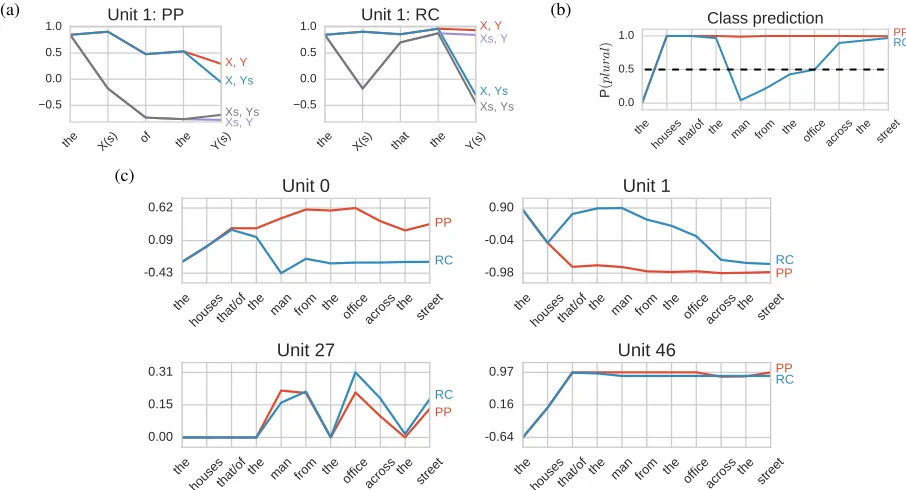
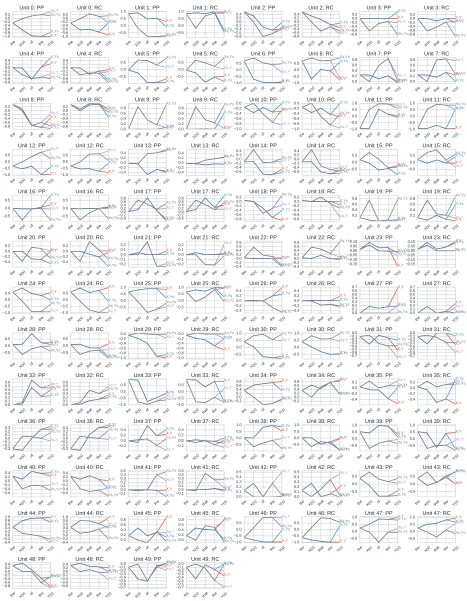
The network made correct number predictions for all 40 PP sentences, but made three errors in RC sen-tences. We averaged the word-by-word activations across all sets of ten sentences that had the same com-bination of modifier (PP or RC), first noun number and second noun number. Plots of the activation of all 50 units are provided in the Appendix (Figure 5). Figure 3a highlights a unit (Unit 1) that shows a particularly clear pattern: it tracks the number of the main clause subject throughout the PP modifier; by contrast, it resets when it reaches the relativizerthat
which introduces the RC modifier, and then switches to tracking the number of the embedded subject.
To explore how the network deals with dependen-cies spanning a larger number of words, we tracked its activation during the processing of the following two sentences:9
(15) The houses of/that the man from the office across the street...
The network made the correct prediction for the PP
9We simplified this experiment in light of the relative
(a) (b)
the
housesthat/ofthe man from the office across the street 0.0
0.5 1.0
P
(
pl
ur
al
) PPRC
Class prediction
[image:7.612.76.529.55.300.2](c)
Figure 3: Word-by-word visualization of LSTM activation: (a) a unit that correctly predicts the number of an upcoming verb. This number is determined by the first noun (X) when the modifier is a prepositional phrase (PP) and by the second noun (Y) when it is an object relative clause (RC); (b) the evolution of the predictions in the case of a longer modifier: the predictions correctly diverge at the embedded noun, but then incorrectly converge again; (c) the activation of four representative units over the course of the same sentences.
but not the RC sentence (as before, the correct pre-dictions arePLURALfor PP andSINGULARfor RC). Figure 3b shows that the network begins by mak-ing the correct prediction for RC immediately after
that, but then falters: as the sentence goes on, the resetting effect of thatdiminishes. The activation time courses shown in Figure 3c illustrate that Unit 1, which identified the subject correctly when the prefix was short, gradually forgets that it is in an embedded clause as the prefix grows longer. By contrast, Unit 0 shows a stable capacity to remember the current embedding status. Additional representative units shown in Figure 3c are Unit 46, which consistently stores the number of the main clause subject, and Unit 27, which tracks the number of the most recent noun, resetting at noun phrase boundaries.
While the interpretability of these patterns is en-couraging, our analysis only scratches the surface of the rich possibilities of a linguistically-informed analysis of a neural network trained to perform a syntax-sensitive task; we leave a more extensive in-vestigation for future work.
5 Alternative Training Objectives
The number prediction task followed a fully super-vised objective, in which the network identifies the number of an upcoming verb based only on the words preceding the verb. This section proposes three objec-tives that modify some of the goals and assumptions of the number prediction objective (see Table 1 for an overview).
Verb inflection: This objective is similar to num-ber prediction, with one difference: the network re-ceives not only the words leading up to the verb, but also the singular form of the upcoming verb (e.g.,
writes). In practice, then, the network needs to decide
between the singular and plural forms of a particular verb (writesorwrite). Having access to the semantics of the verb can help the network identify the noun that serves as its subject without using the syntactic subjecthood criteria. For example, in the following sentence:
Training objective Sample input Training signal Prediction task Correct answer Number prediction The keys to the cabinet PLURAL SINGULAR/PLURAL? PLURAL
Verb inflection The keys to the cabinet [is/are] PLURAL SINGULAR/PLURAL? PLURAL
Grammaticality The keys to the cabinet are here. GRAMMATICAL GRAMMATICAL/UNGRAMMATICAL? GRAMMATICAL
Language model The keys to the cabinet are P(are)> P(is)? True
Table 1: Examples of the four training objectives and corresponding prediction tasks.
onlypeopleis a plausible subject foreat; the network
can use this information to infer that the correct form of the verb iseatis rather thaneats.
This objective is similar to the task that humans face during language production: after the speaker has decided to use a particular verb (e.g.,write), he or she needs to decide whether its form will bewrite
orwrites(Levelt et al., 1999; Staub, 2009).
Grammaticality judgments: The previous objec-tives explicitly indicate the location in the sentence in which a verb can appear, giving the network a cue to syntactic clause boundaries. They also explicitly di-rect the network’s attention to the number of the verb. As a form of weaker supervision, we experimented with a grammaticality judgment objective. In this scenario, the network is given a complete sentence, and is asked to judge whether or not it is grammatical.
To train the network, we made half of the examples in our training corpus ungrammatical by flipping the number of the verb.10 The network read the entire sentence and received a supervision signal at the end. This task is modeled after a common human data col-lection technique in linguistics (Sch¨utze, 1996), al-though our training regime is of course very different to the training that humans are exposed to: humans rarely receive ungrammatical sentences labeled as such (Bowerman, 1988).
Language modeling (LM): Finally, we
experi-mented with a word prediction objective, in which the model did not receive any grammatically relevant supervision (Elman, 1990; Elman, 1991). In this sce-nario, the goal of the network is to predict the next word at each point in every sentence. It receives
un-10In some sentences this will not in fact result in an
ungram-matical sentence, e.g. with collective nouns such asgroup, which are compatible with both singular and plural verbs in some di-alects of English (Huddleston and Pullum, 2002); those cases appear to be rare.
labeled sentences and is not specifically instructed to attend to the number of the verb. In the network that implements this training scenario, RNN activation after each word is fed into a fully connected dense layer followed by a softmax layer over the entire vocabulary.
We evaluate the knowledge that the network has acquired about subject-verb noun agreement using a task similar to the verb inflection task. To per-form the task, we compare the probabilities that the model assigns to the two forms of the verb that in fact occurred in the corpus (e.g.,writeandwrites), and select the form with the higher probability.11 As this task is not part of the network’s training objec-tive, and the model needs to allocate considerable resources to predicting each word in the sentence, we expect the LM to perform worse than the explicitly supervised objectives.
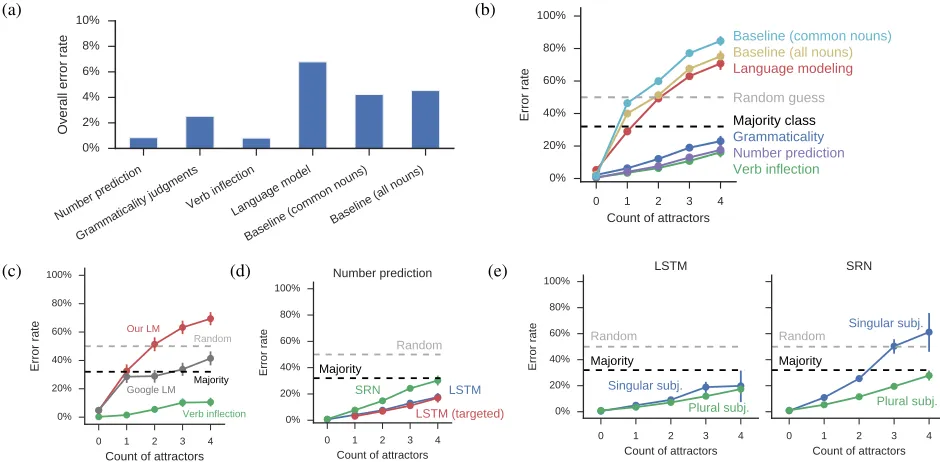
Results: When considering all agreement depen-dencies, all models achieved error rates below 7% (Figure 4a); as mentioned above, even the noun-only number prediction baselines achieved error rates be-low 5% on this task. At the same time, there were large differences in accuracy across training objec-tives. The verb inflection network performed slightly but significantly better than the number prediction one (0.8% compared to 0.83% errors), suggesting that the semantic information carried by the verb is moderately helpful. The grammaticality judgment objective performed somewhat worse, at 2.5% errors, but still outperformed the noun-only baselines by a large margin, showing the capacity of the LSTM ar-chitecture to learn syntactic dependencies even given fairly indirect evidence.
11One could also imagine performing the equivalent of the
(a)
Number prediction Grammaticality judgments
Verb inflectionLanguage model
Baseline (common nouns)Baseline (all nouns)
0% 2% 4% 6% 8% 10%
Overall error rate
(b)
0 1 2 3 4
Count of attractors 0%
20% 40% 60% 80% 100%
Error rate
Grammaticality Verb inflection Language modeling
Number prediction
Baseline (all nouns)
Baseline (common nouns)
Majority class Random guess
(c)
0 1 2 3 4
Count of attractors
0% 20% 40% 60% 80% 100%
Error rate
Our LM
Verb inflection Google LM Majority
Random
(d)
0 1 2 3 4
Count of attractors 0%
20% 40% 60% 80% 100%
Error rate
LSTM
SRN
LSTM (targeted) Majority
Random
Number prediction (e)
.
0 1 2 3 4
Count of attractors 0%
20% 40% 60% 80% 100%
Error rate Majority Random
Singular subj.
Plural subj.
LSTM
0 1 2 3 4
Count of attractors Majority
Random Singular subj.
Plural subj.
[image:9.612.71.541.55.286.2]SRN
Figure 4: Alternative tasks and additional experiments: (a) overall error rate across tasks (note that the y-axis ends in 10%); (b) effect of count of attractors in homogeneous dependencies across training objectives; (c) comparison of the Google LM (Jozefowicz et al., 2016) to our LM and one of our supervised verb inflection systems, on a sample of sentences; (d) number prediction: effect of count of attractors using SRNs with standard training or LSTM with targeted training; (e) number prediction: difference in error rate between singular and plural subjects across RNN cell types. Error bars represent binomial 95% confidence intervals.
The worst performer was the language model. It made eight times as many errors as the original num-ber prediction network (6.78% compared to 0.83%), and did substantially worse than the noun-only base-lines (though recall that the noun-only basebase-lines were still explicitly trained to predict verb number).
The differences across the networks are more strik-ing when we focus on dependencies with agreement attractors (Figure 4b). Here, the language model does worse than chance in the most difficult cases, and only slightly better than the noun-only baselines. The worse-than-chance performance suggests that attractors actively confuse the networks rather than cause them to make a random decision. The other models degrade more gracefully with the number of agreement attractors; overall, the grammaticality judgment objective is somewhat more difficult than the number prediction and verb inflection ones. In summary, we conclude that while the LSTM is capa-ble of learning syntax-sensitive agreement dependen-cies under various objectives, the language-modeling objective alone is not sufficient for learning such
de-pendencies, and a more direct form of training signal is required.
Comparison to a large-scale language model:
One objection to our language modeling result is that our LM faced a much harder objective than our other models—predicting a distribution over 10,000 vocabulary items is certainly harder than bi-nary classification—but was equipped with the same capacity (50-dimensional hidden state and word vec-tors). Would the performance gap between the LM and the explicitly supervised models close if we in-creased the capacity of the LM?
We address this question using a very large pub-licly available LM (Jozefowicz et al., 2016), which we refer to as the Google LM.12The Google LM rep-resents the current state-of-the-art in language mod-eling: it is trained on a billion-word corpus (Chelba et al., 2013), with a vocabulary of 800,000 words. It is based on a two-layer LSTM with 8192 units in each layer, or more than 300 times as many units
12 https://github.com/tensorflow/models/
as our LM; at 1.04 billion parameters it has almost 2000 times as many parameters. It is a fine-tuned language model that achieves impressive perplexity scores on common benchmarks, requires a massive infrastructure for training, and pushes the boundaries of what’s feasible with current hardware.
We tested the Google LM with the methodology we used to test ours.13 Due to computational resource limitations, we did not evaluate it on the entire test set, but sampled a random selection of 500 sentences for each count of attractors (testing a single sentence under the Google LM takes around 5 seconds on average). The results are presented in Figure 4c, where they are compared to the performance of the supervised verb inflection system. Despite having an order of magnitude more parameters and significantly larger training data, the Google LM performed poorly compared to the supervised models; even a single attractor led to a sharp increase in error rate to 28.5%, almost as high as our small-scale LM (32.6% on the same sentences). While additional attractors caused milder degradation than in our LM, the performance of the Google LM on sentences with four attractors was still worse than always guessing the majority class (SINGULAR).
In summary, our experiments with the Google LM do not change our conclusions: the contrast between the poor performance of the LMs and the strong per-formance of the explicitly supervised objectives sug-gests that direct supervision has a dramatic effect on the model’s ability to learn syntax-sensitive de-pendencies. Given that the Google LM was already trained on several hundred times more data than the number prediction system, it appears unlikely that its relatively poor performance was due to lack of training data.
6 Additional Experiments
Comparison to simple recurrent networks:
How much of the success of the network is due to the LSTM cells? We repeated the number prediction experiment with a simple recurrent network (SRN) (Elman, 1990), with the same number of hidden units. The SRN’s performance was inferior to the
13One technical exception was that we did not replace
low-frequency words with their part-of-speech, since the Google LM is a large-vocabulary language model, and does not have parts-of-speech as part of its vocabulary.
LSTM’s, but the average performance for a given number of agreement attractors does not suggest a qualitative difference between the cell types: the SRN makes about twice as many errors as the LSTM across the board (Figure 4d).
Training only on difficult dependencies: Only a small proportion of the dependencies in the corpus had agreement attractors (Figure 2e). Would the network generalize better if dependencies with in-tervening nouns were emphasized during training? We repeated our number prediction experiment, this time training the model only on dependencies with at least one intervening noun (of any number). We doubled the proportion of training sentences to 20%, since the total size of the corpus was smaller (226K dependencies).
This training regime resulted in a 27% decrease in error rate on dependencies with exactly one attractor (from 4.1% to 3.0%). This decrease is statistically sig-nificant, and encouraging given that the total number of dependencies in training was much lower, which complicates the learning of word embeddings. Error rates mildly decreased in dependencies with more attractors as well, suggesting some generalization (Figure 4d). Surprisingly, a similar experiment us-ing the grammaticality judgment task led to a slight
increasein error rate. While tentative at this point,
these results suggest that oversampling difficult train-ing cases may be beneficial; a curriculum progresstrain-ing from easier to harder dependencies (Elman, 1993) may provide additional gains.
7 Error Analysis
Singular vs. plural subjects: Most of the nouns in English are singular: in our corpus, the fraction of singular subjects is 68%. Agreement attraction errors in humans are much more common when the attractor is plural than when it is singular (Bock and Miller, 1991; Eberhard et al., 2005). Do our models’ error rates depend on the number of the subject?
increases; with four plural attractors the error rate reaches 60% (Figure 4e).
Qualitative analysis: We manually examined a
sample of 200 cases in which the majority of the 20 runs of the number prediction network made the wrong prediction. There were only 8890 such depen-dencies (about 0.6%). Many of those were straight-forward agreement attraction errors; others were dif-ficult to interpret. We mention here three classes of errors that can motivate future experiments.
The networks often misidentified the heads of noun-noun compounds. In (17), for example, the models predict a singular verb even though the num-ber of the subjectconservation refugeesshould be determined by its headrefugees. This suggests that the networks didn’t master the structure of English noun-noun compounds.14
(17) Conservationrefugees live in a world col-ored in shades of gray; limbo.
(18) Information technology (IT) assets com-monlyholdlarge volumes of confidential data.
Some verbs that are ambiguous with plural nouns seem to have been misanalyzed as plural nouns and consequently act as attractors. The models predicted a plural verb in the following two sentences even though neither of them has any plural nouns, possibly because of the ambiguous verbsdrivesandlands:
(19) Theshipthat the player driveshasa very high speed.
(20) It was also to be used to learn if thearea
where the lander landsistypical of the sur-rounding terrain.
Other errors appear to be due to difficulty not in identifying the subject but in determining whether it is plural or singular. In Example (22), in particular, there is very little information in the left context of the subject5 paragraphssuggesting that the writer considers it to be singular:
14The dependencies are presented as they appeared in the
corpus; the predicted number was the opposite of the correct one (e.g., singular in (17), where the original is plural).
(21) Rabaul-based Japaneseaircraft makethree dive-bombing attacks.
(22) The lead is also rather long; 5paragraphs ispretty lengthy for a 62 kilobyte article.
The last errors point to a limitation of the number prediction task, which jointly evaluates the model’s ability to identify the subject and its ability to assign the correct number to noun phrases.
8 Related Work
The majority of NLP work on neural networks eval-uates them on their performance in a task such as language modeling or machine translation (Sunder-meyer et al., 2012; Bahdanau et al., 2015). These evaluation setups average over many different syn-tactic constructions, making it difficult to isolate the network’s syntactic capabilities.
Other studies have tested the capabilities of RNNs to learn simple artificial languages. Gers and Schmid-huber (2001) showed that LSTMs can learn the context-free language anbn, generalizing to ns as
high as 1000 even when trained only on n ∈
{1, . . . ,10}. Simple recurrent networks struggled
with this language (Rodriguez et al., 1999; Rodriguez, 2001). These results have been recently replicated and extended by Joulin and Mikolov (2015).
Elman (1991) tested an SRN on a miniature lan-guage that simulated English relative clauses, and found that the network was only able to learn the language under highly specific circumstances (El-man, 1993), though later work has called some of his conclusions into question (Rohde and Plaut, 1999; Cartling, 2008). Frank et al. (2013) studied the ac-quisition of anaphora coreference by SRNs, again in a miniature language. Recently, Bowman et al. (2015) tested the ability of LSTMs to learn an artifi-cial language based on propositional logic. As in our study, the performance of the network degraded as the complexity of the test sentences increased.
Karpathy et al. (2016) present analyses and visual-ization methods for character-level RNNs. K´ad´ar et al. (2016) and Li et al. (2016) suggest visualization techniques for word-level RNNs trained to perform tasks that aren’t explicitly syntactic (image caption-ing and sentiment analysis).
grammaticality judgments includes Allen and Sei-denberg (1999) and Lawrence et al. (1996). More re-cently, the connection between grammaticality judg-ments and the probabilities assigned by a language model was explored by Clark et al. (2013) and Lau et al. (2015). Finally, arguments for evaluating NLP models on a strategically sampled set of dependency types rather than a random sample of sentences have been made in the parsing literature (Rimell et al., 2009; Nivre et al., 2010; Bender et al., 2011).
9 Discussion and Future Work
Neural network architectures are typically evaluated on random samples of naturally occurring sentences, e.g., using perplexity on held-out data in language modeling. Since the majority of natural language sen-tences are grammatically simple, models can achieve high overall accuracy using flawed heuristics that fail on harder cases. This makes it difficult to distin-guish simple but robust sequence models from more expressive architectures (Socher, 2014; Grefenstette et al., 2015; Joulin and Mikolov, 2015). Our work suggests an alternative strategy—evaluation on natu-rally occurring sentences that are sampled based on their grammatical complexity—which can provide more nuanced tests of language models (Rimell et al., 2009; Bender et al., 2011).
This approach can be extended to the training stage: neural networks can be encouraged to develop more sophisticated generalizations by oversampling grammatically challenging training sentences. We took a first step in this direction when we trained the network only on dependencies with intervening nouns (Section 6). This training regime indeed im-proved the performance of the network; however, the improvement was quantitative rather than qualitative: there was limited generalization to dependencies that were even more difficult than those encountered in training. Further experiments are needed to establish the efficacy of this method.
A network that has acquired syntactic represen-tations sophisticated enough to handle subject-verb agreement is likely to show improved performance on other structure-sensitive dependencies, including pronoun coreference, quantifier scope and negative polarity items. As such, neural models used in NLP applications may benefit from grammatically
sophis-ticated sentence representations developed in a multi-task learning setup (Caruana, 1998), where the model is trained concurrently on the task of interest and on one of the tasks we proposed in this paper. Of course, grammatical phenomena differ from each other in many ways. The distribution of negative polarity items is highly sensitive to semantic factors (Gian-nakidou, 2011). Restrictions on unbounded depen-dencies (Ross, 1967) may require richer syntactic representations than those required for subject-verb dependencies. The extent to which the results of our study will generalize to other constructions and other languages, then, is a matter for empirical research.
Humans occasionally make agreement attraction mistakes during language production (Bock and Miller, 1991) and comprehension (Nicol et al., 1997). These errors persist in human acceptability judg-ments (Tanner et al., 2014), which parallel our gram-maticality judgment task. Cases of grammatical agreement with the nearest rather than structurally rel-evant constituent have been documented in languages such as Slovenian (Maruˇsiˇc et al., 2007), and have even been argued to be occasionally grammatical in English (Zwicky, 2005). In future work, explor-ing the relationship between these cases and neural network predictions can shed light on the cognitive plausibility of those networks.
10 Conclusion
Acknowledgments
We thank Marco Baroni, Grzegorz Chrupała, Alexan-der Clark, Sol Lago, Paul Smolensky, Benjamin Spector and Roberto Zamparelli for comments and discussion. This research was supported by the European Research Council (grant ERC-2011-AdG 295810 BOOTPHON), the Agence Nationale pour la Recherche (grants ANR-10-IDEX-0001-02 PSL and ANR-10-LABX-0087 IEC) and the Israeli Science Foundation (grant number 1555/15).
References
Joseph Allen and Mark S. Seidenberg. 1999. The emer-gence of grammaticality in connectionist networks. In Brian MacWhinney, editor, Emergentist approaches to language: Proceedings of the 28th Carnegie
sym-posium on cognition, pages 115–151. Mahwah, NJ:
Erlbaum.
Dzmitry Bahdanau, Kyunghyun Cho, and Yoshua Bengio. 2015. Neural machine translation by jointly learning to align and translate. InInternational Conference for
Learning Representations.
Emily M. Bender, Dan Flickinger, Stephan Oepen, and Yi Zhang. 2011. Parser evaluation over local and non-local deep dependencies in a large corpus. In
Pro-ceedings of EMNLP, pages 397–408.
Kathryn Bock and Carol A. Miller. 1991. Broken agree-ment.Cognitive Psychology, 23(1):45–93.
Melissa Bowerman. 1988. The “no negative evidence” problem: How do children avoid constructing an overly general grammar? In John A. Hawkins, editor,
Explain-ing language universals, pages 73–101. Oxford: Basil
Blackwell.
Samuel R. Bowman, Christopher D. Manning, and Christopher Potts. 2015. Tree-structured composi-tion in neural networks without tree-structured archi-tectures. InProceedings of the NIPS Workshop on Cog-nitive Computation: Integrating Neural and Symbolic
Approaches.
Bo Cartling. 2008. On the implicit acquisition of a context-free grammar by a simple recurrent neural net-work.Neurocomputing, 71(7):1527–1537.
Rich Caruana. 1998. Multitask learning. In Sebastian Thrun and Lorien Pratt, editors, Learning to learn, pages 95–133. Boston: Kluwer.
Ciprian Chelba, Tomas Mikolov, Mike Schuster, Qi Ge, Thorsten Brants, Phillipp Koehn, and Tony Robin-son. 2013. One billion word benchmark for measur-ing progress in statistical language modelmeasur-ing. arXiv
preprint arXiv:1312.3005.
Kyunghyun Cho, Bart van Merrienboer, Caglar Gulcehre, Dzmitry Bahdanau, Fethi Bougares, Holger Schwenk, and Yoshua Bengio. 2014. Learning phrase repre-sentations using RNN encoder–decoder for statistical machine translation. InProceedings of EMNLP, pages 1724–1734.
Noam Chomsky. 1965.Aspects of the Theory of Syntax. Cambridge, MA: MIT press.
Alexander Clark, Gianluca Giorgolo, and Shalom Lap-pin. 2013. Statistical representation of grammaticality judgements: The limits of n-gram models. In Proceed-ings of the Fourth Annual Workshop on Cognitive
Mod-eling and Computational Linguistics (CMCL), pages
28–36.
Chris Dyer, Adhiguna Kuncoro, Miguel Ballesteros, and A. Noah Smith. 2016. Recurrent neural network gram-mars. InProceedings of NAACL/HLT, pages 199–209. Kathleen M. Eberhard, J. Cooper Cutting, and Kathryn Bock. 2005. Making syntax of sense: Number agree-ment in sentence production. Psychological Review, 112(3):531–559.
Jeffrey L. Elman. 1990. Finding structure in time.
Cogni-tive Science, 14(2):179–211.
Jeffrey L. Elman. 1991. Distributed representations, sim-ple recurrent networks, and grammatical structure.
Ma-chine Learning, 7(2-3):195–225.
Jeffrey L. Elman. 1993. Learning and development in neu-ral networks: The importance of starting small. Cogni-tion, 48(1):71–99.
Martin B. H. Everaert, Marinus A. C. Huybregts, Noam Chomsky, Robert C. Berwick, and Johan J. Bolhuis. 2015. Structures, not strings: Linguistics as part of the cognitive sciences. Trends in Cognitive Sciences, 19(12):729–743.
Robert Frank, Donald Mathis, and William Badecker. 2013. The acquisition of anaphora by simple recur-rent networks. Language Acquisition, 20(3):181–227. Felix Gers and J¨urgen Schmidhuber. 2001. LSTM
re-current networks learn simple free and context-sensitive languages. IEEE Transactions on Neural
Net-works, 12(6):1333–1340.
Anastasia Giannakidou. 2011. Negative and positive polarity items: Variation, licensing, and compositional-ity. In Claudia Maienborn, Klaus von Heusinger, and Paul Portner, editors,Semantics: An international
hand-book of natural language meaning. Berlin: Mouton de
Gruyter.
Yoav Goldberg and Joakim Nivre. 2012. A dynamic ora-cle for arc-eager dependency parsing. InProceedings
of COLING 2012, pages 959–976.
Edward Grefenstette, Karl Moritz Hermann, Mustafa Su-leyman, and Phil Blunsom. 2015. Learning to trans-duce with unbounded memory. InAdvances in Neural
Sepp Hochreiter and J¨urgen Schmidhuber. 1997. Long short-term memory.Neural Computation, 9(8):1735– 1780.
Rodney Huddleston and Geoffrey K. Pullum. 2002. The
Cambridge Grammar of the English Language.
Cam-bridge University Press, CamCam-bridge.
Armand Joulin and Tomas Mikolov. 2015. Inferring algorithmic patterns with stack-augmented recurrent nets. InAdvances in Neural Information Processing
Systems, pages 190–198.
Rafal Jozefowicz, Oriol Vinyals, Mike Schuster, Noam Shazeer, and Yonghui Wu. 2016. Exploring the limits of language modeling. arXiv preprint
arXiv:1602.02410.
´Akos K´ad´ar, Grzegorz Chrupała, and Afra Alishahi. 2016. Representation of linguistic form and func-tion in recurrent neural networks. arXiv preprint
arXiv:1602.08952.
Andrej Karpathy, Justin Johnson, and Fei-Fei Li. 2016. Visualizing and understanding recurrent networks. In
ICLR Workshop.
Diederik Kingma and Jimmy Ba. 2015. Adam: A method for stochastic optimization. InInternational
Confer-ence for Learning Representations.
Eliyahu Kiperwasser and Yoav Goldberg. 2016. Simple and accurate dependency parsing using bidirectional lstm feature representations. Transactions of the
Asso-ciation of Computational Linguistics, 4:313–327.
Jey Han Lau, Alexander Clark, and Shalom Lappin. 2015. Unsupervised prediction of acceptability judgements.
InProceedings of ACL/IJCNLP, pages 1618–1628.
Steve Lawrence, Lee C. Giles, and Santliway Fong. 1996. Can recurrent neural networks learn natural language grammars? InIEEE International Conference on
Neu-ral Networks, volume 4, pages 1853–1858.
Willem J. M. Levelt, Ardi Roelofs, and Antje S. Meyer. 1999. A theory of lexical access in speech production.
Behavioral and Brain Sciences, 22(1):1–75.
Jiwei Li, Xinlei Chen, Eduard H. Hovy, and Dan Jurafsky. 2016. Visualizing and understanding neural models in NLP. InProceedings of NAACL-HLT 2016, pages 681–691.
Franc Maruˇsiˇc, Andrew Nevins, and Amanda Saksida. 2007. Last-conjunct agreement in Slovenian. In An-nual Workshop on Formal Approaches to Slavic
Lin-guistics, pages 210–227.
Tomas Mikolov, Martin Karafi´at, Lukas Burget, Jan Cer-nock`y, and Sanjeev Khudanpur. 2010. Recurrent neu-ral network based language model. InINTERSPEECH, pages 1045–1048.
Janet L. Nicol, Kenneth I. Forster, and Csaba Veres. 1997. Subject–verb agreement processes in comprehension.
Journal of Memory and Language, 36(4):569–587.
Joakim Nivre, Laura Rimell, Ryan McDonald, and Carlos Gomez-Rodriguez. 2010. Evaluation of dependency parsers on unbounded dependencies. InProceedings of the 23rd International Conference on Computational
Linguistics, pages 833–841. Association for
Computa-tional Linguistics.
Laura Rimell, Stephen Clark, and Mark Steedman. 2009. Unbounded dependency recovery for parser evaluation.
InProceedings of EMNLP, pages 813–821.
Paul Rodriguez, Janet Wiles, and Jeffrey L. Elman. 1999. A recurrent neural network that learns to count.
Con-nection Science, 11(1):5–40.
Paul Rodriguez. 2001. Simple recurrent networks learn context-free and context-sensitive languages by
count-ing.Neural Computation, 13(9):2093–2118.
Douglas L. T. Rohde and David C. Plaut. 1999. Language acquisition in the absence of explicit negative evidence: How important is starting small? Cognition, 72(1):67– 109.
John Robert Ross. 1967. Constraints on variables in
syntax. Ph.D. thesis, MIT.
Carson T. Sch¨utze. 1996.The empirical base of linguis-tics: Grammaticality judgments and linguistic
method-ology. Chicago, IL: University of Chicago Press.
Richard Socher. 2014. Recursive Deep Learning for
Natural Language Processing and Computer Vision.
Ph.D. thesis, Stanford University.
Adrian Staub. 2009. On the interpretation of the number attraction effect: Response time evidence.Journal of
Memory and Language, 60(2):308–327.
Martin Sundermeyer, Ralf Schl¨uter, and Hermann Ney. 2012. LSTM neural networks for language modeling.
InINTERSPEECH.
Darren Tanner, Janet Nicol, and Laurel Brehm. 2014. The time-course of feature interference in agreement com-prehension: Multiple mechanisms and asymmetrical attraction. Journal of Memory and Language, 76:195– 215.
Oriol Vinyals, Łukasz Kaiser, Terry Koo, Slav Petrov, Ilya Sutskever, and Geoffrey Hinton. 2015. Grammar as a foreign language. InAdvances in Neural Information
Processing Systems, pages 2755–2763.
the X(s) of the Y(s) 1.0 0.8 0.6 0.4 0.2 0.0 0.2 X,Y X,Ys Xs,Y Xs,Ys Unit 0: PP
the X(s) that the Y(s) 1.0 0.8 0.6 0.4 0.2 0.0 0.2 X,Y X,Ys Xs,Y Xs,Ys Unit 0: RC
the X(s) of the Y(s) 0.5 0.0 0.5 1.0 X,Y X,Ys Xs,Y Xs,Ys Unit 1: PP
the X(s) that the Y(s) 0.5 0.0 0.5 1.0 X,Y X,Ys Xs,Y Xs,Ys Unit 1: RC
the X(s) of the Y(s) 0.8 0.6 0.4 0.2 0.0 0.2 0.4 X,Y X,Ys Xs,Y Xs,Ys Unit 2: PP
the X(s) that the Y(s) 0.8 0.6 0.4 0.2 0.0 0.2 0.4 X,Y X,Ys Xs,Y Xs,Ys Unit 2: RC
the X(s) of the Y(s) 0.8
0.6 0.4 0.2 0.0
0.2 X,YX,Ys
Xs,Y
Xs,Ys Unit 3: PP
the X(s) that the Y(s) 0.8 0.6 0.4 0.2 0.0 0.2 X,Y X,Ys Xs,Y Xs,Ys Unit 3: RC
the X(s) of the Y(s) 0.8 0.6 0.4 0.2 0.0 0.2
0.4 X,YX,Ys
Xs,Y Xs,Ys Unit 4: PP
the X(s) that the Y(s) 0.8 0.6 0.4 0.2 0.0 0.2 0.4 X,Y X,Ys Xs,Y Xs,Ys Unit 4: RC
the X(s) of the Y(s) 0.5 0.0 0.5 X,Y X,Ys Xs,Y Xs,Ys Unit 5: PP
the X(s) that the Y(s) 0.5 0.0 0.5 X,Y X,Ys Xs,Y Xs,Ys Unit 5: RC
the X(s) of the Y(s) 1.0 0.5 0.0 0.5 X,Y X,Ys Xs,Y Xs,Ys Unit 6: PP
the X(s) that the Y(s) 1.0 0.5 0.0 0.5 X,Y X,Ys Xs,Y Xs,Ys Unit 6: RC
the X(s) of the Y(s) 0.0 0.2 0.4 0.6 0.8 X,Y X,Ys Xs,Y Xs,Ys Unit 7: PP
the X(s) that the Y(s) 0.0 0.2 0.4 0.6 0.8 X,Y X,Ys Xs,Y Xs,Ys Unit 7: RC
the X(s) of the Y(s) 0.8 0.6 0.4 0.2 0.0 0.2 X,Y X,Ys Xs,Y Xs,Ys Unit 8: PP
the X(s) that the Y(s) 0.8 0.6 0.4 0.2 0.0 0.2 X,Y X,Ys Xs,Y Xs,Ys Unit 8: RC
the X(s) of the Y(s) 0.0 0.2 0.4 0.6 0.8 X,Y X,Ys Xs,Y Xs,Ys Unit 9: PP
the X(s) that the Y(s) 0.0 0.2 0.4 0.6 0.8 X,Y X,Ys Xs,Y Xs,Ys Unit 9: RC
the X(s) of the Y(s) 1.0 0.8 0.6 0.4 0.2 0.0 X,Y X,Ys Xs,Y Xs,Ys Unit 10: PP
the X(s) that the Y(s) 1.0 0.8 0.6 0.4 0.2 0.0 X,Y X,Ys Xs,Y Xs,Ys Unit 10: RC
the X(s) of the Y(s) 1.0 0.5 0.0 0.5 1.0 X,Y X,Ys Xs,Y Xs,Ys Unit 11: PP
the X(s) that the Y(s) 1.0 0.5 0.0 0.5 1.0 X,Y X,Ys Xs,Y Xs,Ys Unit 11: RC
the X(s) of the Y(s) 1.0 0.5 0.0 0.5 X,Y X,Ys Xs,Y Xs,Ys Unit 12: PP
the X(s) that the Y(s) 1.0 0.5 0.0 0.5 X,Y X,Ys Xs,Y Xs,Ys Unit 12: RC
the X(s) of the Y(s) 0.4 0.2 0.0 0.2 0.4 X,Y X,Ys Xs,Y Xs,Ys Unit 13: PP
the X(s) that the Y(s) 0.4 0.2 0.0 0.2 0.4 X,Y X,Ys Xs,Y Xs,Ys Unit 13: RC
the X(s) of the Y(s) 0.6 0.4 0.2 0.0 0.2 0.4 X,Y X,Ys Xs,Y Xs,Ys Unit 14: PP
the X(s) that the Y(s) 0.6 0.4 0.2 0.0 0.2 0.4 X,Y X,Ys Xs,Y Xs,Ys Unit 14: RC
the X(s) of the Y(s) 0.5 0.0 0.5 X,Y X,Ys Xs,Y Xs,Ys Unit 15: PP
the X(s) that the Y(s) 0.5 0.0 0.5 X,Y X,Ys Xs,Y Xs,Ys Unit 15: RC
the X(s) of the Y(s) 0.5 0.0 0.5 X,Y X,Ys Xs,Y Xs,Ys Unit 16: PP
the X(s) that the Y(s) 0.5 0.0 0.5 X,Y X,Ys Xs,Y Xs,Ys Unit 16: RC
the X(s) of the Y(s) 0.4 0.2 0.0 0.2 0.4 0.6 0.8 X,Y X,Ys Xs,Y Xs,Ys Unit 17: PP
the X(s) that the Y(s) 0.4 0.2 0.0 0.2 0.4 0.6 0.8 X,Y X,Ys Xs,Y Xs,Ys Unit 17: RC
the X(s) of the Y(s) 0.8 0.6 0.4 0.2 0.0 0.2 X,Y X,Ys Xs,Y Xs,Ys Unit 18: PP
the X(s) that the Y(s) 0.8 0.6 0.4 0.2 0.0 0.2 X,Y X,Ys Xs,Y Xs,Ys Unit 18: RC
the X(s) of the Y(s) 0.2 0.4 0.6 0.8 X,Y X,Ys Xs,Y Xs,Ys Unit 19: PP
the X(s) that the Y(s) 0.2 0.4 0.6 0.8 X,Y X,Ys Xs,Y Xs,Ys Unit 19: RC
the X(s) of the Y(s) 0.4 0.2 0.0 0.2 X,Y X,Ys Xs,Y Xs,Ys Unit 20: PP
the X(s) that the Y(s) 0.4 0.2 0.0 0.2 X,Y X,Ys Xs,Y Xs,Ys Unit 20: RC
the X(s) of the Y(s) 0.2 0.1 0.0 0.1 0.2 X,Y X,Ys Xs,Y Xs,Ys Unit 21: PP
the X(s) that the Y(s) 0.2 0.1 0.0 0.1 0.2 X,Y X,Ys Xs,Y Xs,Ys Unit 21: RC
the X(s) of the Y(s) 0.4 0.2 0.0 0.2 0.4 0.6 0.8 X,Y X,Ys Xs,Y Xs,Ys Unit 22: PP
the X(s) that the Y(s) 0.4 0.2 0.0 0.2 0.4 0.6 0.8 X,Y X,Ys Xs,Y Xs,Ys Unit 22: RC
the X(s) of the Y(s) 0.15 0.10 0.05 0.00 0.05 0.10 X,Y X,Ys Xs,Y Xs,Ys Unit 23: PP
the X(s) that the Y(s) 0.15
0.10 0.05 0.00 0.05
0.10 X,YX,Ys
Xs,Y Xs,Ys Unit 23: RC
the X(s) of the Y(s) 1.0 0.5 0.0 0.5 X,Y X,Ys Xs,Y Xs,Ys Unit 24: PP
the X(s) that the Y(s) 1.0 0.5 0.0 0.5 X,Y X,Ys Xs,Y Xs,Ys Unit 24: RC
the X(s) of the Y(s) 0.5 0.0 0.5 1.0 X,Y X,Ys Xs,Y Xs,Ys Unit 25: PP
the X(s) that the Y(s) 0.5 0.0 0.5 1.0 X,Y X,Ys Xs,Y Xs,Ys Unit 25: RC
the X(s) of the Y(s) 0.4
0.2 0.0 0.2
0.4 X,YX,Ys
Xs,Y Xs,Ys Unit 26: PP
the X(s) that the Y(s) 0.4 0.2 0.0 0.2 0.4 X,Y X,Ys Xs,Y Xs,Ys Unit 26: RC
the X(s) of the Y(s) 0.0 0.1 0.2 0.3 0.4 0.5 0.6 0.7 X,Y X,Ys Xs,Y Xs,Ys Unit 27: PP
the X(s) that the Y(s) 0.0 0.1 0.2 0.3 0.4 0.5 0.6 0.7 X,Y X,Ys Xs,Y Xs,Ys Unit 27: RC
the X(s) of the Y(s) 0.5 0.0 0.5 X,Y X,Ys Xs,Y Xs,Ys Unit 28: PP
the X(s) that the Y(s) 0.5 0.0 0.5 X,Y X,Ys Xs,Y Xs,Ys Unit 28: RC
the X(s) of the Y(s) 1.0 0.8 0.6 0.4 0.2 0.0 X,Y X,Ys Xs,Y Xs,Ys Unit 29: PP
the X(s) that the Y(s) 1.0 0.8 0.6 0.4 0.2 0.0 X,Y X,Ys Xs,Y Xs,Ys Unit 29: RC
the X(s) of the Y(s) 0.5 0.0 0.5 1.0 X,Y X,Ys Xs,Y Xs,Ys Unit 30: PP
the X(s) that the Y(s) 0.5 0.0 0.5 1.0 X,Y X,Ys Xs,Y Xs,Ys Unit 30: RC
the X(s) of the Y(s) 0.7 0.6 0.5 0.4 0.3 0.2 0.1 0.0 X,Y X,Ys Xs,Y Xs,Ys Unit 31: PP
the X(s) that the Y(s) 0.7 0.6 0.5 0.4 0.3 0.2 0.1 0.0 X,Y X,Ys Xs,Y Xs,Ys Unit 31: RC
the X(s) of the Y(s) 0.0 0.1 0.2 0.3 0.4 0.5 0.6 X,Y X,Ys Xs,Y Xs,Ys Unit 32: PP
the X(s) that the Y(s) 0.0 0.1 0.2 0.3 0.4 0.5 0.6 X,Y X,Ys Xs,Y Xs,Ys Unit 32: RC
the X(s) of the Y(s) 1.0 0.5 0.0 0.5 X,Y X,Ys Xs,Y Xs,Ys Unit 33: PP
the X(s) that the Y(s) 1.0 0.5 0.0 0.5 X,Y X,Ys Xs,Y Xs,Ys Unit 33: RC
the X(s) of the Y(s) 0.2 0.0 0.2 0.4 0.6 0.8 X,Y X,Ys Xs,Y Xs,Ys Unit 34: PP
the X(s) that the Y(s) 0.2 0.0 0.2 0.4 0.6 0.8 X,Y X,Ys Xs,Y Xs,Ys Unit 34: RC
the X(s) of the Y(s) 0.4 0.2 0.0 0.2 X,Y X,Ys Xs,Y Xs,Ys Unit 35: PP
the X(s) that the Y(s) 0.4 0.2 0.0 0.2 X,Y X,Ys Xs,Y Xs,Ys Unit 35: RC
the X(s) of the Y(s) 0.3 0.2 0.1 0.0 0.1 0.2
0.3 X,YX,Ys
Xs,Y Xs,Ys Unit 36: PP
the X(s) that the Y(s) 0.3 0.2 0.1 0.0 0.1 0.2
0.3 X,YX,Ys
Xs,Y Xs,Ys Unit 36: RC
the X(s) of the Y(s) 0.2
0.0 0.2
0.4 X,YX,Ys
Xs,Y Xs,Ys Unit 37: PP
the X(s) that the Y(s) 0.2 0.0 0.2 0.4 X,Y X,Ys Xs,Y Xs,Ys Unit 37: RC
the X(s) of the Y(s) 0.5 0.0 0.5 1.0 X,Y X,Ys Xs,Y Xs,Ys Unit 38: PP
the X(s) that the Y(s) 0.5 0.0 0.5 1.0 X,Y X,Ys Xs,Y Xs,Ys Unit 38: RC
the X(s) of the Y(s) 0.5 0.0 0.5 1.0 X,Y X,Ys Xs,Y Xs,Ys Unit 39: PP
the X(s) that the Y(s) 0.5 0.0 0.5 1.0 X,Y X,Ys Xs,Y Xs,Ys Unit 39: RC
the X(s) of the Y(s) 0.6
0.4 0.2 0.0 0.2
0.4 X,YX,Ys
Xs,Y Xs,Ys Unit 40: PP
the X(s) that the Y(s) 0.6 0.4 0.2 0.0 0.2 0.4 X,Y X,Ys Xs,Y Xs,Ys Unit 40: RC
the X(s) of the Y(s) 0.1 0.0 0.1 0.2 0.3 0.4 0.5 X,Y X,Ys Xs,Y Xs,Ys Unit 41: PP
the X(s) that the Y(s) 0.1 0.0 0.1 0.2 0.3 0.4 0.5 X,Y X,Ys Xs,Y Xs,Ys Unit 41: RC
the X(s) of the Y(s) 0.0 0.1 0.2 0.3 0.4 0.5 X,Y X,Ys Xs,Y Xs,Ys Unit 42: PP
the X(s) that the Y(s) 0.0 0.1 0.2 0.3 0.4 0.5 X,Y X,Ys Xs,Y Xs,Ys Unit 42: RC
the X(s) of the Y(s) 0.5 0.0 0.5 X,Y X,Ys Xs,Y Xs,Ys Unit 43: PP
the X(s) that the Y(s) 0.5 0.0 0.5 X,Y X,Ys Xs,Y Xs,Ys Unit 43: RC
the X(s) of the Y(s) 0.4 0.2 0.0 0.2 0.4 0.6 0.8 1.0 X,Y X,Ys Xs,Y Xs,Ys Unit 44: PP
the X(s) that the Y(s) 0.4 0.2 0.0 0.2 0.4 0.6 0.8 1.0 X,Y X,Ys Xs,Y Xs,Ys Unit 44: RC
the X(s) of the Y(s) 0.0 0.2 0.4 0.6 0.8 X,Y X,Ys Xs,Y Xs,Ys Unit 45: PP
the X(s) that the Y(s) 0.0 0.2 0.4 0.6 0.8 X,Y X,Ys Xs,Y Xs,Ys Unit 45: RC
the X(s) of the Y(s) 1.0 0.5 0.0 0.5 X,Y X,Ys Xs,Y Xs,Ys Unit 46: PP
the X(s) that the Y(s) 1.0 0.5 0.0 0.5 X,Y X,Ys Xs,Y Xs,Ys Unit 46: RC
the X(s) of the Y(s) 0.5
0.0 0.5
1.0 X,YX,Ys
Xs,Y Xs,Ys Unit 47: PP
the X(s) that the Y(s) 0.5 0.0 0.5 1.0 X,Y X,Ys Xs,Y Xs,Ys Unit 47: RC
the X(s) of the Y(s) 0.8 0.6 0.4 0.2 0.0 0.2 0.4 X,Y X,Ys Xs,Y Xs,Ys Unit 48: PP
the X(s) that the Y(s) 0.8 0.6 0.4 0.2 0.0 0.2 0.4 X,Y X,Ys Xs,Y Xs,Ys Unit 48: RC
the X(s) of the Y(s) 0.7 0.6 0.5 0.4 0.3 0.2 0.1
0.0 Unit 49: PP X,YX,YsXs,YXs,Ys
[image:15.612.72.539.65.666.2]the X(s) that the Y(s) 0.7 0.6 0.5 0.4 0.3 0.2 0.1 0.0 X,Y X,Ys Xs,Y Xs,Ys Unit 49: RC