192
Improving Generalization in Coreference Resolution via Adversarial
Training
Sanjay Subramanian University of Pennsylvania [email protected]
Dan Roth
University of Pennsylvania [email protected]
Abstract
In order for coreference resolution systems to be useful in practice, they must be able to generalize to new text. In this work, we demonstrate that the performance of the state-of-the-art system decreases when the names of PER and GPE named entities in the CoNLL dataset are changed to names that do not occur in the training set. We use the technique of adversarial gradient-based training to retrain the state-of-the-art system and demonstrate that the retrained system achieves higher performance on the CoNLL dataset (both with and without the change of named entities) and the GAP dataset.
1 Introduction
Through the use of neural networks, performance on the task of coreference resolution has increased significantly over the last few years. Still, neu-ral systems trained on the standard coreference dataset have issues with generalization, as shown by (Moosavi and Strube,2018).
One way to improve the understanding of how a system overfits a dataset is to study the change in the system’s performance when the dataset is modified slightly in a focused and relevant man-ner. We take this approach by modifying the test set so that each PER and GPE (person and geopo-litical entity) named entity is different from those seen in training. In other words, we ensure that there is no leakage of PER and GPE named entities from the training set into the test set. We demon-strate that the performance of the (Lee et al.,2018) system, which is the current state-of-the-art, de-creases when the named entities are replaced. An example of a replacement that causes the system to make an error is given in Table1.
Motivated by these issues of generalization, this paper aims to improve the training process of
neu-Original: But Dirk Van Dongen , president of the National Association of Wholesaler - Distributors, said that last month ’s rise “ is n’t as bad an omen ” as the 0.9 % figure suggests . “ If you examine the data carefully , the increase is concentrated in energy and motor vehicle prices , rather than being a broad - based advance in the prices of consumer and industrial goods , ”heexplained .
Replacement: Replace Dick Van Dongen with
Vendemiaire Van Korewdit.
Table 1: An excerpt from the CoNLL test set. The coreference between the two highlighted mentions is correctly predicted by the (Lee et al.,2018) system, but after the specified replacement, the system incorrectly resolves “he” to a different name occurring outside this excerpt.
ral coreference systems. Various regularization techniques have been proposed for improving the generalization capability of neural networks, in-cluding dropout (Srivastava et al., 2014) and ad-versarial training (Goodfellow et al., 2015; Miy-ato et al.,2017). The model of (Lee et al.,2018), like most neural approaches, uses dropout. In this work, we apply the adversarial fast-gradient-sign-method (FGSM) described by (Miyato et al.,
ex-hibits state-of-the-art performance on the GAP dataset (Webster et al.,2018), a recently released dataset focusing on resolving pronouns to peo-ple’s names in excerpts from Wikipedia. The code and other relevant files for this project can be found via https://cogcomp.org/ page/publication_view/871.
2 Related Work
(Moosavi and Strube,2017,2018) also study gen-eralization of neural coreference resolvers. How-ever, they focus on transfer and indicate that the ranking of coreference resolvers (trained on the CoNLL training set) induced by their performance on the CoNLL test set is not preserved when the systems are evaluated on a different dataset. They use the Wikicoref dataset (Ghaddar and Langlais,
2016), which is limited in that it consists of only 30 documents. They then show that the addition of features representing linguistic information im-proves the performance of a coreference resolver on the out-of-domain dataset.
The adversarial fast-gradient-sign-method (FGSM) was first introduced by (Goodfellow et al.,2015) and was applied to sentence classifi-cation tasks through word embeddings by (Miyato et al., 2017). Gradient-based adversarial attacks have since been used to train models for various NLP tasks, such as relation extraction (Wu et al.,
2017) and joint entity and relation extraction (Bekoulis et al.,2018).
Our replacements of named entities can also be viewed as a way of generating adversarial ex-amples for coreference systems; it is related to the earlier method proposed in (Khashabi et al.,
2016) in the context of question answering and to (Alzantot et al., 2018), which provides a way of generating adversarial examples for simple classi-fication tasks.
3 Adversarial Training for Coreference
In coreference resolution, the goal is to find and cluster phrases that refer to entities. We use the word “span” to mean a series of consecutive words. A span that refers to an entity is called a mention. If two mentionsiandjrefer to the same entity and mention i occurs before mention j in the text, we say that mentioniis an antecedent of mentionj. For a given mention i, the candidate antecedents ofiare the mentions that occur before iin the text. In Figure1, each line segment
repre-Figure 1: For each mention, the model computes scores for each of the candidate antecedent mentions and chooses the candidate with the highest score to be the predicted antecedent. This image was created by the authors of (Chang et al.,2013).
sents a mention and the arrows are directed from one mention to its possible antecedents.
We now review the model architecture of (Lee et al.,2018) and describe how we apply the fast-gradient-sign-method (FGSM) of (Miyato et al.,
2017) to the model. Using GloVe (Pennington et al., 2014) and ELMo (Peters et al., 2018) em-beddings of each word and using learned character embeddings, the model computes contextualized representations {x1,x2, ...,xn} of each word xi in the input document using a bidirectional LSTM (Hochreiter and Schmidhuber, 1997). For candi-date spani, which consists of the words at indices starti, starti + 1, ..., endi, the model constructs a span representationgi by concatenatingxstarti, xendi,
1
Pendi
j=startiβj Pendi
j=startiβjxj, andφ(endi −
starti), where the βj’s are learned scalar values andφ(·) is a learned embedding representing the width of the span (Lee et al., 2017). The span representations are then used as inputs to feedfor-ward networks that compute mention scores for each span and that compute antecedent scores for pairs of spans. In Figure 1, the number associ-ated with each arrow is the antecedent score for the associated pair of mentions. The coreference score for the pair of spans(i, j)is the sum of the mention score for span i, the mention score for span j, and the antecedent score for (i, j). For each spani, the antecedent span predicted by the model is the spanjthat maximizes the antecedent score for (i, j). Letg = {gi}Ni=1 denote the set of the representations of all N candidate spans. Let L(g) denote the original model’s loss func-tion. (Note that the model’s predictions and the loss depend on the input text only through the span representations.) For eachi∈ {1, ..., N}, let
giadv(g) = ∇giL
{gi}Ni=1
[image:2.595.333.501.59.129.2]Then the adversarial loss with the FGSM is
Ladv({gi}Ni=1) =L
gi+
giadv(g) ||giadv(g)||
N
i=1 !
.
The total loss used in training is
Ltotal(g) =αL(g) + (1−α)Ladv(g).
In our experiments, we find that α = 0.6 and = 1work well. A key difference between our method and that employed by (Miyato et al.,2017) is that the latter applies the adversarial perturba-tion to the input embeddings, whereas we apply it to the span representations, which are an inter-mediate layer of the model. We found in our ex-periments that applying the FGSM to the character embeddings in the initial layer was not as effective as applying the method to the span representations as described above. Another difference between our method and that of (Miyato et al.,2017) is that we do not normalize the span embeddings before applying the adversarial perturbations.
4 No Leakage of Named Entities
Named entities are an important subset of the en-tities a coreference system is tasked with discov-ering. (Agarwal et al.,2018) provide the percent-ages of clusters in the CoNLL dataset represented by the PER, ORG, GPE, and DATE named entity types –15%,11%,11%, and4%, respectively. It is important for generalization that systems perform well with names that are different from those seen in training. We found that in the CoNLL dataset, roughly34%of the PER and GPE named entities that are the head of a mention of some gold clus-ter in the test set are also the head of a mention of a gold cluster in the train set. Therefore, there is considerable overlap, or leakage, between the names in the train and test sets. In this section, we describe a method for evaluating on the CoNLL test set without leaked name entities.
We focus on PER and GPE named entities be-cause they are two of the three most common en-tity types and because in general when replacing a PER or GPE name with another name, it is easy to not change the true coreference structure of the document. In particular, changing the name of an organization while ensuring that it is compatible with nominals in the cluster is nontrivial without a finer semantic typing. By contrast, we describe below how we control for gender and location type
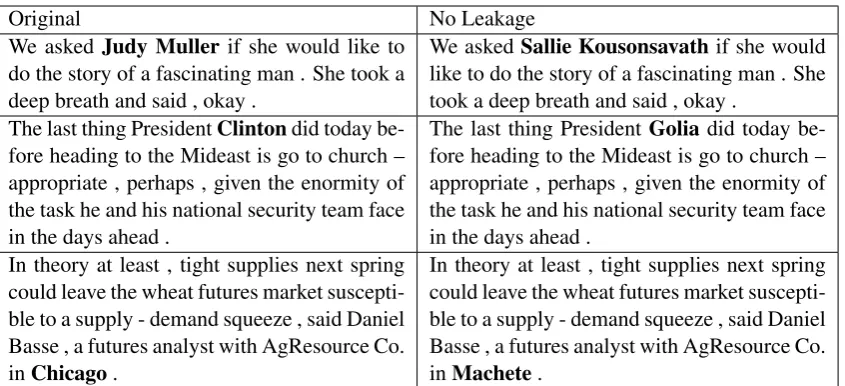
when replacing PER and GPE names, respectively. We also ensure that the capitalization of the first letter in the replacement name is the same as in the original text. Finally, we note that the diver-sity of PER and GPE entities exceeds that of other named entity types; this increases the importance of generalization to new names and, at the same time, enables us to find matching names to use as replacements. Table2 provides examples of text in the original CoNLL-2012 dataset and the corre-sponding text after our modifications.
4.1 Replacing PER entities
Original No Leakage We asked Judy Muller if she would like to
do the story of a fascinating man . She took a deep breath and said , okay .
We askedSallie Kousonsavathif she would like to do the story of a fascinating man . She took a deep breath and said , okay .
The last thing PresidentClintondid today be-fore heading to the Mideast is go to church – appropriate , perhaps , given the enormity of the task he and his national security team face in the days ahead .
The last thing President Golia did today be-fore heading to the Mideast is go to church – appropriate , perhaps , given the enormity of the task he and his national security team face in the days ahead .
In theory at least , tight supplies next spring could leave the wheat futures market suscepti-ble to a supply - demand squeeze , said Daniel Basse , a futures analyst with AgResource Co. inChicago.
[image:4.595.90.513.60.253.2]In theory at least , tight supplies next spring could leave the wheat futures market suscepti-ble to a supply - demand squeeze , said Daniel Basse , a futures analyst with AgResource Co. inMachete.
Table 2: Excerpts from the CoNLL-2012 test set and their versions after we have replaced PER and GPE names to avoid name leakage.
first names inMif the cluster is male or from the remaining first names F if the cluster is female. Note that our sampling from each ofL,M, andF is without replacement, so no last name is used as a replacement more than once, no male first name is used more than once, and no female first name is used more than once.
4.2 Replacing GPE entities
Our approach to replacing GPE entity names is very similar to that used for PER names. We use the GeoNames1 database of geopolitical names. In addition to providing a list of GPE names, this database also categorizes the names by the type of entity to which they refer (e.g. city, state, county, etc.). The data includes the names and categories of more than 11,000,000locations in the world. We restrict our attention to GPE entities that sat-isfy the following requirements: (1) they occur in the GeoNames database and (2) they are not coun-tries. We say that a mention is a GPE-mention if its head (as given by the dependency parser) is a GPE named entity satisfying these three require-ments. (Again, we use the gold NER to identify GPE names in the CoNLL text.) We remove all GPE names occurring in the training set from the list of replacement GPE names for each location category. Then for each cluster containing a GPE-mention, we find the GeoNames category for the mention’s GPE name and replace the name with a randomly chosen name from the same category. As with PER names, we sample names from each
1http://www.geonames.org/
category without replacement, so each GPE name is used for replacement at most once.
5 Experiments
We trained the (Lee et al.,2018) model architec-ture with the adversarial approach on the CoNLL training set for355000 iterations (the same num-ber of iterations for which the original model was trained) with the same training hyperparameters used by original model. For comparing with the (Lee et al., 2017) and (Lee et al., 2018) systems, we use the pretrained models released by the au-thors.2
The datasets used for evaluation are the CoNLL and GAP datasets.
5.1 CoNLL Dataset
Table 3 shows the performance on the CoNLL test set, as measured by CoNLL F1, of the (Lee et al., 2018) system with and without our adver-sarial training approach. The replacement of PER and GPE entities decreased the performance of the original system by more than1F1.
5.2 GAP Dataset
The GAP dataset (Webster et al., 2018) focuses on resolving pronouns to named people in ex-cerpts from Wikipedia. The dataset, which is gender-balanced, consists of examples in which
2Available at https://lil.cs.washington.
Original No Leakage
[image:5.595.76.285.62.106.2](Lee et al.,2018) 72.96 71.86 +Adv. Training 73.23 72.36
Table 3: Results (CoNLL F1) on the CoNLL Test Set. “Original” refers to the original test set, and “No Leak-age” refers to the test set modified with the replace-ment of named entities described in Section4. For each dataset, highest score for each dataset isboldedand is underlined if the difference between it and the other model’s score is statistically significant (p <0.20per a stratified approximate randomization test similar to that of (Noreen,1989)).
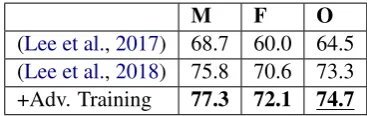
M F O
(Lee et al.,2017) 68.7 60.0 64.5 (Lee et al.,2018) 75.8 70.6 73.3 +Adv. Training 77.3 72.1 74.7
Table 4: Results (F1 metric defined by (Webster et al., 2018)) on the GAP Test Set. M refers to male pro-nouns,Frefers to female pronouns, andOrefers to the full evaluation data. For each category, highest score isboldedand underlined if difference between it and next-highest score is statistically significant (p <0.05 per the McNemar test (McNemar,1947)).
the system must determine whether a given pro-noun refers to one, both, or neither of two given names. Thus, the task can be viewed a binary clas-sification task in which the input is a (pronoun, name) pair and the output is True if the pair is coreferent and False otherwise. Performance is evaluated using the F1 score in this binary classi-fication setup. Table4shows the performance on the GAP test set of the (Lee et al.,2017)3and (Lee et al.,2018) systems as well as the system trained with our adversarial method. The adversarially trained system performs significantly better over the entire dataset in comparison to the previous systems, and the difference is consistent between genders. In particular, we observe that the bias (i.e. ratio of female to male F1 score) is roughly the same (0.93) for the (Lee et al.,2018) system with and without adversarial training and that this bias is better (i.e. the ratio is closer to1) than that exhibited by the (Lee et al.,2017) system (0.87).
3
The results that we report for the (Lee et al.,2017) sys-tem differ slightly from those reported in Table 10 of ( Web-ster et al.,2018) due to a difference in the parser and po-tentially small differences in the algorithm for converting the system’s output to the binary predictions necessary for the GAP scorer.
6 Conclusion
We show that the performance of the (Lee et al.,
2018) system decreases when the names of PER and GPE entities are changed in the CoNLL test set so that no names from the training set leak to the test set. We then retrain the same sys-tem using an application of the fast-gradient-sign-method (FGSM) of adversarial training, showing that the retrained system consistently performs better on the original CoNLL test set, the CoNLL test set with No Leakage, and the GAP test set. Our new model is a new state-of-the-art for all these data sets.
Acknowledgements
We thank Sihao Chen for providing a gazetteer of first names collected from Wikipedia with scores for their gender likelihood, and the anonymous reviewers for their comments. This work was supported in part by contract HR0011-18-2-0052 with the US Defense Advanced Research Projects Agency (DARPA). The views expressed are those of the authors and do not reflect the official policy or position of the Department of Defense or the U.S. Government.
References
Oshin Agarwal, Sanjay Subramanian, Ani Nenkova, and Dan Roth. 2018. Named person coreference in english news. arXiv preprint arXiv:1810.11476.
Moustafa Alzantot, Yash Sharma, Ahmed Elgohary, Bo-Jhang Ho, Mani Srivastava, and Kai-Wei Chang. 2018. Generating natural language adversarial ex-amples. InProceedings of the 2018 Conference on Empirical Methods in Natural Language Process-ing, pages 2890–2896.
Giannis Bekoulis, Johannes Deleu, Thomas Demeester, and Chris Develder. 2018. Adversarial training for multi-context joint entity and relation extraction. In Proceedings of the 2018 Conference on Empirical Methods in Natural Language Processing, pages 2830–2836.
Kai-Wei Chang, Rajhans Samdani, and Dan Roth. 2013.A constrained latent variable model for coref-erence resolution. InEMNLP.
Abbas Ghaddar and Philippe Langlais. 2016. Wiki-coref: An english coreference-annotated corpus of wikipedia articles. InLREC.
[image:5.595.88.272.241.299.2]Sepp Hochreiter and J¨urgen Schmidhuber. 1997. Long short-term memory. Neural computation, 9(8):1735–1780.
Matthew Honnibal and Mark Johnson. 2015. An im-proved non-monotonic transition system for depen-dency parsing. In Proceedings of the 2015 Con-ference on Empirical Methods in Natural Language Processing, pages 1373–1378.
Daniel Khashabi, Tushar Khot, Ashish Sabharwal, Pe-ter Clark, Oren Etzioni, and Dan Roth. 2016. Ques-tion answering via integer programming over semi-structured knowledge. InProc. of the International Joint Conference on Artificial Intelligence (IJCAI).
Kenton Lee, Luheng He, Mike Lewis, and Luke Zettle-moyer. 2017. End-to-end neural coreference reso-lution. InProceedings of the 2017 Conference on Empirical Methods in Natural Language Process-ing, pages 188–197.
Kenton Lee, Luheng He, and Luke Zettlemoyer. 2018. Higher-order coreference resolution with coarse-to-fine inference. In Proceedings of the 2018 Confer-ence of the North American Chapter of the Associ-ation for ComputAssoci-ational Linguistics: Human Lan-guage Technologies, Volume 2 (Short Papers), pages 687–692.
Quinn McNemar. 1947. Note on the sampling error of the difference between correlated proportions or percentages. Psychometrika, 12(2):153–157.
Takeru Miyato, Andrew M. Dai, and Ian Goodfel-low. 2017. Adversarial training methods for semi-supervised text classification.ICLR.
Nafise Sadat Moosavi and Michael Strube. 2017. Lex-ical features in coreference resolution: To be used with caution. In Proceedings of the 55th Annual Meeting of the Association for Computational Lin-guistics (Volume 2: Short Papers), pages 14–19.
Nafise Sadat Moosavi and Michael Strube. 2018. Us-ing lUs-inguistic features to improve the generalization capability of neural coreference resolvers. In Pro-ceedings of the 2018 Conference on Empirical Meth-ods in Natural Language Processing, pages 193– 203.
Eric W Noreen. 1989. Computer-intensive methods for testing hypotheses. Wiley New York.
Jeffrey Pennington, Richard Socher, and Christopher Manning. 2014. Glove: Global vectors for word representation. InProceedings of the 2014 confer-ence on empirical methods in natural language pro-cessing (EMNLP), pages 1532–1543.
Matthew Peters, Mark Neumann, Mohit Iyyer, Matt Gardner, Christopher Clark, Kenton Lee, and Luke
Zettlemoyer. 2018. Deep contextualized word rep-resentations. In Proceedings of the 2018 Confer-ence of the North American Chapter of the Associ-ation for ComputAssoci-ational Linguistics: Human Lan-guage Technologies, Volume 1 (Long Papers), pages 2227–2237.
Sameer Pradhan, Alessandro Moschitti, Nianwen Xue, Olga Uryupina, and Yuchen Zhang. 2012. Conll-2012 shared task: Modeling multilingual unre-stricted coreference in ontonotes. InJoint Confer-ence on EMNLP and CoNLL-Shared Task, pages 1– 40. Association for Computational Linguistics.
Nitish Srivastava, Geoffrey Hinton, Alex Krizhevsky, Ilya Sutskever, and Ruslan Salakhutdinov. 2014. Dropout: a simple way to prevent neural networks from overfitting. The Journal of Machine Learning Research, 15(1):1929–1958.
Kellie Webster, Marta Recasens, Vera Axelrod, and Ja-son Baldridge. 2018. Mind the gap: A balanced cor-pus of gendered ambiguou. InTransactions of the ACL, page to appear.