Balancing Data-driven and Rule-based Approaches in the Context of a
Multimodal Conversational System
Srinivas Bangalore
AT&T Labs-Research
180 Park Avenue
Florham Park, NJ 07932
[email protected]
Michael Johnston
AT&T Labs-Research
180 Park Avenue
Florham Park, NJ 07932
[email protected]
Abstract
Moderate-sized rule-based spoken language models for recognition and understanding are easy to develop and provide the ability to rapidly prototype conversational applications. However, scalability of such systems is a bot-tleneck due to the heavy cost of authoring and maintenance of rule sets and inevitable brittle-ness due to lack of coverage in the rule sets. In contrast, data-driven approaches are robust and the procedure for model building is usu-ally simple. However, the lack of data in a par-ticular application domain limits the ability to build data-driven models. In this paper, we ad-dress the issue of combining data-driven and grammar-based models for rapid prototyping of robust speech recognition and understanding models for a multimodal conversational sys-tem. We also present methods that reuse data from different domains and investigate the lim-its of such models in the context of a particular application domain.
1
Introduction
In the past four decades of speech and natural language processing, both data-driven approaches and rule-based approaches have been prominent at different periods in
time. In the recent past, rule-based approaches have
fallen into disfavor due to their brittleness and the sig-nificant cost of authoring and maintaining complex rule sets. Data-driven approaches are robust and provide a simple process of developing applications given the data from the application domain. However, the reliance on domain-specific data is also one of the significant bottle-necks of data-driven approaches. Development of a con-versational system using data-driven approaches cannot proceed until data pertaining to the application domain is available. The collection and annotation of such data is extremely time-consuming and tedious, which is aggra-vated by the presence of multiple modalities in the user’s input, as in our case. Also, extending an existing applica-tion to support an addiapplica-tional feature requires adding ad-ditional data sets with that feature.
In this paper, we explore various methods for combin-ing rule-based and in-domain data for rapid prototypcombin-ing of speech recognition and understanding models that are robust to ill-formed or unexpected input in the context of a multimodal conversational system. We also investi-gate approaches to reuse out-of-domain data and compare their performance against the performance of in-domain data-driven models.
We investigate these issues in the context of a multi-modal application designed to provide an interactive city guide: MATCH. In Section 2, we present the MATCH application, the architecture of the system and the appa-ratus for multimodal understanding. In Section 3, we dis-cuss various approaches to rapid prototyping of the lan-guage model for the speech recognizer and in Section 4 we present two approaches to robust multimodal under-standing. Section 5 presents the results for speech recog-nition and multimodal understanding using the different approaches we consider.
2
The MATCH application
MATCH (Multimodal Access To City Help) is a work-ing city guide and navigation system that enables mo-bile users to access restaurant and subway information for New York City (NYC) (Johnston et al., 2002b; John-ston et al., 2002a). The user interacts with a graphical in-terface displaying restaurant listings and a dynamic map showing locations and street information. The inputs can be speech, drawing on the display with a stylus, or syn-chronous multimodal combinations of the two modes. The user can ask for the review, cuisine, phone number, address, or other information about restaurants and sub-way directions to locations. The system responds with graphical callouts on the display, synchronized with syn-thetic speech output. For example, if the user says phone
numbers for these two restaurants and circles two
Figure 1: Two area gestures
2.1 MATCH Multimodal Architecture
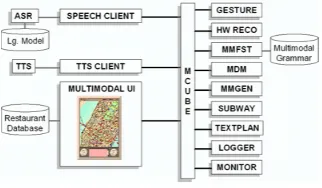
The underlying architecture that supports MATCH con-sists of a series of re-usable components which commu-nicate over sockets through a facilitator (MCUBE) (Fig-ure 2). Users interact with the system through a Multi-modal User Interface Client (MUI). Their speech and ink are processed by speech recognition (Sharp et al., 1997) (ASR) and handwriting/gesture recognition (GESTURE, HW RECO) components respectively. These recognition processes result in lattices of potential words and ges-tures. These are then combined and assigned a mean-ing representation usmean-ing a multimodal finite-state device (MMFST) (Johnston and Bangalore, 2000; Johnston et al., 2002b). This provides as output a lattice encoding all of the potential meaning representations assigned to the user inputs. This lattice is flattened to an N-best list and passed to a multimodal dialog manager (MDM) (John-ston et al., 2002b), which re-ranks them in accordance with the current dialogue state. If additional informa-tion or confirmainforma-tion is required, the MDM enters into a short information gathering dialogue with the user. Once a command or query is complete, it is passed to the mul-timodal generation component (MMGEN), which builds a multimodal score indicating a coordinated sequence of graphical actions and TTS prompts. This score is passed back to the Multimodal UI (MUI). The Multimodal UI coordinates presentation of graphical content with syn-thetic speech output using the AT&T Natural Voices TTS engine (Beutnagel et al., 1999). The subway route con-straint solver (SUBWAY) identifies the best route be-tween any two points in New York City.
Figure 2: Multimodal Architecture
2.2 Multimodal Integration and Understanding
Our approach to integrating and interpreting multimodal inputs (Johnston et al., 2002b; Johnston et al., 2002a) is an extension of the finite-state approach previously pro-posed (Bangalore and Johnston, 2000; Johnston and Ban-galore, 2000). In this approach, a declarative multimodal grammar captures both the structure and the
interpreta-tion of multimodal and unimodal commands. The gram-mar consists of a set of context-free rules. The multi-modal aspects of the grammar become apparent in the terminals, each of which is a triple W:G:M, consisting of speech (words, W), gesture (gesture symbols, G), and meaning (meaning symbols, M). The multimodal gram-mar encodes not just multimodal integration patterns but also the syntax of speech and gesture, and the assignment of meaning. The meaning is represented in XML, facil-itating parsing and logging by other system components. The symbol SEM is used to abstract over specific content such as the set of points delimiting an area or the identi-fiers of selected objects. In Figure 3, we present a small simplified fragment from the MATCH application capa-ble of handling information seeking commands such as
phone for these three restaurants. The epsilon symbol ( )
indicates that a stream is empty in a given terminal.
CMD : : cmd INFO : : /cmd
INFO : : type TYPE : : /type
for: :
: : obj DEICNP : : /obj
TYPE phone: :phone review: :review
DEICNP DDETPL :area:
:sel: NUM HEADPL
DDETPL these:G: those:G:
HEADPL restaurants:rest: rest SEM:SEM:
: : /rest
[image:2.612.324.533.226.453.2]NUM two:2: three:3: ... ten:10:
Figure 3: Multimodal grammar fragment
Speech:
Gesture:
<type> <info> <cmd>
SEM(points...)
phone
<rest> Meaning:
<rest>
<obj> </type> ten
2 sel
loc area G
SEM(r12,r15) restaurants two these for phone
</obj> </rest>
[image:2.612.334.518.325.454.2]r12,r15 </info> </cmd>
Figure 4: Multimodal Example
In the example above where the user says phone for
these two restaurants while circling two restaurants
(Fig-ure 1 [a]), assume the speech recognizer returns the lat-tice in Figure 4 (Speech). The gesture recognition com-ponent also returns a lattice (Figure 4, Gesture) indicat-ing that the user’s ink is either a selection of two restau-rants or a geographical area. The multimodal grammar (Figure 3) expresses the relationship between what the user said, what they drew with the pen, and their com-bined meaning, in this case Figure 4 (Meaning). The meaning is generated by concatenating the meaning sym-bols and replacing SEM with the appropriate specific
con-tent: cmd info type phone /type obj
rest [r12,r15] /rest /obj /info /cmd .
[image:2.612.105.266.471.565.2]the XML output. The example above yields the following meaning representation for concept accuracy.
!
(1)
The multimodal grammar can be used to create lan-guage models for ASR, align the speech and gesture re-sults from the respective recognizers and transform the multimodal utterance to a meaning representation. All these operations are achieved using finite-state transducer operations (See (Bangalore and Johnston, 2000; John-ston and Bangalore, 2000) for details). However, this ap-proach to recognition needs to be more robust to extra-grammaticality and language variation in user’s utter-ances and the interpretation needs to be more robust to speech recognition errors. We address these issues in the rest of the paper.
3
Bootstrapping Corpora for Language
Models
The problem of speech recognition can be succinctly rep-resented as a search for the most likely word sequence (" ) through the network created by the composition of a
language of acoustic observations (# ), an acoustic model
which is a transduction from acoustic observations to
phone sequences ($ ), a pronounciation model which is
a transduction from phone sequences to word sequences
(% ), and a language model acceptor (& ) (Pereira and
Ri-ley, 1997). The language model acceptor encodes the (weighted) word sequences permitted in an application.
'(*)+,' -. /10
2
#435$635%735&98
2
":8 (2)
Typically,& is built using either a hand-crafted
gram-mar or using a statistical language model derived from a corpus of sentences from the application domain. While a grammar could be written so as to be easily portable across applications, it suffers from being too prescrip-tive and has no metric for relaprescrip-tive likelihood of users’ utterances. In contrast, in the data-driven approach a weighted grammar is automatically induced from a cor-pus and the weights can be interpreted as a measure for relative likelihood of users’ utterances. However, the re-liance on a domain-specific corpus is one of the signif-icant bottlenecks of data-driven approaches, since col-lecting a corpus specific to a domain is an expensive and time-consuming task.
In this section, we investigate a range of techniques for producing a domain-specific corpus using resources such as a domain-specific grammar as well as an out-of-domain corpus. We refer to the corpus resulting from such techniques as a domain-specific derived corpus in contrast to a domain-specific collected corpus. The idea is that the derived domain-specific corpus would obvi-ate the need for in-domain corpus collection. In partic-ular, we are interested in techniques that would result in corpora such that the performance of language mod-els trained on these corpora would rival the performance of models trained on corpora collected specifically for a specific domain. We investigate these techniques in the context of MATCH.
We use the notation;=< for the corpus,>< for the
lan-guage model built using the corpus;?< , and&A@B for the
language model acceptor representation of the model> < ,
which can be used in Equation 2 above.
3.1 Language Model using in-domain corpus
In order to evaluate the MATCH system, we collected a corpus of multimodal utterances for the MATCH domain in a laboratory setting from a set of sixteen first time users (8 male, 8 female). We use this corpus to estab-lish a point of reference to compare the models trained on derived corpora against models trained on an in-domain corpus. A total of 833 user interactions (218 multimodal / 491 speech-only / 124 pen-only) resulting from six sam-ple task scenarios involving finding restaurants of various types and getting their names, phones, addresses, or re-views, and getting subway directions between locations were collected and annotated. The data collected was conversational speech where the users gestured and spoke freely. We built a class-based trigram language model (>1CDFEGIH ) using the 709 multimodal and speech-only
utterances as the corpus (;=CDFEGIH ). The performance
of this model serves as the point of reference to compare the performance of language models trained on derived corpora.
3.2 Grammar as Language Model
The multimodal CFG (a fragment is presented in Sec-tion 2) encodes the repertoire of language and ges-ture commands allowed by the system and their com-bined interpretations. The CFG can be approximated by an FSM with arcs labeled with language, gesture and meaning symbols, using well-known compilation tech-niques (Nederhof, 1997). The resulting FSM can be pro-jected on the language component and can be used as
the language model acceptor (&9JLKNMPO ) for speech
recog-nition. Note that the resulting language model acceptor is unweighted if the grammar is unweighted and suffers from not being robust to language variations in user’s in-put. However, due to the tight coupling of the grammar used for recognition and interpretion, every recognized string can be assigned an interpretation (though it may not necessarily be the intended interpretation).
3.3 Grammar-based N-gram Language Model
As mentioned earlier, a hand-crafted grammar typically suffers from the problem of being too restrictive and in-adequate to cover the variations and extra-grammaticality of user’s input. In contrast, an N-gram language model derives its robustness by permitting all strings over an al-phabet, albeit with different likelihoods. In an attempt to provide robustness to the grammar-based model, we
created a corpus (; JLKNMLO ) of Q sentences by randomly
sampling the set of paths of the grammar (%
2SR
8) and
built a class-based N-gram language model(> JLKNMPO )
3.4 Combining Grammar and Corpus
A straightforward extension of the idea of sampling the grammar in order to create a corpus is to select those sentences out of the grammar which make the result-ing corpus “similar” to the corpus collected in the pi-lot studies. In order to create this corpus, we choose
theQ most likely sentences as determined by a language
model (>
CDFEGIH ) built using the collected corpus. A
mixture model (>O ) with mixture weight ( ) is built by
interpolating the model trained on the corpus of extracted
sentences (> ) and the model trained on the collected
corpus (>C DFEGIH ).
;
%
2R
8 (3)
!
("$#(#%"'&)(+* ( @,.-$/1032
24 S8)5 >1O 76 > 8
2:9<;
86 >CDFE1G H (4)
3.5 Class-based Out-of-domain Language Model
An alternative to using in-domain corpora for building language models is to “migrate” a corpus of a different domain to the MATCH domain. The process of migrat-ing a corpus involves suitably generalizmigrat-ing the corpus to remove information specific only to the out-of-domain and instantiating the generalized corpus to the MATCH domain. Although there are a number of ways of gener-alizing the out-of-domain corpus, the generalization we have investigated involved identifying linguistic units, such as noun and verb chunks in the out-of-domain cor-pus and treating them as classes. These classes are then instantiated to the corresponding linguistic units from the MATCH domain. The identification of the linguistic units in the out-of-domain corpus is done automatically using a supertagger (Bangalore and Joshi, 1999). We use a cor-pus collected in the context of a software helpdesk ap-plication as an example out-of-domain corpus. In cases where the out-of-domain corpus is closely related to the domain at hand, a more semantically driven generaliza-tion might be more suitable.
3.6 Adapting the SwitchBoard Language Model
We investigate the performance of a large vocabulary conversational speech recognition system when applied to a specific domain such as MATCH. We used the
Switchboard corpus (;<
.=
< ) as an example of a large
vo-cabulary conversational speech corpus. We built a
tri-gram model (>
.=
< ) using the 5.4 million word corpus
and investigated the effect of adapting the Switchboard
language model givenQ in-domain untranscribed speech
utterances (
#
C
5 ). The adaptation is done by first
rec-ognizing the in-domain speech utterances and then
build-ing a language model (>!MP<LM>@?) from the corpus of
recog-nized text (; MP<LM>@?). This bootstrapping mechanism can
be used to derive an domain-specific corpus and language model without any transcriptions. Similar techniques for unsupervised language model adaptation are presented in (Bacchiani and Roark, 2003; Souvignier and Kellner, 1998).
; MP<LM>A?
)
0
@
5 (5)
'()+
'-B
/ 0
2
#
C
35$35%735& .=
< 8 2
8
3.7 Adapting a wide-coverage grammar
There have been a number of computational implemen-tations of wide-coverage, domain-independent, syntac-tic grammars for English in various formalisms (XTAG, 2001; Clark and Hockenmaier, 2002; Flickinger et al., 2000). Here, we describe a method that exploits one such grammar implementation in the Lexicalized Tree-Adjoining Grammar (LTAG) formalism, for deriving domain-specific corpora. An LTAG consists of a set of elementary trees (Supertags) (Bangalore and Joshi, 1999) each associated with a lexical item. The set of sentences generated by an LTAG can be obtained by combining su-pertags using substitution and adjunction operations. In related work (Rambow et al., 2002), it has been shown that for a restricted version of LTAG, the combinations of a set of supertags can be represented as an FSM. This FSM compactly encodes the set of sentences generated by an LTAG grammar.
We derive a domain-specific corpus by constructing a lexicon consisting of pairings of words with their su-pertags that are relevant to that domain. We then com-pile the grammar to build an FSM of all sentences upto a given length. We sample this FSM and build a language model as discussed in Section 3.3. Given untranscribed utterances from a specific domain, we can also adapt the language model as discussed in Section 3.6.
4
Robust Multimodal Understanding
The grammar-based interpreter uses composition oper-ation on FSTs to transduce multimodal strings (ges-ture,speech) to an interpretation. The set of speech strings that can be assigned an interpretation are exactly those that are represented in the grammar. It is to be expected that the accuracy of meaning representation will be rea-sonable, if the user’s input matches one of the multimodal strings encoded in the grammar. But for those user inputs that are not encoded in the grammar, the system will not return a meaning representation. In order to improve the usability of the system, we expect it to produce a (partial) meaning representation, irrespective of the grammatical-ity of the user’s input and the coverage limitations of the grammar. It is this aspect that we refer to as robustness in understanding. We present below two approaches to ro-bust multimodal understanding that we have developed.
4.1 Pattern Matching Approach
In order to overcome the possible mismatch between the user’s input and the language encoded in the
multi-modal grammar (>J ), we use an edit-distance based
pat-tern matching algorithm to coerce the set of strings (C )
encoded in the lattice resulting from ASR (>D ) to match
one of the strings that can be assigned an interpretation. The edit operations (insertion, deletion, substitution) can either be word-based or phone-based and are associated
with a cost. These costs can be tuned based on the
word/phone confusions present in the domain. The edit
operations are encoded as an transducer (> <)E?) as shown
in Figure 5 and can apply to both one-best and lattice out-put of the recognizer. We are interested in the string with
the least number of edits ('()+GFIH
an interpretation by the grammar. This can be achieved
by composition (3 ) of transducers followed by a search
for the least cost path through a weighted transducer as shown below.
'()+7FIH D
> D 3 > <)E? 3 >J (6)
wj i w : /scost
i w :wi/0
[image:5.612.315.535.19.115.2]i w : ε /dcost i w: ε /icost
Figure 5: Edit transducer with insertion, deletion,
sub-stitution and identity arcs. " and" could be words or
phones. The costs on the arcs are set up such thatscost
< icost + dcost.
This approach is akin to example-based techniques used in other areas of NLP such as machine translation. In our case, the set of examples (encoded by the gram-mar) is represented as a finite-state machine.
4.2 Classification-based Approach
A second approach is to view robust multimodal under-standing as a sequence of classification problems in or-der to determine the predicate and arguments of an ut-terance. The meaning representation shown in (1) con-sists of an predicate (the command attribute) and a se-quence of one or more argument attributes which are the parameters for the successful interpretation of the user’s
intent. For example, in (1), P*
is the predicate
and A !
is the set of ar-guments to the predicate.
We determine the predicate (
) for a token
multi-modal utterance (
) by maximizing the posterior prob-ability as shown in Equation 7.
* ( 2 8 (7)
We view the problem of identifying and extracting ar-guments from a multimodal input as a problem of asso-ciating each token of the input with a specific tag that encodes the label of the argument and the span of the ar-gument. These tags are drawn from a tagset which is con-structed by extending each argument label by three
addi-tional symbols
#
, following (Ramshaw and Mar-cus, 1995). These symbols correspond to cases when a
token is inside ( ) an argument span, outside (# ) an
ar-gument span or at the boundary of two arar-gument spans (
) (See Table 1).
Given this encoding, the problem of extracting the ar-guments is a search for the most likely sequence of tags (
) given the input multimodal utterance as shown
in Equation (8). We approximate the posterior
proba-bility* (
2
8 using independence assumptions as
User cheap thai upper west side
Utterance
Argument price cheap /price cuisine
Annotation thai /cuisine place upper west
side /place
IOB cheap price B thai cuisine B
Encoding upper place I west place I
side place I
Table 1: The
I,O,B5 encoding for argument extraction.
shown in Equation (9).
'(*)+,' -E * ( 2 8 (8) '(*)+,' -E * ( 2 0 8 (9)
Owing to the large set of features that are used for predicate identification and argument extraction, we es-timate the probabilities using a classification model. In particular, we use the Adaboost classifier (Freund and Schapire, 1996) wherein a highly accurate classifier is build by combining many “weak” or “simple” base
classi-fiers, each of which may only be moderately accurate.
The selection of the weak classifiers proceeds iteratively picking the weak classifier that correctly classifies the ex-amples that are misclassified by the previously selected weak classifiers. Each weak classifier is associated with
a weight ("<) that reflects its contribution towards
mini-mizing the classification error. The posterior probability
of* (
2
-8 is computed as in Equation 10.
* ( 2 -8 9 29 8 # 0 "! . ! # !%$'& 8 (10)
It should be noted that the data for training the clas-sifiers can be collected from the domain or derived from an in-domain grammar using techniques similar to those presented in Section 3.
5
Experiments and Results
We describe a set of experiments to evaluate the perfor-mance of the speech recognizer and the concept accu-racy of speech only and speech and gesture exchanges in our MATCH multimodal system. We use word accuracy and string accuracy for evaluating ASR output. All re-sults presented in this section are based on 10-fold cross-validation experiments run on the 709 spoken and multi-modal exchanges collected from the pilot study described in Section 3.1.
5.1 Language Model
[image:5.612.127.248.73.190.2]Scenario ASR Word Accuracy Sentence Accuracy
Grammar Based Grammar as Language Model 41.6 38.0
Class-based N-gram Language Model 60.6 42.9
In-domain Data Class-based N-gram Model 73.8 57.1
Grammar+In-domain Data Class-based N-gram Model 75.0 59.5
Out-of-domain N-gram Model 17.6 17.5
Class-based N-gram Model 58.4 38.8
Class-based N-gram Model with Grammar-based N-gram
Language Model 64.0 45.4
SwitchBoard N-gram Model 43.5 25.0
Language model trained on
recognized in-domain data 55.7 36.3
Wide-coverage N-gram Model 43.7 24.8
Grammar Language model trained on
[image:6.612.74.538.24.203.2]recognized in-domain data 55.8 36.2
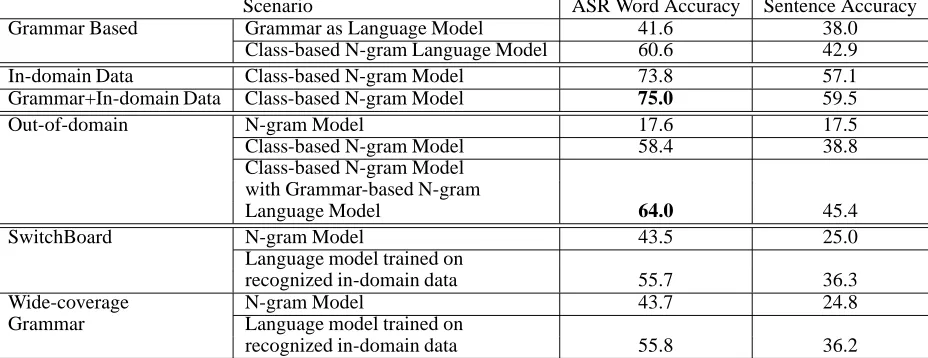
Table 2: Performance results for ASR Word and Sentence accuracy using models trained on data derived from different methods of bootstrapping domain-specific data.
Indonesian), price categories (eg. moderately priced, ex-pensive), and neighborhoods (eg. Upper East Side, Chi-natown).
It is immediately apparent that the hand-crafted gram-mar as language model performs poorly and a language model trained on the collected domain-specific corpus performs significantly better than models trained on de-rived data. However, it is encouraging to note that a model trained on a derived corpus (obtained from com-bining migrated out-of-domain corpus and a corpus cre-ated by sampling in-domain grammar) is within 10% word accuracy as compared to the model trained on the collected corpus. There are several other noteworthy ob-servations from these experiments.
The performance of the language model trained on data sampled from the grammar is dramatically better as com-pared to the performance of the hand-crafted grammar. This technique provides a promising direction for author-ing portable grammars that can be sampled subsequently to build robust language models when no in-domain cor-pora are available. Furthermore, combining grammar and in-domain data as described in Section 3.4, outperforms all other models significantly.
For the experiment on migration of out-of-domain cor-pus, we used a corpus from a software helpdesk appli-cation. Table 2 shows that the migration of data using linguistic units as described in Section 3.5 significantly outperforms a model trained only on the out-of-domain corpus. Also, combining the grammar sampled corpus with the migrated corpus provides a further improvement. The performance of the SwitchBoard model on the MATCH domain is presented in Table 2. We built a tri-gram model using a 5.4 million word SwitchBoard cor-pus and investigated the effect of adapting the resulting language model on in-domain untranscribed speech ut-terances. The adaptation is done by first recognizing the training partition of the in-domain speech utterances and then building a language model from the recognized text.
We observe that although the performance of the Switch-Board language model on the MATCH domain is poorer than the performance of a model obtained by migrating data from a related domain, the performance can be sig-nificantly improved using the adaptation technique.
The last row of Table 2 shows the results of using the MATCH specific lexicon to generate a corpus us-ing a wide-coverage grammar, trainus-ing a language model and adapting the resulting model using in-domain untran-scribed speech utterances as was done for the Switch-Board model. The class-based trigram model was built using 500,000 randomly sampled paths from the network constructed by the procedure described in Section 3.7.
5.2 Multimodal Understanding
In this section, we present results on multimodal under-standing using the two techniques presented in Section 4. We use concept token accuracy and concept string accu-racy as evaluation metrics for the entire meaning repre-sentation in these experiments. These metrics correspond to the word accuracy and string accuracy metrics used for ASR evaluation. In order to provide a finer-grained eval-uation, we breakdown the concept accuracy in terms of the accuracy of identifying the predicates and arguments. Again, we use string accuracy metrics to evaluate pred-icate and argument accuracy. We use the output of the ASR with the language model trained on the collected data (word accuracy of 73.8%) as the input to the under-standing component.
Predicate String Argument String Concept Token Concept String
Accuracy(%) Accuracy(%) Accuracy(%) Accuracy(%)
Baseline 65.2 52.1 53.5 45.2
Word-based Pattern-Matching 73.7 62.4 68.1 59.0
Phone-based Pattern-Matching 73.7 63.8 67.8 61.3
[image:7.612.84.527.22.90.2]Classification-based 84.1 59.1 73.5 56.4
Table 3: Performance results of robust multimodal understanding
for the baseline as shown in Table 3.
The pattern-matching based robust understanding ap-proach mediates the mismatch between the strings that are output by ASR and the strings that can be assigned an interpretation. We experimented with word based pattern matching as well as phone based pattern matching on the one-best output of the recognizer. As shown in Table 3, the pattern-matching robust understanding approach im-proves the concept accuracy over the baseline signifi-cantly. Furthermore, the phone-based matching method has a similar performace to the word-based matching method.
For the classification-based approach to robust under-standing we used a total of 10 predicates such as help,
as-sert, inforequest, and 20 argument types such as cuisine, price, location . We use unigrams, bigrams and trigrams
appearing in the multimodal utterance as weak classifiers for the purpose of predicate classification. In order to predict the tag of a word for argument extraction, we use the left and right trigram context and the tags for the pre-ceding two tokens as weak classifiers. The results are presented in Table 3.
Both the approaches to robust understanding outper-form the baseline model significantly. However, it is in-teresting to note that while the pattern-matching based approach has a better argument extraction accuracy, the classification based approach has a better predicate iden-tification accuracy. Two possible reasons for this are: first, argument extraction requires more non-local infor-mation that is available in the pattern-matching based ap-proach while the classification-based apap-proach relies on local information and is more conducive for identifying the simple predicates in MATCH. Second, the pattern-matching approach uses the entire grammar as a model for matching while the classification approach is trained on the training data which is significantly smaller when compared to the number of examples encoded in the grammar.
6
Discussion
Although we are not aware of any attempts to address the issue of robust understanding in the context of multi-modal systems, this issue has been of great interest in the context of speech-only conversational systems (Dowd-ing et al., 1993; Seneff, 1992; Allen et al., 2000; Lavie, 1996). The output of the recognizer in these systems usu-ally is parsed using a handcrafted grammar that assigns a meaning representation suited for the downstream dia-log component. The coverage problems of the grammar
and parsing of extra-grammatical utterances is typically addressed by retrieving fragments from the parse chart and incorporating operations that combine fragments to derive a meaning of the recognized utterance. We have presented an approach that achieves robust multimodal utterance understanding using the edit-distance automa-ton in a finite-state-based interpreter without the need for combining fragments from a parser.
The issue of combining rule-based and data-driven ap-proaches has received less attention, with the exception of a few (Wang et al., 2000; Rayner and Hockey, 2003; Wang and Acero, 2003). In a recent paper (Rayner and Hockey, 2003), the authors address this issue by em-ploying a decision-list-based speech understanding sys-tem as a means of progressing from rule-based models to data-driven models when data becomes available. The decision-list-based understanding system also provides a method for robust understanding. In contrast, the ap-proach presented in this paper can be used on lattices of speech and gestures to produce a lattice of meaning rep-resentations.
7
Conclusion
In this paper, we have addressed how to rapidly proto-type multimodal conversational systems without relying on the collection of domain-specific corpora. We have presented several techniques that exploit domain-specific grammars, reuse out-of-domain corpora and adapt large conversational corpora and wide-coverage grammars to
derive a domain-specific corpus. We have demonstrated
that a language model trained on a derived corpus per-forms within 10% word accuracy of a language model trained on collected domain-specific corpus, suggest-ing a method of buildsuggest-ing an initial language model without having to collect domain-specific corpora. We have also presented and evaluated pattern-matching and classification-based approaches to improve the robust-ness of multimodal understanding. We have presented re-sults for these approaches in the context of a multimodal city guide application (MATCH).
8
Acknowledgments
References
J. Allen, D. Byron, M. Dzikovska, G. Ferguson, L. Galescu, and A. Stent. 2000. An architecture for a generic dialogue shell. JNLE, 6(3).
M. Bacchiani and B. Roark. 2003. Unsupervised lan-guage model adaptation. In In Proc. Int. Conf.
Acous-tic,Speech,Signal Processing.
S. Bangalore and M. Johnston. 2000. Tight-coupling of multimodal language processing with speech recogni-tion. In Proceedings of ICSLP, Beijing, China.
S. Bangalore and A. K. Joshi. 1999. Supertagging: An approach to almost parsing. Computational
Linguis-tics, 25(2).
M. Beutnagel, A. Conkie, J. Schroeter, Y. Stylianou, and A. Syrdal. 1999. The AT&T next-generation TTS. In
In Joint Meeting of ASA; EAA and DAGA.
M. Boros, W. Eckert, F. Gallwitz, G. G˘orz, G. Hanrieder, and H. Niemann. 1996. Towards Understanding Spon-taneous Speech: Word Accuracy vs. Concept Accu-racy. In Proceedings of ICSLP, Philadelphia.
Stephen Clark and Julia Hockenmaier. 2002. Evaluating a wide-coverage CCG parser. In Proceedings of the
LREC 2002 Beyond Parseval Workshop, Las Palmas,
Spain.
J. Dowding, J. M. Gawron, D. E. Appelt, J. Bear, L. Cherny, R. Moore, and D. B. Moran. 1993. GEM-INI: A natural language system for spoken-language understanding. In Proceedings of ACL, pages 54–61.
D. Flickinger, A. Copestake, and I. Sag. 2000. Hpsg analysis of english. In W. Wahlster, editor, Verbmobil:
Foundations of Speech-to-Speech Translation, pages
254–263. Springer–Verlag, Berlin, Heidelberg, New York.
Y. Freund and R. E. Schapire. 1996. Experiments with a new boosting alogrithm. In Machine Learning:
Pro-ceedings of the Thirteenth International Conference,
pages 148–156.
L. Galescu, E. K. Ringger, and J. F. Allen. 1998. Rapid language model development for new task domains. In
Proceedings of the ELRA First International Confer-ence on Language Resources and Evaluation (LREC), Granada, Spain.
M. Johnston and S. Bangalore. 2000. Finite-state mul-timodal parsing and understanding. In Proceedings of
COLING, Saarbr¨ucken, Germany.
M. Johnston, S. Bangalore, A. Stent, G. Vasireddy, and P. Ehlen. 2002a. Multimodal language processing for mobile information access. In In Proceedings of
IC-SLP, Denver, CO.
M. Johnston, S. Bangalore, G. Vasireddy, A. Stent, P. Ehlen, M. Walker, S. Whittaker, and P. Maloor. 2002b. MATCH: An architecture for multimodal di-alog systems. In Proceedings of ACL, Philadelphia.
A. Lavie. 1996. GLR*: A Robust Grammar-Focused
Parser for Spontaneously Spoken Language. Ph.D. thesis, Carnegie Mellon University.
M-J. Nederhof. 1997. Regular approximations of CFLs: A grammatical view. In Proceedings of the
Interna-tional Workshop on Parsing Technology, Boston.
Fernando C.N. Pereira and Michael D. Riley. 1997.
Speech recognition by composition of weighted finite automata. In E. Roche and Schabes Y., editors, Finite
State Devices for Natural Language Processing, pages
431–456. MIT Press, Cambridge, Massachusetts.
Owen Rambow, Srinivas Bangalore, Tahir Butt, Alexis Nasr, and Richard Sproat. 2002. Creating a finite-state parser with application semantics. In In
Proceed-ings of the 19th International Conference on Compu-tational Linguistics (COLING 2002), Taipei, Taiwan.
Lance Ramshaw and Mitchell P. Marcus. 1995. Text chunking using transformation-based learning. In
Pro-ceedings of the Third Workshop on Very Large Cor-pora, MIT, Cambridge, Boston.
M. Rayner and B. A. Hockey. 2003. Transparent com-bination of rule-based and data-driven approaches in speech understanding. In In Proceedings of the EACL
2003.
S. Seneff. 1992. A relaxation method for understand-ing spontaneous speech utterances. In Proceedunderstand-ings,
Speech and Natural Language Workshop, San Mateo,
CA.
R.D. Sharp, E. Bocchieri, C. Castillo, S. Parthasarathy, C. Rath, M. Riley, and J.Rowland. 1997. The Wat-son speech recognition engine. In In Proceedings of
ICASSP, pages 4065–4068.
B. Souvignier and A. Kellner. 1998. Online adaptation for language models in spoken dialogue systems. In
Int. Conference on Spoken Language Processing (IC-SLP).
Y. Wang and A. Acero. 2003. Combination of cfg and n-gram modeling in semantic grammar learning. In
In Proceedings of the Eurospeech Conference, Geneva,
Switzerland.
Y.Y. Wang, M. Mahajan, and X. Huang. 2000. Unified Context-Free Grammar and N-Gram Model for Spo-ken Language Processing. In Proceedings of ICASSP.